
In short
Ukraine’s air-defence shortfall after Russia’s latest barrage; plus major international headlines including Iran’s Khamenei funeral, a FIFA World Cup disciplinary controversy involving the US, and other global stories.
Guests (named in transcript)
BBC correspondents Sarah Rainsford (Kyiv) and Liz Tussset (Tehran); BBC Sports reporter Joe Currie; TheAthletic.com’s Nick Miller; UNICEF representative Sheldon Yett; former Sri Lanka correspondent Charles Haviland; reporter Richard Kagoi; film critic Alison Wilmore; classics professor Emily Wilson; classics professor Joel Christensen; film reporter Tom Brook; producers Tuli Zuma and Guguletu Zuma Nkubi; author Suni Athi; plus former England captain Wayne Rooney (commentary).
Key claims/examples
Russia launched 23 ballistic missiles at Kyiv; Ukraine intercepted just over half due to insufficient interceptor missiles. Crimea saw Ukrainian drone strikes causing blackouts and fuel shortages. FIFA suspended US striker Falarin Balogun’s red-card ban after reported Trump calls to Gianni Infantino; UEFA called it crossing a red line.
Written by AI. May contain mistakes. Listen to the episode to check what was said.
Chapters
Tap a time to open that second in VOMain Stories Overview
0:32 to 1:24
Overview of the key news stories, including Ukraine and FIFA controversies.
“And the More Than The Score podcast is bringing you the stories beyond the scorelines.”
Ukraine's Air Defense Crisis
1:24 to 2:56
Discussion on Ukraine's urgent need for air defenses following Russian attacks.
“I'm Valerie Sanderson and at 14 Hours GMT on Monday the 6th of July, these are our main stories.”
Eyewitness Accounts of the Attack
2:56 to 5:08
Student and correspondent share their experiences during the air attack in Kyiv.
“Alexandra is a student in Kyiv and she told us what last night was like.”
Explaining the Missile Shortage
5:08 to 7:14
Analysis of Ukraine's missile interception challenges amid ongoing attacks.
“And if Russia was aiming at military targets, well, this is not a military target.”
Ukraine Strikes Back in Crimea
7:14 to 7:38
Details on Ukraine's drone strikes targeting military and energy infrastructure in Crimea.
“The annexation boosted his popularity in Russia.”
Controversy in the Football World Cup
7:38 to 11:24
Discussion on FIFA allowing a US striker to play following a controversial ban.
“Search for BBC News on YouTube and you'll find the Global News podcast in the podcast section.”
Khamenei's Funeral in Tehran
11:24 to 14:00
Coverage of the funeral procession for Iran's late Supreme Leader Ayatollah Khamenei.
“The funeral procession of the late Supreme Leader Ayatollah Ali Khamenei has been moving through Tehran after lying in state in the capital's Grand Masala mosque complex.”
Voices of Discontent in Iran
14:00 to 15:30
Hear the frustrations of individuals in Iran regarding safety and leadership.
“What do you want to change in your life?”
Exploring 'The Polygamist' on Netflix
15:30 to 17:20
Dive into the themes and production behind the Netflix drama 'The Polygamist'.
“If you've been online in the last couple of weeks, you may have come across clips from a Zulu language drama called The Polygamist, a new hit on Netflix.”
Critiques of Polygamy Representation
17:20 to 19:14
Discuss the criticisms surrounding the portrayal of polygamy in the series.
“There have been criticisms on the storyline and the depiction of the characters.”
Show all 15 chapters
Crisis in Sudan
20:36 to 24:02
Unpack the ongoing civil war in Sudan and its impact on children and civilians.
“Listen now wherever you get your BBC podcasts.”
Riots and Overcrowding in Sri Lankan Jails
24:02 to 26:20
Examine the conditions leading to riots in Sri Lankan prisons, highlighting overcrowding and violence.
“The UN Human Rights Council has ordered an urgent investigation into allegations of abuse.”
Political Backlash in Australia
26:20 to 27:55
Learn about Prime Minister Albanese's recent comments regarding Kylie Minogue and the ensuing backlash.
“To Australia Now, where the Prime Minister, Anthony Albanese, has apologised for comments he made on a podcast about the Australian pop star Kylie Minogue.”
Exploring Christopher Nolan's The Odyssey
28:01 to 31:33
Learn about Christopher Nolan's ambitious adaptation of The Odyssey and its cultural implications.
“The cast includes Matt Damon, Anne Hathaway, Robert Pattinson and Zendaya.”
The Evolution of 'Made in China'
32:29 to 32:41
Explore the origins and evolution of the phrase 'made in China' and its significance.
“For more, listen to The Global Story on bbc.com or wherever you get your podcasts.”
Transcript
Automatic transcript. May contain errors.0:00This BBC podcast is supported by ads outside the UK. The United States is about to mark its 250th anniversary. And so on the Global Story podcast from the BBC, we're telling surprising tales of American influence on the world stage and in ordinary people's lives all across the globe. We have this ability to export our story and a lot of people have bought it. I feel like the American dream is alive but not well. From the BBC, it's the United States at 2.50. Listen on bbc.com or wherever you get your podcasts.
1:01are now diehard fans. And the More Than The Score podcast is bringing you the stories beyond the scorelines. More Than The Score from the BBC World Service. Listen now wherever you get your BBC podcasts.
1:18This is the Global News podcast from the BBC World Service. I'm Valerie Sanderson and at 14 Hours GMT on Monday the 6th of July, these are our main stories. Ukraine pleads for air defences after revealing that none of the ballistic missiles in Russia's latest deadly barrage overnight were intercepted. In Iran, the funeral procession for the late Supreme Leader Ayatollah Ali Khamenei is moving through the capital Tehran. Our correspondent hears from people in the country. Also in this podcast, there's condemnation of FIFA's decision to abolish a one-match suspension for America's top goal scorer in the World Cup after a phone call from Donald Trump.
2:02I think it's an absolute disgrace. Infantino, he should be ashamed of this because I think the sportsmanship of this game is in question here. A two-day prison riot in Sri Lanka has left at least 25 people dead and more than 100 injured. And the Zulu language drama The Polygamist, produced by daughters of a former South African president.
2:31We start in Ukraine, where at least 21 people have died after Russia carried out another barrage of air attacks in and around Kyiv. Russia says they were aimed at defence installations, but three blocks of flats have partially collapsed. The assault included 23 ballistic missiles launched by Moscow, none of which were shot down because of a shortage of missiles that could intercept. Alexandra is a student in Kyiv and she told us what last night was like. Last night was an outstanding one. Usually they strike drones, like massive groups of drones, before striking the ballistics right away or other types of arms.
3:12But this night they began And only with the ballistics straight away, which was kind of unexpected. Drones could be intercepted easily. When we see the ballistics approaching the city, you should know, like, the first thing that comes to my mind is that, OK, so I have like 10 seconds and then I can hear. Mentally, this is absolutely horrendous. Like, it is so hard to get back to your usual life. Meanwhile, in Russian-occupied Crimea, electricity was cut in Sevastopol following a Ukrainian attack on energy infrastructure near the city. Here's the view of one resident. The situation is catastrophic.
3:57We have blackouts, water cuts, the beaches are empty. When you step outside in the morning, there are hardly any cars. People thought the world would be far away, in Ukraine. but now it's here. Our correspondent in the Ukrainian capital Kyiv, Sarah Rainsford, told me more. I'm actually at the site in one region of Kyiv where the authorities say one of the missiles hit the block of flats that I'm looking at. It is a big nine-storey building and there's a big hole right through the middle of it. Multiple flats have collapsed in on themselves. There are huge slabs of concrete that have just crashed down to floors below.
4:37It is a scene of massive destruction And there are scenes like this all across Ukraine's capital, because Russia launched dozens of missiles last night, ballistic missiles, cruise missiles, and it also launched hundreds of drones. And the striking statistic, I think, if we can talk about numbers, is how few of those missiles this time Ukraine managed to intercept. Just over half of those missiles were knocked down on their way to their targets here in Ukraine. And that is significant because the damage that they cause when they strike is enormous. And if Russia was aiming at military targets, well, this is not a military target.
5:12This is a block of flats. And we know in this one location, five people have lost their lives. And there's a lady sitting on a bench in tears who, we're told, has two relatives still missing somewhere in the ruins of this apartment block. And why didn't Ukraine intercept the missiles? Because it is really, really difficult to do it because ballistic missiles travel very, very fast. and Ukraine right now doesn't have enough interceptor missiles to knock them out of the sky. It says it really clearly. It says it time and time again. And in fact, I've just been speaking to a lady called Elena who lives in this building and who luckily escaped with her life.
5:49But she has told me she has one question. She says, why are Ukraine's allies not giving us the interceptor missiles that we need? President Zelensky has said the same. He said these are the missiles that save lives and every delay in providing them to Ukraine, he said, is causing destruction like this. So it is a massive problem for Ukraine right now, as Russia is clearly increasing the number of missiles specifically that it launches at Ukraine in every attack. And it is quite clearly focusing very heavily right now on Kyiv itself. And meanwhile, Sarah, there's been an attack by Ukraine on Russian occupied Crimea.
6:22What can you tell us about that? Yeah, that's right. This is something that Ukraine has been doing for recent weeks. and it happened again last night. Drones, Ukrainian drones, are targeting military sites, military logistics and also the energy infrastructure in the peninsula of Crimea, which of course Russia has annexed illegally back in 2014. So we don't have any reports of mass casualties from Crimea. I should make the clear distinction between what's happening in Crimea and what's happening here in Kiev. But certainly in Crimea, there are reports of blackouts overnight, lots of the big cities there with no power.
6:55We know that there are major fuel shortages because Ukraine has repeatedly been striking oil refineries in and around Crimea. The point, Ukraine says, is to try to cut off military logistics, to stop Russia launching its attacks on Ukraine itself, but also to hit Vladimir Putin, frankly, where it hurts, because Crimea is really important to him personally and politically. The annexation boosted his popularity in Russia. It's kind of a foundation stone of his very, very long rule in Russia. So Kiev, Ukraine is quite clearly putting Crimea at the focus of its campaign to try to pressure Russia, Vladimir Putin, to come to peace talks.
7:33Sarah Rainsford in Kiev. And we'll have more on this on our YouTube channel. Search for BBC News on YouTube and you'll find the Global News podcast in the podcast section. There's a new story available every weekday. Now to the Football World Cup, where controversy is growing over FIFA's decision to allow the US star striker, Falaran Balogun, to play against Belgium later on Monday, despite receiving a red card in the previous game. The European football body, UEFA, has expressed disbelief. It follows reports that President Trump made as many as three calls to the FIFA boss, Gianni Infantino, to overturn the one-match ban.
8:12This is former England captain Wayne Rooney's response. I think it's an absolute disgrace. Infantino, he should be ashamed of this because I think the sportsmanship of this game is in question here. Well, just before we recorded this podcast, President Trump was asked about the decision to allow Falaren Balogun to play. I said, boy, that's a big, you know, if it happened to another player, it would have been unfair. But when they take your best player or just about they have some great players, but and they say you can't play That's very unfair. That's you know, it's one thing to penalize somebody for the game But how do you penalize them for a game that hasn't been played yet?
8:57It's very unfair. You can't do that. So Yes, I asked for a review by FIFA I Spoke to a man who's highly respected and by the way whose level of respect has gone up tenfold. Well, Belgium have been allowed to appeal the decision, but as Nick Miller at TheAthletic.com explains, that is not straightforward. The kind of central problem with all of this is that in the Premier League and, you know, the European leagues, if a player is given a red card and then subsequently a suspension for subsequent games, there is a defined appeals process where their club can say, you know, we think this is unfair.
9:35they can make what amount to kind of legal submissions within a kind of sporting context anyway and then the decision on whether that appeal is granted it's all very kind of clear and open and the written reasons given that process isn't in place at the world cup so the decision to suspend Balogun's ban is all very unclear and FIFA haven't really explained the reasons for it. The BBC Sports reporter Joe Currie gave me the background to the story. USA's top goalscorer, Falarin Balogun, was shown a straight red card in the USA's last 32 match over Bosnia-Herzegovina. He was given a one-match ban, which should have mean he wouldn't be missing this last 16 match against Belgium.
10:21However, without explanation, FIFA have said that that ban will now be suspended for a year. And so he is free to play in this match. This has never happened in a World Cup before. Now, our US media partner CBS has confirmed that that change in punishment came after the US President Donald Trump directly phoned the FIFA president Gianni Infantino. Just to put this into precedent, we've had 11 other players sent off at this World Cup. They have all served their punishments. FIFA have simply said that they're using Article 27. And all it says is that it allows them to fully or partially suspend the implementation of a disciplinary measure.
10:56And it has called on some to say this is making an absolute mockery of the rules. In fact, the UEFA have released a statement that said that the decision to suspend the one-game ban has crossed a red line. Sometimes rules are open to interpretation. This is not the case. When the certainty of rules is no longer guaranteed by its guardians, the integrity of the game is at stake and the credibility of competition is undermined. We express our disbelief at the unprecedented, incomprehensible and unjustifiable decision. Joe Currie. The funeral procession of the late Supreme Leader Ayatollah Ali Khamenei has been moving through Tehran after lying in state in the capital's Grand Masala mosque complex.
11:35Huge crowds have lined the streets to mourn the assassinated leader who was killed on the first day of the US-Israeli war in Iran in February. The BBC's chief international correspondent, Liz Tusset, is reporting from Tehran on condition that none of her material is used on the BBC's Persian service. These restrictions apply to all international media organisations operating in Iran. Lise spoke to people in Tehran about the funeral and life there.
12:06A massive funeral farewell like this takes massive preparations, including rest points like this. We're just on the outskirts of Tehran, And we've seen many like this, where in this parking lot, buses keep pulling up, bringing people here from many cities and towns. And in front of us, a huge queue, one of men, the women in a separate queue. And people are going by us with sandwiches, with bottles of water. There are places to rest here, places to pray. Many of them tell us they're heading to Tehran, or they want to be part of this moment. Just get a sense of the mood. Hello, are you going to the funeral?
12:47Yes, yes. And what does it mean to you? If you look at my eyes, the last two days I didn't sleep because my supreme leader, we are so sad, so sad about that. It makes you emotional. Very emotional. He meant a lot to you. This man, for me, is an idol in life, real life. Thank you for your time. Thank you. I wanted to speak about this matter. Is it possible for you? Yes, and what is your name? Behzad. Behzad. Are you on your way to Tehran? No, no, no. Just passenger. Just passenger. Are you going to the funeral? No, no, no. Of course not. Why not? Is it not possible for me? Why? I'm busy. You're busy?
13:38Yeah. Busy. Are you worried about your future? Of course. Very, very much. What is your worry? The situation of the economy of the country is not stable at all. And many of the people don't have work. They have unemployed. We are so unhappy. What do you want to change in your life? I cannot say to you, answer to you, because this is not safe for me. You don't feel you can speak your mind? Of course. Crowds are a bit thinner in the blazing heat of the day. There are young men with water hoses spraying water in people's faces to cool them down. Others are handing out slices of fresh watermelon. I don't know if the faithful, the loyalists here think of the fact that the Iranians aren't turning out for the funeral.
14:34Everybody has their idea. I recommended them to participate in this foranol for and all because they killed our leader by operation. They attack us. Are you worried Mushta Bahamaneh has not been seen in public since those attacks? Because of Israel and America, he cannot appear in general public. And we want the UN to help us. We want our leader. We want Mushta Bahamaneh. And what about you? Does it bother you that nobody knows where Mustafa Khamenei is? He's in my heart. He's in my heart. And I hope that he was safe from Netanyahu and Trump.
15:30Lise Doucette in Iran. If you've been online in the last couple of weeks, you may have come across clips from a Zulu language drama called The Polygamist, a new hit on Netflix. It follows the tangled love life of wealthy Johannesburg businessman Genasi Gamora. Secrets, family conflict and infidelity are at the heart of the story. The series was produced by two daughters of the former African president Jacob Zuma. He was the country's first democratically elected president to openly practice polygamy. We got together producers Tuli Zuma and Guguletu Zuma Nkubi and Suni Athi, the author of the 2012 novel The Show is Based On, which is set in Zimbabwe.
16:12The BBC's Ansoi first asked Suni Athi why it was important to tell the story. I was witnessing something and probably at the time when I was witnessing it, I didn't understand what it was that I was witnessing. Because the inspiration really came from what I call perverted polygamy or underground polygamy. So I'm not a stranger to polygamy. My maternal grandfather was a polygamist and he had five wives. And my great-grandfather had 11 wives. So I understood traditional polygamy in a sense. And it was open and transparent. And oftentimes, you know, everyone knew everyone. Who's who in the zoo? And the children knew each other.
16:51But I started to see a different brand of polygamy. And I found that it was deceptive. You had people living parallel lives with parallel wives. And most of the people in the setup weren't aware of each other. And so for me, it was intriguing because that kind of setup has collateral damage, not just emotionally and mentally, but physically as well in terms of diseases like HIV. And so that's why, you know, I felt it was a pertinent story to tell. There have been criticisms on the storyline and the depiction of the characters. critics and reviewers point out that the central character isn't truly practicing recognized cultural or traditional polygamy.
17:35The Mail and Guardian in South Africa says that, you know, the show consistently chooses sensation over subtlety. Tuli? A friend of mine after watching the show just recently, two days ago, messaged me and said, Jonasi is not a polygamist. He is a perpetual cheat. And I said, you know, you can be both. Yes, polygamy exists traditionally the way it ought to be practiced. And like any system, like any institution, there are those who practice it as it's intended. And there are those who don't. Monogamy, if this was a story about a monogamist who was also a cheater, I don't believe people would be saying, this is not traditional monogamy.
18:20You can't call it this. It's a weak take on patriarchy and its enablers and women are reduced to basically reacting to, you know, the next scandal of the main character. What do you say to that, Gugu? I can't satisfy everyone. We can't tell every single story and give every type of perspective in this one show. I think it's resonated with a lot of people. I think it's hit home and struck chords with a lot of people. And we are very proud of the product that we made at the end of the day. At the end of the day, we're telling a story. It is kind of very explosive and very shocking. I think it still points to a lived reality.
19:06Guguleta, Zuma Nkubi, Tuli Zuma and Suni Athi speaking there to the BBC's Anne Soy. Still to come in this podcast, as the film The Odyssey premieres in London, why the ancient Greek poem it's based on is still relevant.
19:30The United States is about to mark its 250th anniversary. And so on the Global Story podcast from the BBC, we're telling surprising tales of American influence on the world stage and in ordinary people's lives all across the globe. We have this ability to export our story and a lot of people have bought it. I feel like the American dream is alive but not well. From the BBC, it's the United States at 2.50. Listen on bbc.com or wherever you get your podcasts. The 2026 World Cup started with 48 teams and we've now reached the knockout stage. records have been broken the way that Messi has been able to score these goals late in his career he's happy to play football and broken records is the consequence for him and new heroes have emerged this country's caught the fever casual fans are now diehard fans and the More Than The Score podcast is bringing you the stories beyond the scorelines More Than The Score from the BBC World Service Listen now wherever you get your BBC podcasts.
21:06on BBC.com or wherever you get your podcasts.
21:14Sudan is a nation now into the fourth year of a civil war. The focus of the fighting is the city of El Obeid in the south of the country, where drones are increasingly being used. The UN Children's Agency, UNICEF, says that at least 18 children have been killed over the last few months in those attacks. Sheldon Yett is UNICEF representative to Sudan. He's in Khartoum. This is a war now that is grinding into its fourth year, and every year seems to get worse and worse. The conflict expands as we go to every corner of this country. We have some 15 million children who need humanitarian assistance.
21:52Right now, one of the areas that has seen the most conflict is the area of the strategic crossroads of Al-Abaid, where we have just daily attacks, killing children, blocking markets, hitting infrastructure. It's a catastrophe unfolding by the day. Richard Kagoi is our reporter in Nairobi. The fighting seems to be going on. And what has happened is that the paramilitary rapid support forces that has been fighting the Sudanese army has been ensacling the city about two weeks ago. They were said to have been about 60 kilometers to the northeast and the west of the city. So they want to lay a siege on the city, But there have been repeated attacks.
22:35They have been launching drone strikes, which have been targeting civilian infrastructure. So these are hospitals, schools and even markets. And what has happened is that children have also been caught up in this intensified fighting by the two sides. So far, what we are hearing is that 18 children have been killed and 17 others have been injured. So they suffer from fear. They suffer from trauma. They have been largely displaced. And also what has really come out prominently from this research is that from the field monitors, a lot of them really are facing the risk of disease and also hunger.
23:15And Richard, what humanitarian help is there for people near this city and in this city, if any? It's difficult because aid agencies have not been able to access the vulnerable population. simply because the commercial and humanitarian convoys have been targeted. And as a result of that, just as out of abundance of caution, aid agencies have decided to withdraw because the humanitarian corridors have been caught up in this conflict. So it's difficult. So medicine, food cannot reach these populations that have been largely affected. And this is a city of about half a million people. and about 100 ,000 of them are people who have been displaced by the conflict elsewhere and that come to seek refuge there.
24:02Richard Kogoi. The UN Human Rights Council has ordered an urgent investigation into allegations of abuse. The council says it's deeply concerned about the growing risk of mass atrocities. Pictures coming out of Sri Lanka show members of the security forces carrying injured people covered in blood out of a prison. At least 25 people have been killed and more than 100 injured in two days of rioting at Nagombo jail in the west of the country. Charles Havlant is a former Sri Lanka correspondent who's following the story. It seems that it started on Sunday when prisoners grabbed guns. There was some kind of a clash between them, apparently down to a clash between detainees and actual prisoners over drug distribution that was going on in the prison and some of the detainees disapproved of it.
24:50and at least a couple of people were killed on Sunday and matters became much worse when prisoners attempted to storm the entrance to the jail and there were clashes with prison officers, at least four of whom are reported who have been killed. Another thing that happened is that prisoners have been coming out onto the roof, not only the male prisoners but also women from an adjoining section demanding to be freed so it's been quite a spectacle. What do we know about this jail, Nagombo Jail? Well, it's probably typical of Sri Lankan jails and the statistics are quite stark. The average Sri Lankan jail is about 300 % overcrowded.
25:28So there are three times as many prisoners in there as there are capacity for. I've read that there's 1.2 metres space available for inmate in some facilities and that they have to sleep in shifts and sleep beside the toilets. So conditions are certainly not good. And what do the authorities say? Well, the prisons minister has said he has to take responsibility for it. He's trying to get to the bottom of what happened. And he's saying that it seems that there were factions of rival gang members clashing with each other. There has been a network of gangs in Sri Lanka, but there's been a lot of dismantling of those gangs over the years.
26:03So what has happened is that gang leaders, erstwhile gang leaders, have ended up in the jails, some of them having been deported from overseas and brought back to Sri Lanka. So that has obviously served partly to foster this kind of violent activity that's resulted in this tragedy. Charles Haviland. To Australia Now, where the Prime Minister, Anthony Albanese, has apologised for comments he made on a podcast about the Australian pop star Kylie Minogue. He faced a backlash following an appearance on the Bush Deep podcast with the comedian Nicky Osborne. Simon Atkinson in Sydney told us more. So he appeared on this podcast, I think, in an attempt to kind of reach audiences that he might not get through mainstream media.
26:46And as part of that, he was asked, an old kind of game really, a list of some celebrities asked who he would like to sleep with, who he'd like to marry and who he would date. He was given the options of Kylie Minogue, Nicole Kidman and another Australian entertainer, Rhonda Birchmore. He pushed back. He tried to sort of avoid the question. He pointed out he was very recently married. But eventually, when he's kind of pushed on it, he said Kylie Minogue, all three Kylie Minogue, and went on to say she's terrific. And this is kind of in the whole tone of the interview. There's other questions about his sex life and other things like that.
Read the full transcript
27:23But after the podcast went out, the backlash has been fairly swift. It's been pointed out by some opposition MPs that his comments were inappropriate and that he should have pushed back, that rather than engaging in these grubby conversations, as one politician has put it, he should have pointed out that it's a very sexist question and that these are things that weren't really fitting for Prime Minister to get involved in. So, as you say, he has put out a statement this morning, a very brief one, saying that he apologises unequivocally for the comments. Simon Atkinson. Later today, the world premiere of The Odyssey, the film adaptation of Homer's ancient Greek tale, will take place in London.
28:02The cast includes Matt Damon, Anne Hathaway, Robert Pattinson and Zendaya. But can it become another box office blockbuster for its director, Christopher Nolan? And will the story strike a chord with moviegoers? Tom Brook has been finding out. No one could stand between me and home. This long-awaited epic, which follows the Greek warrior Odysseus on his journey home from the Trojan War, directed by Oscar-winning British filmmaker Christopher Nolan, is a very ambitious undertaking. In promotional videos, superlatives are deployed to emphasize the scale of the endeavor. This is definitely the biggest movie that I've ever done in my career.
28:44The Odyssey is a massive story. That's a really exciting challenge to take on. There's scope, fantasy and all these things, but also heart and depth and rawness Filming took place in some half a dozen countries at a cost estimated at more than$250 million Nolan is a proponent of making movies on location and on film Albeit with state-of-the-art giant screen iMatch technology It was Nolan's success with Oppenheimer, the story of the man behind the atomic bomb that partly enabled him to have industry backing to make the ambitious Odyssey. Alison Wilmore is film critic at Vulture and New York Magazine.
29:26Oppenheimer made almost a billion dollars worldwide, two-thirds of that outside of the US market. It won Oscars. It really established that people will come out for a Nolan film because it's made by him. People really believe in him as a filmmaker in a way that is true for almost no other director working today. It's not just movie fans who are animated by the arrival of the Odyssey. At universities around the world, the men and women who have studied ancient Greek mythology, scholars, believe that this film could bring audiences an old epic poem which will be full of resonance for our modern lives.
30:05British-born Emily Wilson, professor of classics at the University of Pennsylvania, translated the Odyssey into English. Christopher Nolan is said to have been inspired by her interpretation. She thinks the film's underlying poem has the potential to resonate with audiences. The poem is very much about who belongs in a community, who doesn't belong. How do we deal with immigrants? How do we deal with those who might be perceived as outsiders? And in New York at the CUNY Graduate Center, Professor of Classics Joel Christensen reads from the Odyssey. And the patrol was still from Mace or Atalantos.
30:40He knows that the film has been the subject of ferocious debate on online platforms over choice of costumes, the actors who've been picked and their accents. The reported casting of a black actor, Lupita Nyong 'o, as Helen of Troy, led some commentators to charge that the film might be too woke. It echoes what you see in controversies about the depiction of Jesus Christ or, say, Santa Claus in certain ways. Every group wants to see its heroes and its narrative vehicles as somewhat looking like themselves. Although it's a grand enterprise, Christopher Nolan sees The Odyssey as just filling a gap.
31:17He has stated that never before has there been a cinematic telling of The Odyssey with all the capacity of a large-scale Hollywood production. To bring that about was his aim with this epic movie adaptation. Tom Brook reporting. And that's it from us for now. If you want to get in touch, you can email us at globalpodcast at bbc.co.uk. You can also find us on X at BBC World Service. Use the hashtag Global News Pod. And don't forget our sister podcast, The Global Story, which goes in-depth and beyond the headlines on one big story. This edition of The Global News Podcast was mixed by Volodymyr Wozzecka and the producer was Marion Straughan.
32:01The editor is Karen Martin. I'm Valerie Sanderson. Until next time, bye-bye.
32:12When you hear the phrase made in China, what do you think? I'm Tristan Redman. And I'm Asma Khalid. And together we host the Global Story podcast from the BBC. And today on our show, we look at the origins and evolution of made in China, because it actually wasn't inevitable. What we're talking about is the world's largest communist nation is at the beating heart of the capitalist system. For more, listen to The Global Story on bbc.com or wherever you get your podcasts.
From the publisher
The Ukrainian Air Force says a shortage of interceptor missiles meant none of the 23 ballistic missiles fired by Russia at Kyiv on Sunday night were shot down. It was the second large-scale deadly Russian attack on the Ukrainian capital in a week. Ukrainian President Volodymyr Zelensky has called on allies to take "strong decisions" at this week's Nato summit to provide Kyiv with air defences. Also, huge crowds fill the streets of Tehran for the funeral procession of Iran's late supreme leader Ayatollah Ali Khamenei. Three of his sons prayed beside his coffin at the Grand Mosalla mosque but Motjaba, the son who succeeded him as supreme leader, did not make an appearance; President Trump has been justifying his intervention in FIFA's decision to lift a one-match ban on Folarin Balogun, America's top scorer at the World Cup. Speaking to reporters in the White House, Mr Trump said it was unfair to take out one of the US's best players, and all that he had done was ask FIFA for a review. As fighting intensifies in Sudan's civil war, the UN Human Rights council has ordered an urgent investigation into allegations of abuses in and around the city of El-Obeid.
The Global News Podcast brings you the breaking news you need to hear, as it happens. Listen for the latest headlines and current affairs from around the world. Politics, economics, climate, business, technology, health – we cover it all with expert analysis and insight. Get the news that matters, delivered twice a day on weekdays and daily at weekends, plus special bonus episodes reacting to urgent breaking stories. Follow or subscribe now and never miss a moment. Get in touch: globalpodcast@bbc.co.uk
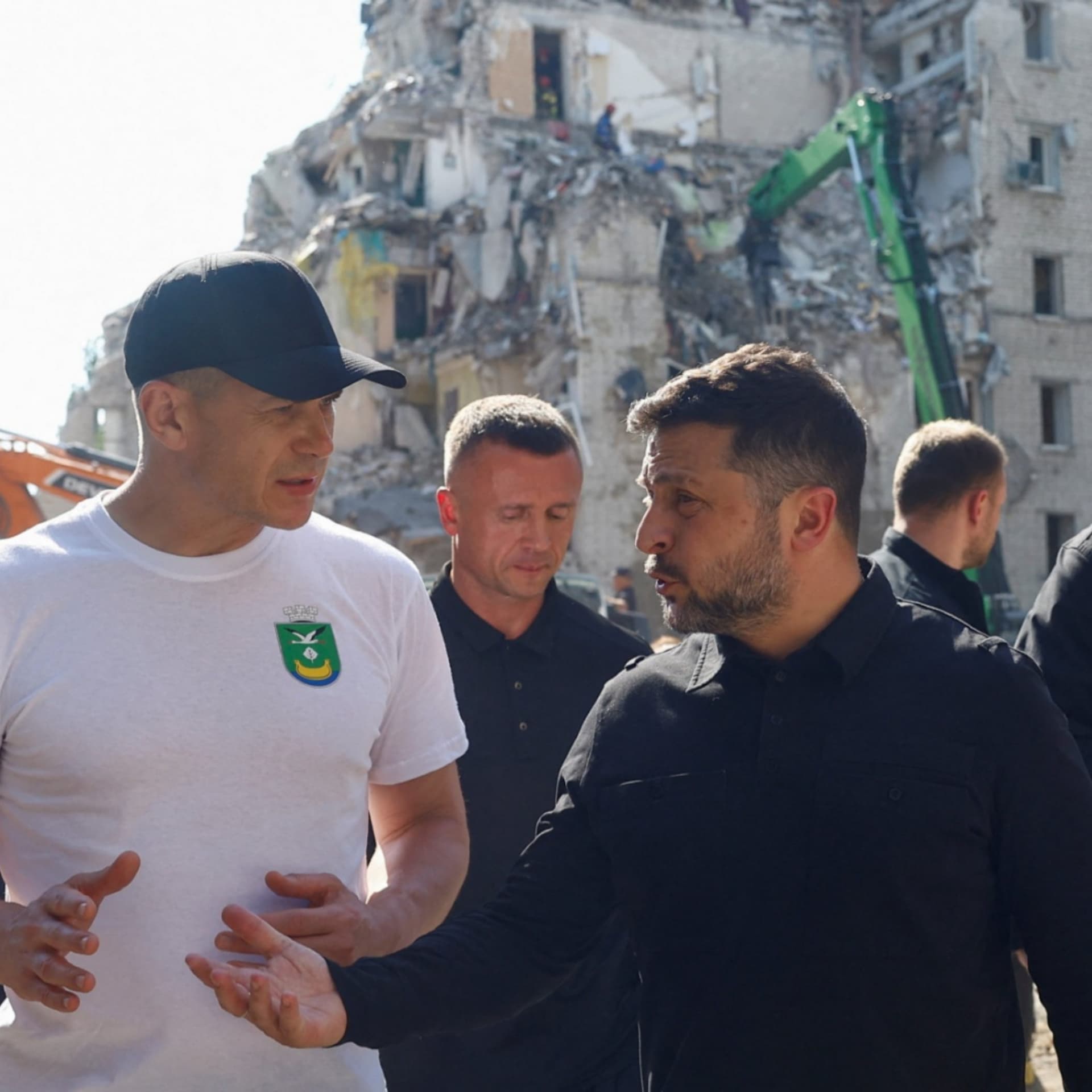
Photo: Ukraine's President Volodymyr Zelensky visits the site of an apartment building damaged during overnight Russian missile and drone strikes in Kyiv on the 2nd of July.
Credit: Reuters