In short
The episode covers US and global politics and culture. Topic: The US House passes a nonbinding resolution to curb President Trump’s war powers against Iran (215-208), ordering troop withdrawal or congressional approval; it’s largely symbolic because Trump can veto and the War Powers clock ran out in May.
Key claims
Democrats call it an “illegal war of choice”; Republicans say it weakens Trump’s Iran negotiations.
Notable examples
Trump’s comments about a possible Iran deal “over the weekend,” and renewed US-Iran clashes in Kuwait.
Guests
Tom Simons (Washington correspondent) explains the vote’s legal limits; Tom Bateman (Washington correspondent) reports Rubio’s view that US mediation on Russia-Ukraine is stalled; Pascal Fletcher (BBC Monitoring) discusses Visa/MasterCard suspensions in Cuba; Elisabeth Grenier (Deutsche Welle) covers Wim Wenders apologizing for withdrawing a topless scene from “The Wrong Move”; Paul Ngea (BBC Africa) reports WHO Ebola updates; Will Grant (Mexico correspondent) on World Cup security in Monterrey; Tom Brook (Tribeca reporter) on an AI-generated film at Tribeca.
Written by AI. May contain mistakes. Listen to the episode to check what was said.
Chapters
Tap a time to open that second in VOUS House Limits Trump's War Powers
1:19 to 2:14
The US House passes a resolution to limit Trump's military authority regarding Iran.
“The US House of Representatives passes a resolution limiting President Trump's power to continue the war with Iran.”
Congressional Vote Implications
2:14 to 3:36
Discussion on the significance and symbolic nature of the congressional vote regarding Iran.
“Donald Trump has suffered another political setback, this time on the war with Iran.”
Iran-US Negotiations Context
3:36 to 4:28
Exploring the complexities of US-Iran negotiations and the recent ceasefire.
“That optimism came despite renewed clashes between the US and Iran, which left at least one person dead in Kuwait.”
Hezbollah's Role in the Conflict
4:28 to 7:10
Examining Hezbollah's position and the potential impact of the ceasefire on the region.
“Also, the War Powers Resolution, which was passed in 1973, on which all this is based, gave the president 60 days to request permission from Congress to effectively have a war.”
US Support for Ukraine
7:10 to 9:32
US Congress votes on providing further support for Ukraine amidst rising tensions.
“But you're right, the US clearly realises the importance of all of this to the Iran conflict.”
Cuba's Economic Challenges
9:32 to 12:44
Discussion on the impact of US sanctions on Cuba and the current economic situation.
“And on Wednesday, a large hotel chain announcing it was ceasing operations there.”
Negotiations with Cuban Authorities
12:44 to 14:01
Insights on the stalled negotiations between the US and Cuban government.
“But there is that pressure, but there are also those who support the government.”
Film Controversies and Industry Reactions
14:01 to 16:34
This segment discusses a filmmaker's struggle with past decisions in his films and industry reactions to it.
“She started by telling him about the film in question.”
Ebola Outbreak Update
16:34 to 17:21
An overview of the ongoing Ebola outbreak in the Democratic Republic of Congo and the WHO's response.
“And still to come in the podcast, how Mexico is gearing up to host the Football World Cup in a week's time.”
World Cup Security Concerns
17:21 to 21:39
Discussion on security measures and concerns surrounding the upcoming Football World Cup in Mexico.
“Republic of Congo has been causing global concern, particularly because of initial delays in identifying and reporting cases.”
Show all 11 chapters
Tribeca Festival Highlights
21:39 to 24:46
Coverage of the Tribeca Festival's 25th anniversary, including notable films and their impact.
“officers are less concerned with cartels than criminality and crowd trouble.”
Transcript
Automatic transcript. May contain errors.0:00This BBC podcast is supported by ads outside the UK.
0:30or just stop by. Grainger, for the ones who get it done. Shop the Sherwin-Williams Memorial Day Sale and get 30 % off paints and stains May 15th through the 28th. Whether you're refreshing your interior or exterior, we've got the colors to bring your vision to life. And with delivery, getting everything to your door is easier than ever. Shop online to have it delivered or visit your neighborhood Sherwin-Williams store. Click the banner to learn more. Retail sales only. Some exclusions apply. See store for details. Delivery available on qualifying orders.
1:07You're listening to the Global News Podcast from the BBC World Service. Hello, I'm Oliver Conway. This edition is published in the early hours of Thursday, the 4th of June. The US House of Representatives passes a resolution limiting President Trump's power to continue the war with Iran. But how effective will it be? Israel and Lebanon agree another ceasefire after talks in Washington on the condition that Hezbollah stops its attacks. And Cuba's central banks' Visa and MasterCard payments will be suspended from Saturday because of US sanctions. Also in the podcast... The achievement for me is to be able to convey the real human emotions without interrupting the viewer with the notion that this is AI or not, or how it's made.
1:56A film generated entirely by artificial intelligence gets people talking at the Tribeca Film Festival.
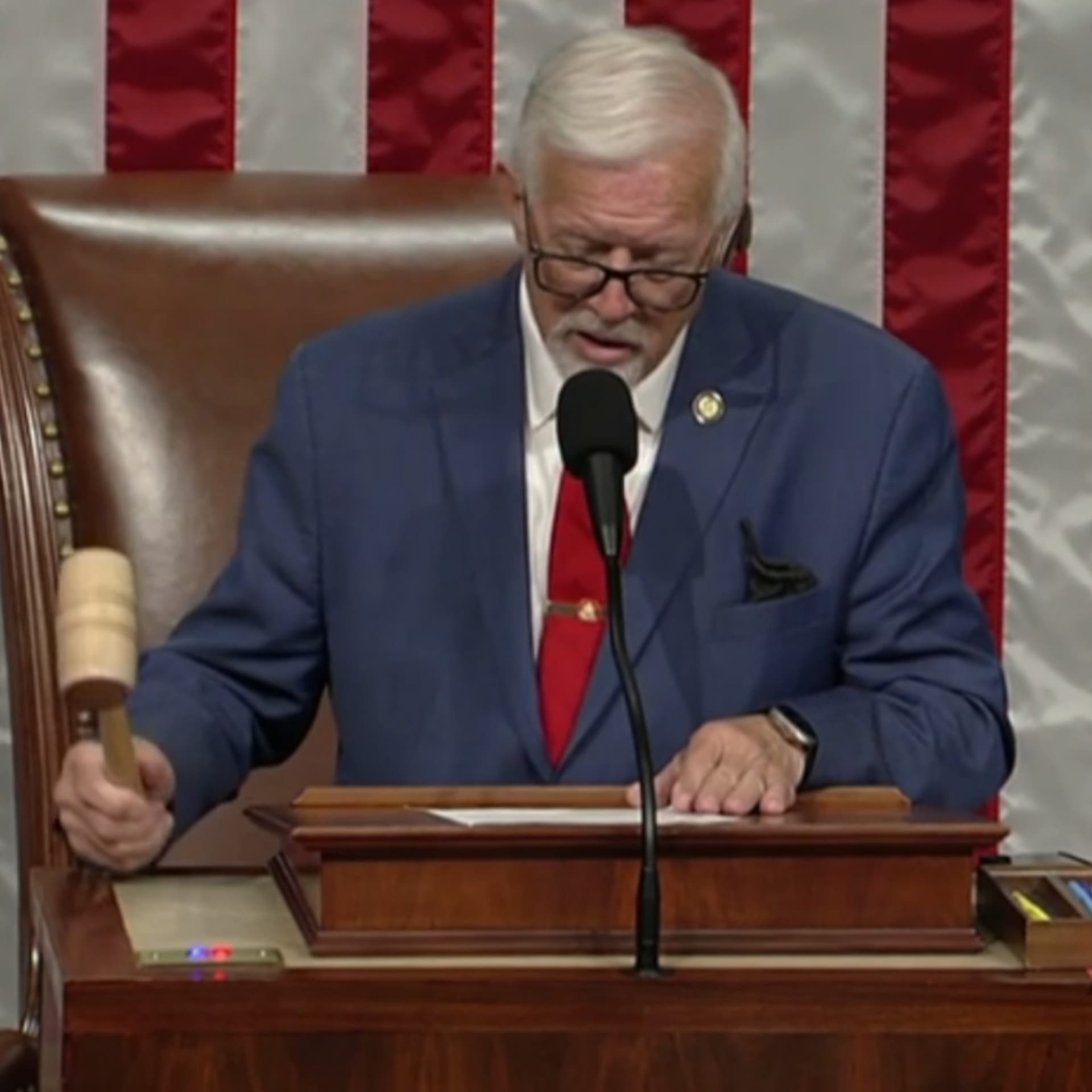
2:07Just a day after he was forced to drop his plan for a$1.8 billion alleged slush fund, Donald Trump has suffered another political setback, this time on the war with Iran. Since the US and Israel launched their attacks in the Middle East three months ago, the Democrats have tried and failed to rein in the president's war powers. But now the US House of Representatives has passed a resolution ordering him to withdraw American troops or gain congressional approval for the conflict. On this vote, the yeas are 215 and the nays are 208. The concurrent resolution is adopted.
2:47Four Republican members of the House sided with the Democrats to pass the resolution in the latest sign of growing opposition from the president's own party. Before the votes, the Republican Speaker Mike Johnson said the legislation would weaken Mr. Trump's hand in negotiations with Iran. Democrats said it was an unambiguous message from the American people to the president to end his, quote, deeply unpopular and illegal war of choice in Iran. The measure will now go before the Senate, but even if it passes, it's largely symbolic, and the president has the power of veto. In any case, Mr Trump said on Wednesday, the fighting may soon be over once and for all.
3:26The negotiation itself has gone very well, actually. Very well. I mean, if it happens, it might not happen, who knows. But if it happens, it could happen like over the weekend. That optimism came despite renewed clashes between the US and Iran, which left at least one person dead in Kuwait. But there does appear to have been some progress in the parallel conflict in Lebanon, with the US State Department announcing after talks in Washington that Israeli and Lebanese officials had agreed to implement a conditional ceasefire. Fighting has continued in Lebanon despite a truce brokered by President Trump in mid-April.
4:03I heard more from our correspondent in Washington, Tom Simons. First, he told me about the significance of the congressional vote on Iran. It doesn't actually go before the president, so it's not legally binding. And as you said, if it did go in front of Donald Trump, he would veto it. And then that could only be reversed by a two thirds majority vote in each of the House and the Senate, which is not likely currently. Also, the War Powers Resolution, which was passed in 1973, on which all this is based, gave the president 60 days to request permission from Congress to effectively have a war. That clock ran out in May, but the White House has said in a statement that the war actually ended in April, when the US and Iran agreed a ceasefire.
4:51Now, that ceasefire has been broken many times. Both sides are using their military to blockade the Straits of Hormuz. But it doesn't look like this vote's going to change very much. But it is politically quite symbolic. Yeah, I mean, it might all be academic anyway, because President Trump has again been talking about a possible US-Iran peace deal. But has there been any real progress there? Yeah, let's wait and see on that, shall we? Because Donald Trump, there was reporting last week that the talks had stopped, and earlier this week as well. And in a fairly rambling press conference today, Donald Trump said the negotiations were actually going very well.
5:26well, we could see a deal over the weekend. We'll see. And I was quite interested that he gave an example about one of the issues at stake. I mean, Iran has agreed, he said, not to develop a nuclear weapon. But then there was a question of what if it tried to buy one? And Don Trump said that US negotiators had to effectively close that possibility down, which resulted in another two weeks of negotiation. So it's quite interesting getting an insight there of how he sees what's going on behind the scenes. And he also said that he had previously, he used the word overrated, the need to remove the nuclear materials that Iran has from underneath their bombed out bunkers in Iran.
6:07So that's now looking like less of an issue. And that's despite the emphasis he was putting on it last week. So maybe some signs of hope there in two different ways. Now, one of the main sticking points for Iran has been Israeli attacks on the Iranian back group Hezbollah in Lebanon. But now Lebanon and Israel have agreed this ceasefire. Hezbollah, of course, not party to those talks in Washington. So will this latest agreement make any difference? Well, there could now be a ceasefire. So that would stop the attacks on Hezbollah that seem to have been a sticking point for Iran in these negotiations.
6:45But it's much easier to say, let's have a ceasefire than to actually have a ceasefire. Hezbollah is going to need to stop firing under this agreement. It's going to need to pull out of a key part of southern Lebanon. The Lebanese army is going to have to take control in various places. And Israel is going to need to be happy that its aim of disarming Hezbollah is being met. So there's clearly quite a lot that could go wrong there. But you're right, the US clearly realises the importance of all of this to the Iran conflict. So it's insisting on the need to keep brokering what will need to be the talks that will potentially turn this ceasefire into a peace deal.
7:23Tom Simons in Washington. US Congress members today also agreed to move forward with a vote on providing more support for Ukraine. It came as the US Secretary of State Marco Rubio told a Senate committee that the risk of escalation between Russia and Ukraine was now higher than it was two years ago. He said the U.S. was ready to mediate in peace talks despite the difficulties. It's been a difficult role to play because, frankly, we're not an impartial mediator. We sanctioned Russia and we are providing and have sold weapons through the Pearl Program, which has remained unimpeded, to the Ukrainians.
7:57Unfortunately, those talks have stalled in recent months for a variety of reasons. The Ukrainians have actually made some battlefield gains in the last month. The Russians are losing 5 ,000, not injured, dying. According to the Department of War, it is one of the first conflicts ever in which the death rate is higher than the casualty rate on the Russian side. Our State Department correspondent Tom Bateman listened in to the meeting. The message that they got from him was that in the view of the administration, their attempts to mediate a negotiated outcome to the war have effectively hit a stalemate and that they're not currently engaged in that process to all intents and purposes.
8:34I mean, I heard a similar message from Mr. Ruby. I spent about a week on the road with him last week. And a few times we put him that question about the current state of play with the US role when it comes to Russia, Ukraine. And really, the language around it has become, well, you know, we're prepared to re-engage in negotiations, but the two sides were too far apart. They wouldn't make the necessary concessions. I think there is more to it than that, of course, which is both the situation on the ground has shifted. There clearly is some momentum behind Ukraine at the moment, and they've managed to freeze the front line.
9:08And at the same time, you've had President Trump and the Israeli war against Iran, which has clearly taken, sucked all the oxygen as far as Washington is concerned, away from continuing to deal with the process when it comes to Russia, Ukraine. Tom Bateman in Washington. Cuba is in a bad way with rubbish piling up on the streets, shortages of food and fuel. And on Wednesday, a large hotel chain announcing it was ceasing operations there. From Saturday, things could get even worse for the economy, with Visa and MasterCard transactions no longer working as a result of US sanctions, the authorities say.
9:47A presenter on state TV announced the news reading out a government statement.
9:57The foreign bank that processes the transactions has terminated its relationship with Cuba, he says, as a result of the executive order issued by President Trump as part of his strategy to, quote, strangle the Cuban people. Well, Pascal Fletcher from BBC Monitoring has lived and worked in Cuba for many years. So what does this suspension of payments mean for people living on the island? Well, I think it's just going to be another turn of the screw, if you like, in what is already pretty ratcheted up US sanctions. In the case of these particular cards, not everybody will have them. So it will be people who've been able to obtain them through travel or through having foreign relations who can help them with this sort of thing.
10:39It's not everybody. And a lot of people have a lot of other things on their mind, just, you know, trying to live with having 18 or 20 hour power cuts a day, problems with water, problems with obtaining food. So while this will certainly affect people and affect their ability to make purchases, it's certainly not something that will affect the whole population who've already got a lot on their mind and are under a lot of pressure with this sort of ratcheted up US sanctions situation. Yeah, and what sort of alternative payment systems are there in Cuba? There are some. I mean, there are national cards they can use.
11:10And I noticed that the central bank in announcing this also mentioned the Mir card. Of course, that's a Russian payment system. But of course, the Cuban economy is still plugged into the international economy, which is very dependent on U.S. financial transactions, the U.S. dollar. So this will definitely have an impact. And these other cards that they mentioned are not really going to replace or solve the problem. Now, the U.S. Secretary of State, Marco Rubio, has said that Cuba has, quote, technocrats ready to negotiate change in the island's governance. What is the latest in terms of negotiations between the U.S.
11:43and the authorities in Cuba? Well, there certainly hasn't been any really good news recently. You know, the US side, the Trump administration has not concealed the fact that it's really wants maximum pressure on the Cuban government in a bid to obtain political and economic changes. And on the Cuban side, you know, this is a government, an island that's used to playing hardball, particularly under US pressure. There's not much sign of any change either. I mean, today, for example, they're celebrating the 95th birthday of Raul Castro. So we're seeing pretty entrenched positions on either side. We really haven't seen a great deal of movement.
12:17We've seen contact visits by the CIA director, a contact on the perimeter of the Guantanamo Bay naval base the other day between military officials. But progress towards some kind of deal or solution, certainly not very visible so far. And what about pressure on the authorities from ordinary Cubans? There's certainly internal pressure coming from discontent, which has kind of rumbled on for the last few weeks. Protests in certainly in the poorer parts of Havana and other cities are almost nightly now with pots and pans beating, expressing people's displeasure and discontent with not having power and all sorts of other of other shortages.
12:52And there's even been signs more recently that these have been spreading to areas of the city, Havana, the western part where, you know, the elite have homes and where, you know, closer to sort of government centers and even during the day. But there is that pressure, but there are also those who support the government. So as I say, it's a very, very tight situation at the moment. Pascal Fletcher in Miami. For years, the German actress, Nastassja Kinski, has been trying to get one of her earliest films taken out of circulation. The Wrong Move, filmed when she was 13 years old, includes a scene where she is topless and an older man lies on top of her.
13:30The director, Wim Wenders, has always resisted her requests. But on Wednesday, in a statement online, the director admitted that she should have been better protected. I apologise to you, Nastassia, unreservedly. No ifs and buts, he said. And the wrong move will now be withdrawn. It's just one example of a film from the 60s or 70s with then-young actors who now feel they're exploited. Sean Lay spoke to Elisabeth Grenier, culture reporter with the German broadcaster Deutsche Welle. She started by telling him about the film in question. It's one of the lesser known films than Wenders, but it came back into the spotlight this weekend, especially after Wenders got Lifetime Achievement Prize at the German Film Festival.
14:17And that's when he reacted by saying, well, I can't blame myself as a young filmmaker at the time, but I wouldn't do that in the same way today. But, you know, I have this problem. I feel so alone with the film. I don't know what to do. I would be asking the public and other younger filmmakers to help me with this issue. How should I deal with it? Is it right to edit a film that has already been released as a completed artwork? And people in the industry acted by saying, well, obviously you should have apologized very simply. And the right move would have been just to delete the scene because you're the filmmaker in the end.
14:53You have the sole rights to decide on this and we don't have to help you decide. We had any reaction from Miss Kinski to this now? Yes, she did write on his Instagram account. Well, after all these years, simply because the public is now weighed in, commenting in so many newspapers and my colleagues have done so as well. And now, because thousands have spoken up, only now do you react to the outcry. It clearly cuts very deep for her and understandably so. And she's not the only actress who was arguably exploited in this way when they were under the age of sexual consent in many countries and nonetheless performing scenes of a sexual nature, sometimes partially dressed or naked.
15:36Exactly. Well, it was really another era. Vendors is right about that. I mean, you have examples of Brooke Shields who appeared in the film called Pretty Baby by Louis Mal. She was only 12 years old and she was nude, playing the role of a child prostitute. She also talked about how she felt forced and uncomfortable on the set of the film The Blue Lagoon in 1980. And there she was only 14 years old. We have the very famous example of the actors in Zeffirelli's film Romeo and Juliet from 1968. They filed a lawsuit because they felt uncomfortable being nude when they were just 15 and 16. Yeah, this is Olivia Hussey and Leonard Whiting.
16:18Exactly. The court permanently dismissed their case. That was in October 2024. But it did really put these issues in the spotlight. Elizabeth Grenier, culture reporter at Deutsche Welle in Berlin. And still to come in the podcast, how Mexico is gearing up to host the Football World Cup in a week's time.
17:02with Kyan Carter will come out three times a week, Monday, Wednesday and Friday, starting May 13th. Subscribe on YouTube or wherever you get your podcasts.
17:17You're listening to the Global News Podcast. For weeks, the outbreak of Ebola in the Democratic Republic of Congo has been causing global concern, particularly because of initial delays in identifying and reporting cases. But the World Health Organization boss, Dr Tedros Sadanom Gabrielsas, says progress is now being made in tackling it. WHO's risk assessment remains unchanged, very high at the national level, high at the regional level, and low at the global level. The outbreak had a big head start, and we're still behind. But under the leadership of the government of DRC, we're catching up. BBC Africa correspondent Paul Ngea told Valerie Sanderson what more the WHO chief had had to say.
18:07Dr Tedros Adhanom Ghebreyesus did reveal that as of today there are 344 positive cases of Ebola in the DRC, including 60 deaths and 116 suspected cases. Six people have so far recovered and then in neighbouring Uganda there are 15 confirmed cases and one death. But Dr Tedros was also keen to speak about efforts and also the challenges that they are facing. While he said that the world is catching up with the Ebola outbreak, he also admitted that there are challenges in scaling up testing capacity and also spoke about the fact that only about 45 percent of contacts have been followed up. He said that there needs to be, that that figure needs to be around 90 percent.
18:48So really tough times indeed for responders to the Ebola virus. But he warned, didn't he, against blanket travel restrictions imposed by some countries. Why was that? That's right, Valeri. He was very blunt in that warning and cautioning against those blanket travel restrictions because he said that they disrupted supply chains and hindered the response. He rather urged countries to prioritise exit screenings at airports and ports and, you know, to ensure there are these screening operations ongoing because closing the border as as the WHO has said over the last couple of weeks, also hinders access to data, up-to-date data, that is really needed for the information of people around the virus.
19:32So it's something that is really important, as the WHO says. And over the last couple of weeks, we've seen countries such as Canada, the United States, rolling out some of these restrictive measures. Canada, for example, has a 90-day pause on documentation or immigration for people from DRC, Uganda and South Sudan. And with the World Cup coming, people from these different countries that are going to take part, especially from the DRC, supporters say they remain stranded because they don't know how they are going to support the DRC that will be participating in the tournament for the first time in over 50 years.
20:07And recently, authorities in Spain also cancelled a World Cup-friendly game that the Congolese National Football Squad was supposed to participate in against Chile. the council that over concerns about the spread of Ebola virus. Paul Ngea of BBC Africa. The World Cup kicks off a week from today and it will be the biggest tournament yet with 48 nations taking part. Matches will be played in 16 cities across the US, Canada and Mexico with the first match in Mexico City. Some fans had expressed concerns after violent scenes gripped Mexico in February following the killing of a major cartel leader.
20:45The government insists fans will be perfectly safe, but it's also faced violent protests this week. Our correspondent Will Grant went to one of the country's host cities, Monterey, in northern Mexico. Patrolling the skies over the steel giant, as Monterey's World Cup stadium is known locally. The overflights in one of two Black Hawk helicopters purchased from the US are for both surveillance and for show, intended to reassure visitors they'll be safe, even in Mexico's dangerous border region. Few could blame fans for having their doubts. In February, the Jalisco cartel wrought havoc across the country following the killing of their leader, El Mencho.
21:28The violence sent a stark message that cartel gunmen could derail this event if they so choose. In the Monterrey police nerve centre responsible for the stadium, officers are less concerned with cartels than criminality and crowd trouble. Some 300 ,000 fans are expected to visit Monterrey, watched over by more than 1 ,500 street cameras in this municipality alone. We have no information that any cartel will harm any tourist, claims the local security chief, Alfredo Favela.
22:07It's mainly the common crimes, mobile phone theft and robberies, he adds But we've reduced those a lot here Visitors should rest assured there'll be peace in this city and this state
22:21To that end, the police have sent in the machines In a promotional video, the city shows off its four robot dogs which will patrol the stadium during games using facial recognition technology to identify known criminals. They're able to detect early signs of crowd trouble and then alert their masters to intervene.
22:44Three of Monterrey's four robo-dogs have been brought out to this very hot car park outside a supermarket and have been wandering around to show us what can be done. much to the surprise and fascination of some of the customers. Some here are extremely doubtful about the dystopian sight of robotic dogs with AI and facial recognition technology patrolling the stadium, but the authorities on Monterrey insist they're a crucial part of keeping visiting football fans safe. I think it's good and bad, says Jocelyn Morales. I know they're here to keep watch, but I worry about them taking jobs from real people.
23:27I've never seen robot dogs before, laughs Angel Perez. I just hope this new tech is used to our benefit.
Read the full transcript
23:36However, there's plenty in Mexico that could still disrupt this World Cup. The main teachers' union is on strike over pensions and threatening to close arterial roads into the stadium unless the government meets their demands. The slogan for the protests, there will be no kick-off.
23:56The authorities, meanwhile, are adamant there will be. In the final days, the anti-riot police in Monterrey are running through their training drills, practising at removing an injured colleague while facing a hostile crowd. In a nation all too often associated with violence, the hope is such scenarios remain on the exercise yard and that the only clashes in this World Cup are on the pitch. Will Grant in Mexico. Finally, the Tribeca Festival, one of the biggest cultural events in North America, has just got underway in New York. Co-founded by movie legend Robert De Niro, it's now celebrating its 25th anniversary.
24:34Over the next two weeks, it'll show more than 100 independent films from around the world, including one generated entirely by artificial intelligence. Tom Brook reports from New York. The Tribeca Festival is expected to bring some 150 ,000 people to New York City. A Tribeca film getting a lot of attention is Dreams of Violence. It makes the claim of being the first feature-length live-action film generated entirely by AI to be part of the official selection of a major film festival. It dramatises the killings of protesters in Iran earlier this year. It's a fictionalised story inspired by photographs as well as journalistic and eyewitness accounts.
25:19It cost only$2 ,000 to make. None of the actors are real. Writer-director Ash Kusher sent his film out to industry colleagues, and they had no idea it was an AI creation. We sent it to around 30 people in the film industry, and 27 people, these are top executives, been in the cinema for a long time, they didn't know it was AI. The achievement for me is to be able to convey the real human emotions, be able to tell a story without interrupting the viewer with the notion that this is AI or not, or how it's made. This AI film raises many questions. How much can we trust the images we see in a movie as being authentic?
25:59And to what extent could this kind of AI-generated filmmaking put people out of work in the film industry? This year marks the 25th anniversary of the Tribeca Festival. It began here in the downtown Manhattan neighbourhood of Tribeca. Back then, it was a very different story. The community had been devastated by the September 11th attacks, and the film festival came about partly as a civic restoration project to revitalise the area. And it dawned on me that this is real. The impact of the 9-11 attacks is explored in a Tribeca film called IXXI. It features testimony from 12 unrelated individuals on how they reacted to the devastation of 9-11.
26:42It's a collection of quite moving stories. The film is directed by Sean Wilsey. I think they portray humanity in a way that's really apolitical. And I kind of had that in mind in this divisive moment that it feels like we're in an America. That, like, it's a film for everybody. This year marks the 50th anniversary of the classic New York film Taxi Driver, starring Tribeca co-founder Robert De Niro. He will appear in a special screening reuniting with Taxi Driver co-star Jodie Foster and director Martin Scorsese. In Taxi Driver, De Niro plays the mentally unstable Travis Bickle, who uttered what's become one of the most famous lines in movie history.
27:25You talking to me? Like it or not, Robert De Niro will forever be associated with that line of dialogue. Do you find when you walk down the street, people yell out at you, you talking to me? Oh, yeah, and I say, you're the only one there, and I sing it sometimes in the street, and I, you know, it's a whole thing. Tribeca may lack focus and big breakout memorable hit films, but on its 25th anniversary, it's fair to say that this New York extravaganza has always been adventurous, and it's generated an estimated more than$1 billion to the local economy. Tom Brook. And that is all from us for now, but the Global News Podcast will be back very soon.
28:09This edition was mixed by Jancis Haycox and produced by Siobhan Leahy and Chantal Hartle. Our editors, Karen Martin. I'm Oliver Conway. Until next time, goodbye.
28:32and the best journalists just trying to understand the world through smart conversation and honest reporting. We don't have billionaires telling us what to say. Stateside with Kyan Carter will come out three times a week, Monday, Wednesday, and Friday, starting May 13th. Subscribe on YouTube or wherever you get your podcasts.
From the publisher
The US House has passed a resolution directing Donald Trump to withdraw American forces from the Iran war, in a largely symbolic move that nonetheless deals a political blow to the president. Four Republicans backed the Democrats, who accuse Trump of violating the Constitution by launching strikes without congressional authorisation.
Also in this podcast: US Secretary of State, Marco Rubio, warns that the Ukraine-Russia war is at high risk of escalating. Cuba accuses the US of "strangling the island", as major bank cards are set to be suspended after another Trump sanction. Filmmaker Wim Wenders withdraws his 1975 movie 'Wrong Move' over actress's teen topless scene. The WHO says the number of suspected Ebola cases in the Democratic Republic of Congo has reduced as testing ramps up. Mexico tries to curb cartel violence and protests ahead of the World Cup. And we visit the Tribeca Festival, which this year includes a film generated entirely by artificial intelligence.
The Global News Podcast brings you the breaking news you need to hear, as it happens. Listen for the latest headlines and current affairs from around the world. Politics, economics, climate, business, technology, health – we cover it all with expert analysis and insight. Get the news that matters, delivered twice a day on weekdays and daily at weekends, plus special bonus episodes reacting to urgent breaking stories. Follow or subscribe now and never miss a moment. Get in touch: globalpodcast@bbc.co.uk
Photo: Moment US House of Representatives votes to limit Trump’s Iran war powers Credit: AFP