
In short
This episode covers escalating conflict in the Middle East, European security and politics, US antitrust action, and several UK/Europe domestic stories. Main topic: US reinstates a naval blockade on Iran over the Strait of Hormuz, with President Trump demanding a 20% charge on cargo using the waterway.
Key claims
the US says it can strike and control the strait’s capability; Iran says the tariff and control demands justify its own traffic-control stance; oil prices rise; the situation risks miscalculation and full-blown conflict.
Notable examples
US strikes across Iran; Iran hitting oil tankers and US targets in Bahrain; Kiev hit by Russian ballistic missiles; Hungary’s amended constitution removing figures from the prior administration; US states challenging Paramount–Warner merger under the Clayton Act; UK counter-terrorism taking over Anne Whittacombe investigation; Spain euthanasia law debate; De Beers halting production at Venetia; Dua Lipa-backed bookshop project promoting banned books.
Guests
Rob Watson (British affairs correspondent); Tom Bateman (BBC correspondent, Washington); Zhuzhona Selanyi (former MP, Liberal Hungarian Together Party); David Vig (Amnesty International Hungary director); Rebecca Hoare-Allensworth (Vanderbilt law chair); Stephanie Prentice (reporter); Valerie Sanderson (British affairs correspondent); Linda Presley (reporter); James Campbell (De Beers former employee); Francesca Pedro Pinto (Livraria Lelo, Porto).
Written by AI. May contain mistakes. Listen to the episode to check what was said.
Chapters
Tap a time to open that second in VOEscalating Tensions in the Strait of Hormuz
0:44 to 1:11
Discussion on the US reinstating a naval blockade on Iran and its implications.
“And to think, that's just a small taste of what Schwab offers.”
Escalating Tensions in the Strait of Hormuz
1:14 to 1:26
Discussion on the US reinstating a naval blockade on Iran and its implications.
Escalating Tensions in the Strait of Hormuz
2:20 to 6:54
Discussion on the US reinstating a naval blockade on Iran and its implications.
“We start in Iran, where the conflict over the Strait of Hormuz continues to escalate and President Trump says he'll reinstate a naval blockade.”
Ukraine's Defense Against Russian Attacks
6:54 to 13:21
Coverage of Ukraine's recent missile attacks and international responses.
“The Ukrainian capital, Kiev, has been hit again by Russian ballistic missiles, sending residents to air raid shelters, with initial reports saying cars and warehouses have been set on fire.”
Legal Challenges in Media Mergers
13:21 to 14:05
Discussion on US states' opposition to the Paramount-Warner merger.
“So I think it was a little bit too early.”
Legal Battle Over Hollywood Merger
14:05 to 16:39
Learn about the antitrust legal bid against the Warner and Paramount merger.
“The Clayton Antitrust Act was put in place in the US in 1914, designed in part to block anti-competitive mergers.”
Global Story Podcast Introduction
18:00 to 19:25
Explore the role of the U.S. in shaping the modern world as it celebrates its anniversary.
“AT &T Fiber, limited availability in select areas.”
Investigation into Anne Whittacombe's Murder
19:34 to 23:02
Investigate the circumstances surrounding the murder of politician Anne Whittacombe.
“British counter-terrorism police have taken control of the investigation into the killing of the former government minister, Anne Whittacombe.”
Euthanasia Law Controversy in Spain
23:03 to 28:01
Understand the complexities of Spain's euthanasia laws through personal stories.
“In March this year in Spain, Noelia Castillo died by euthanasia.”
Challenges in the Diamond Industry
28:01 to 29:24
Learn about the impact of synthetic diamonds on the natural diamond market and strategies for recovery.
“is that not every diamond mine is the same.”
Show all 11 chapters
Collaborating for Banned Books: Livraria Lelo and Dua Lipa
29:24 to 31:35
Discover how a renowned bookshop is partnering with Dua Lipa to promote banned literature.
“Finally, the Livraria Lelo is one of the world's most renowned bookshops and a popular tourist attraction in the Portuguese city of Porto.”
Transcript
Automatic transcript. May contain errors.0:00This BBC podcast is supported by ads outside the UK.
0:30No bouncing between tabs. And best of all, no spreadsheets. Stop managing software and start managing your business with one unified system. Try for free today at odoo.com. That's O-D-O-O dot com. Self-directed investing. Trading. Full-service wealth management. Automated investing. Financial planning. Thematic investing. Retirement planning. Phew. And to think, that's just a small taste of what Schwab offers. because Schwab knows that when it comes to your finances, choice matters. No matter your goals, investing style, life stage or experience, Schwab has everything you need, all in one place, so you can invest your way.
1:11Visit schwab.com to learn more.
1:2614th of July, these are our main stories. Tensions over the Strait of Hormuz continue to escalate with further strikes and demands from President Trump for a 20 % charge to use the waterway. And a new European anti-ballistic missile defence initiative is launched as Kiev suffers another night of Russian attacks. Also in this podcast, Hungary's new government pushes through an amended constitution in order to rapidly remove several figures linked to the previous administration. And the law in Spain recognises euthanasia as an intensely personal decision. It isn't appropriate for someone else to call that decision into question.
2:12We hear about the division in Spain over its euthanasia laws.
2:20We start in Iran, where the conflict over the Strait of Hormuz continues to escalate and President Trump says he'll reinstate a naval blockade. For a third night in a row, the US military says it has successfully struck military targets across the country. Tehran says there have been explosions in several locations, including islands in the Gulf. Meanwhile, Iran's Revolutionary Guards say they've been hitting oil tankers in the Strait of Hormuz and American targets in Bahrain. President Trump told journalists in the Oval Office that the US will act as a guardian of the strait in return for a 20 % charge on all cargo shipped through the waterway.
3:03We're hitting them very hard. We are just going forward. We're attacking them tonight. that we're taking out all of their capability for anything having to do with the straight with the hormone straight and i think in the end we will end up just controlling the whole thing uh we're putting the blockade back the blockade was probably more effective even than hitting them but i think the combination is the thing that that really does it but you think a deal is still possible you think they'll return yeah i think a deal is possible sure i do they are crazy and we're not going to put it up. Yeah, I want to be reimbursed because we're protecting a very rich portion of the world.
3:42We're spending money. And so what we've done is we are going to be reimbursed for protection. Well, Iran has responded by saying those comments justify its demand to be able to control traffic and also charge a tariff. Oil prices have risen once again, too. I got more from our correspondent Tom Bateman in Washington. It's unclear just how quickly the Americans can get the blockade up and running again. Although, you know, we've heard from US Central Command in the region there that this is effectively underway. And I think out of all the things Donald Trump has been saying over the last day or two, this is one of those that will be seen on the Iranian side as one of the most provocative because the naval blockade was causing significant problems for Tehran in terms of what they need and want, which is financing money for reconstruction.
4:32destruction and it's you know it's one of the biggest pressure points on the regime because people have been suffering not just because of the war because of years of sanctions and so it was a vital interest for the Iranians to get that naval blockade lifted which was part of the discussions going into this memorandum of understanding about a month ago and it's another way in which I think this whole situation is now deteriorating and it's just a further kind of rung on the ladder of escalation as this entire situation moves back closer to something like a full-blown conflict. Because Iran's reaction to this was quite sarcastic.
5:08But do you think in reality they will be very worried about this? The sarcasm from Abbas Arachi, the foreign minister, was largely around this issue about charging ships money to pass through the Strait of Hormuz. Because remember, the Iranians have been saying for a long time it was their right to charge what they'd called a fee for ships passing through the strait. The Americans had always said, no, this is a toll. It's completely illegal under international law. You can't do that. And they had suggested that under the Memorandum of Understanding, the Iranians would not do this. But we then saw very clearly the Iranians seeming to suggest they would press ahead with this, perhaps at the end of the 60-day period.
5:46What we've had from President Trump is President Trump saying the Americans are going to charge, he says, a 20 % fee on ships to pass the Strait of Hormuz. And he says it is the Americans in control of it. Now, that is objectively clearly untrue. The Americans do not have complete control of the Strait of Hormuz. And the idea of charging this vast sum for ships passing through appears to be for the birds. But the reality is what it does is to effect endorse the concepts that the Americans were saying the Iranians simply couldn't do as a breach of international law. So there's again, a lot of contradiction in the American position here.
6:23And I think the situation on the ground or on the water now is really serious. I mean, you know, you're seeing almost daily attacks now by both sides. Gulf countries are being struck again by the Iranians. The Americans are escalating the form of military attacks on the Iranians. So I think we're now locked into a cycle where, to be honest, I think Tehran is testing to see how far President Trump will go. But the scope now for miscalculation on either side, I think, is very severe and has the potential to lead to a far more grave escalation of the conflict. Tom Bateman in Washington. The Ukrainian capital, Kiev, has been hit again by Russian ballistic missiles, sending residents to air raid shelters, with initial reports saying cars and warehouses have been set on fire.
7:08Kiev's mayor said the city's air defences were operating. But Ukraine has been open about its struggles encountering Russian missiles because of its lack of US-made Patriot interceptors. In France on Monday, President Zelensky agreed to develop, along with nine European countries, new air defences.
7:31We have launched an anti-ballistic programme comprising of the Freya anti-ballistic system and missile, which can become one of our shared major contributions to protecting lives, strengthening Europe and enhancing Europe's global capacity to prevent conflicts. You can all see the threat that ballistic missiles now pose in Russia's war against Ukraine. Ballistic missile strikes have become Russia's last resort, effectively its final means of prolonging this bloody war. It was part of a meeting of the so-called Coalition of the Willing taking place in Paris alongside Western allies led by President Emmanuel Macron and the British Prime Minister Keir Starmer.
8:13Now Putin is on the back foot, he will try to intimidate us once again with more talk of escalation and hybrid attacks. Today, with EU partners, we are attributing last year's attempted attack on Poland's energy infrastructure to Russia's security services. It is another example of their reckless attempts to undermine European security. So we need to be absolutely clear that whilst we do not seek confrontation with Russia, these tactics will not deter us from our support to Ukraine. President Macron also announced that the multinational force for Ukraine, due to be deployed once the fighting has ended, will hold exercises in the coming months in Ukraine's neighbouring countries.
9:04Three months ago, Peter Mojor secured a huge election victory in Hungary, ending Viktor Orban's 16-year grip on power and what many had seen as his increasingly authoritarian rule. On Monday, the new government pushed through an amended constitution in order to remove several figures linked to that past administration. And top of the list is the president, Tomáš Šujok. He now just has a few days to sign the amendment or face impeachment. But there are concerns about the speed in which this is all happening. Zhuzhona Selanyi, a former MP for the Liberal Hungarian Together Party, said the new government had limited options.
9:47Very few countries in the world is going through a so-called post-liberal restoration of democracy. Actually, there is no other country really in Europe doing this after 16 years. There are a huge number of autocratic holdover appointees, basically nominated by Viktor Orban's regime for 9-12 years over several cycles. These appointees may subverse a new democratic regime. David Vig is the Hungary director for Amnesty International. Tim Franks asked him what he thought about the amended constitution. It is really justifiable that changes are needed. Some key figures that were cemented into as late as 2037, they are obstacles to the restoration of rule of law.
10:36But while these aims are justified, some methods that were used, that were chosen are pretty problematic because they violate due process. Give me an example of how due process is going to be violated in your view. There is an existing procedure, for example, to remove the president of the country. There is an impeachment procedure that, in our view, could have been used and it's an existing procedure. But the governing majority did not choose to use this procedure. But basically, by law, just write one sentence in a constitutional amendment that, in fact, terminates the mandate of the president, who is the current mandate order.
11:15without any due process, basically. One of the arguments that Peter Modja might make is that, look, you know, we've got a mandate. We made it very clear going into the election that we wanted to sweep the old system away. We got a huge majority, a supermajority. Opinion polls seem to suggest that, you know, the overwhelming majority of people surveyed do want the president to be removed from office, we're sort of affecting the democratic will in order to set up a more robust system. I mean, what do you make of that argument? Yeah, I think that's correct that the majority of the people actually want this president to be done.
12:00But in order to set a precedent where the protection of human rights and system of checks and balances can be restored in a way that it actually respects the rule of law, is a very important precedent going forward. This new governing majority does have the necessary public support to undertake these measures. The previous consecutive four urban governments that have undermined human rights and rule of law so many times used the exact same arguments that Peter Mojder is making right now, referring to the view of the public. So I think when we talk about due process and when we talk about the protection of human rights, it is really important to understand that while the majority in a country may wish a process to be very quick.
12:44Sometimes it really pays off on the long run to respect your process. I guess there could be another arbiter of this, which would be the European Union. I mean, they in the past have withheld billions of dollars of funding to Hungary because they've been concerned about the rule of law and about human rights. the EU has pretty much unlocked, I think, about$19 billion worth of funding to Hungary since Peter Modsuk came to power. Do you think that they've acted a bit too hastily? I think they were a little bit too quick in approving these measures, as I think it is very important to learn from lessons from the past where some legislative measures were not properly implemented as they should be in practice.
13:38So I think it was a little bit too early. David Vig speaking to Tim Franks. Why are a collection of US states getting involved in a potential media takeover that's been given the green light by the Department of Justice? California, along with 11 other states, says if Paramount takes over Warner Brothers' discovery, it would weaken competition and have negative repercussions for the industry and consumers. Stephanie Prentice has this report. The Clayton Antitrust Act was put in place in the US in 1914, designed in part to block anti-competitive mergers. And now stood in front of the Hollywood sign in LA.
14:21California Attorney General Rob Bonter used it to explain why he's leading a legal bid to freeze a deal between Warner and Paramount. It prevents mergers. That may substantially lessen competition. or tend to create a monopoly. The states opposing it say it would extinguish competition in Hollywood and threaten jobs across film, TV and journalism. The latter, they say, will have a negative impact for viewers, an act, in Rob Bonta's words, as a death knell for democracy. This merger will mean fewer journalists informing the electorate. It'll mean fewer opportunities for Americans to hear the full breadth of information and opinions on a subject and then come to their own conclusions.
15:09It'll mean fewer documentarians, filmmakers, showrunners, producers, writers and artists shedding light on important stories that too often go untold. Paramount and Warner have been competitors for a long time and the$110 billion deal, the largest of its kind in Hollywood, could give them power on the ground that's never been seen before. Now, all of a sudden, that will give them negotiating power and allow them to dictate terms with movie theaters. And it will also give them incredible negotiating power when it comes to licensing of basic cable channels. And they will be able to raise prices, set dictate terms with cable companies.
15:52That means higher prices for people who have satellite or cable TV, higher prices at movie theaters. The deal will now face delays, but can it be stopped? Rebecca Hoare-Allensworth is chair of law at Vanderbilt University in Nashville, Tennessee. The arguments they bring are serious. They will definitely be taken seriously by the court. And I think it's always hard to win an antitrust lawsuit, especially over the last 40 years. The law has really been narrowed by the court's interpretation. So I don't want to say that they will win this lawsuit, but I would say they have a real fighting chance.
16:27Paramount's CEO has said the scaled-up organisation will have more money to commission projects and vow to vigorously defend the merger. Stephanie Prentice. Still to come in this podcast. We do have lots of books that have been censored, that have been banned from schools. For example, The Handmaid's Tale or The Satanic Verses from Salman Rushdie. how a music megastar has teamed up with a Portuguese bookshop to promote band literature.
17:06Chicago talks a lot. Hold on, let me step over here. People are talking too much. We debate about food, deep dish, tavern style, who's got the best beef. We yell across rooms, across blocks, across generations. Yes, nice earrings, Grammy. And now we're doing it on our phones, too. Video calls from the L train, group chats that never shut up. Neighbors texting you the score before your TV catches up. Come on! Get a load of this guy. Catch up. On a dog. Yeah, we've got thoughts. Too loud? In Chicago, you're gonna hear it. Because nothing here gets built without conversation. Nothing moves without connection.
17:43So if you think you know AT &T, it might be time to rethink that. Because their network has improved, like, a lot. So Chicago can keep speaking its mind with AT &T Wireless and AT &T Fiber. Chicago won't stop talking. Our improved network backs it up. AT &T, connecting changes everything. AT &T Fiber, limited availability in select areas. How has America shaped the world? I'm Asma Khalid, host of the Global Story podcast from the BBC. As the United States marks its 250-year anniversary, we've been exploring the surprising and often hidden ways the US has shaped the modern world. And today on the show, we answer your questions about this moment and what to expect in the years to come.
18:27From the BBC, it's the United States at 250. Listen to the global story on bbc.com or wherever you get your podcasts.
18:37Decisions made in Washington can affect your portfolio every day. But what policy changes should investors be watching? Listen to Washington Wise, an original podcast for investors from Charles Schwab, to hear the stories making news in Washington right now. Host Mike Townsend, Charles Schwab's Managing Director for Legislative and Regulatory Affairs, takes a non-partisan look at the stories that matter most to investors, including policy initiatives for retirement savings, taxes and trade, inflation concerns, the Federal Reserve, and how regulatory developments can affect companies, sectors, and even the entire market.
19:15Mike and his guests offer their perspective on how policy changes could affect what you do with your portfolio. Download the latest episode and follow at schwab.com slash Washington Wise or wherever you listen.
19:32This is the Global News Podcast. British counter-terrorism police have taken control of the investigation into the killing of the former government minister, Anne Whittacombe. The authorities had previously insisted the attack was not politically motivated. A 28-year-old British man arrested on suspicion of murder at the weekend is now also suspected of commissioning or preparing acts of terrorism. Anne Whittacombe, who was 78, was found dead at her remote home on Thursday. In a statement in Parliament, the Home Secretary, Shabana Mahmood, addressed the reality that this is the third British politician attacked and killed in recent years.
20:13I know this raises questions about the security of those in public life. I will not be the only one here, thinking also of two other beloved members of this House. Politics is a calling for those of us here, but it should not be a dangerous one. And so it is incumbent on the House and the government to work together to protect those who choose to serve. My colleague Valerie Sanderson has been speaking to our British affairs correspondent, Rob Watson. I think the big development is the idea that over the weekend when the police first said this was a murder, they said they had no information to suggest that it was politically motivated or in some way anything to do with terrorism, that now we have the counter-terrorism in the lead.
20:59But all the government is saying, all the police are saying is that new information and evidence has emerged for them to give the lead to counterterrorism. But why on earth they've done that? We're still no clearer. It seems crucial evidence was taken from door cam footage from Anne Whittacombe's home. Well, I mean, what has been quite striking is the door cam footage of the suspect who was a 28-year-old white male from the north of England, from a long way away from Devon where the murder happened, where Anne Whittacombe lived. And it seems to show him getting into a red car with a weapon in his pocket.
21:38And to that extent, I guess an awful lot of people who've been looking at it say it seems curious that counterterrorism police would be involved in such a case. But there you are. Rob, other political figures have been killed in the last 10 years. I'm thinking of the MPs, Joe Cox and David Amos, as the minister said in the House. There is growing concern, do you think, about the safety and security of those in public life, as she mentioned. I mean, growing concern would be an understatement, Valerie. I mean, one of the things that this murder has brought out is the level of concern that politicians have.
22:14And it was interesting watching the debate, and I watched it quite carefully, where Shabana Mahmood was giving the statement about where the police investigation was. The number of politicians, including Shabana Mahmood, to be fair, talking about the vast increase in threats that they face. And I know from talking to British politicians, they often tell me about the just exponential rise in the level of abuse and threats that they received, particularly in an area of social media. And so one of the themes in this debate was how could the security of MPs and politicians be improved without somehow putting them behind barriers, keeping them away from the public.
22:54But, I mean, I think there is a real sense of crisis about the way politicians are treated in this country in terms of their personal security. you. Rob Watson. In March this year in Spain, Noelia Castillo died by euthanasia. She was just 25, a young woman who became paraplegic after a suicide attempt that followed a serious sexual assault. Her father fought for two years in the courts to stop the euthanasia but failed. Since then, the Supreme Court has ruled that those with a particularly close connection to the person wanting to die, a family member or a loved one may have the right to contest that death wish.
23:34Our reporter Linda Presley travelled to Spain to meet two people with different takes on the law. We meet Monica on a cafe terrace in Madrid. She discovered quite by chance that her mother had begun the process of asking for euthanasia. I found out through another family member that relative's pet dog had died from natural causes. She didn't have the dog put to sleep. And she said to me, not like your mother, who's going to have euthanasia. Monica, who's in her 40s, didn't want us to meet her mum. She said she's too fragile. So this is solely Monica's version of events. Certainly her mother's health had declined.
24:16She'd spent time in hospital, had a stroke and was dependent on carers. She'd invested a lot of money in rehabilitation, but her soul, her heart, they were very sad. She started saying she wanted to die. Monica was used to reassuring her mother, telling her that with psychological support she'd feel better. Now she challenged her mum about the decision to formally apply for euthanasia. Monica's a devout Catholic. She prayed. and then she made an appointment to see the doctor who was helping her mother make the request. I said my mother's mentally competent but she's physically disabled and therefore vulnerable.
24:59The doctor said she couldn't tell me anything because of data protection. I said my mom isn't eligible for euthanasia under the law. She isn't suffering intolerably. The doctor said my mother fit the criteria perfectly and that as her doctor, she would make sure the euthanasia happened. If you see someone who's about to jump off a bridge, do you offer them your hand or do you give them a kick? What comes naturally to us as human beings? It's to offer a hand. And that's what Monica did. And her mum's still alive. She went on holiday with her daughter, withdrew from the euthanasia process and changed doctors.
Read the full transcript
25:39Monica wants Spain's euthanasia law repealed. But she thinks the Supreme Court's recent decision to allow a loved one to contest an adult's application for the right to die is a good first step.
25:53Since Spain passed the law legalising euthanasia, the highest number of applications to die have been in Catalonia.
26:02The law in Spain recognises euthanasia as an intensely personal decision. It isn't appropriate for someone else to call that decision into question. Dr Xavier Busquets has overseen the euthanasia process for more than 20 patients, and he's been present at the deaths of more than a dozen people. He believes it's wrong for the law to take into account the opposition of loved ones as may now happen. Either we truly believe in personal autonomy or we don't. Healthcare professionals were motivated by compassion. I see a profound cruelty in this legal taint. The euthanasia process is already difficult.
26:40It's emotionally demanding. And now, on top of that, there's this threat. Will someone sue you or not? In only one of some 20 euthanasia cases has Dr. Busquets seen opposition from a loved one. In the others, he says, family are integral to those final moments. The whole setting is chosen by the patient and the family is there holding their hand. I don't think this will ever become a common way to die. It takes tremendous courage to face death like this. And the patient always says to us, thank you. The last words are always thank you. Linda Presley. A diamond ring was once a non-negotiable purchase for a couple.
27:27But fewer and fewer people are now splashing out for the natural stones and the industry is struggling. The diamond giant De Beers is halting production at its biggest South African mine. James Campbell worked for De Beers and told us what's led to the decision. Firstly, there is the overall decline in the diamond market itself, and that's caused by the advent of lab-grown diamonds, which have eroded much of the bottom end of the section, and the cost of living crisis, which most people are having throughout the world at the moment. And the second reason is very much linked to the first one, is that not every diamond mine is the same.
28:03Some diamond mines produce small numbers of very high quality large diamonds, but others produce much larger qualities of smaller quality diamonds. And Venetia is sadly one of them. So their prices have eroded much more than larger high quality diamonds. And therefore, De Beers has made the decision to put a Venetia mine basically on care and maintenance for two years. And I think that maybe one or two other mines may also have to go on care and maintenance to allow the industry to recover. I think it all goes to marketing to a large degree. It goes to what does the consumer want when the consumer buys a diamond.
28:40And for many, many years, diamonds were seen as the ultimate source of your expression of love. And when you're going to get engaged, you give your partner a diamond engagement ring. But much of that market has been eroded by synthetic diamonds. However, many of us in the diamond industry do believe that if there is a resurgence in marketing, natural marketing around natural diamonds, that that will grow. If you look at Louis Vuitton handbags, for example, you can often not tell a Louis Vuitton handbag, which is made by a fake manufacturer, from a genuine thing. But the owner of that handbag actually knows that this is a real thing.
29:18And that's what the diamond market really has to focus on in order to resurrect itself. That was James Campbell. Finally, the Livraria Lelo is one of the world's most renowned bookshops and a popular tourist attraction in the Portuguese city of Porto. They're now collaborating with the pop star Dua Lipa to sell books that have been banned in some countries. Francesca Pedro Pinto is from the bookshop and has been telling Sean Lay more about the project. So we expanded and we of course had to have an auditorium, a place where we could host our cultural programming. And we started thinking what books belonged on these shelves.
29:59Then we challenged Service 95 Book Club to create this project with us. And this is the book club that's run by the singer Dua Lipa? Yes, we wanted this to reach new audiences and we believe that Dua Lipa has the power to do that. Now, are these books that have been in different places around the world at different times been banned or censored or indeed removed altogether from bookshelves? Some of them have. Unfortunately, we're living strange periods. Just in the US in the past year, over 4 ,000 books have been banned. So that's the highest number ever documented. So we do have lots of books that have been censored, that have been banned from schools.
30:42for example, The Handmaid's Tale or the Satanic Verses from Salman Rushdie, other types of books that, for example, in the voice category, which are books that maybe people haven't heard of. And so we try to broader that voice and amplify it. And when you say voice, these are people's accounts of their own experiences. Yes. For example, Shimamanda with The Half of the Yellowstone, that talks of the Bifurian War and how a million people have died of starvation. So these are stories that not many people know of and that we believe deserved a special category within this library. Are you hoping that maybe Dua Lipa herself will visit at some point?
31:23I bet she will. This is now her home as well. These are the books that she helped select to be represented. I'm sure she will want to visit the Manifesto Library. Francesca Pedro Pinto. and that's all from us for now if you want to get in touch you can email us at globalpodcast at bbc.co.uk you can also find us on x at bbc world service use the hashtag global news pod don't forget our sister podcast the global story this edition of the global news podcast was mixed by chris casaris and the producer was marian strawn the editor is karen martin i'm charlotte Gallagher. Until next time, goodbye.
From the publisher
Washington and Tehran continue to exchange strikes, President Trump restores the US blockade of Iranian ports and unveils a new levy on cargo shipped through the Strait of Hormuz. Also: the Ukrainian capital, Kyiv, is again hit by Russian ballistic missiles after Ukraine launches a european defence system in Paris; Hungary's new government pushes through an amended constitution; US states sue to block the Paramount-Warner Bros. merger; British counter-terrorism police take control of the investigation into the killing of the former government minister, Ann Widdecombe; the legal and ethical rows over euthanasia in Spain; the travails of the diamond industry; and Dua Lipa teams up with a Portuguese bookstore to promote banned literature.
The Global News Podcast brings you the breaking news you need to hear, as it happens. Listen for the latest headlines and current affairs from around the world. Politics, economics, climate, business, technology, health – we cover it all with expert analysis and insight. Get the news that matters, delivered twice a day on weekdays and daily at weekends, plus special bonus episodes reacting to urgent breaking stories. Follow or subscribe now and never miss a moment. Get in touch: globalpodcast@bbc.co.uk
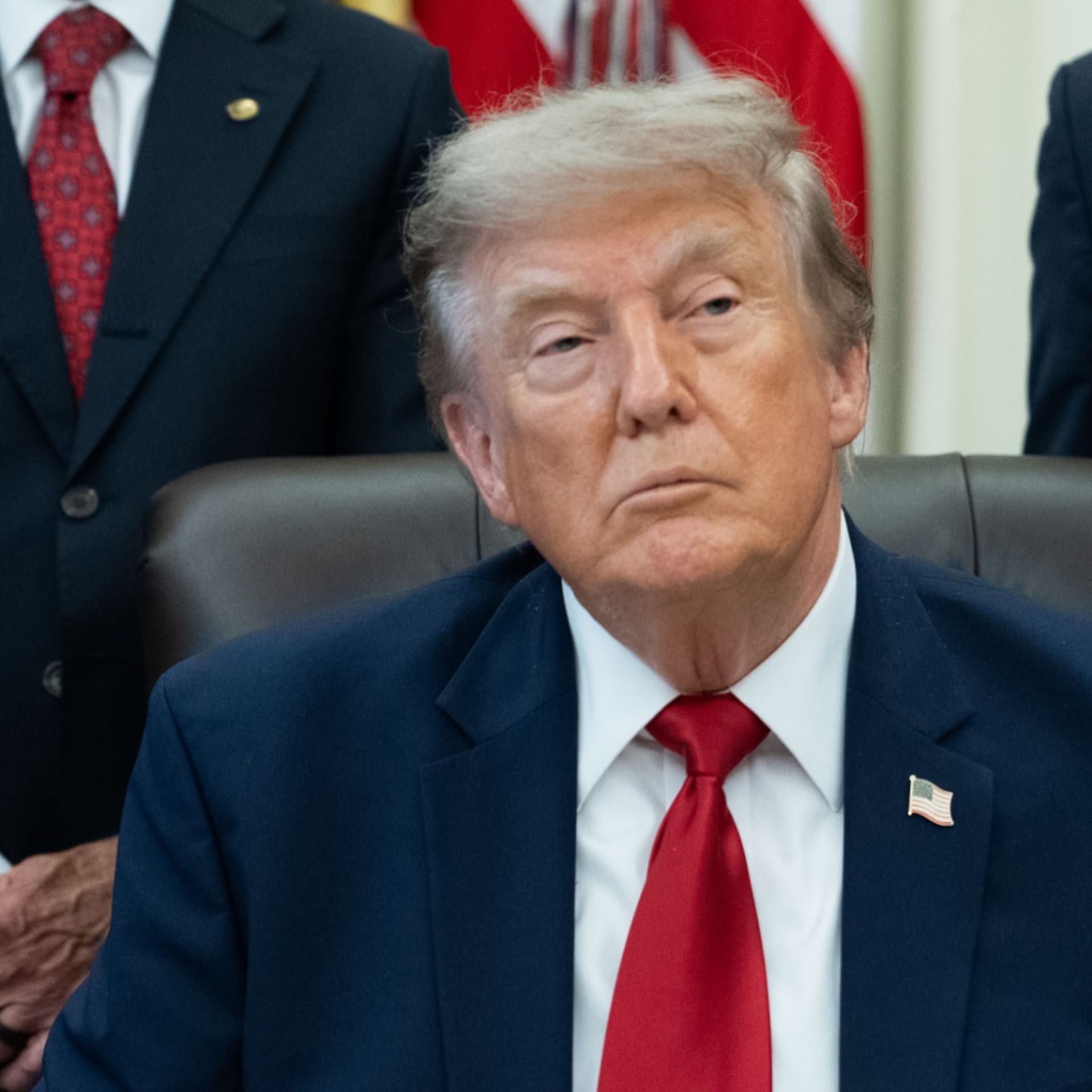
Photo: United States President Donald J Trump in the Oval Office of the White House in Washington, DC, USA, 13 July 2026. Credit: EPA/Shutterstock