Ask ChatGPT
 Google DeepMind: The Podcast
11 Nov 2026 · 40m · 21 chapters
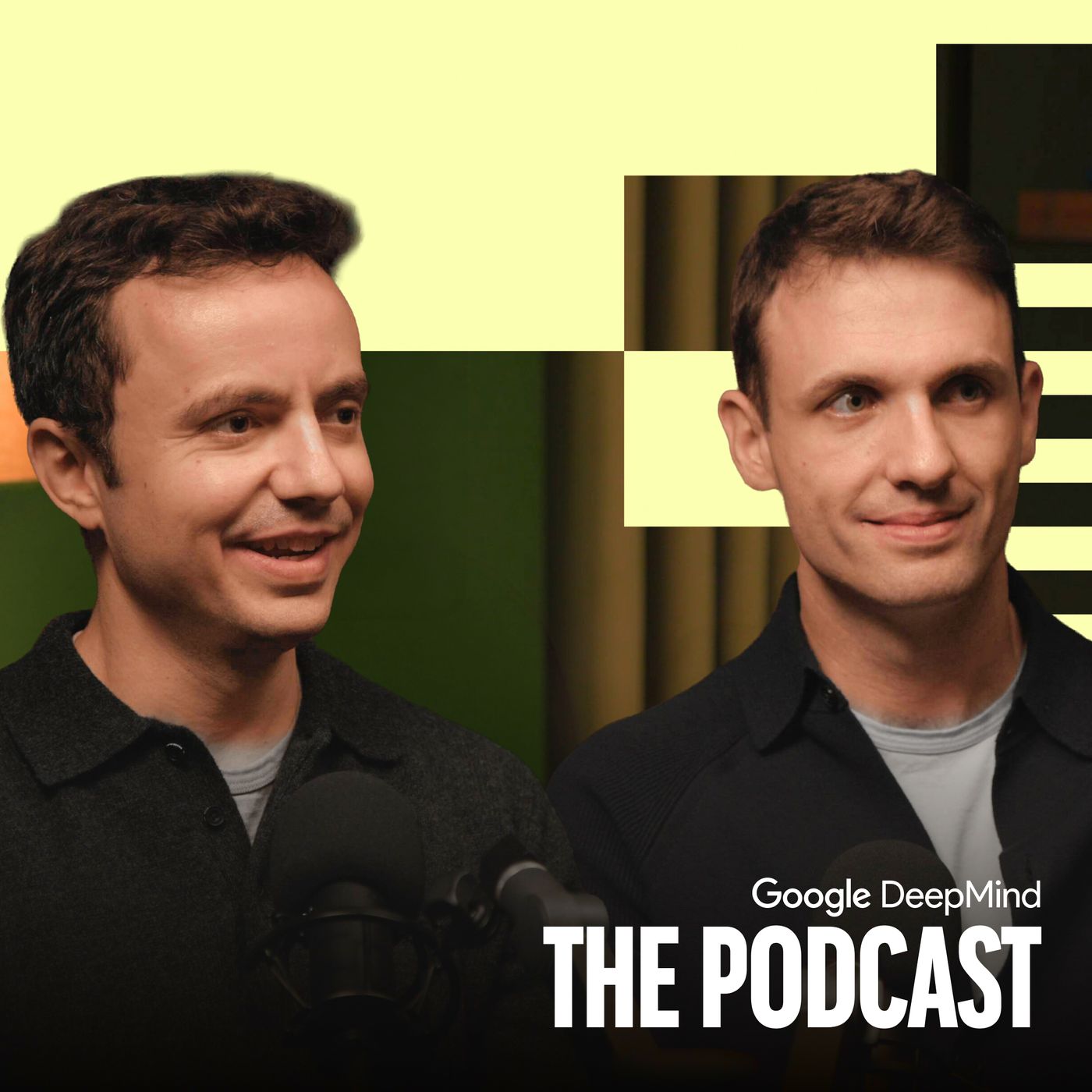
DeepMind’s AlphaGenome 2 models how DNA sequence variants affect cellular function, focusing on non-coding DNA and single mutations driving disease. It builds on AlphaGenome (whole tissues) and expands to individual cell types, producing variant impact predictions and a public resource (Alpha Genome Atlas) for ranking mutations.
Giga Adam (physicist-turned-ML; motivated by rare disease variant interpretation; works on ML in genomics) and Adam (computer science/operations research background; motivated by family illness/cancer; entered via single-cell genomics and computational biology).
AlphaGenome “reads” DNA like text to predict what changes inside cells and what happens if a letter changes (e.g., A→T). It uses public reference-genome training aligned to modalities like gene expression and TF binding (not individual genomes). Outputs a research AVI score (0–~80) for variant prioritization; high scores are “high-precision, low-recall.”
A rare pediatric epilepsy case where AVI ranked the correct splicing variant, later validated by engineered DNA constructs measuring altered RNA splicing. A macrophage/inflammatory bowel disease locus where AlphaGenome 2 predicted a variant regulating a gene 290,000 bp away, later supported by experimental work.
Written by AI. May contain mistakes.
Discussion of Alpha Genome's purpose and its advancements over time.
“Now, way back in season two of this podcast, we heard how Google DeepMind had developed a transformer model that could predict the effect of DNA sequences across the body.”
Exploration of personal motivations of researchers in the genomic field.
“In a nutshell, what is Alpha Genome actually designed to do?”
Clarification of genotype and phenotype and their complex relationship.
“During my studies, I realized that physics is not my true calling.”
Understanding the complexities of Mendelian and complex diseases.
“me, maybe let's start from the beginning here.”
Discussion of how DNA produces proteins and the importance of regulation.
“And many genes can be involved in a disease.”
Explanation of how different cells specialize and function based on DNA.
“And this code to generate the code of when and where to produce these proteins can be quite complex because we have so many different cell types in our body, right?”
Updates on advancements in AI models for decoding the genome.
“It's a very complicated on and off switch.”
Description of how the model maps mutations in the genome to phenotypic outcomes.
“Where you actually understand the impact in mutation.”
Introduction to the Alpha Genome Variant Impact Score and its implications.
“Okay, so let me make sure I understand this then, right?”
Learn how AVI scores help geneticists prioritize genetic variants associated with diseases.
“But then also people who have rare diseases to try and hone in on what those differences might be, right?”
Discover a specific case where Alpha Genome helped identify a genetic variant causing epilepsy.
“So when we developed Alpha Genome Atlas, we gave early access to it to researchers at the Broad Institute, in particular Laura Covel.”
Understand how researchers validate genetic variants through experimental methods.
“How did they validate it experimentally?”
Explore the significance of identifying genetic causes in rare disease patients.
“The first is, obviously, if you know what the root cause is, you have more chances of finding the right cures.”
Learn about genome-wide association studies and their role in genetic research.
“do you think that cilantro tastes like soap?”
Discover how Alpha Genome provides a more detailed analysis of genetic variants.
“So Giga was describing the atlas, This was done over 9 billion possible variants, which is essentially all the possible variants in the human genome.”
Understand the importance of making predictions at the cell type level in genetic research.
“You can talk about the difference when a cell is being a T cell versus a red blood cell versus...”
Exploring how Alpha Genome 2 makes predictions and its performance across different cell types.
“and with Alpha Genome 2, we were able to successfully make this prediction, retrospectively validating the results of this other study.”
Discussion on the limitations of the model and its capabilities in predicting biological outcomes.
“And one of the things that we also did with Alpha Genome 2 is allow people to basically plug in their own data.”
Insights into DNA structure and how it affects prediction accuracy in Alpha Genome 2.
“So we're still very, very far from simulating biology.”
Discussing the future vision of Alpha Genome and creating virtual cells for better drug development.
“and things that are far from each other in the linear space.”
The importance of data infrastructure in achieving the vision of true precision medicine.
“But this is sort of step one on that journey.”

Get the gist, explore an idea or ask about something said.
 Claude
On Google DeepMind: The Podcast, what are the key points of this episode?
Searching your listeningAutomatic transcript. May contain errors.
0:28Welcome to Google Deep Mind, the podcast. becoming more legible. Now, way back in season two of this podcast, we heard how Google DeepMind had developed a transformer model that could predict the effect of DNA sequences across the body. We're trying to build AI that essentially can understand the genome. The fact is we now have the kind of level of data where deep learning can really take hold. And we've been able to build together the kind of deep learning models that are able to read a DNA sequence a bit like you might read a piece of text. Since then, progress has been rapid. In 2025, they unveiled Alpha Genome, which predicts the function of non-coding DNA across whole tissues.
1:10And now, Alpha Genome 2 zooms down to individual cell types to shed light on how single mutations drive disease.
1:25Giga Adam, thank you so much. Welcome to the podcast. Thanks for having us. In a nutshell, what is Alpha Genome actually designed to do? Give it to me simply. So Alpha Genome is designed to read a stretch of the DNA or the genetic material, the instruction manual in the cell and tell us what's happening inside the cell at that location in the genome and also tell us what happens if we make a small change to the DNA sequence if we change the letter A to a letter T, what would change at that location in the genome. So it's a tool for us to study sequences and variants at the molecular level. Let me ask you both, what was your personal motivation to work on this?
2:04I mean, you started off as a physicist, didn't you? Yes. During my studies, I realized that physics is not my true calling. And I stumbled upon a machine learning course, and then I learned that machine learning has a lot of components that I loved in terms of problem-solving maths, and it was also very applied. and it turned out this course was taught by two researchers in genomics. So after the course, I went to them and asked if they had any interesting problems in machine learning in genomics and they had, of course, we do have. And my first project was in trying to pinpoint variants in the rare disease patients and I feel like that problem of not knowing what mutations do and how should we think about them really stuck with me over the years and I feel like the motivation for our work is both to help patients with rare diseases and also patients potentially suffering from other diseases, as well as the feeling of being able to advance the frontier of science is something I find very exciting.
3:04How about you, Adam? Well, actually, my background is in computer science and operations research. I think for me, I'm actually coming into this field from the lens of like a family illness. And I think what's refreshing about, you know, doing things to improve human health is that there's a lot of different ways you can do it. And for me, I literally just Googled machine learning biology 12 years ago. And then I took this route that pretty much ended here. Because you had the personal experience of living with rare diseases? Cancer in this case. Yeah, so basically Googled it, came across this really interesting field called single-cell genomics.
3:43And then one step after another, I sort of entered into computational biology and more serious machine learning models. And I think, you know, I'm really happy with where we're at in terms of applying these models. And I think, you know, in the future, really making an impact on human health. On things like cancer and MRI diseases, as you were describing. Okay, well, for the non-biologists among us, i.e. me, maybe let's start from the beginning here. Because you've got a genotype and a phenotype. And, I mean, tell me what those are first of all, and how big of a challenge it is connecting them both up.
4:18Yeah, so genotype is really the set of letters that we have in our DNA. ACGT, I think a lot of people are familiar with that. And humans have three billion, the genome is three billion in length. And the phenotype, this is really an overused word in biology. This can mean like hair color. But we really think about phenotypes at the cellular level. So how will genes change their expression in different cell types? And the connection between genotype and phenotype is how does variation in the genome affect these phenotypes at different molecular scales? Because you're right that, you know, one example that people often use, or maybe I often use, is that the MC1R gene is the thing that gives you red hair.
4:58You've got kind of genotype and phenotype. But we're talking down a much smaller level here. Yes. I mean, ultimately, you would want to really understand the relationship between high-level phenotypes, such as, you know, whether somebody has a certain disease like Alzheimer's or type 2 diabetes. But this distance between genotype and phenotype is very long and very complex. It's a very complex relationship. A lot of things have to happen in order for the phenotype to happen. So we try to simplify the problem by focusing on things that are closer to the molecular biology, to really the underpinning of how the genome works at the molecular level, because we feel like it's a simpler process and we have a lot more data in order to make accurate predictions.
5:39Because I think for a while, there was sort of a suggestion that if you had a particular mutation, that would then sort of causally result in a particular change in the body. I'm thinking about the BRCA1 gene, for example, here, where we know that it's associated with increased risk of certain types of cancers, breast cancer in particular. But it's more complicated than that, right? Yeah, so I think we can break down these sort of diseases in two classes. There's Mendelian diseases where you have a variant that affects a gene, and this gene directly causes a particular disease. And then there's complex diseases.
6:13And essentially, as humans, we have a risk profile that's determined by our genetic background. And these are often also caused by environmental factors. So it's not always just like one variant, sort of one disease, but it can be quite complicated across the genome. And many genes can be involved in a disease. Because I guess there's a lot going on in the DNA that is sort of switching things on and off. I mean, people used to call this junk DNA, didn't they? Yes, exactly. So I think the main role of the genome is to produce proteins, which are these building blocks in the cell. And I like to use an analogy of Lego building blocks.
6:49You can think of proteins as these Lego building blocks. and we all started off as a single cell that contained one instruction manual from our mother and one from our father and then the cell divided and specialized into different cell types in our body. So all the cells carry the same genetic material yet they get specialized and by specialization this means that they need to produce different building blocks to build up different machines so that they can carry out specific functions such as cells in our eye need to be able to detect light muscles need to be able to perform physical movement So they need different machines inside them.
7:23So that's why the 2 % of the genome encodes for these, you know, what are those building blocks? You know, you think of this as the shape and the color of the Legos. But then the rest of the genome, the 98%, tells the cells how many of these building blocks should they produce so that they will assemble into the right machines to carry out the function. And this code to generate the code of when and where to produce these proteins can be quite complex because we have so many different cell types in our body, right? And they all have to respond differently. So there's a lot of action going on in the regulation part of the genome.
7:58Well, because if every cell has a complete copy of your DNA, how does an eye cell know to be an eye cell and a heart cell know to be a heart cell and, you know, whatever else is going on in your body? Yeah, it's really fascinating. I mean, essentially, as Giga said, we have these control elements within this 98 % of the non-coding genome. And really, different cell types use these in different combinations. and with these different combinations they can perfectly fine tune the levels of expression that are required to perform their function. Is it a bit like on and off switches? It's a very complicated on and off switch.
8:32So about five years ago, maybe six years ago on this podcast, we were talking to some of your colleagues about some work that had been done using transformers to read DNA sequences. I mean, quite a lot has happened since then, hasn't it really? Do you want to give us a rundown? Yes. Yeah, so we continued on our mission to try to use AI to decipher the genome. And Informer was really our first project in collaboration with Calico on building these models that read the DNA sequence. Then obviously AlphaFold2 came along and we went from also studying the non-coding genome back to the coding genome because we felt that AlphaFold was a great opportunity for us to really think about how do mutations affect proteins.
9:15So hang on a second then, because a minute ago you said only 2 % of the genome goes into encoding proteins. Exactly. So at this point you're like, well, let's just go for that. We've got alpha fold. Exactly. Protein folding is our thing. Exactly. Let's focus on that. Yeah, I spoke to John Jumper and one of the first questions that I asked him when I joined DeepMind is like, how good is alpha fold two at predicting the effects of mutations? And he's like, unfortunately, not very good. It always keeps predicting almost the same structure. because it has been designed to be robust to mutations. But it felt that there should be something inside the model that might be helpful for predicting mutations.
9:51Like if you understand structures and evolution of sequences, then this might contain useful clues to predict what mutations do. So we've done alpha-missense, which really uses alpha-fold as a base model and then fine-tunes it to predict which mutations will be potentially pathogenic or deleterious and which ones will be benign. So that was our kind of detour into the world of coding variants. Because I think this sort of makes sense. This is sort of like a, it makes sense that this would be the first thing that you would want to try. Yes, exactly. That you've got, you know, you've got this incredibly complicated recipe that builds a body, like builds life forms, but a tiny bit of it will build proteins.
10:26Exactly. You can fiddle around with that. Exactly. And try and get that map between what the instructions say and what the output is. Exactly, yeah. So that was one project we've done. Only on proteins. Only on proteins, yeah. But we felt that people have been building these kinds of models for a long time. And I feel like we're getting quite close to these models being quite good at predicting the effects of variants. Where you actually understand the impact in mutation. Exactly, yeah. There's still a lot of things we don't understand, such as, you know, what precisely biophysically happens. But the accuracies of these models are getting quite good.
10:55Unfortunately, it's only for 2%. Exactly. Unfortunately, so this has bothered us, basically, that, you know, what do we do with the rest of the 98 %? So we went back and we worked on alpha genome, which was then the next iteration of the Informer model where we expanded the sequence from 200 ,000 to a million. And we also increased the resolution from 128 base pairs down to a base pair. And that really allowed us to leverage more information in the data and thereby improve the model. And then we decided, well, it's a complex model and it still takes quite a bit of compute to run. So why don't we make it more accessible to people to use it?
11:37So we generated Alpha Genome Atlas, where we took Alpha Genome and we pre-computed the effects of mutation for every single possible letter change in the human genome. That's 9 billion changes. And then we have exposed this resource as a website. And we also made it easier for people to quickly grok whether a mutation is something worth paying attention to by compressing down the 10 ,000 numbers that Alpha Genome gives you, plus the alpha MSN score, plus evolutionary conservation into a single number. which we call the AVI score or Alpha Genome Variant Impact Score, that then allows people to rank mutation and then find the needle in the haystack.
12:11Okay, so let me make sure I understand this then, right? So what is it actually doing? How are you getting this mapping from the genome to the phenotype? So over the last 15 plus years, the community has really put together a lot of amazing data resources. So we actually just use public data that has been collected at various universities or labs. This is people's DNA? This is data that essentially takes people's DNA and measures different properties about it, such as how expressed are the genes, how open are different regions of the DNA that allow different proteins to bind it. We're not actually training the model on individuals' genomes.
12:52We actually train with respect to what's called the reference genome, which is really interesting because we make predictions about different variants in the genome, despite the fact that we only train it with respect to one fixed genome. So what we do is we take different modalities, such as gene expression, TF transcription factor binding, and essentially we align them to the reference genome. And then just by training a model that maps from the reference genome to these modalities, we can make these variant predictions. Maybe it's worth also giving a historical perspective. So after the human genome was sequenced in 2003, people realized, oh, there's actually a lot we don't understand.
13:26There was a big project that spun off on the back of a human genome project called the ENCODE project, Encyclopedia of DNA Elements. And they've invested a lot in technology development that allows us to use DNA sequencing as a way to measure what's happening at the genome in a molecular way. That point you make about the human genome project is a really good one. I mean, it's literally like an entire shelf of books, right? Yes. It's like a one person's DNA. And that's great, but who knows what any of it actually means? Exactly, yes. Yes. But then it turns out you've got many, many people's DNA and you can look across them for differences and changes and work out which ones are the changes that lead to the individual variation amongst us in the way that like my DNA might be different to yours or to yours.
14:10But then also people who have rare diseases to try and hone in on what those differences might be, right? Exactly, yes. And then even though we still don't understand everything between the genome to what you get as the output, you're now at least able to predict how likely a change, a single mutation will be at impacting the outcome. Is that a fair way to describe AVI? Yeah, exactly. So it gives you for a single mutation or a single variant, it gives you a score, a number between zero and roughly 80. and the higher the number is, the more you should pay attention to it, meaning that it probably does something to the cells that you should pay attention to it.
14:56So from a geneticist's perspective, if you end up with a list of variants that are all suspects in causing either a disease or being causally associated with a phenotype, you can use AVI to sort them and to rank them and then spend more energy at looking at things that have higher AVI scores. If it comes back with a zero, don't worry about it. It's not going to make a difference. The way we've trained this is we took all these scores and we built another model to predict which variants are frequent in the human population and which ones are absent from the human population. Because things that are frequent in the human population are generally benign.
15:32We all carry these variants and we're all fine. We're generally fine. But things that we haven't observed in the human population could be because the human population is too small and we didn't have the time to observe these mutations or variants or because they're bad. It is a very noisy signal, but it's good enough to point us in the right direction. So obviously the models and so forth are still imperfect. There's a lot of things we need to be much better at, but at least it gives us some hints about what's potentially happening at the molecular level so we can then better reason about these associations between the genotype and the phenotype, which can be quite complex.
16:11Because I guess that's the point, right? is that sometimes when the genome gets copied, some typos don't make any difference. Some typos might change your hair color, you know, make you a bit taller, something sort of innocuous, but some end up really causing serious problems. And ATLAS can tell you which typos are more likely to be problematic. Correct, yes. It also tells you what, at the molecular level, why that is, right? Is it because of increased expression in certain cell types and so forth. So it allows you to get a little bit more information than just, you know, the score is high, but that's it.
16:50But this isn't supposed to be a sort of clinical tool, is it, right? It's sort of, it's much more of a research tool. Yeah, so this is a research tool that allows geneticists or other biologists really to prioritize variants and interpret them. I can say, oh, actually, this variant looks like it causes this particular gene to be processed in a slightly different way. And that actually might be what's causing this particular disease. But really, this is one part of what would be a huge pipeline that people follow. And it's very important that this tool is used as part of an actual rare disease pipeline.
17:32Like you're looking for clues, I guess, ultimately. Yeah, that's a good way to do it. You're looking for clues and you need to, at the end of the day, make sure that all the clues that you've gotten through different things all add up and then you can gain your confidence. So when we developed Alpha Genome Atlas, we gave early access to it to researchers at the Broad Institute, in particular Laura Covel. The researcher that really looks at these hard, rare disease cases where people have, you know, they were sequenced, but they did clinical geneticists that didn't know what was the cost. in one case there was a patient who was a baby suffering from a rare epilepsy case and she was diagnosed at six weeks of age and then for a number of years I think it was like four years or even five years they've done a number of tests to figure out what is the mutation.
18:25So they knew it was genetic? They knew it was genetic but they didn't know what exact variant was causing this child to have this disease. And then Laura applied alpha genome variant impact score to this patient. She ranked the variants and she saw that the top ranked variant made sense, that it was affecting a protein that has a function related to that condition, the seizures and the epilepsy. And it was actually matching some reports from the previous literature about this function of this variant actually. And they went in and actually validated this experimentally and then all the puzzle pieces clicked and connected and they were able to solve that case.
19:08How did they validate it experimentally? So, because this variant was a splicing variant where it changes how RNA gets cut and joined together, they could design a small gene that contains sub-parts of it and then you look at where these cutting patterns will occur and then you insert mutations in there to see if these cutting patterns change and that's why that's how you can experimentally validate that the splicing matches what you're experimentally predicting so this is all in a lab presumably all in petri dishes this is all in a cell line you insert this piece of dna into a cell line and then the cell line produces this gene and then you see what kind of version of the gene it produces whether it splices here or splices there.
19:54But then if you do identify the genetic cause of a particular rare disease like, you know, pediatric epilepsy, I mean, can you do anything about it? How does it help? I think there are two important implications of finding this, the so-called molecular diagnosis in rare disease patients. The first is, obviously, if you know what the root cause is, you have more chances of finding the right cures. And also these days, there are new genetic medicines being developed, such as the antisense oligos, which are short pieces of RNA that bind the RNA and can change how this RNA is processed and potentially reverse that.
20:32Or genome editing is also another option on the table in terms of potential ways to cure. So like knowing the variant, obviously it's still a very long road and small chances of actually developing that medicine. But I think it gives hope that this might be possible one day. The other thing is obviously for future family planning, you'd want to understand you know whether the parents had the same mutation if you have the second child you know how likely is it that the child would have suffer from the same disease and so on and so forth or does anybody else have have in the family is predisposed for these things so it's useful to also understand to that so that you understand the family genetics through that lens i'm just wondering how these approaches compare to population-wide studies that have that have happened for a really long time here i mean particularly in the case of alzheimer's for example.
21:19Just talk me through those. What are those? How do they work? You know, we've been talking a lot about rare disease, but I think a very common tool that geneticists use is what's called a genome-wide association study. And this is conceptually very simple. I just take a bunch of people, I sequence their DNA, and I look at the differences, and I try to associate that with a trait. And geneticists, they look at all kinds of traits. I think one of my favorites is like, do you think that cilantro tastes like soap? Coriander. Yeah, exactly. Do you, by the way? I don't, but I have a friend who does.
21:50I don't think so. No, I don't either. I'm not necessarily about what it is. But this is how niche I think the traits are. There's traits like that. And then, of course, there's traits like risk of inflammatory bowel disease, things like this, diseases, different kinds of cancer, and so on. So the thing is, though, once you have this list of associations, they're just associations, right? And what we aim to do with our modeling efforts is really try to understand which of these variants is actually what are they doing at the molecular level and could these molecular changes be driving particular phenotypes that we see in cells?
22:27And then can we have a better sort of causal association towards a disease? Because I guess also with the association studies, we're not necessarily talking about single-letter typos here, right? I mean, genes are sort of, you kind of get inherited in chunks. Right, yeah. So one of the challenges with genome-wide association studies is what's called linkage disequilibrium, which is just a fancy way to say you inherit your DNA in chunks. And what can happen is that I might see that there's a particular change that looks important, but that's just because it's correlated with a different change that's actually the causal one.
23:04But because things are inherited together, we can't really disentangle these two things. And this is where computational modeling and statistics really comes in handy to unpack which of these changes are really the causal one. I guess also, though, I mean, how good are gene-wide association studies when you're talking about rarer diseases? I mean, the epilepsy example that you gave earlier, if it's an extremely rare thing. I mean, I think this is a question of statistics. You need a lot of people to detect rare variation. So genome-wide association studies tend to focus on common variation, which I think we put a line at around 1 % frequency of occurring in human populations.
23:40But rare disease would be a different ballgame. So they're much less applicable to rare diseases because you don't have many people that have the same disease and also the variants that are affecting are very rare. So then, okay, if that's how you do it with lots of people, how does Alpha Genome give you a more granular view of this? I mean, because it does. Yeah. So essentially we take these mutations and we just plug them into the model and we record what the model thinks changes about these different molecular properties. And we can do this systematically and at very large scale. So Giga was describing the atlas, This was done over 9 billion possible variants, which is essentially all the possible variants in the human genome.
24:20It's down to one letter. Down to one letter, right. And really what we do after the fact is look at exactly which biological context are we seeing these changes. What do you mean by biological context? Yeah. So a biological context could be a cell type, but this could be a cell type that's taking a particular state. Maybe it's an immune cell that's in a pro-inflammatory state. And these differences can be actually pretty important when we try to understand, is this variant actually having an effect in this particular state? So it can really go down to this level of, for example, immune cells in this inflammatory state and not just broadly the heart or something.
25:03So I think there are three clues we're looking for when you're trying to analyze the genome-wide association study. The first question is, we said that we co-inherit DNA in blocks, and then imagine you have 10 or 20 variants that all seem to be associated with a higher risk of having Alzheimer's. The first question is, which of these variants actually is the cause of making you have a higher chance? This is similar to the rare disease example, but here we're talking about prioritizing variants that are all associated with the phenotype, but only one of them is, say, causal. is the first question.
25:34The second question is what gene is being targeted by these variants? And the third question, as Adam mentioned, is what's the cell type in which this variant has an effect? So is this what's going in to give rise to alpha genome 2? Yeah, exactly. So previous models in this sort of class of models have focused on making predictions typically at what's called the bulk level. And this means you're taking a bunch of cells at the tissue level and sort of grinding them up and making predictions about the heart, about the lung. With Alpha Genome 2, we wanted to make these models more capable at the cell type level.
26:07And this leverages a bunch of data that's been generated over the last 10 years with a lot of credit to the Human Cell Atlas effort. So you can imagine, for example, your blood. Your blood has a lot of different cell types. They're all derived from like a stem cell that's sort of differentiated into a bunch of different cell types. And when we think about the impact of variants, it's very clear that certain variants are going to have different impacts in different cell types, even potentially at different developmental time points. So with Alpha Genome 2, we really wanted to improve the model's performance at the cell type level.
26:39So you could be way more specific. You can talk about the difference when a cell is being a T cell versus a red blood cell versus... Actually, we're at the limit of the type of cells that I know, I think. Exactly. So one of the interesting cases that we looked at in the paper has to do with macrophages. And macrophages, their function is in their name, big eater, right? So they gobble stuff up. And in the intestine, they're really important because when you start, when you eat food, they sort of like, you know, gobble up different pathogens that might be in your gut. And specifically with Alpha Genome 2, we looked at this one locus where there's several variants that have been implicated in different diseases like inflammatory bowel disease.
27:22So researchers have been looking at this locus and trying to understand what gene is being affected by these variants, right? And what's pretty challenging is that there's no genes nearby, right? So if you look at this locus, it's like there's genes over here, there's genes over there, but the variants are kind of like right in the middle. And you know there's something going on in this section, in this locus, because of... The genome-wide association, the GWAS, right? And with Alpha Genome 2, what you can do now, due to the increased performance, is make predictions at the cell type level. So what we did was we took a particular locus that had been studied, And the model actually predicted that there was a particular variant that affected a gene that was 290 ,000 base pairs away, which in genomic terms, that's like really far.
28:06And as it turns out, there was a group at the Crick Institute just down the street that looked at this locus and they validated that in fact, yes, this variant very likely does regulate this gene 290 ,000 base pairs away. and with Alpha Genome 2, we were able to successfully make this prediction, retrospectively validating the results of this other study. So for Alpha Genome 2, these are kind of the things that we wanted to tackle and we made several architectural improvements that allowed us to make the model more capable and really start to drill down better than ever before. Can we predict the differences between cell types?
28:41And then can we predict how a variant might have a different effect in different cell types? But then does this end up affecting how good your model is? If you end up having loads of data for blood, presumably, like blood cells, I imagine, as you described, there's an abundance of data. Other types of cells, you know, bone marrow, for example, I don't know what else would be really difficult to collect. Other types of cells would be really hard. Do you find that Alpha Genome 2 is more comfortable in certain types of cells making these predictions than in others? Yeah, so certainly the way that the model was trained, there's going to be some kind of bias probably towards immune cells in the blood because there's a lot of blood out there.
29:22But really what we tried to focus on is to collect different tissue samples that cover that diversity of tissues in human and mouse. So we tried to stratify biology reasonably well, which is very hard to do, so that the model isn't too biased really in any direction. But I think naturally there are some cell types that are in a lot more tissues than others. So of course it's going to be very hard maybe sometimes to get that extremely rare cell state that might be in, for example, the lung or something. And one of the things that we also did with Alpha Genome 2 is allow people to basically plug in their own data.
29:59So what you can do is if you're a lab and you're focused on, for example, some disease in the lung, you might have your own data. And essentially you can plug your data into Alpha Genome 2 and make predictions, variant effect predictions, with respect to your data. If I change this, if I change that, what will the output be? Yeah, exactly. But it's with respect to the data that you collected, and you don't really even need to fine-tune the model. So this is something that we were focusing on to make the model more usable for everyone. I imagine there could be some biologists who are listening to this and thinking, well, this is all very well, but this is all in silico.
30:28You know, you're running all of this computationally within a machine. How well can it possibly map onto what actually happens in a pet register or within a body? Yeah, I think biology has all sorts of edge cases and exceptions and so forth, which make it very hard to predict. Our models don't fully simulate what's happening inside the cells, and we'll miss a lot of these edge cases. But we think that they're good enough to make useful predictions and give clues to people and point them in the right direction. So we're still very, very far from simulating biology. And really, I think performing experiments is more important than ever.
31:05but we think that the models have an important role to play because of their ability to scale up and make predictions at the large scale with fast iteration cycle to make those new discoveries. So what stage are we at at the moment then in terms of what these tools can be used for? Can they reliably identify the cause of a rare genetic condition? Are we sort of getting close to that? I think these tools are, I would say, high-precision, low-recall tools, meaning that whenever these models predict there's a strong effect, they're usually right, but there's a lot they miss. So it's very good when it says there's something going on here.
31:45There's almost definitely something going on there, but there's a lot of false negatives. It misses a lot of stuff. Right, because of all of these gaps that you're trying. I mean, it's like enormous, enormous gaps. Exactly, and really just to be clear, even when it finds a problem, this is still early days, right? And what the model predicts as an effect, this is upstream of a whole investigation you might take as a biologist to understand, well, what's the pathway downstream of this variant? How are these genes co-regulated and potentially causing some kind of effect in these cells that might be associated with the disease?
32:22So really, I think it's very early days, but I think we've made a lot of good progress. Because I guess also one of the things that makes this tricky or trickier in some parts of the genome than others is that, I mean, you sort of think of DNA as though it's like a long, nice list, but it's not, right? It's like a wrapped up, tight little structure. So some bits, I imagine, are much harder to read than others. Yeah, exactly. So I like to say that DNA is kind of like a bowl of spaghetti where everything is kind of entangled and some bits are close to each other and they influence each other and some bits are far from each other.
32:56and things that are far from each other in the linear space. Actually, people thought that these models are particularly bad if the variant is further away from the gene. But just with this Alpha Genome 2 paper, we realized it's actually not exactly true. It turns out that if the variant is in a region that is accessible, then it's pretty good, even if you're far away. But if the variant is in a region that is not accessible, then it's pretty bad. So then does that mean that some of it sort of around the outside is really easy to read? Well, easier. Yeah, there are pockets where they are more available or more accessible or less tightly bound that are easier to read and access and be bound by proteins.
33:38And there are some parts that are really compacted and sort of stovet away. And the model is better at making predictions on the bits that are accessible, the bits that are on the outside? Yes, yeah. Yeah, I mean, probably it understands the things that are really stove the way well as well, but probably things that are in between are probably harder. But you don't know whether it's just there's less data for it or whether there's something structurally going on in the knotting of this tangle. Correct, yeah. Whether there's perhaps some way of additional repression happening or some other mechanism, this is still something we need to speak to our molecular biologist colleagues about.
34:17Guys, how do you, when you leave work, does your brain explode? There's so much to this. Sometimes. Yeah, we have been going around for like, I think it was two or three weeks where we're like, what is happening here? Like, we don't understand. But I feel like this is also the excitement of science, right? Going into the unknown and sometimes having no clue what's happening and then trying to gradually unravel it. And yeah, there's something nice about that process as well, if you embrace it. I mean, it makes quantum physics look like an absolute walk in the park, doesn't it, really, frankly? It's still very complicated.
34:53I know, I'm slightly teasing. Adam, surely there's going to be lots of geneticists who are watching this who are like, oh, this sounds, I'd like to get my hands on this. How do they do that? Yeah, so for the Alpha Genome family of models, we have a public API. And basically, you can install a Python package. You can basically make these predictions for free. For the Atlas, we've created a no-code website, essentially. So you can go to the Atlas, you get to this nice-looking page, and you can make predictions, look up variants, and then you get this really nice page that explains, does this variant have an effect in different cell types, and also what could be the molecular consequence of this variant.
35:32It's also very exciting with these coding agents these days that once you have an API, you can ask a high-level question in English, please analyze me this locus, and then the agent can go off and call alpha genome and synthesize information. I mean, okay, let's dream big here for a minute, because I know that at the moment we're talking about sort of associations between the genome and phenotypes. But what is the big dream here? Let's say that we get to the point where you can map directly from one to the other. I mean, where could this go? It would be amazing to be able to predict the effect of every single variant fully accurately at the molecular level.
36:12That would be amazing. But then also build towards something like a virtual cell. This is a vision that Demis really likes to talk about, which is can you build a computational system that, given a certain cell state and its genome, plus you apply certain perturbation to that cell, can you predict how the state will change in the future? So kind of like simulate how the cells will respond to different changes or different contexts. And these perturbations could be either genetic changes, but it could also be you treat them with a drug and so forth. So I feel like that vision of being able to simulate biology at a very useful level seems very compelling.
36:52It's very, very hard, I shall say, and we are still very, very far from this. But this is sort of step one on that journey. Exactly. So we really see that understanding the genome as the fundamental component of the cell. Because I like to talk about the genome being the central command center of the cells where proteins bind to, turn genes on and off, and so forth. So I feel like this feels like a good starting point to build from, to then build out the rest of the cell. Because ultimately you'd want to increase our chances of making drugs that pass the clinical trials. The success rate is pretty low, right?
37:30Only 10 % of drugs make it through clinical trials. Which just indicates our lack of understanding of what actually happens. It's mostly due to our lack of understanding in biology of what is the true cause of disease and how can we intervene. So I feel like these tools will someday hopefully be able to point us in the right direction to build better medicines that will succeed much more often. Yeah, I think biology is very humbling. I'm quietly confident we can get to this vision of a virtual cell in the future. but I think we need to make decisions now that increase our probability of success going forward.
38:01And I think data is a big part. We're still really building out all the infrastructure that we need to have the right data. Fill in all the gaps. Fill in all the gaps. And I think with Alpha Genome, we're focused on the genome and this is sort of one component of the cell. But I think for now, we're still really building things up. And I think, I don't want to give a guess on how many years. That was going to be my next question. Many, many. It could be many years, but... I think we're going to have AGI before we have a virtual cell. Right. That's my prediction. I think you're probably right. Intelligence is less hard than biology.
38:39It seems like, yeah. Amazing. Thank you both so much. That was so interesting. Thank you. Thanks for having us, yeah. I really liked what they said about biology being humbling. Because it's hard. The goal here is really simple. They have the genetic recipe. They have the biological outcome. The whole question here is just how you get from one to the other. But unfortunately, life has had 4 billion years weaving everything into this unimaginable complexity. And by contrast, alpha genome is only 18 months old. So bridging that gap, it's going to be a monumental task. But if our vision is a future of true precision medicine, where we can pinpoint and understand disease at the molecular level for every individual, this is an absolutely fundamental step to getting there.
39:29You have been listening to Google Deep Mind the podcast with me, Professor Hannah Fry. If you enjoyed this episode, make sure that you click subscribe as we have plenty more episodes to come. See you next time.
Learn more about AlphaGenome 2: https://deepmind.google/blog/alphagenome-2-deciphering-how-cells-read-dna-to-better-understand-disease/
Please leave us a review on Spotify or Apple Podcasts if you enjoyed this episode. We always want to hear from our audience whether that's in the form of feedback, new idea or a guest recommendation!
Hosted by Simplecast, an AdsWizz company. See pcm.adswizz.com for information about our collection and use of personal data for advertising.