 Ask ChatGPT

Kalila Holt recounts her Palestinian identity crisis, her late grandfather Sidhu’s immigration and trauma, and her attempt to visit Palestine that ends with denial of entry at the Israeli border.
No traditional guests. Sidhu (Kalila’s grandfather) is discussed via a recorded oral-history interview. Kalila’s “boss/host” Jonathan Goldstein appears only as an off-mic framing device. Other trip participants are mentioned (Julia, Miriam, Mai, Nadia, Mariam) with brief backgrounds.
Gaza genocide is referenced as widely recognized by major human-rights/medical groups. Kalila believes her silence and avoidance during the crisis mirrored her later decision to not challenge border scrutiny. She claims she was denied entry for “public safety/order” reasons and that her media work and Palestinian identifiers may have triggered extra questioning.
Sidhu’s stories (chemistry degree at NYU; SuperSmile toothpaste; “struggle” philosophy). Border interrogation: her IDF agent asks “Do you know Ezra Klein?” and her WhatsApp/flags are reviewed. Final outcome: she cooks Palestinian masachan with other denied travelers in Jordan and later starts Arabic lessons in Ramallah.
Written by AI. May contain mistakes.
Khalilah reflects on her family's history and her identity as a Palestinian.
“First of all, can you just tell me your name, age, the date, and where we are so that I can ID it later?”
Khalilah discusses her feelings of inadequacy regarding her Palestinian identity.
“But this felt like erasing the Palestinian part of myself.”
Khalilah listens to her grandfather Sidhu's stories and reflects on their meaning.
“Then again, my mom was exhausted from fighting, and she only had a few friends left.”
Exploring personal reflections on the struggles of Sidi and the desire to learn Arabic.
“Some of Sidi's struggles, of course, I know about.”
A deep dive into the Nakba and its effects on Sidi's life and family history.
“All I'm left with are the broad strokes of Sidhu's life in Palestine.”
The journey of discovering family origins and the implications of displacement.
The narrator's yearning to visit Palestine and connect with their heritage.
“cutting off the villagers from their farmland, and the village is under constant attack from Israeli settlers.”
Reflections on personal growth and the healing journey tied to heritage.
“You know, I feel the loss of not feeling connected and not being able to pass that along to you.”
Discussing the complexities and anxieties of traveling to Palestine.
“check out new episodes of Grown-Up Stuff on the iHeartRadio app, Apple Podcasts, or wherever you get your podcasts.”
Capturing the experience of arriving in Jordan and preparing to meet with peers.
“As soon as Jonathan says this, I know I'm not buying Starbucks instant coffee.”
The group arrives at their hotel and begins sharing personal stories and backgrounds.
“Like the three bears Miriam writes back, which I guess makes me papa.”
The group visits the Dead Sea and reflects on their emotions upon seeing Palestine for the first time.
“Practically no one is allowed to go to Gaza, which Israel restricts so tightly that even before October 7th, it was often called an open-air prison.”
The group attempts to cross the Israeli border, facing unexpected scrutiny and questioning.
“and I try to see this as an exercise in giving up control.”
The group is denied entry and reflects on the implications and feelings surrounding this experience.
“It can turn the findings into a strategic deck in your team's template that you can review before presenting to your leadership team.”
Despite their border experience, the group bonds over cooking a traditional dish, masachan, in Jordan.
“And now that he's gone, I've failed to see it through my own.”
The speaker shares feelings of loneliness and grappling with identity while abroad.
“But truthfully, it was my favorite night of the whole trip.”
The speaker discusses their journey of learning Arabic and personal development.
“For a while, I considered not making this story at all.”
The segment features a poetic reflection on life's struggles and perseverance.

Get the gist, explore an idea or ask about something said.
 Claude
On Heavyweight, what are the key points of this episode?
Searching your listeningAutomatic transcript. May contain errors.
0:06Pushkin
0:14Hello? Hi, could I please have your social security number? Sure, let me fish it out of my wallet. Okay, thanks. Wait, hang on a second. Is this some kind of scam? Yeah, it's Khalilah. This was a phishing scheme. Okay, so I did it. I passed the test. I will send you the certificate of how you passed the phishing. Okay. If you just send me your email passwords, I can use that to get the certificate ready for you. I have one of those where the computer auto-generates a good password. Let me just figure out how to get that for you. great aggie my 10 year old he's the one who set it up for me aggie do you know how to get my password out of the computer kalila needs it
1:05from pushkin industries i'm kalila holt and this is heavyweight today's episode see you
1:19Right after the break.
1:26This is an iHeart Podcast. Guaranteed human. If you love music and great artist interviews, check out Before the Moment, hosted by Niall Rogers. This new series follows Niall as he travels across the country talking with some of today's most fascinating artists about the moments that shaped their lives and careers. From hit makers like Miguel to rising stars like Alex Warren, Niall explores the stories behind the careers, the songs, and the moments that changed everything. Because every musician remembers the point where everything changed, and this podcast tells the stories that came before it.
2:05Listen to Before the Moment, a Lincoln Original series on the iHeartRadio app, YouTube, or wherever you get your podcasts. This is Jacob Goldstein. When you're a business owner interested in expanding to new markets, there's a lot to consider and countless questions to answer before making the call. The most important one being, are you ready? That's where ChatGPT comes in. Give it a goal, add your files, and ask Chat to help you map out different scenarios for the future of your business. So when growth is on the table, you've got an expansion plan ready to implement. Get started today at ChatGPT.com.
2:41These days, there are more people than ever telling you how to manage your health. Your social media feed is packed with wellness trends telling you to cold plunge, protein max, and so much more. But what's actually real? What's exaggerated? And what's just plain wrong? Health vs. Hype from the American Medical Association breaks it all down. Emmy-nominated host Trace Dominguez talks to health influencers, real people, and most importantly, to doctors to separate fact from fiction. Because when it comes to your health, who you listen to matters. Listen to Health vs. Hype wherever you get your podcasts.
3:13Some journeys are about leaving home. Others are about returning. This is a story about both. Okay. First of all, can you just tell me your name, age, the date, and where we are so that I can ID it later? Here's me, age 18, interviewing my grandfather. My name is Saeed, or Isaac. Shall I spell it? That person laughing is my mom. I'm 77 years old, and I came to this country back in June 1955. This was when my grandfather's journey began, when he left Palestine and eventually ended up in suburban St. Louis. I was interviewing him as part of a college project, gathering oral histories from the adults in my life.
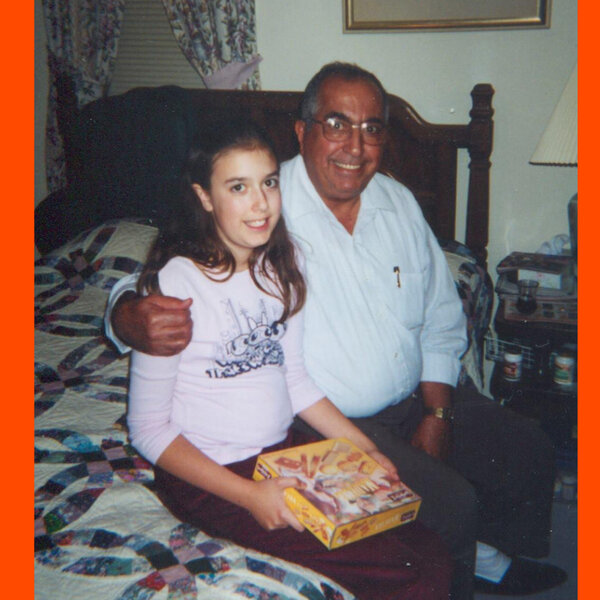
4:05But rather than set up the interview at an intimate locale with qualities like silence, I instead slipped it in over lunch at a fast casual restaurant, a suboptimal setting for a talk that should have been neither fast nor casual. I loved my grandfather, and yet I didn't really know how to talk to him. So I guess I thought I'd take the pressure off to have Top 40 music blaring in the background and my mother seated beside me. I lost an answer. This is, like, really broad, but can you tell me about one of your best memories? I was looking for a granddaughter until you came by. I called him Sidhu, our Americanized version of an Arabic nickname for Grandpa.
4:52He was always dressed formally, in a sport jacket, slacks, and a button-down shirt. When I was a kid, he used to pinch my cheeks and go, oh, Habibti, oh, Habibti. We went to a lot of Chinese restaurants together, and if the paper napkins were nice, he'd try to get my mom to take them home in her purse. Sidhu was against pet dogs as a concept, but he had a change of heart thanks to my childhood dog, Orbit. He loved Orbit so much that once he asked my mom, does he like hummus? I'm not sure, my mom said. Sidhu dumped a big pile of hummus on the rug. Orbit sniffed it and walked away. Hmm, said Sidhu.
5:32He does not like hummus. I've had this electric blanket sitting in my closet for years. My apartment is always so hot that I don't have much use for it anymore. But I refuse to get rid of the blanket because it's the last thing Sidhu ever gave me. He died in 2015. After making this recording of SEDU, I largely forgot about it. I only returned to the interview in the fall of 2023. This was soon after Hamas attacked Israel on October 7th, taking 251 hostages and killing over 1 ,000 people. In response, the Israeli military had begun a campaign against Gaza so deadly it's been recognized as a genocide by groups like the United Nations, Doctors Without Borders, and the Israeli human rights group B'Tselem, to name a few.
6:2574 ,000 people killed by the most conservative estimate. Other estimates, accounting for those still missing and the toll of starvation, say hundreds of thousands more. It took my brain a few weeks to catch up to the sheer scale of violence. Then, all at once, I found I couldn't stop crying. Do you have any other Palestinians to talk to about this, my mom asked me. Besides me? The answer was no. I'm only part Palestinian. My dad is white, and my mom is half-Palestinian, half-Polish. Since Sidhu's death, my mom and I had been largely siloed from the Palestinian part of our family. He was always our way in, so now we were the odd ones out.
7:10And I only recalled meeting one Palestinian outside my family, a woman who once came to the book club I was in. When she found out I was Palestinian too, her face lit up, and on her way out the door, she went, see you later, sister. I should have hugged her and called her sister back. Instead, I froze up. I'd always been proud of the fact that I was Palestinian, but I couldn't shake this sense that I wasn't Palestinian enough, that if I tried to talk about it too much, people would see me as a poser. I'd never been to Palestine. I didn't speak Arabic. I basically just looked white. Plus, compared to my Arab family, I seemed so waspy, keeping quiet at parties, pronouncing it falafel.
7:54Even my name. In proper Arabic, it should really have an H in it, Khalilah. But I've always been Khalilah. I went through a small existential crisis every time I had to check my race on a form. To the U.S. government, Palestine isn't even considered a real country. An Arab wasn't usually an option. A lot of times, I'd just check white. But this felt like erasing the Palestinian part of myself. So other times, I'd check mixed slash biracial. But then I felt like I was committing racial stolen valor. I remember once we had to do this Zoom bias training at work. This was in the period after George Floyd's murder, when every brand suddenly acted like they cared about racism.
8:38them. The facilitator told us to go to breakout rooms based on race. There was a white room and a not-white room. I went through my regular panic about which room it was appropriate for me to join and eventually chose the white room. When it was time for me to speak, I monologued about my struggles with what it meant to be Palestinian. Everyone just looked at me with blank faces. Then we went back to discussing white privilege.
9:08Watching the genocide in Gaza, I was furious all the time. There were so many videos online, and between seeing these horrific things play out on the surface of my palm, I was supposed to function as normal. I watched children murdered, children starved. I went to work. I watched huge masses of Palestinians leave their homes on foot to go to safe zones, only for Israel to bomb the safe zones, too. I did my dishes. Birth defects increased. Hospitals performed operations without anesthetic. I selected Christmas presents for my family. I felt tremendous grief, but also guilt about that grief, because who was I to be so upset?
9:50I was safe in my home with running water whenever I wanted. And yet, the genocide was on my mind constantly. At first, I tried to share how hopeless I felt with my friends and coworkers. My voice would shake, and I'd see this record scratch of confusion on their faces, and I'd get embarrassed and go, but anyway, how are you? I was afraid they found it performative, this crying over people I didn't even know. Like I was going, the real victim of this genocide is me. How to explain my despair to people when I could barely explain it to myself. It seemed easier not to talk at all. So I didn't. And while it was clear most people around me didn't know much about Palestine, I was at the office or I was at a party or I was at dinner with my white family.
10:37I didn't want to start sobbing while delivering a guest lecture on the Palestinian cause. I'd hear people make these offhand remarks about everything from protests to keffias to some posts they'd seen, and I usually let it all slide. It was just a small comment, I'd think. They weren't trying to be offensive. It was so hard to even talk about these issues without being accused of anti-Semitism or of supporting terror. Why turn it into a whole thing? My mom, on the other hand, was arguing with people all the time, got a whole Indian restaurant staring at her when she blew up during a girl's night out.
11:16This made me feel weak in comparison, like I wasn't doing my part to fight injustice. Then again, my mom was exhausted from fighting, and she only had a few friends left.
11:31So it was in the midst of all this that late one night, I dug up the interview with Sidhu on an old hard drive for the first time since I'd made the recording 12 years earlier. I wanted to hear stories about his life in Palestine, about our family's roots, my roots. Maybe it helped me feel less alone. How old were you when you left Palestine? About 19. But in the interview, 18-year-old me immediately jumps to the moment Sidhu journeyed away from Palestine. I vaguely reference his life there, I guess hoping he'll elaborate. How are, like, all the places you lived different? Like, how is Palestine different from Venezuela?
12:11But frustratingly, I mostly stick to the questions I'm sure he'll be comfortable answering. The stories I've already heard about his immigration to Venezuela and then the U.S. How he arrived with nothing. How he scraped together money as a peddler. Knocking on doors and trying to sell. Rugs? Rugs, yes, stuff like that. How he heard that the way to succeed was to study a science. So he decided, why not chemistry? And went to get a degree at NYU with only three months of English. It's hard enough to take a chemistry class at like your first language. Did you find when you started studying chemistry and math that you liked it?
12:49Or did you just keep doing it because you knew it? No, I kept doing it, no. I wasn't brilliant in them either. But I knew I'm not wasting my time because I could make some decent living from it. Right. And he did make a decent living from it. As a chemist, he even helped invent a luxury toothpaste, SuperSmile. Elizabeth Taylor was an early fan. These are all nice stories, stories I love, but they aren't about Palestine. And though I'm happy to hear his voice again, I'm also disappointed. I did know that you'd be better off if you can build yourself an honest, strong background of education to arm yourself in fighting this life, because this life is always a struggle.
13:35It strikes me in listening back how much of our conversation revolves around these illusions to struggle. We come struggling, and we go away struggling. If you want something, you have to struggle for it. And you have to fight for it. If you want to do just everything just because that's what you like, you cannot stand on your feet in the jungle of love. Life is a jungle. I mean, out there, you don't know. You don't know everything. Some of Sidi's struggles, of course, I know about. But the insistence of what he's saying, I suspect there's more behind it than just taking a difficult chemistry class.
14:19I wish I'd asked him a single follow-up question about what he meant. Say alhamdulillah. Alhamdulillah. Yeah. Always say alhamdulillah. Alhamdulillah means thank God. Here, I can tell he's turned to my mom. Remind her about those things. Well, she wants to study Arabic. Yeah, well, that's a good starting point. That's a good starting point. It's true that I'd been wanting to learn Arabic. But the intro classes at my college were held five times a week, and it seemed like too big a time commitment. I had friends to get drunk with, my little short stories to write. I'm not going to be able to learn Arabic anyway, I thought.
14:59It's like the hardest language on earth. I never even tried. I forgot, I guess, about life being a struggle. Is there anything else for you? No. That was good. Thanks, Dad. Yeah, thank you so much. You're welcome. No, it's not enough at all.
15:27All I'm left with are the broad strokes of Sidhu's life in Palestine. He would have been about 14 years old in 1948, when the modern state of Israel was founded. Zionist paramilitaries, and later the Israeli Defense Force, pushed at least 750 ,000 Palestinians from their homes, killed thousands more, and destroyed over 500 villages. This mass displacement is called the Nakba, or catastrophe. Many displaced Palestinians ended up in the area where Sidhu was. This is the area that's now the West Bank. And in the face of so much upheaval, many Palestinians made the difficult decision to leave the region entirely.
16:09Sidhu, at age 19, was one of those people.
16:15I asked my mom if she'd ever heard Sidhu talk about any of this, but she says no. I hear myself in you because I don't know much about my own father. My mom's parents split up when she was four years old. It happened after Sidhu had a mental breakdown. All of a sudden, my mom wasn't living with him anymore. When that happened, no one really explained to me what was happening. So I got the message very clearly from that, that you just don't ask questions. You don't talk about it. Only as an adult has my mom realized that the breakdown might have come from trauma, the Nakba, the decision to leave, all the people he left behind.
17:01And then layered on top of that, coming to this country and experiencing deep levels of racism everywhere and the guilt of leaving Palestine and being here and the many people in the family that relied on him and always called him and asked him and he was sending money to everyone and just massive amounts of pressure on him at all times. Like me, my mom has only recently begun digging into our background in Palestine She's learned some from family members But the information comes in disjointed bits and often contradicts what we knew before Like, we both always thought our family was from the city of Ramallah We are actually not from Ramallah We're from a village near Ramallah that's called Sinjil Okay And I didn't find that out until last year Without my grandfather to query, I query Google instead.
18:02Sinjal, I type. All these news articles pop up. The Israeli military has built a wall there, cutting off the villagers from their farmland, and the village is under constant attack from Israeli settlers. Earlier this year, a settler beat a man with a spiked club in the middle of the day while he was trying to harvest wheat.
18:28After putting away my recording of Seedoo, I start casting around for anything else that might help exercise my anguish. I go to protests. I donate money. I learn to trees, Palestinian cross-stitch. Then, one day, I'm doing dishes and listening to a podcast. Shout out to the medium. It's a conversation between two Palestinian-American women, and one of them mentions this program that runs trips for youth with Palestinian ancestry. Visiting Palestine is something I've imagined since I was a kid. But in the same way a kid imagines visiting Hogwarts or Narnia, this magical place where I couldn't actually go.
19:09But maybe I can go. If I can see Palestine, meet my family that's living there, maybe I'll feel more Palestinian. I can come back and tell people in America, I've been to Palestine. I've seen what's happening there with my own eyes. Let me talk about it. Let me tell you about it. When I go to the program's website, I see that I'm just under the age limit. If I want to do it, this could be my last chance. With Sidhu gone, the story of his life full of holes, I have a choice. I can let my connection to Palestine die with him. Or I can build a new connection. So, I decide to take a journey of my own.
19:50I decide to go to Palestine. You know, I feel the loss of not feeling connected and not being able to pass that along to you. But I also feel really hopeful that you're half my age and now you're going to take this trip. And I feel like the fact that you're doing this is healing for me. And I don't know if this is going to make any sense, but I feel like what you're doing now reaches back through time to Sidhu and is healing to him as well. After the break, I set off.
21:02If you're a music fan, here's a new podcast to check out. It's called Before the Moment, a new series hosted by the legendary Niall Rogers. You know him as the producer, songwriter, guitarist, and co-founder of Chic. But in this series, he's hitting the road to sit down with some of today's most fascinating artists. From hitmakers like Miguel to rising stars like Alex Warren, Niall explores the stories behind the careers, the songs, and the moments that changed everything. Because every artist can point to that turning point, that moment before the breakthrough, before the success, before everything changed.
21:41Through candid conversations and personal stories, you'll hear what happened before the moment that made them who they are today. Listen to Before the Moment, a Lincoln original series on the iHeartRadio app, YouTube, or wherever you get your podcasts. This is Jacob Goldstein. With ChatGPT, you can do more than get answers. You can get things done. When you're running a business and looking to expand, you need a clear view of the landscape before making any decisions. ChatGPT can help you prepare. Connect your Google Drive, point to relevant files and reports, and ask it to research competitors, industry forecasts, and market signals.
22:19It can turn the findings into a strategic deck in your team's template that you can review before presenting to your leadership team. Growing a business is ambitious, and ChatGPT can help you do it with confidence. Get started today at ChatGPT.com. So you're considering getting a home security system, But you want something that fits your space. Well, with ADT Blue, it's easy to customize a system that's right for you and set it up yourself. Just pick the kit and monitoring plan that makes sense for your home. Let's say you're worried about package theft. The ADT Plus app can walk you through setting up a new doorbell camera kit.
22:59Once it's installed, ADT Pros can help you keep tabs on it 24-7. or you can manage it yourself from the ADT Plus app. There are no long-term contracts, so you can change your monitoring plan whenever you want. The flexibility doesn't end there. You can add to your system as you need to with things like extra cameras or motion sensors. Some life decisions are hard, but thanks to ADT Blue, you can DIY trusted ADT home security in a snap. Head to ADT.com slash BLU to build your system today. And to hear more about home protection and other grown-up topics, check out new episodes of Grown-Up Stuff on the iHeartRadio app, Apple Podcasts, or wherever you get your podcasts.
23:51It is Monday, and when are you leaving? Wednesday night. It's June of 2026, the week of my departure for Palestine, and I'm checking in with Jonathan, my boss and the regular host of this podcast. In an alternate timeline, maybe Jonathan could have helped me ask Sidhu some difficult questions, and his trademark stammering and foot-and-mouthing could have made me look hyper-competent by comparison. But in this timeline, I'm on my own. Hopefully by the next time we talk, I tell him, I'll have sorted out my whole identity crisis and healed a rift within myself. So how are you feeling? Are you well-packed?
24:31No. You are not. It's hard for me to imagine what traveling in Palestine will be like. I don't have any sort of comparable experience. The West Bank, where my family's from, has been under Israeli occupation since 1967, an occupation that's illegal under international law. I'll have to cross an Israeli-controlled border to enter Palestine and then deal with Israeli checkpoints and encounters with IDF soldiers once I'm in Palestine, not to mention Israeli settlers. Do you feel any fear? Yes, but I think it's hard to feel like the big safety level of fear. so I feel like the fear I am feeling is more like about smaller stuff like having to share a room with people and this is technically a youth trip and I'm 34 at the geriatric cutoff of what's considered young traveling abroad at age 21 I had no problem climbing into a bunk bed alongside like 10 drunk strangers and if someone told me there were no towels for the shower I'd just be like no problem and use a shirt instead.
25:41None of this is compatible with the lifestyle of someone now fighting fine lines with expensive nightly face creams. I don't know what the coffee situation's gonna be. That's another, like, just logistical anxiety. I'm like, we're gonna be getting up really early every day. Am I gonna have access to coffee? What I do sometimes is I'll bring along some instant coffee. I got some Starbucks instant coffee. Have you ever tried that? As soon as Jonathan says this, I know I'm not buying Starbucks instant coffee. I've been boycotting Starbucks for years, since they sued their union for its pro-Palestine statements.
26:16So can you imagine if I showed up on a Palestinian heritage trip and whipped out Starbucks instant coffee? But I also know I'm not going to take the time to explain this, because I'm stressed and I'm at work and I like Jonathan, and I know he's just trying to be supportive. And so the easiest course of action is to breeze by and not turn this into a whole thing. I used to have that when I was a camp counselor, yeah. Starbucks specifically. Mm-hmm. It's only in re-listening to this tape later, but it strikes me as a perfect illustration of how I've behaved with people ever since the genocide began.
26:50I'll hear a comment about something small, instant coffee, that to me connects to something big, mass murder, and I'll feel like I could say something, but decide to act pleasant instead. This entire process takes about half a second. Well, you're all packed. I'm not packed. Your suitcase is by the door. Nope. You're going from here to the airport directly from the studio, so you have a good 48 hours to make your flight. So, in conclusion, bon voyage.
27:24Hello, hello. I'm at the airport, heading to the gate. We're all meeting up as a group in Amman, Jordan. And after a few days there, we'll cross the border into Palestine together. This will serve as a general boarding call for all passengers traveling on 262 non-stop service. At the gate, I see this guy who looks just like my uncle. Then I see another guy and think, wow, he also looks just like my uncle. It turns out I'm headed to a whole country full of men who look like my uncle.
27:58When I land in Jordan, I WhatsApp message my two roommates for the trip, Julia and Miriam. Julia has already arrived and sends us a picture of our hotel beds, three single beds all in a row. Like the three bears Miriam writes back, which I guess makes me papa. Hello! I quickly feel comfortable around Julia. She identifies the artist of my tattoo with a single glance, and we have the same mix of heritage, Palestinian, Polish, and English. She tells me she's been having trouble sleeping these past several nights, which isn't usual for her. Same, I say. And same. Feel free to decompress. Thank you.
28:43Like, I'm sure we'll talk enough, but... Yeah.
28:49There are eight of us in total, a mix of Christians and Muslims. As we get to talking, there are things we all implicitly understand about each other. Their identities are mixed up too. Their Arabic skills lacking. Their family histories confused. There's Mai, who's always laughing loudly and taking videos. There's a woman I'll call Nadia. She works as a lawyer in Central America. And there's Mariam, my other roommate, a PhD student with curly hair. We chat about our families, and she tells me how her grandparents, her teta and Zidi, were so poor when they came to the States. They only owned two plates.
29:27And one day, my CD came home from work and my teta was, like, crying and she had broken one of the plates. Oh, no. And then he told her, like, it's okay, we're just going to eat off of the same plate. And they did.
29:42In the weeks to come, we'll be traveling all over the West Bank, as well as to Nazareth, Jaffa, and Haifa. We won't be going to Gaza. Practically no one is allowed to go to Gaza, which Israel restricts so tightly that even before October 7th, it was often called an open-air prison. The day before we head to the border, we do some sightseeing in Jordan. And as we're driving down into the valley to visit the Dead Sea, our guide points out the window, across the water. The dark again, open shape, that's Jericho. Jericho. This is the first time most of us have ever laid eyes on Palestine, and we all squint out at it.
30:20It's hard to see much, just a hazy bit of green in the distance. Still, I feel my eyes well up. Julia pulls up the map on her phone. Look, she says, holding it out to me. It's right there. Part of me was afraid that when I arrived in Palestine, I wouldn't feel anything. That I'd look around and feel strangely underwhelmed. That maybe that, finally, would be proof that I wasn't really Palestinian. but now I know that's not how it's going to be.
31:00We float in the Dead Sea, float without trying to, and I try to see this as an exercise in giving up control. In the car back to the hotel, everyone's on edge. Should I cover my tattoos tomorrow, someone asks. I think maybe it's better to show them, says someone else. We all agree it's probably best to look as Western as possible. Early the next morning, we head to the Israeli border. Our program leader told us there's no need to be nervous, that they've been running this trip for years, and only one person has ever been turned back. Those of us with American passports, especially, shouldn't have an issue.
31:40I thought the border would be patrolled by teenagers with guns, but I don't see any guns. and when we line up at the window to talk to the Israeli border agent, he seems like an aging bureaucrat. Mai speaks with him first. He asks her a few basic questions and hands her back her passport with a small paper visa inside. And then, Mai crosses through to wait for the rest of us in our bus on the other side. With Mariam, it's the same story. Couple of questions, here's your visa, off you go. But when Nadia goes up to the window, something shifts. Maybe it's the accumulation of three people in a row with Arab last names.
32:20Maybe it's Nadia's non-U.S. passport. Whatever the reason, the border agent keeps her passport and tells her to step to the side and wait. That becomes the new pattern.
32:34When it's my turn at the window, I watch the man Google me in Hebrew on his phone. Where's your name from, he asks. Oh, my parents got it out of a book, I say. But where are your parents from, he clarifies. Oh, I say, Chicago. They're American. My name, which has never seemed Arab enough, now suddenly a point of issue. Okay, stand to the side, he tells me, and I join the others.
33:04We sit down in an area reminiscent of an airport gate, and eventually, an extremely young woman in an IDF uniform emerges, holding photocopies of all our passports. She starts calling people up for more questioning, starts going through their phones and social media. By the time I'm called up, the woman superior is up there too. He asks what I do for work, and I say I produce the podcast, Heavyweight. The IDF girl types something into her phone, and then abruptly goes, do you know Ezra Klein? Which is so unexpected that I actually laugh. Uh, not personally, I say. But he's part of your podcast, she says.
33:43No, I say. Later, I'll learn that Ezra Klein said something critical of Israel a few months prior, so maybe that's why she was asking. But in this moment, it's just completely baffling. Have you gone to protests? Some, I say, not wanting to be caught in a lie. Against Israel, the man asks. Uh, against death, I say. Where was this? New York, I say. and they write it in big letters across the printout of my passport. New York. You can sit down, they tell me. Our program leader still has no doubt we're getting in. They just want to make things unpleasant, he says, so that we won't want to come back.
34:26But as the hours tick by, I'm starting to get a really bad feeling.
34:46If you're a music fan, here's a new podcast to check out. It's called Before the Moment, a new series hosted by the legendary Niall Rogers. You know him as the producer, songwriter, guitarist, and co-founder of Chic. But in this series, he's hitting the road to sit down with some of today's most fascinating artists. From hit makers like Miguel to rising stars like Alex Warren, Niall explores the stories behind the careers, the songs, and the moments that changed everything. Because every artist can point to that turning point, that moment before the breakthrough, before the success, before everything changed.
35:25Through candid conversations and personal stories, you'll hear what happened before the moment that made them who they are today. Listen to Before the Moment, a Lincoln Original series on the iHeartRadio app, YouTube, or wherever you get your podcasts.
36:02forecasts and market signals. It can turn the findings into a strategic deck in your team's template that you can review before presenting to your leadership team. Growing a business is ambitious, and ChatGPT can help you do it with confidence. Get started today at chatgpt.com. These days, there are more people than ever telling you how to manage your health, and we've all gone down an internet rabbit hole exploring the latest health trends. Your social media feed is packed with wellness advice telling you to cold plunge, protein max, detox, track your sleep. But what's actually real? What's exaggerated?
36:37What's just wrong? That's exactly what Health vs. Hype from the American Medical Association and iHeartMedia's Ruby Studio is here to find out. Each episode, Emmy-nominated science communicator Trace Dominguez, who's racked up billions of views across PBS, Discovery Channel, and YouTube. talks to health influencers, real people, and most importantly, doctors, to separate fact from fiction. Because when it comes to your health, who you listen to matters. Listen to Health vs. Hype on iHeartRadio app, Apple Podcasts, or wherever you get your podcasts. The longer we're at the border, the tenser the atmosphere gets.
37:20At one point, they ferry the most visibly Arab member of our group into a separate interrogation room, and we don't see him again for a long time. Then it comes up on the computer about one of us has a parent from Gaza, and this small, authoritative man comes out and starts yelling, Gaza, Gaza, Gaza! Then I'm called up for more questioning, where the IDF girl scrolls through my WhatsApp messages, taking a picture of my screen every time she sees a Palestinian flag. And then, after we've been there for about five hours, a man emerges with a stack of papers. At the top of each one, it reads, denial of entry.
38:05Out in the parking lot, Mai and Miriam have been alone with no information for all this time. Now, suddenly, a group of men floods the bus where they're waiting, screaming at them to give up their passports and return to the building. Like, it's almost like if you thought you, like, won the lottery and then someone tells you that, like, you misread one number. Then I knew that, like, that was going to be my experience with Palestine, was five hours in a parking lot.
38:38We take a cab back to the same hotel we checked out of that morning. Out the window, I watch some goats up on their hind legs, straining to eat from a banana tree. In retrospect, there are so many things I wish we'd done differently. Why did I come with a group? Why did I come with other Palestinians instead of with my partner, who has a Jewish last name? Why didn't I just delete WhatsApp? Did they say why they denied you? Um, I can tell you what it says on my form. Back at the hotel, I call my mom to fill her in. Everyone else says prevention of illegal immigration considerations, which mine also says.
39:19but then mine also says public security or public safety or public order considerations. I'm not sure what it is about me specifically that seems like a threat to public safety. My best guess is that it's because I work in media. I feel like I failed. I failed to see Palestine through Sidhu's eyes. And now that he's gone, I've failed to see it through my own.
39:49Back in Jordan, no one quite knows what to do with themselves. We feel we should use our time somehow, and so a few of us go stay overnight in the desert of Wadi Rum and to see the famous archaeological site at Petra. But the whole tourist excursion has a strange, unsettled tenor. We'll be walking through some picturesque canyon, and someone will go, do you think we might have gotten in if we'd just flown into Tel Aviv? In Palestine, I've been planning to meet my cousin who lives in Ramallah. I talk to her on the phone and explain we aren't coming after all, that Israel found us suspicious, kept us out, dashed our hopes with nothing we could do about it.
40:29Well, she tells me, now you can say that you're really Palestinian.
40:37Later, I share our cousin's words with my mom. You had the experience that proves it. Yeah. But that's also sad. It is sad. It is sad. But I think it's really good that you went. I feel really happy about that. Why?
41:06I think because you tried.
41:16After our failed border crossing, towards the end of our time in Jordan, we did have this one night. A bunch of us ended up staying at a hostel together, and Nadia said she wanted to cook dinner for us all, a Palestinian dish called masachan. My wish, my desire was to go to Palestine and make masachan there. while that was not possible this time. So we're making it here. Masaha and his chicken cooked in sumac and olive oil. We packed into the tiny kitchen, and Nadia walked us through each step. We're going to season the chicken. All the flavors can meet each other. The overhead light was too dim, the knives too dull, and space was so tight that we kept getting in each other's way.
41:59We need to grind them. Oh, I can do that. But truthfully, it was my favorite night of the whole trip. Well, when I was a little kid, my mom found me in the kitchen more than once eating onions as they were apples. Oh, you're just as disgusting as my brother. Red onions? Weirdo. I'd come on this trip to see Palestine, to meet Palestinians there. Well, that was not possible this time, but I met Palestinians here. I met these other people like me, grappling with the same things I have these past three years. The Musahan, the first time I made it was after October 7th. Even with my close friends at the beginning, it was hard at the beginning.
42:42I felt really lonely. Me too. Yeah, like I wasn't able to have conversations. In the weeks to come, we get more information about our odds of ever returning. We learn that we're banned from entering the country for at least five years, but possibly ten years, and possibly forever. We discover that it's difficult to appeal without a lawyer in Israel, and that will cost at least$3 ,000 each. And while no one can tell us the exact odds of success, they seem low. In the end, I decide not to appeal. Food is ready, people. But for now, we have this time with each other. A peaceful terrace to eat on and a Palestinian meal to share and a small bowl in which to leave our chicken bones for stray cats.
43:27Thank you, Lord, for this meal. I hope you all enjoy it and it is a pleasure for me to be here with you tonight.
43:43For a while, I considered not making this story at all. Talking about my identity, about getting turned away at the border. Why make a whole thing of it? I know I run the risk of being misunderstood. I know that to try to talk about this makes my chances of going to Palestine in the future even lower than they already are. But what am I supposed to do? I am finally learning Arabic. My mom and I began weekly lessons with a woman in Ramallah. It really is an exceptionally hard language. But now I can say good morning. How are you? My name is Khalilah. I am from Follestine. Always be a fighter. I've been around in this world, and I can tell.
44:28I can tell about the character of a person. And I have confidence you'll make it. You'll do it. I'm positive. I'm really positive. But don't let your emotion interfere with your objective.
44:49Life is a jungle. Life is a struggle. But you have to at least try. You have to stand on your feet in the jungle of life.
45:04Thank you.
45:32Now that the furniture is returning to its goodwill home Now that the last month's rent is scheming with the damaged deposit Take this moment to decide If we meant it, if we tried Or felt around for far too much From things that accidentally touch
46:08This episode of Heavyweight was produced by me, Kalila Holt, along with Jonathan Goldstein and Lisa Wang. Our supervising producer is Stevie Lane. Editorial guidance from Emily Condon. Fact-checking by Andrea Lopez Cruzado. Special thanks to Brian Reed, Soraya Shockley, Nadia Raymond, Lucia Elledge, Sarah Cole, Howard Chakowicz, and my Pally Girls group chat. Extra special thanks to Sam Reisman and Annalise Razik. Emma Munger mixed the episode with original music by Christine Fellows, John K. Sampson, Emma Munger, and Bobby Lord. Additional scoring by Arms and Sleepers and Blue Dot Sessions. Our theme song is by The Weaker Thans, courtesy of Epitaph Records.
46:49Follow us on Instagram at heavyweightpodcast or email us at heavyweight at pushkin.fm. We also have a free newsletter at patreon.com slash heavyweight. We're taking a short break for American Thanksgiving, but Jonathan will be back on December 10th with a brand new episode.
47:21If you love music and great artist interviews, check out Before the Moment, hosted by Niall Rogers. This new series follows Niall as he travels across the country talking with some of today's most fascinating artists about the moments that shaped their lives and careers. From hitmakers like Miguel to rising stars like Alex Warren, Niall explores the stories behind the careers, the songs, and the moments that changed everything. Because every musician remembers the point where everything changed, and this podcast tells the stories that came before it. Listen to Before the Moment, a Lincoln original series on the iHeartRadio app, YouTube, or wherever you get your podcasts.
48:04For I don't know how long, maybe 12, 13 years, I've worn a Whoop band on my wrist. I started doing it because I met the founder of Whoop at a conference. He heard that I was a runner, and he said, oh, you'll love this. It's perfect for athletes. and he was right. I've worn one ever since. Every time I work out, I see how hard I worked, how long I need to recover. I wake up in the morning and I get a complete picture of how my sleep went, which helps me understand the kinds of things that lead to a bad night and the kinds of things that lead to a good night. It's sleek, long-lasting battery, and now with AI looking at all my numbers and coaching me.
48:43Whoop is a winner. New members can try Whoop with a 30-day free trial before committing to a membership. That's whoop.com for your free month of Whoop. Coca-Cola. For the big. For the small. The short. And the tall. Peacemakers. Risk-takers. For the optimists. Pessimists. For long-distance love. For introverts and extroverts. The thinkers and the doers. For old friends and new. Coca-Cola. For everyone. Pick up some Coca-Cola at a store near you. This is an iHeart Podcast. Guaranteed human.
When Kalila was 18, she made a recording for a school assignment that she promptly forgot about. 15 years later, the voice on the tape compels her to make a long and difficult journey.
See omnystudio.com/listener for privacy information.