
 Ask ChatGPT


 Here & Now Anytime
5 Nov 2026 · 27m · 9 chapters
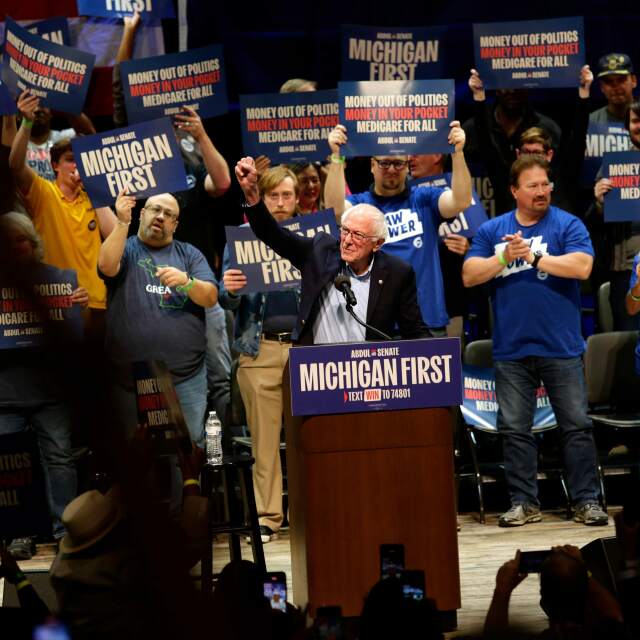
The episode argues that Bernie Sanders-style economic populism helped drive a nationwide leftward shift in the 2024–2026 midterms, with health care affordability as a central issue. Exit polls cited show every major demographic group moving left, including Latinos, young men, suburban women, and working-class white voters; the shift is framed as protest against President Trump and his policies. Guests and backgrounds: Bernie Sanders, independent senator from Vermont who caucuses with Democrats; Kyle Kondik, managing editor of Sabato’s Crystal Ball (UVA Center for Politics); Romero Turner, a Seattle-area cancer patient (Ewing sarcoma) describing high costs; Dr. Ezekiel Emanuel, oncologist and bioethicist (Obama administration); Brian Blaze, economist and founder of Paragon Health Institute.
Medicare for All is a four-year transition; health care is broken and profit-driven; Congress can end the Iran war by cutting funding; hospital prices and employer insurance costs drive unaffordability. Examples: Texas Senator-elect James Tallarico and Michigan Senator-elect Abdul El-Sayed; Romero’s $16,000 scans and $6,000 out-of-pocket; 40% of adults with medical debt.
Written by AI. May contain mistakes.
Exploring how economic issues influenced voter behavior in the midterms.
“Today on the show, exit polls show every major demographic group moved left in the midterms compared to 2024.”
Discussion on the impact of economic populism and health care on election results.
“More on what they might do in about 15 minutes.”
Senator Bernie Sanders discusses the structural issues of income inequality and health care.
“That was Texas Senator-elect James Tallarico, El Sayed, Texas Governor-elect Gina Hinojosa, and Iowa's Senator-elect Josh Turek.”
Senator Sanders shares insights on his approach to health care and other economic issues.
“What do you say to Democrats who don't want to go that far?”
Discussion on Congress's role in funding military actions and restoring responsibilities.
“And I think we're going to be having some serious conversations with the secretary.”
Analysis of the leftward shift among various voter demographics and its implications.
“It's part of a broader nationwide story this election.”
Explore the shift in voter demographics and implications for future elections.
“Basically, every demographic group shifted from 2024.”
Hear about the financial burden of medical costs through Romero's experience.
“That's tied for number one with the economy, by the way.”
Experts discuss the rising costs of health care and potential reforms.
“In each one, I checked my billing thing from the past year because I had to do four last year.”

Get the gist, explore an idea or ask about something said.
 Claude
On Here & Now Anytime, what are the key points of this episode?
Searching your listeningAutomatic transcript. May contain errors.
0:00Support for Here and Now Anytime comes from MathWorks, creator of MATLAB and Simulink software, to design and develop engineered systems, accelerating the pace of discovery in engineering and science. Learn more at mathworks.com. WBUR Podcasts, Boston. The people of this country have given responsibilities to the Democrats. Democrats are not going to have to deliver for working families. President Trump was not on the ballot, but he kind of was. Bernie Sanders wasn't on the ballot either, but a lot of his ideas sure were.
0:47It's Thursday, November 5th, and this is Here and Now, Anytime from NPR and WVUR. I'm Chris Bentley. Today on the show, exit polls show every major demographic group moved left in the midterms compared to 2024. What unites Latinos, young men, suburban women, and just about everyone else who turned out to vote for Democrats on Tuesday? As they say, it's the economy, stupid. A lot of people who are reliable, typically in the past, reliable Republican voters decided to go to the Democrats as a protest against the president and his policies. And one big part of the economy is health care. Voters said loud and clear they think it's too expensive.
1:33Will Congress get the message? This is not a left or right issue. This isn't a Republican or Democrats. We disagree. There's a lot of overlap. More on what they might do in about 15 minutes. But first, health care was one issue motivating voters to back Democrats pretty much everywhere, flipping control of both chambers of Congress and state houses across the country. A few candidates, most notably Michigan's Senator-elect Abdul El-Sayed, backed Medicare for All, the policy championed by Bernie Sanders. That was a hot topic when he ran for president in 2016 and 2020. Most did not go that far. But even people the media described as moderates sounded a lot like Bernie in the way they talked about health care, the economy, and class politics.
2:21And we just sent a message to every billionaire megadonor, every trillionaire megadonor. We built a movement. Government of the people, by the people, and for the people. We showed that in a battle between the money and the many, that the many really can't win. Is Texas a state that is by and for the people of Texas?
2:51Or is this the billionaire's world and we just live here?
2:59I'm going to the Senate to fight for affordable housing, to drive private equity out of housing, out of health care and out of nursing homes. I'm going up there to fight for affordable and accessible health care because I believe that health care is a human right. That was Texas Senator-elect James Tallarico, El Sayed, Texas Governor-elect Gina Hinojosa, and Iowa's Senator-elect Josh Turek. With Democrats winning in Republican strongholds on a message of economic populism, it's a good time to talk to Bernie Sanders about where this all might be headed. He is, of course, the independent senator from Vermont who caucuses with Democrats.
3:41And he told Indira Lakshmanan he's not surprised to see that economic message resonating even in conservative parts of the country. So this is a historic week for progressive Democrats. Why did their populist message break through in several states this time when it hasn't in the past? I think people increasingly understand that there is something fundamentally and structurally wrong when in the richest country in the history of the world, 60 % of our people are living paycheck to paycheck, struggling to put food on the table, pay for rent, pay for health care and other basic necessities. while at the same time, Elon Musk and the people on top have never, ever had it so good.
4:30More income and wealth inequality in America today than at any time in the history of this country. So income inequality is a big part of this. I want to ask you about this. A huge part of this blue tsunami, especially in red states, has been thanks, though, to moderate Democratic candidates like James Tallarico in Texas, Pastor Adam Hamilton in Kansas, Roy Cooper in North Carolina. So I'm wondering how the left wing of the party, the Democratic Party, and the centrists are going to work together in the next Congress. Well, I'm not quite so sure I agree with your analysis. I was listening to Tallarico in Texas, who was talking about how he's prepared to take on billionaires and his outrage that Mr.
5:16Musk, I think, spent$190 million in Texas alone trying to defeat Tallarico. So I think all over this country, you are seeing working people asking fundamental questions. Why is the minimum wage today$7.25 an hour? Got to raise the minimum wage. And really, quite importantly, everybody knows, and I go all over the country, everybody knows that our current healthcare system is broken. It is designed to make huge profits for the insurance companies and the drug companies. We pay twice as much for a person as healthcare, for healthcare as the people of other countries. We are the only major country on earth not to guarantee healthcare to all people.
5:59How come the United States can't do what Canada does, what Europe does, what every other major country does? People now want Medicare for all. I'm going to fight to make that happen. I'm really glad you brought up healthcare affordability, a huge issue. You're likely to become chair of the Senate Health Committee. You are going to push for Medicare for all. What do you say to Democrats who don't want to go that far? Rebecca Cook, who won a seat in Wisconsin, said the party needs to do things incrementally, restore ACA subsidies and expand coverage first. What do you say to that? Well, I know Rebecca well.
6:33I helped get her elected in Wisconsin, and she's going to be a wonderful member of the Congress. But what Rebecca is saying is not in contradiction to what I'm saying. Of course, we have to rescind this disastrous and cruel action on the part of the Trump administration through a big, beautiful bill, which threw 15 million people, working people, low-income people, off the health care they have in order to give a trillion dollars in tax breaks to the top 1%. Of course, we got to move aggressively and quickly to rescind that. But second of all, we have to move toward Medicare for All. And the truth is, and I think Rebecca understands this and supports it, that Medicare for All is a four-year transition program.
7:18It's not overnight. And you know what we do in the first year? What we do in the first year is expand Medicare, which is what Rebecca is talking about, the dental, hearing, and vision. We lower the eligibility age to 55. We cover all the kids. We do away with out-of-pocket expenses. That is widely popular. That is what we have to do. Senator, will you push to oust Health Secretary Robert F. Kennedy Jr., who has been a barrier to many of the things you want? I think what Kennedy has done, especially in the area of vaccines and other areas, is horrific. And I think we're going to be having some serious conversations with the secretary.
7:58All right. How can the Democrats use their power in Congress to end the war in Iran, one of the top concerns of voters? Very important question. And the answer is not complicated. We have got to restore the constitutional responsibility for war back into the hands of the Congress. But the immediate tool is to end the funding for the war. Congress controls the purse strings. You can't fight a war in Iran, an illegal and unconstitutional war, which has resulted in the deaths of 19 service members, thousands of innocent men, women, and children in Iran and neighboring countries driven up the prices of so many commodities.
8:40We have to end that war by cutting the funding. So funding cuts. In the short time we have left, a few rapid fire questions. Will you support Chuck Schumer for majority leader? I'm going to support a candidate for leader who's going to stand for working class families, who's going to take on oligarchs, who's going to fight for Medicare for all, raise the minimum wage and bring federal controls to AI. We'll see who that is. Will Congress try to impeach the president? Maybe, maybe not. I don't know. My main concern right now is that the people of this country have given responsibilities to the Democrats.
9:18Democrats are not going to have to deliver for working families. And that means pay attention to the economic issues. Senator Bernie Sanders, thank you so much for your time. Well, thank you very much.
9:39We'll be right back with more on that massive shift of voters towards Democrats this election and how much we should read into it going forward. Stick around.
10:17fees. Jerry even tracks rates and alerts you when it's best to shop. Drivers who save with Jerry could save over$1 ,300 a year. Don't overpay. Download the Jerry app or visit jerry.ai slash NPR today. In Mississippi, one reason that Senate race is still too close to call is that every major voting group in the state swung left, especially white men who had been the backbone of the Republican Party's hold on that state. It's part of a broader nationwide story this election. To understand it better, we're joined now by Kyle Kondik. He's managing editor of Sabato's Crystal Ball, an elections newsletter from the University of Virginia's Center for Politics.
10:59Welcome, Kyle. Thanks for having me. All right. So Mississippi voted for Trump by 24 points just two years ago. Now we're seeing this leftward shift in a deep red southern state. What does it tell us about national trends? It tells us that this was just a Democratic wave of immense proportions, bigger than a lot of the big recent wave elections in the United States. I mean it looks like Democrats are going to win the national House vote by 12, 13, 14 points. And when you see a state like Mississippi shift so much that it could potentially be electing a Democratic senator, there's a lot that goes into it.
11:41One of the things that it's clear that happened across the South is that black voter turnout was strong and white voter turnout wasn't as strong. And so the mix of the composition of the electorate was just more Democratic leaning. But also you're not going to get a swing of this magnitude without a lot of persuasion, meaning that a lot of people who are reliable, typically in the past, reliable Republican voters decided to go to the Democrats as a protest against the president and his policies. All right, Kyle, we've been hearing a lot about why the Republican Party took such a beating, the war in Iran, tariffs, the high cost of gas, groceries, health care, etc.
12:19It's not surprising that the economy was the top concern. But according to exit polls, the state of our democracy was number two on the list. 33 % of voters, one in three, said the state of our democracy was their top issue. Now, Kyle, it occurs to me that Democrats tried and failed to run on democracy versus autocracy back in 2024. So why this switch up in concerns suddenly and did it surprise you? I have a theory about this. So I see in the exit poll you mentioned 33 percent said it was a top issue faced in the country. Democrats won that group basically 80 to 20. My guess is that these are already reliable Democratic voters who are – they hate Trump and they think Trump has been really bad for the country and the state of the democracy.
13:10But I don't think that that was necessarily moving the people who were switching from Trump to Democrats. My guess is that that's just the sort of core of the Democratic coalition and that's what they're particularly concerned about. But for the people who switched, my strong guess is it was more economically based. All right. Talk more about the exit polls. I'm struck that everyone from young men, including, you know, fans of right wing podcasters who had gone for Trump in 24 to older voters to working class white voters without college degrees, all of them, every group swung left. You know, what is the takeaway here and what is the reason?
13:49Yeah, I'm looking at the New York Times. In addition to the exit poll that the networks report, the New York Times did their own voter trends. And they have a little arrow that shows what direction they went. And all you see are blue arrows. Basically, every demographic group shifted from 2024. That's what happens when you go from Trump winning by a point and a half to Democrats winning the House popular vote by double digits. It seems like the change is more pronounced among some of the groups that swung hardest to Trump in 2024. So young people and also some voters of color, particularly Latino voters.
14:26I mean the New York Times analysis has the electorate as being 10 percent Hispanic, and they voted for Democrats by 40 points, 69 to 29, which is a 29-point swing from 2024. You know, other groups swung heavily as well, but not as strongly as Latino voters did. And I just think prices and affordability was the biggest thing there. I think with Latinos in particular, I'm sure the administration's extremely heavy-handed immigration enforcement was also a factor. I want the big picture here. What does this Democratic tsunami say to you? Is it just a flash in the pan? Is this an actual generational realignment?
15:08Both parties are preparing for 2028. Trump's now a lame duck. You know, how significant is this shift? I don't think it's a realignment. I do. And typically, I would say midterms don't have to have predictive value for the presidential election. We've seen in like 1994, 2010, Democrats got hammered in the midterms and then reelected their party's president the following election. What I would say, though, is that Donald Trump is still going to be president in 2028. He's unpopular. And that's going to be a problem for Republicans in 2028 if he doesn't get his act together. All right. So there's going to have to be some realignment within that party as well.
15:46Kyle Kondik, managing editor of Sabato's Crystal Ball, an elections newsletter from UVA. Kyle, thanks so much. Thank you.
16:01Well, another issue uniting voters across demographics and geography this election was health care. After the break, we'll talk about why health care is so expensive in the U.S. and what the government might do about it. That's in just a minute.
16:21Stay tuned for the following announcements and messages from our sponsors. This message comes from Prolon. Want to look and feel your best this fall? Prolon's five-day fasting mimicking diet is a clinically developed nutrition program with the goal of promoting fat loss while protecting lean body mass. Developed at USC's Longevity Institute, it aims to assist the body in entering a fasting-like state that helps reset metabolism, target visceral fat, and support healthy metabolic markers. Get 15 % off plus a bonus gift when you subscribe at prolonlife.com slash NPR. Half of voters who spoke to Gallup said healthcare was, quote, extremely important to their vote.
17:02That's tied for number one with the economy, by the way. In a minute, we'll hear some ideas from two experts about possible solutions going forward in a divided government. They've got different political affiliations, but agree that Americans deserve better health care and more money in their pockets. But first, someone who's seen up close just how much a major diagnosis can cost. Romero Turner is 24 years old, lives in the Seattle area, and says his follow-up treatments for cancer cost him$6 ,000 every few months. He spoke to Scott Tong. I'm glad to hear your soft tissue cancer is in remission.
17:43I've been there. What are your costs now? So spring of 2024, I was diagnosed with Ewing sarcoma. It's a very aggressive type of soft tissue cancer. Long story short, it took me about seven months of treatment, chemotherapy and radiation. And now because a part of remission, I had to make sure I get scanned every so often to verify that the cancer is staying away or it doesn't come back. Because like I said, it's a very aggressive tumor. Now, those scans, they do pile up. In each one, I checked my billing thing from the past year because I had to do four last year. I'm going to be going to two for this next one.
18:17It's$16 ,000 a pop. My insurance coverage is about$10 ,000. I had to pay about$6 ,000 out of pocket, which I do on payment plan, which is$251 ,000 a month. Wow. And surely that's a financial burden. I mean, how easy or hard is it to deal with? It is big time. Big time. Yeah, Yeah, tell me about it. Well, for me, I just moved out on my own. When I was under through treatment, I lived with my sister. So naturally, my cost of living was a little lower than my area. But now, since my sister moved away to another state, I had to find a place up here in Kirkland, where I live. And, well, it's expensive.
18:54And I work in more an entry-level position at my job. I mean, I'm paid decently well for that particular position compared to other dealerships in the area. but it's still expensive. Yeah. So what do you have to, are there certain things you have to forego because of your medical costs? Well, the thing for me is I got to be a lot, I'm a lot more careful in how much I can spend on things. I am a car enthusiast. So for me, it was one of those, I got to be very careful in what car I can buy and drive and own because otherwise I could have a car that drinks a lot of fuel. I can have a car that's very expensive to insure, that kind of stuff, I got to keep an eye on those costs.
19:31And Romero, what is your insurance situation? Do you get insurance through your employer? You work for a Subaru dealership? Yeah, I get insurance through my employer. Because I was out of work for a few months while I was undergoing treatment, I was still hired on, but I couldn't work. I was on medical leave. Washington State offers paid medical leave, but it only goes for like three months. And of course, my treatment was seven months, so I was able to enroll in Medicaid to help pay for that. Yeah, I understand. So when you were not working, you also had high health care costs, yeah? Yep. Understand.
20:07Yeah. Well, Romero, thank you. Let me pause you for a second to get the perspective of two people. We have Ezekiel Emanuel on the line. He's an oncologist and bioethicist, served in the Obama administration. Dr. Emanuel, welcome. Nice to be here. We've also got on the line Brian Blaze, an economist and founder of the think tank Paragon Health Institute. He formally advised the Trump administration on health care policy. Brian, how do you? Great to be with you. Thank you. So, Brian, I want to ask you about health care costs, rising costs. What do you hear in Romero's story that's relevant? Yeah, Romero, and it's great to hear that his cancer is in remission.
20:48You know, hospital, well, healthcare is unaffordable, and it is an increasing frustration for Americans. I'd say the number one driver of the unaffordability is high and rising hospital prices. Since 2000, hospital prices have risen three times inflation and twice worker wages, and they tend to be less visible costs than costs for, say, prescription medications that people regularly get. So I think that's one thing that stands out. The second is, you know, most people who don't have government coverage, they get their health insurance through their employer. And there is this notion that employers pay a portion of that premium.
21:36And that's false. Employees bear the full cost of employer-provided premiums, and that is a cost that has been growing significantly and that crowds out worker wages. I just want to make sure I understand you. When you say employers bear the full, I mean, my employer pays a portion of my monthly insurance premium, doesn't it? So yes and no. If you look at your paycheck, there will be an employer contribution to that, an employee contribution, but the employer contribution is a part of your compensation. If you didn't get that compensation from your employer in the form of a health benefit, you would get it in the form of a wage.
22:22So I think it is important for people to know that they bear the full cost of the employer contribution. That is not a gift from your employer. That is compensation that you are getting in the form of a health benefit. All right. Dr. Emanuel, what would you like to add? I agree with everything Brian said, and we didn't even talk about Romero's cost for the drugs for his cancer, which I'm sure all of them, being an oncologist, all of them are super expensive, including the ones to take care of his side effects, like the anti-nausea medications. And those are another burden, even before he gets to what we call survivorship, being in remission and living like that.
23:07But, you know, for the rest of his life, he is going to have these scans and tests to make sure his cancer hasn't come back or some other cancer hasn't developed, maybe because of the treatments. So that's going to be a cost he bears forever. And we know, you know, that healthcare, I mean, we talk about healthcare costs and we hive it off from economic costs, but they're really the same thing. They're money coming out of people's pay. And we know that in the United States, for example, we pay$5 ,000 more roughly per person for health care than the next highest country, which is Switzerland. That's crazy.
23:44Just imagine if families didn't have the$5 ,000 per person in the family, but they had half of it or something,$2 ,500 across four people in a family. That's$10 ,000 extra they should have and still get great health care. So we have a terribly inefficient system. All right. Let me come back to you, Romero, in Seattle, the patient paying these high costs. Let me ask about your coverage, your insurance. Did you ever lose your coverage or think about skipping it because of the price? Well, while I was doing treatment, I did have to do COBRA because I wasn't working, which, of course, made my insurance premium go doubled from$360 to$680 a month.
24:26That's Cobra when you're paying for all of it by yourself, right? If you're kind of not working at the time. Yeah. I had money saved up, but it wiped out my savings. Yeah, but this is a classic case. Here's a guy who's working hard, saving up money for maybe buying a house or getting married or something. Getting a new car. Getting a new car. And, you know, here comes a health, one health problem, wipes out all his savings. And many people, it not only wipes out their savings, but puts them into debt. You know, 40 percent of American adults have medical debt. And we've seen how bad that can be.
25:07You know, you saw this in the Kansas election where Marshall, the Republican senator, went after unpaid medical bills because people are in debt and could afford to pay him. And he threw some of his ex-patients in jail. Well, you know, this is an untenable situation in America. You shouldn't have to use all your savings to get medical care. So let me come back to economist Brian Blaze here. What do you think a next Congress, now we'll have divided government in Washington, might be able to do to address access to insurance, to address costs? Well, I think the government should target areas in its programs that have incentivized consolidation, particularly hospitals, taking over independent physician practices.
25:53Dr. Emanuel and I have an op-ed in The Washington Post where we agree on a variety of reforms to target high costs. So anything that limits competition in the market, Congress would be wise and states would be wise to undo. All right. And briefly, Dr. Emanuel, one thought from you. Yeah, we really need to get our arms around AI in healthcare. We need more certification of it. We need liability clarification, and we need changes in how we're going to pay so that it actually will reduce costs. It'll reduce administrative costs. It'll also reduce clinical costs for some chronic illnesses. And unless we do that, AI is actually going to escalate costs and not bring them down.
26:42But it has the potential to really bring, I believe, to really bring down health care costs and make people actually healthier and avoid hospitalization. So those are some of the suggestions that Brian and I made. And again, this is not a left or right issue. This isn't a Republican or Democrats. We disagree. There's a lot of overlap. And I think I'm hoping that the new Congress will come in and give us a very good set of legislative proposals that will be able to do all the things we suggest and bring costs down. We have about 10. We break it into six suggestions, but don't break it out. There are about 10 or 12 suggestions.
27:18We've been talking to Dr. Zeke Emanuel of the University of Pennsylvania and Brian Blaze of Paragon Health. Thanks to both of you. Thank you. Thank you. And we've been talking to Romero Turner in the Seattle area about his cancer costs, his financial situation. Romero, we send our best to you. Thank you very much. Thank you very much, guys. Enjoy the rest of your day. Thanks.
27:43That's it for the show today. Here and Now, Any Time comes from NPR and WBUR Boston. Today's stories were produced by Sam Raffleson, Wilder Fleming, and Ashley Locke. Our editors were Todd Munt, Mikaela Rodriguez, and Michael Scotto. Technical direction from Caleb Green, Matt Reed, and Nick Dusalt. Our theme music is by Mike Moschetto, Max Liebman, and me, Chris Bentley. Our digital producers are Alison Hagen and Grace Griffin, and here and now's executive producer is Alan Price. Thanks for listening. We'll be back with you tomorrow.
28:32Stay tuned for the following announcements and messages from our sponsors.


