
 Ask ChatGPT


 Here & Now Anytime
5 Oct 2026 · 25m · 8 chapters
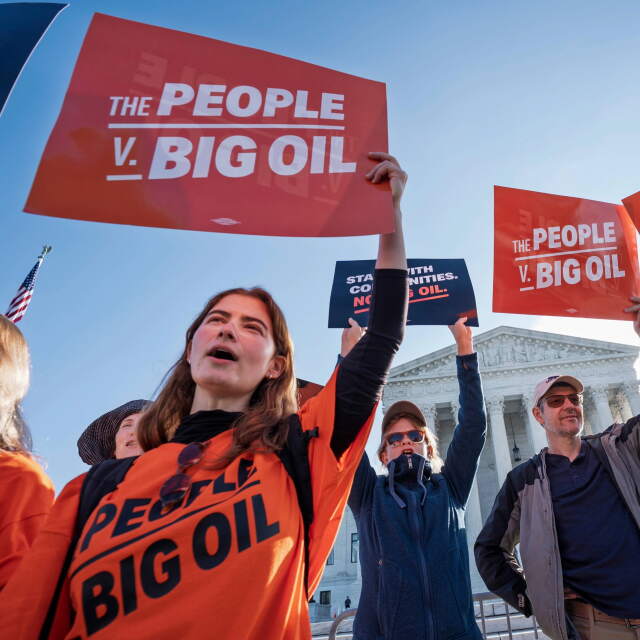
The Supreme Court hears Boulder, Colorado’s climate lawsuit seeking damages from ExxonMobil and Suncor, arguing the companies knowingly caused harms from fossil fuels; the episode also covers other Supreme Court term expectations and features Nobel Prize medicine news on optogenetics.
Kathleen Kelly, 3rd-generation rancher (Rio Blanco County, CO; in her 70s) describing wildfire, drought, and heat impacts on cattle and ranch infrastructure. Cody Davis, Mesa County commissioner (western CO; energy-dependent economy with 1,000+ active oil wells). Stephen Vladek, Georgetown Law professor. Dr. Carl Deisseroth, Stanford bioengineering/psychiatry professor and Nobel Medicine winner.
Boulder’s suit is about state-law damages and alleged cover-up; defendants argue it’s a federal issue and a national problem. Kelly says climate change is local and costly; Davis says the issue is who sets policy and warns lawsuits can function like regulation. Vladek predicts ideological splits and possible 5-3 outcomes; notes Alito recused. Deisseroth explains optogenetics uses light to control specific brain cells via a light-responsive gene.
Kelly’s record-low herd, increased wildfires (5–6/year vs first at 22), dried runoff streams, ice-free winter; $300,000 fencing replacement after fires. Davis contrasts rural impacts vs Boulder’s tech economy. Deisseroth cites restoring vision in retinitis pigmentosa patients.
Written by AI. May contain mistakes.
Discussion on the Supreme Court's case regarding climate change lawsuits.
“Support for Here and Now Anytime comes from MathWorks, creator of MATLAB and Simulink software, to design and develop engineered systems, accelerating the pace of discovery in engineering and science.”
Discussion on the Supreme Court's case regarding climate change lawsuits.
“It's Monday, October 5th, and this is Here and Now, Anytime.”
Exploration of Boulder, Colorado's legal actions against oil companies.
“On the other hand, Suncor Energy and ExxonMobil say state law should not allow local officials to sue multinational corporations for big global problems like climate change.”
Interview with rancher Kathleen Kelly about the effects of climate change.
“But first, Kathleen Kelly, a rancher in Rio Blanco County in northwestern Colorado.”
Cody Davis discusses the importance of oil production to local economies.
“You are not trying to halt gas or oil operations at all, as I understand it, right?”
Discussion on the accountability of oil companies for climate change damages.
“Kathleen, you respond to that because it's a two-pronged lawsuit.”
Discussion on the Supreme Court hearing regarding Boulder suing oil companies for climate damages.
“I think it depends very much on what the elections look like, if they're close.”
Interview with Nobel laureate Dr. Carl Deiseroth about his groundbreaking work in optogenetics.
“The Nobel Prize in Medicine was awarded today to a trio of scientists for their groundbreaking work in octogenetics.”

Get the gist, explore an idea or ask about something said.
 Claude
On Here & Now Anytime, what are the key points of this episode?
Searching your listeningAutomatic transcript. May contain errors.
0:00Support for Here and Now Anytime comes from MathWorks, creator of MATLAB and Simulink software, to design and develop engineered systems, accelerating the pace of discovery in engineering and science. Learn more at mathworks.com. WBUR Podcasts, Boston. I didn't see my first wildfire until I was 22 years old. Now I see five or six a year and it's outrageous. I mean, the expenses we're going to bear on our ranch alone are going to be close to a million and a half dollars. Who's going to pay for that? Who's going to pay for that? That is the million dollar question before the Supreme Court in one of its biggest climate cases to date.
0:54It's Monday, October 5th, and this is Here and Now, Anytime. From NPR and WBUR, I'm Chris Bentley. Today on the show, a new Supreme Court term opens with major cases about gun rights, religious freedom, and elections. If the Democrats retake either chamber of Congress, the kinds of interbranch disputes that we haven't seen over the last two years that could reach the justices very quickly. Also, we speak to one of the winners of this year's Nobel Prize for Medicine, whose work illuminates how pulses of electricity in our brains can shape things like feelings and memories. How optogenetics could revolutionize neuroscience, coming up in about 15 minutes.
1:36But first, climate change had its day in court today. More specifically, the Supreme Court heard arguments about whether states can continue suing oil companies for the mounting costs of global warming. Representing local officials who want to hold corporations accountable for local climate impacts is Boulder, Colorado, which is suing two oil companies under state law for damages they say are caused by the effects of climate change. On the other hand, Suncor Energy and ExxonMobil say state law should not allow local officials to sue multinational corporations for big global problems like climate change.
2:16That technical question of who has the legal power to grapple with climate change means a lot to people far beyond Boulder and to lots of similar cases making their way through the courts. But since this case is all about local impacts, we wanted to hear from two people in Colorado with different views on it. In a minute, we'll hear from Cody Davis, a commissioner in Mesa County in western Colorado, which depends on energy production. But first, Kathleen Kelly, a rancher in Rio Blanco County in northwestern Colorado. She's a third-generation rancher in her 70s, and she tells Robin Young her herd is at a record low because of heat waves, wildfires, and drought.
2:57Well, I think a lot of times we focus on the high temperatures of climate change, and we don't often look at the lower extremes of temperatures and how those have actually increased to the extent in the last two years. I've perhaps broken ice on ponds three times. That's unheard of. I used to have to do it on a daily basis. The ice would freeze as much as three to five inches overnight. That didn't happen at all this last winter. We didn't break ice at all. And then when you say you feel less water, how do you see that? We don't have the live streams that we used to have. We were entirely, had become entirely dependent on surface water runoff, which means runoff from the snow.
3:45And that completely dried up three years ago. We had water this last winter because of floods that resulted from some minor downpours. as a result of the fires that we experienced. Well, and cattle die when it's too hot and calves, do I understand, can't handle it. That's right. I mean, we thought we were being smart one year by calving in May, thinking that we were going to beat some of the winter conditions that related to some calf diseases. And the problem is that in May of that year, it was so warm that when the calves hit the ground, They were very lethargic. They had trouble getting up.
4:28And I'm seeing the same thing now with friends that are in Texas, in Nebraska, in Missouri that are doing fall calving. They're having some of the same problems that we had. And just quick on the fires, they burned through the ranch. But that meant, just talk about the fencing. Well, just the fencing alone, we're right now at$300 ,000 in replacing exterior and some interior fencing. You don't expect that you're going to have to face a situation where 100 years of infrastructure is destroyed in two days. And you can't have cattle if you don't have fences. Exactly. Well, so you rent out your land now.
5:10Cody, I just want to turn to you. Your county has more than 1 ,000 active oil wells. How important is that oil industry to your county's economy? Well, yeah, it's super important. And I think there's just kind of the stark difference between Mesa County and Boulder, who's running this suit. Boulder's driven largely by technology, aerospace, and higher education. And so a lawsuit like this, if it were successful, would impact them a lot less, hardly at all really. But the impacts in rural Colorado on rural economies and such like that would be massive. I'm very sympathetic with Kathleen. And yeah, it has been getting warmer and there's less water in the river.
5:49We're all dealing with that down here in Mesa County as well. And for us, this wasn't at all about debating or denying climate change and the impacts because those, for what we're experiencing, are real. I think the question that we've been wrestling with is, you know, who gets to make those policy decisions about these national and really global issues? And through what process? Should it be through lawsuits that are essentially setting regulation? Or should they be through our state legislature, or federal government and things like that. Well, I'm going to jump in here and ask Kathleen, ask you to respond to that.
6:22You are not trying to halt gas or oil operations at all, as I understand it, right? It's just... That's exactly right. In fact, the position that we're really taking is that those who created the problem are best positioned to solve it. And it would not do anyone any good whatsoever to shut down the industry or create a situation where the economy goes away. What I find particularly interesting is that, for example, while a number of counties have filed their brief related to this, Weld County, which is the number one gas and oil producing county in the state of Colorado, chose not to be part of that brief.
7:05And I find that to be very interesting that there's some either tacit acknowledgement or something that says maybe we should not give away our 10th Amendment rights. Remind us. The 10th Amendment of the Bill of Rights is our state's rights amendment. And as a former state legislator, I look at that and say, why would we ever give up local control if we're arguing that our climate change issues are to be delegated out of Washington, D.C. or London? Then we're giving away that right. Great. And going back to what this lawsuit is about, Cody, what about this idea that it's asking these companies just to pay for the damages and for you, the taxpayer, not to have to pay for the damages?
7:55Well, yeah. And I mean, there's a couple of points there, but a lawsuit can become regulation just by another name. If a court imposes these enormous financial liabilities on the industry, they change. They operate differently and it becomes quasi-regulation. And by no means are we saying that counties can't sue when they're harmed. This brief, you know, recognizes that counties still need that ability to sue when they have genuine localized harms within their jurisdictions. We just see this one completely different as this is a national issue. The connection between Boulder and the specific companies is tenuous at best.
8:33And we just don't think it's appropriate to be done in this manner in state court. Kathleen, you respond to that because it's a two-pronged lawsuit. One is about the damages caused by climate change, and one is about a cover-up of that, that these oil companies, Exxon, for instance, have known, Exxon knew as early as 1977 that their product was risky. It's been reported in many different ways. What about your sense of what you just heard, that it is a tenuous connection between your one city, Boulder, and what we're seeing, the result of climate change? Well, I hear that argument a lot. But the reality is that climate change is very local and very personal.
9:17It affects each of us extremely differently. There are some pockets of the United States now that have excessive precipitation. And then there are areas like ours. I didn't see my first wildfire until I was 22 years old. Now I see five or six a year, and it's outrageous. I mean, the expenses we're going to bear on our ranch alone are going to be close to a million and a half dollars. Who's going to pay for that? Because I look at that and say, I'm 71 years old. Do you want me to pull a loan to pay for that? Yeah. Cody, you know that in some states, lawmakers are trying to protect oil and gas companies from just this kind of a suit.
9:58In Utah, Oklahoma, state lawmakers have introduced bills to shield energy companies from liability over their emissions. Do you want to see that in Colorado? No, not necessarily. I actually agree with Kathleen that we should keep a lot of this stuff as local as we can. And the state legislator has the power to put in more regulation, and they're doing a lot of that. I'm just saying with a more tenuous, ambiguous connection and the cross connection between states, that interstate activity, we're just questioning if this is the right place. And this kind of opens up a bigger discussion in the future.
10:29Today, it's disputed between over fossil fuels. But in the future, it could involve water, transportation, agriculture, statewide industry and resources. So I think we want to settle a question of where this is most appropriate to happen. Well, and you also don't want to lose jobs that come from the oil wells in your town on the micro level. Isn't that also your concern? There's an economic concern as well. I think Kathleen hit it on the head. She goes she shouldn't have to pay for it. And there's different economic realities from Boulder to Mesa County. If this lawsuit is successful and oil companies have to pay out, they start operating differently, that's going to get paid for by rural Colorado and their taxpayers because that's their economy.
11:11And, Cody, one last thing. I mentioned the idea of fraud, that the companies knew what the risk of fossil fuels could be and maybe could have mitigated it decades ago. Doesn't that burn you a little? Yeah. I mean, if there's genuine fraud and they lied to the community, then, yeah, that's – it almost seems like two separate lawsuits should be going forward. But for us, it's about where the damage is and how the damages are calculated and where that should end up in that process. How it's going to hurt you. Yeah. That's Cody Davis, commissioner in Mesa County in western Colorado, a community that depends on energy production.
11:46Kathleen Kelly, a rancher in Rio Blanco County up in northwestern Colorado, impacted by climate change. Thank you both so much. Thank you both. Thank you, Robin, and thank you, Cody.
12:05After the break, Robin has more on what the Supreme Court's new term means for you in a conversation with Georgetown Law's Stephen Vladek. That's in just a minute.
12:23Stay tuned for the following announcements and messages from our sponsors. I am a bona fide boomer. We just hit it at the right time. The right time to accumulate power, voter influence, and wealth. Boomers were born into a time where there was greater economic prosperity and a greater chance of upward mobility. It's an odd feeling that my grandkids are not going to have that situation for them. I'm Meghna Chakrabarty, host of On Point from WBUR. Look out for our special series. It's called Senior Class, Gerontocracy in America. So be sure to follow On Point wherever you get your podcasts.
13:07We're spending a few minutes with Stephen Vladek. He's a law professor at Georgetown University. Professor Stephen, welcome back. Thanks for having me. Great to be with you. And first, the court didn't have much of a summer break because of emergency requests involving the Trump administration. Is the Trump administration expected to dominate this term as well? So I think the answer is yes, but not as obviously as last year. Last year, when we went into the term on that first Monday in October, there were already a number of pretty high-profile Trump-related cases on the docket. I think this term, those cases are going to come a bit later.
13:39And I think a lot's going to depend upon, first, what happens in the midterms next month, but also if the Democrats retake either chamber of Congress, the kinds of interbranch disputes that we haven't seen over the last two years that could reach the justices very quickly. Yeah, well, stay with the elections. Is there something you're looking for that might be coming? Well, I think the first thing to say is, you know, the court has already had an outsized influence on the midterm elections. You know, through all of those redistricting cases from last year and earlier this year, through its voting rights ruling, through its refusal to let President Trump interfere with mail-in ballots, through its interference in the Missouri redistricting case.
14:15So it's already had a huge impact. Will it have yet more of an impact? I think it depends very much on what the elections look like, if they're close. And if, you know, a couple of critical House or Senate seats come down to lawsuits, very hard to imagine this particular Supreme Court staying out. I'll just say, you know, one of the reasons why I hope the elections aren't closed, no matter how they turn out, is because I think that would reduce the likelihood of a Supreme Court election season, you know, Lollapalooza. Well, suddenly I'm thinking hanging chads. You remember Bush v. Gore, the Supreme Court case that decided the 2000 election.
14:51So we'll keep, of course, an ear on that. But let's stick with what's happening today. Today, the justices have been hearing a case about Boulder, Colorado suing oil companies over damages the city says are caused knowingly by the oil companies, by their fossil fuels. Now, Boulder is only asking for compensation. The companies argue that's a federal, not a state issue. And today, Justice Brett Kavanaugh had this to say, seeming to agree with one of the lawyers for the companies, Cannon Shamugam. This court has said four times that interstate air and water pollution are federal or matters for federal law unless Congress preserves or, in Mr.
15:32Shamugam's words, authorizes state law. And we also heard from Justice Elena Kagan, who brought up comparisons between this climate lawsuit and actions against tobacco and opioid companies. Let's listen to that. This is the same kind of lawsuit against the same kind of actors for the same kind of harm. And by the way, one person we didn't hear from, Justice Samuel Alito, he recused himself from this case. He has invested in oil companies. So, Professor Stephen, what did you hear today? I mean, obviously we seem to hear one justice agree with one side, one with the other. Yeah, I mean, I think what we heard today is what we're going to hear a lot this term, which is this court sorting itself into its usual political and ideological divide, where you have, you know, five today, but usually six Republican appointees who are going to be pretty consistent in siding with business and siding with deregulation against the Democratic appointees who have been, I think, ironically, much more protective of a robust role for states in these kinds of cases than others.
16:32And the broader point is this is a court that really is not afraid of its shadow, and that leans into those divides much more than its predecessors. Part of why I think we're seeing so much public polling from Gallup and other enterprises about declining public support for the court, not necessarily the outcomes the justices are reaching, but the fact that every major case really does seem to sort them into their camps. But meanwhile, that Alito recusal, Stephen Vladek, would seem to open the door potentially for a 4-4 tie. Can you just look at those stealings? It could. I mean, so, you know, a 4-4 tie, just so that folks know, would have the effect as if the Supreme Court had never heard the case.
17:09And so the lower court ruling, which had allowed this case to go forward, would be left intact. is to go forward. If we saw that, I mean, I think if the justices knew they were going to be divided 4-4, they probably would have, you know, got rid of this case already. Really, this is one of those cases, and there are going to be a lot of them this term, where I really expect the most predictable outcome coming out of the argument is that you'll have the Republican justices on one side and the Democratic appointees on the other, and that would mean a 5-3 outcome here. And I think that's an alarming sign of where we are, that without even necessarily knowing the issues and without necessarily reading the briefs, most of us can walk into the typical Supreme Court argument with a decent chance of predicting how it's going to go.
17:51I'm going to pick one law. Justices will be looking at local laws that ban semi-automatic rifles like AR-15s. How big a deal could that case be? I think it's an enormous deal for two reasons. The first is when we look at all of the mass shootings in this country over the last 15, 20 years, AR-15s have been at the middle of just about all of them. And, you know, to this point, states, local governments that have chosen to restrict or ban them have been upheld by the courts, even after the Supreme Court has reinvigorated the Second Amendment. For the justices to take this case now, when the lower courts are not divided, I think it's a pretty worrying sign that the justices might say, no, there's a right to carry these weapons as well, even though they've been so central to so much of the violence we've seen in this country.
18:36Again, another major headline-generating case where the most likely outcome is the one we all would predict. Yeah. Well, Stephen Vladek, again, law professor at Georgetown University. We're going to keep you close during this Supreme Court term. Thank you so much. Thank you.
18:56Coming up, scientists who figured out how to control nerve signals with light have won the Nobel Prize in medicine. The Nobel Committee said their work laid the foundation of a new era in neuroscience. Robin speaks with one of the winners after the break.
19:24Stay tuned for the following announcements and messages from our sponsors. This episode is sponsored by Carvana, which offers the following message. Carvana Value Tracker lets you see what your car is worth, understand how the value changes, and sell your car when the time's right. Try it now on Carvana.com. The Nobel Prize in Medicine was awarded today to a trio of scientists for their groundbreaking work in octogenetics. You'd be forgiven for saying, what is that? Because it's a field they somewhat recently developed, which uses light to show how individual nerve cells shape behaviors in the brain.
19:59The Nobel Committee described their discoveries as laying the foundation for a new era in neuroscience. The winners are Dr. Peter Hegemann, Jörg Nagan, and Dr. Carl Deiseroth. He is a professor of bioengineering and psychiatry and behavioral sciences at Stanford University. He's on the line right now. Dr. Deiseroth, congratulations. The first question always is, what was last night like for you, the call? Well, thank you so much. It was very disorienting, unexpected. I'm a bit of a night owl, but I was working late, and I had just gone to bed and was at the interface between sleep and wake, and then the call came.
20:40And so I was not sure if it was a dream or not, I'll tell you that. Well, the committee said that all three of the recipients said that they thought it was absolutely wonderful to receive the prize with the other two, and we want to find out more about that. But I was on the Stanford campus this past weekend. My brain is bigger just for having been there, but not this big. Can you explain in layman's terms what the discovery was? Yes. So what we figured out was how to use light to control cells in the brain. And so this is different from how you normally think about light as an imaging tool to look at things.
21:16In this case, it's totally different. We're using light to make things happen, to turn cells on or off. but deep within a brain that's functioning in an animal or even a person that's moving and behaving and living. And this is so powerful because what we can do, the way this works is we make cells sensitive to light by introducing a gene from algae, from single-celled algae that gives rise to a light-responsive ion current, current, a flow of charged particles, which is electricity. So basically, long story short, we can use light to create electricity in exactly the cells we give the gene to.
21:59And maybe change the way the brain is reacting to something? Yes, for example. So normally, you know, we take for granted the choices we make and the priorities we think. Of course, survival drives like hunger and thirst will do what it takes to make them happen. If we need to nurture our young or if we need to be aggressive or defensive, will do the right thing. In reality, all these actions and priorities are set by cells and the cells are competing with each other and deciding what to do based on the connectivity of the neural circuits. And what optogenetics has let us do is to tease that apart and say, okay, here's why this action is taken.
22:38Here's why this priority is rising to the top and here's how to change it. So it's interesting to get to that level of understanding of why we do what we do. Well, everything from blindness to schizophrenia. But it also sounds very powerful how you in particular got involved. You're also a psychiatrist. And we're reading that your work made you very frustrated because you couldn't explain to patients why they were having their suffering, this very human suffering. You didn't have a precise explanation or maybe a fix. Is that part of this? Yes, it is very much so. So psychiatry is probably the field of medicine that is most in need of explanatory power like that.
23:27Why is something happening? What is the biological basis for it? And this is in part not through any lack of effort or trying, but because the brain is very complicated. It's very hard to study, very fragile and intricate. And what optogenetics does is it gives us the tools to pierce through that intricacy. Optogenetics is fast. Optogenetics is precise, just like the brain. So we can keep up with the brain and make things happen and infer the results in terms of a larger theory. As a psychiatrist, it's so exciting to look at this and think, oh, this is a way we can come to a deeper understanding of ourselves.
24:06Well, and we mentioned you shared the award with two other neuroscientists, Peter Hageman and Yurik Nagan. they discovered a protein which you transformed into this light-controlled switch, so to speak, for nerve cells. Are you saying, you know, it sounds like we're hearing, could this ultimately be used for people who it seems impossible to overcome addictions? And how would it possibly affect blindness? Yes. So it's already been tested in human beings who are blind. And this is a disease called retinitis pigmentosa, where there's loss of cells that's due to neurodegeneration. And optogenetics has been used to confer light sensitivity back on these people and let them see things that they couldn't see before.
24:56And that's just one of many examples. But once you understand the cells that matter, which is something we've lacked for so long in psychiatry, once you understand the cells that matter, you can design any kind of treatment. You could design a medication that targets those cells, grounded for the first time and knowing what matters. And that's the real power of optogenetics is it tells you what matters. Nobel laureate, Dr. Carl Diceroth. Are you used to that yet? No, perhaps never. Well, maybe take a day off and get used to it. Yes, I think so. He's at Stanford University, one of three winners of the Nobel Prize in Medicine.
25:34Dr. Dysrock, congratulations again, and thank you so much for your work. I appreciate it. Thank you very much. Take care.
25:45It's Nobel week, everybody. Buckle up. That's it for the show today, though. Here and Now, Any Time comes from NPR and WBUR Boston. Today's stories were produced by Jill Ryan and Hapsa Qureshi. Our editors were Todd Munt, Mikaela Rodriguez, and Michael Scotto. Technical direction from Caleb Green and Matt Reed. Our theme music is by Mike Moschetto, Max Liebman, and me, Chris Bentley. Our digital producers are Alison Hagen and Grace Griffin, and here at NOW's executive producer is Alan Price. Click that follow button in your podcast player as we continue to cover the Supreme Court, the Nobel Prizes, and so much more going on.
26:20Thanks for listening. We'll be back with you tomorrow.
26:32Stay tuned for the following announcements and messages from our sponsors.


