
 Ask ChatGPT


 Here & Now Anytime
29 Oct 2026 · 29m · 9 chapters
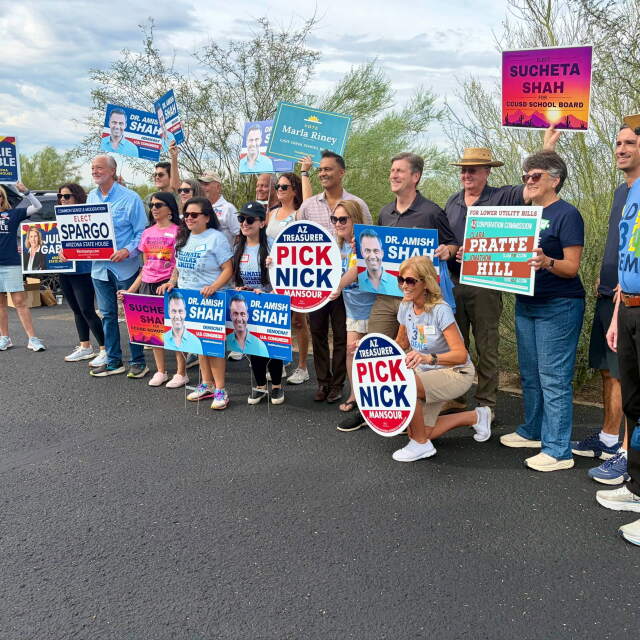
The episode focuses on two election-related segments and two guest interviews. Topic 1: Arizona’s competitive congressional races, especially Arizona’s 1st district (CD1), where Democrat Amish Shah (former state lawmaker and emergency room doctor) challenges Republican Jay Feely (former NFL kicker and broadcaster). Key claim: outcomes hinge on independents; polls may overstate Democrats’ support, making races closer than expected.
CD1 debate over data centers; independents like Jewish voter Emily Schwartz supporting Shah despite opposing Trump on women’s/reproductive rights. Topic 2: Michigan Senate candidate Abdul El-Sayed and Trump’s rhetoric.
Beshara Baba, Palestinian-American academic and former co-founder of Arab Americans for Trump, now renamed Arab Americans for Peace, who says he regrets supporting Trump due to anti-Arab/Muslim rhetoric and Gaza policy. Topic 3: Dolores Huerta memorial.
filmmaker Luis Valdez, longtime friend, recounts Huerta’s farmworker organizing, “Si se puede,” and her resilience.
Written by AI. May contain mistakes.
Overview of the political landscape and current congressional races in Arizona.
“Today on the show, the co-founder of Arab Americans for Trump has changed the group's name and says he made a mistake.”
Discussion of a Democratic candidate's campaign efforts and the political dynamics in Arizona's CD1.
“Help the party take control of Congress.”
Examination of the role of independent voters in Arizona's elections and their political tendencies.
“Samara Klar is a political scientist at the University of Arizona.”
Insights from Republican leaders on their strategies and expectations for the upcoming elections.
“The polls have historically overstated support for Democrats more often than Republicans, especially in recent years.”
A Democratic volunteer canvasser discusses voter emotions and challenges in a red district.
“There's lots more about the elections, races to watch, ballot questions under consideration, and how much money is being spent on ads.”
A conversation with Beshara Baba about his disillusionment with Trump and the impact on the Arab-American community.
“President Trump has ratcheted up his rhetoric about the Michigan Democratic Senate candidate Abdul El-Sayed.”
The segment covers the interviewee's experience with the Trump administration, including feelings of being misused and the impact of Trump's rhetoric on Arab-Americans.
“You have a credible history here and you have said that you worked with the Trump administration to do things like come up with the peace plans, free some hostages.”
The hosts introduce a segment reflecting on the life and contributions of civil rights activist Dolores Huerta.
“Coming up, Robin reflects on the legacy of civil rights activist Dolores Huerta, with one of Huerta's longtime friends and collaborators, the filmmaker Luis Valdez.”
Filmmaker Luis Valdez shares personal stories and reflections on his friendship with Dolores Huerta and her impact on the labor movement.
“Barack Obama told her he stole her slogan.”

Get the gist, explore an idea or ask about something said.
 Claude
On Here & Now Anytime, what are the key points of this episode?
Searching your listeningAutomatic transcript. May contain errors.
0:01WBUR Podcasts. Boston. The polls have historically overstated support for Democrats more often than Republicans, especially in recent years. So the races do end up being much closer, I think, than people think they will be. Democrats are eager to flip to congressional seats in Arizona. Can they get enough independents on board to do it?
0:36It's Thursday, October 29th, and this is Here and Now, Anytime from NPR and WBUR. I'm Chris Bentley. Today on the show, the co-founder of Arab Americans for Trump has changed the group's name and says he made a mistake. We were quite surprised to see how he has turned his tone against us when he thanked the Arab and Muslim communities for voting him into power. Also, filmmaker Luis Valdez joins us to remember labor leader and civil rights activist Dolores Huerta, who died on Wednesday. Her eyes, particularly as she got older, would seem to penetrate and to understand where people were coming from.
1:23But first, there are just a few days left of voting in the midterm elections. Polls close on Tuesday, November 3rd, and we're continuing our look at some competitive congressional districts around the country. If you missed our stories from Iowa, by the way, scroll back in the podcast feed two episodes to Tuesday to hear how Iowans are feeling about the election. Today, we are in Arizona, where Peter O'Dowd recently met up with a group of Democrats in a parking lot in North Phoenix. Thank you. How you been? I'm good. I'm good. You know, happy as a clam. Their goal was pretty simple. Help the party take control of Congress.
2:00Go win. Don't lose. Don't lose. That was Representative Greg Stanton with some words of wisdom for Amish Shah. Shah is running for an open seat in Arizona's first congressional district. Stanton was there to help get the volunteers pumped up to knock on voters' doors. We're working on dozens and dozens of races around the United States of America as we battle to win the majority. Make no mistake, this race right here, CD1, is the most important race in the entire United States of America. Registered Republicans outnumbered Democrats by about 60 ,000 voters in this wealthy suburban district in the picturesque foothills of the Sonoran Desert.
2:45Shaw ran here two years ago and narrowly lost. But this year, the Republican incumbent chose to run for governor. And Shaw is hungry to flip the seat for Democrats. This was the district that John McCain used to be in. He was the maverick and he always put Arizona first. That's what I'm hoping to continue to do in Washington. Shaw is a former state lawmaker and emergency room doctor. He's up against Republican Jay Feeley, who's a former NFL kicker and broadcaster. He was inspired to run after President Trump was nearly assassinated in Pennsylvania two years ago. With blood on his face, President Trump raised a fist and he told this nation to fight.
3:28That's Feeley at the president's political convention in Texas back in September. After 14 years of playing in the NFL and 10 years broadcasting the game I love, I walked away from a dream job to get off the sidelines and into that fight. I asked Feely's campaign for an interview and never got a response. But the issues that dominate national politics are dominating this race, too. Inflation, the cost of gas, the war in Iran. At a recent debate, both candidates sparred over data centers. Here's Feely. They add about a billion dollars in revenue to the state of Arizona. That's giving you the opportunity to increase teachers' pay.
4:05It's giving you the opportunity to do programs to actually help people. You want to get rid of those programs. And here's Shaw. We are going to need data centers. I just don't want them in CD1, our district here. Polls show the race leaning in Shaw's favor. As with every competitive race in this state, it'll come down to independence. A third of registered voters in the district aren't affiliated with any party. Samara Klar is a political scientist at the University of Arizona. Arizona voters are pretty moderate voters. both Democrats and Republicans. My perspective as a political scientist and frankly as a resident of Arizona is that it's the Democratic campaigns in Arizona who seem to be winning over that centrist mentality much more than the Republicans.
4:47In recent years, Arizona independents have swung to the left to help elect a Democratic governor and two U.S. senators. But in 2024, they broke for President Trump. Klar has a warning for Democrats feeling optimistic. The polls have historically overstated support for Democrats more often than Republicans, especially in recent years. So the races do end up being much closer, I think, than people think they will be. And Republicans in key districts aren't ready to concede. The best poll is on election day. Kathleen Wynne is chair of the Pima County Republican Party in southern Arizona. Nearby Congressional District 6 is another critical seat that Democrats think they can flip from Republicans.
5:28So Wynne is trying to boost turnout. Her party headquarters in Tucson is crowded with stacks of campaign yard signs. These signs will all be gone by next Tuesday. And we are a storage facility, apparently, but we don't charge if you're a Republican candidate. She's not convinced the blue wave will crest over Arizona. No, I don't expect a wave. I think there'll be one-offs. I think there'll be races where we may lose. But overall, I'm confident if people vote not with their emotions, but vote with facts, the Republicans win walking away. So with control of Congress on the line, both parties are doing whatever they can to expand their base.
6:07Oh, hi. Are you Emily? Back in CD1, Democrat Dana Rakinick is canvassing a neighborhood in Phoenix when she comes to the door of Emily Schwartz. And I'm just coming around giving people some information. Did you get your ballot? Thank you for not giving me Trump things. Thank you. Oh, hell no. Schwartz is Jewish and one of Arizona's highly coveted independent voters. She supports Republicans because they're allies of Israel. But she can't stand Trump's policies against women and reproductive rights. See, I think the Democrats got way too liberal and I think the Republicans are on acid or whatever.
6:43And they're not doing a good trip. So you're stuck. Who are you going to vote for, for Congress? That's why I'm going to look at this. I really want the Democrats to win Congress so we don't have all this bias. Trump is doing everything that I fought for and he's taking it away. I'm a kid of the 60s and 70s. This year, she's voting for Amish Shah, the Democrat running in CD1. As we head to the next house on Dana Rakonek's list, I ask how the volunteer door knocker is feeling about Election Day. I'm very cautious about it, but I will remain optimistic till the end. I do know one thing for sure, and that is that even though we're in a red district, we will get out the democratic and independent vote.
7:26We will.
7:36Peter O'Dowd reporting. There's lots more about the elections, races to watch, ballot questions under consideration, and how much money is being spent on ads. It's all at hereandnow.org. And it's all on this podcast. So click that follow button in the top right corner of your podcast player right now to keep up. Coming up next, though, the founder of a group formerly called Arab Americans for Trump shares some regrets and calls out racist rhetoric on the right about Michigan Senate candidate Abdul El-Sayed.
8:11Robin Young has that after the break. Stay tuned for the following announcements and messages from our sponsors. This message comes from Wallace Annenberg GenSpace, a project of the Wallace Annenberg Legacy Foundation and a national model to reimagine aging. With programs and experiences designed to foster purpose, connection, and lifelong learning, GenSpace helps older adults build richer, more joyful lives. Learn more at AnnenbergGenspace.org. to work. President Trump has ratcheted up his rhetoric about the Michigan Democratic Senate candidate Abdul El-Sayed. Here is Trump at a rally in the state just days ago.
8:52I'm here to keep a jihadist Muslim Brotherhood member from becoming a United States senator. And what started as a personal attack on El-Sayed has expanded. Here is Trump at another campaign event. You know, if you're in doubt about somebody's name from the Middle East, just say Mohammed. You had about a 65 percent chance. Hello, Mohammed. I've done it for years now. I've never been wrong. To which Al-Sayed said. Look, however he wants to say my name, we're going to force him to say it with the word senator in front of it in November. While others are less able to laugh this off, Palestinian-American academic Beshara Baba, long a leader in the Arab community in this country and a go-between during peace talks in the Middle East, is one of them.
9:37Beshara Baba, who voted for Joe Biden in 2020, switched his support to Donald Trump after the October 7th attacks on Israel, believing Trump would end the brutal war that ensued in Gaza. Now, I spoke to Bashar today. There's some strong language in this conversation. He has strong feelings. He created the group Arab Americans for Trump. He would change that title and now has changed his mind about Donald Trump. I asked him how he would put it. Well, the important thing here is actually the rhetoric of the president toward the Arab and Muslim communities. And for that, I am very resentful. We were critical in the election of the president in 2024.
10:19And history will mark that our votes, as tiny as they might have been, they were crucial because they were in the swing states. and unfortunately we were quite surprised to see how he has turned his tone against us when he after the elections thanked multiple times the Arab and Muslim communities for voting him into power. We voted for Trump because he promised that he would end the war in Gaza and because President Biden completely ignored us and continued arming the Israelis to commit the genocide against our people in Gaza. So the primary reason why we voted for Trump was because of Gaza. I'm terribly disappointed because we put, I put, and the community put a lot of faith in President Trump.
11:12If that does not give you the answer, I don't know what else does. Yeah. There was a specific moment, we understand, when your disenchantment seemed to turn to something even stronger. And I believe it was when Donald Trump talked about building the Riviera of the Middle East on what had been Palestinian land, Gaza. Can you talk about that moment? That was sometime in February of last year. He started talking about turning Gaza into a Riviera that would be owned by the United States. I don't mind turning Gaza into a Riviera, But it has to be for the Palestinians, not for international investors or so-called investors.
11:56Or I don't want it to be an occupation in a fancy name, you know, Riviera of Gaza. So that was a turning point for me. And at that point in time, my team and I decided that we would change the name of Arab Americans for Trump to Arab Americans for Peace. Because ultimately, our goal for supporting Trump was peace and continues to be peace. Beshara Baba, you know, and I'm sure you're hearing from people who cannot understand how your support of Donald Trump started in the first place, even after you explain that you felt that he would do what you thought President Biden wasn't doing, which is ending the war in Gaza.
12:35I mean, President Trump is a friend and admirer of Netanyahu's. He tried to ban travel for citizens from predominantly Muslim countries. He said Haitians were eating pets. He mocked Somalis. His son-in-law, Jared Kushner, to please Netanyahu, moved the U.S. embassy to what was hoped to be part of a Palestinian state. I mean, the list is long. How could you overlook that? You know, a wise individual has to make a choice between a bad and a worse choice. And at that point in time, in April of 2024, as an academic, I did my own analysis of how, what the prospects would have been for Biden versus Trump.
13:28And I came to the conclusion that Trump was going to win. If Trump was going to win, I was going to woe the individual that would win. And because Biden was totally ignoring us and allowing the Israelis to commit what some call the genocide in Gaza, then I decided to throw my support behind Trump and get the commitment personally from him in order to stop the war in Gaza. Yeah. Well, how do you feel about the fact that you have said and you have in the past been part of negotiations, been advisors to people like Yasser Arafat, leader of the PLO. You have a credible history here and you have said that you worked with the Trump administration to do things like come up with the peace plans, free some hostages.
14:16Because the Trump White House says that's not true. They've discounted that, and this is for the New Yorker, asked for comment about some of your claims about working with them. A Trump administration official said none of this is accurate. This individual was not involved in peace negotiations. Do you feel a little thrown under the bus? I want to also mention you partnered in a lot of this with Mossad Boulos, who's the Lebanese-born businessman, but also Tiffany Trump's father-in-law. With him, you co-created this Arab-American PAC supporting Trump. You first created the Arab-Americans for Trump.
14:54Do you feel maybe even a little bit used by the Trumps in this administration? First of all, the fact that the White House claims that I was not involved is a complete lie. I have the evidence to support it. And it's going to come out in a book. Well, good. But again, doesn't that raise the question? Do you feel used by them? I've been thrown under the bus. I've been put into a grinder, not just thrown under a bus, but a meat grinder. I've been put into a meat grinder. But at the same time, you know, I as an individual can tolerate that. The people of Gaza, the people of Lebanon, South Lebanon, the people of Syria and other parts of the world who are suffering from the actions of this administration.
15:43It's nothing compared to the suffering of those individuals. Yeah. Well, and what about the people of Michigan? We understand you're in Detroit right now and you're working having to do with this election. How so? And how, you're Christian, but Arab American. Can you explain what it's like to hear the name of Muhammad used in the way President Trump did? To hear somebody being accused of being a terrorist just because of their name? What's been the impact of that? As a Christian who was born in the old city of Jerusalem and who grew up among Muslims, I really resent that statement. because to just throw a whole bunch of people who supported you to get elected and start calling them Muhammad because he felt like it, it hurts us.
16:31Even as a Christian, it hurts me because I'm an Arab as well. And in that regard, I think payback is a bitch. And the bitch is coming on November 3rd. Okay. Well, but I have to ask, you say you're still a Republican. You've voted for Democratic candidates in the past. You say you're still a Republican. What are you doing in Michigan? What are you going to say? There's a candidate, Michael Bouchard, who is a Republican, who's running for Congress. I'm supporting him. Are you supporting Mike Rogers, who is running against Abdul El-Sayed? No, I am not supporting Mike Rogers. I will not be supporting an individual who is going to be holden to pro-Israel groups in this country.
17:12The interests of the United States come first. even MAGA Republicans young MAGA Republicans believe that America comes first and I believe that America comes first and for those people to be beholden to foreign interests is not in the interest of the United States and I will not be supporting them Mike Rogers also in a podcast agreed with the podcast host that Al-Sayed was a terrorist Mike Rogers is stupid then what can I tell you I mean how can you talk about somebody who was born in the United States raised in the United States, educated in the United States, served his community in Michigan as a public health official.
17:52How can you accuse that individual of being a terrorist? And who's a nice guy then? Who's a nice guy if he's a terrorist? Bishara Baba, again, a prominent Arab-American academic who first created the group Arab-Americans for Trump, has changed that title to Arab-Americans for Peace. Thank you so much for speaking with us. A lot of emotions here. Thank you. Thank you, Robin. Take care. Bye-bye. Bye-bye.
18:21Coming up, Robin reflects on the legacy of civil rights activist Dolores Huerta, with one of Huerta's longtime friends and collaborators, the filmmaker Luis Valdez. Stick around.
18:41Stay tuned for the following announcements and messages from our sponsors. I still hesitate when I buy grapes, and it's because of her. Barack Obama told her he stole her slogan. Here it is. Si se puede. Yes, we can. Si se puede. Si se puede. Y 'all would follow us. Amado. She, of course, is Dolores Huerta as a young woman rallying farm workers and laborers decades ago in one of the most successful worker movements in this country, which included a boycott of grapes and the rallying cry, yes, we can. The feminist icon and labor leader who co-founded United Farm Workers with Cesar Chavez died at home on Wednesday at 96.
19:25Luis Valdez credits her with helping him start a theater group with farm workers to tell their story about how they worked to get their first union contract in America. Luis later became a filmmaker. His movie La Bamba, about the life of rock and roll star and Chicano, Richie Valens, has been described as the most successful Latino film ever made. And Luis joins us now to remember his friend Dolores Huerta. Luis, first, so sorry for your personal loss. Well, it's a loss, I think, for everybody, you know, but she had a complete life, though. There's no question about that. And that's the wonderful and amazing thing about her whole trajectory.
20:03Amazing, because I'm thinking, for instance, she was vibrant at, you know, 96 and beaten when she was in her 20s. I mean, we heard some of when she said, you know, down with violence, she faced a lot of violence. She had ribs broken. She was beaten. I was witness to that. Yeah. In the L.A. produce market when we were chasing scab grapes early in the first season. And the goons came and threw her off the ducks, you know, under cement. These are goons. These were union breakers. Yes, yes. Well, the produce market is unionized, you know, except for some of the produce coming in from farm workers.
20:41But the thing is that she stood her ground and came back from the cement up to the dock again and kept on arguing, you know, until she was arrested. So it was a spectacle I had never seen before. I had no idea. I had no idea you were there. Oh, yeah. What a moment. Yeah, we used to chase trucks, you know, early in the morning to try to see where the scab grapes were going. I mean, we're talking about, we didn't have, of course, the internet, you know, because we had to literally follow the trucks to find out where they were going. Well, this is the strike in 1965 when there were about, you know, 1 ,200 members of this fledgling farm workers group, and they joined with Filipino workers, and it was a strike against grape growers, a bitter fight because the growers, as you said, brought in strike breakers.
21:32And some growers tried to sell the grapes under other labels, but it didn't work. It was astonishing. Can you describe for people? I mean, I remember you did not buy grapes. You know, 17 million Americans did not buy grapes or households actually didn't buy grapes. Can you describe that moment? Well, I think, I mean, what's important is people need to know that we weren't fighting the traditional farmer of old, you know, this was agribusiness. Right, right. Look, she was this firebrand, but she also borrowed from the teachings of Martin Luther King. She was a mother of 14, you know, people in the movement doing diapers, you know, to help her.
22:19Can you talk a little bit about, I mean, you were there. How did she do that? That's amazing. It was a collective effort from her family and others. She just kept going. It's that same manic energy that she had, you know, that plowed through. Well, let's hear a little of that because Dolores Huerta appeared on Jimmy Kimmel Live last year at 95, still worried about inequity and, you know, gave advice, for instance, in the interview, on what to do if you're detained by police or ICE. Number one is stay silent. don't say anything. Don't give any information at all. The next thing, don't sign anything either.
23:01If they give you a paper to sign, don't sign it. Then either memorize a number or have it on your arm with a little Sharpie, a pen or something, a telephone number of someone that you can call. She was interviewed that night by a substitute host, Diego Luna, who was in tears just being in her presence. Can you just talk about, you know, this woman as she aged and still stayed engaged to what she thought were important issues? She was 35 years old when I met her. So she was a firebrand then, and she remained that firebrand to the last day of her life. Her personality was deepened, you know, more profoundly.
23:45And her eyes, particularly as she got older, would seem to penetrate and to understand where people were coming from, you know, but she rebounded time and again. She was ill at a few times. She was, of course, almost killed, you know, by a policeman's baton in San Francisco during the first Bush administration. But the thing is that she always rebounded because she had a tremendous faith in what she was doing. And I never saw her truly fully exhausted. You know, she was always doing something. She would dance. She was the last person to leave a party, you know. So indefatigable, you know, just an amazing force of nature was Dolores Huerta.
24:29Well, even more amazing when you consider what we now know, which was, first of all, there were internal squabbles as the organizations grew. And, you know, by the 80s, a lot of chauvinism. Some of the men in the group would hold a press conference, not tell her. But also the secret that she was carrying. This year, an investigation by The New York Times revealed that Cesar Chavez allegedly sexually abused girls and women, including, she revealed, Dolores Huerta. She said she stayed silent for 60 years about this because she didn't want it to compromise the work, you know, that she felt was more important.
25:09She told Latino USA this year, it was my personal pain, it was my personal problem, and, you know, I think it was worth it. It was my cross to bear. Your theater company put out a statement in support of her at the time. Just your thoughts again, you know, on the crosses she bore. Well, okay, it goes without saying that it was a terrible event. She did tell me before it went public that she wanted me to know. And all these years I had not known. I thought they were the same people that we always imagined, you know, but they have tremendous discipline. I said, I don't know how they do it, but they're very morally up and stalwart people, you know.
25:51But the fact is that they were human, you know. And so there was an event there that unfortunately taints Cesar's reputation and figure, you know. But Dolores, I think, comes out as, again, she never played the victim. She never played the victim. So I understand why she didn't want to even bring it up. Can you just leave us, Louise, with just, you know, a memory? Just maybe it's a photograph in your mind, but a memory? I have this image of Dolores that came from, again, early in the strike. And I had just met her in a way. We were in the trenches. And we were chasing those semi-trucks with scab grapes.
26:34And I was staying at her house with a bunch of volunteers. I mean, we all slept in the kitchen and on the floor with sweeping bags. But we had to be up at 4 a.m. to go chase trucks. And this is Dolores' house. she was back in one of the bedrooms you know and so I got up and she wasn't up yet so I went down the hall and very quietly tapped on the door of her bedroom and and no answer and so I cracked it open I said Dolores and she sat up in bed it was a little tiny half bed and I mean there was a mound of people on the bed but she her head popped up and then seven little kids popped up around her and I mean it was the most engaging an image of motherhood I have ever seen it's memorable because it just emphasizes the humanity of this young woman you know and her kids and be all sleeping with her and I'll never forget that that sealed it for me I said what an incredible person and the kids just love her and so I leave you with that and we thank you for it Louise Valdez, filmmaker, long time friend of Dolores Huerta who died this week at 96.
27:46Luis, thank you. Thank you so much. Well, here she is again with the Jimmy Kimmel Show, guest host Diego Luna. She stands up at 95 and leads an incredibly young audience, receptive young audience, in her passionate chant. Let's listen. Si se puede. Let's do it all together with an organized hand clap. Yes. Let's go. Si se puede. Si se puede. Si se puede.
28:18That's it for the show today. Here and Now, Anytime comes from NPR and WBUR Boston. Today's stories were produced by Peter O'Dowd, Thomas Danielian, and Ashley Locke. Our editors are Todd Munt, Michaela Rodriguez, and Michael Scotto. Technical direction from Caleb Green and James Trout. Our theme music is by Mike Moschetto, Max Liebman, and me, Chris Bentley. Our digital producers are Alison Hagen and Grace Griffin. And Here and Now's executive producer is Alan Price. Thanks for listening. We'll be back with you tomorrow.


