

 Here & Now Anytime
24 Nov 2026 · 24m

 Add vo to ChatGPT or Claude to ask about everything you hear
vo listened to this episode to put together the overview and transcript, so there may be the odd mistake.
The episode covers (1) forensic scientist Michael Freeman’s review of Jeffrey Epstein’s 2019 jail autopsy, arguing Epstein’s death was murder/strangulation rather than suicide, and (2) national-security and election-system follow-ups: export-control fallout from the NVIDIA/Megaspeed China-chip scandal and a proposal to replace the Electoral College via a National Popular Vote Interstate Compact.
Michael Freeman, forensic medicine/epidemiology professor (Netherlands) and OHSU director at Forensic Research and Analysis; previously analyzed George Floyd’s cause of death. Gina Raimondo, former U.S. Secretary of Commerce (Biden). Jesse Wegman, Brennan Center fellow and author of Let the People Pick the President.
Freeman says ligature-mark shape/orientation, “double” mark, missing crime-scene evidence (no DNA/fingerprints; cell not treated as crime scene), and alleged neck scratching/fabric left in cell are inconsistent with the guard’s described hanging; he argues “exclusion of the impossible” leaves homicide. Raimondo argues export controls are still needed to block China’s military/AI/cyber/surveillance access and calls for full investigations into possible risks. Wegman argues states can legally shift electors to the national popular vote through an interstate compact, potentially reaching 270 electors by 2027.
Freeman contrasts typical suicidal hanging ligature marks (sloping toward ears) with Epstein’s largely horizontal mark; he cites a DOJ/medical examiner information gap appearing two years later and a torn towel-edge candidate for ligature that was never recovered; he references peer pushback (e.g., one journal declined publication). Raimondo references shell/front-company tactics used to bypass export controls. Wegman references the 2000 Gore/Bush popular-vote loss and 18 states signing the compact since.
0:01WBUR Podcasts. Boston. It's not good enough for someone to say, well, anything can happen in a hanging. That's not an analysis. A review of Jeffrey Epstein's autopsy says his death was not a suicide.
0:27It's Tuesday, November 24th, and this is Here and Now, Anytime from NPR and WBUR Boston. I'm Chris Bentley. Today on the show, investigations are coming after the president intervened to save the job of a man whom parts of the government accused of undermining national security. This is America. I don't care if you're penniless or the founder and CEO of one of the most valuable companies on the planet. You need to be held to the same standards. You need to be held to account. Also, is it time to graduate and move on from the electoral college? So when states representing a majority of electoral votes, which is what you need to win the presidency, join this compact, you automatically get a president who always wins the popular vote.
1:15That story coming up in about 15 minutes. But first, a new review of evidence gathered after Jeffrey Epstein's 2019 death in jail casts doubt on the official conclusion by the New York City medical examiner that he died by suicide while awaiting trial on charges of sex trafficking. Robin Young spoke with the man who did that review, and I'll let her take it from here. Our next conversation will include the description of an autopsy report. We'll discuss suicide and murder and will include graphic descriptions of the aftermath of one. Our guest is questioning which one, suicide or murder, it is.
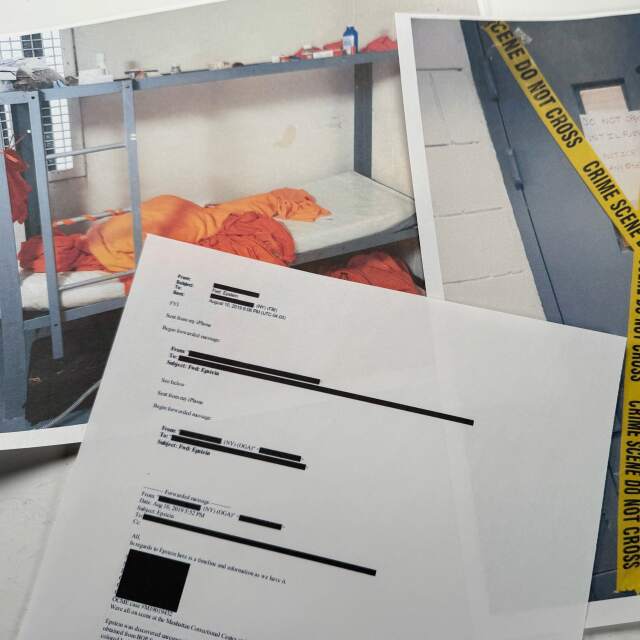
1:51So as always, if you or anyone you know is having thoughts of self-harm, the National Suicide and Crisis Hotline number is 988. Or you can join us again in about 10 minutes. This story is about the recent claims by forensic scientist Michael Freeman that the convicted sex offender Jeffrey Epstein did not die by suicide by hanging in his jail cell in 2019, as New York City's chief medical examiner determined. Last November, Jeffrey Epstein's brother Mark gave the autopsy results to forensic scientist Michael Freeman. This month, after a year of studying the results, he concluded Epstein's wounds were consistent with murder.
2:29Now, the investigation of Epstein's death was highly criticized, but the medical examiner's office is standing by its conclusion of suicide. So far, one peer-reviewed journal has declined to publish Dr. Freeman's work, but a week ago, he and two scientists he worked with presented their findings to a London legal society. Dr. Freeman teaches both in the Netherlands and at Oregon's Health and Science University. He's also a fellow of the Faculty of Forensic and Legal Medicine at the Royal College of Physicians in the UK, and senior scientist and director of the consulting firm Forensic Research and Analysis.
3:03He joins us from Oregon. Professor, Dr. Michael, welcome. Thank you. Nice to be here. Well, some other givens. Mark Epstein says he didn't pay you. You are not a board-certified forensic pathologist like medical examiners are, but have two doctorates in forensic medicine and epidemiology, and you study cases in which there might have been bias. For instance, in the George Floyd case, it was you who determined he did not die from previous health issues. So Epstein, start with these very graphic photos of his neck. We'll have a link at herenow.org. You say the markings are not consistent with how Epstein was found.
3:39Well, I was first shown the photographs more than a year ago. There were a couple of photos that depicted the shape, the orientation, distribution, and depth of the ligature mark, the mark made by what the body had been suspended from. And it was largely horizontal across the neck, which would be somewhat unusual for a suspension. Typically, you would expect the marks to slope up toward the ears. And there was this odd-looking double mark. There was sort of a Y branch on the right side of the neck, which also would be unusual for a suicidal hanging where there was no other violence to the body.
4:18So I asked to see the entire file. I obtained it from the next of kin and then made a full evaluation of all of the information, which did take the better part of a year. Yeah. And by the way, you obtained it from Mark Epstein. He wanted you to go deeper. If the marks to you did not seem like a hanging. What did the marks say to you? I can't look at the marks alone and say, this is definitely hanging. This is definitely strangulation. There are scenarios where the marks could be accounted for by a suicidal hanging, just the marks from the ligature. But without pairing that information to the circumstances in which the body was found, that was the critical missing piece.
5:00The medical examiner never had it. That information didn't come out until two years after the death. And so my goal was to take the information we knew about how the body was found, apply a biomechanical analysis based on applied physics to look at what kind of marks you would expect given how we knew the body was suspended, and then match that with the autopsy findings. And talk more about the biomechanical analysis. You created models, I understand. Yes, we completed a three-dimensional model where we could map out where the injuries were, and then we could move the model around in space to figure out how the model would be positioned relative to where the ligature had to be.
5:42There were also bruises to the body that wouldn't be consistent with just a hanging. There were a lot of things you saw in these photos, including you saw things that were left in the cell, including one piece of orange fabric. Yes, the cell was not investigated as a crime scene at any point in time, despite the fact that the initial determination by the medical examiner was that there could not be a determination whether it was a suicide or a homicide. No material from the cell was recovered with the exception of a noose that was unrelated, picked up by an EMT, and put on the gurney as they moved the body out.
6:18No DNA, no fingerprints, nothing. You mentioned DNA, and that reminds me that you feel you also saw evidence of fingernails scratching above whatever the method was on the neck, indicating that perhaps Epstein had tried to stop someone from strangling him, but might he also try to stop their own hanging? Sure. Until you realize, though, that Epstein's body was found in a seated position with his buttocks about an inch to an inch and a half off the ground, suspended by a noose that was behind him, all he had to do to take the force off the noose was to bring one foot up and stand up. The scratching at the neck, which is above the ligature mark, cannot be caused by the ligature.
7:07You can start a ligature down low, and then it can gradually slide up, but it can't ever start high and then go down. Well, something that can is a method that someone might have used to strangle someone. And you saw something in the photos might have been that. It was a piece of fabric. It was never examined. When the medical examiner was asked three years later by the Department of Justice investigators, what do you think was the ligature? She said that she thought that a good candidate for the ligature was a piece of edging that had been torn off of a towel, which could have served as a ligature to hang the body.
7:42It also could have served as a ligature with which the body could be strangled. Yet it was never even picked up from the scene. Look, you're not the first to question the medical examiner's conclusion. In 2020, forensic pathologist Dr. Michael Bodden told 60 Minutes that the neck injuries raised doubts for him, but the New York Medical Examiner's Office, as you know, stands by its report. The New York Times did an in-depth report in June and wrote that almost none of the scientists they spoke with said that the question of manner of death could conclusively be settled. In other words, they didn't agree with the medical examiner's office.
8:17It was suicide. What makes you so sure? Well, it's a matter of exclusion of the impossible. It's based on this old premise from the Sherlock Holmes stories, which is once you've ruled out the impossible, the only remaining explanation is the truth. and in this particular case, we have injuries that could not have resulted from a suicidal hanging as described by the guard. And so if those injuries could not have occurred based on what we know from the guard who gave information two years after the autopsy, the only thing that's left is a homicide. Exactly how the homicide was accomplished, we can't say that.
8:55But if we can say it's definitely not suicide, well, it certainly wasn't a natural death. He didn't die of old age in that cell, and it wasn't an accident. He didn't slip on a bar of soap. So we don't have any other explanations. And a lot of people are not wondering as much about the what, but the who. Why do you think so many of your peers have not been as willing as you to speak about this? No one in the forensic community is saying what you're saying. They're using words like inconclusive. That's because nobody else has done the analysis we've done. Nobody else had the records that we did.
9:26We released the records to the public. Everybody else can now do the same thing we did. But we also did a very detailed analysis of how the injuries would have been caused given the circumstances. So it's not good enough for someone to say, well, anything can happen in a hanging. That's not an analysis. So we did an analysis suitable for a scientific publication, which we will be submitting within the next two weeks. And we'll see how we fare with that. Those of us who are involved with this feel very comfortable standing on the quality and the conclusions of what the analysis was. And just very briefly, why does this matter?
10:04Well, because the next person who dies in police custody or in state custody is not going to be a multimillionaire white accused sex trafficker with lots of resources and lots of public interest. It's probably going to be a young black male who dies while being restrained by police. And if it's easy to, in a case like this, where there is so much public scrutiny and so much public attention to what the conclusions are, to be able to say, well, we don't have to show you why we said what we did. We're just saying it. And so you don't get to question it. We're not going to explain it further. Nobody gets to examine this anymore.
10:42Then it's certainly going to happen more often to somebody who doesn't have the resources and isn't as of great public interest as Jeffrey Epstein was. That's forensic scientist, professor Dr. Michael Freeman. His new analysis of Jeffrey Epstein's autopsy report concludes Epstein was killed and didn't take his own life, as concluded by the New York City Medical Examiner's Office, which stands by its conclusion. Michael, Dr. Freeman, thanks so much. We'll stay in touch. Thank you. All right. Thank you very much for having me. Coming up next, more about the continuing fallout over President Trump's extraordinary intervention in the NVIDIA scandal.
11:23Indira Lakshmanan has that in just a minute.
11:33Stay tuned for the following announcements and messages from our sponsors. The Trump administration has blacklisted Singapore-based Megaspeed, the company at the center of the scandal embroiling the leading U.S. chipmaker, NVIDIA. This on the heels of Jensen Huang being reinstated yesterday as CEO of NVIDIA, despite his admission of an affair with an alleged Chinese spy who was an executive at Megaspeed. The events have raised concerns about whether sensitive information and technology was being passed on to China. Joining us now to discuss the national security fallout, the export control loopholes China is exploiting, and what Congress must investigate next is Gina Raimondo.
12:17She was U.S. Secretary of Commerce under President Joe Biden. Madam Secretary, welcome. Good morning. Thank you for having me. Or good afternoon, I guess. So you oversaw export controls that were imposed on China to keep the most advanced AI chips out of their hands. Can you talk about what was the concern at the time with regards to national security and what concerns do you still have now? Yes, thank you. So the concerns then were the same as the concerns now, which is that we, in order to protect America and Americans from China, we need to stay ahead of them on artificial intelligence. And that means to the extent that we have AI semiconductor chips that are more sophisticated and more powerful than theirs, we need to deny them those chips.
13:13Because we know, you know, we know that China is trying to have access to our chips to put into their military, to use against us for AI-powered cyber attacks, to put into surveillance. And so, you know, what I had to do, they're very, very difficult decisions, and they do involve denying U.S. companies revenue because you tell a U.S. company you can't sell that chip to China. But I always felt that national security was the North Star, and frankly, we couldn't put a price on it. Well, these concerns over the Singapore-based company Megaspeed date back at least to 2024. When you were in charge of the Commerce Department, an investigation was launched into Megaspeed to try to figure out if it was a front company that was merely bringing the advanced chips in the front door and taking them out the back door to give them to China.
14:08So let me ask you, at the time, was anyone at the Commerce Department aware of Alice Huang and her close relationship with Jensen Huang or of allegations that she might have been a Chinese security asset? I never knew. I had never been privy to any intelligence of the kind related to her. However, the Megaspeed, what you just said, is extremely common technique by the Chinese government and Chinese military. They will set up shell companies, front companies outside of China to get around our export controls. They will then purchase high quantities of those chips, and somehow all of those chips find their way into China, into the Chinese military apparatus, into the Chinese intelligence community.
15:07And, you know, they have a whole web, a whole network of these front companies all over the world, not just in Asia. And so the U.S. government, including the Commerce Department, is constantly trying to get intelligence on these companies. And when we have enough evidence, we'll put them on the entity list. Right. Now, we know that the current Commerce Department, under Secretary Howard Lutnick, actually suspended an investigation into Megaspeed. We also know that Jensen Huang, who you worked with when you were Commerce Secretary, you have referred to him as a genius. He became very close to President Trump.
15:46He pushed the current administration to loosen export controls that you were in charge of putting into place. The same Jensen Huang has admitted to having an affair with this woman who's alleged to be a Chinese spy. Do you believe Jensen Huang himself is a national security risk? We don't know. What I know is there needs to be full and complete investigations. And I do think Jensen is a genius. I stand by that. I had a very professional and productive working relationship with him. And NVIDIA is a company that matters a lot to America. That being said, this is America. I don't care if you're penniless or the founder and CEO of one of the most valuable companies on the planet.
16:39You need to be held to the same standards. You need to be held to account. And there needs to be right now the FBI has an open investigation. The SEC is investigating. Congress is planning to investigate. So let's just let the process play out, right? Like let's do the investigation. let's determine if in fact Jensen or anybody else did anything wrong. We don't know until we fully investigate. And I would say we can't allow those processes to be subverted because no one should be allowed to put America's national security at risk. That's Gina Raimondo, U.S. Secretary of Commerce under President Joe Biden.
17:23Thank you so much, Secretary. Thank you.
17:32Stay tuned for the following announcements and messages from our sponsors. 22 states will have a democratic trifecta next year, meaning they'll control the governor's mansions and both chambers of their state's legislature. That means they could take up a plan to effectively end a wonky instrument of American representative democracy that has been criticized for decades, the Electoral College. Some say the plan is unconstitutional. But Jesse Wegman says it's worth a shot. He's the author of Let the People Pick the President, the case for abolishing the Electoral College. He spoke to Indira Lakshman on.
18:11So Jesse, the Electoral College is controversial. Is this a plan to eliminate it by using a constitutional amendment? Or is there some other way to try to effectively bypass the electoral college? Yeah, I mean, a constitutional amendment right now is not viable just because the lift is too high and too hard. What this is, it's called an interstate compact. It was just an agreement among states to do something. In this case, the states are agreeing to award their electoral votes in a different way than they currently do. Right now, almost all states award their electors to the candidate who wins the most votes in their state.
18:54That's called the state winner take all rule. But it is just one of many options states can use. The Constitution is very clear that states have total control over that choice of how to award their electors. So the compact's ingenuity is in its design, which is to get states to just change that method. And the states that are members of the compact will instead award their electors to the candidate who wins the most votes in the entire country, the national popular vote, as we call it. So when states representing a majority of electoral votes, which is what you need to win the presidency, join this compact, you automatically get a president who always wins the popular vote.
19:33All right. Well, let's step back and give people some context. It was back in 2000 when Al Gore won the popular vote but lost the presidential election to George W. Bush that this National Popular Vote Interstate Compact was created. 18 states that were led by Democrats at the time have signed on to it since. Are we likely now to see additional states sign on next year? Yeah, after the midterms in early November, five new states gained Democratic trifectas. And that means they are more likely to pass this compact. It doesn't mean that Democrats are the only ones who are interested in the compact.
20:14But so far, because of the national political environment, it has been easier to get the compact through Democratic-led states. So these five states, Michigan, Pennsylvania, Wisconsin, Arizona, and Nevada, all now have Democratic leadership. And that Democratic leadership has already expressed strong interest in the compact, if not had already, you know, passing bills in earlier sessions. So the chance is much higher now than it's ever been. But would people be enraged if their state completely flipped to support the opposite candidate that most of the residents of that state picked? I don't know.
20:51I mean, I don't think so. I think some people might be upset, but it's, you know, people don't care about what happens in their state. They care about who wins the election. People don't vote because of what state they live in. They vote for the candidate they want to win. If the candidate they want to win wins, they're happy. They don't care what the result in their own state was. So I just don't think that, you know, that's going to be a major issue. If this compact is adopted before the next election or before 2032, those will be the rules in place. People will be told about them. People will understand them.
21:25And just as today, when the result often doesn't go the way people want, they'll accept it. Well, talk about what the support is nationally for a move like this. We know that Democrats have won the popular vote in seven of the eight elections before 2024. So who is pushing for this? Is it partisan or is this something that Americans across the board want? You know, people of all political stripes have argued in favor of a popular vote for president. up. There was support was as high as 80 percent in the late 1960s when the House of Representatives actually passed an amendment to abolish the Electoral College and replace it with a popular vote.
22:08But that died after a filibuster in the Senate. So it's always been political and it's always been something that, you know, one party or another thinks works in their interest. And so they block any reform. Now, critics of using this method say that a change this big should only happen with a constitutional amendment. What do you say to that? I mean, you know, there's no harm in passing it as a constitutional amendment. I think the bottom line is that this does not violate the Constitution. It is not an end run around the Constitution, which is what a lot of critics say. It is literally using the language of the Constitution in the same way that all states currently use it today, which is for states themselves to choose how they award their electors.
22:55Before I let you go, how likely do you think it is that this could actually be passed and that in the next election or others going forward that we could see our candidate elected through a national popular vote? I think there's a very good chance it could clear that threshold of 270 electors within the next legislative session in 2027. There are still legal challenges, obviously, that would end up at the Supreme Court. And I would not dare to guess how the Supreme Court would handle them. But I think that all of the legal challenges have good answers to them. And I think that the compact has the stronger case to make.
23:34Jesse Wegman is a senior fellow at the Brennan Center for Justice and a contributing opinion writer for The New York Times. Jesse, thank you so much. Thank you so much.
23:49That's it for the show today. Here and Now, Anytime comes from NPR and WBUR. Today's stories were produced by Karen Miller-Metzen, Jessica Carissa, and Joel Ryan. Our editors were Mark Nabin, Micaela Rodriguez, and Michael Scotto. Technical direction from Caleb Green and Matt Reed. Our theme music is by Mike Moschetto, Max Liebman, and me, Chris Bentley. Our digital producers are Alison Hagen and Grace Griffin. And Here and Now's executive producer is Alan Price. Thanks for listening. We'll be back with you tomorrow.
24:34Stay tuned for the following announcements and messages from our sponsors.
Scan the code with your iPhone camera
Listen in the app.


