In short
Paul Kingsnorth argues that “the machine” is a mindset that treats the world as parts to be redesigned, leading to the “death of Western culture” and preparing the way for AI/superintelligence as a quasi-religious project. He frames today’s culture wars, surveillance, and algorithm-driven polarization as “apocalyptic” in the literal sense (revelation), unveiling how digital life enslaves attention and inflames passions.
Guest background
Paul Kingsnorth is a novelist and essayist, a former direct-action environmental activist, known during COVID-19 for his viral three-part series The Vaccine Moment. He later moved through Zen Buddhism, paganism/Wicca, and became Orthodox Christian, saying this clarified his critique of modernity.
Key claims
AI creators are building a “false god” and may be ushering an Antichrist-like future; the machine is broader than AI (a century-long trajectory from Industrial Revolution technique); screens and abstraction erode apprehension, community, prayer, and the past.
Notable examples
Ray Kurzweil/Google’s singularity framing; COVID-accelerated Zoom/digital immersion; social media algorithms whipping users into “fanatical opposing camps”; “digital holding camp” and monitoring; transgenderism as a case amplified by smartphones and identity-labeling.
Written by AI. May contain mistakes. Listen to the episode to check what was said.
Chapters
Tap a time to open that second in VOPaul's Journey to Christianity
3:30 to 7:42
Paul discusses his spiritual journey from environmental activism to Christianity.
“Paul Kingsnorth, welcome to Hidden Forces.”
The Quest for Meaning
7:42 to 9:08
Exploring the deeper meaning behind human existence and relationships with nature.
“One more question about your religious journey before we get into the book.”
The Machine and AI
9:08 to 9:46
Discussion on AI as a manifestation of a deeper metaphorical machine in society.
“in Against the Machine, which I suppose runs along two parallel paths.”
The Birth Pangs of AI
9:46 to 10:52
Paul articulates the profound changes and challenges brought by AI.
“all we know is that some force has been unleashed in our world, which we are struggling to contend with.”
The Machine and AI
10:52 to 14:00
Discussion on AI as a manifestation of a deeper metaphorical machine in society.
“or that you argue we're being prepared for here?”
Understanding the Concept of the Machine
14:00 to 18:11
Explore the broader implications of the term 'machine' in modern context.
“because not everyone will necessarily be familiar with your work, it would be helpful to know explicitly what you mean when you use the term machine.”
The Relationship Between Humans and Machines
18:11 to 22:38
Discuss how societies progress towards machine-like structures and its implications.
“that we're always periodically attracted to, that some cultures will manifest more than others.”
The Apocalyptic Nature of Our Times
22:38 to 28:01
Delve into how modern society reflects apocalyptic themes through technology.
“And as you say, it's very difficult for us to actually apprehend reality.”
Understanding Our Technological Moment
28:01 to 29:18
Explores the difficulty in grasping the implications of modern technology on society.
“Why do you think it's so hard for people to understand what's wrong?”
The Complexity of Modern Life
29:18 to 31:06
Discusses the bureaucratic complexities and psychological alienation in today's world.
“adults are addicted to their smartphones.”
Show all 15 chapters
Cultural Identity and Alienation
31:06 to 36:15
Analyzes the impact of digital technology on cultural identity and the sense of belonging.
“You have a place, which is the place you live in, the place you know, it gives you a connection to nature.”
The State of Modern Culture
36:15 to 42:01
Debates the erosion of culture in contemporary society and the implications of culture wars.
“gender and sexuality and all sorts of things.”
The Culture War and Its Roots
42:01 to 45:50
Exploring the nature of modern culture wars and their implications.
“these woke people from the institutions, our culture would be working again.”
The Four S's of Modern Culture
45:51 to 50:06
Discussing the replacement of traditional cultural pillars with modern constructs.
“I was born in 1981, the year that Ronald Reagan was elected president.”
Nostalgia and the Search for Meaning
50:07 to 52:16
Reflecting on nostalgia as a longing for a lost sense of home and meaning.
“how everything was terrific at a certain period in the past.”
Transcript
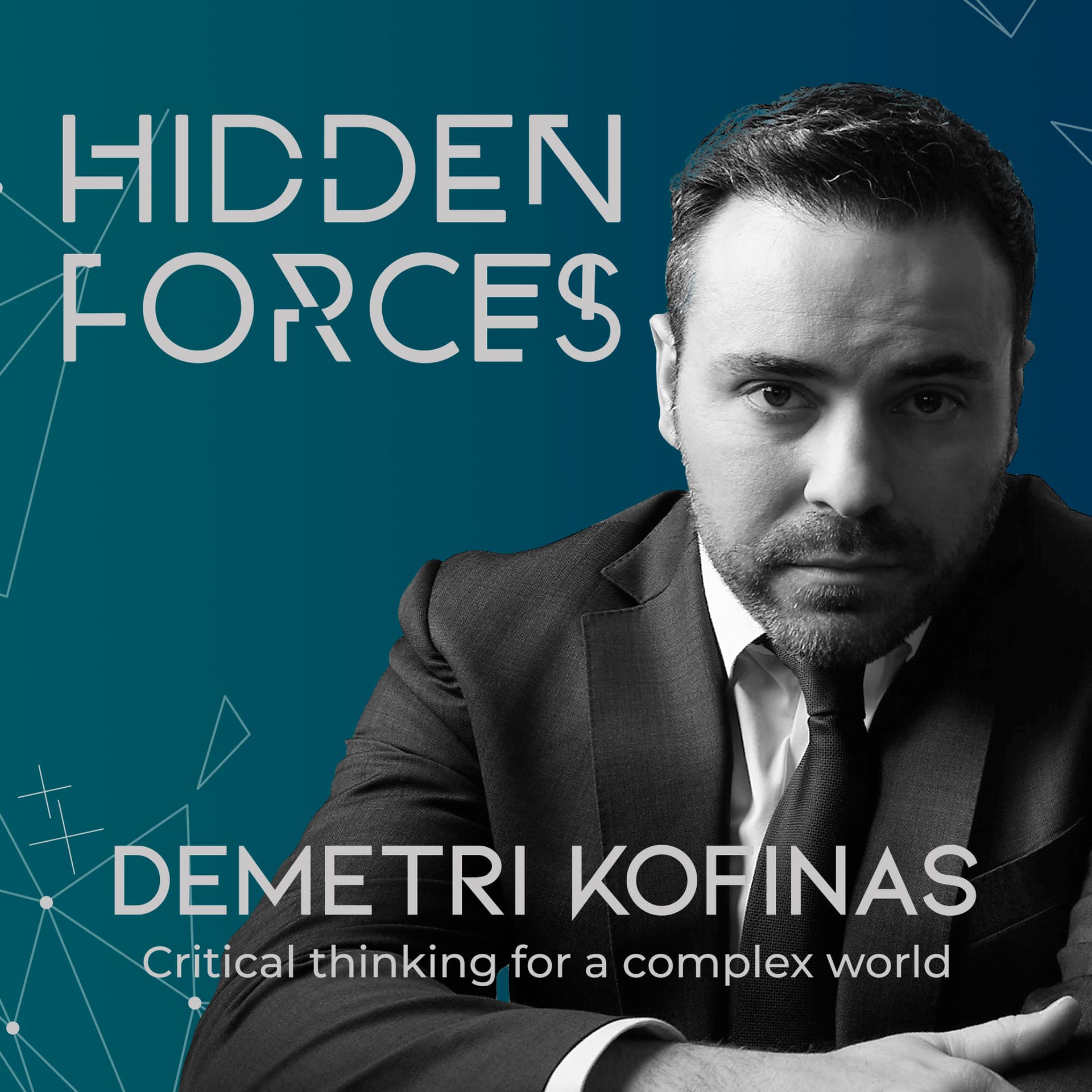
Automatic transcript. May contain errors.0:00Demetri Kofinas:What's up, everybody? My name is Demetri Kofinas, and you're listening to Hidden Forces, a podcast that inspires investors, entrepreneurs, and everyday citizens to challenge consensus narratives and learn how to think critically about the systems of power shaping our world. My guest in this episode of Hidden Forces is Paul Kingsnorth, a novelist, essayist, and former environmental activist who first came on many people's radars during the COVID-19 pandemic with the publication of his viral three-part series, The Vaccine Moment, and whose current work explores the intersection of technology, culture, and the divine.
0:40Demetri Kofinas:In Paul's latest book, Against the Machine, he examines how our increasingly mechanized way of seeing and being in relationship to the world and ourselves is responsible for what he describes as the death of Western culture and what it would take to reclaim our humanity and save our souls. Paul and I spend the first hour of our conversation tracing his journey from direct action environmentalism through Buddhism and paganism to his eventual baptism into Orthodox Christianity. and how that quest informs his critique of what he describes as the machine. We discuss AI as a false god, and as the possible conduit through which humanity may be ushering in the Antichrist, how Paul's machine framework relates to the popular theories of Jacques Ellul and his concept of technique, and Ian McGilchrist and his model of the left and right brain.
1:31Demetri Kofinas:We also explore why this moment in history feels apocalyptic in the literal sense of that term, that something is being unveiled. Perhaps more accurately, that something is being born through the wires and towers of the web, through the electrical pulses and touchscreens of our connected devices. The conflict and strife we're experiencing, the culture wars, the political infighting, are its birth pangs. The internet, its nervous system. Its body forms in the cobalt and silicon, while its mind is being built by the steady, 24-hour pouring forth of your mind and mine, and your children's minds, and your countrymen's.
2:10Demetri Kofinas:As Paul so evocatively writes, through our efforts and our absent-minded passions, something is crawling towards the throne. The second hour turns to a conversation about how we should each respond in this consequential time, how we draw practical lines around our technologies, how to rebuild our communities, how to guard ourselves against charlatans and false prophets, and why love and nostalgia can guide us home. If you want access to all of this conversation, go to hiddenforces.io slash subscribe and join our premium feed, which you can listen to on your mobile device using your favorite podcast app, just like you're listening to this episode right now.
2:53Demetri Kofinas:If you want to join in on the conversation and become a member of the Hidden Forces Genius community, which includes Q &A calls with guests, discounted access to third-party research and analysis, and in-person events like our intimate dinners and weekend retreats. You can also do that on our subscriber page. And if you still have questions, feel free to send an email to info at hiddenforces.io, and I or someone from our team will get right back to you. And with that, please enjoy this incredibly important and deeply meaningful conversation with my guest, Paul Kingsnorth.
3:34Demetri Kofinas:Paul Kingsnorth, welcome to Hidden Forces. Thanks very much. Nice to be here. I'm super excited to have you on, Paul. People who may not be immediately familiar with your name may know you from having read The Vaccine Moment, which was a three-part series. They may have read only one of the parts during the pandemic, but that's how you first came on my radar. Before we start, I'd love to learn a little bit more about you. How did a nice environmentalist like you get mixed up with Orthodox Christianity? Yeah, it's an interesting career path, isn't it? Well, it's a long story, but we've got a couple of hours.
4:09So I suppose the answer to that question is that what I've been doing for a long time, and this is really something that threads through all of my writing and all of my books, which maybe we'll talk about later, is a quest for meaning, which is also a spiritual quest. And even though when I was a younger man, I wouldn't have framed it in those terms. I think that I have, since I was young, been on this kind of strange search for meaning. So you said I was an environmentalist. So the way that that panned out was that as a young man, I just grew up in an ordinary English suburb. And my dad used to take me on long walks across the mountains, long camping trips for weeks at a time.
4:50And the contrast between the kind of suburban upbringing I had and the experiences I had in nature, I suppose, was very profound for me. And something was going on there, which was not really reachable by the rational mind. And probably a lot of people will experience this and would know what I'm talking about. The experiences you may have on a mountain at sunset or in a forest or anywhere that's profoundly wild and different are experiences that you can't necessarily rationalize. And I had this profound love of nature that came from that, which I couldn't really quite explain. And that led me when I was at university in the early 90s into environmental activism.
5:25I mean, literally locking myself onto things to stop bulldozers destroying forests so that they could build roads, real direct action stuff. And for a long, long time, I considered myself to be an environmental activist, somebody who wanted to use politics and activism to protect the natural world. And at the same time, I was digging into the big question of why do we seem to be destroying so much of our natural heritage, what's the hidden force, if you like, behind that? Is it economic? Is it spiritual? Is it political? What's going on? What can we do? And the older I got, the more I realized that that was actually a question that was much deeper than just a question of what economic system we were running or what politics we had or whether left-wing or right-wing people had the right ideas.
6:06It was a question of relationship, really. It's a question of what our relationship is to the rest of nature, whether that might be broken. And there's the bigger question of what actually is the meaning of any of this? Where does it come from? What is nature? What is a human? And I suppose when I was in my 40s, I started digging into so-called spirituality in a serious way. I went on a Buddhist retreat for my 40th birthday, ended up as a kind of practicing Zen Buddhist for six years or so. But something was missing from that, and I didn't know what it was. The search led me through mythology, through kind of paganism, through Wicca in the end, and then eventually through a series of experiences, which I didn't expect at all, which were really experiences of Christ, actually, I ended up becoming a Christian, which was the last thing I expected or wanted.
6:50I was a bit like C.S. Lewis. I kind of felt myself dragged reluctantly towards this thing that I thought was the truth. And I've ended up in a position now where, as you say, I'm a member of the Orthodox Church. And curiously enough, this past I've had of political activism and writing and environmentalism makes a lot more sense to me in retrospect now that I feel like I've arrived somewhere that gives me a picture of reality. But yeah, it's maybe not a usual path. I don't know if there is a usual path, but I mean, having said that in the West today, certainly where I come from, there is no usual path because we kind of grow up, maybe not even atheist, but people who certainly in Britain don't have any sense of religion or spirituality as it were at all.
7:34So we have to go and find our own way. We have to kind of wade through all the traditions of the world and search for the truth, which can be a long journey.
7:41Demetri Kofinas:So I'm kind of torn between whether I want to ask you one more question. All right. One more question about your religious journey before we get into the book. You said that something was missing when you were searching. You were on the spiritual path. You started with Buddhism and then you went down some other roads, paganism, et cetera. What was it that was ultimately missing that you were able to find in Christianity. Yeah, what was missing was God. I mean, that's what's missing from all of these paths. The kind of forbidden word. And it's interesting, as I say, growing up in a very kind of secular England, that people will talk a lot about spirituality, but they'll never talk about God, at least not in a way that's specific to a tradition, say the Christian tradition, the Trinitarian God, the incarnation.
8:23These are not things people talk about or even really know how to talk about. And I sort of fought against the possibility that there might actually be an intelligent creator who had our interests at heart for a long time because I didn't want to believe the story and I didn't think I did believe the story. And I suppose like a lot of other people, I wanted to sort of make up my own spirituality as I went along, which is always the convenient thing to do. But that was what turned out to be missing. I had a strong sense that I was being called by somebody and I fought it for a long time. And then I stopped fighting it.
8:54And that's what happened. And the thing that was missing was Christ in the end, which is what, as I say, led me to Christianity much against my own, well, much to my own surprise.
9:03Demetri Kofinas:Well, I'm sure we're going to have an opportunity to discuss more of your journey in depth in this conversation, Paul, because it informs so much of the larger story that you tell in Against the Machine, which I suppose runs along two parallel paths. One is, I would say, I would describe it as the story of what's been lost, a story about our culture and our identity, and the other is about what is struggling to be born and the machine, as you call it. I'd like to start by maybe quoting a passage from the book where you address the birth pangs, as you describe them, of this thing that is being ushered in.
9:44Demetri Kofinas:You write, quote, all we know is that some force has been unleashed in our world, which we are struggling to contend with. A huge change is birthing itself. Something is being ushered in. Through our efforts and our absent-minded passions, something is crawling towards the throne. The eruption that is shaping and reshaping everything now, the earthquake born through the wires and towers of the web, through the electric pulses and touchscreens and the headsets, these are the birth pangs. The internet is its nervous system. Its body is coalescing in the cobalt and the silicon, and in the great glass towers of the creeping yellow cities.
10:25Demetri Kofinas:Its mind is being built through the steady 24-hour pouring forth of your mind and mine and your children's minds and your countrymen's. Nobody has to consent. Nobody has to even know. It happens anyway. The great mind is being built. The world is being prepared. That is quite a passage, and I must say the vision of something crawling towards the throne is quite evocative, Paul. What is it that you think or that you argue we're being prepared for here? What is being birthed in your view? Well, the simplest answer to that is that what I'm describing there is what people are calling AI, and particularly this quest for a superintelligence, which is going on now very openly.
11:10And if you listen to the people who are either warning against that quest from a position of expertise, or indeed who are involved in putting it together. And interestingly, those are often the same people these days. The people creating AIs are often the ones warning us against what it could do. You will hear a couple of different claims. You'll hear firstly, the claim that within five to 10 years maximum, the entirety of the world is going to be transformed by the creation of a superhuman intelligence of some kind. And this is what has been openly worked towards since at least the 1950s. And the second claim is that once that happens, the potential for disaster is very high indeed.
11:50There's a good deal of research and writing in the book in Against the Machine about these people in Silicon Valley and the people in the generative AI world especially, and what they're actually doing and what they think they're doing. And if you listen to what they say about it, they're often very open about the fact that they consider it to be a spiritual project. They talk about ushering something in. They talk about making God and building God. They talk about uploading minds into cloud files so that we can live forever. There's a actually curiously Christian inflected story about creating a paradise and building God.
12:25Most famously, maybe Ray Kurzweil, who's the head of engineering at Google, who's the great prophet of the singularity. He was asked if he thought God existed and his answer was not yet. So what's going on here is very open, very conscious project to build something that is greater than our intelligence, which will in many cases supplant us. And many of these people think it's inevitable that it will. This is the next stage of evolution. So that's what's going on. I think that a lot of these people don't really know what they're doing. And it feels to me like there's a kind of spiritual darkness at the heart of this.
12:59There's a lot of people out there talking about ushering things in, and they don't know what they're ushering in. And if you wanted to sound like a biblical prophet, then the thing that they're ushering in sounds very much like the thing that was talked about in the Garden of Eden when eating the fruit from the tree of good and evil made us as gods. So these people are doing something that I don't think even they quite understand. But there's no doubt at all that we're going into the age of superhuman intelligence, whatever that quite means, and whatever the implications of it are. Everything is moving so fast that even the people creating it don't know what's happening within the systems that they're building.
13:31So that's the simple answer to the question. As I say, it seems to me there's a kind of strange spiritual picture of what's happening that even I don't really understand, but it's a dark one.
13:41Demetri Kofinas:So from my reading of the book, the machine is more of a metaphor that describes a particular way of seeing or approaching or being in relationship with the world. And AI is a manifestation of that perspective. Just so that we're clear as we progress into this discussion, because not everyone will necessarily be familiar with your work, it would be helpful to know explicitly what you mean when you use the term machine. And what was the inspiration for this term? Was it something that other people were using? Is it some composition of a series of ideas? What was the inspiration for this? Well, I start the book in the introduction by talking about where I get this term from, this notion of the machine.
14:27And you're right, The machine is not just AI. The machine is not just the digital world that we inhabit now. It's not even just technologies. It's something bigger than that. Now, it's not my term. It's a term that I have borrowed from a lot of writers who came before me, poets like D.H. Lawrence or R.S. Thomas or Robinson Jeffers, novelists like George Orwell or Aldous Huxley. What we've had for about 100 years in poetry, in fiction, and in films, go from Metropolis to The Matrix via The Terminator, is a story being told about this force that rises from the kind of minds that we have built for ourselves since the Industrial Revolution.
15:07Now, you mentioned Ian McGilchrist earlier. There's a whole chapter on his work in the book. But if you were to take the notion that Ian McGilchrist talks about the human brain is divided into two, that the left brain is excellent at seeing the parts, the right brain sees the whole, and that the left brain has effectively usurp the right brain, and so we see the world now as a series of parts, then another way of putting that is that we see the world as a machine. And we've been building a machine since at least the Industrial Revolution, actually probably much earlier than that. And we have created a system which as much as anything is a mental map.
15:39And the technologies that exist are just a kind of effusion of the mental map. We've created a world in which we don't see, when we look out of the window, we look into the natural world, we don't see an organism, we see a mechanism. We see a world which is a series of parts which we can take apart and redesign and put back together for our own pleasure or our own profit or our own progress. And that's how you get to the idea that the fundamental goal of human progress is to build a giant godlike intelligence that will enable you to live forever. It's a refusal to live in the world and a desire instead to create a new world.
16:15So the machine, as much as anything, it certainly is the sum of its parts. It certainly is all the technologies that we built around us, this very technologized, very mechanized, very digitized world that we all have to inhabit now. But as much as anything, it's a way of seeing. It's a way of seeing which views the world as a collection of parts that humans can take apart and put back together in whatever order they like.
16:36Demetri Kofinas:How does your notion of the machine relate to Jacques Ellul's concept of technique? Yes. There's a fair bit about Ellul. in the book as well. I would say that what Elul calls technique is the mindset that maybe it's a way of saying a similar thing. Technique is a way of seeing. Technique is a way of relating to objects, a way of relating to the world, which again ends up creating what Elul sees as an inhuman society. So it may be that the machine is the ultimate manifestation of technique as a way of seeing. That might be a good way of putting it. So in dynamical systems theory, there's this something known as an attractor, which is a state or set of states toward which a system evolves.
17:20Demetri Kofinas:Is there some sense in which the machine can also be thought of in these terms, that it's always there? It's almost like a fixed point in space that we are attracted towards and that people and societies tend to move towards over time? It's an interesting question. And the really interesting question is how far back this goes. One of the writers I talk about in the book is Lewis Mumford, who wrote a two-volume book in the late 60s called The Myth of the Machine. Mumford traces this right back at least to ancient Egypt. He sees the pyramids as the first manifestation of a machine society. He sees ancient Egypt as what he calls a machine made of human parts, the parts in that time being slaves.
17:58We don't need slaves anymore, at least not slaves in the countries we live in. The slaves are nicely hidden away in Africa or Asia, but we also have digital slaves to do the work for us. But the mentality is the same. So I think it's quite an interesting question. You could almost see the machine as something that we're always periodically attracted to, that some cultures will manifest more than others. There's something in at least some human societies that wants to push on, wants to progress towards, that ends up manifesting again and again and again in this kind of giant, very inhuman, technocratic society.
18:33And the technologies may differ, but the mindset's very similar.
18:37Demetri Kofinas:So let me try to play with this framing. One of the things I really like about how Ian McGilchrist talks about this is he says that the left brain is focused on apprehending, whereas the right brain is focused on comprehending. And when I think about your work around the machine and also what McGilchrist talks about, it feels like one of the ways in which this manifests is that we create superstructures and schemas and maps in our heads to navigate the world and to exercise power in the world. And the conversion of the world to an increasingly machine-like world, it seems to me follows from taking those templates and those schemas and applying them more and more to that world.
19:20Demetri Kofinas:In other words, it seems like we increasingly in doing so, we lose the ability to see the world for what it is. And rather than see the tree, the actual thing in the world with its leaves and the wind moving the branches. We just see the schema of the tree. And increasingly the world gets schematized because by schematizing the world, it becomes easier to exercise power on it, even if we lose our ability to actually comprehend it in its deeper essence. Does that sort of follow or track with what you have written about? Yeah. That's a really interesting way of thinking about it. So again, what McGilchrist is doing is He's applying a huge amount of psychiatric and psychological and scientific research to produce an enormous body of work, which in some ways says a very simple thing.
20:08As you've just said, we've lost the ability to apprehend the world because we're too busy comprehending it. We can't see the forest for the trees. We can't see the territory for the map. And I think it's a really good way of thinking about it. And I think it also explains how different cultures see things so differently. So there are cultures on earth, I suppose an obvious example would be the cultures of Aboriginal Australia who have, at least historically before the arrival of Europeans, have had no interest particularly in comprehending the world in the kind of terms that Europeans would appreciate, but are extremely good at apprehending it, almost to the opposite extreme to the one that we have gone to.
20:44And what we've done, again, you can choose your timeframe, but we've certainly done it very, very fast since the Enlightenment scientific revolution, the industrial revolution, is we've gone very, very fast into a project, a scientific project, and this is really the aim of science, of being able to measure the world, being able to map and measure absolutely everything and turn everything into, as you say, a kind of a concept. And it's interesting to talk about a tree, for example. even the word tree immediately makes you conceptualize something rather than see it. I wrote a whole book years ago called Savage Gods, which was a kind of writer's interrogation of writing.
21:21And I wondered aloud in that book whether writing is something that gets you to the heart of things or whether it can also disguise them. Because of course, writing is almost the original technology of being able to distance yourself from the world. Once you can describe something in words and put it down on paper and have other people read it, people are reading your concepts rather than experiencing the world. And we've gone so far down that path now that not only can we look at a tree and see the concept of a tree rather than the being that's there, but over the last 10 or 20 years, we've gone into this digital universe where we can all create fictional representations of trees.
21:54And over the last couple of years, we've now been able to get AIs to do it for us. We have no idea if we're even looking at a real picture of a tree, let alone... So we're going further and further and further down this rabbit hole, which takes us away from experiential reality and towards a kind of abstraction. And the more abstraction we have, the more easy it is for us to live inside this machine and the harder it is for us to step outside it. And now that we spend most of our times on screens, looking at screens, looking at other people on screens, like I'm looking at you now, we're being withdrawn more and more and more from just ordinary human relations and ordinary relations with nature.
22:31And it's not as if you need a giant plan or a conspiracy to do that, it's like boiling a frog. And the frog's boiling very fast now. And as you say, it's very difficult for us to actually apprehend reality. It takes an effort now for us to see the world in the way that maybe our ancestors would have seen it very easily on a daily basis.
22:49Demetri Kofinas:So I want to take another quote from the book, Paul. Like I said, I've got to do this a few times. This is also a rather long passage. You write, I don't think it's an exaggeration to say that the times we are living in would be regarded by many of our ancestors as apocalyptic. The degree of control and monitoring which we endure in developed societies, which has been accelerating for decades and which has reached warp speed in the 2020s, is creating a kind of digital holding camp, which we all find ourselves trapped in. The rising paranoia that extends now across the political spectrum through the Western world, the anger, confusion, the sense of broken promises and established systems coming up, All of this, I think, can be traced to the rise and consolidation of the machine, this great matrix which strips from us our understanding of what a human life is and makes us instead lonely cogs in its drive for self-creation.
Read the full transcript
23:47Demetri Kofinas:Can you elaborate a bit further on this passage, Paul? Specifically, what do you mean by this current time being apocalyptic? What is being revealed? and how was the machine responsible? Well, firstly, just to build on what I said just now, I suppose, the COVID pandemic, which you started off by talking about, whatever you think of vaccines or viruses or whatever, has radically accelerated our immersion in the digital world. I don't think anyone had even heard of a Zoom call before 2020. I haven't. I certainly hadn't. And most of the world is now spending a good deal of its time on them. We have been rushed very, very fast, even just over the last decade, into a world in which it's virtually impossible to live without a smartphone.
24:29It's virtually impossible to live without being online a good amount of the time. And that was not the case, as I say, even a decade ago. So society becomes digitized. And of course, the more digitized society becomes, the more everybody is connected to everybody else, the easier it is to monitor and control and manipulate situations and manipulate cultures. the culture war that's going on in in the united states and in britain and in much of the rest of the western world at the moment would not be happening at least in the same way to the same degree without social media without algorithms without the internet as a whole that's not to say that the issues wouldn't be there and people wouldn't be concerned about them but there's absolutely no way that we would have been whipped up into these kind of fanatical opposing camps without algorithmic social media pumping into your feed, whatever is going to make you angry and whatever is going to make you post again.
25:22And that, again, has accelerated very, very fast just over the last five years. There are so many grown adults out there acting like angry 15-year-olds on the internet because they've allowed themselves to be manipulated by these algorithms. We have seen this huge division of society. We have seen a kind of social breakdown because culture and politics can't keep up with what's going on. And we have seen, as I said, a world in which it's almost impossible for us to exist without the internet now, even if we want to. And that's completely unprecedented. We've never had a situation like that. So when I say it's apocalyptic, I mean that in the literal sense of the word, because the literal sense of the word apocalypse is revelation.
26:06In other words, something is unveiled. We tend to talk about apocalypse as a collapse or a disaster, and it might be that. But an apocalypse is a revelation. It's when you unveil something. It's when you remove the sheet and look at what's below it. So we're seeing unveiled something about machine society, something about technology, something about what we've allowed the digital world to do to us, and particularly how we have been very, very easily and very quickly enslaved by it. I mean, we're living in a world now that Aldous Huxley, the author of Brave New World would not have been remotely surprised about because it's a world he predicted quite effectively.
26:39And so did many other of those 20th century science fiction writers. But we've allowed ourselves to be coerced and corralled and manipulated. And we're now kind of trapped literally in a web or a net. And we don't really know how to get out of it again. But certainly from a Christian perspective, we're allowing our passions to be inflamed to such a degree that we're lashing out at whoever we can see the enemy is. And I think if there's an enemy, the enemy is the machine because it's this giant digital network that we're all caught in that's making us behave like this. Yeah.
27:12Demetri Kofinas:I mean, the use of the word paranoia, anger, confusion, broken promises, established systems coming up, this overbearing bureaucracy. I mean, all this resonates and can certainly resonate with many of our listeners. And I think this is what so many people are reacting to in the US today. And I think there's also a sense of surreality that you've picked up on and written about that I think we also see all around us. And I want to quote a passage from your book where you give voice to this. You write, quote, all across the culture now, there is an inverse relationship between reality and its perception, between nature and simulation, between map and territory.
27:46Demetri Kofinas:As a result, it increasingly feels like nothing is true and nothing is real. And yet we can't quite see what is actually wrong. This feels so true to me. And I'm curious to ask you, first of all, why? Why do you think it's so hard for people to understand what's wrong? What is it about this technology or this technological moment and how it affects our minds that is so different from the core technologies of the industrial revolution, where yes, people had to contend with drastic changes in how they perceive time and space with the introduction of the locomotive and telegraphy and the ability to illuminate spaces at all hours of the day.
28:28Demetri Kofinas:But I'm not aware of people losing their minds on this scale, which is what it feels like is happening today. And I'm curious to ask you, how do you make sense of this? How do you understand the seeming discrepancy at scale from previous technological revolutions to what we're experiencing today? Yeah, really interesting question. I mean, the first question you ask is, why can't we understand what's going on? Why can't we get a grip on it? And I think the answer to that is that everything's just so enormous that it's almost impossible to understand. Because I think the human mind is not actually capable of dealing with the things that it's having thrown at it at the moment.
29:06The sheer amount of information, the sheer amount of propaganda, as I say, the manipulative power of the algorithm, of advertising. It's not news that children are addicted to their smartphones. It's not news that adults are addicted to their smartphones. And that's because those things are designed to addict you. I mean, there's a huge amount of research on this. We know this is the fact. We know about so-called limbic capitalism, which is designed to give you a dopamine hit every time you see something. So we've allowed ourselves to be literally drugged by this form of technology, But we've also got a world which is now so complex, as you say, so bureaucratic, so many layers of bureaucracy, so many layers of government, so many layers of corporate power, so many layers between us and what we actually want to do.
29:49I mean, I don't know if you've had this experience. I imagine a lot of your readers have. You buy something, the thing you have bought doesn't work. You phone up the manufacturer and you get passed around a thousand different call centers in different countries and different people. And it's almost impossible to talk to a human being directly and find out what's actually going on. So it's almost as if every area of our lives is so bound up in so many layers of complexity that we can't see what the actual problem is. And that is hugely magnified by the digital age. It's interesting to talk about early technologies and industrialization, because if you look at some of the narratives, I mean, say you read William Blake, the great English mystic who's living in London during the Industrial Revolution in the late 1700s, when London's a much smaller place and the part of London he lives in is almost a village on the outskirts.
30:36He's writing in great depth about how this machine is coming to consume everybody. and yet he's still walking on the common. He's still living in a family and a community and the basic things of life are still there. There's a part of the book in which I try to define what a traditional society is made up of to try and work out what's gone wrong. This formula that I come up with is what I call the four Ps, which are people, place, prayer, and the past. In other words, you have a community around you that you belong to and you understand, that's people. You have a place, which is the place you live in, the place you know, it gives you a connection to nature.
31:15Even if it's in a town or a city, it's a community you understand. Then you have prayer, which is your religion, which is probably shared by the people you are around, although not necessarily. And then you have the past, which is your sense of history, your sense of where you came from. Now, I would say that this society we're living in now pretty much digs up and scatters all of those things. And so it makes us rootless and alienated from almost everything we can see around us. I mean, this is again, not a new claim. Marx was talking about alienation in the 1840s. It's a common theme. But even though we could look back and we could say, well, the giant industrial cities of the 19th century alienated people in a huge way from their landscape and from the communities they came from, they certainly did.
31:55That's accelerated again a thousandfold with the digital world. And I think it all comes back to the screen again, all the time, because we spend so much time on the screen now, we are literally not in the real world. Even in an industrial city in 1850, you're walking down the street, you're surrounded by human beings, they're talking to each other, they have not got their heads in their phones. There is not a thousand layers of bureaucracy for you to go through to get anything done. There are not a hundred different laws which prevent you from doing this, that or the other. You're not scared about what you can say.
32:21There isn't this kind of insane feeling that a digital algorithm is corralling you into thinking a certain thing and you're not even sure where that came from. You're not obliged to have opinions about something that's going on on the other side of the world that you saw on a screen today. I mean, how many horrors do we have projected into our head about what's going on everywhere from Gaza to, you name your horror zone? I'm not trying to downplay those things at all, but we feel completely helpless in the face of them. We don't even really understand them. We're required to have an opinion about them.
32:50Everyone's shouting about them. I think it's just kind of mentally overwhelming. And we're just not equipped as human beings to deal with what's happening.
32:59Demetri Kofinas:Yeah, that's also a great point because we have been, I think this was especially true in the pandemic period. We needed to have an opinion. It wasn't okay. It wasn't enough just to not have a view and just sort of observe and try and understand. You had to be on the quote, right side of history. Even if you didn't really understand what that meant, or even if the thing and transgenderism is a great example of that, because this came... Again, this is something that I just knew a little bit about from movies, like The Crying Game and Boys Don't Cry. I didn't know much about it. My understanding of transgenderism was that it was something that was a thing that happens to a few people.
33:38Demetri Kofinas:It's tragic because the people that experience it feel like they're trapped in the wrong body and all I could feel was sympathy for people like that. But I never had a much stronger view or opinion understanding of it. But suddenly I felt that I had to have a view and I had to be on the right side. And if I wasn't, and we could see this from other examples of people, if you weren't on the right side, you could be attacked by the mob and canceled and lose your job. And that's another thing that's unique about the time we live in today. There's a kind of mob justice roaming around. Yeah, precisely.
34:05And I've experienced that myself for trying to talk about some of these things. And so of many, many other people who are saying things which 10 or 15 years ago would have been regarded as completely normal, middle of the road. Transgenderism is the perfect example. Is a trans woman a woman? I would bet that most people don't even know what that question means even now, let alone what they think about it or what any of this is. I mean, who actually really does have an opinion about this other than the one they're told they ought to have by the internet? But because it sifts us into tribes, as you say, we need to signal that we're on the good side and the right side of history.
34:38We have to join the tribe that is saying the thing that we all know we have to say. And so most people either say the thing they know they have to say, or they just keep their head down, whether it's on that issue or any other. And then of course, people who disagree, they all get cancelled and then they get angry and then that turns into a kind of a fight back. And there's a craziness in the air, which comes precisely from that pushing, firstly, this pushing of an extremist narrative on people that they don't even understand in the first place. And that narrative usually comes from a cultural elite that does not represent anybody and isn't representative of them.
35:10So the narrative is pushed, then we all know we have to get onto the right side and then the culture war kicks off. And it's, as I say, It's manifested a thousand times through digital tech. Now, again, I think this is a question that Jonathan Haidt, the psychologist, has asked. Would transgenderism as it is now exist in the same way without the smartphone? Would this idea that you can identify as something else and then become that thing, which young teenagers, especially teenage girls, are very vulnerable to, would that have gone into anybody's head without them having a phone in their pocket that's pushing all this stuff into their timelines?
35:41I very much doubt it. I think that if it wasn't for that, transgenderism would have remained what it was in the way that you're talking about it. It would have remained a thing that happens to a few people, and most of us don't know about it, and we need to treat those people well. But it doesn't really impinge on people's consciousness. It doesn't become this huge, divisive political issue that everybody has to have an opinion about. I don't think much of that would have happened without these technologies. And so it's almost as if they're not designed to divide us. They're certainly doing a very good job of it.
36:08Demetri Kofinas:You know, Ian also has this interesting insight about transgenderism where he applies his framework to it, which is that we've always lived in a world where people were fluid in gender and sexuality and all sorts of things. Some men were more or less feminine. Some women were more or less masculine. But what Ian said, which I found so interesting, he said this years ago, was that in a world dominated by the left brain, again, this is his framework and I'm using it more metaphorically than I am specifically, whether it's the left or right brain. But in this world, people need labels. They need to put you in a box.
36:42Demetri Kofinas:They need discreteness. They need to be able to say this X, Y, Z. And so this, in his mind, is a symptom of this kind of way of looking at the world. And it explains why there are so many genders and so many identities, and everyone needs to have a specific identity. And increasingly, we become identities of one. We become a world where each individual has to be so unique in a labeled form, even if we can't actually see who they are in reality, even if we've lost that ability to be in the moment. Yeah. And I think in a curious way, society used to be a lot more diverse and a lot more tolerant than it is now, even in the age of diversity and tolerance.
37:20Because diversity is the watchword for everything, and we're all supposed to be very supportive of it. And government schemes and private sector schemes exist to promote it and all the rest of it. But as you say, it's promoted in this extremely narrow way where people have to choose an identity box and ticket, whether it's racial, or whether it's gender, or whether it's sexuality. We're all supposed to have these identities so that we can be placed on a kind of pyramid of oppression and the rest of it. And it's just not how normal people think. People do not think like that. We do have identities, and they're usually a bit complicated and mixed.
37:49And most people probably in a healthy society, and this is one of the points I make in the book, don't really think about it very much. I think identity and And having to define yourself in this particular way is only something that happens in a society that's already quite broken. I live in the west of Ireland and my neighbors are in their 80s and they've lived in Ireland all their lives. They're ordinary rural Irish people, traditional Catholic people. Do they have an identity? Well, if I were to ask them that question, they wouldn't know what I was talking about. It would make no sense to them.
38:16I mean, in a sense, they do. They're Irish, they're Catholic, they're, you know, whatever. But they're not thinking like that. They're just living their lives in a kind of normal human scale place.
38:24Demetri Kofinas:And they don't need you to get it right. They don't need me to get it right. They don't care. It's completely irrelevant. I'm not interested, and neither are they. And in a normal human society, including in Western society up until fairly recently, that was the case as well. But now, as you say, it's become not only a very rationalized, almost very nerdy way of dividing people up into little boxes, but it's also become, in the age of the culture war, this thing that everybody has to choose a side on. So you've got to choose your identity, and then you've got to be against this identity and the rest of it.
38:54And again, I would bet that the great majority of people have no interest in this stuff and would like it all to go away. But again, it would not exist without the digital world that we find ourselves stuck in.
39:06Demetri Kofinas:So we haven't spoken much about culture, but culture is a big part of the book. And in fact, at one point you write that our culture is not in danger of dying. It is already dead and we are in denial. Why do you believe that our culture is dead? And maybe before you even answer that question, how do we even think about or define what a culture is? Yeah, well, that's a good question. And that's kind of the question that opens the book in a way. And that statement is sort of deliberately hyperbolic. There's a few slightly hyperbolic statements in the book, but they exist to make a point. It depends what you mean, doesn't it?
39:36So again, if I were to talk about my elderly neighbors here in Ireland, everything they've grown up with has completely disappeared from the Catholic church to the small community that they lived in around here to the very small scale world in which people weren't even using cars when they were young. So in that sense, culture has radically changed. That always happens. But there's something bigger going on as well, I think. And if we were to go back to those four Ps, people place prayer and the past, and we were to say, well, how is the culture that we live in doing in terms of those things being alive and well?
40:07Now, I suppose the answer to that will differ depending on where you are. If I look at the country I come from, which is England, I would say that in almost all of those cases, those things are severely eroded. So not everywhere, obviously, it's different from place to place. But broadly speaking, we've been very, very much uprooted psychologically, often geographically, economically, culturally. It's very, very hard for anyone to find any footing that will last very long at all, whether it's having a job for life or even living in the same place, or if you do live in the same place, not seeing that place so radically transformed that you don't recognize it.
40:43This is kind of the story of modernity. The death of religion is another big one. You may have grown up like my elderly neighbors in a country that was very, very Christian, which is now pretty much sort of secular progressive and very much aggressively so. So again, a huge change. And I think that that's the measure of it. That's the measure of the culture. If we were to say, I mean, that statement you quote there is, I think, is written in the context of talking about this culture war, because everyone's fighting about the culture, right? So all the progressives on the left want to change the culture because they think it's racist and sexist and colonialist.
41:16And lots of conservatives on the right want to defend whatever they think their culture is against the woke left, and they want to go back to whenever they think it was good. But if I look at both sides, I think they're both scrabbling over something that's already gone.
41:29Demetri Kofinas:You describe it in the book as two bald men fighting over a cone. Yeah. I mean, it pretty much is that. I mean, if you want to be a conservative, and I've got a lot of sympathy for people who are conservative, because I would call myself small c conservative in some ways anyway, in instinct anyway. Wanting to conserve the good things about your culture is, you know, that's good. You need to have that to keep your culture alive. But what are you conserving? What is there that already hasn't actually been ripped up? And again, if you're a progressive, what exactly are you progressing towards? What exactly are you fighting?
41:56There's no ground on which I think we can stand at the moment where we could look back, say you were on the right, it's not feasible to say, well, if only we could get rid of all these woke people from the institutions, our culture would be working again. I don't think it would be working again. I think economically, culturally, in terms of the digital world, in terms of the machine and the rise of AI, which is just around the corner, there is no old fashioned culture which you can stand on now and say, well, we've got it back again. Because it's like modernity has eaten itself. The project we've been on for the last 300 years or so, scientific rationalism, liberalism in a political sense, individualism, the death of religion, all of those things have actually undermined what makes a real culture.
42:37That's how it seems to me. And so the culture war, which is very loud and destructive, is almost not exactly a distraction, but it's missing the point. And again, this is another point I tried to make in the book. I think you only get a culture war when you don't have a culture. I think if you're in a healthy culture, you don't need to do this. So we're only screaming like this because the culture's already so broken. In my view, you have to go back to the roots and start building something else rather than trying to retain what has already gone.
43:05Demetri Kofinas:That raises an interesting question because this isn't the first culture war we've had. So how long has our culture been dead in your view? How long have we been without a culture or has a different culture replaced it and we're not aware of? Yeah, sure. I mean, in a sense, I suppose you could say that's always happening. I mean, the Reformation is a culture war in the 16th century in Europe. It's a huge culture war that changes an enormous number of things. There are culture wars in Victorian England. If a culture war is people battling over what a culture is and what culture should dominate, then it's a very normal thing.
43:33What I try to talk about in the book is what we call the West. If we want to talk about the West, which everyone's doing today, we'd have to say, well, what is the West? There is no reason to talk about the West at all, unless you're talking about the heritage of the Christian church in the West, which originally would have been the Roman church. That's why we talk about the West. The territory we call the West is the inheritor of a thing we used to call Christendom, which was the territory of the Roman Christian church. So that's what the West is. It's a society or a group of societies of people very loosely tied together by an interpretation of the Christian story.
44:08Now, whether or not you like that story or believe in that story, I think it's difficult to argue against that. And I think that in the West today, and this may be less true in America than it is in Europe, actually, but certainly the Christian story is fading very, very fast. I mean, where I come from, it's pretty much gone completely. And where I live now, it's going very fast as well. People don't believe it on a scale that's very, very large, but more to the point, societies don't base their laws or their structures or their worldviews around the Christian story or an interpretation of that story.
44:39So what we had is we had a thing called Christendom until maybe till the Reformation. Then we had a thing called the West, which was kind of enlightenment, liberalism, scientific revolution, individualism, all of them, though, based on the Christian values that still existed in society. The values of liberalism were primarily Christian values. And now we've got to the point where I think that liberalism is collapsing as well. The values that it was built on are gone. And so we don't have any shared values. We don't, I mean, even when I was born or certainly when my parents were born in my country, you could look around and say, well, what are the shared values?
45:11It was still broadly speaking, a Christian country had a certain sense of itself. Whether that was good or bad, it was there and it's not there anymore. We're broken up into these sort of digital warring tribes. And so there's no way I think you can look around and say that you have a culture that ties you together. Now, that doesn't mean there aren't cultures at local level. It doesn't mean there isn't a lot that's going on that's nourishing and good. But I don't think you could say that the West is a thing. And I think increasingly, I don't think you can even say that the nations of the West have anything that really ties them together.
45:39Demetri Kofinas:In the book, you talk about how we've become slaves to the power of money and worshipers of the self. This is something I totally agree with. I've seen it. It's something that I've spoken about with other guests on this podcast. I was born in a culture of money. I was born in 1981, the year that Ronald Reagan was elected president. But the extent to which money has come front and center in people's lives, especially in the lives of young people, is something that I just didn't experience. It could not relate to when I was younger. And it feels like it's happened in parallel with this kind of society-wide regression, where adults are acting more like children.
46:19Demetri Kofinas:And this is something that you also talk about in your book, where you quote Robert Bly, who said that we've forgotten how to produce adults. Are these some of the most obvious examples of symptoms of a dying or dead culture that you think we exhibit in Western society? And how important is it to be able to identify them? And is there a good way of thinking about where they fit in the context of the framework that you put forward earlier? Well, again, lots of this is in the book, but what I would try and say, if we were to go back to those four Ps again, people place prayer in the past, if that's a sort of very crude, but maybe useful way of defining what are the pillars of a culture, then what I come up with in the book as an attempt to describe the thing that's replaced it, it's what I call the four S's, which are sex, science, the self, and the screen.
47:09So in other words, you have, if we take those in a slightly different order, we have science, which replaces prayer. Science is supposed to be the tool that we use to give us meaning, to explain what the world is. But it's inadequate to that task, because although it's very good at doing what it does, what it does is actually very narrow. It's much more narrow than a lot of its public proponents suggest that it is. Science is a way of finding out how things work. And it's very good at that. And it's given us lots of tools and medicines and all the rest of it that we either like or we don't like, but it's a huge success story in that sense.
47:39But it can't tell us anything about what life is, what the meaning of life is, where life comes from, whether there's a bigger story to it. It can't do any of those things. It's not designed to do them. So we have science there. Then we have the self, which as you've just discussed, is pretty much the essence of the culture now, there is very little selflessness left. Effectively, the morality that we live in is a kind of extremist liberalism where we effectively say people should be allowed to do anything they want as long as it's not harming anyone else, which of course is a very difficult thing to define.
48:10So we put ourselves primarily first. And that ties up with what you were saying about money there, I think, because this is consumerism. It's kind of capitalism gone absolutely wild. And again, you're right, I feel the same. When I was young, when I was a boy, say, the level to which we are manipulated by advertising, to which we are sold things, to which people spend money and are obsessed with money and will buy absolutely everything from, I don't know, from Botox to new cars every two years. It's just a craziness. It's an absolute craziness. I'm in my early 50s now. Not that old, but I'm not young.
48:44I've seen that accelerate unbelievably just over the last couple of decades. It's a society now which is absolutely soaked in the self and soaked in consumerism. So you have science, you have the self, you have sex, which again, the kind of sexual liberation is an enormous story. The sexual mores have changed so much since the 1960s. It's impossible for people of my generation probably to imagine what they would have been like before when, say, my parents were -
49:08Demetri Kofinas:I mean, I feel like we went through a phase where you could be, I don't know if you could be canceled, but you could be publicly shamed for not properly labeling people that live in polyamorous relationships or people that spend their time on OnlyFans making money selling images of their bodies. If you called that prostitution and not sex work, you could be labeled the person who is on the wrong side of the issue. Well, you're slut shaming, which is an incredible phrase that I think the notion, I can't imagine what my grandparents would think if I tried to explain to them what slut shaming was.
49:43Because of course it's fine. It's fine to do absolutely anything you want now and there's to be no judgment about it at all. And that's such a radical change. And then finally have the screen, which we've talked about at length already, this kind of new device, which is supposed to be your portal to reality, which actually takes you out of it. So I would say that those four S's are my attempt to explain what's replaced the culture that we lived in before. And the culture we lived in before, however imperfect it was, and it's important to say this is not a kind of pain to how everything was terrific at a certain period in the past.
50:11Every culture, every time period has plenty of problems that it brings with it. But I don't think we've ever lived in a time, and this is something Ian McGilchrist says as well quite forcefully, where we have been so completely disconnected from reality in every respect, from our history, from what the natural world is, from each other, from communities. And young people can feel that. That's why there's such a high level of depression and anxiety amongst young people, because they know this. Even if they can't intellectualize it, they can feel that they're growing up in this kind of weird vortex of unreality where the things that humans actually need, human culture and community and connection to nature and all these real things, which are actually very simple, are very, very difficult to come by.
50:50Yeah.
50:51Demetri Kofinas:I mean, I'm going to move to the second round, Paul, but I would say I certainly feel that there's been a collapse of, I don't know what the word is. I mean, it's bred nihilism, but there's a collapse in people's sense of meaning. What is the purpose? What is the point? I mean, we've seen this in, And I've talked about it in the form of financial nihilism in financial markets. We've seen it in the way that people conceptualize the role of the United States internationally, where we've broken so many of the rules that we claim to uphold. And I feel like there is this kind of collapse. And in that process, I think also in this, our conversation today so far has touched on this, there's a kind of nostalgia that comes up.
51:28Demetri Kofinas:And I love this part in the book where you essentially say that when we're being nostalgic, people will often say, well, or when we think about the past, we talk about the past, people will say, well, you're just being nostalgic. And they'll kind of like... But I think that's a way of dismissing something really important because the roots of nostalgia are nostos, which is a reference to homecoming, and algos, which is a description of sorrow or grief. The word describes a longing for home, for the return. And I often think of the past in those terms of it being a place that feels like home. And today it feels almost like a dream.
52:06Demetri Kofinas:So I'd like to talk a little bit more about that. And also, how do we ask the question of how do we live in this world? What is the correct response for us? If let's say large scale solutions don't work here, what do we do in our own lives in order to live in this world that we've talked about today? For anyone new to the program, Hidden Forces is listener supported. We don't accept advertisers or commercial sponsors. The entire show is funded from top to bottom by listeners like you. If you want access to the second hour of today's conversation with Paul, head over to hiddenforces.io slash subscribe and sign up to one of our three content tiers.
52:42Demetri Kofinas:All subscribers gain access to our premium feed, which you can use to listen to the rest of today's conversation on your mobile device using your favorite podcast app, just like you're listening to this episode right now. Paul, stick around. We're going to move the rest of our conversation onto the premium feed. If you want to listen in on the rest of today's conversation, head over to hiddenforces.io slash subscribe and join our premium feed. If you want to join in on the conversation and become a member of the Hidden Forces Genius Community, you can also do that through our subscriber page. Today's episode was produced by me and edited by Stylianos Nicolaou.
53:20Demetri Kofinas:For more episodes, you can check out our website at hiddenforces.io. You can follow me on Twitter at Kofinas, and you can email me at info at hiddenforces.io. As always, thanks for listening. We'll see you next time.
From the publisher
In Episode 440 of Hidden Forces, Demetri Kofinas speaks with Paul Kingsnorth, a novelist, essayist, and former environmental activist who first came on many people's radars during the Covid-19 pandemic with the publication of his viral three-part series "The Vaccine Moment." His current work explores the intersection of technology, culture, and the divine. In his latest book, Against the Machine, Kingsnorth examines how our increasingly mechanized way of seeing and relating to the world—and to ourselves—has contributed to the death of Western culture, and what it would take to reclaim our humanity and save our souls.
Paul Kingsnorth and Kofinas spend the first hour of the episode tracing his journey from direct-action environmentalism through Buddhism and paganism to his eventual baptism into Orthodox Christianity and how that quest informs his critique of The Machine. They discuss AI as a false God and conduit through which humanity may be ushering in the anti-Christ and how Kingsnorth's Machine framework relates to Jacques Ellul's concept of technique and Iain McGilchrist model of the divided brain. They also explore why this historical moment feels "apocalyptic"—as if something is being unveiled—or perhaps more accurately as if something is being born through the wires and towers of the web and through the electric pulses and touchscreens of our connected devices.
The second hour turns to a conversation about how we should each respond in this consequential time, how we draw practical lines around technology, how to rebuild our communities, how to guard ourselves against charlatans and false prophets, and why love and nostalgia can guide us home.
Subscribe to our premium content—including our premium feed, episode transcripts, and Intelligence Reports—by visiting HiddenForces.io/subscribe.
If you'd like to join the conversation and become a member of the Hidden Forces Genius community—with benefits like Q&A calls with guests, exclusive research and analysis, in-person events, and dinners—you can also sign up on our subscriber page at HiddenForces.io/subscribe.
If you enjoyed today's episode of Hidden Forces, please support the show by:
-
Subscribing on Apple Podcasts, YouTube, Spotify, Stitcher, SoundCloud, CastBox, or via our RSS Feed
-
Writing us a review on Apple Podcasts & Spotify
-
Joining our mailing list at https://hiddenforces.io/newsletter/
Producer & Host: Demetri Kofinas
Editor & Engineer: Stylianos Nicolaou
Subscribe and support the podcast at https://hiddenforces.io.
Join the conversation on Facebook, Instagram, and Twitter at @hiddenforcespod
Follow Demetri on Twitter at @Kofinas
Episode Recorded on 09/16/2025