In short
Miles Taylor argues AI will cause an “order of magnitude” shift in national security and governance, weakening centralized state power and accelerating consensus breakdown. He prioritizes biosecurity because it lacks a “kill switch,” and warns of domestic unrest targeting physical tech infrastructure (data centers, undersea cables) by displaced groups. He also claims private “AI titans” are concentrating power and that synthetic media drives epistemic collapse.
Guest background
Miles Taylor is former Chief of Staff to the Secretary of the U.S. Department of Homeland Security (first Trump administration). He later became Head of Advanced Technology and Security Strategy at Google. He entered Washington after 9/11, worked on homeland security and biosecurity reorganization, and helped architect major DHS restructuring.
Key claims
AI enables asymmetric capabilities for individuals; government is “pathetic” at understanding frontier tech due to talent/economic constraints and SCIF echo chambers; AI source code leakage undermines alignment control; democracy may struggle as individuals become “self-sovereign.”
Notable examples
Anthropic’s “Mythos” model claims; Claude/Anthropic source code reportedly appearing online; 2016 IRA election meddling (500 people) as a scale comparison; quantum computing “Q-Day” and 2030s optimization/compute concerns; potential violence against data centers and cables.
Written by AI. May contain mistakes. Listen to the episode to check what was said.
Chapters
Tap a time to open that second in VOUnderstanding AI Threats
0:45 to 4:59
Miles Taylor discusses the significant threats posed by AI to modern civilization and governance.
“community has confronted before, and that the institutions responsible for protecting us are failing to grasp it.”
The Role of Power in AI
4:59 to 9:50
Discussion on the concentration of power in AI and potential societal unrest.
“A messenger for a year delivering packages and envelopes for members of Congress.”
Navigating AI Challenges
9:50 to 14:00
Exploration of how synthetic media and AI influence consensus reality and governance.
“And I say that, by the way, as a techno-optimist, I generally believe that, you know, all technologies that human beings create can be used for the advancement of the species.”
The U.S. Government's Immaturity with Tech
14:00 to 16:40
Explore how the U.S. government struggles to integrate emerging technologies for national security.
“And so for a period of time, I helped right that ship and bring Google back into the fold in collaborating with national security agencies.”
Quantum Computing and National Security
16:40 to 20:00
Delve into the implications of quantum computing on encryption and AI advancements.
“Then you can solve problems like how does a cancer spread?”
Economic Disparities in Talent Acquisition
20:00 to 23:20
Understand how economic factors hinder the U.S. government from attracting top tech talent.
“You know, there are some very smart people who have written about this, Joseph Schumpeter on the conceptual level, and Carlota Perez in Technological Revolutions of Financial Capital.”
Technological Revolutions and Government Power
23:20 to 26:40
Discuss how past technological shifts have altered the relationship between state and individual.
“function more sophisticated, but marginally more sophisticated than some of the other models out there.”
The Evolving Threat Landscape
26:40 to 28:00
Examine the implications of AI models on national security and individual capabilities.
“It's possible we've seen something like that happen in other elections.”
The Empowerment of the Individual in Democracy
28:00 to 29:16
Explore how individual empowerment challenges traditional democratic structures.
“They don't need a centralized broadcast network to give them the news.”
AI's Impact on Corporate Organization
29:16 to 30:26
Discuss how AI is transforming corporate structures and scaling.
“having that conversation, and it's a conversation that needs to happen in our lifetimes.”
Show all 21 chapters
Ranking AI Threats to National Security
30:26 to 32:44
Learn about the hierarchy of AI-enabled threats to security and preparedness.
“I want to push you on the threat hierarchy here.”
The Need for Community-Based Biosecurity
32:44 to 34:19
Understand the importance of local networks in responding to bio threats.
“I, Miles, can't share my immunity with Dimitri over Zoom, at least not right now.”
The Future of Governance and State Power
34:19 to 36:41
Examine how governance might evolve towards a more decentralized model.
“Man, that was literally going to be my next question.”
Federalism and Local Autonomy in Politics
36:41 to 42:09
Explore the rising call for increased state and local autonomy in governance.
“And, you know, that may sound revolutionary, but also, you know, back yourselves up to 1776.”
The Rise of Networked States
42:09 to 44:55
Explore how federalism can lead to more responsive governance and state competition.
“This plays into the bigger picture of what you and I were talking about, Dimitri, is people trending towards a desire for a closer polity, a networked state that's more responsive to them.”
Internal vs External Threats
44:55 to 47:42
Discuss the shifting focus from nation-state threats to internal challenges and civil conflict.
“And if we have to risk a terrorist attack or a lone wolf attack or whatever you want to call them, that this is just the price we have to pay to protect ourselves from these more formidable adversaries.”
Future Political Landscapes
47:42 to 50:09
Examine the potential outcomes of political pressures driven by technology.
“You will see more civil conflict in the 21st century because of this.”
The Limits of Arms Control in a Networked World
50:09 to 55:59
Analyze the challenges governments face in regulating emerging technologies like AI.
“So just to cap off this part of our discussion, Miles, about the relationship between prioritizing great power rivalry versus non-state or lone wolf style threats.”
The Limitations of Global Governance on Technology
56:01 to 58:48
Explore the challenges of achieving global agreements on emerging technologies and the need for local defense capabilities.
“It's a bet I could put my limited assets against in their entirety.”
Future Governance Frameworks and Policy Proposals
58:49 to 59:43
Delve into how traditional public sector roles must evolve in response to AI, synthetic media, and policy recommendations.
“I'd also like to have a discussion about synthetic media.”
Future Governance Frameworks and Policy Proposals
59:44 to 59:54
Delve into how traditional public sector roles must evolve in response to AI, synthetic media, and policy recommendations.
“We don't accept advertisers or commercial sponsors.”
Transcript
Automatic transcript. May contain errors.0:00Demetri Kofinas:What's up, everybody? My name is Demetri Kofinas, and you're listening to Hidden Forces, a podcast that inspires investors, entrepreneurs, and everyday citizens to challenge consensus narratives and learn how to think critically about the systems of power shaping our world. My guest in this episode of Hidden Forces is Miles Taylor, the former Chief of Staff to the Secretary of the Department of Homeland Security during the first Trump administration, and later as Head of Advanced Technology and Security Strategy at Google. Miles and I spend the first hour of this episode establishing the nature and scope of the threat that he believes AI poses, not just to individuals and nation states, but to all of modern civilization, arguing that AI is an order of magnitude more consequential than anything the national security community has confronted before, and that the institutions responsible for protecting us are failing to grasp it.
0:54Demetri Kofinas:We then turn to what this means for the architecture of governance itself, how the extraordinary empowerment of the individual is eroding the foundations on which centralized states were built, whether democracy, as currently constructed, can survive that pressure, and whether new, more decentralized modes of governance and organization will naturally emerge as a response to the failure of federal institutions to protect and provide for the most basic needs of their citizens. In the second hour, Miles and I discussed the growing concentration of private power in the hands of a small number of AI titans and tech oligarchs, what history tells us about where that leads, and why Miles believes that the more immediate security threat in the years ahead is not great power conflict, but waves of domestic unrest punctuated by outbreaks of violence targeting data centers, undersea cables, and the technological infrastructure of the physical economy by those who will be displaced or end up on the losing end of the AI revolution.
1:52Demetri Kofinas:We then turn to a discussion about the role of synthetic media and how it is accelerating the breakdown of consensus reality and the epistemic collapse that we are already living through and which makes enlightened self-governance ever more difficult. Finally, Miles and I end on a note of guarded optimism, drawing on the history of the nuclear age, to argue that humanity has navigated transformative and potentially civilization-ending technologies before, and that we retain both the agency and have the obligation to each other, to our children, and to those who came before us to do so again. If you want access to all of this conversation, go to hiddenforces.io slash subscribe and join our premium feed, which you can listen to on your mobile device using your favorite podcast app, just like you're listening to this episode right now.
2:41Demetri Kofinas:If you want to join in on the conversation, become a member of the Hidden Forces Genius Community, which includes Q &A calls with guests, discounted access to third-party research and analysis, and in-person events like our intimate dinners and weekend retreats. You can also do that on our subscriber page. And if you still have questions, feel free to send an email to info at hiddenforces.io, and I or someone from our team will get right back to you. And with that, Please enjoy this incredibly riveting and thought-provoking conversation with my guest, Miles Taylor.
3:18Demetri Kofinas:Miles Taylor, welcome to Hidden Forces. Great to be with you, my friend. It's great having you on, Miles. I think I should probably put John Borthwick on the payroll because I think you're like the third guest in a row that has come directly from John, either because he introduced us, like happened between you and I, or because there was someone I needed who I couldn't get in contact with and he just happened to have the contact. But yeah, this is getting dangerous. This is a concentrated amount of power that John has over the production process of the show apparently.
3:52Miles Taylor:Yeah. This episode is sponsored by John Borthwick. John Borthwick, the best energy drink of a person you could ever have.
4:01Demetri Kofinas:So I'm very excited to have you on because this falls at the intersection of one theme that I've talked about on this podcast for a long time and another one that we've covered here and there, but that I'm making a conscious effort to build a deeper knowledge base, which is artificial intelligence. So before we do any of that though, I would love to learn a little bit more about you. Tell us a little bit about who you are, what you did in government, and how did you get your start working in Washington?
4:29Miles Taylor:Well, I first came to DC after 9-11. Like a lot of folks in the millennial generation, the attacks really changed my life. They changed the trajectory that I was on. And I decided after that I wanted to do whatever I could to prevent a day like that from happening again. I mean, it was pretty much that simple. It was, okay, we were attacked. Thousands of Americans died. How can I give my career to stopping something like this? And that took me to Washington, D.C., first working in the House of Representatives and as a lowly, lowly bottom of the totem pole, lowest job you can get. I was a congressional page, right?
5:07Miles Taylor:A messenger for a year delivering packages and envelopes for members of Congress. But then I worked my way up, worked my way into the Bush administration. I was at the Pentagon in Vice President Dick Cheney's office, and then at the Young Department of Homeland Security as it was being built. And that's where I had wanted to be, is inside the government apparatus being created to prevent another 9-11. And then I stayed in Washington for a number of years, worked on Capitol Hill on various committees, and then ultimately went into the first Trump administration.
5:39Demetri Kofinas:When did you start following the work being done and the progress being made in the field of AI and AI research?
5:46Miles Taylor:It's a good question. I feel like at the very end of my tenure in the Bush administration, so we're talking 2008, that there was a nascent feeling inside of DHS that we were shifting, that we were shifting from this sort of conventional war against terrorist organizations into an age where the Department of Homeland Security was going to have to adapt to emerging threats. We were just like seeing the signs over the horizon that this was coming and that we were going to need to be ready for it. And I can remember in particular a moment, I still can't talk too much about it, but I was in a briefing on biosecurity concerns and the danger of foreign adversaries being able to develop and weaponize their own pathogens, aided by technology in creating designer pathogens.
6:50Miles Taylor:Now, this was closer to sci-fi at that point in time and further from reality, but we saw it coming. And I can remember when I shifted from the Bush administration over to Capitol Hill, this was something I was obsessed with, is how do we prepare for the possibility that AI is going to allow people to potentially design their own pandemics if they want to. And for almost a decade, I went on this odyssey to try to make sure that the Department of Homeland Security and the whole federal government was reorganized around this threat. It's a big thing to take on. Literally, to make sure that we were ready for that moment required the movement of dozens of offices, billions of dollars required some huge changes.
7:39Miles Taylor:Now, I'll give you the spoiler alert. We ultimately made it happen. I architected one of the largest reorganizations of the Department of Homeland Security since it was created, and we pushed that through Capitol Hill. And then later when I was in the Trump administration, we got the president to sign it. But that was just to deal with the bio threat. And I'm still not convinced that what we did is even close to enough. But long answer to your question, Dimitri, that's really where it started. It wasn't me immediately being worried about AI and the robots taking control. It was, what's someone going to be able to do with artificial intelligence in the sphere of bio?
8:14Miles Taylor:And that worry really led me to do a lot of the different things that I did in the national security community.
8:21Demetri Kofinas:Well, we are recording this on Tuesday, May 12th. And I would say that we are at the point now in the new cycle where we're past the first, I'm referring to the Hantavirus outbreak that first emerged on this cruise liner that made multiple stops. And now we're finding that this virus spread much further from the patient zero than was originally thought. And we're at that second phase now where the first phase, everyone knew what was going on, everyone was confident they had an explanation that made sense of what was going on. Same thing with WHO and US Health Services. And now we're in that second phase where everyone's got to backtrack.
8:58Demetri Kofinas:Now we realize we don't really know exactly what's going on. We're still figuring it out, which should have been the attitude from the beginning. But it does from the outside feel like, wow, we still really don't have, we're not prepared on an institutional level to deal with this. And we're going to have a chance to talk about that. But I want to circle back to 9-11. So you said that your motivation for joining government originally was the 9-11 attacks. Where would you rank AI in terms of national security? And is your sense of mission and calling in government similar today with respect to AI as it was on 9-11?
9:31Demetri Kofinas:And where and how is it different? Your sense of urgency, I should also emphasize.
9:36Miles Taylor:I would say it's an order of magnitude different and more significant. What we faced after 9-11 was a threat to a nation, what we face with artificial intelligence is a threat to the species. And I say that, by the way, as a techno-optimist, I generally believe that, you know, all technologies that human beings create can be used for the advancement of the species. It's just that this one has the particular ability to also destroy it. And so I think we have to be cognizant of that, But it makes 9-11 pale in comparison. It makes the global war on terrorism pale in comparison. It makes all of those things look more pedestrian threats.
10:22Miles Taylor:And what I would say is this. It sounds so hyperbolic when folks the past couple of years have been saying that AI is a threat to the species. But I actually think what's more hyperbolic is someone trying to make the case that it's not. I have a hard time believing folks who paint the rosy view that we're going to be able to maintain control over this intelligence, that we're going to keep the intelligence aligned with human interests, that it will remain accountable to them, especially when the core ingredients are crowdsourced. Now, the most sophisticated models belong to the companies with the money to spend on them.
11:00Miles Taylor:But those models and their source code are, in many cases, not nearly as controlled as we thought. We just saw Claude's source code, Anthropics AI product, reportedly hit the web the other week. When things like that happen, you're talking about billions of dollars in investment being given for free to cyber actors out there. who then can weaponize them, build upon them, potentially strip the safety protocols from them. That's why I say it's hyperbolic for folks to insist that we can keep control and alignment on these models. How? How have they kept water from flowing through rocks? You can't.
11:43Miles Taylor:And so the question then becomes, if you assume that we are developing an intelligence that will leapfrog our species, how do you prepare for that? Let's stop pretending we're going to be able to control it and start thinking about how we prepare for its evolution and its rise.
12:02Demetri Kofinas:So we're going to have a chance to talk about that, as I mentioned, and the overall threat hierarchy, at least as you see it. Just a few more foundation-setting questions. So you went from the Department of Homeland... You were chief of staff at the Department of Homeland Security, and then you moved to Google as the head of advanced technology and security strategy. So basically from the largest consumer of national security technology to one of the most powerful producers, what did you come to understand having worked both on the public and private side about how differently the national security state and Silicon Valley actually perceive themselves?
12:37Demetri Kofinas:And is there a fundamental misunderstanding that exists there between both sides, do you think?
12:42Miles Taylor:Well, there certainly was when I went in. I mean, one of the reasons that I went into Google is at that time, the company had a terrible relationship with the national security community. Google had just backed out of something called Project Maven with the Pentagon. And, you know, there's finger pointing on both sides. But basically, Google and the government both had a bad taste in their mouths. And one of the reasons I joined the company was because at that time period, I believed that Google had the prime position to develop the most sophisticated AI on the planet, just by virtue of its size, its size, its scale, the company's budget, and that it was really important for the US government to be able to team with that company.
13:28Miles Taylor:I didn't think it was good that there was this chilly relationship between the two, especially because I knew from my time in government that our foreign adversaries had no delta between their technology development and their regimes. And that put them in some ways, especially the Chinese, at an advantage that the Chinese were actively and aggressively weaponizing AI for national security purposes. So it would be a mistake for our most sophisticated AI company at that time to not be working with the U.S. government. And so for a period of time, I helped right that ship and bring Google back into the fold in collaborating with national security agencies.
14:07Miles Taylor:More than anything, the reason I think that's important is it allows the U.S. government to see where things are going. The U.S. government's a really immature consumer of emerging technology, very immature. It's very difficult to get government departments and agencies to use tech in a sophisticated way. There's a lag time. However, seeing where things are going is really important from a defensive perspective. And I would really say that the operative word there is sandboxing. You know, we needed the U.S. government to be playing in these sandboxes with these companies, preparing for what was to come.
14:40Miles Taylor:And even more than what was later to be called, you know, generative predictive text and those sorts of models, LLMs, large language models, I was looking about a decade beyond that while at Google handling their emerging tech policy. namely towards quantum computing. And in that period, and I still believe Google remains in this place, Google had the most sophisticated quantum computer on the planet. And to me, the US government needed to be plugged into that, needed to be, I don't mean directly monitoring or taking control of Google's quantum computer, but aware of the progress the company was making because it would have seismic implications.
15:21Miles Taylor:Even back then, I think I joined the company in 2018 or 2019, even back then, it was clear that Google was well on a path to breaking 256-bit encryption, right, which is what people call Q-Day, the moment that quantum computers can break standard encryption that we use for everything, from protecting our bank records to our health records to our emails. But that wasn't even my worry. People were so obsessed with Q-Day. I think Q-Day is a mathematical inevitability. It is going to happen if it hasn't happened already. Now, I'd say it's probably only 10 % likelihood it's happened already, but it's going to happen before the end of the decade.
15:59Miles Taylor:And I would put that at probably 70 % likelihood. But the bigger concern to me was what happens in the 2030s when quantum computing supercharges parts of artificial intelligence, the parts that AI has a hard time with. And the parts that AI has a hard time with are things that require extraordinary compute, what are called optimization problems, where you just have a lot of variables that you need to factor in to solve something. Now, we could go down the rabbit hole. There's a zillion things that fall under the category of optimization problems, but that is literally the key to unlock nature.
16:37Miles Taylor:The key to unlock nature is being able to do extraordinary, breathtaking compute and doing it very, very quickly. Then you can solve problems like how does a cancer spread? How do the neurons fire in a brain? How do you optimize a battery to be more efficient? I mean, there's a zillion fields that will be affected by this. And it seemed to me that, again, by the 2030s, Google would be on a path to doing some of that and that the US needed to be prepared.
17:05Demetri Kofinas:How well do you feel the national security state and the government writ large understands not just what's happening inside of these frontier labs in terms of capabilities and timelines, but also just generally speaking at the technological frontier today.
17:20Miles Taylor:Pathetic is probably the word that comes to mind. And this is across administrations. Oh yeah, yeah, yeah. Across administrations. And what explains that, do you feel? Simple economics. The US government cannot afford high quality bleeding edge talent. It just simply can't. You know, you think, for instance, about just AI. Think about what a, you know, the average AI engineer is paid now. And Dimitri, you probably have better stats off the top of your head. But I mean, I think last year, average salary was pushing half a million for an AI engineer.
17:53Demetri Kofinas:And that doesn't even take into account stock options. I mean -
17:55Miles Taylor:Oh yeah, that's like base salary. You know, I mean, a lot of these folks after options, incentives, annual equity refreshes, you know, are talking about an average of close to a million. You know, in the U.S. government, a GS-13 is making, you know, maybe$150 ,000 a year. And so the U.S. government just cannot compete. It cannot compete financially. It has hemorrhaged talent in all of these emerging tech categories. And that's put it really far behind. Then you couple that with the fact that people in government, rightly or wrongly, have a sort of arrogance about the information they have access to.
18:35Miles Taylor:So people who work in the American intelligence community, noble patriots doing important work, will have this false illusion that because they're getting classified information on a regular basis, they sort of know more than the rest of us know. I can tell you from having sat in those rooms for decades, it's not the case. You get these blinders on where you're like, well, I get these reports. I see what our adversaries are doing. I got a good sense of what's going on out there. But when they're not bumping around with folks actually building things in the tech sector, they fall very, very, very quickly behind.
19:09Miles Taylor:And those classified channels become an echo chamber. Rather than an asset to further develop your worldview, they often become a literal echo chamber. People spend all day without their phones in the SCIF, the secure compartment of the information facility, focusing with a soda straw view on certain issues instead of exposing themselves to tech. And just look, Dimitri, for instance, at how slow the U.S. government has been in allowing people to even use LLMs at work. Extremely slow. Lots of restrictions. And just that has put US government agencies behind. So it's the economics, it's the structure of the situation, and there are ways to solve it, but it does mean that the government is inherently at a disadvantage when it comes to preparing for these moments.
20:03Demetri Kofinas:You know, there are some very smart people who have written about this, Joseph Schumpeter on the conceptual level, and Carlota Perez in Technological Revolutions of Financial Capital. But hearing your response makes me wish that I had a much better understanding of exactly how previous technological revolutions impacted the public institutions that sought to either regulate them and manage various negotiated settlements between the public and private sectors, or that undermined or amplified, in many cases, the government's power and changed the nature of the relationship between the state and the individual.
20:40Demetri Kofinas:I mean, we certainly have many examples of this during the industrial revolution and how it put stress on the relationship between labor and capital, which led to the creation of new regulatory bodies to mediate that relationship and to manage the newly created problems of the commons that industrialization and mass migration into urban centers created. And similarly, we've seen the relationship between the state and the individual change markedly in the internet era with the rise of mass surveillance and profiling. But in all those previous instances that I'm aware of, at least, the government's powers only grew as a result of those technological revolutions and in response to the public's outcry for regulation or in the post 9-11 period, safety.
21:22Demetri Kofinas:Whereas now it feels like the opposite might be true. And it's also worthwhile thinking about how exactly our institutions would even go about trying to regulate these new technologies that aren't just innovating faster than regulators can keep up, but in the case of AI are capable of recursive self-improvement. How do you even manage that as a centralized bureaucracy? And again, this is not new. Technology has always upend the status quo, but there is something that feels different about how this particular technology coupled with this multi-decade information revolution that we've been living through could invalidate not just the social contract, but the government's own power and its ability to act as a mediator.
22:06Demetri Kofinas:So we'll have a chance to discuss that, I'm sure, in more detail later, or perhaps in the second hour. But let's talk a little bit about the threat landscape, just so that we can establish some common points of understanding about what's at stake and where we should be prioritizing our attention. Anthropic recently announced its clawed mythos model, which was quickly followed by, I think, ChatGPT's announcement of Daybreak, which has similar capabilities. Anthropic said it assessed that Mythos was too dangerous to release to the public. And according to its own researchers, it can conduct automated software vulnerability discovery, the superhuman level performance, finding thousands of critical vulnerabilities, many of them zero days that underpin critical systems like bank network software and power grids and hospitals.
Read the full transcript
22:53Demetri Kofinas:What do you understand about Mythos' capabilities and what specifically do those capabilities tell us about the national security implications of these models going forward?
23:05Miles Taylor:The real story is both better and worse than what's been portrayed out there. Better in the sense that it seems a little bit like Anthropic might have overstated Mythos' capabilities. You know, a number of independent tests have shown that Mythos is not a step function more sophisticated, but marginally more sophisticated than some of the other models out there. But that margin is just enough to make it cocktail party dangerous when it comes to breaking into supposedly secure systems. So there's that piece. Again, not a step change, but, you know, marginally more sophisticated, enough to create worry.
23:48Miles Taylor:However, what I think Mythos has done is it's really opened the door to us seeing what is meant by the term asymmetric capabilities. We have spent almost 20 years in the national security community talking about this notion of asymmetric capabilities. In other words, at the dawn of the war on terrorism, we were saying how Al-Qaeda had deployed nation-state-like capabilities by turning airplanes into missiles. Only nation-states have missiles. Well, this group of 19 hijackers turned airplanes into missiles. They're getting close to being powerful like a nation-state. That was probably a dramatic overstatement in the time period that individuals were developing nation-state capabilities because at that point in time, it was an extraordinary rarity.
24:40Miles Taylor:Only the smallest groups of dedicated militants could find ways to develop nation-state-like capabilities to launch attacks. Fast forward to 2026, 25 years later, we are now there. And we're now there because almost any individual, not just a handful of groups, almost any individual alive today could, with dedicated time and a limited amount of money, develop nation state-like capabilities in almost every domain. And I mean that with you could develop your own weaponized drone, and that would be a nation-state-like capability. You can create your own missile. You can – we'll talk about bio in a bit.
25:28Miles Taylor:You're on the cusp of being able to do something like that in bio and develop capabilities that only the most powerful nations have had over the past half century. And the most obvious place, though, is in cyber, is individuals now, especially with the development of models like Mythos, can go launch attacks that previously only a handful of nations could launch just a few years ago. And for perspective, I'll mentally take people back to when the Russians meddled in the 2016 election in the United States. According to declassified information, it was about 500 people at the Internet Research Agency that were responsible for that undertaking.
26:12Miles Taylor:I look back at that and I think, that's hilarious. I could orchestrate all by myself using commercial capabilities a very similar operation, one person with one, probably one thousandth of the budget. That is what's changed in just 10 years. Is now an individual is hypothetically capable of taking on election meddling at the scale of a great power? And has it happened yet? I don't know. It's possible we've seen something like that happen in other elections. But that's the scale in which things have changed very, very quickly.
26:49Demetri Kofinas:Now, isn't that just the normal progression of technology in terms of how it reduces limitations to scale? Not just scale, but speed. And so now we're at the place where, as you say, individual actors will eventually have the capabilities to exact the kind of punishment that only nation states could devise.
27:07Miles Taylor:Yes. I don't necessarily think it's inevitable because we have plenty of points in human history where we've seen technological regression into the proverbial dark ages, but it's foreseeable. And it was foreseeable that technology was going to develop along these lines. I think some people might say that AI has developed more quickly than they thought or less quickly. I kind of think that we're on track for some of the projections that we saw in the early 2000s of being in this kind of moment in the 2020s. But here's the real question, Dimitri, which is, if this is happening across the board. We're not just talking about one LLM or one model.
27:46Miles Taylor:We are talking about the extraordinary, unprecedented empowerment of the individual. How do you respond politically to that? I don't mean Democrats and Republicans. I mean, the actual structure of your society. How does a democracy respond to the fact that compared to 100 years ago, an individual has gone from feeling like one little tiny data point in a big society to feeling like their own sovereign, like they are self-sovereign over their existence because they are so powerful. They don't need a centralized broadcast network to give them the news. They don't need a government agency to get them information about nutrition.
28:29Miles Taylor:They don't need centralized postal service to get a message from point A to point B. They need central institutions delivering services less than they've ever needed them. What do you do with that? How do you respond? Because that means any individual can be a god or a devil. And we have an architecture of democracy that's built on centralized services, centralized defense and police forces. I'm not saying we have to answer this in the next one or two years, but genuinely one of the biggest challenges for society in this century will be, how does democracy survive the extraordinary empowerment of the individual?
29:09Miles Taylor:How does it adapt? Because that's going to determine whether people are protected from the downsides. And right now, we haven't even been having that conversation, and it's a conversation that needs to happen in our lifetimes.
29:22Demetri Kofinas:No, I couldn't agree more with you, actually. And that fits to my point before that I was trying to make about how technology and technological innovation changes the limitations to scale. and in so doing, it changes the nature of the relationship between these institutions, whether these are public or private and the individual. We're seeing the same thing with AI and the corporation. I mean, the mode of corporate organization and then the internalization of the economies of scale that derive from it is something that has already been breaking down post-COVID especially with all the gig economy.
29:53Demetri Kofinas:And now with AI, I mean, I see it so much in my own work. What I'm able to do today, and I'm only harnessing a fraction of the capabilities of these systems, but what I'm able to do today essentially replaces, in my case, I didn't actually have these individuals on staff, but if I had producers, I could have replaced them with artificial intelligence. And essentially, Claude is a superior senior producer than any of the people I've ever tried to hire. So, like I said, I'm seeing it firsthand. So, let's continue on. I want to push you on the threat hierarchy here. So when you stack up all the categories that dominate AI and national security conversations, AI enabled cyber attacks on critical infrastructure, AI accelerated bioweapons development, which we just talked about, autonomous lethal weapons systems, synthetic media, which again, we're talking about an information operations and active measures, all of which benefit from AI.
30:49Demetri Kofinas:And AI is just a force multiplier in great power competition, how do you actually rank these threats in terms of imminence, in terms of severity, and our current preparedness to address them? Are bioweapons number one in your view?
31:04Miles Taylor:Number one far and away, and here's what I would say, is my answer ultimately comes down to a really rudimentary metric, which is, do you have a kill switch for it? In the worst case scenario, on any of these threat vectors. Do you have a kill switch? So take autonomy. All right, let's just imagine every self-driving Tesla has been hijacked and they're ramming people into the walls. Okay, your kill switch is Tesla has the ability to just shut down those cars, to pull back the software, or you don't have to get in the car. You don't have to turn it on. You can kill the battery. There's a lot of ways to prevent that from being a problem.
31:47Miles Taylor:Mass cyber attacks. Okay, the answer is not as simple, but let's, in the elementary understanding of this, in the worst case, is there a kill switch for your network? Yeah, there probably is. Is there a kill switch for the internet? Yeah, there probably is, right? You can play that one out to the extremes. In bio, we don't have a kill switch. Someone invents a pathogen. It takes us time, effort, sometimes months, sometimes years to develop the kill switch for the pathogen. That is what makes me worry about bio. Now, on the flip side, I think there is actually a great deal of possibility to be leveraging these same technologies to rapidly diagnose new bio dangers and develop ways to thwart them.
32:37Miles Taylor:But you're still talking about a delivery system that is manual. We're people. We're not interconnected. I, Miles, can't share my immunity with Dimitri over Zoom, at least not right now. And so there's an inherent disadvantage there of adversary versus the target that is going to exist for a long time until we start to develop the architecture to fight biothreats that's really diffuse down to the local level. Here's the thing. In the United States, we're dependent on Health and Human Services, the Department of Health and Human Services, and the Center for Disease Control, CDC, to defend us against these dangers and a handful of companies.
33:21Miles Taylor:We're going to be talking about a future that's not too far away where these types of dangerous things can be developed in individual communities. And you're going to need a networked and community approach to fighting back and identifying those dangerous pathogens and responding to them quickly. That's not 40 years out. That's a lot closer than we think. Yet right now, we don't have an architecture like that. Most people listening are in a local community where they have maybe a couple of detectives that go out and investigate robberies at homes. They don't have a local architecture that can identify a novel pathogen and stop it in its tracks and contain it and assess it.
34:00Miles Taylor:But we're going to need to figure out how to have that ability. And we still do have several years here to prepare for that moment. But I mean, it's got to be post 9-11 style, massive attention and spending and bipartisan effort to get us prepared for what's to come.
34:19Demetri Kofinas:Man, that was literally going to be my next question. And it makes so much sense. You know, I could imagine a world where, first of all, governance, and this goes back to, again, the point about technology and how it changes the relationship between institutions and people where governance becomes more distributed or decentralized. Is that how you see things evolving?
34:37Miles Taylor:Yeah. I mean, there was a, I'm blanking on his name. You probably know his name, but the guy who wrote a book a couple of years ago, I didn't read it, but I read about it called The Network State. And the title tells you almost - That's right. The title tells you, I think, mostly what you need to know is, and it seems very logical to adapt to a highly networked society. You're going to need a state that is constructed similarly. And, you know, at the most basic level, that's the ability of people to take their citizenship and take it where they want to. I mean, right now you or I, Dimitri, can join any digital club we want and switch products.
35:18Miles Taylor:And we have total agency in shifting between the associations that we make, with one exception, our polity, is we can't change what society we're a part of. Societies are very calcified, bureaucratic, rigid, and ultimately increasingly unresponsive to the needs of their populations because they're centralized, they're non-networked. That is going to create more and more threats to the individual because fundamentally, Finally, without getting too philosophical, I mean, if we want to go back to the idea of the state of nature and why governments exist, governments exist to protect us from each other.
35:57Miles Taylor:First and foremost, more than anything, in a state of nature, we're out in the wilderness. We form tribes to protect ourselves from each other and from people doing bad things. We don't form them to do single-payer health care. That's not the first priority. The first priority is mutual defense. If a government can't do that anymore, if it cannot protect its citizens, it completely falls apart. Public trust is eviscerated, and then you're on the pathway to societal collapse in a place where the government cannot protect its people. We are going to be in that place in the not-too-distant future when it comes to emerging technology.
36:35Miles Taylor:We're going to be in that place where governments are unable, as they are currently constructed, to protect us. And again, it sounds fanciful right now, but I would project in the 2030s, you're going to see more mainstream conversation around, oh, wow, we need to make some dramatic changes to representative democracy because it's not responsive enough to all of these dangers people are encountering on a regular basis. And, you know, that may sound revolutionary, but also, you know, back yourselves up to 1776. Those are very radical propositions that a group of folks were pushing back then. We need to have some revolutionary conversations to adapt to this new age.
37:18Miles Taylor:And I think it's possible. I think we could get ahead of it. Unfortunately, I don't think enough people will wake up to it until there is some tragic event, which tends to be the course of history.
37:28Demetri Kofinas:I had no idea how far outside the sort of 80 % mainstream you are in terms of how you think and the stuff that this is. No, I think this concept of governance architecture and thinking about it in terms of how it needs to change in order to remain relevant and how it must change and will change as a result, I think it's very interesting. Are there any people that are having these conversations that you follow in particular that you could recommend for people to look up? Anyone producing any interesting research in this area? I mean, you mentioned Balaji, who wrote The Network State. I think some of his ideas have proven to be more durable than I would have predicted.
38:10Demetri Kofinas:It's been, I think, five or six years since he was on the podcast to discuss his framework. So I don't know if my memory can be counted on, but my recollection of his argument was essentially that the secondary, tertiary, et cetera, layers of the stack would dominate and control the base layer. And that specific aspect never made causal sense to me because it's the base layer of the nation state and its executive functions that have not just legal monopoly over the use of force, but escalation dominance. And that base layer is what has secured the entire political economy. But if nation states lose the ability to guarantee the safety of their citizens in any kind of meaningful way, then I think I'd have to rethink the entire concept of a stack as a useful metaphor for thinking about this.
39:00Demetri Kofinas:And so I think what's really interesting then in the context of this conversation is to take biology's framework on the network state and think about how maybe some of these network policies would form, how each node would coordinate and collaborate with each other node, and how this could create larger entities that pool resources and solve collection action problems like security that were previously offloaded to nation states. And so maybe the future ends up looking more confederal than federal. And I realize now, Miles, in mid-train of thought that I asked you if there was anyone else you could recommend that we follow, and I didn't actually let you answer.
39:41Demetri Kofinas:So is there?
39:43Miles Taylor:There isn't. But I also think that, I mean, I'm sure there are out there, but the fact that I can't readily think of folks should be heard by a listener as an indicator of how far behind the eight ball we are in having this conversation. This is not a far futurist conversation. This is a conversation that many of us are going to have to deal with while we are raising our kids. And it's going to come upon us faster than it's come upon any of our ancestors because they had generations to assess the movements of technology and how to adapt society and their political architectures. We will in some cases have years or less to adapt to some of these changes.
40:32Miles Taylor:I'm glad that you said confederalism though, Dimitri, because here's one of the conversations that will make this nearer term and tangible to people. In the next few years, folks are going to hear more interesting conversations around increased federalism in the United States. And here are the early inklings of it. There's a real strange thing happening out there, and you see it in surveys of Americans, which is that folks on the far left who might self-describe as socialists and folks on the far right who might be either MAGA folks in the United States or, like me, small-l libertarians, are both talking about the need for increased state and local autonomy.
41:16Miles Taylor:For the first time ever, you're seeing far ends of the political spectrum, at least in modern times, both saying they want powers from the federal government devolved more to the state and local level. That used to be something that was anathema to people on the political left because a lot of the things that they wanted to do collectively required a strong central government. Now, you're seeing a lot of those same people who wanted a hyper-empowered Barack Obama or Joe Biden say, oh, no, I don't like that much power in the hands of the federal government when someone I don't like, such as a Donald Trump, is in office.
41:53Miles Taylor:Maybe this is better if my blue state had those powers. And there's something very interesting there because a lot of Republicans or small C conservatives have fought for a long time for a more federalist architecture. This plays into the bigger picture of what you and I were talking about, Dimitri, is people trending towards a desire for a closer polity, a networked state that's more responsive to them. And federalism is the sort of elementary version of that. The more you devolve power closer to the people, the more responsive it is to them. That's a step towards something like a network state.
42:33Miles Taylor:You're going to see a desire in the next few years of blue states and red states in the United States to take some of those powers back from the federal government as a way to diffuse tensions in this country. And I also think that that creates new opportunities for self-selection. In other words, to create competition again in a democracy. You'll have a California competing with a Texas and saying, hey, live here because here's what your social benefit package will look like. Here's what your tax package will look like. And that creates a competition among states and breathes new life into democracy.
43:07Miles Taylor:That's a conversation that's going to be evolving over the course of the next decade instead of some of the stuff you and I were talking about on the 20, 30, or 40-year time horizon. And I'm already seeing the early inklings of that coming from actual politicos, elected members of Congress and other folks saying, we got to think about when this Trump administration's over, what some of the big political reforms are to turn down the temperature between the two sides.
43:29Demetri Kofinas:So I love where this conversation is going, and it was not scripted. To go back to what I said earlier about the challenges to devolving power and to confederalism, this is also one of the concerns that made the articles of confederation unworkable. Besides the lack of a central authority to tax and to regulate interstate commerce and enforce laws. And it was also one of the concerns that Abraham Lincoln had about Southern secession, specifically that a major European power like Britain or France might enter into an alliance with or enter closer relations with the Confederacy and ultimately threaten the viability of the union and the entire American project.
44:07Demetri Kofinas:And so where I'm going with this is essentially to point out that as we've established, we're living in this world where technology reduces the limitations to scale and the speed at which events occur that need to be responded to so that eventually a single actor, a single node has the ability to destroy the entire network. And at the same time, traditional great powers are more powerful than ever in absolute terms. And therefore, conventional threats pose a real danger to a nation's people. Is your contention that individual nodes or actors acting alone or in smaller groups represent a bigger long-term threat than nation states?
44:49Demetri Kofinas:Or is a nation like China still the long-term primary adversary and threat to the people of the United States? And if we have to risk a terrorist attack or a lone wolf attack or whatever you want to call them, that this is just the price we have to pay to protect ourselves from these more formidable adversaries.
45:11Miles Taylor:There's going to be a lot of caveats to this answer. Let's say you can control for warfare, nuclear conflict, the big things that a great power at this point can inflict upon another great power. If we assume that there's no spiraling conflict with China that could get us into a nuclear exchange, then I would say that the graver threat to stability from a national security standpoint comes from within than the outside. And not just in the United States. I mean, I think that's everywhere. That would apply to China as well because of this underlying force. I mean, I know this all sounds very philosophical, but it translates directly into the security challenges we see.
45:55Miles Taylor:That wasn't the case 30 years ago. 30 years ago, you would not have to worry about the ability inside of a country, in most countries, of people to organize rapidly to upend the power structure in that country. We're trending towards a future where we need to worry a lot more about folks being able to militarize themselves online and across borders into a unit challenging the state than we do a whole other state going to war with us because it's going to be more frequent. It's going to be more likely. There's going to be more incentives in that direction. And this, Dimitri, is what creates the tension, is as that starts to happen all around the world, but we'll keep using the United States as an example, it will be derided, perhaps rightfully, as in some cases rebel movements, terrorist movements, militia movements.
46:46Miles Taylor:It will be met with state power to suppress it. To some people, that state power will look like authoritarianism. There is a reason why Freedom House, which has been the organization tracking the trends of political freedom around the world, has been observing multi-year declines in freedom around the world. Why? Because governments are trying to reassert themselves in the face of sovereign, self-sovereign movements of people challenging their authority. This looks different in a lot of places. In some countries, it's a straight-up obvious terrorist movement that's trying to oppress the population and take over.
47:23Miles Taylor:government. In other places, we may look at it like a legitimate rebellion to overthrow an authoritarian regime. It's going to have different faces. But this structure, if we're just looking at the world as a petri dish, is lots of little tiny nodes trying to connect within countries to take control over their destiny and states resisting that change. You will see more civil conflict in the 21st century because of this. And I think less great power conflict because more and more countries are going to be facing this internal pressure and grappling with what it means. And it's going to have different outcomes too.
47:59Miles Taylor:Some countries are going to adapt and further democratize and reform their democracies, and it will release the pressure. Other countries will not, and they will slide backwards into autocracy and potentially be overthrown. So let me paint a picture for people. This doesn't have a uniform outcome. As these pressures that Dimitri and I have been talking about, most of them driven by technology, increase, you can see outcomes that are feudal outcomes and outcomes that are futurist outcomes. What do I mean by that? Well, in some places, that may sound and look a lot like the Dark Ages. And in others, it may sound and look a lot like a new renaissance.
48:38Miles Taylor:Because to your point, Dimitri, ultimately the state is responsible for security. So when these structures fall apart, people will say, who's going to protect me? In some places, that may look like roving bands of modern warlords and militias trying to protect folks. That's the Dark Ages frame. In other places, the new Renaissance frame is kind of what we were talking about before, a version of the network state is, yeah, we've devolved powers of federalism down to more localities. And blue states or blue localities and red ones have more agency, and they're also taking on more of those responsibilities of security.
49:11Miles Taylor:And there's a reason why confederalism failed in the early days of the American Republic is because none of these states could provide the security of a large federal government. That has changed now because the individual is able to exert so much more power than they were before. Think of my answer with drones. Now, we're a couple of years out from any individual with just enough cash, being able to develop their own micro air force. I mean, you're going to be able to have your own drone swarms. Now, hopefully we're regulating that in a way that protects the population, but that's the type of thing that we're talking about here.
49:44Miles Taylor:And I'm not saying any of these things normatively. This isn't really the future I'm excited about. I'd love to go back 100 years and be like, all right, great, semi-stable polity. Let's focus on some other issues. But this is coming for us whether we like it or not, and we're going to choose. Do we want that futurist approach? Do we want the feudal approach? And that is going to be testing every country around the world in the coming decades.
50:05Demetri Kofinas:I feel like there might be some lessons here or some parallels to draw between the world we're moving into and Europe between the end of the Franco-Prussian War and the collapse of the Austro-Hungarian Empire, specifically the rise of these nationalist movements that posed existential threats to those empires and to the existing monarchies of Europe who were at the same time a threat to each other in this kind of three-body problem. So just to cap off this part of our discussion, Miles, about the relationship between prioritizing great power rivalry versus non-state or lone wolf style threats.
50:42Demetri Kofinas:Do you feel like governments should be doing more to collaborate and pursue something equivalent to arms control measures in order to strike a balance between these types of threats? Or do you fall in the category of someone like, say, Chris McGuire, who believes that any attempt at arms control should be a secondary priority to maintaining US technological dominance and doesn't really believe that China would be willing to engage in good faith anyway. You know, it's referred to as a wicked problem in game theory.
51:13Miles Taylor:It's a wicked problem. Indeed, I sort of wish some of the fathers of game theory had survived a little bit longer because they were on the cusp of playing with some of these challenges, like the John von Neumanns of the world who helped invent game theory. They died while they were just on the cusp of playing with ideas about artificial intelligence and what it was going to mean for solving collective dilemmas. So here we are. Dimitri, it's over to you and I to figure that out. Oh, wow. Good luck, world. Humanities. Good luck, world.
51:45Demetri Kofinas:Jesus Christ. We're toast.
51:47Miles Taylor:Look, if we're going to try to draw lessons from history on how to do this, it's basically you have to create new power centers that align with the threat. Here's what I mean by that. If we wanted to – this ties back to our previous conversation as well. If we wanted to break down history into really big digestible buckets, you would see that we had an era of, let's call it 2 ,000 years that was like the period of empires. Then after that, you have a smaller period of time that was the period of monarchies and then the development of nation states. And then you had a period after that of a period of democracies.
52:34Miles Taylor:And about 100 years or so were those democracies further shrunk down into a little bit more stable representative democracies. You basically have the devolution of legitimacy going from these huge, huge empires to smaller monarchies to nation states to representative democracies. It's a general trend we're seeing in history. So if we are indeed continuing to trend that direction to a smaller level frame of networked threats, you also have to start thinking about it being met with a networked response. This answers your question, Dimitri, because if we are confronting the threats of tomorrow by using the arms control frames of the last century, we're totally mismatched.
53:20Miles Taylor:We're saying let's find a nation state solution between China and America to a problem that's now devolved to the network level. That goes back to the water through rocks framing from before. And we sort of lived a micro version of this debate here in Washington, D.C. about a decade ago. So I was very, very involved in the debates about encryption. And folks might remember, regardless of what your political opinions are of James Comey, James Comey was FBI director. And there was a terrorist attack in San Bernardino, California. And they could not get into the ISIS operatives iPhone. Why? Because it was encrypted.
54:02Miles Taylor:And Apple was using not full end-to-end encryption. But anyway, the device itself was encrypted and the FBI had trouble getting into it. And there was this huge debate about whether the federal government should pass laws requiring technology companies to have a backdoor into encrypted systems. And this was not a, you know, 90-10 debate. At the time, it was like a 50-50 debate in Washington. Like half of members of Congress, Democrat or Republican said, hell no, we need to have the most secure digital architecture for the future. We should have unbreakable encryption possible for anyone, even if that means the government can't get in.
54:45Miles Taylor:And then you had national security folks on the other side saying this is a huge threat. If we can't get into the phones of criminals and terrorists, then what function does the government get to perform anymore? Well, I'll tell you how that debate ended. It didn't end with some decision that was made. It was just that people really wanted to be able to encrypt their devices, whether it was against the government or against a bad guy trying to get in. And we trended in the direction of unbreakable encryption. Now it's a foregone conclusion. Now it's a 90-10 debate. As no one in Washington is arguing for backdoors into this technology.
55:19Miles Taylor:We realize how important it is to have our sensitive information encrypted. Now we're seeing new vulnerabilities come along. My point being there was no big arms control solution to that because there couldn't be. Because even if the government had mandated backdoors, guess what? Everyone would have just bought products from some other country that allowed them to fully encrypt their data and fully encrypt their devices. There was no state-level solution. That's why Congress couldn't reach agreement on it, is it wasn't even possible for Congress to pass a law and enforce a law on encryption because the power had devolved to a lower level, to a network level that the state could not stop.
55:58Miles Taylor:That is where we're at on AI. There is not. I'm going to tell people right now. It's a bet I could put my limited assets against in their entirety. The US government, the Chinese Communist Party, these major governments cannot and will not reach some big global accord, some arms control accord on emerging technology that has any sort of durable impact on controlling those technologies. They don't have the ability to. It's not doable at that frame. So all you can do is start to develop the more devolved local and network capabilities to defend against emerging technology. And that's something that we're in the very early innings of thinking through.
56:41Miles Taylor:And just a final note, to attach a practical frame on it for people, what might that look like? What it might look like is pick something like a mythos. If your everyday person is able to deploy agentic cyber capabilities to go attack your infrastructure, you're probably going to have to have your own ability to do intelligent, agentic, active defense of your networks, potentially to include hackback capabilities of the adversary to actively neutralize their agents coming after yours. That's something that we're not really used to thinking about, right? If a robber breaks into your home, you're calling 911 to guard against the robber.
57:23Miles Taylor:We don't tell every citizen you all must be able to defend yourselves for the first five to 10 minutes until law enforcement gets there. But at least in the cyber domain, we're going that direction. You can't count on cyber 911 to come protect you in these moments. So that's a way to think about it. But that's the way we're headed. We can't depend on major arms control agreements on emerging tech to protect us.
57:45Demetri Kofinas:Man, you're blowing my mind right now. I remember the San Bernardino shooter. And in fact, I did an episode. I published, I think my only monologue ever in 2017 titled Machine Intelligence, Encryption, and the Will to Power. and that was one of the stories that I referenced. And I might've even pulled the sot of Obama speaking about it, or maybe it was Obama at some conference in Europe talking about how a cell phone is a Swiss bank in everybody's pocket and how do we deal with this? And what a blast from the past because back then we had the luxury of time, or at least we perceived that we did.
58:26Demetri Kofinas:We could sit around here and have these philosophical Jeffersonian debates about privacy versus security. And that world is so far gone. And as you say, we're kind of at the mercy of events at this point. And what you've sketched out here is, I think, a conversation that I haven't really heard anyone else talking about. So let's dig into this more in the second hour, Miles. I want to dig into governance frameworks and how the role of what we traditionally think of as the public sector for a wide variety of things, from social services like education to research and development and what we traditionally think of as industrial policy will have to change and what might replace those services and policies.
59:07Demetri Kofinas:I'd also like to have a discussion about synthetic media. This is something that I'm very interested in, deep fakes and active measures and how AI used in the context of our internet media platforms and social media networks makes our ability to tell unifying narratives about hundreds of millions of people more difficult and how that impacts both the viability of the nation state and the function of the market economy. And finally, what can actually be done to mitigate some of the fallout? What are some of the practical policy proposals, in other words, that you would like to see implemented and how do we get there?
59:43Demetri Kofinas:For anyone new to the program, Hidden Forces is listener supported. We don't accept advertisers or commercial sponsors. The entire show is funded from top to bottom by listeners like you. If you want access to the second hour of today's conversation with Miles, head over to hiddenforces.io slash subscribe and sign up to one of our three content tiers. All subscribers gain access to our premium feed, which you can use to listen to the rest of today's conversation on your mobile device using your favorite podcast app, just like you're listening to this episode right now. Miles, stick around. We're going to move the second hour of our conversation onto the premium feed.
1:00:21Demetri Kofinas:If you want to listen in on the rest of today's conversation, head over to hiddenforces.io slash subscribe and join our premium feed. If you want to join in on the conversation and become a member of the Hidden Forces Genius community, you can also do that through our subscriber page. Today's episode was produced by me and edited by Stigliano Nicolaou. For more episodes, you can check out our website at hiddenforces.io. You can follow me on Twitter at Kofinas, and you can email me at info at hiddenforces.io. As always, thanks for listening. We'll see you next time.
From the publisher
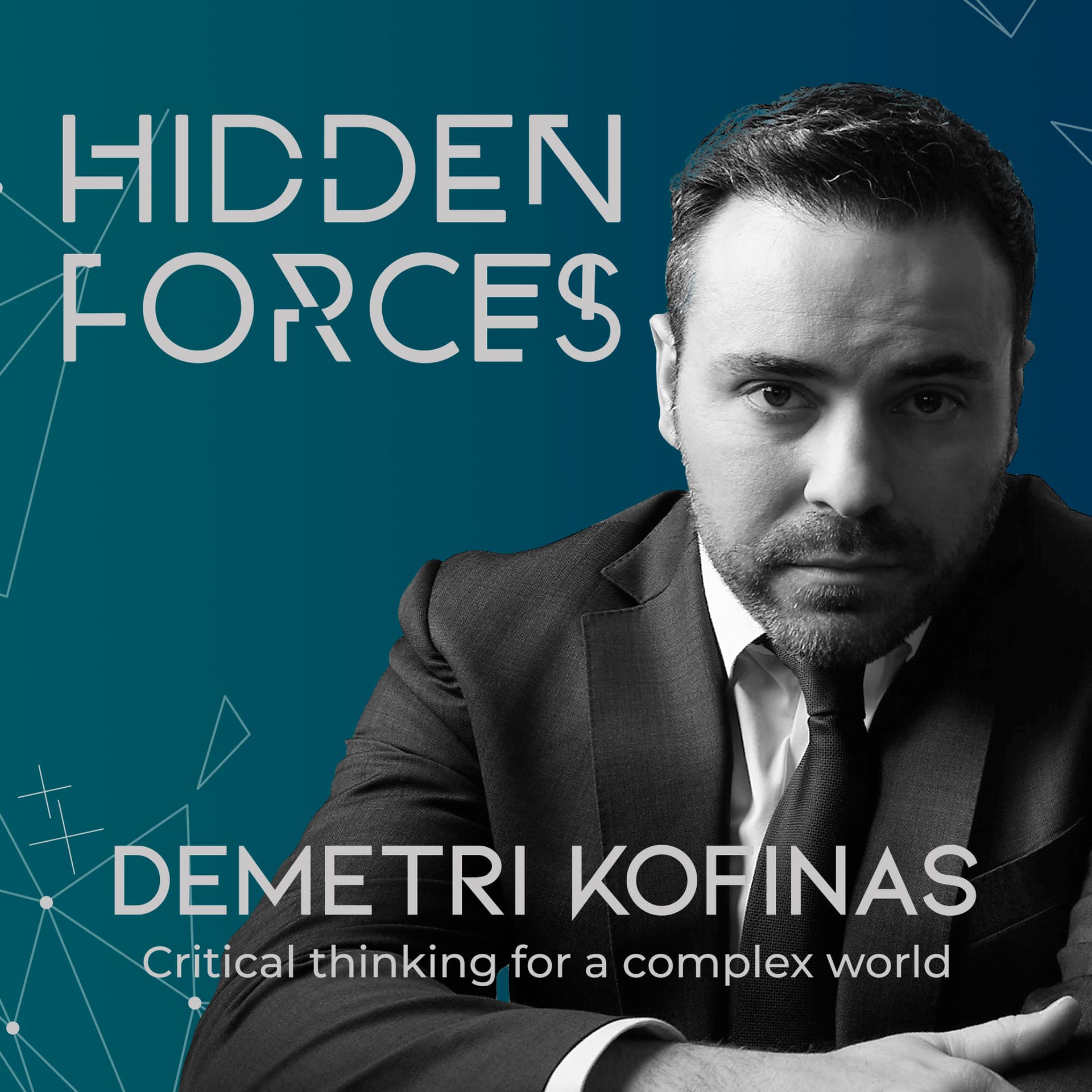
In Episode 480 of Hidden Forces, Demetri Kofinas speaks with Miles Taylor, former Chief of Staff at the Department of Homeland Security during the first Trump administration and later head of advanced technology and security strategy at Google, about the existential stakes of AI development, the erosion of centralized state power, and the domestic security threats that may define the years ahead.
The first hour establishes the nature and scope of the threat Miles believes AI poses—not merely to individuals and nation states, but to modern civilization itself—arguing that it is an order of magnitude more consequential than anything the national security community has previously confronted, and that the institutions responsible for protecting us are failing to grasp it. From there, the conversation turns to what this means for governance: how the extraordinary empowerment of the individual is eroding the foundations on which centralized states were built, whether democracy as currently constructed can survive that pressure, and whether new, more decentralized modes of organization will emerge in response to the failure of federal institutions to protect and provide for their citizens.
The second hour examines the growing concentration of private power in the hands of a small number of AI titans and tech oligarchs, what history tells us about where that leads, and why Miles believes the more immediate security threat in the years ahead is not great-power conflict but waves of domestic unrest—punctuated by outbreaks of violence targeting data centers, undersea cables, and the technological infrastructure of the physical economy—by those displaced or left behind by the AI revolution. They then turn to synthetic media and how it is accelerating the breakdown of consensus reality and the epistemic collapse already underway, making enlightened self-governance ever more difficult.
The conversation closes on a note of guarded optimism, drawing on the history of the nuclear age to argue that humanity has navigated transformative and potentially civilization-ending technologies before, and that we retain both the agency and the obligation to do so again.
Subscribe to our premium content—including our premium feed, episode transcripts, and Intelligence Reports—by visiting HiddenForces.io/subscribe.
If you'd like to join the conversation and become a member of the Hidden Forces Genius community—with benefits like Q&A calls with guests, exclusive research and analysis, in-person events, and dinners—you can also sign up on our subscriber page at HiddenForces.io/subscribe.
If you enjoyed today's episode of Hidden Forces, please support the show by:
-
Subscribing on Apple Podcasts, YouTube, Spotify, Stitcher, SoundCloud, CastBox, or via our RSS Feed
-
Writing us a review on Apple Podcasts & Spotify
-
Join our mailing list at https://hiddenforces.io/newsletter/
Producer & Host: Demetri Kofinas
Editor & Engineer: Stylianos Nicolaou
Subscribe and support the podcast at https://hiddenforces.io.
Join the conversation on Facebook, Instagram, and Twitter at @hiddenforcespod
Follow Demetri on Twitter at @Kofinas
Episode Recorded on 05/12/2026