In short
Henry Farrell argues the U.S. is “weaponizing interdependence,” turning financial, military, and internet infrastructure into coercive tools. He says recent rhetoric (Canada’s Mark Carney calling the U.S. an “attack,” and Scott Bessent’s “economic D-Day”/Pascal’s wager op-ed) signals panic and a shift toward “dark empire”/“neo-royalism,” where power is exercised through threats rather than a rules-based order. He claims this approach is failing because credibility and long-term commitment are eroding, prompting allies to insulate themselves and diversify.
Guest background
Henry Farrell is an Irish-born political scientist. He co-originated “weaponized interdependence” with Abraham Newman and co-authored Underground Empire: How America Weaponized the World Economy.
Key claims
U.S. “flexible realism” is incoherent; Trump’s behavior is attention-seeking, not strategy; institutional checks are weakened (e.g., unitary executive dynamics); interdependence is fragile and being smashed.
Notable examples
U.S.-Canada trade breakdown; Bessent’s Financial Times op-ed; U.S. dollar clearing/internet surveillance networks; “big tariff day.”
Written by AI. May contain mistakes. Listen to the episode to check what was said.
Chapters
Tap a time to open that second in VOUnderstanding America's Empire and Its Challenges
0:45 to 3:18
Discussion on America's global power structure and recent geopolitical events affecting it.
“Henry and I devote the first hour of our conversation to examining two recent and very important events.”
Introducing Henry Farrell
3:18 to 4:14
Henry Farrell shares his background and how he became interested in political science.
“And if you still questions, feel free to send an email to info at hiddenforces.io and I or someone from our team will get right back to you.”
Analyzing Mark Carney's Speech and Economic D-Day
4:14 to 6:40
Exploration of Canadian Prime Minister Mark Carney's speech and U.S. Treasury Secretary Scott Bessent's op-ed effects on international relations.
“Henry Farrell, welcome to Hidden Forces.”
The Implications of Pascal's Wager in International Politics
6:40 to 10:40
Discussion on Bessent's comparison of international relations to Pascal's wager and its implications for U.S. foreign policy.
“So I think, well, those are two very, very big questions, of course, and I think we'll probably get into them in different ways during the rest of the conversation.”
Interpreting the Current Administration's Strategy
10:40 to 13:20
Debate on the perceived chaos and lack of strategy within the current U.S. administration and its impact on global dynamics.
“The key question for Basant here is that the actor, the country which is doing the most to support Iran or is capable of doing the most to support Iran, is China.”
Analyzing Trump's Administration and Global Reactions
14:00 to 18:03
Explore how Trump's chaotic leadership affects global perceptions and actions.
“I feel like I have a good idea of what he wants to hear.”
Institutional Challenges in American Democracy
18:03 to 23:48
Discuss the flaws in U.S. institutional design exacerbated by Trump's leadership.
“I think also, I think Besant is especially attuned to and concerned about perception as a guy who has spent his lifetime working in financial markets.”
Public Trust and Government Capacity
23:48 to 27:44
Delve into the growing public dissatisfaction with government responsiveness.
“stupid person cannot actually sort of override everything.”
Reforming Democracy and Building Public Engagement
27:44 to 28:00
Examine potential reforms to enhance government responsiveness and public trust.
“Institute and Johns Hopkins University thinking about the problems of democracy and thinking about how to try to build up institutional reforms which are more responsive and more capable of being responsive.”
Navigating Public Trust and Governance
28:00 to 29:05
Discussing the challenges of public trust and governance in today's political landscape.
“And if you want to see somebody, and this is, I guess, wandering somewhat off the initial topic, I think it's very, very interesting to see what Mamdani is doing in New York.”
Show all 17 chapters
Comparing Governance Styles of Trump and Mamdani
29:05 to 30:54
Examining the similarities and differences in governance styles between Trump and Mamdani.
“Because the final thing, or the final stressor here, is that the United States is no longer the only big gorilla in town.”
Experimental Governance and Political Promises
30:54 to 33:38
Exploring the necessity of experimentation in governance and its implications for political promises.
“And there was a really interesting conversation that happened between Ezra Klein and Chris Hayes.”
The Shift from Soft Power to Hard Power
33:38 to 36:59
Analyzing the U.S. administration's shift from soft to hard power and its implications.
“If we want to solve these problems, we do need that experimental attitude.”
Institutional Weakness and Political Future
36:59 to 42:03
Assessing the weakening of political institutions and the potential for future rebuilding.
“And so in other words, this is a world in which the interests of the monarch, the interests of the country, and the interests of those around the monarch are all supposed to converge in the same direction.”
The Fragility of Global Interdependence
42:03 to 43:57
Explore the fragility of global economic interdependence and its implications.
“And I think that a lot of these have to do with the fact that the old system did not particularly work well.”
Weaponized Interdependence and Recent Developments
43:57 to 48:54
Discuss the concept of weaponized interdependence and its recent manifestations in US-China relations.
“What did the two of you mean by that statement?”
The Inshittification of American Power
48:54 to 50:38
Examine the concept of inshittification and its impact on American power and the global economy.
“But if there are real conversations that have taken place about how to build from that to something a little bit more stable, certainly I know nothing about them.”
Transcript
Automatic transcript. May contain errors.0:00What's up, everybody? My name is Demetri Kofinas, and you're listening to Hidden Forces, a podcast that inspires investors, entrepreneurs, and everyday citizens to challenge consensus narratives and learn how to think critically about the systems of power shaping our world. My guest on this episode of Hidden Forces is Henry Farrell, a political scientist, the originator, alongside his co-author Abraham Newman, of the concept of weaponized interdependence, and the co-author of Underground Empire, How America Weaponized the World Economy. By the end of today's conversation, you will have a much deeper understanding of not only how America built its empire, including the financial, military, and technological infrastructure undergirding its power, but how that scaffolding is buckling under the weight of a compounding series of domestic and foreign policy errors that have eroded the political consensus that made this empire possible, and the consequences of its collapse for the global economy and the world over which Washington has presided unconditionally.
1:03tested for most of the last 35 years. Henry and I devote the first hour of our conversation to examining two recent and very important events. The first being Canadian Prime Minister Mark Carney's speech announcing the breakdown in the latest trade negotiations between the United States and Canada, wherein he claimed his country was under attack by the United States. And the second being US Treasury Secretary Scott Besson's Financial Times op-ed declaring an economic D-Day, which reads more like a veiled threat aimed at America's allies than a defense of the world Washington sought to liberate in 1944.
1:39We explore the implications of these two announcements, how they fit into a pattern of behavior by an administration that seems intent on converting the once liberal, rules-based international order into a more overt and darker form of American imperial power, why that process is failing, and what that failure means for the global economy, international security, and the lives of billions of people. The episode's second hour builds on these insights through a comprehensive exploration of the hidden infrastructure that underwrites U.S. hegemony, the financial messaging systems, dollar clearing networks, and the internet surveillance architecture that quietly became instruments of American coercion.
2:21We trace how this underground empire was slowly built and eventually adopted by much of the rest of the world. When it began to become weaponized, against America's enemies and eventually against its own allies and partners, and why that weaponization has led to a deterioration of American power and where we see uncontroverted evidence of its depreciation and decline. We examine how a world once held together by an establishment of lies and hypocrisies is quickly giving way to one organized around clans, cartels, and naked self-interest, the role being played by technologies like AI and social media in facilitating the breakdown and refashioning of traditional political coalitions, and the deeper sources of Western insecurity, specifically the risk of a new kind of world war that may soon arrive on our shores, embedded in our systems of communication and control, and where Henry still finds grounds for optimism in what is otherwise a frightening new world.
3:18If you want access to all of this conversation, go to hiddenforces.io slash subscribe and join our premium feed, which you can listen to on your mobile device using your favorite podcast app, just like you're listening to this episode right now. If you want to join in on the conversation, become a member of the Hidden Forces Genius Community, which includes Q &A calls with guests, discounted access to third-party research and analysis, and in-person events like our intimate dinners and weekend retreats, you can also do that on our subscriber page. And if you still questions, feel free to send an email to info at hiddenforces.io and I or someone from our team will get right back to you.
4:01And with that, please enjoy this incredibly timely, wide ranging and deeply insightful conversation with my guest, Henry Farrell.
4:14Henry Farrell, welcome to Hidden Forces. Thank you. I'm delighted to be here. It's my pleasure to have you here. I feel very fortunate that we scheduled this ahead of time. I didn't have any foresight into Mark Carney's speech, the breakdown in trade negotiations, or Scott Besson's economic D-Day news piece in the Financial Times, but it's going to converge perfectly with what today's conversation is supposed to be about. Before we get into that, as well as your book, Underground Empire, which is what inspired today's conversation, Henry, tell me a little bit about you. What got you started in political science?
4:52What's your background? I'm from Ireland originally. I was interested in political science and economics. I was not quite smart enough at math to be a good economist, but I was always very interested in the politics of the economy. That is, not thinking about the economy as a place in which you see all of these optimizing decisions happening and markets producing their wonderful things, which they do produce, but the politics that goes along with that, the ways in which actors try to use fair means and foul to gain position, to gain advantage, and to really shape the economy and shape markets in ways that suit their own particular self-interest, even if they do not suit the self-interest of others.
5:35So that is the kind of place that I think that Abe Newman, my colleague, and I have been playing in for the last couple of decades. So I want to also reference another conversation you had with Ezra Klein about six months ago, where the two of you discussed Mark Carney's speech delivered at Davos. And he has since delivered another speech, the one that happened a few days ago, announcing the breakdown in trade negotiations between the United States and Canada, in which he reiterated many of the same sentiments and also essentially said that Canada was under attack and under attack from Washington.
6:09And that was followed up by a very curious article in the Financial Times written by Secretary of the Treasury, Scott Besant, in which he essentially compares the decision that foreign countries and US allies in particular need to make to Pascal's wager. And it comes across very much as a threat against America's allies. And so I'm curious, before we get into the book, what do you make of these two latest pieces of information. And what do you feel like is really happening to the global system, the global economy, and to the world? So I think, well, those are two very, very big questions, of course, and I think we'll probably get into them in different ways during the rest of the conversation.
6:53But I think if you look at this debate, I think Carney is expressing a sense of reality that is really building on what he said in Davos, where he made it clear that the old world system had gone. He is very fond of saying that nostalgia is not a strategy. We cannot just assume that the old world is going to come back. We need to face up to the world that we're in. And I think that really what we're seeing at the moment is a second stage of that strategy where Carney has looked at the trade negotiations that are happening between the US and Canada, has looked at the way in which the United States really wants to create a permanently subservient position for Canada in which it would accept its subservience.
7:35And Carney has decided that Canada simply doesn't have any advantage from dealing with that and is prepared to endure, at least for the moment, the short-term costs that are associated with Donald Trump getting mad at you and deciding to tariff the hell out of all of your industries and using whatever other forms of pressure he can use. So I think that's the Carney side of it. The Bessel side is very interesting. And this is a deeply weird op-ed because really what he's doing, I think the part that I find fascinating, which you pointed out to me when we were talking as we were setting up, is this comparison between Pascal's wager and the situation of other countries in the international system.
8:17And really what I think that Bessent seems to be saying here is you've got to think about the United States as if it were God. You have to think about the United States as if you need to do everything you possibly can in order to appease this wrathful deity before it decides to smite you with lightning bolts. Because if you don't, you do not know what is likely to happen to you except that it is likely to be horrible. So Pascal's wager is more or less an argument that even if you don't believe in God, you ought to behave as if you do, because if you don't, the odds are that if God does exist, that you're going to spend the entirety of eternity burning in the fires of perdition.
8:57So therefore, you ought to believe it. And so I think what Besant is saying is you need to believe in the United States the same way, because if the United States decides to get angry with you, you are going to find yourself in this situation in which you would wish that you would be in hell, because that is going to be much, much better than what Donald Trump has in store for you. So this is really, it feels to me like one of the 17th century Puritan preachers, you know, sort of sinners in the hands of an angry God, except that the sinners are the recalcitrant countries of the rest of the world.
9:30And the angry God is the United States of America with Donald Trump as its prophet and also as its enforcer. Yeah, it feels as though what he's saying is that the realization of Trump's worst instincts represent tail risk, and there is no premium that you shouldn't pay to insure yourself against the possibility of that tail risk actualizing. And that's essentially the wager. Well, the other thing that this makes me feel like, it feels like it is a angry fundamentals preacher who is losing his congregation, who is losing his audience, and is upping the rhetoric in order to try and keep the few fearful parishioners who are still there in the benches.
10:11So there's a famous phrase that Teddy Roosevelt used, which is that the United States ought to, what was it, speak softly and carry a big stick. In other words, that it ought to moderate its rhetoric, but keep its genuine threat in reserve. And so I think what we're seeing here is that Scott Bessent is adhering to an approach to U.S. foreign policy, which is speak bigly and carry a soft stick. So these are big, angry words, but everybody knows that the follow-through is not particularly obvious. The key question for Basant here is that the actor, the country which is doing the most to support Iran or is capable of doing the most to support Iran, is China.
10:54So the question that Basant does not really want to have answered, and you see some soft foot maneuvering happening around this, is if China continues to import oil from Iran, if China continues to provide a lot of support to Iran, is the United States going to want to try and visit the wrath of God on China's head? And I think that the markets and everybody else are betting, no, absolutely it does not. This is an empty threat. And in a certain sense, I think Besant, by using this kind of ridiculous rhetoric, is really exposing how the United States is playing from an empty deck. So his mentor, Stanley Druckenmiller, wrote an op-ed for the Wall Street Journal, which I just want to point out was also partly written by AI, which is very disappointing because Druckenmiller is a brilliant person who can afford a copy editor, and we should be doing better than that.
11:45But that aside, the substance was, I think, important. And I read a lot of things, so maybe I'm conflating what he wrote with something else I read. But I remember him essentially suggesting that what Besant wrote was more of a sign of panic than it was of strength, to your point. Well, we certainly saw a lot of panicking happening, I think, back during Davos, where it was really interesting to watch the commentary coming from Besant and from Lutnik, who I think are the Tweedledum and the Tweedledee of this particular administration, where they begin going into Davos, more or less saying that the entire world is going to fall at our feet, that the resistance of Europeans is ridiculous.
12:27And then you see over time, you see a genuine sense of panic beginning to set in when they realize that the Europeans are going to push back and they start talking about how the Europeans really ought to do this. It is not in everybody's best interest. Can we just get along with each other? And so I feel like something similar is happening here. And my read of this, and I don't know percent from Adam, but my sense is that he is not a particularly stupid individual. And so he is playing a extremely, he doesn't have very many cards to play with. He's doing the best that he can. But I think at a certain point where you've been coasting on empty for a long while, you do begin to panic.
13:07you do begin to press all of the buttons that you can at random in the hope that something magically will come along and will save you from this awful dire position that you and your colleagues have found yourself in. So I think another, before we get into the book and some other questions I have about what's happening to the international system, it seems to me that many of us are still struggling to interpret the actions of this administration and to understand whether or not there's an actual deeper strategy at work. And in my mind, there isn't. In my mind, there is essentially a capricious leader, a series of fiefdoms underneath him, whose lords are each competing for the attention and audience of the king, during which time they hope to achieve certain objectives that in some cases, in many cases are graft related.
13:57In other cases, like Skampasen's case, I don't know what they are. Maybe they are. And I think this is also true of this administration, it certainly was of Trump's first term, you have cabinet members who essentially come into the administration thinking, okay, I'm going to do what I can to appease Trump. I feel like I have a good idea of what he wants to hear. I'll tell him what he wants to hear. I'll bend over backwards if I have to. But at the end of the day, I'll be able to shift the vector just enough so that I make a positive difference on the country and in the world. And I feel like what we're seeing with this administration is that no amount of backbending is enough.
14:33No amount of chaos is enough. And the percussion of these incidents of Trump lashing out, of waging wars, trade wars, real wars, is shortening and shortening. And it feels like we are running up against some kind of wall. And I don't know what that's going to look like, But I'm curious, how do you go about trying to interpret the actions of this administration? And what is the framework that you apply to understanding them? So I think that that is more or less right. And you see various attempts to try and cover over the chaos. So there is, of course, in the national security strategy, we saw the articulation of this new doctrine called, quote, flexible realism, unquote.
15:16And as far as I can make out, flexible realism does nothing more than to say the United States is going to do what it wants and everybody else had better react accordingly. So I think it is less a serious strategy than an effort in your terms to try and cover up the fact that there isn't really a strategic position here. And so I think that the comparison you make to a court with all of these fiefdoms and these different squabbling barons and court officials, each trying to get its own interests, his or her own interests, each trying to, perhaps some of them trying to do a little bit of good for the country, trying to fulfill some previous vision that they have had.
15:55I think that is absolutely right. And I think that the way that I think about this, there's a famous article among political scientists and sociologists by these two sociologists and political scientists, Chris Ansell and John Padgett, which looks at the Medici. And more or less, it looks at this guy called Cosimo Medici, who was really, really good at making sure that every time everybody else did something, that he always had the last words, that everybody was trying to orient themselves towards him and towards his ideas. And so he manages to do this. He manages to create this spider's web in which he is always maintaining the flexibility to do what he wants, and everybody has to pay attention to him.
16:38And he manages to get his way a lot. And so I think that what Donald Trump is doing is a really stupid version of that. And I don't think that this is a strategy. I think this is just he wants people to pay attention to him. And he wants always to be the person who everybody is reacting to. And even if this leads him to do some incredibly wildly stupid things in the long term, and even in the medium and short term, it doesn't matter to him as long as he is the center of people's attention. And this really creates a world in which at a certain point, I think other countries, they just shrug their shoulders and they start looking at this as a exercise in damage limitations.
17:17So I think that countries have not fled from the United States, but they are looking insofar as they can to really build their long-term strategies around the expectation and the assumption that the United States does not have a long-term strategy, that it is flailing around, that it is capable of doing huge damage to them, as well as enormous colossal self-damage. And so the best way forward is to figure out how do you insulate yourself? How do you cut yourself off from the chaos as much as you possibly can? Which is, of course, is the exact opposite of what Besant is saying. Besant is saying, you better stick with America's systems and you have no choice but to stick to America's systems.
17:56And I think other countries are beginning to figure out, well, if this is America and if this is how these systems are likely to be used, we're going to look to see what other options we have. Yeah. I think also, I think Besant is especially attuned to and concerned about perception as a guy who has spent his lifetime working in financial markets. And there's an effort to manage the perceptions of America's competency and its imperial strength while also struggling to bring the war in Iran to some kind of conclusion, fulfill his promises to end the war in Ukraine, all the things that this administration has talked about doing, I think there's a concern that the rest of the world is going to call Washington's bluff.
18:40Does that resonate with you? Yes, very much. And I think you see that happening, of course, a lot in the last week or so, where there clearly is a lot of worry about bonds and a lot of worry about what is happening to people's beliefs in the full face and credit of the United States of America. And here, I think on the one hand, the United States still has a lot going for it. I think back to Bismarck back in the 19th century saying that God loves fools, drunks, and the United States of America, which is perhaps its own weird version of Pascal's wager in reverse, you know, the United States manages to get away with a lot.
19:14And I think that is much more true now than it was in the 19th century, because the United States still plays a very central role in the global financial system. It still has an enormously powerful army, even if huge amounts of the ammunition and the materiel that it needs have been dissipated away in this foolish war against Iran. So the United States still has a lot that is going in its favor. But as you say, there is also a lot that the United States gets not from its material power, but from other actors' belief in that material power and other actors' belief in the continued centrality of the United States.
19:52So in a certain sense, I think, you know, the danger that the U.S. faces is that at a certain point, sometimes beliefs can become self-fulfilling. That is, if everybody gets nervous, if you're in an increasingly panicky environment, then suddenly you get perhaps the version of a financial crisis, which you have when it is not so much a financial crisis in the standard sense as it is a political crisis, where what you are beginning to lose face in is not whether or not your counterparties are going to do what it is they signed up to do, but you're beginning to lose faith that the United States is capable of behaving in a way that supports its own interests, an enlightened version of its self-interest with respect to the rest of the world.
20:36And you begin to sort of start figuring out, you know, so you begin to find yourself in a world where people's and countries' efforts to protect themselves against that may begin to compound upon each other in unexpected ways, leading to crises, leading to panics, leading to all of these problems which come from the fact that nobody believes that the United States is really capable of getting its act together on stuff. And so we get things like the efforts to try and spend over the last week, which are like trying to put a sticking plaster on top of a separating and festering wound and telling people, just ignore all of the nasty stuff that is dripping out.
21:14Just pay attention. Please, everybody pay attention to the sticking plaster. I feel like there was a broad consensus that was held not just among Trump's detractors, but also his supporters, that the institutions would restrain him. What we have found is that is not the case. I'm curious what that can tell us about the state of American institutional representative democracy, the state of the country? What lessons can we draw from Trump's success and his ability to shape policy and to remain in office? So I think here, in a certain sense, this points to some of the flaws or the problems in the U.S.
21:54constitution and the efforts that the framers of that constitution, who of course were extraordinary people, but were also, like all of us, were limited in their understanding of what could happen, the efforts that they tried to counter that have turned out not to be successful. So here, I think in particular, a Federalist paper number 10, which is a place where you see some of the key people who write the Constitution talking about how the best way to deal with political ambition, and here I'm being very crude and simplifying, is to set ambition against ambition. In other words, if you are in a world where nobody has complete control or a country where nobody has complete control, where everybody is trying to vie with each other for power, that to some extent, my vying for power is going to be counteracted by your vying.
22:40And so you end up, if you create a system that is sufficiently good at doing this, you end up in a system where the different powers exhaust themselves and where you get something which roughly corresponds perhaps to the common good emerging. And so I think what we see with Donald Trump is the fundamental problem that we have is, crudely speaking, it is the Republican Party. And that is that typically sort of the United States system, and it has many flaws which go together with this, has been a system of factionalism in which presidents have always had to contend not just with the opposition, but with the fact that many people in their own party have different interests, don't necessarily want to go along with what the president wants.
23:21And so the president is forced perpetually to compromise. I think this has been the standard way in which you think about things. Furthermore, we have within the government, there also has been, within the federal government, there also have been sort of various different power bases. And this also has created, as the administrative state has grown, it has created its own separate independent source of opposition, which makes things much more difficult to do, but also ensures that a single deeply stupid person cannot actually sort of override everything. So I think we're in a world now where both of these things have been greatly weakened.
23:56On the one hand, the Republican Party, it works much more closely in lockstep with the president than past parties have done. And even people who clearly are deeply opposed to the president, which in the senators typically have had a lot more power, have been extremely reluctant to confront him directly, even when is doing obviously stupid things. And when you have a lock on all three parts of the government, that means that a lot of the opposition disappears. And secondly, we see also a effort within the federal government, which has been encouraged by the Supreme Court to move towards some version of the unitary executive.
24:33And here the theory is very, very crudely that the president has been elected, that the job of the executive is to do the president's will. This is what the current majority on the Supreme Court believes and has embraced. And that means that when the president does really, really stupid things, some of the internal sources of opposition, some of the internal drags that prevent really stupid ideas from becoming implemented in policy, all of that begins to disappear as well. Because you have a bunch of people appointed who are yes men. You have things such as the inspectors general who are supposed to ensure that different departments are behaving above board.
25:11You have them being either fired or terrorized. And you have, and this is the reforms that are going through at the moment, you have ordinary civil servants suddenly being classified effectively as at-will employees so that if they do not jump five feet when the president tells them to jump five feet, they are in danger of getting fired. And so this then creates, I think, almost this perfect storm in which if you put somebody who is fundamentally not competent at the top of the system, you begin to get all of the crazy bad stuff happening that we see happening right now. It's interesting that you brought up the theory of the unitary executive because 25 years ago, we had an administration whose vice president in particular pushed that theory and many of whose members of the administration lamented the loss of executive power that followed Watergate.
26:01How far back do we need to go to understand the sources of institutional weakening? How much of it can we point to as things like the unitary executive and the desire to enhance the power of the executive and what Schlesinger called the imperial presidency? And how much of it is a result of other things that have led to the loss of institutional trust on the part of the public? Okay, this is really, you know, this is a huge, huge question. And, you know, I guess, you know, so if this is something like where all of us as political scientists, as commentators, as politicians, we're all trying to figure out the answer to these big questions.
26:36There's a lot of stuff that is happening here. And I think that if you want to get into those other questions about loss of public trust, you would want to get into some general problems of, I think, government incapacity to deal with a more complex world, and also the increased inability of government to really pay attention to ordinary people. So I think that we're in a world now, and this is not just a problem in the United States. So I think that we can talk about the problems, the particular problems of the U.S. Constitution, of the U.S. design of institutions. But I think across the developed world, we are seeing a lot of people who are suddenly becoming very angry because they see these massive problems coming down the pipeline.
Read the full transcript
27:15They do not agree necessarily on what those problems are. Some people are deeply worried about climate change and global warming. Other people pretend that it isn't happening. But nonetheless, everybody is pretty mad because they see the government as not being capable of responding to the things that they want government to respond to. So I think that is a second compounding set of questions. And here, half my life I spend thinking about international politics and international economic coercion. Half my life I spend at the Agora Institute and Johns Hopkins University thinking about the problems of democracy and thinking about how to try to build up institutional reforms which are more responsive and more capable of being responsive.
27:58And I think that there are things that you can do. And if you want to see somebody, and this is, I guess, wandering somewhat off the initial topic, I think it's very, very interesting to see what Mamdani is doing in New York. And here, what I'm saying here is, I don't think that you necessarily have to buy or believe in his particular political orientation, which is well to the left of the Democratic Party, to recognize that what he is trying to do is he is trying to create feedback loops between what the public seems to want in New York, actually getting the government to do that stuff, and then also figuring out how to use social media to communicate that back to the public in a way that says, yes, I am here.
28:38Yes, I am listening to you. Yes, I am responding to you. And so I think that that particular set of problems, the broader set of problems about public trust. I think that the answer to that set of problems probably comes more from people on the center and perhaps on the right as well, adopting a Mamdani-type vision of how to try and bring the different pieces together than it does from big questions of either constitutional design or, of course, geopolitics. Because the final thing, or the final stressor here, is that the United States is no longer the only big gorilla in town. It is having to deal with the rise of China.
29:15It is having to deal with the relative loss of its own power, influence, and authority. So we really have these multiple different crises happening all at once. And our job, I think, is to try and figure out how to navigate our way the hell out of them. So Trump famously gets along very well with Mondami. And in fact, he gets along so well with Mondami that it, in some cases, has made his aides feel visibly uncomfortable. When I look at Mondami's governance style, it seems very much like Trump's. It's just the difference is that we haven't yet seen Mondami veer off course. This is what Trump did.
29:49Trump was regularly A-B testing ideas with the public, deciding what worked and resonated the best, and promoting those ideas to them. Some of the policy proposals that he put forward heading into his second term, some of which were associated with Doge, were very popular among his base. He just hasn't happened to follow through with a lot of what he promised to do. So what is the difference between Trump's governance style, which is heavily populist, and Mandami's, and heavily populist and also one that exploited and leveraged social media, and Mandami's, where he not only speaks to certain populist ideas, but also uses social media very adroitly and has a very strong sense of camera presence?
30:30Okay, so I think that the question is here, really, you know, there are clear similarities, as you say, in their adeptness with social media. I think the key question here, and the question does seem to me to be getting answered in the right way, is whether Mamdani is willing and capable of using the administration, using the capacities of government to actually do things that people want to get done. And there was a really interesting conversation that happened between Ezra Klein and Chris Hayes. Probably this must have been around the time when Mamdani was beginning to rise, where Ezra and Chris were debating this, and they were agreeing that they really liked the style.
31:11They wondered whether there would be the follow-through. And I think that the follow-through, as far as I can see, does seem to be happening. People actually seem to, in general, be quite happy with the ways in which he's fixing stuff, like he had this big thing yesterday about the expressway, which are real of support. Yeah, the BQE, which has been a crappy... I know. And I read that article, by the way, and I had the same reaction. It's clearly a populist policy. People want the expressway to be fixed. And he has entered office actually making promises to do all those things, but it's going to take a long time to fix the BQE.
31:45So I think that that still falls in my category of promises, but he has to deliver. And we haven't yet seen whether Mandami can and will deliver. He's very early in his administration. Yeah, absolutely. And we will see. But I would say that the initial auguries are more encouraging. And I really would love to see other politicians, as I say, on the center and on the right, try to build different versions of this. Because if we are in a world where instead of trying to sort of gin up issues of one sort or another, the government is trying to respond to the problems that people actually have, this actually ends up, I think, of sort of bringing the United States into a much, much healthier space.
32:23And here's the other thing that I think is interesting and important about the Mamdani governing style. And this is something which may be trickier. If you look back to the last time that I think the United States was in so much political turmoil, I really think you want to look back to the period of the Great Depression. And back in the Great Depression, Franklin Roosevelt says that what the country needs, what the country demands is bold, persistent experimentation. That is trying stuff out to see what works, building on the stuff that does, and discarding the stuff that doesn't. So here, when I see things like Mamdani proposing city-run grocery stores, I see this as experimenting.
33:00And then the question is, if stuff, you know, some of this stuff will work, some of this stuff will probably not work particularly well, some of this stuff may turn out to be sort of minor disasters, can you actually build a governing style in which you're capable of abandoning the disasters? And will ordinary people, will the media system be willing to bear that and be willing to actually sort of bear with a politician who says, this didn't work. I'm still trying to solve the problems. Here's another way. Let's try that way instead. That, I think, for me, is the big open question. But I think you need to, you know, we're fundamentally in a much more complex, much more messy, much more difficult world.
33:38If we want to solve these problems, we do need that experimental attitude. So when Trump first came into office, it felt like what was clear was that he wanted to reset the terms of the international rules-based system. Shortly thereafter, I got the sense that, and so did many other people, that he was more interested in abandoning the system. Then the key insight that came to me at some point was that, no, no, no, he didn't just want to abandon the system. He and his coalition wanted to tear it apart. I feel like that no longer is a sufficient framework for understanding what's going on here.
34:14Based on the public communications of this administration and taking the Economic D-Day article by Scott Besson in the Financial Times as the latest example, it seems that this administration wants to convert the soft power of American imperial primacy to a new form of imperial hard power that in some sense, we're turning into a kind of dark empire. And I wonder if that resonates with you. And if so, what does that portend about where things are going and what the future of the international system or international non-system is going to look like. Okay. I think that's absolutely right. And here I would lean also on my co-author of Underground Empire, Abe Newman, and Stacey Goddard, who is a fantastic political scientist at Columbia.
34:57And the two of them talk about what they describe as neo-royalism. So they suggest that what Trump and people around Trump want to do is to move into a world in which this is much less about states and state interests, and much more about different clans in a certain sense, different clans, you know, sometimes linked by family connections, sometimes linked just by, you know, relationships or connections of convenience, where they try to carve up the world economy around their interests in ways that sort of advantage them. And so that, I think, is plausibly part of where the, where I think the Trump administration would like to go.
35:35And if you go back to the famous Davos thing that we began with, the Mark Carney speech. Really, I see that Davos as having been an effort by the Trump administration to really try and, in a certain sense, create a kind of a coronation ceremony for Donald Trump, in which Trump would be recognized by everybody as more than the first among equals, as being the center, the sun king around which the world system gravitated, and that everybody would sort of effectively defect from the old way of doing things and to move to the new. And Davos, because of course this is a congregation of the rich and powerful, would be a place where that happened.
36:12And then we have, I think, Mark Carney acting a little bit like the small boy in the procession of the emperor who has no clothes, rudely pointing this out and is effectively completely disrupting the ceremonial aspect of this. So I do think that there is this effort, as you say, you know, so this is not just about destroying the old system. And I wouldn't say that this is a strategy. You know, I think it's a tendency more than a strategy. It's a sense that the United States really needs, you know, which Trump has been blunt about from the beginning. On the one hand, the sense that the United States needs to be much more blunt in pressing for its interests, even when others don't like it.
36:48And on the other, that the interests of the Trump administration and the personal interests of Donald Trump and of the United States all tend to coincide. So this is, you know, like Louis XIV, the Sun King, l 'état c 'est moi, the state it is me. And so in other words, this is a world in which the interests of the monarch, the interests of the country, and the interests of those around the monarch are all supposed to converge in the same direction. And that direction is a direction of supreme power. But, you know, so as you say, there is a sense of this dark empire, this dark kingdom. I don't think it's working.
37:23I don't think that people are aligning themselves towards it in the way that the Trump administration expects them to do. That's maybe partly to do with what happened at Davos. But I think it's much more to do with the fact that this kind of approach really doesn't work. So we talked earlier about how the Trump administration describes itself as engaging in a policy of flexible realism. And flexible realism, I think, the way that the Trump administration interprets flexibility is fundamentally incoherent. If you are a country that wants to get things done, you actually need to be, in certain ways, pretty fundamentally inflexible.
38:01That is, you have to be capable of creating binding guarantees and binding threats. You have to think a lot about your credibility. And this is the argument that old-style realists like Thomas Schelling, who won the Nobel Prize in Economics, used to make, is that a country's greatest asset, in a certain sense, is its credibility. If you are flexible all the time, that is, you chop and change, and you decide to break promises when these promises are no longer convenient to you, and you make them sort of grandiose threats, and those threats sort of disappear the following day, then at a certain point, others stop believing in you.
38:35Others stop taking you seriously. And I think this is the world that we are in with the United States. On the one hand, people still take the United States' capacity to use coercion quite seriously, but they don't take seriously its capacity to do anything that involves long-term thinking. I think that this is much more like I'm sort of, I don't know, grandpa has been on a bender and is waving around his shotgun. You say everything that you have to say in order to make sure that grandpa does not fire the shotgun at you, but you're humoring rather than actually responding to grandpa as being a serious actor who's capable of thinking in a long-term way.
39:12So it's interesting that you bring up Thomas Schelling because I do feel like part of what we're dealing with here is a coordination problem, a coordination problem on the part of the majority of the public that would otherwise agree with a particular political agenda. In other words, a majoritarian coalition, I feel like, has not really emerged that is able to enunciate what its desires are and push them through in a new form of sort of populist governance. But let's go back to, because I feel like we'll have an opportunity to address this larger point by revisiting my original question, which to your point, I do think we veered a bit off course with our conversation about Mandami.
39:52Let me ask my question about the institutions in a different way. Do you feel that whatever it is that is responsible for having weakened the institutions, first of all, do you agree that the institutions have been weakened and that this is why Trump has become emboldened and empowered? Would you agree with that? And that Mandami is winning in New York City, et cetera? Yes, I would. I would. And this is a global phenomenon. This was your point earlier, correct? Yes. I think that it is a global phenomenon, but it is manifesting in different ways in different countries. And in the United States, I think the United States, because of its particular mode of presidentialism, is particularly vulnerable to a certain kind of configuration.
40:33So we see in other countries, we see, for example, in Italy, you know, Italy is now governed by a formerly, and not especially formerly fascist party, but its capacity to do stuff is limited, both by the Italian constitution and by the European Union. And so I think that, you know, a lot depends on the particular institutions of a particular country, and the United States has a particularly bad case. So my question is, is that trend reversible, or does it need to play out and run its course? And if it is reversible, what do you think are the most essential sort of ingredients to reverse it? Okay.
41:14So I think that in an important sense, it is not reversible. And this gets back, I think, to Carney's point that nostalgia is not a strategy, which I take as being an argument that whatever emerges from this is not going to resemble the kind of consensus that we had from, say, the early 1990s through 2012, 2014, 2015 was when the wheels began to come off. I don't think we're going back there. I don't think that we can create a system which is going to go back there in any way. Equally, I think that the question of whether or not we are doomed to enter into a spiral of misery and awful, there's no reason to believe that that is true.
41:53So I think if you're thinking about trying to rebuild something which is better and different from the ruins of what we have, I think that there are genuine prospects in the United States. And I think that a lot of these have to do with the fact that the old system did not particularly work well. So a lot of the problems that have given Trump the range to do the things that he has done, emerged long before Donald Trump was himself actually particularly interested in politics. So I think if you want to be thinking about this creatively on the right, on the left, on the center, I think you need to start thinking about, you know, on the one hand, we're in a terrible situation.
42:31All of these institutions have been ravaged. We see in foreign policy, for example, the National Security Council is a ghost of its former self. We see enormous amounts of the expertise of government, which has shrunken and dissolved over the last number of years. And this is bad. This is really bad. There's a lot of bad things that have happened. Equally, this does provide some opportunity to think if you have to build up institutions to some extent from scratch, what are the things that you want to build them up to do? So I do think that there are possibilities there. As you say, to some extent, this does depend upon this almost a dialogue happening between politicians and the public in which you get a coherent public that seems to back to some degree a greater degree of institutional experimentation and change.
43:17And getting there is hard, but I don't think it's impossible. At the international level, I think, again, there is stuff that you can begin to work out. I think that we are going to end up in a much, much messier world than the world we were in the past because economic coercion, the risks of globalized networks and so on are much more visible and apparent than they used to be. So I don't have nearly as good a sense of where the beginning points are for trying to build something better. I do think that it is possible to do, but it's going to take a lot of experimentation and I can wave my hands vaguely in the direction of some kinds of experimentation we should be thinking about, but I don't have any grandiose schemes for getting us into a better place.
43:59You and your co-author Abraham Newman write in your book Underground Empire that we may be on the verge of a greater catastrophe brought about not by chance but by battles that tear apart the silken webs that weave the world economy together. What did the two of you mean by that statement? So I think what we meant by that was that if you look at the global economy, the global economy is fundamentally based upon the assumption of interdependence and the assumption that we can do things better economically and in other areas of problem solving by working together and by, in a certain sense, intertwining our national systems together into a much bigger system globally that allows us to do things.
44:43So if you think about global markets, this is fundamentally the basis of globalization. It's the idea that you create all of these markets that are interdependent with each other. If you think about the internet, The internet is this vast structure, which provides most of the world with a common store of knowledge with common access, albeit with various restrictions, of course, in different parts that allow you to build a common store of knowledge together. If you think about global supply chains, which really have built upon the promise of globalization, it used to be that trade involved primarily trade in raw materials or in finished goods.
45:18Now we live in a world where still complex products very often involve huge numbers of different components and subcomponents, perhaps from thousands of different suppliers in 70 or 80 different countries. So this is a bet on interdependence and on interdependence producing a better world for all of us. And so the insight that I think that Abe and I had when we were writing this book is that this interdependence is very, very fragile. And it is especially fragile because when we were writing, the United States has, on the one hand, has sought to promote this world. On the other hand, the United States had felt that it was perfectly reasonable for it to try and create a dealer's advantage for itself, that is to use these interdependent networks as a means of getting its own way and threatening other actors in other parts of the world, say, for example, with being cut off from the international financial system, which depends upon the US dollar if they did things that the United States did not want them to do.
46:15And so I think when we wrote this, we were warning that this is a wonderful, extraordinary, intricate set of mechanisms. The United States has been chipping away at those mechanisms, and this is a bad thing. And now, of course, the Trump administration is going in there with a massive hammer, smashing away, I'm sort of half at random at this or that part of the overall system. So, I think we need to start thinking, and this is maybe what I said that I had vague things that we ought to wave our hands towards. We need to start thinking not about trying to make our systems fully independent from each other, because I think that would be disastrous in a variety of ways, but we have to start thinking about the ways in which interdependence and resilience can go better together.
47:00And that partly involves building up independent capacities so that countries cannot be threatened as much. say, for example, by the risk of withdrawal of this or that crucial component or this or that crucial aspect of the financial system. But it also requires, I think, some much greater degree of conversation than has been happening to date between powers and other countries about how it is that you can exercise restraint in this world. So here, and this gets back to the ideas of Thomas Schelling, of course, because Schelling was pointing towards, in a certain sense, a much more disastrous possible set of outcomes, which is the possibility of nuclear conflagration.
47:40He was trying to work out systems through which the United States and the USSR could begin to coordinate expectations about the kinds of things that they would grudgingly assent to, the kinds of things that they would view as being completely out of line. And I think we are perhaps at the moment where we are beginning to start talking about this, but we are still not at the point where we have really begun to confront the system. And I think that one of the most interesting moments for Abe and I was last year when we saw the big tariff day. And we saw people like, again, Besant talking about how they impose these massive tariffs on China.
48:18And Besant more or less says that we have all of the aces in our hand. China only has low cards to play. And a couple of weeks later, China plays the rare earths card and the critical minerals card. And suddenly the United States realizes that it has a busted flush. And so I think that this was a really important moment because I think this is the moment that you see this in speeches that are made by Marco Rubio and others, the moment at which the United States realizes that China is capable of substantially damaging the US economy. And it's very clear that the US and China since then have been living in a somewhat fragile state of mutual awareness that each could do things to devastate the other.
48:59But if there are real conversations that have taken place about how to build from that to something a little bit more stable, certainly I know nothing about them. But then again, I'm not the person you would want to turn to for insights on what is happening deep within the Trump administration. Well, what you're describing there is what you and your co-author, Abraham Newman, have coined, weaponized interdependence. In fact, you were the two that came up with that term. Another framework that you've put forward that has echoed throughout many of your responses today is what you've described as the inshittification of American power.
49:33Now, Hidden Forces listeners will already be familiar with the term inshittification because we recently had Corey Docter on the podcast who coined the term to discuss it. So we'll be able to build on that framework in the second hour by applying it to the mechanisms undergirding American power, which you spoke to a few minutes ago. And in so doing, explore how, in more precise terms, the infrastructure of this empire is visibly buckling under the weight of what appear to be really a compounding series of policy errors, both domestic and foreign, that have eroded the political consensus that made this empire possible in the first place, as well as explore the consequences of this collapse for the global economy and the world over which Washington has presided uncontested, I would say, for most of the last 35 years.
50:24For anyone new to the program, Hidden Forces is listener supported. We don't accept advertisers or commercial sponsors. The entire show is funded from top to bottom by listeners like you. If you want access to the second hour of today's conversation with Henry, head over to hiddenforces.io slash subscribe and sign up to one of our three content tiers. All subscribers gain access to our premium feed, which you can use to listen to the rest of today's conversation on your mobile device using your favorite podcast app, just like you're listening to this episode right now. Henry, stick around. We're going to move the second hour of our conversation onto the premium feed.
51:03If you want to listen in on the rest of today's conversation, head over to hiddenforces.io slash subscribe and join our premium feed. If you want to join in on the conversation and become a member of the Hidden Forces Genius community, You can also do that through our subscriber page. Today's episode was produced by me and edited by Stylianos Nicolaou. For more episodes, you can check out our website at hiddenforces.io. You can follow me on Twitter at Kofinas, and you can email me at info at hiddenforces.io. As always, thanks for listening. We'll see you next time.
From the publisher
In Episode 495 of Hidden Forces, Demetri Kofinas speaks with political scientist Henry Farrell, co-author of Underground Empire, about how the United States built its empire, why the hidden infrastructure underwriting American hegemony is now buckling under a compounding series of domestic and foreign policy errors, and what the collapse of the liberal, rules-based order means for the global economy and international security.
The first hour examines two recent and consequential events—Canadian Prime Minister Mark Carney's speech announcing the breakdown of trade negotiations with the United States, in which he claimed his country was under attack by Washington, and US Treasury Secretary Scott Bessent's Financial Times op-ed declaring an "Economic D-Day," which reads more like a veiled threat to America's allies than a defense of the world Washington sought to liberate in 1944. They then explore the implications of both announcements, how they fit a pattern of behavior by an administration intent on converting the once liberal, rules-based international order into a more overt and darker form of American imperial power, why that process is failing, and what its failure means for the global economy, international security, and the lives of billions of people.
The second hour explores the hidden infrastructure that underwrites US hegemony—the financial messaging systems, dollar-clearing networks, and internet surveillance architecture that quietly became instruments of American coercion. They trace how this "underground empire" was slowly built and eventually adopted by much of the world, when it began to be weaponized first against America's enemies and then against its own allies and partners, how that weaponization has corroded American power, and where the evidence of its decline is now unmistakable. They also examine how a world once held together by an establishment of lies and hypocrisies is giving way to one organized around clans, cartels, and naked self-interest, the role technologies like AI and social media play in breaking down and refashioning traditional political coalitions, the deeper sources of Western insecurity—including the risk of a new kind of world war that may arrive embedded in our systems of communication and control—and where Henry still finds grounds for optimism in an otherwise frightening new world.
Subscribe to our premium content—including our premium feed, episode transcripts, and Intelligence Reports—by visiting HiddenForces.io/subscribe.
If you'd like to join the conversation and become a member of the Hidden Forces Genius community—with benefits like Q&A calls with guests, exclusive research and analysis, in-person events, and dinners—you can also sign up on our subscriber page at HiddenForces.io/subscribe.
If you enjoyed today's episode of Hidden Forces, please support the show by:
-
Subscribing on Apple Podcasts, YouTube, Spotify, Stitcher, SoundCloud, CastBox, or via our RSS Feed
-
Writing us a review on Apple Podcasts & Spotify
-
Join our mailing list at https://hiddenforces.io/newsletter/
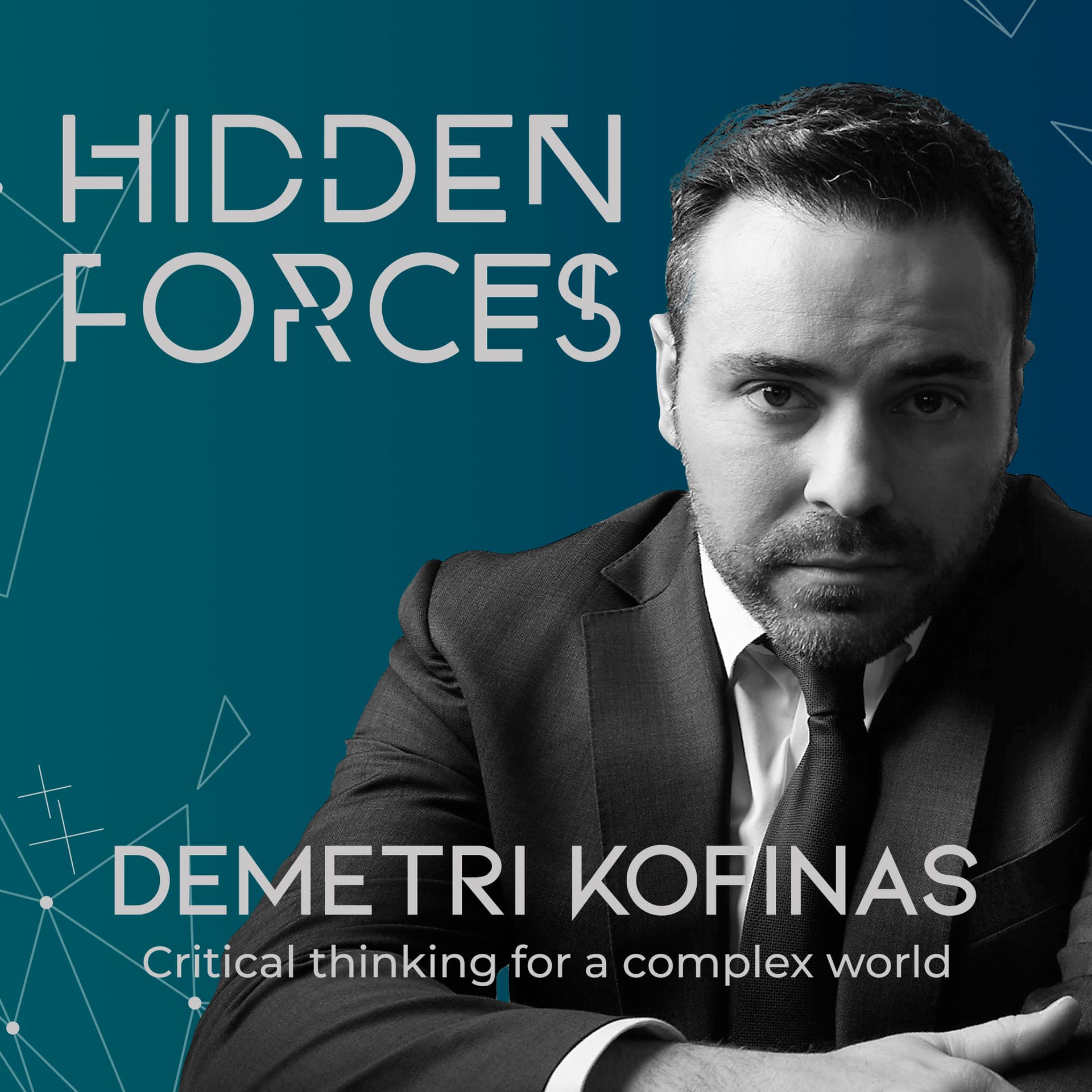
Producer & Host: Demetri Kofinas
Editor & Engineer: Stylianos Nicolaou
Subscribe and support the podcast at https://hiddenforces.io.
Join the conversation on Facebook, Instagram, and Twitter at @hiddenforcespod
Follow Demetri on Twitter at @Kofinas
Episode Recorded on 08/26/2026