In short
Episode topic: Will Manitas argues that Western secular institutions have exhausted their ability to provide order and meaning, and that a new cycle of “divine faith and savage violence” is emerging alongside AI-driven economic disruption. He connects collapsing state legitimacy, rising street-level chaos, and weakened moral judgment to renewed interest in Christianity and to political coalitions spanning anti-war progressives, tech bros, libertarians, and the religious right.
Guest background
Will Manitas is co-founder of healthcare AI company Science.io, a 2019 Thiel Fellow, and an early-stage investor. He grew up in Quaker schooling (Quaker “meeting for worship” in silence), writes on technology, religion, society, and business, and publishes via his Substack (Minutes).
Key claims
AI wealth will concentrate geographically (“narrow set of individuals and zip codes”), undermining the broad participation that earlier industrial revolutions enabled. The resulting new social contract will not be negotiated peacefully; it will be preceded by violence targeting infrastructure and people. Secular “judgment” substitutes fail, so moral restraint weakens.
Notable examples
London phone thefts; Brown University shooting (a faith-based conservative club leader killed); Brown/elite “no-violence” zones no longer holding; a personal story of renting a New York apartment from a convicted wealth manager allegedly scamming clients and stripping the AC for years.
Written by AI. May contain mistakes. Listen to the episode to check what was said.
Chapters
Tap a time to open that second in VOWill Manidis' Background and Perspectives
0:45 to 3:12
Exploring Will's upbringing, career, and views on technology and faith.
“and data science company before we turn to the central theological arguments that animate his writings about technology, the innovation cycle, and the political movements that grow up around them.”
The Role of Faith in Technology
3:12 to 5:48
Discussion on how Will's faith shapes his views on technology and society.
“If you still have questions, feel free to send an email to info at hiddenforces.io and I or someone from our team will get right back to you.”
Millenarian Instincts of Technology
5:48 to 8:02
Examining the millenarian aspects of technological advancements and their implications.
“And Quakerism is really defined by kind of five cultural testaments we call the spices.”
Cycles of Technology and Community Collapse
8:02 to 14:00
Analyzing how technology movements and communities face cycles of rise and fall.
“I would argue maybe 10 % were actively Quaker or would consider themselves ongoingly so, but it gave you kind of a set of cultural norms that were useful.”
Technological Movements and Religious Arcs
14:00 to 14:57
Explore how technology movements relate to religious ideals and their generational challenges.
“So you can map every technology movement onto this religious arc, and none of them have figured out how to persist past a single generation.”
Crypto's Collapse and Utilitarian Ideals
14:57 to 16:49
Discusses the downfall of crypto through the lens of utilitarianism and moral failure.
“through kind of a pure expression of utilitarian values.”
The Role of Religion in Modern Society
16:49 to 17:48
Analyzes the rising interest in religion amidst societal changes and technological advancements.
“like a slowly totalizing force that just eats more and more.”
Christianity and Political Coalitions
17:48 to 20:44
Examines the convergence of Christianity with right-wing political movements and its implications.
“members of the anti-war tradition, the religious right, and what we would broadly describe as tech bros.”
Violence and the State's Inability to Protect
20:44 to 22:12
Investigates the state's failure to protect citizens from violence and the implications of this reality.
“And I want to read them to you and to our audience, and then I want you to comment on them.”
The Changing Nature of Security and Violence
22:12 to 24:59
Discusses how perceptions of safety have shifted and the role of class in protection from violence.
“And the reaction to it on campus was terrifying, kind of similar to the weeks after the Kirk shooting.”
Show all 23 chapters
Legitimacy of the State and Economic Factors
24:59 to 28:05
Explores how the legitimacy of the state is tied to tax yield and the implications for mobile capital.
“There's just all these ways in which society has become progressively lower trust that the state does not provide good answers for.”
State Legitimacy and Taxation
28:05 to 29:28
Explore how legitimacy of the state is tied to tax yield and the mobility of different social classes.
“So if you think about what gives the state legitimacy, it's mostly tax yield, right?”
Migration Patterns and Taxation
29:28 to 30:41
Discuss the migration trends of high earners and the implications for U.S. citizenship and taxes.
“And if you talk to people that run large corporates or large kind of high taxable entities, you can see this move where they're choosing to move to places that offer a better ROI on their dollar.”
Views on Tax Refugees
30:41 to 32:18
Analyze the perspectives on wealthy individuals relocating to less taxed countries like Uruguay.
“still have to pay taxes unless they give up their citizenship.”
Safety Perceptions in Urban Areas
32:18 to 34:04
Examine the contrasting views on safety in urban environments like New York City versus Gulf states.
“I think Uruguay is a pretty good option.”
Meritocracy and Social Class
34:04 to 35:59
Discuss the importance of living in a meritocratic society and the implications of class dynamics.
“First of all, it makes me so sad to think that smart immigrants would leave the United States to go somewhere else.”
Cultural Norms and Corruption
35:59 to 38:10
Explore the cultural implications of corruption and the shift in societal ethics.
“It is a much higher cost of living rate for any city on earth, especially at the ultra high end of that spectrum.”
Personal Experience with Corruption
38:10 to 42:00
Share a personal story illustrating the impact of corruption in real estate dealings.
“to pull a quote from that article I told you, The Server Has No Mods Left, because I think it speaks to this.”
Living in a Stolen Apartment
42:00 to 44:48
Learn about the complexities of a rental dispute involving a fraudulent landlord.
“She has ripped the AC out of the wall while I'm living there in order to sell it, presumably to cover more of her stopgap.”
Moral Collapse and Resource Scarcity
44:48 to 47:51
Explore the ideas of moral decay and the implications of resource scarcity in society.
“and enforcement is just much slower than it's ever been.”
Impacts of Displaced Workers
47:51 to 50:23
Discuss the effects of automation on job security and the political implications for workers.
“You wrote, when you lose the framework that ties your daily work to a moral account of the universe, that void does not stay empty.”
Political Insurgencies and AI
50:23 to 56:01
Analyze how AI can reshape political movements and electoral strategies.
“larger topic of AI that you've talked about and written about, which we haven't had a chance to discuss more explicitly here, but which we will certainly in the second hour.”
Exploring Reality and Political Economy
56:01 to 57:46
Discussion on the breakdown of consensus reality and its implications on politics and the economy.
“By the way, I don't necessarily disagree, nor do I think that you're necessarily wrong, but I just want to highlight how cynical it is that you are comparing American politics to a zero-day exploit.”
Transcript
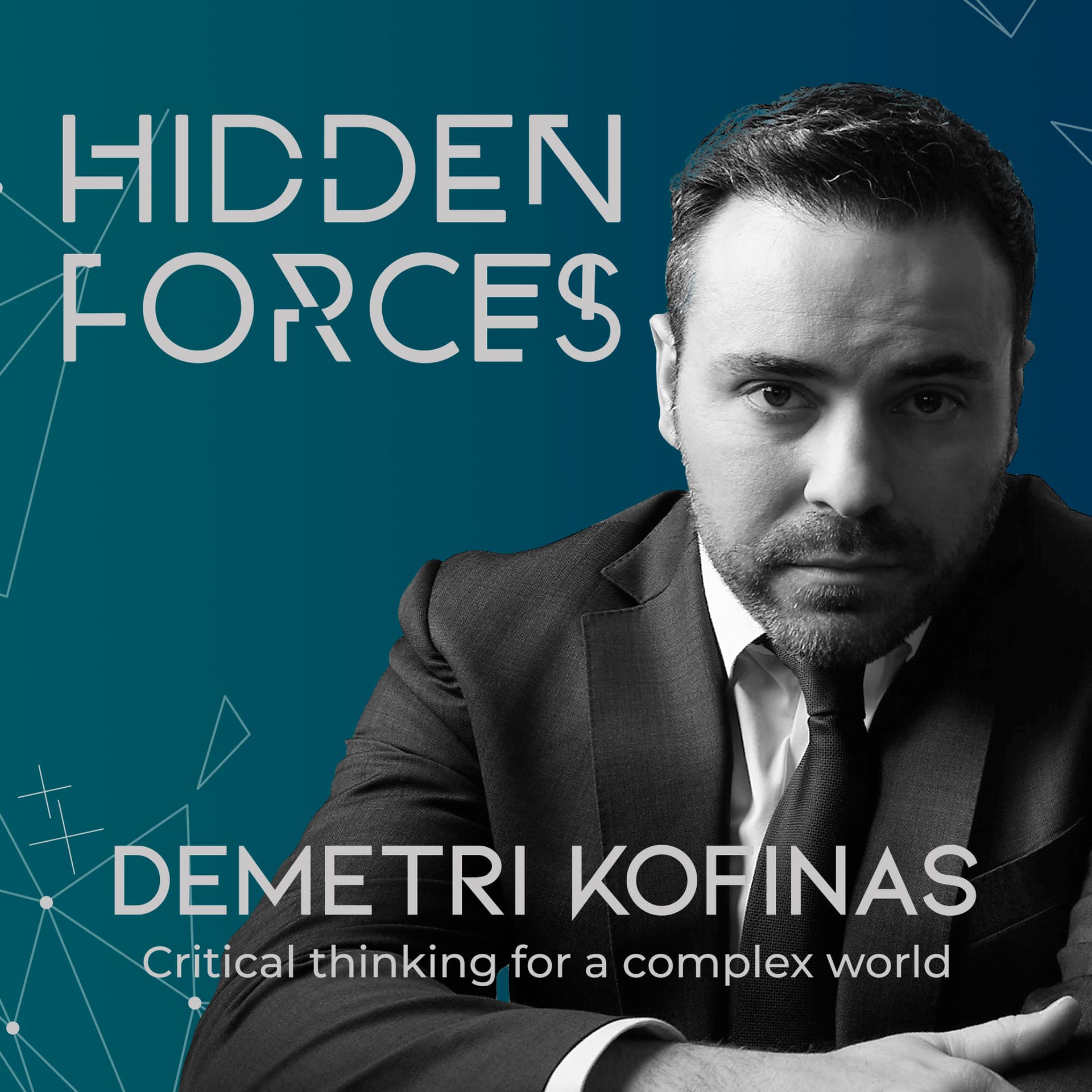
Automatic transcript. May contain errors.0:00Demetri Kofinas:What's up, everybody? My name is Demetri Kofinas, and you're listening to Hidden Forces, a podcast that inspires investors, entrepreneurs, and everyday citizens that challenge consensus narratives and learn how to think critically about the systems of power shaping our world. My guest on this episode of Hidden Forces is Will Manitas, the co-founder of healthcare AI company Science.io, a 2019 Thiel Fellow and an active early stage investor who writes thoughtfully on topics of technology, religion, society, and business for several independent publications and through his substack at minutes.substack.com.
0:40Demetri Kofinas:Will and I spend the first hour of our conversation discussing his background, including his early upbringing as a Quaker and his experience building and selling a successful AI and data science company before we turn to the central theological arguments that animate his writings about technology, the innovation cycle, and the political movements that grow up around them. It's Will's contention that the secular institutions we have been building and iterating upon in Western societies since the early 20th century have exhausted their capacities to provide order and meaning, and that we are entering a period in which the ancient forces of divine faith and savage violence are reasserting themselves.
1:18Demetri Kofinas:We discuss the ongoing collapse of state legitimacy, the competition over people and capital amid eroding institutional trust, as well as the renewed interest in Christian theology and the rise of a new political coalition consisting of anti-war progressives, tech bros, libertarians, and the religious right. The second hour is largely an exploration of artificial intelligence, alongside its consequences for the political economy, labor displacement, wealth disparity, terrorism, and the social contract. Manitas argues that the wealth being created by AI is rapidly concentrating among a narrow set of individuals and zip codes, foreclosing the kind of broad economic participation that previous technological waves once offered, and which created the foundations for more equitable distributions of capital and resources.
2:06Demetri Kofinas:Drawing a parallel to the first and second industrial revolutions, and specifically to the labor violence that preceded the New Deal, he contends that the new social contract that will emerge from the latest wave of technological innovation will not be negotiated peacefully, but will be accompanied by explosive acts of violence directed at both infrastructure and people. We discuss the vulnerability to data centers and the electric grid, how the threat of labor displacement could lead to a new left-wing coalition of aggrieved, highly motivated, and educated white-collar workers, and the international implications of AI-driven job destruction across Southeast Asia and other economies that have greatly benefited from the outsourcing of service jobs in the last several decades.
2:48Demetri Kofinas:We close with the discussion about Will's essay, Nobody Walks to Canterbury, and his concept of totemization, the idea that in a world of infinite digital supply, only those things that can motivate a person to get on a plane, drive cross country, or somehow surrender or sacrifice their daily comforts and routines in search of the truly extraordinary will command real economic pull and monetary value in the world to come. If you want access to all of this conversation, go to hiddenforces.io slash subscribe and join our premium feed, which you can listen to on your mobile device using your favorite podcast app, just like you're listening to this episode right now.
3:29Demetri Kofinas:If you want to join in on the conversation and become a member of the Hidden Forces Genius Community, which includes Q &A calls with guests, discounted access to third-party research and analysis, and in-person events like our intimate dinners and weekend retreats, you can also do that on our subscriber page. If you still have questions, feel free to send an email to info at hiddenforces.io and I or someone from our team will get right back to you. And with that, please enjoy this truly extraordinary and immensely valuable conversation with my guest, Will Manitas.
4:08Demetri Kofinas:Will Manitas, welcome to Hidden Forces. Thank you for having me. So Will, I don't know much about you other than that you grew up a Quaker and went to a Quaker boarding school. Then you went on to a tiny engineering school outside of Boston that I'd never heard of before, but apparently it's a very good school. It may not exist. It was a very good school at some point. We will see what the next decade brings. You were also a Thiel fellow. You played lacrosse. You started and sold a healthcare AI and data science company in a nine-figure exit. You lost 150 pounds in a year, which is remarkable.
4:42Demetri Kofinas:you are 50 % Greek and you were also recruited into a cult, almost recruited, I should say, into a cult. Almost recruited, yeah. So first of all, is everything I just said correct? And what, if anything, of importance did I miss in that short biography? Mostly correct. I think many kind of pure-blooded Quakers would reject my claims to Quakerism. I grew up in Quaker schooling. My mother was a Methodist, my dad a Catholic, and Quaker schooling was like a pretty steady medium for the two of them. I would claim to be a Quaker, but I have not stood for a clearness committee. So I think some Quakers would disown me, but otherwise all correct.
5:22Demetri Kofinas:So you're also the first person I've ever met who's Greek or partially Greek and also grew up a Quaker. What does that actually mean? So like the only thing I know about Quakers is they wear funny hats and I think I've seen them mostly on horses and buggies, but maybe I'm mixing them up with the Amish. Yeah. So there's this weird intersection between Quakerism, the Amish community in the Mennonites. And I would say the Quakers are largely kind of far outside of this. So the way to think about Quakers is it's kind of a great awakening era faith that comes out of the Midlands of England from William Fox.
5:52And Quakerism is really defined by kind of five cultural testaments we call the spices. Simplicity, peace, integrity, compassion. The E is either environmentalism or something else that we've recently invented, kind of post-Cold War. and an S for stewardship. So the way to think about it is it's people that try to live simple lives, people that try to practice simple faith. And I think the core of Quaker religion is a thing that we call meeting for worship, which is we sit in a room in silence. The room is kind of austere. It's typically a white room with a bench facing the front. Everyone sits around, sits in silence for an hour, and that's our fundamental form of worship.
6:32If you're called to speak, that is if you have the voice of God, Quakers believe that there's a small piece of God inside of all of us. that you can get to through a process called discernment, discernment sitting in silence and reflecting. If you're called to speak, you can stand before the meeting and deliver testimony. But other than that, Quakers live relatively modern lives, largely centered in the Philadelphia suburbs. There's a ton of Quakers in Africa right now, but it's like a very, very different branch from the kind of stuff I grew up in. And they're largely in decline. I would say Quakers are almost extinct outside of the Philadelphia suburbs and have largely become kind of a left-wing political project, which is somewhat disappointing to me based on their origins.
7:12Demetri Kofinas:So it's clear from having read almost everything you've written in the last few years that your faith forms the bedrock upon which your life is built and is the prism through which everything that you write about seems to be filtered. All moral questions and decisions about how to live a human life. Talk to me a little bit about your relationship to your faith, how it has shaped who you are and how it informs the way in which you interpret the subjects that you've been writing about and the arguments that you've been making. Yeah. So I grew up kind of intensely tied in this Quaker community, right?
7:45Same school, K to 12, boarded the last couple of years. That was Sunday meeting for worship, Thursday meeting for worship. So at least two hours a day in this active community. And the thing that was incredibly useful about Quakerism is that you kind of have a basis set of norms that you can call upon. Like certainly not everyone in the school was Quaker. I would argue maybe 10 % were actively Quaker or would consider themselves ongoingly so, but it gave you kind of a set of cultural norms that were useful. And then I end up at Olin College, which if it's not the least religious college on earth, it's pretty close.
8:19And we're next to Wellesley College, which is simultaneously kind of the most religious and zealotry and the least religious and conviction campus in America. And it shocked me the degree to which faith was not a set of tools that everyone had to understand what was happening in the world. I kind of largely ignored the question of faith while I was running a company. We ran the business for five years before selling it. And I did not stumble my way back to Christianity until the end of that journey, which was tremendously stressful and ended up falling back into it. But subsequent to selling it, I've been trying to work through this question of what is the function of technology in our society and what is the function of business in our society.
9:05And I think it's useful to process these through kind of a shared basis set of religion. And I've been orienting towards a narrow set of ideas in this essay series I've been publishing over the last year. but I think there is very limited contemporary writing on the question of faith and work that I find useful. And I'm trying to fill some of that gap.
9:26Demetri Kofinas:Well, so you kind of preempted my next question, which was to ask you really about your writing because your writing was introduced to me through the Canterbury piece, the Nobody Walks to Canterbury, which is a beautiful piece. By the way, my favorite piece of all is one that kind of in some ways doesn't deal directly with technology, but it certainly speaks to faith, which is your piece about Norway and your time spent in Norway. That was beautiful. So I want to recommend that people actually, why don't you actually give out your Substack now, just so it's top of mind for people? Yeah, it's Minutes, M-I-N-U-T-E-S.substack.com.
10:00You can also find it on my website, willminutes.com. Minutes is a Quakerism joke and Quaker meeting when we hold a meeting for business, which is a fascinating concept that only exists in Quakerism, where you sit together in silence and discuss matters of business for the community, which I think is very exciting. Middens are the records that we keep from those meetings. So you can read them all in Substack, you can read them all on Twitter. There's probably 25 essays now. Yeah.
10:24Demetri Kofinas:So, I mean, AI is a big part of this. And AI, as I mentioned, you started and sold a healthcare AI and data science company. And you're, again, you went to an engineering school, so you have that background. But I would say that religion factors in even more consistently throughout all the writing. And what I wanted to ask you essentially was what inspired you to begin writing? Like what was it that was percolating inside of you that needed to come out? Yeah, I've struggled with the definition of technology over the last 10 years, right? If you think about kind of the arc of the internet, we think of it as kind of a set of net new technologies in the 90s.
11:01There's a concept of an internet business, right? Like a business that could not exist, but exists on the internet, like pets.com, you sell food online. And then if you about what the internet is today, it's like a much more amorphous thing, right? Like there's no such thing as like an internet business. Like in some way, all businesses are internet businesses today. So if we're going to ask and answer questions about technology, we have to define what we think of as technology. And it's not like there's software companies anymore, right? There are companies that use software and that happens to be everything.
11:35So we start to think about technology not as a set of technologies that we use to build things, but a way to view the world. And I think if you look from kind of the mid-2000s to present, we see kind of three eras, right? Era one is like internet businesses, where this is like a toy that we use to sell things on the internet. And then we see software companies as such, which are like building software, shipping software, selling subscribable software. And then we see this kind of internet social wave where it starts to be clear that technology is kind of a core fabric of our world. And then finally, in this AI thing where technology is the underlying substrate of everything that's happening in our world today, there is nothing outside of it.
12:14It, much like the writers have said about techno capital, it absorbs everything. So if we are going to treat technology as an all-absorbing substrate that the world is going to operate on, it's useful to think about it in religious terms. And a question that I've been repeatedly dealing with is why does it have this millenarian instinct, that every single technology and wave that we've seen suggests that it's about to bring about the end of times. And what is the question of morals given that every technology wave has become less and less religious, clearly, but less and less religious in substance, more and more religious in shape, and none of them have been durable, none of them have lasted.
12:51Demetri Kofinas:Can you elaborate on that? I'm not sure I entirely understand. Yes. So if you think about the shape of most religions, you have kind of a long period of prosecution of believers filled with rituals of proof of belief, martyrdom, tests in community, etc., followed by a rewarding of the faithful that comes with infinite wealth, infinite blessings, infinite post-judgment. This is self-evidently the AI wave, right? Like if you think about AI doom, if you think about AI foom, if you think about permanent underclass, these are like profoundly orthodox ideals. And you're like, oh, that's okay. AI is like uniquely millenarian.
13:37Like it's a unique thing. And then we look at crypto. And like crypto had the same stuff, right? Like diamond handsing is like a conviction of faith. There's this like infinite wealth when Bitcoin goes to a billion. And then you just run through every technology movement. And what you find is they're very similar to kind of like first century Christianity, where they're so confused about why their Lord is not coming back, right? They're like waiting for a reward to the faithful, and then they collapse on themselves. So you can map every technology movement onto this religious arc, and none of them have figured out how to persist past a single generation.
14:11Like one of the pieces I wrote with Nabeel Qureshi this year, Ren at Virtue, we dealt with the question of what does a durable moral system for technology look like and came to the conclusion that it must necessarily be at least religious in shape, if not in content, because you can't have this arc of judgment to salvation without a transcendent ideal to orient towards.
14:33Demetri Kofinas:When you talk about them collapsing onto themselves, are you describing the business and innovation cycle of technology? Also the communities themselves. Like if we think about crypto, right, which was inexplicably linked to effective altruism, right, this utilitarian core, that movement ended with a false prophet that claimed to be beyond morals and then was found to be a fraud and collapsed onto himself through kind of a pure expression of utilitarian values. Sam Bankman Freed. Sam Bankman Freed, yeah, right. If you take SBF at his word, which I think we should do, his acts were purely rational under a utilitarian frame, but they obviously don't work, right?
15:13Like if we have religions that practice their faith in the way that Sam Bankman Freed practiced his faith, they would destroy themselves after a generation. And I think today, crypto and effective altruism, which is a movement of debatable merit, would be much stronger if they had transcendent ideals rather than this kind of collapse on itself thing.
15:33Demetri Kofinas:So I see that in crypto. I see that in AI, in the early AI movement. What is the equivalent in the internet, in the internet boom? You have to cut into multiple things. I certainly think in the social internet boom, it was this influencer thing that if you were famous enough on the internet, you could live essentially similar to like a living saint, right? People would be excited to see you, they would give you free room and board. You'd be extended civility in places where you otherwise would not have it. You could live like a saint. And that was like a near-term imminence of judgment thing, where if you could develop enough of an audience, you'd be saved.
16:10Demetri Kofinas:So the reason, though, I asked more specifically is because I suppose I could see that maybe when it comes to the saint analogy for social media, though I think that extends to celebrity in general. But I definitely see what you're saying when it comes to crypto. I just didn't see anything like that. It may have been because I was too young to really like... I still think part of it is like it's accelerating, right? Like if you think about each concussive internet wave, it is more totalizing. Like the internet eats more of the world with each of these waves. And if you think about AI as kind of the final wave of techno capital absorption, it is the final wave where like tech as such can eat the pieces of the world that it cannot touch yet.
16:48The internet has been like a slowly totalizing force that just eats more and more. And I think we're in kind of the final wave here, or at least one such final wave.
16:58Demetri Kofinas:So do you feel like people are turning more toward religion? I get in trouble thinking about this a lot because every six weeks, a journalist wants to write a story about how, you know, more young people are going toward to St. John's in the West Village and everyone's religious again. And, you know, if you believe Ross Duthet, it's not true in the numbers. And if you go to St. John's, it seems to be true. So I think it's like hard to make normative claims about this that are useful. I do think the AI thing is like the single greatest jump ball of meaning that we've ever had. Like the questions of how then do we live and how do we conduct ourselves are incredibly consequential over the next few years.
17:35And I just don't think there are particularly good answers, secular answers to them that exist outside of religion.
17:41Demetri Kofinas:So we live during a time where Christian theology and references to God and the Bible have become a way of signaling one's participation within a new right-wing coalition consisting of members of the anti-war tradition, the religious right, and what we would broadly describe as tech bros. Before I ask you any more specific questions about your relationship to the mystery that Christianity grapples with, which I think that you did so beautifully in that Norway piece, I'd love to understand what you think is happening. What explains the rise, not just of this observable, renewed interest in the Christian faith, but the rise of a very specific political movement and coalition that puts Christianity and the gospel at its center?
18:33Yeah, I think it's useful to separate a handful of factor input. So if you think, I think there's a couple of things that are happening on top of each other. There is the Christian right that is overlapping with the tech right, which I think are maybe at best parallel forces that occasionally touch each other. And the question of what the tech right is and why it failed, I think, is an interesting one that I would love to think through at some point. But people much smarter than I am are writing books about it at this point. But I would view the tech right as a thing that broadly took up the coat of Christianity but perhaps was not intimately Christian inspired.
19:18And then you have kind of a revitalizing of what I would call low church Christianity in the right, which is, you know, the rise of the rest, the kind of J.D. Vance core of the party, the people I grew up around in PA, which is good, right? There is some sense in which is this pieces of elite culture that are being ascribed to what was predominantly a working class culture. Like we are prioritizing these for the first time in a long amount of time. And then there's, I think, a more interesting thread that I haven't totally figured out what to do with is what I would call kind of the new elite politics or like the new Tom Wolfe, which is like the people that would be on the Upper East Side holding parties for the Black Panthers in Bonfire of the Vanities are now going to St.
20:03John's in the West Village. and this like high church smoke and incense kind of Christianity is becoming a class signifier of a certain kind of new intellectual elite. And I don't totally know what to make sense. I don't know totally how to make sense out of that. But one of the questions I've been concerned with over the last few years, this is a question of elite politics. And I do think this kind of Christian high church Anglican thing is going to become more prominent as part of that.
20:32Demetri Kofinas:So one of the challenges I had in preparing for this conversation, Will, is that you pull on so many different threads in your writing. So what I decided to do, rather than try to create some kind of structural narrative that we follow, is I pulled a lot of quotes from a lot of the different pieces that you've written. And I want to read them to you and to our audience, and then I want you to comment on them. So one of them, this first one here is from Sivis Romanasam. And you write, quote, my contention is that we are entering a period where the appeal of religion becomes for a growing number of people, not an anachronism, but a live option.
21:08Demetri Kofinas:When everything in your life, your family, your community, your career, your property is greenlit by the enemy. When violence can reach you anywhere and knows who you are, the question of what protects you becomes deadly serious very fast. And for the first time in most of our living memory, the state doesn't have a convincing answer, no matter how much it's willing to spend. So give me the context here, first of all, that inspired you to write this. And what is the violence that you're referring to? And why is the state unable to protect us from it? Yeah, I think I was sitting in London writing this, and outside of my hotel, you could just listen to people have their phones stolen out of their hands by guys on motorbikes.
21:49And there was just some sense in which day-to-day street life was much more chaotic than you wanted it to be. And I think overshadowing this was this was the week when the Brown University shooting happened, when that girl was killed on campus in a conservative club that ran a conservative club in a study group.
22:07Demetri Kofinas:Can you please just summarize the details of that instance for people, most of whom will not know them? Yeah, there was a girl, I believe, from Alabama, I'll forget her name, which is a sin of mine, who went to Brown University, was a woman of faith, had been running a conservative club on campus, and was shot dead by what was reported to be kind of a crazy on-campus homeless person who then went on to kill, I believe, a nuclear researcher in Brookline, Massachusetts. And the reaction to it on campus was terrifying, kind of similar to the weeks after the Kirk shooting. There was some sense so much violence.
22:43A useful way to think about America in the post-war era is that we could not provide a joint security guarantee for all of our citizens. But if you were wealthy enough, if you came from the right class circles, if you had the right skin color and you lived in the right communities, you could pretty much guarantee that you were going to live in what I dismissively call a no PVP zone, right? You could live in a place where you were not going to be killed. and the campuses of elite universities were perhaps the most clear examples of this, right? These are like in like Tom Wolfe language, like beautiful wasps children being sent to consider the classics for four years.
Read the full transcript
23:19These are places where violence does not happen. New York, largely for people of a certain background and social class, was a place where violence does not happen and you could always earn your way out of experiencing violence directly. And I just don't think that's true anymore, right? Like one of my contentions across all the essays is there is this understanding that we came to after probably World War II, maybe after World War I, that we were leaving the driving forces of history behind. That if all of history was animated by divine faith and savage violence as kind of two dueling forces, that we were now civilized and that things like institutions and things like states could in some way prevent them from touching our lives and that we lived kind of outside of our animal instincts or outside of our flesh and blood.
24:10And I just think that's clearly false. Like the world is a profoundly savage place and the state cannot protect you from that anymore.
24:18Demetri Kofinas:But why can't the state protect us? I think it's because the state never could. It's too large and too diffuse. And it's hard to think of a coherent American identity that kind of, you know, connects the farmer in Tulsa to the doctor in the Upper East Side to the council housing on the other side of the city. There is no kind of cross-coherent cultural ideal that provides a reason to not return to savage violence and divine faith with the things that animate your actions. I also do think a big piece of this is just like the court and criminal justice systems don't work as well as they used to.
24:56Like the prosecution of crime, the normalization of violence, the fact that scamming is just completely tolerated now. There's just all these ways in which society has become progressively lower trust that the state does not provide good answers for.
25:10Demetri Kofinas:What explains that? So also, it sounds like you're saying that most of what we consider to be policing was just self-restraint by people that were proceeding under the assumption that there would be repercussions if they were to act. And now that that has dissipated, many people are calling the bluff of the security state. Yeah, I just don't know why you wouldn't do crime today, right? Like the state has told you that it is legal to do crime, that you are greenlit, that your families are greenlit. If you are an actor there that does not have morals, the efficient frontier is to do crime. And so what explains that in your view?
25:44I do think religion provides a really neat answer to the question of why should you not behave in immoral ways, right? Like even if the state does not see your actions, God will, and that's a useful frame. But more importantly, I do think part of it is just there is no, we've built all these secular alternatives to the concept of judgment and they just don't work, right? Like if you think about cancellation as kind of a way to immunitize judgment, right? Where you can look at the sins of another and cast them to hell during their life instead of waiting for the next one. That also provides for a culture where if you are not caught in the moment, there is no consequence to your actions.
26:27Demetri Kofinas:So what we've broadly thought of as cancel culture or getting canceled for something. It's clearly a Christian conception of judgment that's brought into this lifetime. And that if you're not publicly shamed or flogged for what you did, you can keep on doing it and there really no other consequences. Yeah. There's a question of like, what is the relevant moral window, right? If I walk out of my door today and go to the Walgreens and steal something, if NYPD doesn't catch me in that moment, they're not going to catch me three months from now. And if there's not a benevolent God watching me, then who cares, right?
27:01And there's just some sense in which if I'm not terrified of judgment, then I'm only concerned about what's going to happen to me in the moment. And if nothing happens to me in the moment, then I'm happy to continue transgressing. Yeah.
27:10Demetri Kofinas:So there's another piece that I'm sort of debating on which one to quote right now. It's titled, The Server Has No Mods Left, and it relates to what you're talking about now. But I actually want to pull one more quote from the previous piece that I mentioned, because you mentioned in your initial answer, or you drew this distinction between immobile and mobile citizens. And in that piece, you write, quote, when protection fails for immobile citizens, a state decays slowly. When it fails for mobile capital, the repricing is sudden. The question for the next decade is which sovereigns can offer what Rome once offered, the cloak, the words, that guarantee that your person and property are inviolable, backed by a credible threat that makes violence against you and your property unthinkable.
27:52Demetri Kofinas:Can you clarify this distinction between protection for immobile citizens and mobile capital, how that translates into this notion of a sudden repricing and what that means in actuality? Yeah. So if you think about what gives the state legitimacy, it's mostly tax yield, right? Like the U.S. is worthless unless it can collect taxes on a large tax base. And the U.S. has had relative global homogeny because we have such great industry and that industry is a thing that is easily taxable. What is hard about the industries today is that they are not like brick and mortar factories, right? If you look at the percents of GDP that are made up by things that are relatively amorphous, don't have brick and mortar contingents, or could be moved, right?
28:41All of technology, all of finance, all of private credit, all of the professional managerial class. Those groups, if they are put at risk, can get up and walk away. That is not true of the lower and middle classes, right? Those are predominantly tied to zip code level careers, right? The community I grew up in was filled with people that could not get up and walk away, right? Who are probably home poor. 90 % of their net worth was tied into a house they couldn't get out of. Their careers were local. Their communities were local. They could not move. But as a percentage of tax yield for the state, those are not where, you know, trillions of dollars of U.S.
29:23military funding are coming from, right? That's not where trillions of dollars of U.S. police funding is coming from. And I think you're seeing this in small form with New York City where many kind of small groups of incredibly high earners are choosing to just move to Miami to get out, to move to Palm Beach. And if you talk to people that run large corporates or large kind of high taxable entities, you can see this move where they're choosing to move to places that offer a better ROI on their dollar. And I'm very skeptical of this idea of exit as a way to check the state. But certainly, if you go to London today, there's a lot fewer finance professionals living there than there were 10 years ago, right?
30:03A lot of them have moved to the Gulf states. And it's somewhat crazy that when I want to see my British friends, I go to Dubai. And when I want to see my Dubai friends, I go to London, right? There is just more mobility in these classes than have ever existed before. And I think that provides a much deeper and profound check on the powers of the state than anyone ever has before.
30:24Demetri Kofinas:So would you say that most of the migration we've seen has been intrastate as opposed to international? So people moving from New York to Florida, as opposed to people moving from New York to Dubai and renouncing their citizenship? And is that the primary reason why Americans aren't doing it internationally? It's because they still have to pay taxes unless they give up their citizenship. At which point you have to ask the question of, well, when does it no longer become worth it to be a US citizen? Which goes back to the central question of the peace, civis romanus sum, I think. Yeah, I try to resist as much as possible thinking about America as a special economic zone.
31:00I think of America much closer to a spiritual project in which I would, no matter the tax yield, struggle to give up my American passport because I believe in this thing foundationally as a project of God so we are manifesting here on earth. I don't think that's shared largely among the capital class. I am hearing more and more conversations among individuals that are incredibly high taxpayers about places like Uruguay as a preferential option for the rich in America today. Certainly happened in the UK, right? The reversal of non-dom tax status in the UK chased something like 70 % of the billionaires out of the country, right?
31:40If you go to the Gulf states today, many Americans, many expats that are there as tax refugees, it's useful to think about tax much more as a marginal product that you are buying than it is a right that the state has over your earnings. And I think more and more people are going to take it seriously.
32:00Demetri Kofinas:So I've been to Uruguay. It's not a great place to live. I really like it. I'm like a Uruguay truther, but I think it's like one of the last bastions of kind of like Anglo life accessible to you. You can shoot birds year round. It's like quite nice. It could use some mountains, like geographic variety. But like, I don't know. I think Uruguay is a pretty good option. Well, so this brings it, let me make a further point, which is that I'm also skeptical about, you know, how many of the people that moved to Dubai now regret it because of the security aspects of this? You know, you're much safer living in London, presumably.
32:35Demetri Kofinas:I mean, you know, again, like - I don't think you're safe. You don't think so. I disagree strongly. So just to clarify, the small instances, or maybe small is the wrong word, but what we think of a traditional criminality, those instances represent a larger threat to your safety in living in London than the periodic potential fat tail outbreak of ballistic missiles raining down on your city. Yeah, I think people are very bad about thinking about personal risk, myself included. and the odds of my apartment being blown up once every 10 years is a much lower mental toll on me than the constant, is my phone going to be grabbed out of my hand on my streets?
33:14And right, I took a walk last night with a good friend who's having kids this year, is running a very successful business. And depending on the outcome of this year for him, he's not a U.S. citizen today. He may choose to not progress his application status. provisional on if the business does well or not and move to the Gulf states. He's not Muslim, right? He's like a Canadian. And if you talk to him about it, he's just like, I don't want to raise kids in New York City or in San Francisco where I worry about their safety every day. And it's much easier to be in a low tax jurisdiction where I can sit.
33:50Do I find this like slightly distasteful as an American? Yes, right? Like I'm tied to the mast on this one. But like we should worry about the legitimacy of state in a world where there's an increasingly mobile, high-tax-y old class.
34:03Demetri Kofinas:I find this so interesting. First of all, it makes me so sad to think that smart immigrants would leave the United States to go somewhere else. I wonder also to what degree that's because we've created a cultural atmosphere that is not hospitable to them and makes them feel like they're not wanted. But we no longer live in New York City. We did up until the pandemic. I still go periodically. I don't want to live in New York City anymore for lots of reasons. It definitely feels not as safe as it was, but it doesn't feel as unsafe as it did when I was a kid. I grew up for some years when I was a kid in Astoria, Queens.
34:39Demetri Kofinas:It was way more dangerous. And then even in the 1990s, my aunt got carjacked on the Major Deegan. I remember even, again, I feel like we're kind of back to what it was somewhere in the 90s. And we live out in the suburbs now and it's completely safe. So I guess this framing or the preconditions or assumptions that underlie this conversation, I don't immediately accept them. So how unsafe is New York City really? I mean, we see people, I saw recently some guy in Grand Central Station with a machete. He attacked some people and was shot. That's obviously scary, but does it rise to the level of, again, to your point about comparing statistics, does it rise to the level where I should be concerned about going into Grand Central Station or more concerned about it than I am living in the Gulf or living in some other part of the world where there are periodic earthquakes or tsunamis?
35:36Look, I think New York is probably the safest it's ever been in statistical basis. It's a lovely place to live. The way I would think about this is not in terms of like relative statistics or base rates. I just think it's a purely emotional decision for a very narrow class of people. And if you think about what the marginal product of New York consumption is, it's a much higher tax rate than any city on earth. It is a much higher cost of living rate for any city on earth, especially at the ultra high end of that spectrum. So if you think of the legitimacy of New York as a tax coalition, as a thing that can afford to cover its bills, A lot of the tax yield is coming from the high end of the power law, the ultra high earners, right?
36:17The people that are yielding five, 10,$20 million a year to tax authorities. And for those people, the question is, is the marginal difference in spend worth it relative to the four other cities in which I could live and do my career on earth? And I think like, look, as like an upper middle class, happy guy, I like New York. I'm going to make this trade all day. But if I was paying a billion dollars in tax yield here, I think I might think very differently about the calculus.
36:46Demetri Kofinas:Well, so I think the people I speak to who have made the move, it's hard to disentangle the financial incentives from all the other stuff that makes those of us who have lived in New York or live in New York or spend time in New York dislike it. And I think the class war element the way that... This is another thing, Will. I was speaking with my wife about this. As I told you, she's from Argentina. I'm Greek, but I grew up in the United States, but I spent a lot of time in Greece as a child and throughout my entire life. And we spend every year some time in London. We see this every... I mean, Europe writ large is not as meritocratic as the United States has been, but the United States is becoming less meritocratic.
37:28Demetri Kofinas:And so, we realized something, both of us, but independently, that we want to live in a meritocracy. Living in a country that is less meritocratic is meaningfully worse. And it's not just about taxes. I don't know what the incremental amount of taxes I'd be willing to pay in order to live in a meritocracy would be, but there is some number that I would be willing to pay just to not deal with the bullshit of having to live in a sort of left-wing populist society where capitalists and people that are working hard and trying to climb the ladder are constantly being demonized, and where there is a general attitude among the population that the game is rigged, it's fixed.
38:08Demetri Kofinas:And so actually, this feels like a great opportunity to pull a quote from that article I told you, The Server Has No Mods Left, because I think it speaks to this. And it's something that I think I've spoken about on the show in numerous occasions in various ways. So the quote is, once a game goes free to play under weak moderation, the culture of play shifts. Cheating, exploiting, and re-rolling are no longer edge cases. They are baseline assumptions. Resources concentrate in the hands of those most willing to abuse the meta. We see analogous patterns offline. Legal, financial, and social exploits are pursued until they are formally patched, at which point attention shifts to the next loophole.
38:50Demetri Kofinas:The practical ethic is simple. If the system is obviously broken, you are a sucker for not playing it to the hilt. So that very last bit there, you're a sucker. So I said, again, my Greek heritage, the Greece that I grew up in was a Greece where that was a very common phrase. Or there was an underlying sentiment that I'm not going to be the sucker at the table. If everyone is breaking the rules, I'm going to have to be forced to break them also. And I feel like that has accelerated in America. And we've really seen just like overt levels of corruption under this administration. And it feels like we're becoming a banana republic.
39:28Demetri Kofinas:So I'm curious, to what degree was that? Because you're not very clear in the piece that that's what you're referring to. You could be referring to a lot of things. And in fact, you may be. So I'm just curious, what was the inspiration for what I just read there. Yeah, I'm probably less interested in questions of corruption at the state level than others are, mostly because I have the strong belief that states have always had extremely high rates of corruption, that the corruption we're seeing now is just different in character and appearance, but probably not in intensity. Before you move on there, can I just ask you, isn't there a meaningful substantive difference between open versus closed levels of corruption, overt versus covert, because one is creating norms of corruption.
40:13Yeah, there's definitely a norming effect. My question is like, when you stand before God, a judgment, are those two things different? And I'm not sure they are.
40:20Demetri Kofinas:But if your society is becoming more corrupted as a result of the fact that you're creating cultural conditions that now make corruption acceptable, and where everyone is basically saying, I'm not going to be the sucker at the table, even though I'm an ethical person, if I just play by the rules, I'm going to end up below because in order to live a normal life, I have to break the law. I don't think that the loss of trust at the non-elite level is causally downstream of elite corruption. I think there are almost entirely two separate phenomena. Fair enough. So why don't you continue? I just wanted you to clarify that before.
40:58Demetri Kofinas:Yeah. Sorry, this is just not a threat I've thought about before, but I would argue that they're almost entirely separate things and that the elite corruption that we're seeing today is probably similar in scale and intensity to what we have seen in almost every area of American life. It's just the internet and the loss of kind of elite cultural norms of silence make it more visible. Like maybe these things would happen in Yale dorm rooms in past generations and they just don't anymore happen on the internet. So what were you referring to then or what inspired you to use those words? So I had a landlord.
41:37This is a fun story. I rented an apartment from a landlord that she was a wealth manager from the nation of Brazil that was convicted by SDNY of stealing many millions of dollars to purchase the apartment that I lived in. And I was renting it from her without knowledge of this? It's a funny story. We'll loop back around to kind of big cosmic questions, but this is a good concrete example. So I'm living in a stolen apartment. She has ripped the AC out of the wall while I'm living there in order to sell it, presumably to cover more of her stopgap. And the co-op that this apartment is occupied in is simply interested in allowing her to continue to rent it regardless of her criminality because then she's paying more in common dues than anyone else in the apartment.
42:25So over the course of the two years I live in this apartment, I end up in a complex, multi-sided lawsuit in between her and me, the co-op and me, and the SDNY and her, where she commits this crime in 2011, or give or take.
42:40Demetri Kofinas:What did she steal the deed, replace the deed? No, she was a wealth manager. She took money. This is all alleged. Please don't sue me, former landlord. But she took money from her clients, fabricated certificates of investment, and used that money to buy this apartment. She gets charged in like 2014. This is like 2021. So it's like 10 years of these poor people that have been scammed. And then I'm living in this apartment paying rent for what is like a piece of stolen property that I find out once the air conditioning goes out. And it becomes very clear that she's just like looting the apartment for additional money.
43:14And everyone inside of the situation is incentivized to allow her scam to continue to run up until she finally is put into jail after 10 years of court. She's put into jail. oh, I think she'll be deported in 14 months or something. And like the externalities of this was passed purely onto people outside of their social class. Like the building did not care to fix this because I was the only renter in the building. And therefore I was like below them. And therefore they could like force me to have this horrible landlord. And like SDNY did not care to fix this because the victims were offshore and it was like not high on their conviction roadmap to deal with this like small level scam.
43:51And New York City Housing Court did not care to fix this. Because questions of who actually owned this apartment were like secondary to questions of like, is air conditioning part of my lease or not? And I do think as we like live in an increasingly complex society, the interfaces between different levels of enforcement are just so much more complex. And like 50 years ago, 60 years ago, this is actually a very solvable issue, right? Like this is like a thing that gets solved in court in a month. But over the course of two years living in this apartment where, you know, the scales of everything is so much bigger in today's world and the interchanges between all these different federal agencies are so meaningfully complex that there is no reason to suspect that you'll ever be caught.
44:34And she got to run the scam without all that much harm. And like if you look at PPP loans, if you look at all these other areas where it's just like the world is so meaningfully complex that the efficient frontier is just to cheat. That is a scary thing. and enforcement is just much slower than it's ever been.
44:51Demetri Kofinas:So what explains that? Is that a natural derivative of the evolving complexity of the legal system and the compounding growth in bureaucracy? Or does it speak to a kind of ongoing moral collapse in society that's happening independently of that? Or are those two things connected somehow? I think two connected things. One is like a moral collapse, right? You would not do that. You would not scam like this if you believed that you were going to have to account for it at judgment, right? First level. And second level is just like as society grows, like I think a useful way to think about the global homogenization that's happening is not only that we are all collapsing into the same society, but we're all collapsing into the same reference frame.
45:38that like the part of the thing that we were losing as we homogenize is any sense of a local frame that is normal, right? Like if you commit a crime in New York City, you were treated under the same jurisdiction as committing a crime in another state functionally, same law, same everything. And that means that the community enforcement is stretched across the totality of the U.S. and the systems that interface are much more complex. This was not the case, generation ago.
46:07Demetri Kofinas:So you said that you wouldn't do this if you believe that you would face judgment. It seems to me also that there's something else going on because one could argue that there's also a biological basis in morality, which is to say that there's empathy. I mean, regardless of what my faith is or is not, I imagine that I would also be repulsed by the idea of scamming somebody, stealing something from someone, ruining someone's retirement plans. I mean, that is deeply immoral in ways that I think go beyond simply the scripture that I'm inheriting or the religion in which I'm brought up. So what else is going on there?
46:42Yeah, a frame I like on this is like the concept of resource guarding. And I've been thinking a lot about this in the context of anti-data center popular action in the US. But there is some sense in which when upward mobility disappeared in our society, right, it's not particularly legible to anyone in the US at this point, how you move from middle class to upper class outside of this kind of casino-ification that I've written about. There is much more a sense of which the world is, if not negative sum, then at least a closed pie that you must kind of hold onto the resources you're given. And if it's not a positive sum world and you can't climb, then you should like get yours and you should like protect your family.
47:25And even if that means scamming, then like, you know, it's like a world, just like take what is yours. And it's a very interesting frame to view AI water use discussion as well, but we can table that for later. But I do think in some sense, part of it is just like there is no legible American dream left and therefore you can't climb class and therefore you must keep what is yours to kind of hold onto your social standing with both hands.
47:50Demetri Kofinas:So this is probably a good time to bring up another quote. This one was from Rented Virtue. You wrote, when you lose the framework that ties your daily work to a moral account of the universe, that void does not stay empty. Something else fills the house. So up until now, we've been talking about what is gone, the decay, the collapse in the foundation. But what is it that you're referring to when you say that something else fills the house? Yeah, demons, demons. I have this really strong belief that the world makes a lot more sense if you assume that like demons from scripture are real and around us and that the immoral forces that occupy the heart when it is empty of faith are ones that are not amoral, but are actually embodied and evil and bad.
48:39And if you think about the kind of alienation of labor in work, right? Like the, if you're like a median professional managerial class employee, if you're like a paper belt employee, like top deck of the Titanic stuff, your income is like totally untied from the amount of contribution you give to the world. Like my bid on this is like Google, right? If you think about like the economics of Google and you like look at like how much everyone's paid proportional to how much of the P &L they contribute, it's like almost a banana republic, right? Like core search and core ads are like 90 % of revenue.
49:13Maybe GCP is bigger now than the last time I looked at this. And the people that run that are like 30 people at the core of the company. Like the core Google algorithm, I think, is like 15 people maintaining the thing that probably contribute 90 % of revenue. And in like a purely meritocratic world, those employees would be paid, you know, tens of billions a year because they're like actually contributing to the core thing. But in the professional managerial class world that we've invented today, you can't pay people$10 billion a year. So instead, you have 150 ,000 employees that all make kind of half a million to a million bucks a year, and that the outputs of your labor are totally untied from what it actually does in the world.
49:50And the question of what we're doing in rented virtue is if capital does not provide a justification for your work, right? Like if you can get a job that is unmoored from the output and you're comped unmoored from the output, then you must come up with some kind of moral counting of what that work is worth.
50:09Demetri Kofinas:Well, what are the implications of that? So I feel like this speaks to some of the other stuff you've written related to political insurgencies and what sounds like a potential political revolution may be driven by the displaced workers or a coalition of displaced workers on the left, driven again by this larger topic of AI that you've talked about and written about, which we haven't had a chance to discuss more explicitly here, but which we will certainly in the second hour. But how does that relate to that stuff that you've written about, the political economy of large language models, in other words?
50:43Yeah. My joke on this is that all the job replacement that will happen as a result of AI has already occurred, right? The job loss that is happening is a thing that happened in the 70s, right? Most of the losses to automation are actually losses to offshoring, and they happened a long time ago. It's just the blue collar coalition in America does not have a political coalition that will protect it, right? When automation stripped the middle of this country, there was no reckoning for those jobs, right? It was just complete offshoring. But if you think about the professional managerial class, like these people have profound political power, right?
51:24Like when the New York Times editor loses their job due to AI, that person is going to be protected by the state, right? That person is going to be given something that approaches universal basic income. That person is going to – and this is just totally incoherent, right? Like these are like – these jobs did not exist a decade ago but will exist 600 years from now because of the political coalition of AI.
51:48Demetri Kofinas:So this is actually a good opportunity to pull a quote directly from that written piece, The Political Economy of Large Language Models. You write there, quote, the next political insurgency, that is the one enabled by AI, will not resemble the last one. The meme war required thousands of participants producing and distributing content with wide appeal. An AI enabled operation can require only a handful of operators and customized content to target ultra-narrow areas of resentment. The right won the last information war with these tools and these people, but the next information war will be fought with people who don't share its commitments and deployed through channels it can't monitor with models it can't detect.
52:32Demetri Kofinas:What is it that you're envisioning here when you describe an insurgency enabled by AI? Yeah, this is sitting in the context of one of the strongest convictions I have about the political process, which is that every trick we use to win an election only works once, right? If you think about the Obama coalition, the messaging there was legitimately novel and will never work again, right? A new hope for America. It's not going to happen again, right? It's over. Well, what do you mean? Because, well, I feel like there have been variations of that throughout American history and throughout political history.
53:08I think the Obama effect was broadly singular, a cross-racial, cross-economic, multicultural, global coalition that believed that a new America was in front of it and that the way we would get there is kind of progressive opening and progressive norms was a kind of one of one. What in common does the Chicago street organizer and the hedge fund manager, like what common praxis do they actually have? Very limited. But the Obama coalition brought them together through this positive and totally underdescribed, you know, optimistic vision of the future. Global norms, institutions, et cetera. The Trump coalition is perhaps more striking in how weird and unique it was, right?
53:57I jokingly call this the Chud and Capital Coalition, where what does the factory owner have in common with the factory labor? Almost nothing, right? The interests of capital and labor have never been aligned outside of the Trump coalition. And part of that is this kind of highly kinetic, online-first, meme-based campaigning that just will never work again.
54:21Demetri Kofinas:But wasn't the Reagan coalition in part a coalition of lunch bucket Democrats and capitalists? Yes, but the carrier of the message was different. Like the Reagan and Trump coalition, I think, are interesting to an interesting pair of trade on this one because Reagan started both as like an elite effect, right? Like a beautiful family from California, literally a movie star from the top down, right? Painted this positive vision that America was off track but stable, very similar to Trump, right? You can listen to like a time to choose that speech and it's like almost Trumpian in many ways. but it was an elite first politics.
55:03What's interesting about the Trump coalition is it's almost kind of like fully automated boomer luxury communism. Like they're not going to tax your $2 million fishing boat anymore. Like it's like of the people of the like chud class, like, you know, you're not going to get taxed on buying a snowmobile with your 401k anymore. Just very different from the Reagan thing and very online, very, very online. TikTok first, kind of four transfers, very concussive. And this thread of kind of performative cruelty that I find really distasteful, but is at the core of a lot of this. And that just won't work.
55:41Like you can see the left trying to adopt pieces of this, but it's just this trick that every election has some conceit that decides the election that never works again. It's like a zero day in software. Once it's deployed, it never works again. And I think people are not taking the AI zero day nearly seriously.
55:59Demetri Kofinas:It's very interesting. By the way, I don't necessarily disagree, nor do I think that you're necessarily wrong, but I just want to highlight how cynical it is that you are comparing American politics to a zero-day exploit. Is that how you view the merits of the case that are made by politicians on a continual basis to govern in a democratic society like ours? I think people largely vote based on tricks played on them by politicians on the national stage. Well, certainly I would say that's how a lot of people feel today, given some of the policies of this administration. So as I mentioned, you've written on so many different topics, that there are through lines that run through all of them.
56:37Demetri Kofinas:And I have many more quotes that I want to pull in the second hour, Will. I think something you've written about that we're going to talk about first when we move to the second hour is what I would just describe as the breakdown of our models of reality, or maybe a better way to put it is of consensus reality, of the way that we've agreed to agree about what is and is not. Because I think you've written a number of profound things there, which also very much resonate with me. I also, as I said at the beginning, the Nobody Walks to Canterbury piece was how I got introduced to you. And I love that piece and it speaks directly to the nature of the economy that we're building.
57:15Demetri Kofinas:So what I envision for the second hour is to really shift our focus to discussing the political economy and artificial intelligence. And that'll also give us a chance to discuss your piece on the garden. And then I have some very specific questions about the venture capital industry, as well as what you envision for the future of media and continuing education. For anyone new to the program, Hidden Forces is listener supported. We don't accept advertisers or commercial sponsors. The entire show is funded from top to bottom by listeners like you. If you want access to the second hour of today's conversation with Will, head over to hiddenforces.io slash subscribe.
57:52Demetri Kofinas:and sign up to one of our three content tiers. All subscribers gain access to our premium feed, which you can use to listen to the rest of today's conversation on your mobile device using your favorite podcast app, just like you're listening to this episode right now. Will, stick around. We're going to move the second hour of our conversation onto the premium feed. If you want to listen in on the rest of today's conversation, head over to hiddenforces.io slash subscribe and join our premium feed. If you want to join in on the conversation and become a member of the Hidden Forces genius community, you can also do that through our subscriber page.
58:29Demetri Kofinas:Today's episode was produced by me and edited by Stylianos Nicolaou. For more episodes, you can check out our website at hiddenforces.io. You can follow me on Twitter at Kofinas, and you can email me at info at hiddenforces.io. As always, thanks for listening. We'll see you next time. you
From the publisher
In Episode 479 of Hidden Forces, Demetri Kofinas speaks with Will Manidis, co-founder of healthcare AI company ScienceIO, 2019 Thiel Fellow, and early-stage investor, about the collapse of secular institutional legitimacy, the reassertion of divine faith and political violence as organizing forces in modern life, and what the concentration of AI-generated wealth means for the social contract, labor, and the future of economic participation.
The first hour traces Manidis's background — his early upbringing as a Quaker and his experience building and selling a successful healthcare AI and data science company — before turning to the theological arguments animating his writings on technology and the innovation cycle. He contends that the secular institutions Western societies have built and iterated upon since the early twentieth century have exhausted their capacity to provide order and meaning, and that we are entering a period in which ancient forces of divine faith and savage violence are reasserting themselves. They discuss the collapse of state legitimacy, the competition over people and capital amid eroding institutional trust, the renewed interest in Christian theology, and the rise of a new political coalition spanning anti-war progressives, tech entrepreneurs, libertarians, and the religious right.
The second hour turns to artificial intelligence and its consequences for the political economy, labor displacement, wealth disparity, terrorism, and the social contract. Manidis argues that AI wealth is rapidly concentrating among a narrow set of individuals and zip codes, foreclosing the broad economic participation that previous technological waves made possible. Drawing a parallel to the First and Second Industrial Revolutions — and the labor violence that preceded the New Deal — he contends that the new social contract emerging from this wave of technological innovation will not be negotiated peacefully, but will be accompanied by explosive acts of violence directed at infrastructure and people. They examine the vulnerability of data centers and the electric grid, the prospect of a new left-wing coalition of aggrieved white-collar workers, and the international implications of AI-driven job destruction across Southeast Asia and other economies that have benefited from decades of service-sector outsourcing. The conversation closes with a discussion of Manidis's essay "Nobody Walks to Canterbury" and his concept of totemization — the idea that in a world of infinite digital supply, only those things capable of motivating genuine sacrifice and surrender of daily comfort will command real economic and monetary value.
Subscribe to our premium content—including our premium feed, episode transcripts, and Intelligence Reports—by visiting HiddenForces.io/subscribe.
If you'd like to join the conversation and become a member of the Hidden Forces Genius community—with benefits like Q&A calls with guests, exclusive research and analysis, in-person events, and dinners—you can also sign up on our subscriber page at HiddenForces.io/subscribe.
If you enjoyed today's episode of Hidden Forces, please support the show by:
-
Subscribing on Apple Podcasts, YouTube, Spotify, Stitcher, SoundCloud, CastBox, or via our RSS Feed
-
Writing us a review on Apple Podcasts & Spotify
-
Join our mailing list at https://hiddenforces.io/newsletter/
Producer & Host: Demetri Kofinas
Editor & Engineer: Stylianos Nicolaou
Subscribe and support the podcast at https://hiddenforces.io.
Join the conversation on Facebook, Instagram, and Twitter at @hiddenforcespod
Follow Demetri on Twitter at @Kofinas
Episode Recorded on 04/05/2026