In short
How early internet counterculture (collaboration, “public park” ethos, text-based social spaces) shifted into commercialized, depersonalized platforms and toward “techno-feudalism,” with digital environments fostering disembodiment, binary thinking, and authoritarian “atmosphere.”
Guests
Douglas Rushkoff, media theorist and bestselling author (Present Shock, Team Human, Survival of the Richest), documentarian/graphic novelist and professor. Background: grew up in Queens (Whitestone/Flushing) and later Westchester; theater director for years; wrote early internet books as a journalist (Siberia; Media Virus, which popularized “viral media”); engaged with media ecology/media studies circles (e.g., Media Ecology Association; worked with Neil Postman’s network).
Key claims
digital tools became systems for controlling behavior rather than extending human creativity; commercialization replaced ritual; messaging at massive scale reduces meaningful interaction; digital “quantized” environments (0/1, yes/no) encourage factional boundaries and authoritarian texture; financialization/derivatives logic enables lopsided value extraction; early internet’s “go online” ritual was replaced by living online.
Notable examples
Netscape IPO (1995) as pivot; Wired vs Mondo 2000; AOL’s “closed garden”; Clear Channel radio consolidation; Napster-era rebellion; MP3 as abstraction; Reagan “tear down this wall” vs Trump “build a wall.”
Written by AI. May contain mistakes. Listen to the episode to check what was said.
Chapters
Tap a time to open that second in VODouglas's Early Influences
1:25 to 2:36
Explore Douglas's childhood influences and his journey to media theory.
“If you still have questions, feel free to send an email to info at hiddenforces.io, and I or someone from our team will get right back to you.”
The Impact of the World's Fair
2:36 to 4:25
Discover how the World's Fair shaped Douglas's perspective on the future.
“Douglas Rushkoff, welcome to Hidden Forces.”
Theater and Social Rituals
4:25 to 6:39
Learn about Douglas's passion for theater and its societal implications.
“I mean, when I was a kid, I lived in Queens, New York, which is a borough, one of the outer boroughs of New York.”
Disillusionment and the Internet
6:39 to 8:13
Understand Douglas's disillusionment with theater and his turn to the internet.
“It became some kind of Marxist or something, but I didn't quite understand why more money led to more isolation and a less social, less happy life, that those things didn't make sense to me.”
Early Writing and Media Theory
8:13 to 12:10
Examine Douglas's early writing and the intersection of media theory with his work.
“And around that time is when the internet emerged and I thought, oh, here's going to be kind of a people's medium.”
The Evolution of Media Studies
12:10 to 14:00
Analyze the evolution of media studies and Douglas's impact on the field.
“So I hung out with them for 10, 15 years before I decided to eventually get a PhD of my own.”
The Early Internet as Counterculture
14:00 to 14:59
Explore the countercultural roots of the early internet and its original users.
“the early internet culture was a counterculture.”
Memories of the 1990s Internet
15:00 to 16:56
Reflect on personal experiences and the ephemeral nature of memories from the 1990s internet.
“Present Shock and Team Human and Survival of the Richest, it's the same, whatever the modern equivalent of this audience who would have read Norman Mailer or somebody or Tom Wolfe back in the 70s, just thinking adults.”
The Shift from Tools to Control
16:57 to 19:28
Discuss the evolution of digital tools from extensions of creativity to mechanisms of control.
“I spent the first 30 years of my career telling people about what the digital future was going to be like.”
Commercialization of the Internet
19:29 to 20:54
Understand how the commercialization of the internet changed its original ethos.
“I mean, the world we're living in today is as different as if you said, okay, I want you to walk into a surround movie theater and spend the rest of your life in there.”
Show all 24 chapters
The Impact of Capitalism
20:55 to 22:56
Examine the effects of capitalism on the internet and media ecosystems.
“journalists who are capable of understanding that it's possible to critique aspects of the market without being entirely against every form of transaction.”
The Transformation of Media and Connection
22:57 to 24:46
Analyze how media and personal connections have transformed with internet evolution.
“are diminished when the balance between the commercial and the social goes out of whack.”
Personal Experiences and Changes in Communication
24:47 to 28:00
Discuss personal experiences with communication changes in the digital age.
“describing what it was like to go on the internet in the early days, what stuck out for me was you said something along the lines of finding other people.”
The Social Era of Early Internet Culture
28:00 to 29:44
Explore the social dynamics of early internet use and its impact on creativity.
“and then wait a couple of days until you see how people responded.”
The Shift from Anarchy to Monopolies
29:44 to 31:38
Discuss the transformation of the internet from a rebellious space to a corporate battleground.
“And now the most reactionary wealthy billionaires on the planet are still casting themselves as the rebels.”
The IPO That Changed Everything
31:38 to 33:38
Examine the implications of Netscape's IPO and its symbolic value in internet history.
“I would agree that that may have been the moment that the disastrous pivot of the internet from a cultural to a business phenomenon became palpable and damaging to people.”
Capitalism's Evolution in the Digital Age
33:38 to 35:35
Analyze how traditional capitalism has evolved into a more abstract form in the digital age.
“So I took that kind of symbolically as the 1960s radical revolutionary hippie values that had been responsible for internet culture were now going to be left behind.”
Derivatives and Digital Disconnection
35:35 to 37:20
Explore the complexities of financial derivatives and their impact on real-world connections.
“same industrial age principles to digital age technologies, it gets a little scarier, a little bit worse.”
The Tactile Experience of Analog vs. Digital
37:20 to 39:38
Contrast the embodied experiences of analog communication with modern digital methods.
“So you can keep moving into more and more abstract and highly leveraged forms of value extraction.”
The Return to Embodied Experiences
39:38 to 42:00
Discuss the resurgence of interest in tactile and embodied experiences in modern culture.
“Those always sounded like sawtooth waves to me.”
Embodied Experiences and Digital Disconnection
42:00 to 43:53
Explore the contrast between tactile, embodied experiences and the disembodiment resulting from digital technology.
“I mean, there was a more, and not to sit here and sort of go down memory lane and nostalgize, add in fun item on this stuff.”
The Rise of Authoritarianism in Digital Media
43:54 to 47:48
Discussion on how digital media creates an environment conducive to authoritarianism and fascism.
“And that fear, that reality is definitely something to reckon with.”
The Dichotomy of Digital Culture
47:49 to 51:24
Examining the binary nature of digital interactions and the consequences on society and identity.
“Everything is discrete because we know everything is sampled.”
Solutions to Digital Dystopia
51:25 to 55:38
Exploring the potential solutions to combat the negative impacts of digital environments on society.
“to be in that liminal, in-between space?”
Transcript
Automatic transcript. May contain errors.0:00Demetri Kofinas:What's up, everybody? My name is Demetri Kofinas, and you're listening to Hidden Forces, a podcast that inspires investors, entrepreneurs, and everyday citizens to challenge consensus narratives and learn how to think critically about the systems of power shaping our world. My guest in this episode of Hidden Forces is Douglas Rushkoff, a pioneering media theorist, the best-selling author of books like Present Shock and Team Human, and a leading voice on how digital technologies shape societies, economies, and culture. Douglas and I spend the first hour of our conversation tracing the arc of his career from his time growing up in a communal 1960s neighborhood in Queens and a career in theater to his time as a cultural and media critic writing about the rise of the early internet with its rave-like collaborative ethos and anarchic counterculture, along with the moment it pivoted from being a human-centered medium to a highly commercialized, impersonal platform of economic and political consolidation and control.
1:06Demetri Kofinas:The second hour turns to a conversation about consequences and remedies for our increasingly disembodied and highly intermediated world with its blurring of public and private spaces, its hyperreality and epistemic dislocation, and its noticeable drift toward techno-feudalism and digital pacification. We examine ways to rebuild sovereignty over our communities, along with steps that we can take to reclaim our attention, reaffirm our relationships, and reassert our power as citizens over our governments and the large-scale commercial and technological forces shaping our lives. If you want access to all of this conversation, Go to hiddenforces.io slash subscribe and join our premium feed, which you can listen to on your mobile device using your favorite podcast app, just like you're listening to this episode right now.
1:58Demetri Kofinas:If you want to join in on the conversation and become a member of the Hidden Forces Genius community, which includes Q &A calls with guests, discounted access to third-party research and analysis, and in-person events like our intimate dinners and weekend retreats, you can also do that on our subscriber page. If you still have questions, feel free to send an email to info at hiddenforces.io, and I or someone from our team will get right back to you. And with that, please enjoy this deeply important and at times nostalgic conversation with my guest, Douglas Rushkoff.
2:39Demetri Kofinas:Douglas Rushkoff, welcome to Hidden Forces. Hi, good to be with you. I'm super stoked to have you on, Douglas. I was thinking about how I wanted to introduce you. I originally thought about introducing you as a person who falls in the category of baby boomers who haven't lost their souls. But then I thought about kind of more concretely, who do I put in this category? And I think I put you in the same category as people like Tim O 'Reilly, who's been on the podcast before, or someone like John Borthwick, who introduced us. People who are not only old enough to have been adults before the web first flickered on in the early 1990s, but also old enough to have been either aware of what was happening during the 1960s, or at the very least old enough to have lived in the afterglow of that period of social and cultural liberation, spiritual renewal, and a kind of utopian sense of our generation can change the world and love, importantly, love has something to do with it.
3:38Demetri Kofinas:Now, when I asked Chad GPT, who Douglas Rushkoff is, it said you're a prominent American media theorist, writer, documentarian, graphic novelist, and professor who emerged in the early 1990s as an active member of the cypherpunk movement, an intellectual firmly rooted in the critical traditions you value, was speaking to me. Though I do think you're critical, I think that that biography misses quite a bit. And I think it kind of gets to some of the discrepancies that you talk about in your work, which I would like to flesh out in our conversation. But I'm curious just to learn a little bit more about you, your life, and the journey that led you to where you are today.
4:12Demetri Kofinas:let's first start with that, with how you grew up. What are some of the most important early influences on your life, be they people, events, ideas, that you believe did the most to shape who you are and who you've become? I mean, gosh. I mean, when I was a kid, I lived in Queens, New York, which is a borough, one of the outer boroughs of New York. What part of Queens? Whitestone flushing. And it was just when Shea Stadium was going up and the World's Fair was happening in New York. So some of my first memories were going to the World's Fair and seeing these, or experiencing these simulations of the future.
4:59What the World's Fair was, was different big corporations showing. Here's the AT &T future, or the Sinclair Oil future, or the Westinghouse future. So they would have giant robots and moving sidewalks and jetpacks and things. So it was an interesting time. And I was growing up on the one hand with that kind of early space age optimism with the Unisphere. And I was living in a genuinely middle-class community. We lived on a dead-end block with all of our neighbors were similar, like cops, shoe store salesmen, accountants. It was a mix. And it sounds utopian, but through the eyes of a four-year-old, but you could eat at anybody's house on the block that night.
5:57On a weekend, they would torch up a barbecue pit at the end of the block and your parents could send you down the street with a couple of weenies and some neighbor would cook it up for you. It felt like it was this thing that I got used to. And my dad got better jobs as I grew up. And we moved to better neighborhood. We moved to Westchester. We moved to Larchmont and then to Scarsdale. And I remember that in Scarsdale, there was no barbecue pit at the end of the block. Everybody had their own$500 guest Weber grill. And you were no longer barbecuing with the Joneses. You were barbecuing against the Joneses.
6:38And it embedded in me, It became some kind of Marxist or something, but I didn't quite understand why more money led to more isolation and a less social, less happy life, that those things didn't make sense to me. The other big thing I did as a young person was theater. From the time I was around 11, I got interested in directing plays. So I really started in middle school directing plays. By the time I got to high school, I just ran the theater thing there. I used to put Aaron Sorkin was the actor who would be in the plays I would direct. It was really, I mean, he's become the real deal now. But I did that, theater, theater, theater.
7:22So I did theater and science. And by the time I got to college, I decided I really wanted to do theater and not be some kind of doctor or researcher or whatever. And did theater till I was in really my late 20s, early 30s. And for the theater, again, was about creating worlds that people could explore. It sort of, in some ways, restored that sense of collective ritual that I was missing when I was a kid. And that kind of shaped who I was. And ultimately, it was my disillusionment with theater that, again, the better the theater I did, the more elitist it seemed, the more expensive it was, the more difficult it was for anybody to come.
8:05If I'm doing a Bertolt Brecht play about social justice, yet the cheapest seat is$70, what am I doing? What's happening? And around that time is when the internet emerged and I thought, oh, here's going to be kind of a people's medium. Here's something a little bit more exciting than the museum sort of operatic distance of theater that period.
8:28Demetri Kofinas:So at that point, had you already begun studying the works of people like Marshall McLuhan and Neil Postman. How did this intersect with your interest in media and culture? I mean, I wrote my first two or three books on the internet before I read any media theory. I mean, I wrote a book called Siberia, Life in the Trenches of Hyperspace, but I wrote it as a journalist, going around raves and psychedelic gatherings and uncovering the way that the largest Silicon Valley firms were seeking out psychedelics users to program their stuff because they found that psychedelic people were better at imagining new realms than regular computer programmers.
9:16So, I mean, I was writing about culture and change and knew enough about some of these things. But I went to Princeton. You couldn't learn media studies at Princeton. They looked at it like learning dental hygiene or something. They looked at it as a craft, as a clinical skill, not as like learning the classics or learning literature. You couldn't include a reference to a television show in a paper where I went to school. So that stuff wasn't available. So I wrote a book called Siberia about that. And then I wrote a book called Media Virus, which kind of launched the viral media thing, or at least it named it.
9:58Demetri Kofinas:So what years are we talking about here? Now, you graduated from Princeton when? In the mid-1980s? Yeah. And then when did you begin writing these books? Then I went to Princeton, graduated in 83, went to California Institute of the Arts, which was a three-year MFA in directing. Because you were still interested in pursuing theater at that time. You hadn't yet gotten disillusioned. Right. I mean, disillusioned at least with the business of it. Then I went to American Film Institute. So I thought maybe I could do the film thing, but I really didn't enjoy film. I worked on Bonfire of the Vanities as an apprentice director for Brian De Palma.
10:31And it was just such a, ugh, it's like giant construction cruise. And it's just not, and you shoot these little 10 second bits.
10:39Demetri Kofinas:Right. Although he has that one magnificent opening, which was shot over the course of several minutes, right? Where he goes from the parking Yeah, but that's not even about acting. That's a stunt, right? A stunt one shot. The focus of that day was not what is going on in the character's heart as we move through this. It was something else. It's great skills, but different skills than I had learned and different passions than I had as a theater director, which was really about creating a real event in time and space with live humans in a room together. It's a social construction. It's something different.
11:18Even you watch a middle school play and you still see what's happening here. There's people pretending in front of other people who are, well, it's a thing. But I wrote a couple of books on the stuff that was happening because no one was writing my first book, Siberia, about sort of the early internet culture. It was canceled by Bantam in 1992 because they thought the internet would be over by 1993 when it was supposed to come out. So oddly enough, that's how early this stuff was. And so I wrote Media Virus and I did something called the Gen X Reader, but Media Virus was sort of a sensation and got the attention of people in media.
12:02So that's when it was actually Neil Postman and his people who called me and said, do you understand what you're doing is from this field called media studies that we're all in and that we do. Welcome. So I hung out with them for 10, 15 years before I decided to eventually get a PhD of my own. Now, when you say you hung out with them, what do you mean? They invited me to speak at their conferences. They invited me to be on the board of directors of the Media Ecology Association.
12:35Demetri Kofinas:And that's because of your understanding of the internet. What was the conduit through which you became interesting and relevant to these folks who had been doing this work for several decades? I think the thing that honestly made me the most interesting to them was that I was making media studies popular. I was writing bestselling books that were using an interesting, critical, analytical lens on how media works. So I was kind of a self-taught media theorist. And what they were doing was both acknowledging that what I was doing was the kind of stuff that they did. And they're like, here, read this guy McLuhan.
13:21Here, read my book, Amusing Ourselves to Death. There's a tradition in what you're doing. You're one of us.
13:27Demetri Kofinas:Who was interested in reading books like this about modern media theory and the internet and the intersection between the internet culture and society in the early 1990s? Well, nobody knew it was media theory. I didn't even know it was media theory. If I write a book called Siberia with weird psychedelic things on the cover, also, I mean, for that first book, it was young people. It was people in high school and college, people who were discovering rave, who were discovering psychedelics, who were part of the psychedelic revival, people who were playing on the internet, which was a very particular, the early internet culture was a counterculture.
14:07It was not business people. It was something else. It was like Burning Man people before Burning Man. Those are the people who were buying that book. Mediavirus, the next book, which launched viral media, a lot of the people who bought that, the additional people who bought that were marketing people. I started getting invited to advertising conferences because they wanted to know not about viral media, but how to do viral marketing. What would that look like? And for me to translate that to them. And then I did a book on young people and gaming and the internet and what sort of launched this idea of digital natives and screenagers.
14:43So then it was educators and parents were started to buy those books. I did a book called Coercion about media manipulation of people. And that's the social justice people came to me, people interested in political change. So it's been broad. And now with books like Present Shock and Team Human and Survival of the Richest, it's the same, whatever the modern equivalent of this audience who would have read Norman Mailer or somebody or Tom Wolfe back in the 70s, just thinking adults. I mean, the people who read books, that is, is already such a narrow subset of society that it's almost like that picks your audience for you.
15:31It's like NPR listeners, I guess, is who reads my books.
15:35Demetri Kofinas:So when I was preparing this interview, it really sent me down memory lane because I was born in 1981 and I started using the internet, really not the internet so much as the closed garden of AOL in the early 1990s as a kid, which was earlier than most of my peers. But I remember the 1990s very well. And I actually speak with some of my friends who grew up during that period who went to high school. I graduated in 2000. And it's almost like it feels, at least for us, and I don't know if it feels like this for you because you were already an adult by this time, but for me, it feels like a dream.
16:14Demetri Kofinas:It feels like it almost didn't happen. It almost feels like someone might, if everyone else started telling me that it didn't happen, I might believe them. That's how ephemeral the whole memory feels. What would you say, and this has happened before, I did conversations with Chuck Klosterman on his book, The 1990s, and another book with Brian McCullough on how the internet happened. And I had the same experience going back, looking at old TV commercials for web companies, listening to the sound of dial-up modems or images of AOL's DVDs. Remember that? You needed a physical mailing address in order to get a DVD that you would use to install software that you could then use to go online.
16:52Demetri Kofinas:For those who have forgotten what that was like or what the internet was like in that era or who never experienced it at all, what do you think is important for people to understand about that period? What made it so special in your view? It's interesting. I spent the first 30 years of my career telling people about what the digital future was going to be like. And now I'm spending the next 30 years of my career telling people what analog was like. It's a strange thing. The main difference, and this is hard for people to imagine, The main difference in the 1990s was that digital tools were like any other tool.
17:41They were ways for people to accomplish new things. And tools were extensions of human thought and attention and creativity. What tools became were ways of controlling human thought and behavior. So instead of giving people tools to realize their visions, we use tools on people to create their visions. And that's why it's almost unimaginably different because we've been living in a highly influenced landscape. And it's where media used to have content that we watched on TV, in a movie, in a book. Now it's a landscape that we inhabit. It's different in the sense that, like McLuhan was right, the medium is the message.
18:41When you're watching television, it almost doesn't matter what show you're watching because the act of watching television is doing something else. but at least the act of watching television was the act of watching television. Like the act of going online used to be you would go online. Now you live online, most people anyway. They have a smartphone in their pocket that does more than most computers could do 10 years ago and keeps you in a mediated environment, a mediated mindset, and particularly a mediated mindset that people are investing hundreds of billions of dollars to turn it into a kind of Skinner box of emotional, mental, psychological, social, political control.
19:30So that's a weird thing. I mean, the world we're living in today is as different as if you said, okay, I want you to walk into a surround movie theater and spend the rest of your life in there. That's sort of what's happened. And so people look at the 90s the way that, it's interesting, 90s television had what, Mad Men, that show which was looking at the moment before we went into the television haze. It was about the advertising men that created the television universe. Now we long for the 90s because it was the last moment before we stepped into this. before we lost the ritual of going online.
20:19Demetri Kofinas:That's an interesting analogy because I would say that it wasn't as much that they created the modern television ecosystem, but rather that they commercialized it. Is that what you would say is what went wrong? I mean, no one's against people making enough money to make a living and make an industry viable and raise the capital needed to make further investments. But is that your view that sort of it was capitalism run amok on the internet? That's what happened here? Yeah. I mean, thanks for prefacing with that because I do way too many podcasts, but there's many podcast hosts or investigators, journalists who are capable of understanding that it's possible to critique aspects of the market without being entirely against every form of transaction.
21:15So I've gotten stuck so much when I try to explain that there was an ethos that pervaded the early internet, which was one of sharing and collaboration. And it's partly because it was like a public park. It was a government and university sponsored play space. So in order to get an account on the internet, you'd have to make an agreement that you wouldn't do any commercial activity, that it was all for research and exploration. And then you would log on and go into these text-only worlds and interact with people. When the internet was like that, it was interesting. AT &T was offered the internet at that point.
21:55Will you take this thing? And they said no, because they couldn't see a way to make any money with it. They thought this is great. It was like a buck 79. They really could have had it for almost nothing. They turned it down. And yeah, there was a moment then where it kind of flipped where, and I don't blame Wired Magazine for it, but Wired Magazine is a great symbol for the switch that we went from Mondo 2000 Magazine being the main magazine of the internet, which was a psychedelic, cultural, crazy, anything can happen, hypertext universe, Generation X, free for all. It kind of changed to Wired, which was saying, you can make money, you can invest.
22:41The future is investable. And once people are betting on the future, they don't want infinite possibility anymore. They want predictable outcomes. And I understand they made an investment. They want high probability of return. And you could look at any of these media, sure, the possibilities of the media are diminished when the balance between the commercial and the social goes out of whack. So I really liked both AM and FM radio through most of my childhood. You got the tail end of that, where FM radio, they'd play a whole album side at night. There'd be weird shows. There There were local radio stations, local sports and all.
23:28And it was commercial. Maybe some people felt there were too many ads or whatever, but we all got a lot out of radio. It had kind of heart and soul, and it had an ecosystem of professionals who learned to DJ, who learned to talk, who did all these things. Then it must have been the early 2000s or late 90s, Clear Channel came and started to buy up the radio dial. And now you no longer had your local FM station. They had a bunch of people out in Utah or Arizona sitting in air-conditioned buildings, broadcasting the shows to everywhere. So you lost the ecosystem and then you lost a lot. And so the medium changed.
24:12Same with television. People thought it was going to be educational and this and that. And there was a golden age of television. Then it kind of came back in the early HBO era with Sopranos and The Wire. Here's another new medium. But the internet, we saw where it went. And with the internet, it was kind of more dangerous because on television, it's only the content that changes to make it more influential or more persuasive. With the internet, the fabric of the medium changes. The programs themselves change and often invisibly.
24:44Demetri Kofinas:And also it became increasingly two-way. It's interesting because when you were describing what it was like to go on the internet in the early days, what stuck out for me was you said something along the lines of finding other people. And man, that really resonates with me because I remember going on the internet and sending an email and waiting for the reply, or sending a message and waiting for the reply in a chat room. There was a real sense that there were people on the other side of it. And I think that's an important difference that the internet has become increasingly depersonalized in the decades since the World Wide Web first came online in the early 1990s.
25:20Would you agree with that statement? Yeah. Although oddly enough, I mean, I look at my daughter and other young people and they're on one form or another of texting constantly. When you say one form or another of texting, we're talking about social media applications? Messaging, either iMessage, a lot of them using iMessage. I mean, WhatsApp.
25:41Demetri Kofinas:Because even with iMessage, I mean, I'm texting gazillions of people a day. I have all sorts of DMs open on social media platforms. And I have to say that the way that I feel when I text people, I even think about it now, like all the different, each of these conversations feels less meaningful than it used to. I guess there was something, and maybe it's just about the scale. It's a scale of interaction. Yeah. But that's partly because there's too many of them. Yeah. And I feel bad. It's not like, oh, I have so many friends. It's not that. It's, oh, I have so many what I would now consider acquaintances.
26:11And I mean, it's hard for me to judge. And I don't know how much of this is because I'm a kind of a semi-famous person or if this is just life. But between Signal, WhatsApp, SMS, there's messaging that comes through on platforms that I'm only half on, like LinkedIn and Instagram and those, there's all their message streams. I haven't been on Twitter in God knows how long. And I'm sure there's a ton of people trying to DM and then email with four email accounts because of the various things I do. If I open them up, you basically see
Read the full transcript
26:50there's something coming in somewhere every 10 seconds. How am I supposed to live like that? And the problem for me, I mean, partly because I've got a codependent type personality, but partly because this is just life, is I still feel the human social obligation on the other side of each one of those messages. And not all of them are even from humans, I'm sure. But the surface area of our accessibility is so great that we can no longer respond in the human way we might want to. And then that requires us to depersonalize. You know, so in some ways, it's not just social. It is social in that sense, but it's that the scale at which it's happening makes it impossible.
27:42Whereas the scale you were describing before and the speed, which was like chess by mail, it's the way I experienced it. These were bulletin boards. You would use a modem and log in and use your Telnet and get to it. Use net. You'd see what was talked about. You'd spend an overnight crafting the paragraph that you're going to upload to the conversation. and then wait a couple of days until you see how people responded. That was sort of a delightful pacing.
28:09Demetri Kofinas:Right. And many of us spent more time in internet cafes or in computer rooms than we did at home on our computers, which meant that for a long time, getting on the internet itself was a very social experience because you were physically around other people when you were sending emails or visiting websites. When do you feel like that culture began to meaningfully change? because I still remember in the early 2000s when I was sitting in my dorm room using Napster or Kazaa to share and download pirated music files peer to peer off the internet. There was still a sense of experimentation and anarchy.
28:49Demetri Kofinas:I mean, I remember when Sean Parker, the co-founder of Napster went to the MTV Awards. This was also, I think in 2000, wearing a Metallica t-shirt, making fun of the band because they were suing him and his company for copyright infringement. I mean, that's radical by the standards of what we think about today. You just wouldn't see that kind of assault on such a powerful industry by a punk 20-year-old kid. No one would stand for it. But who was the radical one in that case? Was it Napster or was it Metallica? Because now in hindsight, Metallica took a stand against what turned out to be the big business of Napster and Smartify.
29:31Demetri Kofinas:It is true that that's how it involved. And that's an important point to note. But simply in terms of what the conception was at the time at the very least was that there was still a sense that the internet was for the rebels. It was for the people that were pushing boundaries. Right. And now the most reactionary wealthy billionaires on the planet are still casting themselves as the rebels. Elon Musk and Peter Thiel and - 100%. Sam Altman, they are acting as if they're the great agents of change, pedal to the metal revolutionary ideas. If you can't stand the heat, get out of the kitchen, where the reason why they want to accelerate the development of AI so quickly is so they can maintain their own monopolies, that they're reactionary.
30:19They are not revolutionary at all. They're going to keep the balance of power the same or worse.
30:25Demetri Kofinas:So Jillian Tett, who's also been on the podcast, I remember her telling me on the show, and this was in 2017, I think, that the internet was beginning to feel like, or not the internet, Silicon Valley rather, was beginning to feel like the financial industry pre or slightly post-2008. And that definitely tracked for me too. There was, I mean, because post-2008, Silicon Valley still felt avant garde. It still felt like it was where innovation was happening. It's where real investment was happening, where all the real entrepreneurs were. And the people that are disillusioned with the financial sector and with what happened during the great financial crisis could find some hope in what was going on at Elon Musk's companies.
31:13Demetri Kofinas:This was also around the time, 2014 is kind of when I put it in my head, where 2012 maybe actually would be better. when I began to feel like something changed. And for me, it was like the combination of ubiquitous connectivity through mobile and social media. And maybe this was around the time that Facebook innovated with its like features. I don't remember exactly, but that's kind of around the time that I feel like things changed. I would agree that that may have been the moment that the disastrous pivot of the internet from a cultural to a business phenomenon became palpable and damaging to people.
31:55I mean, for me, it was earlier, but again, that's because I was thinking about the fate of the internet itself. So for me, it was the day that Marc Andreessen took Netscape public in 1995. This was shareware. This was something that was developed at the University of Illinois Champaign-Urbana. And here's a guy who didn't even make the thing, said, no, no, no, let's not go with that shareware model anymore. Let's go big business. And he did a big IPO and all these people invested in this thing. And when that happened, I realized, oh, wait a minute. If they're investing in this thing, then they're going to want to make money off this thing.
32:40They invested in something that already existed. So this is not capital going into the development of a product. That's traditional capitalism. Oh, I want to build cars. Oh, we'll give you the money to make the factory and get the metal to start building those cars. And then once you make profit, you pay us back. This wasn't that. Mosaic existed.
33:07Demetri Kofinas:Right. Mosaic was a browser that was developed out of Urbana Champagne. Yeah, for free, shareware, like a school. And a guy says, oh, I think I can somehow flip this into a marketplace where I can make money off this thing that's already basically in the public domain. And it was interesting because the day that Netscape went public was also the day that Jerry Garcia, the guitarist of the Grateful Dead died. So I took that kind of symbolically as the 1960s radical revolutionary hippie values that had been responsible for internet culture were now going to be left behind. And the libertarian values of Wired Magazine, who announced that we're now living in a long boom, which meant that thanks to the internet, the global economy would grow exponentially forever, uninterrupted.
34:11And that seemed like a big, tall order for the market to grow exponentially uninterrupted forever. But that's what these folks were buying into. That's still where Marc Andreessen is with his sort of insane proclamations of crypto optimism and AI and libertarianism and growth as if this is an infinite realm.
34:34Demetri Kofinas:Is this the product, the inevitable byproduct of any technology's maturation, or is it actually a very specific reflection of a particular form of capitalism that's especially rapacious and whose outcomes are exceedingly lopsided in their distribution, specifically in terms of the ownership of the means of production? Yeah. Industrial age capitalism was good for some people, but bad for a whole lot of people too, right? It was good for the people, for some of the people in the colonizing regions, but really bad for the people in the regions that got colonized. And it was ultimately really difficult for workers because industrial technology was used to de-skill labor and make everybody interchangeable in the company rather than enhance labor and develop cultures of competence and expertise.
35:34When we apply those same industrial age principles to digital age technologies, it gets a little scarier, a little bit worse. So I think that's what we're seeing. Industrial capitalism was stocks in companies. It was everybody who made money was once removed from the labor. Digital age technology allows you to be hundreds of steps removed through derivatives of derivatives of derivatives. And the derivatives of business are leveraged much bigger than whatever is actually going on. Can you elaborate? I'm not sure I followed there. What do you mean? It allows us to be more removed. Okay. So a person digs a ditch, right?
36:21And that worker is creating value by making a hole for a well. What capitalism taught us early on is it's better to be the boss of that person digging the ditch than the person who's digging the ditch itself. Well, rather than being the boss of the person digging the ditch, what if you're a shareholder in the company that hires the boss. That's really good. Now I can do whatever I want to do and passively collect that. Well, what if instead of being the shareholder who has to wait six months for returns and dividends, what if I buy a derivative in the shares of stock that that shareholder owns?
37:03That way, I can compress the six months and I can own that stock six months from now today. Well, what if instead of being the derivatives person, I buy a derivative of that derivative? So now I can have that derivative six months in the future. So the way that digital technology assisted this process is it created new kinds of computerized record keeping systems that allowed you to have derivatives of derivatives of derivatives, baskets of mortgages, credit default swaps on a basket of mortgages. So you can keep moving into more and more abstract and highly leveraged forms of value extraction.
37:43And it got to the place where the New York Stock Exchange, which understandably is an abstraction of business, ended up being purchased by its own derivatives exchange. ITEX, the New York Stock Exchange derivatives exchange was so much bigger than the stock market itself. So the stock market was purchased by its own abstraction. And that's very common in the digital age where symbol systems start to matter more than the things themselves. An MP3 is not a song. An MP3 is letters that can recreate the experience of a song, but it's not actually music. It's steps and steps away. Right.
38:22Demetri Kofinas:It's the encoding of music into binaries so that your MP3 player can read that music and replay it to you based on what your phone thinks it sounds like. Right. And information is like infinitely scalable and abstractable and all that where people and the planet are not. I mean, that's another interesting dichotomy between the digital and the analog world, which is that we used to call people on the phone and you'd actually hear their voice. You don't actually hear their voices anymore. That's an important distinction. It's why calls overseas sounded different. And in fact, the person sounded like he or she was further away than calls to your neighbor because frequencies had to be compressed.
39:01Demetri Kofinas:Voices also had to be amplified and repeated, which meant more noise would build up in the channel. Now that's not what you experienced. What you experience now is packet loss and latency. Even the way in which the signal is compressed is different, which is a very different experience and further removed from the physical source itself. And while someone might chalk that up as being largely insignificant, when you view it in the totality of what we've been talking about today, it is part of this larger move toward increased intermediation of experience where we are quite literally physically less in touch with each other than we used to be.
39:38Yeah. I mean, it's interesting. There's a place where, and I don't know if it's true on a spiritual or whatever level, but I feel like Like digital music has finally gotten to the place where with a dedicated$1 ,000 digital to analog converter, I feel like digital files now sound as good as records. CDs certainly did not. These 44 ,000 hertz sampled, whatever. Those always sounded like sawtooth waves to me. But finally, we're there. And if you talk with someone using FaceTime audio on an iPhone, yes, those are digital packets, but it's like, I wonder, is that better? Is that more personal? Is that more soulful, pranic than twisted pair?
40:35It's got the kind of wire that used to be used for telephones, that twisted pair analog connection. Have we gotten there or is it just a better simulation? And does that simulation leave out some, and again, I'm asking, I'm not saying it does, I'm not new aging here. Does it leave out some essential analog physical connection or was that just a fantasy to begin with?
41:04Demetri Kofinas:It may be just a fragment of my imagination. it's hard to know because there are no opportunities to have analog phone calls anymore. I know. So I can't actually compare. I mean, how many people realize that the reason we had rotary phones to begin with is because when you put your finger into one of the numbered holes and rotated the dial, you were effectively winding a spring. And when you released it and let it spin back, it opened and closed an electrical circuit corresponding to a certain number of electrical pulses that the telephone company switches could then read and route you to the person you were trying to reach.
41:38Right. It would go, like if you dialed a five on the way back, it would give five clicks to the phone, which is why what you could do until they figured it out on a payphone was you could click, click, click, click the, if you did it fast enough, the, like the hang up thing, whatever that's called. You could click that fast enough and in the right sequence to dial a phone number.
42:04Demetri Kofinas:Yeah. I mean, there was a more, and not to sit here and sort of go down memory lane and nostalgize, add in fun item on this stuff. But I think that what we can agree on at the very least, whether it's good or not, is just that it was a more tactile way of being in the world. It was embodied. It was more embodied. It was a more embodied way of being in the world. Exactly. Which is why you see people trying to get embodied again. I mean, I'm going to ecstatic dance nights and things like that and cuddle puddles. And in the East Village here in New York, it's just jammed with kids all weekend, kids, 20-somethings going out.
42:40I do think that we are getting back. Kids now, they're buying LPs, meaning the vinyl, even if they don't have turntables, they're buying it to have their record. That's interesting.
42:53Demetri Kofinas:Well, so I should just mention this before I quote a passage from one of your sub stacks. I think there is something to be said about the rising incidence of depression and anxiety and people's sense of disembodiment. Because I do think that people, I mean, I've even found this to be true for myself before I began to put limits on technology. For example, I years ago stopped allowing Twitter to send me notifications. there's something... I think a lot of people feel increasingly like floating heads because so much of our lives are lived out in our minds and also we're projecting and essentially running simulations of what other people are thinking all the time as opposed to being more physically present.
43:31Demetri Kofinas:And I think that probably explains some of what we're seeing in terms of people's psychology. I'd like to quote a passage, Douglas, from a post you wrote on Substack a few months ago titled The Fascist Atmosphere as a jumping off point for a discussion about what you were trying to get out with this piece. I thought it was really interesting. And you wrote, quote, I know many people right now are very concerned with what feels like the encroachment of fascism or authoritarianism on our government. And that fear, that reality is definitely something to reckon with. I'm not suggesting it's not real or that it's not urgent, but I do think it's part of something greater, something that might require even more of our collective attention at this moment.
44:11Demetri Kofinas:I'm less concerned right now with fascism as a philosophy or a form of government than I am fascism or authoritarianism as an environment in which human beings are attempting to operate. The easiest way for me to express it is as a digital or quantized environment where everything is one or zero, yes or no, right or wrong, us or them. That's what I'm looking to address here, this pervasive atmospheric quality that is biased towards these distinct boundaries between people and their feelings and their ideas and their origins. These are boundaries that are not real. They are artifacts of our thought systems made all the more distinct by the digital.
44:52Demetri Kofinas:When we were talking about the difference between analog and digital, this came up for me, which is why I wanted to quote this to you now. Can you elaborate more on what you've been seeing that inspired you to write this piece and how it fits into the discussion that we were having? I mean, it's interesting. This is why the media theorists, the media ecologists saw sort of resonance in my work. And what I'm trying to do is describe the digital media environment as kind of conducive to this fascism, authoritarianism. And you think about the television media environment, and that means like the world on television.
45:33Think about like each medium like a drug. So the world's on TV now, or it was. What did that look like? It was global. That world was very global. We had globalism and global markets. We had a president like Ronald Reagan. We experienced things simultaneously together watching TV, like the moon landing or the Olympics. Those were sort of these global real-time events. We had monoculture. We did. I mean, on the downside, yeah. We had monoculture, we had global markets, we had scale.
46:08Demetri Kofinas:But would you say though that the media that we had at that time was more aligned with and conducive to the systems of political and social organization that we lived under? That in other words, they were conducive, they fit with each other. We had large scale systems of organization and large scale media. Well, it did, but it changed things though. Like politically, the peak of the radio media environment was Franklin Delano Roosevelt and his style of politics and community, you know, pulling us out of the depression. And the only thing we have to fear is fear itself. It was something hot, what McClellan would call hot media and passion media.
46:53The stars of radio politics were Franklin Delano Roosevelt, Winston Churchill, Chairman Mao, and Adolf Hitler. So it was political, but it was very particular politic. The television media environment brought us cooler stars of politics. Both Kennedy and Ronald Reagan were really good TV performers in a different way, but they were kind of cool. like that, think more Cary Grant, Clint Eastwood. Cool. These are cool guys, Dean Martin kind of politicians. But at the peak of television and television being globalist and connecting, you end up with Ronald Reagan saying, Mr. Gorbachev, tear down this wall.
47:39That was sort of the peak of the television political era is Ronald Reagan at the Berlin Wall saying, we are in one world. This is artificial. Tear it down. When we get into the digital media environment. It's about yes, no, off, on. Everything is discrete because we know everything is sampled. It's packets. It's separate. It's that feeling. You're auto-tuned onto a quantized bit and everything else is sort of cold blank space. So in the digital world, which is interesting, which is built on memory because everything digital is memory, RAM and ROM is memory, We have the one bias toward memory, which is make America great again, Brexit, things were better before, nationalism.
48:22And the other bias is this discrete binary thing. So instead of Reagan tearing down a wall, you get Trump literally building a wall between us and them and tariffs and separation. So it's as if the air we breathe is based in memory, false memory for that point. and separation and division and binary and yes, no, off, on, one, zero. And so that does tend toward which side am I on? What nation am I in? And everybody is all on or all off. There's no in between. There's no volume knob.
49:02Demetri Kofinas:So I asked you before we started, if you were familiar with the work of Ian McGilchrist, I think you said you may not have been. He's of course the author of The Master and His Emissary and also The Matter with Things, very well-known philosopher. And the dichotomy that he draws between the left and right brain is that the left brain is the part of our brain that's concerned with apprehending, whereas the right brain is the part concerned with comprehending. And the left brain is the part of the brain that schematizes the world, that creates models in order to compress reality into a manageable map that it can use to navigate it.
49:34Demetri Kofinas:And one of the other consequences, I mean, he would say this, he would agree with you on this point. He would also say, for example, that the cornucopia of new gender identities that are in the hundreds now, I think, is an example of this. Because we used to have a very fluid concept of gender and sexuality. So people were more or less masculine, more or less feminine. But now it's like, and this is just one example, but I think it's such an interesting one. It's like people need you to be in a box. They need you to fit in a tight little box. And if you don't fit in that box, it's a problem. And I'm curious, is this a good direction in which I'm going, this idea that it's got to fit?
50:07Demetri Kofinas:It's almost kind of like, we're all kind of, I don't know if neurotic's the term, but it's like everything needs to have a clear definition. If it doesn't, it doesn't work because we're struggling to deal with the fluidity and the continuity of the world. Well, we don't have the fluidity. There's no in-between. It's like we're living in a world where there are only the ticks of the clock, and digital technology doesn't recognize the duration between the ticks when life actually happens. So on which tick do you fall? And those ticks, importantly to point out, those ticks are 100 % artificial. They don't actually exist in the world.
50:44These are boundaries that we're creating. Right. It's a symbol system, which is the same as money. Sorry, again, it sounds like I'm being radical. Money's not real. Money's an invention. We print this stuff on paper. I mean, it's not even just not real because it's not based on gold. Gold wasn't real as money. It was just, it's a scarce thing that we decided to make - Right.
51:05Demetri Kofinas:Gold as the physical thing is real, but the value we ascribe to it is artificial. It's also artificial. It's also a social construction. So even those, like you're saying, all those little lines, all those little division points are fake, but the problem is we desperately want to be machine readable in this world. And the way to be machine readable is not to be in that liminal, in-between space? Where do you fall? Twitter, as I know it's not the entire digital media environment, but as a good case study in the digital landscape, especially a digital landscape owned by a single person, you can't be in-between.
51:48You can't be subtle. You can't be neither Democrat nor Republican. You've got to do one. You are either a Zionist colonizer or a terrorist. You know, that's the problem with basing our society on binary systems and now running our social, cultural, and in some ways, biological systems on these. So when I say living in a fascist or authoritarian environment, I mean, it's the texture of everything. And it's partly because we're new in it also. Even the switch from analog television to digital television, it's everything's standardization also, right?
52:38Demetri Kofinas:I mean, it's interesting because this totally resonates with me. I mean, I would say again, this is, I don't know if this is a good way to go about this, but I think that more standardized systems are more fascistic. Less standardized or more artisanal systems are less fascistic, kind of like a really smooth set of staircases or cracked, broken, brick-laden staircases with roots coming out of them are less fascistic, so to speak. Right. And you could look at the same way, having screens in front of your face at one distance and flat is more fascistic. Having a long view with multiple depths of field is less fascistic.
53:13That complexity and circularity is the kind of thing that we're calling fascism or authoritarianism can't tolerate. That capitalism run at this level is a straight line towards a goal. We keep on going and you never allow the kind of cycles of karma or anything to come back.
53:35Demetri Kofinas:Yeah. I mean, there's so much here to explore, Douglas. I think also capitalism is an important part of it, but capitalism is such an insufficient definition because capitalism, at least the way I think of it, is essentially the private ownership of the means of production, but the distribution of that private ownership can vary dramatically. You can have wide scale distribution of ownership, which means that the majority of people actually have a stake in that economy or in that business. And then you can have a very narrow distribution, which is no different than totalitarianism or authoritarian rule in a political sense, in a political model.
54:06Demetri Kofinas:I'm going to move us to the second hour, Douglas, where I want to continue this conversation. I also want to discuss techno-feudalism because that's something that you've either written explicitly about or I've inferred it from some of your writings. I do think that there's a sense in which we're moving towards this type of a society. And I think it's the type of a society that many of the people who have captured these new mediums want. These These mediums that we talked about that in the 90s felt very sort of libertarian and anarchic and laden with human feeling and human interaction that have since become more fascistic are led by people that seem to want this type of a world.
54:40Demetri Kofinas:And we'll sort of explore what that is in my mind. And then one of the things I want to talk to you about before we end today's conversation is solutions. What is the solution here? Because this is something that I've really tried to explore. Because I think that I don't take a fatalist view of this. In fact, I've been frustrated by the constant sense of inevitability that people want to put on this. And I think people that talk about inevitability of this kind of dystopia are either depressed and that's why they feel it's inevitable or they want to make it seem inevitable, which is why they keep talking about it in those terms.
55:12Demetri Kofinas:But a good example that I have brought up on the show is social media and how this is a choice, the way social media works. It's a choice that we have the outcomes that we have. We don't have to have them. And I feel like we have lost a sense of the public purpose of public policy. Public policy for the common good, or is it public policy for private corporations and the powerful? And it seems that we have tended consistently towards the latter. And I want to explore solutions in that context as well when we head into the second hour, Douglas. For anyone who is good to the program, Hidden Forces is listener supportive.
55:43Demetri Kofinas:We don't accept advertisers or commercial sponsors. The entire show is funded from top to bottom by listeners like you. If you want access to the second hour of today's conversation with Douglas, head over to hiddenforces.io slash subscribe and sign up to one of our three content tiers. All subscribers gain access to our premium feed, which you can use to listen to the rest of today's conversation on your mobile device using your favorite podcast app, just like you're listening to this episode right now. Douglas, stick around. We're going to move the rest of our conversation onto the premium feed.
56:15Demetri Kofinas:If you want to listen in on the rest of today's conversation, head over to hiddenforces.io slash subscribe and join our premium feed. If you want to join in on the conversation and become a member of the Hidden Forces Genius community, you can also do that through our subscriber page. Today's episode was produced by me and edited by Stylianos Nicolaou. For more episodes, you can check out our website at hiddenforces.io. You can follow me on Twitter at Kofinas, and you can email me at info at hiddenforces.io. As always, thanks for listening. We'll see you next time.
From the publisher
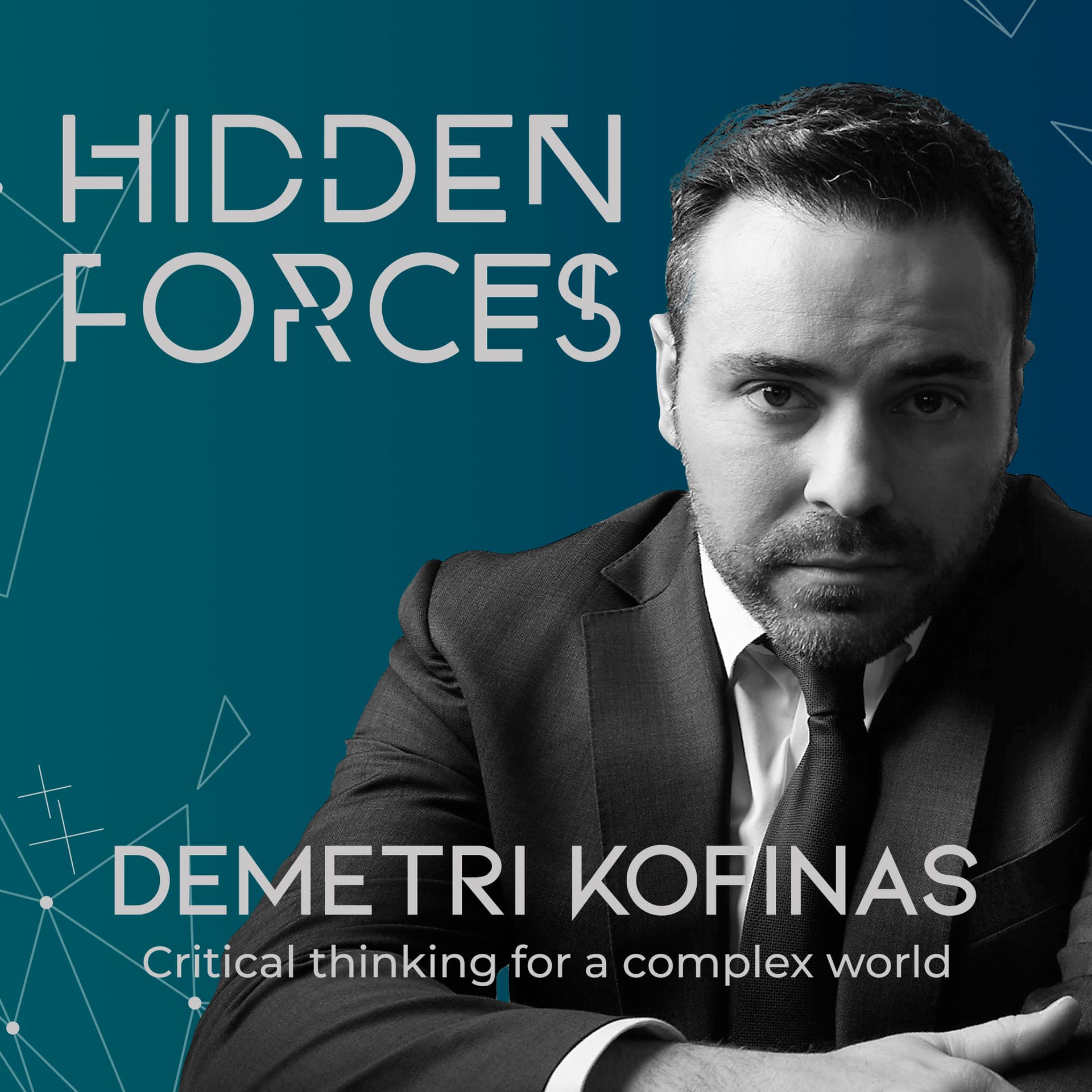
In Episode 439 of Hidden Forces, Demetri Kofinas speaks with Douglas Rushkoff, a pioneering media theorist, best-selling author, and leading voice on how digital technologies shape societies, economies, and cultures.
Rushkoff and Kofinas spend the first hour of their conversation tracing the arc of Douglas' career, from his upbringing in a communal 1960s neighborhood in Queens and early work in theater to his role as a cultural and media critic chronicling the rise of the early internet. They explore how the internet's rave-like collaborative ethos and anarchic counterculture gradually gave way in the 1990s and early 2000s to a highly centralized, commercialized, and impersonal platform for economic and political consolidation and control.
The second hour turns to a conversation about consequences and remedies for our increasingly disembodied and highly intermediated world—with its blurring of public and private spaces, its hyperreality and epistemic dislocation, and its noticeable drift toward techno-feudalism and digital pacification.
We examine ways to rebuild sovereignty over our communities and how to reclaim our attention, reaffirm our relationships, and reassert our power as citizens over our governments and the large-scale commercial and technological forces shaping our lives.
Subscribe to our premium content—including our premium feed, episode transcripts, and Intelligence Reports—by visiting HiddenForces.io/subscribe.
If you'd like to join the conversation and become a member of the Hidden Forces Genius community—with benefits like Q&A calls with guests, exclusive research and analysis, in-person events, and dinners—you can also sign up on our subscriber page at HiddenForces.io/subscribe.
If you enjoyed today's episode of Hidden Forces, please support the show by:
-
Subscribing on Apple Podcasts, YouTube, Spotify, Stitcher, SoundCloud, CastBox, or via our RSS Feed
-
Writing us a review on Apple Podcasts & Spotify
-
Joining our mailing list at https://hiddenforces.io/newsletter/
Producer & Host: Demetri Kofinas
Editor & Engineer: Stylianos Nicolaou
Subscribe and support the podcast at https://hiddenforces.io.
Join the conversation on Facebook, Instagram, and Twitter at @hiddenforcespod
Follow Demetri on Twitter at @Kofinas
Episode Recorded on 09/08/2025