In short
Hidden Forces episode with Nicolas Collin argues that markets are in the maturity phase of the “computing and networks” technological revolution, not the start of a brand-new wave. He builds on Carlota Perez’s technological revolution stages (eruption, frenzy/speculation, inequality/unrest, maturity) and Bill Janeway’s emphasis on venture capital and innovation.
Key claims
AI is an intensification of decades-long computing/network progress; dominant “winners” have already emerged, driving extreme stock-market concentration (he compares today’s “Magnificent Seven” to the 1960s “Nifty Fifty”); financial systems are typically rebuilt last, so a major financial reset is likely when the old plumbing no longer fits the new paradigm. He analogizes the 1970s reset to today, citing the Nixon shock (1971 end of dollar-gold convertibility) and later financial restructuring (e.g., London Big Bang). He also discusses programmable money/tokenization, US-China financial fragmentation, public debt servicing, inflation, financial repression, and wealth redistribution.
Guest
Nicolas Collin, former French senior treasury civil servant; co-founder of a pan-European startup accelerator (2013–2021; ~100-company portfolio).
Written by AI. May contain mistakes. Listen to the episode to check what was said.
Chapters
Tap a time to open that second in VONicolas Collin's Background and Career Journey
0:45 to 3:06
Nicolas shares his journey from engineering to investment writing.
“We also compare the current moment to the 1970s as a historical analog, and discuss why he believes financial systems are often the last piece to be rebuilt after a major paradigm shift.”
The Art of Writing and Its Impact
3:06 to 4:08
Discussion on the importance of writing for understanding and networking.
“Nicolas Collin, welcome to Hidden Forces.”
The Evolution of Interests Since 2017
4:08 to 6:14
Nicolas elaborates on his focus on startups and economic transformation.
“graduated from my engineering school, it was right after the dot-com crash.”
Concerns Over Economic Development and Policy
6:14 to 14:00
Insight into Nicolas's main concerns about economic progress and policy implications.
“Well, I guess I've always been into writing.”
Exploring Global Trends and Economic Contributions
14:00 to 14:36
Discover how different regions may evolve and the role of finance and policy in shaping society.
“What are the promises if you look at the Middle East or Africa or South America or Southeast Asia?”
The Late Cycle Investment Theory Overview
14:36 to 16:38
Understand the late cycle investment theory and its relevance to current market conditions.
“I have vested interests in Europe, catching up and not slowing too much in the current transition.”
Artificial Intelligence and Market Continuity
16:38 to 20:07
Learn about the impact of AI on current markets and how it represents a continuity of technological trends.
“The way I see what I call the age of computing and networks, that's our age, is that every year we add more of those, like more computing, more networks, and we combine them in ever more efficient ways.”
Carlota Perez and Technological Revolutions
20:07 to 24:12
Explore Carlota Perez's framework on technological revolutions and its influences on investment strategies.
“What are the consequences for you as an investor, a founder, a financier, a corporate executive or a policymaker?”
Historical Context of Technological Impact
24:12 to 26:39
Analyze historical cycles of technology and their societal implications, emphasizing the need for proper institutions.
“because at the time I was doing a lot of work on institutions and you know social policy etc The push I was trying to make was how to convince European policymakers that tech can be good and is not necessarily bad.”
Stages of Technological Revolutions
26:39 to 28:00
Identify the stages of technological revolutions according to Carlota Perez and their significance for future investments.
“First of all, how many historical cycles does Carlotta draw upon?”
Show all 17 chapters
Understanding Investment Cycles
28:00 to 29:29
Explore the phases of technological investment cycles and their implications.
“Because when you're in the maturity phase of the finishing revolution of the current revolution or great surge, you can already spot the signs of the inception of the next one.”
Historical Context: The Nifty Fifty
29:30 to 31:35
Discuss the Nifty Fifty and its parallels to today's investment landscape.
“So there are many signs and my essay, Late Cycle Investment Theory, is precisely an attempt at going through the list of all the signs that make me think we are in the maturity phase of computing and networks.”
Lessons from the 1970s Economy
31:36 to 33:15
Understanding economic factors from the 1970s relevant to current markets.
“So today we have exactly that, except we don't have 50 of them.”
The Nixon Shock and Financial Transformation
33:16 to 35:45
Analyze the Nixon Shock and its role in changing the financial system.
“if you're all piling up in the same stocks, in the end, no one makes money.”
The Need for a New Financial System
35:46 to 42:00
Investigate why a new financial system is required in the current economic era.
“radical transformation of financial markets from May Day on the New York Stock Exchange to the London Big Bang in 1986.”
Redesigning Financial Markets for a Global Economy
42:00 to 45:18
Learn how historical changes in financial markets relate to today's global economy and the challenges faced by the current financial system.
“the economy had grown so large and so fast and technological progress was so spectacular that we needed much more flexibility, much deeper capital markets.”
Implications for Investors and Financial Systems
45:18 to 47:08
Explore the implications of modern economic conditions on investors, the financial system, and societal impacts.
“And then also debt and the social contract, how debt factors in.”
Transcript
Automatic transcript. May contain errors.0:00Demetri Kofinas:What's up, everybody? My name is Demetri Kofinas, and you're listening to Hidden Forces, a podcast that inspires investors, entrepreneurs, and everyday citizens to challenge consensus narratives and learn how to think critically about the systems of power shaping our world. My guest in this episode of Hidden Forces is Nicolas Collin, a former French official and the co-founder of a European startup accelerator whose work sits at the intersection of technology, markets, geopolitics, and global finance. Nicolas and I spend the first hour breaking down his late cycle investment theory and the framework behind it.
0:39Demetri Kofinas:We draw on Carlota Perez's model of technological revolutions and techno-economic paradigms, explore the role of speculative manias and market concentration, and examine why Nicolas thinks AI is less a brand new technological revolution than an intensification of the computing and network paradigm that has been unfolding for the last 50 years. We also compare the current moment to the 1970s as a historical analog, and discuss why he believes financial systems are often the last piece to be rebuilt after a major paradigm shift. In the second hour, we explore what this late cycle thesis means for investors, the public, and the geostrategic competition between the United States and China.
1:22Demetri Kofinas:We talk about how tokenization and programmable money could reshape the plumbing of the global financial system, and how today's Trump shock might be the opening move in a broader financial reset. We also discuss what financial fragmentation between two competing spheres, one led by China and one led by the US, may look like in practice. Why programmable grid infrastructure and a new scale of electrification may be the primary candidates for the next technological revolution. And what all of this means for public debt servicing, inflation, financial repression, and wealth redistribution, as proximity services replace the factory floor as the central battleground over which a new social contract will be formed.
2:04Demetri Kofinas:If you want access to all of this conversation, go to hiddenforces.io slash subscribe and join our premium feed, which you can listen to on your mobile device using your favorite podcast app, just like you're listening to this episode right now. If you want to join in on the conversation and become a member of the Hidden Forces Genius community, which includes Q &A calls with guests, discounted access to third-party research and analysis, and in-person events like our intimate dinners and weekend retreats, you can also do that on our subscriber page. And if you still have questions, feel free to send an email to info at hiddenforces.io and I or someone from our team will get right back to you.
2:48Demetri Kofinas:Lastly, because this conversation deals with investing, nothing we say on this podcast can or should be viewed as financial advice. All opinions expressed by me and my guests are solely our own opinions and should not be relied upon as the basis for financial decisions. And with that, please enjoy this immensely interesting and valuable conversation with my guest, Nicolas Collam.
3:17Demetri Kofinas:Nicolas Collin, welcome to Hidden Forces. Thank you. Very glad to be here. It's exciting to have you on, Nicolas. So, you were introduced to me by a mutual acquaintance who initially sent me a paper you published in the summer of 2025 titled Late Cycle Investment Theory, the Foundation for the Coming Decade. And that sent me down a rabbit hole of reading some of your additional work, which I quickly realized has so much in common with the subjects that we've covered, the perspectives that we've taken. You cite many of the guests that have been on this podcast. So I'm very excited to talk to you today.
3:53Demetri Kofinas:Before we do, just real quick, give me your background. I don't know much about you. What's your story? How did you get into writing about investment questions and related matters? So I was born in France, grew up in France. Studied engineering in the 1990s, never really practiced engineering because when I graduated from my engineering school, it was right after the dot-com crash. And so engineering became unattractive suddenly. So I switched to a different career, studied political science, public administration, joined the French government where I worked for a few years as a senior civil servant at the treasury and then I left because I got interested in tech again after a 10-year hiatus and had a brief entrepreneurial experience to try to found a startup in France faked miserably like many startup founders and then I co-founded a pan-European startup accelerator which grew from zero in 2013 to three offices in Europe, London, Paris, Berlin, a portfolio of about 100 companies.
5:06And we stopped investing in 2021. So today I'm managing that portfolio, which still exists and is still growing. I consult with investment firms, mostly on research, investment theses, markets, etc. And I write several newsletters actually on mostly macro and geopolitics.
5:27Demetri Kofinas:Fantastic. So you actually have a few different substacks. You have three from what I've seen, but your main one is driftsignals.com. Is that right? Yes, that's the main one. That's my personal newsletter where I cover the economy and how I see things. The second most important, I would say, is the one I'm writing with my colleague, Marie Flamand, who used to work for Circle, is a specialist in stable coins and everything crypto. And we have launched this newsletter called Currency of Power about the emergence of a new monetary order. So it looks like you started publishing almost nine years ago, to the day, actually, which is roughly as long as I've been hosting this podcast.
6:09Demetri Kofinas:What motivated you to begin writing for public consumption all the way back in 2017? Well, I guess I've always been into writing. Most of my work, including in government, was writing reports, memos, et cetera. Many, many good things have happened to me because of my writing, people reading my stuff and reaching out. And that's a good networking tool, I find. And it's also a good way to clarify your own ideas. It's like when you try and understand a situation or a topic, the best way to really go deep is to try and write about it or teach it if you are lucky enough to have students, which I don't have at the moment, but I used to teach quite a lot.
6:53So I launched my newsletter in 2017. The idea was to, well, I was interested in this idea of, you know, writing regularly for a growing audience. that is people who receive a newsletter in their mailbox like every week or every month or whatever. But I had been writing forever. I wrote several books before that in French and again, reports and stuff like that. So writing is my natural way of working and building a network, et cetera.
7:26Demetri Kofinas:Have you always been doing this or have you gone through phases where you write more and then go through phases where maybe you spend more time researching and thinking without actually putting pen to paper? Yeah, so you're right to ask that question because I find that writing and researching are to a certain extent mutually exclusive. Like when you write, you don't have that much time to read or have interactions with people. But no, mostly I prefer writing. Again, it's the best way for me to absorb knowledge and to get interested in new things. There were periods where I wrote quite a lot, like during COVID, like we were all stuck at home with the lockdown, etc.
8:05So I increased the pace of, you know, sending editions of my newsletter at the time. And then I stopped for a few years between 21 and 23 because I was busy with restructuring my firm and taking care of the portfolio, etc. And I resume mostly essentially earlier this year because I found myself with more time on my hands and realized like so many things are changing over the course of three years, like launch of Chad GPT in 2022, Russia's invasion of Ukraine, also 2022, re-election of Trump 2024. the world is so different from when it was like three years ago. I had to catch up and the best way to catch up, like understanding the world for me is to write.
8:51Demetri Kofinas:Who are you writing to? Who is your ideal reader? Well, my theory is that you mostly write for yourself, but it turns out when you write for yourself, you also address an audience that is people that are interested in what you think or see the world the same way as you and so I've grown this audience of people that are at the confluence of you know finance strategy geopolitics policy and what they like about my writing and which tends to provide a guideline for me in terms of deciding what to write about is precisely that mixing all those topics together and have a broad perspective on things like it's not narrow.
9:37I'm not like an equity analyst. I'm not a policy researcher. I can do all of those things together, which by the way, is a very French tradition. We have this tradition of being a generalist. A connaissance thinker. Yes.
9:52Demetri Kofinas:I'm working on my French accent since we turned on the microphones earlier. So what were the things that you were interested in writing about in 2017 and how have your interests evolved or your focus become better defined in the last decade? Yeah, so 2017 was the peak of our business as a startup accelerator. And we were right in the middle of a very interesting decade, which I would sum up as the decade of software eating the world to echo Marc-Andreessen's words. And so the challenges we were confronted as an investor backing early stage tech startups in Europe was that everyone knew what was coming, how the economy needed to be transformed, how new entrants were toppling incumbents and disrupting entire markets.
10:40But there was a lot of resistance because it's Europe. People are not like in all in front of tech companies. The markets are small. It's difficult to build businesses across borders in Europe. There are many different lines of fragmentation, like regulations, language, culture, many things. So it's still difficult, but it was difficult to grow tech companies in Europe. And so a lot of what I did as the policy guy in the startup world was advocating for startups and making the case that we should help startups instead of resisting them. And so most of my time was spent addressing audiences in the corporate world, in the policymaking world, the media, think tanks, everyone that was not either a founder or a venture capitalist.
11:30Those were addressed by colleagues of mine at the firm, but I was in charge. I was kind of like the foreign minister for the startup world. And so when I started writing this newsletter, it was really about that. why startups are important. What can we do in Europe to help them grow instead of curbing their growth and making sure we weren't missing that opportunity of embracing a new paradigm and growing our economy with it?
12:02Demetri Kofinas:So the way that I view the world, Nicola, is more often than not informed by a series of unanswered questions that continue need to resurface over and over again in my head. One of those questions that's relevant to today's discussion is, how do I protect myself, my friends, my family from a changing economic and political order so that we don't become the collateral damage of government policies resulting from some inexorable set of structural economic and social trends? Another would be, how do I help arm the public with the information needed to steer public policy in a direction that will prove more beneficial for everyone.
12:43Demetri Kofinas:And that could help us avert large scale catastrophes of our own making that will imperil all of us. What would you say are the corresponding questions that you find yourself asking over and over again that motivate your concerns and the things that you've been writing about in recent years? So I would say my main concern, I didn't use those words back in the days, but is economic development. I think as a European, I've been enjoying living, growing up and living in a country that was in a continent that is a very advanced economy. We have very high standards of living. We have safety. We have strong institutions.
13:28We have democracy, everything you can wish for. And for some reasons, which we can discuss, for about 20 years, it stopped working. And so the main question I've been interested in working with startups or working from a policy perspective has been what explains the slowdown in European development? What explains the acceleration, the spectacular acceleration in Chinese development? What explains the difficulties the US is going through at the moment? What are the promises if you look at the Middle East or Africa or South America or Southeast Asia? Where will those different countries or regions be 20 years from now?
14:18And what can we do to reverse the trends if we can spot them? that's really what I'm interested in and I think the business world has a critical contribution to make to you know winning or losing that game but also the policy making world and that's where my world view of you know embracing all of that finance policy business all together makes real sense so I'm kind of obsessed with that and I'm I'm in Europe I've been living in different European countries, so I know the differences, but I'm kind of vested. I have vested interests in Europe, catching up and not slowing too much in the current transition.
15:03Demetri Kofinas:So if I'm hearing you right, your focus is much more on how to strengthen our societies and make our economies work in the public interest, and less so in terms of how can you understand the current environment in order to increase the market capitalization of your portfolio? Well, I think both are correlated. I'm a big believer in, you would call them hidden forces, but key trends or long-term trends. Yeah, you can certainly do both. I'm not suggesting you can't. I mean, again, these are the two biggest concerns for me as well. I mean, the ones that those two, both how do I respond to this on a personal level?
15:41Demetri Kofinas:And then also what can I do to help inform people so that we can shift the vector at the earliest stage possible in order to have the biggest long-term effect, and also so that we don't end up way down the road having missed key opportunities where our economies are now stagnating for the long-term and there's little we can do to reverse the trend. I think that's the concern that we're facing today. So as I said, what brought us together initially was a paper that you published over the summer, the paper titled Late Cycle Investment Theory, in which you argued that today's markets show signs that we've entered the maturity phase of the computing and networks revolution.
16:16Demetri Kofinas:And the paper is your attempt to help people navigate this phase and help them spot opportunities that consensus thinking might be overlooking. Let's start first with a summation of the argument that you make in that paper, as well as what your inspiration for this late cycle investments thesis has been, and when you began to see confirming evidence of it in the world. Yeah. So as I mentioned earlier, when I resumed writing earlier this year, one of the big things that had changed in the meantime, when my writing was on hold, was the rise of artificial intelligence, the launch of ChatGPT and suddenly every tech company trying to become an AI company, etc.
17:01et cetera. The way I see what I call the age of computing and networks, that's our age, is that every year we add more of those, like more computing, more networks, and we combine them in ever more efficient ways. And sometimes it has a dramatic effect, like a transformative effect on certain industries or society as a whole, et cetera. And so when I see new things happening in tech, what I see usually is the continuity. It's like, oh, it's more computing and more networks, which makes my view very different from that of many venture capitalists who tend to see change in terms of waves. Like you have like open source and then cloud computing and then mobile and then social and then crypto and metaverse and now AI.
18:03And so what they tend to see is, oh, AI, it's a new wave. So the world is completely different and we need to restart from zero in terms of understanding what's going on. So what I see when I see AI is just the continuity of all of that. And what I see is something else that I think is very important is the fact that AI has been going so fast in terms of market adoption that it should tell you if it's going so fast, it's because people are understanding right away. And it's not radical innovation for that precise reason. If everyone understands it in an instant, it's not radical. It's more like the continuity, the deepening, the acceleration, of things that were already happening.
18:56And you could see that because when ChatGPT launched, everyone was impressed. Like you could test it and realize, oh, wow, that's absolutely amazing. Like it can write an entire article based on a prompt. But then three months later, maybe, there were already like similar models launched by all the big tech companies. Like Meta had its own thing. Google had its own thing. Everyone was catching up so fast, like, okay, that's not radical innovation. That's more like, okay, someone opened the door and everyone's rushing in to try and take positions. And so what I was looking for was a way to articulate this idea of everything that we're seeing, even though it looks like it's radically new, is in fact the continuity of everything that has been going on for decades, like more computing, more networks.
19:53And because I like to think in systems, that's another very French trait, I try to build this castle of a theory that puts all of that into perspective. And that explains, OK, we're in the same cycle. We're at the late stage of this cycle. What are the consequences for you as an investor, a founder, a financier, a corporate executive or a policymaker? And that's the birth of this concept of late cycle investment theory.
20:27Demetri Kofinas:So let's take a step back now and try to build a solid foundation for listeners who are following along. Because Carlota Perez's framework on technological revolutions and techno-economic paradigms has been a very important inspiration for your thinking. Walk me through her framework. And to the extent that differs from how you view things, please elaborate. but give us more detail into how the mental model that you're using to understand the innovation cycle. And I know also from having read some of your additional work that Bill Janeway has also been an inspiration. His book, Doing Capitalism in the Innovation Economy, was also a really influential book for me when I read it as a younger man, and he's been on the podcast as well.
21:07Demetri Kofinas:And in that sense, feel free to pepper in other inspiration. Just help us really build out, flesh out the mental model that you use to understand the world and the innovation cycle? Sure. So historically, I think I discovered Carlota through Bill's book. I don't really remember how I discovered Bill's book, Doing Capitalism, Innovation, Economy. I think it was in a TechCrunch article about Bill giving a talk at Andreessen Horowitz back in 2013 or something like that. I met him through Robert Johnson at INET. So people that don't know the Institute for New Economic Thinking. He's a founding member, yeah.
21:44Demetri Kofinas:Right. They did some really important work post-2008. I assume that they were founded after 2008. I don't remember. But that was the period where critical thinkers really had an opportunity to say, okay, here's what didn't work. Let's do the hard work of figuring out why it didn't work and how do we need to evolve our mental models in order to address the challenges that we're facing going forward? Yes. So Bill's book was very compelling for that reason, in that he was explaining the critical role of venture capital in funding innovation and in turn the critical role of innovation in shooting economic growth.
22:19And so I don't remember exactly, I probably sent him an email and by coincidence he was in Paris like a few days after that. So I probably was based in London at the time, but I was in Paris often. So we had lunch and became friends and he kind of became my mentor. Like he's the one I turn to when I want advice or ideas or discuss ideas related to venture capital and the economy in general. But in his book, he mentions Carlotta's work. And I connected with Carlotta, I think a bit later after watching an old video of hers where she was interviewed by Fred Wilson, a prominent venture capitalist, Union Square Ventures at WebExpo, an O 'Reilly conference in 2011.
23:06So you can find that video on YouTube. It's a great interview because they really go in depth into work, how model or framework helps understand the economy and innovation and technology in general. And so when I watched that video, I was blown away. This is so clear and so systemic. And I like the very systematic manner in which she explained the different stages of a technological revolution, etc. And so I bought the book, Technological Revolutions and Financial Capital, read it, was blown away. And I think I contacted her by introduction of Bill and then started to see her from time to time because she lives in Sussex.
23:50and so I would take the train in London and meet her for lunch or dinner and we would discuss a bit and exchange ideas etc so I would say I really absorbed her work and read a lot of what she wrote in addition to the book itself and it really became my mental model to explain what's going on because at the time I was doing a lot of work on institutions and you know social policy etc The push I was trying to make was how to convince European policymakers that tech can be good and is not necessarily bad. And one of my arguments is that tech contributes to creating value. But then on top of that, we need to build institutions so that that value is distributed more equally and contributes to shared prosperity at the society level.
24:47and the best way to explain that you know is to go back in history and explain how they did it the previous time so when automobiles were invented it triggered the previous technological revolution which led to what carlodach calls the age of oil automobiles and mass production and at first it was a mess like you could even say that it was so hard on society it created such inequalities and such tension especially in the relationship between you know employers and workers that it fueled the rise of fascism during both world wars and it's only after world war ii that western governments decided to do something about it okay we've seen how far it goes if we we let technology do its thing to society without safeguards and institutions to make sure that the value it creates is redistributed to everyone.
25:50So they basically set up the wealth estate, social insurance regimes, et cetera. And it opened that golden age of 30 years of uninterrupted growth across the western world and so when i started explaining that to people in europe like especially policymakers like look this is what they did the previous time this is what we need to do this time like the age of computing and networks will be an age of shared prosperity if we put in place the right institutions and at the time i saw the power of you know going back into the past and revisiting history and using historical precedents, that's how you really convince people that technology is important and should be supported as opposed to co-op.
26:39Demetri Kofinas:I have some clarifying questions. First of all, how many historical cycles does Carlotta draw upon? So each of these cycles has four stages or four waves. We have the recent one, the computing and networking revolution. We have the industrial revolution. Are those the two main ones? Is there a previous one that she looks at as well? She has five technological revolutions or great surges of development in her model. The first is the industrial revolution. It's basically the invention of labor productivity. You combine humans and machines and it creates that thing that didn't exist before, that is productivity.
27:20Then you have the second revolution, which is the age of steam and railways. So you deploy railways and it completely changes the geography of our economy. Then you have the revolution of electricity, steel, and heavy engineering. So that's the end of the 19th century. Then the revolution of oil, automobiles, and mass production. That's essentially the history of the 20th century. And then you have computing and networks. And the birth date of that is the invention of the microprocessor in 1971 at Intel.
27:57Demetri Kofinas:And there's overlap between these two phases. Yeah, yes. Because when you're in the maturity phase of the finishing revolution of the current revolution or great surge, you can already spot the signs of the inception of the next one. Obviously, if you're a very good investor, you can spot the signs really well. There are many false starts. Like at the time, if you ask people like, what's the next technological revolution? A lot of people will say it's AI. Others will have other ideas. I think it's a bit early, but in 10 years or 20 years, we'll revisit this period and we'll see the signs of whatever happens.
Read the full transcript
28:41Demetri Kofinas:So each of these, as I said, each of these cycles has phases. The eruption phase is the initial phase where there's an intense amount of funding of innovation and new technologies. Then there's a frenzy phase, which is characterized by increased speculation and financialization that leads to a temporary decoupling between financial capital and productive capital. Then there's a phase of growing inequality and political unrest, which actually feels a lot more like the phase that we're in now, though there are also signs that we're in a maturity phase, which is what you think that we are in. So my first question is, help clarify for me what stage we are in and why, given that we do see some signs of this stage of there being political dislocations, why that isn't a better fit for where we are today in this cycle.
29:31So there are many signs and my essay, Late Cycle Investment Theory, is precisely an attempt at going through the list of all the signs that make me think we are in the maturity phase of computing and networks. I'd say the most important one is the fact that the dominant players have emerged and are clearly identified. And typically in this cycle, the stage at which you see the winners emerge and secure their dominant position is the synergy phase. It's because some companies use the technology of the day better than others and use it as leverage to take dominant positions in the market. And then during the subsequent maturity phase, they enjoy their dominant position and make a lot of money.
30:26And so you could say that the decade of software eating the world is the decade during which all those big tech companies have emerged and reached the dominant positions. And now they're really enjoying their immense power, including their influence over policymaking, which we're seeing in the US with the unprecedented relationship between the tech sector and the world of policymaking with the Trump administration, etc. And you can see it from another angle, which is that it's so clear that those are the winners, that everyone wants to invest, to participate in the big feast, like want to invest in them.
31:10And this is why the stock market is so concentrated, which, by the way, happened the last time as well. At the end of the 1960s and early 1970s, there was something known as the Nifty Fifty. Do you know that one? Sure. Those were all the blue chip industrial companies that were considered safe heavens for investors. So everyone wanted to invest in them. And there was an inflation of prices for the Nifty 50s, companies like GE and IBM and many others that were household names and that were considered safe bets for investors. So today we have exactly that, except we don't have 50 of them. We have seven of them, as you know, the magnificent seven.
31:57And everyone wants to invest in them because it's so obvious they've won the race of the synergy phase and have secured dominant positions, which they probably enjoy for the rest of the maturity phase.
32:12Demetri Kofinas:So as you're speaking, I'm reminded of some other guests that have been on the show, one of whom you mentioned earlier, Tim O 'Reilly, who is a great follow. And I recommend people go back to listen to that episode to compliment what they're hearing from today, as well as an episode with Howard Marks, where we briefly discussed the nifty 50 and that investment period in the late 60s. And also Sebastian Malavy, who wrote a book on the origins of the venture capital industry, which also compliments a lot of Bill Janeway's work on the innovation cycle. So just sticking with this thread of what characterizes an economy that's in this maturity phase of prevailing technological paradigm.
32:51Demetri Kofinas:You have brought up the 1970s, both in this conversation and also in your work as a tight analog for what we're living through today. What happened in the 1970s that's relevant for today's discussion? Yeah. So I'd say two additional things. So one thing that happened was the concentration of the stock market, which ultimately prompted investors to seek returns elsewhere. Because if you're all piling up in the same stocks, in the end, no one makes money. Another thing that happened was the reset of the financial system. And so it started in a way with something known as the Nixon shock in 1971, when the Nixon administration decided to disconnect the dollar from gold.
33:39and it triggered like Ray Dalio has this great video, which you can see on his YouTube channel. He was a young Wall Street guy at the time, watched Nixon announce the Nixon shock on television and went to work the next morning expecting like a complete collapse of the market. And what he says in the video is the opposite happened because people were investing and buying stocks and all the stock prices went up. And that was because the gold standard or the Bretton Woods version of the gold standard was in fact a constraint on the economy. And the fact that Nixon put an end to it freed capital to flow more easily towards various assets.
34:25So that's one thing. The reason why we need a reset of the financial system in the maturity phase or stage is the following, according to me. It's the fact that the financial system is the last thing to transform in a technological revolution. That is, for the previous stages, technologists and investors in technology have to make with the financial system inherited from the previous paradigm. Most of the financing in the computing and network era has been done in the financial system designed in the 1970s. That is the stock market, the bond market, derivatives, hedge funds, payments, currencies, etc.
35:20etc the reason it has to break it's because at some point the new paradigm is so different is such a mismatch with the old financial system that you have to get rid of the old financial system and rebuild it from the ground up and that can only be done if something collapses and so the previous time, it was like they put an end to the Bretton Woods system, which made room for radical transformation of financial markets from May Day on the New York Stock Exchange to the London Big Bang in 1986. And today, I think, well, one hypothesis would be that the equivalent of the Nixon shock for the computing and network era would be the Trump shock of 2025.
36:17where they've really made an effort in dismantling a few things and thus creating room for reinventing financial markets entirely from top to bottom. It won't happen in a day, but at least we have a clear ground here to start reflecting on what needs to be done for financial markets to really serve this economy of computing and networks, which is radically different from the previous economy of automobiles and mass production.
36:52Demetri Kofinas:So I'd like to delve into that more in the second hour where we discuss implications for investors. But let's go back to the gold standard here, because I think this is important for people to understand, because I don't fully get it, by the way. When I read it in your paper and you talked about how the gold standard was an example of how technological maturity breaks institutions designed for earlier paradigms, I didn't understand what it was about the computing and network revolution that made gold or the Bretton Woods system of fixed exchange rates no longer viable. So what was it about that system that worked for the previous era?
37:29Demetri Kofinas:And then explain to me exactly why it didn't work for the next one and what What needed to change and why? What they dismantled in the 1970s was a financial system shaped right after World War II, at a time when the financial implications of the economy of the automobiles and mass production was not fully understood. What they tried to do was to rebuild the financial system that everyone was familiar with, that is the old gold standard system pre-World War I, but with a tweak, which was that instead of all currencies being convertible in gold, only the dollar would be convertible in gold and then all the other currencies convertible in dollars.
38:19Demetri Kofinas:Wasn't that largely philosophical, not actually a reflection of what they thought an ideal system would be for a particular technological paradigm? Yes, it's because it's a lack of imagination. When you're invited right after World War II to rebuild the financial system, you can only go as far as what you know and what historical precedents tell you. So most of them tried to rebuild the system that had delivered so much value, supposedly decades earlier. The reason it didn't work was that when you peg a system to gold, you're constrained by the quantity of gold available so you can mine and extract more gold from the earth but not that much like it goes very slowly so at some point if the economy is so productive that you create a lot of value and you create currency to account for that value because a thriving economy means a lot of credit to entrepreneurs who invest in machines and hire people and build new activities.
39:27At some point, there's a disconnect between the quantity of gold and the quantity of money.
39:32Demetri Kofinas:The amount of credit and capital available to make the investments that are commercially viable, that would be otherwise commercially viable isn't there because you're on a limited supply. Exactly. And America's problem that prompted Nixon to implement the Nixon shock was that the economy was growing so fast and had reached such a scale that the global economy, I mean, they didn't have enough gold to support that, to support that growth. We were already seeing indications through the emergence of the euro dollar market that something wasn't functioning in the Bretton Woods system. So the economies were demanding more capital and credit in order to finance these opportunities.
40:14Demetri Kofinas:Is that the right framing here? Yes, that's the right framing. Plus the fact that the US was not really playing it fair. Like Martin Wolf explained on the Outlaws podcast that, well, the US had spent so much money funding the Vietnam War and they should have devaluated the dollar because the dollar wasn't worth what it was officially worth. But they didn't want to because it would be humiliating for the US to have to devaluate the currency. And so that also contributed to breaking the system. And the social welfare programs that LBJ instituted in the 1960s. Yeah, in part. But just one more question, though, before you continue, though.
40:50Demetri Kofinas:We were under a strict gold standard in the 19th century, and that was a period of massive capital investment. So why would the same principle not have held then? Well, it was a period of massive capital investment. But as Karl Polanyi explained in The Great Transformation, it was also what led to the rise of fascism in a way because World War I broke the gold standard. After World War I, they tried to reinstate it and it created so much rigidity in the economy that when the, just as a new paradigm was taking shape, the paradigm of oil, automobiles and mass production, that it broke and it basically destroyed many societies, including Germany, Italy etc and the whole of Europe basically so the gold standard in general imposes rigidity which is not good for an economy that is thriving on technological progress and is going into many directions especially at the global level so I think it's more of an intuition here but it's that the reason why we had to reinvent the financial system in the 1970s was because the economy had grown so large and so fast and technological progress was so spectacular that we needed much more flexibility, much deeper capital markets.
42:15Plus, there was the start of the Nixon shock also made it possible to enter a new phase of globalization and so international trade, etc. And that really called for reinventing financial markets because you can't fund an economy that's so global and so dynamic with old capital markets. So I think it was done over the course of 15 years between 1971 and again, the London Big Bang. But at the end of the 1980s, you had a financial system that was completely new, completely different from what it was in the 1960s. And it basically provided the paradigm of the time with 30 more years of healthy life, Until the great financial crisis, we basically grew the economy off the back of one, financialization, and two, globalization.
43:10And it worked well. And that's because we finally had a financial system designed for making the most of the mature paradigm that was the age of oil, automobiles, and mass production. And so I would argue today we're at exactly the same stage with computing and networks. We're trying to make it work with a financial system inherited from the past, from essentially the 80s. But it doesn't work for many reasons. The world is completely different. First of all, the technologies of the day are completely different. They have created a much more service-oriented, much more globalized economy. There are a lot of flows of services, goods, and money going across borders.
43:56Plus, there's a key difference in today's world compared to back in the days, the size of China and the weight of China in the world economy. And the fact that China has been using a lot of computing and networks to propel their manufacturing industry and have become so powerful in terms of exporting manufactured goods. They have passed the record level of one trillion trade surplus this year. and that's also in part because thanks to computing and networks that they use in the factories to make them more efficient more productive but also computing and networks that sustains international trade and makes it easier to trade to finance to buy to ship and so the economy is in on steroids in many respects and the old financial system has difficulties keeping up not only in terms of you know the plumbing but also in terms of the balance of the whole system.
44:59And the trading balances, in a way, are key signal that something needs to be redesigned here.
45:06Demetri Kofinas:So, Nicola, I'm going to move us to the second hour, where I wanted to devote that time to the implications of what we've discussed in this first hour, the implications to investors, the implications to the financial system, to programmability and tokenization, decentralized finance, to the geopolitical competition between the US and China, and how that also relates to AI and the embedding of AI in manufacturing versus its application of the service sector. And then also debt and the social contract, how debt factors in. And I'm particularly talking about public debt and public obligations and the social contract, because I think we're also in a phase now where we're seeing a lot of social and civil strife, and that plays into what sorts of political solutions come out of this.
45:51Demetri Kofinas:I also want to mention a few books that came to mind. They're all from the same author. And actually the reason it came to mind is, are you familiar with Kevin Phillips by any chance? He wrote famously The Emerging Republican Majority back in the early 1970s. Yes, I have that book, but I think it's the only one I have. So I only know him as the author of that book. I had a chance to interview him back when I had my TV show years ago. He had written a book called 1775, A Good Year for Revolution, which is not the book I was going to recommend, but it's also an awesome book. and it's essentially about what was going on in the Americas before the onset of the American Revolution.
46:27Demetri Kofinas:So super important. There's a really great chapter there on the hyperinflation that happened to the Continental. But he had two books. The first was American Theocracy, which had three sections, one of which was about the deregulation of the financial industry. Then he wrote a follow-up book to that titled Bad Money, where it was just devoted entirely to this wave of deregulation, which most people don't realize actually started under Carter. It didn't started under Reagan. Yes, absolutely. Yeah. Yeah. So, Nicola, I've already given our listeners an idea of what we're going to talk about in the second hour.
46:56Demetri Kofinas:For anyone new to the program, Hidden Forces is listener supported. We don't accept advertisers or commercial sponsors. The entire show is funded from top to bottom by listeners like you. If you want access to the second hour of today's conversation with Nicola, head over to hiddenforces.io slash subscribe and sign up to one of our three content tiers. All subscribers gain access to our premium feed. which you can use to listen to the rest of today's conversation on your mobile device using your favorite podcast app, just like you're listening to this episode right now. Nicola, stick around. We're going to move the second hour of our conversation onto the premium feed.
47:35Demetri Kofinas:If you want to listen in on the rest of today's conversation, head over to hiddenforces.io slash subscribe and join our premium feed. If you want to join in on the conversation and become a member of the Hidden Forces Genius Community. You can also do that through our subscriber page. Today's episode was produced by me and edited by Stylianos Nicolaou. For more episodes, you can check out our website at hiddenforces.io. You can follow me on Twitter at Kofinas, and you can email me at info at hiddenforces.io. As always, thanks for listening. We'll see you next time. you
From the publisher
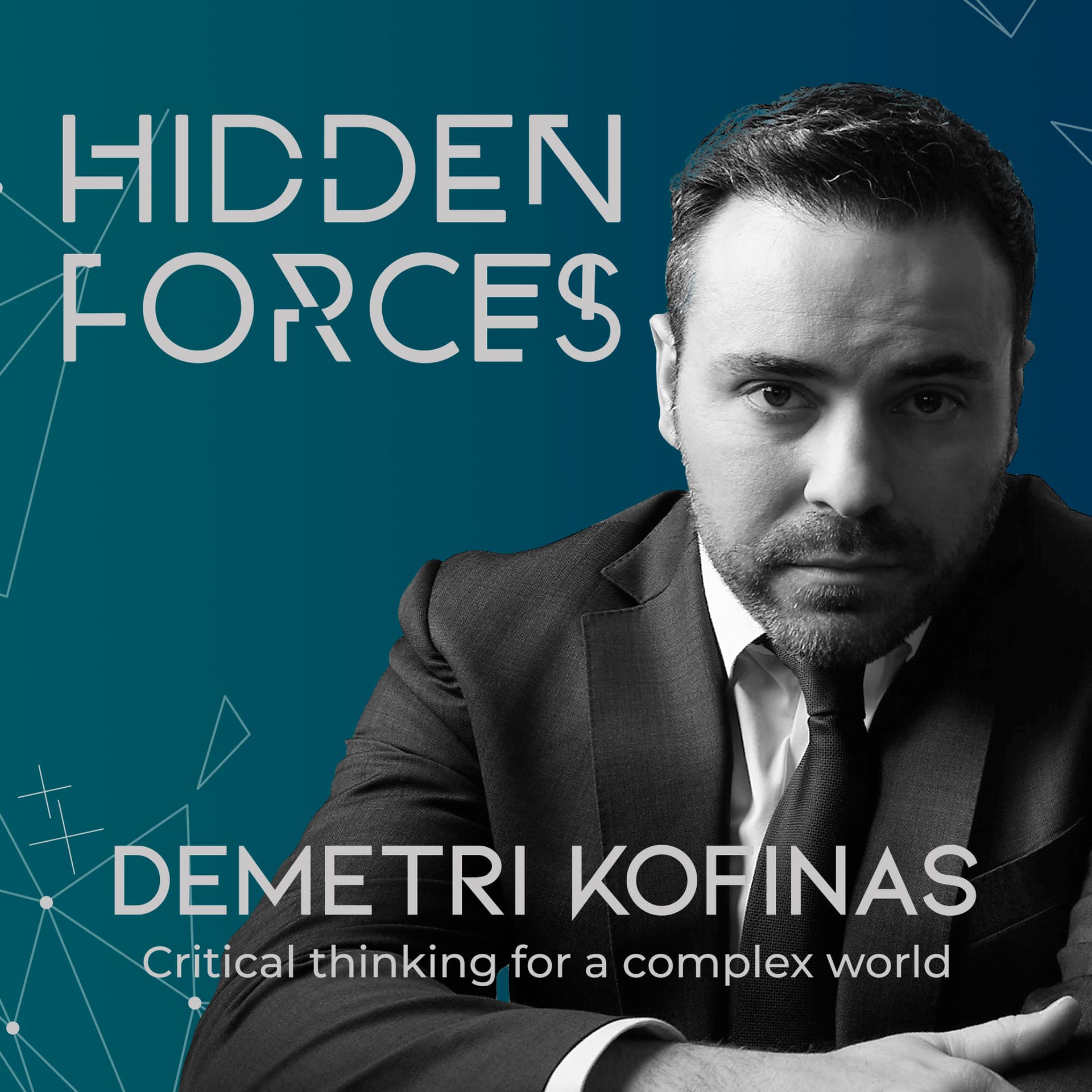
In Episode 455 of Hidden Forces, Demetri Kofinas speaks with Nicolas Colin, a former French Treasury official and the co-founder of a European startup accelerator whose work sits at the intersection of technology, markets, geopolitics, and global finance.
In the first hour of their conversation, Kofinas and Colin break down Colin's "Late Cycle Investment Theory" and the framework behind it. They draw on Carlota Perez's model of technological revolutions and techno-economic paradigms, explore the role of speculative manias and market concentration, and examine why Colin argues that AI is less a brand-new technological revolution than an intensification of the computing-and-network paradigm that has been unfolding for the past 50 years. They also compare the current moment to the 1970s as a historical analogue and discuss why Colin believes financial systems are often the last piece to be rebuilt after a major paradigm shift.
In the second hour, Kofinas and Colin explore what this late-cycle thesis means for investors, the public, and the geostrategic competition between the United States and China. They discuss how tokenization and programmable money could reshape the global financial system's infrastructure, and how today's "Trump Shock" might be the opening move in a broader financial reset.
They also examine what financial fragmentation between two competing spheres—one led by China and one by the U.S.—may look like in practice, why programmable grid infrastructure and a new scale of electrification may be leading candidates for the next technological revolution, and what all of this implies for public debt servicing, inflation, financial repression, and wealth redistribution as proximity services replace the factory floor as the central battleground over which a new social contract will be formed.
Subscribe to our premium content—including our premium feed, episode transcripts, and Intelligence Reports—by visiting HiddenForces.io/subscribe.
If you'd like to join the conversation and become a member of the Hidden Forces Genius community—with benefits like Q&A calls with guests, exclusive research and analysis, in-person events, and dinners—you can also sign up on our subscriber page at HiddenForces.io/subscribe.
If you enjoyed today's episode of Hidden Forces, please support the show by:
-
Subscribing on Apple Podcasts, YouTube, Spotify, Stitcher, SoundCloud, CastBox, or via our RSS Feed
-
Writing us a review on Apple Podcasts & Spotify
-
Joining our mailing list at https://hiddenforces.io/newsletter/
Producer & Host: Demetri Kofinas
Editor & Engineer: Stylianos Nicolaou
Subscribe and support the podcast at https://hiddenforces.io.
Join the conversation on Facebook, Instagram, and Twitter at @hiddenforcespod
Follow Demetri on Twitter at @Kofinas
Episode Recorded on 12/22/2025