In short
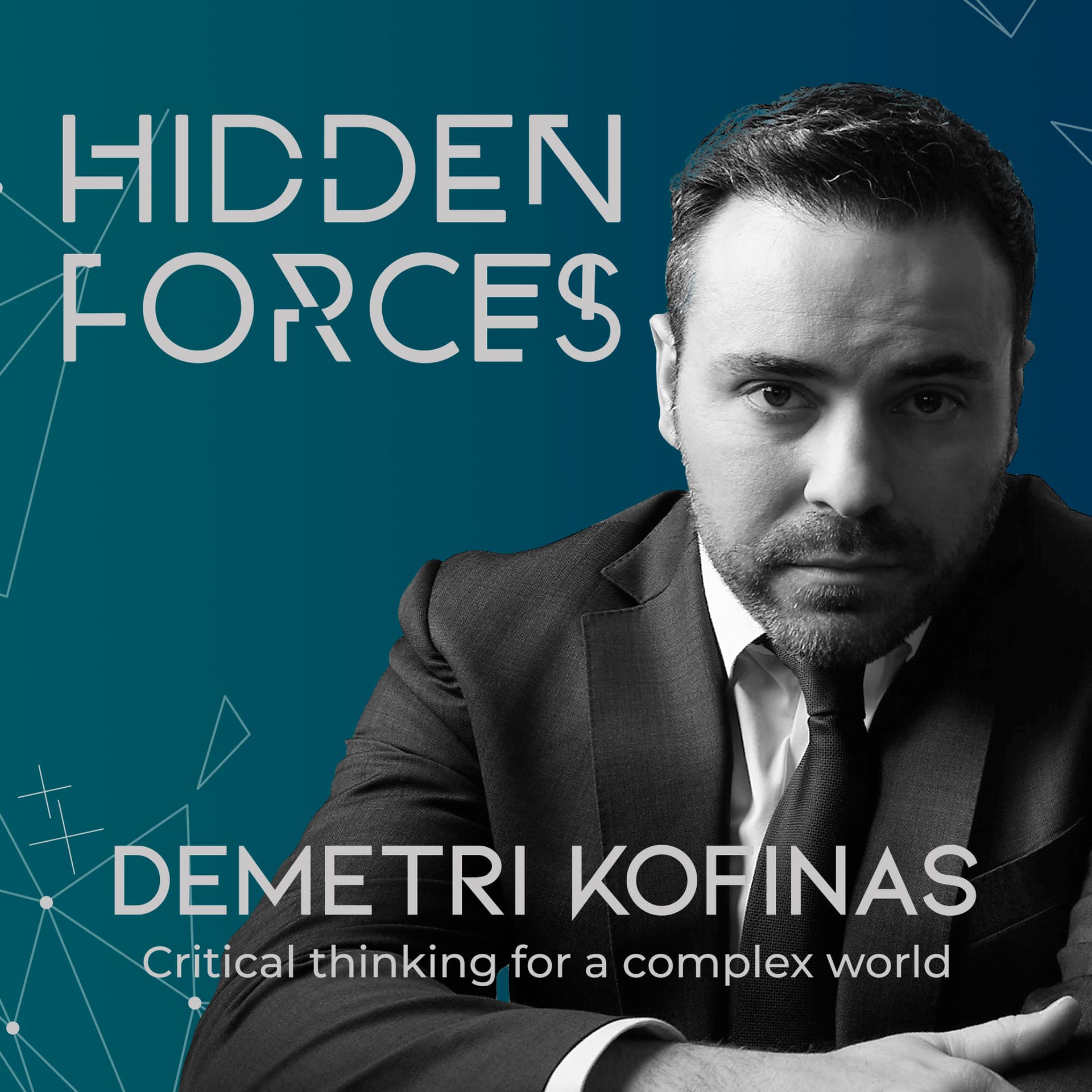
Hidden Forces episode with historian Odd Arne Westad arguing that 2026 resembles the pre-1914 era more than the Cold War. He claims the Cold War is the wrong lens because today is not bipolar or ideologically split, and because structural conditions for multipolar rivalry, rapid change, and failed integration of rising powers are closer to 1914 than 1945-1991.
Guest backgrounds
Ad Arne Westad is a Yale professor of history and a leading historian of the Cold War in East Asia; author of major global-history works, including The Coming Storm.
Key claims
After the Soviet Union’s fall, the West failed to incorporate Russia (and China) into meaningful security frameworks; Europe kept Russia outside integration and underestimated Russia’s economic collapse, fueling resentment that enabled Putin. Bretton Woods’ end helped enable global capital flows that supported China’s export-led growth. Pre-1914 parallels include multipolarity, globalization and tariff/trade conflict, rising resentment, and terrorism/assassinations as catalysts.
Notable examples
Germany’s rise before 1914; China’s rise and integration difficulties; flashpoints Westad flags: Taiwan, Korean Peninsula, South China Sea, and China-India border; nuclear weapons in a multipolar world; assassination of Austria-Hungary’s heir as the “Black Swan” trigger in 1914.
Written by AI. May contain mistakes. Listen to the episode to check what was said.
Chapters
Tap a time to open that second in VOHistorical Context and Perspectives
0:41 to 1:33
Discussion on the relevance of historical perspectives for understanding current global tensions.
The Rise of Powers and Conflict
1:33 to 2:56
Exploration of how rising powers and historical integration failures could lead to conflict.
“We also discussed the internal political dynamics that boxed leaders into impossible positions before 1914, and how frighteningly familiar those constraints look today.”
Transition to Guest Conversation
2:56 to 3:19
Transition into the conversation with Professor Westad.
“And if you still have questions, feel free to send an email to info at hiddenforces.io and I or someone from our team will get right back to you.”
Professor Westad's Background
3:19 to 6:04
Professor Westad shares his journey into history and its significance in understanding the present.
“Professor Westad, welcome to Hidden Forces.”
Critique of Cold War Analogies
6:04 to 10:16
Discussion on why the Cold War is not an appropriate model for today's geopolitical conflicts.
“As I said, I know you primarily as a scholar of the Cold War in East Asia.”
China's Economic Reform vs. Soviet Union's Fall
10:16 to 14:00
Comparative analysis of economic reforms in China and their outcomes versus the Soviet Union.
“And what struck me from the very beginning when I started thinking about this, are how many parallels there are between our own time and the time between the late 19th century and the early 20th century.”
Economic Transformations: China vs. Russia
14:00 to 19:10
Explore the contrasting economic developments in China and Russia post-Soviet Union.
“the economy, changing the economy through private enterprise that took place from a kind of bottom up direction within Chinese society, which was not the case in the Soviet Union or in early Russia.”
The End of Bretton Woods and Globalization
19:10 to 24:10
Discuss the implications of the Bretton Woods collapse on global economies.
“So it has to do with Bretton Woods, because I've heard you say that the Bretton Woods system was one where private actors had to put what the government wanted center stage.”
Warnings from History: Lessons from 1914
24:10 to 28:00
Examine historical parallels between today's world and the lead-up to World War I.
“And the transformation of the US economy that went into this is probably as important than what happened in China or happened in Europe.”
Globalization and Economic Resentments
28:00 to 29:16
Learn about the interdependent global economy and rising resentment in leading countries.
“ever been since, in terms of economic interaction overall.”
Show all 15 chapters
Historical Parallels: 1914 and Today
29:16 to 31:33
Explore the striking similarities between pre-World War I dynamics and current global tensions.
“summer of 1914 was one such assassination of the heir to the throne of Austria-Hungary.”
Structural Drivers of Conflict
31:33 to 36:22
Understand the deeper structural drivers that contribute to the possibility of war, comparing it with the current international climate.
“So just like Europe was the most significant part of the world back in the early 20th century, In the early 21st century, without doubt, it's Eastern Asia.”
Nationalism and Internal Political Dynamics
36:22 to 42:00
Analyze the role of nationalism and internal politics in shaping international relationships and conflicts.
“and allies in the Eastern Asian region or the Pacific.”
China's Position and Russia's Weakness
42:00 to 46:30
Explore China's geopolitical considerations regarding Russia and historical parallels to pre-World War I Europe.
“from a Chinese perspective, but also in a more general sense, very parallel to Germany and Austria.”
Lessons from History: 1914 and Today
46:30 to 51:41
Discuss the parallels between the lead-up to World War I and current geopolitical tensions, including nuclear deterrence.
“So I'm not sure if you're familiar with Carlo Mazala.”
Transcript
Automatic transcript. May contain errors.0:00Demetri Kofinas:What's up, everybody? My name is Demetri Kofinas, and you're listening to Hidden Forces, a podcast that inspires investors, entrepreneurs, and everyday citizens to challenge consensus narratives and learn how to think critically about the systems of power shaping our world. My guest in this episode of Hidden Forces is Ad Arne Westad, one of the world's foremost historians of the Cold War in East Asia, a professor of history at Yale University, and the author of several landmark works on global history, including his latest book, The Coming Storm, in which he draws on the turbulent decades leading up to World War I to both illuminate and help guard against the precarity of the present moment.
0:41Demetri Kofinas:We spend the first hour of this conversation exploring why the Cold War is the wrong historical lens through which to view today's world, and why the period between the late 19th and early 20th centuries, the age of multipolarity, rapid globalization, imperial decline, and great power rivalry offers a far more instructive and, frankly, more alarming set of parallels. We begin by discussing what went wrong after the fall of the Soviet Union, how the end of the Bretton Woods system helped make China's economic rise possible, and the striking structural similarities between the rise of Germany before 1914 and the rise of China today.
1:18Demetri Kofinas:We also examine the roles that Russia, India, and the United States play in this historical analogy, and how the failure to integrate rising powers into meaningful international frameworks then and now has set the stage for catastrophic conflict. The second hour is devoted to a deeper exploration of the specific forces that could push the world from strategic rivalry and competition to outright war and conflict, including conversations about the role of nuclear weapons in a multipolar world, the most dangerous flashpoints from Taiwan to the Korean Peninsula, to the South China Sea, and China's border with India, and the underappreciated threat that terrorism could pose today as a catalyst for great power conflict.
2:01Demetri Kofinas:We also discussed the internal political dynamics that boxed leaders into impossible positions before 1914, and how frighteningly familiar those constraints look today. We close with what Professor Westad believes must be done urgently to stabilize the international system and reduce the risk of a conflict whose consequences we are not remotely prepared to face. If you want access to all of this conversation, go to hiddenforces.io slash subscribe and join our premium feed, which you can listen to on your mobile device using your favorite podcast app, just like you're listening to this episode right now.
2:40Demetri Kofinas:If you want to join in on the conversation and become a member of the Hidden Forces Genius Community, which includes Q &A calls with guests, discounted access to third-party research and analysis, and in-person events like our intimate dinners and weekend retreats, you can also do that on our subscriber page. And if you still have questions, feel free to send an email to info at hiddenforces.io and I or someone from our team will get right back to you. And with that, please enjoy this incredibly rich, informative, and urgently needed conversation with my guest, Ad Arne Westad.
3:19Demetri Kofinas:Professor Westad, welcome to Hidden Forces. Thank you very much, Dimitri. It's a pleasure to be with you this morning. Oh, I'm very excited. Do you remember when I reached out to you a year or so ago when I was reading your book on the Cold War? Yeah. You do remember. Okay. I do remember that. I don't think you responded to me, but anyway, the great thing is that - Yeah, this is the problem. I mean, particularly when I'm in writing mode, I sometimes get to my inbox, but I wouldn't always claim to get through it. Yeah. Well, it's okay because you came up with a new book and it's so timely and it was a great opportunity to have you on and I've read it and that's what the main thrust of this conversation is about, but just a couple of questions to begin with, one philosophical question to kick us off, and then maybe a few questions on the Cold War.
4:00Demetri Kofinas:Since, again, I know you primarily as a historian of the Cold War in East Asia. What drew you into history? So I grew up in a small port city in Norway on the Norwegian West Coast. And I think I was always fascinated by all of these ships that were coming in and leaving to the port from faraway places, from Southern Europe, from Britain, even from this side of the Atlantic, I was always struck by, how do you get to understand that world that is out there? And I think when I was quite young, history was one of the things that I was thinking about would help me understand better the bigger picture in terms of what was going on.
4:42It wasn't the only thing. It took me a long time to become convinced that I would actually do this as an historian, but I was always interested in history. And that I think goes back to those very early childhood years.
4:54Demetri Kofinas:Did you have a sense that it was important, or is that something that you think you arrived at once you began to study it? I do think my sense was that it was important, but of course, I didn't know how it was. You think about it in terms of background, you think about it even in sort of personal terms, in terms of your own family background and friends and others. So I do think there was a sense that it was important. I think it was also something else that played, probably a little bit later, played a bit of a role. The area that I grew up in was very severely impacted by the Second World War, so the German occupation of Norway.
5:29And I think that history, which was told and retold over and over again by friends and relatives, I think that also drew me towards history. because even though I hadn't experienced this myself, I was born 15 years after the occupation was over, that was still the central historical epoch in the lives of my parents and my grandparents. So understanding how history had played into their lives very directly, I think that also pushed me towards at least thinking more about history. I mean, how seriously I took it at an early age, I can't tell you, but I certainly was interested in it.
6:04Demetri Kofinas:And what drew you to East Asia as well? As I said, I know you primarily as a scholar of the Cold War in East Asia. The Cold War makes sense. You grew up during the period of the Cold War in Norway, but where did your interest in China especially come from? Oh, it was quite accidental in many ways. At that point, I was already in college. I had no idea what I was going to do for a major. I was thinking at one point about doing it in linguistics. And one of the things that you would have to do then would be at least to have some sense of a non Indo-European language. So that's how I got started with studying Chinese language in college.
6:40And then a little bit later than that, I got this offer to go to China on a scholarship to spend some time at Peking University. And that particular year in Ova, you got your scholarship paid up front, and I was short on money already when we were getting into September or thereabouts. So I thought, going to China, all expenses paid to study the language would be a good idea. So that was how I was drawn into an interest in East Asia. It was the language to begin with and then gradually, quite a bit later, to its history.
7:14Demetri Kofinas:And you taught when you were also in China. And as I understand it, some of your students, this was of course, you lived there during the period of Tiananmen. Yes. And you had students that were at the protests. That's right. How long were you in China for? And how much do you feel that that experience advanced your understanding of history in a way that many of your colleagues simply lack? I think it's really important to have been there, particularly in that period of transformation. So, I think coming to China first time as a student in the late 1970s, when China were going through all of these tremendous changes from a dirt poor, terrorized society during the Cultural Revolution, and then over onto the beginning reform era that I just wrote about in another book, and then onto the crackdown on the democracy movement in 89.
8:03I mean, for me experiencing some of that, I wasn't in China continuously during that period, but spending quite a bit of time there was really formative, not just in how I think about China, but also how I became a historian. So I was really struck when I first came to China by how significant many of my friends thought that their own history, China's history was for understanding the country. And And of course, China has a lot of history. So we spent quite a bit of time when I was there talking to friends, talking to fellow students about history. So I think that's the connection in a way. I mean, I wouldn't say that it was my interest in China that made me a historian, but I certainly got much more attuned to the significance of the historical background for understanding a contemporary situation through working with my Chinese friends.
8:56Demetri Kofinas:So, as I mentioned, we're here to talk about your latest book, which is titled The Coming Storm, in which you draw a historical parallel to the present time that reaches as far back as the pre-World War I period. I'm curious why, given again, your extensive studying of the Cold War, that is not the appropriate analogy, which many other people have reached toward. What makes the Cold War not the appropriate vantage point from which to view today's conflict? Yeah, I think that's really important to me. In a way, this book was written in irritation over the amount of time that's spent on making the Cold War a kind of parallel to our own time, which I firmly believe that it is not.
9:39Of course, there are things that we can learn from the Cold War, and I hope we can come back to that later on, because it is the more recent past. But as an international system, it seems to me that our world today is nothing like the Cold War. It is not bipolar in terms of the division between two superpowers. It is not divided by ideologies that are sharply opposite in terms of how to organize society and organize the economy. So I started thinking, if we are going to be helped by history, as I think we should be, going back to what we just discussed, in terms of understanding the present, then the Cold War in many ways is not a particularly good model.
10:15So we have to try to look elsewhere. And what struck me from the very beginning when I started thinking about this, are how many parallels there are between our own time and the time between the late 19th century and the early 20th century. And of course, that's not a very happy message, because we know how that world ended in cataclysmic war in 1914. But the parallels are really striking. So I think that's how we should try to make use of history, is to think about it in terms of what we can learn, what kind of warning signs we can pick up. But then we have to be able to do it through something that is really reflective on the world that we live in today, not just what we are interested in pulling out from the recent past.
11:01Demetri Kofinas:What do you think we most misunderstand about the Cold War or the wrong lessons that we take away, including about how it ended? So I think the main issue here is with regard to the lack of what I would call structural similarities. So I mean, these bases that we just talked about, that they are so profoundly different between the Cold War scenario and what we are looking at today. I also do think that there are many things that are generally misunderstood about the Cold War and not least about the war, the way that it ended. I think there is this overall sense that it was through Western, and particularly US strength, and the lack thereof on the Soviet side, that the Cold War came to an end the way it did.
11:48Well, there is a grain of to that. But the most important thing is that the Cold War ended peacefully. It ended through negotiation, ended in ways that made it possible to negotiate not just on some of these core issues with regard to Europe, the vision of Europe in Cold War terms, but also with regard to the wider world. So understandings that were reached, for instance, on issues such as arms control between the United States and the Soviet Union. Now, it's right to say that they wouldn't have taken the form that they did without this pervasive sense of Soviet weakness that was there during the Gorbachev era.
12:24But it still took negotiations and it still took the kind of talks that unfortunately so far we haven't seen very much of in the world today.
12:33Demetri Kofinas:So I'm glad you actually mentioned Gorbachev because the process of opening up and reforming the Soviet political economy under Gorbachev, rather than save communism, it accelerated the disintegration of the Soviet Union, whereas the opposite occurred in China. And I'm curious, what was it about the way that the CCP approached their opening up to the Western world that led to a different fate? That's a really good question. And I think there were two things mainly that happened. I mean, one thing was that on the Chinese side, most of the effort was put into reforming the economy and reforming it from within.
13:12While on the Soviet side, while there were attempts at reforming the economy, most of the efforts were on the political side and on the institutional side. And I think the Chinese in many ways got this right. I mean, there are similarities with regard to those two processes. And in this recent book that Chen Jian and I published on the origins of reform and opening in China, we look at some of those similarities. So for instance, in terms of privatization, going from a completely state-owned economy over onto a much more privately centered economy, it was the powerful and the strong who got the advantages in Russia, just like what happened in China.
13:51But the difference was that in China, there were also a lot of things happening from below. There were lots of attempts at reforming the economy, changing the economy through private enterprise that took place from a kind of bottom up direction within Chinese society, which was not the case in the Soviet Union or in early Russia. So, that's the reason why in Russia, you ended up with a kleptocracy in terms of how the economy worked. While in China, you had a mix. I mean, you had some people who had confiscated the economic power that they had coming out of the earlier period because they were influential members of the Communist Party.
14:32But you also had a lot of people who built themselves up from the grassroots. And that made for a much more sustainable economic mix in the longer run.
14:41Demetri Kofinas:So, just a few more questions, if you don't mind, in the interest of steel manning or stress testing, the larger argument that we're going to explore today about the World War I analogy. Because this is also, I mean, with all the ways in which... I grew up in the 19... I mean, I was born in 1981, but really the 1990s was the period when I started to wake up and was aware of international affairs to one degree or another. The decade began with the fall of the Soviet Union, the first campaign against Saddam Hussein in Iraq, the era of unipolarity under Bill Clinton, all those chummy photo ops between him and Yeltsin.
15:19Demetri Kofinas:And there was a sense that the future was going to be just absolutely marvelous. And here we are having this conversation four years into the war in Ukraine, and it feels like the world we were promised or we'd hoped would come to be is turning out into a nightmare. And And I'm curious, if you have to tell this story, because many people have been telling it in recent years, what would you say went wrong after the fall of the Soviet Union that explains the world that we're living in today? I think the 1990s for future historians is going to be the pivotal decade in many ways with regard to this.
15:56It's going to be the one that more people will be looking at. Because as you said, that's when the turns happened, both in the shorter run, so in terms of what came immediately after the Cold War, but also in the longer run in terms of setting up our own time. And I remember those years as well. I mean, filled with optimism about creating a better world across what had been the Cold War divides. I spent a lot of time in Moscow, particularly in the early 1990s, because I got access to Soviet-era archives. And this is what historians do when new archives open up, then they switch over to trying to make use of those for understanding what's happening.
16:35And the sense I got, even though the breakdown of the Soviet system was not a pretty sight, was still that Russia had this fantastic future ahead of it, joining in with the rest of the world. So what went wrong? I mean, I think several things went wrong roughly at the same time. I think the West, broadly speaking, failed in trying to incorporate Russia and to some extent China into a meaningful kind of political or security relationship. It's interesting because very often the United States is held up as the key factor with regard to that. And I'm not sure if that's true. I think with Russia, I think it was first and foremost a lack of vision in Europe.
17:15So the idea that you could have a united Europe with Russia sort of entirely on the outside, even back then, struck me as a really bad idea. Sooner or later, that was going to lead to new division lines. I mean, I very appreciate it being possible to extend the European Union to Russia or NATO to Russia at that point. But locking us into a situation where Russia would be forever outside any kind of broader European integration framework, I think that was a really bad idea. Then secondly, I think we just didn't take the depth of the Russian economic collapse seriously enough. And I count myself, even though I spent a lot of time there, among those who got that wrong.
18:03I mean, the effect that that had on the Russian psyche, I mean, going from being one of two superpowers to having pensioners starve to death in their apartments in Moscow because they couldn't get food. That was such a shock to everyone who lived there that when Putin then came along and could proclaim that he wanted some return to normality, the way things had been before, ignoring the whole issue of democracy or political progress, people gladly embraced that because what had come out of democratization for Russia seemed to many people to be economic decay and despair. So I think if we are talking about Russia, I think those are the main problems.
18:46We always ask the question, and I'm sure we're and ask it later on in this program as well. Were there really opportunities for another direction? And in this case, I would say yes. I think we would have ended up with a different result if we had taken some of these concerns that I spoke about much more seriously than what we did.
19:05Demetri Kofinas:One last question, Professor, and then we're going to get into the book, and we have plenty of time to do that as well. So it has to do with Bretton Woods, because I've heard you say that the Bretton Woods system was one where private actors had to put what the government wanted center stage. And it seems that we may be moving back toward a similar dynamic between government and the private sector, and that much of the world that we're living in today stems as much from the end of Bretton Woods as it does from the disintegration of the Soviet Union and the collapse of communism. How important is it to understand the origins of the end of the Bretton Woods system and its aftermath in order to understand where we are today?
19:47Demetri Kofinas:And why are the 1970s, with all the fear about decline and economic disruption, not also a good analogy? It is to some extent. I mean, if you think about it primarily in economic terms, I mean, there are some similarities, certainly in terms of the significance of change between what has happened over the last decade and what happened immediately after the collapse of Bretton Woods. So it's important to understand this because historians always operate with periodization. I mean, we are very preoccupied with what happened in what particular time period in order to understand it better. And of course, most periodizations, most ways of understanding how we divide in international history in particular, in the late 20th century have to do with the Cold War, the beginning, middle part, the ending of the Cold War.
20:37But there is another way of looking at it, And that is true global economic systems, and particularly financial arrangements and how those developed over time. And there, we had this extraordinary period of heavy government coordination and government control in some areas that came into being after the disasters of the Second World War, and then lasted up to the early 1970s, when that order starts to fragment. And the first period of what we later on came to call globalization, late 20th century globalization really began, particularly with an expansion of financial capital on a global scale that the world had never seen before.
21:21So clearly, by the early 1970s, early to mid 1970s, we had entered into a completely new era in economic terms. And that had an enormous impact for what was to come later on. It impacted how Chinese reform was constructed. I mean, without these changes that, as you said, predated what actually happened inside China itself, I don't think China would have moved that quickly and that clearly in the direction of a market-driven economy as they did. Markets seem to be working, right? And that's what the Chinese wanted to embrace. And for the Soviets, coming from an even more sort of entirely state-oriented kind of framework, that was the same message that they heard, right?
22:05And that's the reason why you got these, at the time, very often referred to as shock therapy kind of approaches to the Soviet economy, most of which turned out to be entirely mistaken, where one could force on the population a very quick turnaround from an entirely state-centered economy, which to Americans and Europeans seemed so old school, right? Pre-1970s, over onto a much more market-driven economy. And especially in the Russian case, this turned out to be a disaster. Maybe not in economic terms, first and foremost, but in social terms, and in terms of how people talked about these things.
22:42So that kind of periodization is also very important to bear in mind.
22:47Demetri Kofinas:Are you suggesting that it was that the unshackling of global capital, ironically, the further internationalization of the dollar, even though moving away from Bretton Woods, one could argue, was in part a way to make the US economy more competitive. And in turn, it actually internationalized the US dollar and further entrenched its power. Are you suggesting also that this was a key part of what explains China's ability to plug into the global economy and benefit from export-driven growth? Absolutely. I think it was a sine qua non. It was absolutely necessary in order for the Chinese economy to develop in the direction that it did from the 1980s onwards.
23:24I mean, there just wouldn't have been enough capital, both in terms of loans and investments available, to help fund the transformation of China if it hadn't been for that liberalization. So as you indicated, and that's actually a very interesting part of this story with some implications, I think, for our own time, this was not something that was intended to happen. I mean, some of the consequences of the collapse of Bretton Woods were almost entirely unintended, especially from a US perspective. As you rightly indicated, de facto American devaluation, which then became possible of its currency, which became possible through the breakdown of the Bretton Woods processes, were not intended by themselves to internationalize or globalize the US economy, but that ended up being the result.
24:12And the transformation of the US economy that went into this is probably as important than what happened in China or happened in Europe. Because the American economy, already by the end of the 1970s, early 1980s, is much more internationalized than it's ever been in its history. And that, of course, had tremendous consequences for what would happen next, which was that countries like China and others were able to compete with the United States, not just on the international markets, but inside the United States in terms of their export-led economic drive to a degree that just would have been unthinkable generationally.
Read the full transcript
24:51Demetri Kofinas:I'm not going to selfishly continue to ask questions because I think my next one was going to be about the dollar recycling, the capital surpluses, the persistent deficits, which I think is the key insight here. But let's progress to the book because it is really remarkable. It's incredibly timely, and I cannot recommend it enough. The title of the book, as I will have mentioned in the introduction, is The Coming Storm, power conflict, and warnings from history. What would you say that this book is about? I mean, we've already established what motivated you to write it because you wanted to correct the record, or in part what motivated you to write it to correct the record on people's misuse of the Cold War as an apt analogy.
25:29Demetri Kofinas:But what would you say the book is about? What should people expect to find in its pages? The book is first and foremost a warning or a set of warnings about what could happen when international systems start to accelerate towards conflict. And I think that's the parallel of all the parallels that I see with the pre-1914 world that I try to present in this book. It's not a history. It's very much a history. It's very much a book about our own time and about the choices that we need to make, in my view, in order to move away from some of those striking parallels that exist with the world in the early 20th century.
26:10So the warnings are at the core of it. We have to try to understand what went terribly, terribly wrong in a period of intense change back then that is very similar to Rome, that then produced the worst possible outcome, which was global war.
26:27Demetri Kofinas:What was it about the period leading up to World War I that makes it a more appropriate analogy? And what are some of those parallels? So this is what I tried to lay out in the first part of the book, as you will have seen. I think a great number of them. Let me just do a few. So the most important thing to me in terms of the structure of the system is that the early 20th century world was a multipolar world that had come into being rather quickly from a system back in the 19th century when Britain was the hegemonic power, the dominant global power. By the early 20th century, that was no longer the case, in part because other countries had caught up with Britain economically and financially.
27:12Increasingly also militarily or strategically, that took longer. And it wasn't just one power. It was a number of powers that seemed to divide influence in what was then the center of the world, which was in and around Europe, amongst themselves. And as this turn towards multipolarity took place, tensions increased, all kinds of tensions. So that's a second similarity that you find. I mean, it was a world that was very much preoccupied with rapid economic and technological change, quite a lot like our world today. It was a period that had been preceded by a rapid increase in globalization, so on international trade and international finance, which had reached a level by 1913 that was higher than it's ever been since, in terms of economic interaction overall.
28:06We almost got there in the mid-2010s before things started to turn in a different direction. But it was a very interdependent, very globalized kind of world in terms of the economy. But at the same time, there were lots of people who were saying that this globalization had not worked for them. And particularly people in the leading countries who were saying, loss of jobs, loss of economic opportunity, the rising powers, especially Germany and the United States were taking advantage of everyone else by exporting jobs overseas to them. So that's a striking similarity also with our own time. Let me do one more, which I think is significant, certainly significant for how things then came to be in 1914, which is the emphasis on issues such as immigration and terrorism and general resentment towards other people.
29:01There's never been a time, I think, in human history where as many heads of state had been assassinated as in the period before 1914. And that was, of course, then the Black Swan event that set in motion the disaster in the summer of 1914 was one such assassination of the heir to the throne of Austria-Hungary. So these are among the similarities. Unfortunately, Dimitri, there are many more. So, but these are among the most striking similarities that I see.
29:31Demetri Kofinas:So, you mentioned that this was obviously the period of the height of British imperial power and the British empire, but it was also the period known as the Concert of Europe. It was after the Congress of Vienna, and there was already a kind of framework for dealing with international disputes within the European system. So, the European states already existed within a framework of multipolarity for a longer period of time, it seems, than we are today. Why is that not as important? I mean, how would you respond to a critique that says, actually the period was not the same? Yeah, I think all of that seemed to have a chance to work in terms of how it would contain developments overall.
30:11A little bit like, think the UN being set up after 1945. What it wasn't able to handle was the very rapid growth of Germany at the center of the European system. And this is one of the striking parallels with today, of course, is that just like Germany went from nothing in terms of international power as a state, unified state, before 1870, China has now gone from being entirely on the periphery of the international system prior to the 1980s, and to a position of immense power. And it seems to me that these kinds of international systems, and we can discuss actually when this happens in the late 19th century.
30:54I don't think that is really that important. But with these rapid changes, what happened back then was that the establishment powers, Britain, France, Russia, etc., didn't really act in ways that could meaningfully incorporate this entirely new and powerful Germany into the system that had existed before. Just like I think we have found it extraordinarily difficult to integrate China within a meaningful international system, not just globally, which would be really hard under all circumstances, but also within Eastern Asia. So just like Europe was the most significant part of the world back in the early 20th century, In the early 21st century, without doubt, it's Eastern Asia.
31:42I mean, at least in terms of international rivalries. And even there, as we see more recently, the conflicts are so severe and so intense that it doesn't take many missteps before they could lead to the kind of situation that we saw prior to 1914.
31:57Demetri Kofinas:So when I studied World War I, I came away with the impression, and I think this is a common narrative, that it was the alliance structures, coupled with technology, the railway system, the imperative for mobilization, the Schlieffen plan, the cult of the offensive, these were the primary structural drivers that led to World War I. You make an argument that that's overly simplistic. And I love actually now that you highlighted the comparison between China and Germany and what seemed to have been a sort of resistance, an unwillingness almost on the part of the Europeans and particularly the French to accept the rise of a new powerful Germany at the heart of Europe.
32:38Demetri Kofinas:What is the story that you would tell to explain what those deeper structural drivers were that explain what made war possible in 1914? So the structural aspect here is very important. Structure in and by itself never leads to war. It's human decisions, people who decide for war who do that. But they underpin it. And under certain circumstances, they would make it more likely. So that's in a way what happened in the period just prior to 1914, that the economic resentments that I've talked about, the intensification of economic competition, the reintroduction of tariffs, trade wars, the sense that grew, I think, on the side of many of these powers among its populations, that the other countries were out to get them.
33:29Not just get their state or their government, but were out to get them. And you can follow this in the period just before the war in terms of how intense those kinds of perceptions actually became. They're not as intense, by the way, as they are between populations in leading powers today, where the level of mutual resentment is even higher than what it was in 1913. But it was still very high back then, and that, of course, led in the direction of leaders not being able to hold back when real conflict then became an issue. The other structural aspect I think is important is the one that has to do with security.
34:10And this is the one that people generally get the most wrong, in my view. There is this general sense still, when you get a general presentation of 1914, that it was the alliances that led to war. I think that's profoundly mistaken. It was the failure of alliances that led to war. It was the failure of the ability to draw on the deterrent factor that these alliances should have been that led to war. If it had been clever, to be very specific about this, if it had been clever to people in the German leadership in Berlin and in Potsdam in the summer of 1914, that their actions, which became increasingly aggressive, could actually lead to a global conflagration because the Russian-French alliance was actually going to hold, and quite a number of people in Berlin queried that.
35:05And even more importantly, that Britain would then come in on the side of France, at least indirectly Russia. If that belief had held up, there wouldn't have been a war. The sense on the German side that these alliances were fragile, that they could be exploited by rapid action on the German side, particularly towards France, that's what contributed very significantly to the catastrophe. So one has to think about the strategic aspect of things here as well. And we don't do that often enough, in my view.
35:40Demetri Kofinas:I mean, there's an obvious parallel there between China and the United States and Taiwan and strategic ambiguity and the possibility that Chinese may feel that the United States is simply unwilling to come to Taiwan's defense and they'll be willing to roll the dice. There's also a very clear and ominous parallel in the German case with how they felt encircled. The European powers were afraid of Germany, and at the same time, their fear of Germany led to actions that led the Germans to feel understandably encircled. And so that also seems in some way to have driven us towards this conflict in 1914.
36:16That's precisely the process. And I'm afraid that we are repeating some of those same mistakes, which is not an argument for the United States not fulfilling its obligations towards friends and allies in the Eastern Asian region or the Pacific. Quite on the contrary, as I say in the book, I think an American withdrawal or an American decision to become less involved in the security of that region at this point would be a disaster because it would encourage exactly the kind of problems that we had prior to 1914. in that you have global change taking place much too quickly for anyone actually to handle.
36:57But the issue is, how do we then deal with a resurgent China into a position, of course, that China held for a very long time in Eastern Asia until the middle part of the 19th century, without it leading to conflict and war? And that's where deterrence plays a role, for instance, with regard to Taiwan, as you mentioned. But reassurance also plays a very important role. And that means, for instance, trying to involve China in dealing with important regional conflicts that exist within this region overall. On the US side, and for that matter, on the European side as well, trying to ameliorate the relationships overall between China and some of its neighbors, rather than being seen as trying to exacerbate the conflicts that exist, would, in my opinion, be a much, much smarter approach.
37:49Because it was the latter. It was those kinds of issues, and particularly the German alliance patterns being allied to a decrepit empire in continuous decline right next to Austria that led to the disaster in 1914. So de-escalation, I think, is an important part of all of this. And of course, as you will have seen from the book, I couldn't help being struck with the parallel between China's relationship with Russia today and Germany's relationship to Austria pre-1914?
38:19Demetri Kofinas:You set this up perfectly because that was going to be my next question, which is going to start with the observation that this was a very rich period in diplomatic history. And the world that we live in today looked very different. Even though there are parallels in terms of multipolarity, this was the world of the end of empires. You had the Austro-Hungarian empire coming apart. You had the same thing in the case of the Ottoman Empire, and you had the rise of nationalism and nation states. Again, something that's different today. Many of these nations that were vying for nationhood at that time now have nation states, and we're dealing with the conflicts that stem from that.
38:56Demetri Kofinas:So, as you said, there are analogies here. One of them is the parallel you draw or the analogy you draw between Austro-Hungaria and Russia. China, as we established, is Germany. Britain is the United States. France, it seems to me, based on having read the book that your closest parallel to that is India, which just shows you how the geographic footprint that we're talking about here has expanded. Let's just, for those, again, not everyone will know this history. What was so unique about Austro-Hungaria's internal political, and that's the other thing too, which I love about the book. Now, I have to mention this, which is you made such an important point of bringing out how internal political dynamics and constraints within all of these countries were also primary drivers.
39:36Demetri Kofinas:In the case of Britain, what led to so much of the strategic ambiguity was the internal politics. In France, Alcest Lorraine and the loss of its territory was an outstanding source of grievance. The rise of German nationalism created this tenuous alliance between Germany and Austria-Hungary, which on the face of it, people that are looking at Austria and saying they both speak German, they might think that seems like a natural alliance, but yet it wasn't because the rise of German nationalism threatened the monarchy in Austria-Hungary. So, I'd love for you to talk a little bit about this, the richness of the political challenges, and then let's try and draw those parallels.
40:14Demetri Kofinas:Most strikingly, of course, Russia. I mean, Russia today, in some senses, is the only remaining large country that still exhibits some of those late imperial dynamics. Yeah. No, that's right. I mean, let me start with one point where I disagree with you slightly, and that is with regard to the nationalism and nation state kind of issue. So you're absolutely correct in saying, of course, in our own time, at least to some extent, much of that division into new nation states breaking away from earlier empires has already taken place. The parallel though, I think, with the pre-1914 world is in the issue of where that had happened up to that point.
40:53And that was mainly in Eastern and southeastern Europe, where that process had already taken place, was underway prior to 1914. And it was exactly that, that had in the end set off the disaster that led to the 1914 cataclysm. So even though there is no exact parallel, and I agree with you on that, there are some striking similarities with regard to, I guess, what you could call the imperial collapse and immediate post-colonial kind of setting back then as well. It's difficult to handle under any circumstance, And the magnitude of those difficulties today are far greater than what they were, at least on paper, in 1914.
41:30On that, we would agree. So I think with regard to Russia, I think it's always difficult, even though I had great fun with my students when we were putting together this manuscript to sort of point out who is who in terms of current international affairs compared to what was the situation prior to 1914. I think, by the way, that you're entirely right in saying that India is France. I think that's a really smart observation. With regard to Russia, I mean, the problem is this, from a Chinese perspective, but also in a more general sense, very parallel to Germany and Austria. Where else could China turn?
42:09And it's not that there is that much love lost in Beijing. I'm just back from Beijing. With regard to Russia, contemporary Russia, they see all of its weaknesses. They see how it's likely that Russia, even after the war in Ukraine, could get involved in all kinds of other wars and conflict at its borders, and that this would be problematic for China. Just like Austria's many wars and many conflicts prior to 1914 was problematic for Germany. But the question is, where else to turn? So that's the issue that I hear over and over again in Beijing, of the larger countries, there is only Russia. And Russia is willing, because of its weakness, to accept Chinese power and Chinese influence, even over some of its own territory and some of its own resources.
42:59Quite similar to the relationship between Germany and Austria prior to 1914. And I think this is one of the real difficulties that we are facing, is that if we end up in situation where China and Russia become ever closer integrated with each other in opposition to almost anyone else. Then we have a situation in which I think conflicts much more severe than the ones that we are seeing at the moment in terms of international affairs are very, very likely to happen. Again, absolute parallel to the early 20th century. And this is why so many historians, when they look at the summer of 1914 are saying, what happened in the summer of 1914 was a disaster, but it was also to some extent an accident.
43:44I don't believe in the accident theory with regard to this. It was built up structurally and politically over some time. But I do think that the structures, for instance, the relationship between Germany and Austria, were so significant that the chance that there would have been some kind of conflict later on, even if the summer of 1914 had not happened, are quite important, are quite significant. So we need to bear that in mind when we think about the relationship between structure and agency on these kinds of issues. We have to think about both.
44:16Demetri Kofinas:Are there parallels we can draw between Austro-Hungary's invasion of Serbia following the assassination of the Archduke and Russia's invasion of Ukraine in 2022? Yes. And similarly speaking, the desire by... I mean, this also I think is an opportunity to reach back into the end of the Cold War and the disintegration of Russia's influence into Europe and its Eastern satellite countries. I mean, so what are those parallels, do you think? Absolutely. So I think with regard to Ukraine, there is not an immediate parallel, I think, I hope, with what took place prior to 1914. It's more of a indication, very clear indication, of the kind of difficulties that Russia will have, even after, which we would hope, there would be some kind of fragile ceasefire with regard to Ukraine on so many of its borders.
45:08I mean, the chances that Russia would go from this one to stumbling into some other kind of conflict, that could then be the kind of conflict that would have even more wide-ranging international repercussions. But the chances of that happening are quite high. So I think one has to be careful with drawing immediate parallels here with regard to the conflicts themselves. I think that's hard to do, or at least it's beyond what I'm capable of doing. But I think seeing the Russian war of aggression against Ukraine as a symptom of where Russia is now in terms of international affairs, and the likelihood that even after that conflict is, if not over, then more limited than what it is now, that Russia could end up in some kind of catastrophic conflict with others, that chance is pretty high.
46:02So I think it goes back actually to how I think we have to think about history. I mean, the point about this book is not to present history as some kind of straitjacket. Because things developed the way they did in the early 20th century, we're more or less bound to repeat some of the same mistakes today. We are not, But we are in very similar territory. And it's understanding that territory, I think, in a way, that under the best kind of circumstances would help set us free from repeating some of those same mistakes.
46:30Demetri Kofinas:So I'm not sure if you're familiar with Carlo Mazala. He was on the show recently. He wrote a book called If Russia Wins, and it explores one of a number of potential scenarios in which Russia, in this case, were to occupy the city of Narva in Estonia. And the driver of this is a desire to test NATO and in testing NATO, essentially neutering the alliance and then giving Russia now free reign into influencing Europe in a way that it hasn't been able to since the end of the Cold War. How familiar are you with some of these scenarios? And is that, in your view, something that could you see the Russians driving this of their own initiative, not taking a backseat to the whims coming from Beijing, but actually seeking the initiative on their own?
47:18Very much so. And I think, I mean, again, the parallel is very striking with what happened in the year 1914, all put together in the relations between Germany and Austria. It wasn't the Germans who were telling the Austrians what to do. Just like the Chinese didn't tell the Russians to go and invade Ukraine. I mean, this is to me, one of the best cases we have for understanding of this being a multipolar world, but a multipolar world with alliances and friendships built into it. And I'm afraid in future situations of future Russian policies, the same will be the case. I think the potential for Russia wanting to test out what the alliance relationships in Europe really are worth, I mean, that temptation is going to be very great if Putin is able to sum up his involvement in Ukraine as a victory.
48:14So I would almost say that it's incredibly unlikely that that wouldn't happen if that is the direction that the war in Ukraine is seen as going in. And again, unfortunately, there is a very clear parallel to the early 20th century. So the Austrian attack on Serbia was in order to discipline Serbia, for sure. But it was also to test out what the relationship between France and Russia would really be like. I mean, everyone understood that attacking, shelling Belgrade, attacking Serbia, issuing demands that made Serbia basically into a country that would forever be under Austrian control, that that would provoke Russia.
48:58Everyone understood that. But the question was, the question Vienna especially was, would France really bother about that? I mean, would it really be interested in that kind of confrontation? And I'm pretty sure that if that had been understood at the time, again, I think the chances for war would have been much less.
49:15Demetri Kofinas:So I'd like to explore at least one more analog to the present time before we move to the second hour, and that is maybe Britain is the good one to explore you because Britain was the maritime empire just as the United States is. And it was in some sense protected by its geographical detachment from Europe. It saw itself as an offshore balancer in some sense. What are some of the other obvious parallels, do you think, between Great Britain in 1914 and the United States today? Well, I think there are many parallels. I mean, the most striking one is, of course, how some leading politicians in Britain prior to 1914 had decided that this globalization that Britain had been key in setting up really wasn't working for them or working for the British people.
50:02There's a difference that these people in Britain, even though they influence policy to a very high extent, they never had one of their own elected prime ministers. So there isn't a sort of immediate parallel with the Trump phenomenon. But many of the attitudes are strikingly similar. At the core of it is the sense that the systemic power, the power that is really, if not in control of the international system, that contributed most to setting it up, is deserting from the system that it itself has built up. And that, I think, was one of the most destabilizing parts of the world prior to 1914, the sense that the center does not hold.
50:45I mean, that there is no power within that international system that would be able to work, if not as a hegemon, then as a balancer of how that system came to unfold. And I think that parallel is actually really striking between Britain and the United States. There are differences as well. I mean, quite a few differences also in terms of alliances. United States today has worldwide friendships and alliances of a kind that Britain just didn't have prior to 1914. in. And there are other differences as well. But that similarity of not being willing to uphold the system anymore, that one I think is quite striking.
51:23Demetri Kofinas:So Professor Westad, I'm going to move us to the second hour where I'd love to explore several additional dimensions of this story that we haven't had a chance to discuss yet. One of them has to do with the role of nuclear weapons. I mean, this is one of the obvious differences between today and the world as it was in 1914. we of course have grown up in a period where multiple generations have become intuitively comfortable with the concept of nuclear deterrence through mutually assured destruction, where nuclear weapons have served as a way of mitigating the outbreak of great power war that may in theory not have broken out in 1914, were the counterparties similarly armed with world ending weaponry.
52:05Demetri Kofinas:This is an argument I've heard many people make, and I'm curious if you would agree with it. I'm also curious if you think that the proliferation of nuclear weapons today, the fact that more countries have them, increases or decreases their deterrent effect, and whether the fact that nuclear weapons haven't been used since World War II increases the likelihood that they'll be used today because the taboo against their use has diminished. And we have some evidence of this in the case of Russia's willingness to escalate in order to deescalate during the Ukraine war and the Kyrgyzstan offensive in the late summer and early fall of 2022.
52:40Demetri Kofinas:I'd also like to explore some specific flashpoints. We mentioned Taiwan, but there are others as well. And perhaps our emphasis on Taiwan has made some of these other flashpoints more likely to serve as catalysts. I know we talked a little bit about this, but I do want to explore the role that fear plays in politics, because I see a striking similarity between the period leading up to 1914 and today, especially in the example of Britain and its American analog where politicians felt boxed in by public opinion and by what was politically feasible or not feasible, and in some ways closed themselves off to compromises that were right there for the taking that could have prevented the war.
53:23Demetri Kofinas:And this for me, I think, is one of the most striking and dangerous parallels today. And so I'd love to talk to you about ways to mitigate it and to mitigate the larger incentives that may push us into such a war? And what are some of the recommendations that you would make? Because you devote quite a bit of time to corrective actions in the book that I'm looking forward to talking about. For anyone new to the program, Hidden Forces is listener supported. We don't accept advertisers or commercial sponsors. The entire show is funded from top to bottom by listeners like you. If you want access to the second hour of today's conversation with Professor Westad, head over to hiddenforces.io slash subscribe and sign up to one of our three content tiers.
54:03Demetri Kofinas:All subscribers get access to our premium feed, which you can use to listen to the rest of today's conversation on your mobile device using your favorite podcast app, just like you're listening to this episode right now. Professor, stick around. We're going to move the rest of our conversation onto the premium feed. If you want to listen in on the rest of today's conversation, head over to hiddenforces.io slash subscribe and join our premium feed. If you want to join in on the conversation and become a member of the Hidden Forces genius community, you can also do that through our subscriber page.
54:38Demetri Kofinas:Today's episode was produced by me and edited by Stylianos Nicolaou. For more episodes, you can check out our website at hiddenforces.io. You can follow me on Twitter at Kofinas, and you can email me at info at hiddenforces.io. As always, thanks for listening. We'll see you next time. Don't Jingle
From the publisher
In Episode 465 of Hidden Forces, Demetri Kofinas speaks with Yale historian and Cold War scholar Odd Arne Westad, author of The Coming Storm, about why the pre-WWI era of multipolarity, imperial decline, and great power rivalry offers a far more instructive — and alarming — historical parallel to today's world than the Cold War, and what must be done to prevent the catastrophic descent into total war.
The first hour explores what went wrong after the fall of the Soviet Union, how the end of the Bretton Woods system helped enable China's economic rise, and the striking structural parallels between the rise of Germany before 1914 and the rise of China today.
Westad and Kofinas also examine the roles that Russia, India, and the United States play in this historical analogy, and how the failure to integrate rising powers into meaningful international frameworks — then and now — has set the stage for catastrophic conflict.
The second hour takes a deeper look at the specific forces that could push the world from strategic rivalry to outright war, including the role of nuclear weapons in a multipolar order, the most dangerous flashpoints — from Taiwan to the Korean Peninsula to the South China Sea and China's border with India — and the underappreciated threat that terrorism could pose as a catalyst for great power conflict.
They also examine the internal political dynamics that boxed leaders into impossible positions before 1914, how frighteningly familiar those constraints look today, and what Professor Westad believes must be done to stabilize the international system before the world faces consequences it is not remotely prepared to confront.
Subscribe to our premium content—including our premium feed, episode transcripts, and Intelligence Reports—by visiting HiddenForces.io/subscribe.
If you'd like to join the conversation and become a member of the Hidden Forces Genius community—with benefits like Q&A calls with guests, exclusive research and analysis, in-person events, and dinners—you can also sign up on our subscriber page at HiddenForces.io/subscribe.
If you enjoyed today's episode of Hidden Forces, please support the show by:
-
Subscribing on Apple Podcasts, YouTube, Spotify, Stitcher, SoundCloud, CastBox, or via our RSS Feed
-
Writing us a review on Apple Podcasts & Spotify
-
Join our mailing list at https://hiddenforces.io/newsletter/
Producer & Host: Demetri Kofinas
Editor & Engineer: Stylianos Nicolaou
Subscribe and support the podcast at https://hiddenforces.io.
Join the conversation on Facebook, Instagram, and Twitter at @hiddenforcespod
Follow Demetri on Twitter at @Kofinas
Episode Recorded on 02/23/2026