In short
Who wins and loses in the AI economy, focusing on job exposure, hiring slowdowns (especially entry-level software), and broader social/demographic effects.
Guest
John Burn-Murdoch is a columnist and Financial Times chief data reporter (about 13 years at FT). He previously worked at The Guardian (started in 2011) after a journalism master’s and a climate science undergrad. He leads AI-focused data journalism with Sarah O’Connor.
Key claims
AI’s impact is mixed within the same occupation: AI can multiply workers who write to their own spec, but can erode junior roles that write to someone else’s spec. The strongest evidence of AI-driven hiring effects shows up later (around 2024) for younger software developers, after earlier hiring slowdowns tied to interest rates and post-COVID unwinding. AI adoption mirrors existing inequalities: men adopt more so far; risk-averse people use less due to perceived hallucination risk. Soft skills plus quantitative skills outperform.
Notable examples
ATMs vs internal combustion engine; bank teller employment stagnation then later decline; iPhone as a later paradigm shift. Mentions Copilot/agentic tools, and Mercore as a domain-expert training example.
Written by AI. May contain mistakes. Listen to the episode to check what was said.
Chapters
Tap a time to open that second in VOJohn Burn-Murdoch's Journey in Journalism
0:45 to 4:00
Discussion on John Burn-Murdoch's path to becoming a journalist and his role at the Financial Times.
“Our discussion then turns squarely to the subject of artificial intelligence and to the central question animating much of the current discourse, specifically, what is AI going to do to the economy and to our jobs?”
The Impact of AI on the Economy
4:00 to 7:00
Exploration of AI's implications for jobs and the economy, including historical parallels.
“I mean, you're an FT journalist, but that's not really what makes you interesting.”
The Changing Landscape of Work
7:00 to 9:00
Insights into how AI transforms work dynamics, particularly for curious individuals.
“So I've had to build in that time and really think about where the ideas come from and how to get those, because that really is the currency.”
Reader Engagement and Feedback
9:00 to 11:00
Discussion about the quality and type of engagement John receives from readers.
“So there are all sorts of questions that someone might have had about the world a couple of years ago where they would have just thought, well, you know, I'll wait until someone does some research into that.”
Concerns About AI and Future Jobs
11:00 to 14:00
John shares his thoughts on the impact of AI on future job prospects and advice for the next generation.
“how much engagement do you get from your readers?”
Reflections on AI's Impact on Work
14:00 to 15:00
Exploration of personal thoughts on AI's role in the future of work.
“Since then, especially in the last year, my focus has been much more, I mean, the questions that just keep popping up in my head really have to do with my own work.”
The Automation Dilemma
15:00 to 16:00
Discussion on which jobs can be automated and the implications of these changes.
“It's not like for sure for my job, I'm often thinking about that question very, very directly.”
Understanding Job Exposure to AI
16:00 to 17:00
Analyzing how different jobs are exposed to AI and the effects on productivity.
“What are the sort of defining characteristics that we can identify?”
The Coding Landscape and AI
17:00 to 18:00
How AI is transforming the coding profession and its implications for developers.
“If parts of your job could be done with AI, that could be either disempowering or empowering.”
The Future of Entry-Level Jobs
18:00 to 19:00
Examining the impact of AI on entry-level job opportunities in tech.
“So if someone else is determining what your code does and you're just the one who writes the code, then that feels like a problem.”
Show all 31 chapters
Analyzing Employment Data
19:00 to 20:00
Discussing hiring trends and employment data related to AI's influence.
“on day one or month one or even year one of your job, you generally are writing code to fit a spec that someone else has given you.”
The Shift in Software Development Hiring
20:00 to 21:00
Exploring the hiring dynamics among software developers of different experience levels.
“So there's loads of work being done in this space, both by data journalists such as myself and by huge numbers of economists, especially in the US.”
Lessons from Past Technological Revolutions
21:00 to 22:00
Identifying how previous technology shifts inform our understanding of AI's impact.
“So that seems to be something which happened in mid-2022 on the hiring side.”
The ATM Analogy: Understanding Job Displacement
22:00 to 23:00
Using the ATM's impact on bank tellers as a metaphor for AI's effects on jobs.
“It shows up in a few countries, but I think it's strongest in the US.”
Future Predictions for AI's Impact
23:00 to 24:00
Speculating on AI's long-term effects on job markets and industries.
“So I feel like this revolution, this general purpose technology of artificial intelligence is going to be disruptive in, I think, a very different way than the internet was.”
Emerging Jobs in the AI Economy
24:00 to 25:00
Contemplating potential future jobs that could arise from advancements in AI.
“So that, I think, is actually quite different to what we're looking at right now.”
The Role of Experts in AI Development
25:00 to 26:00
Discussing how domain experts might shape the future of AI technologies.
“but there was a significant slowdown in employment growth in that sector as the more junior people, especially were the ones who you would simply not hire, you get the machine instead.”
AI's Competition for Talent
26:00 to 27:00
Exploring how AI firms may attract top talent from various fields.
“the need, for example, for any code to be written at all.”
The Future of AI and Knowledge Workers
28:00 to 28:51
Exploring the potential competition for elite knowledge workers in AI.
“listeners might be familiar with, where the idea is exactly this, to bring in domain experts to train AI models.”
AI's Impact on Employment and Entrepreneurship
28:51 to 31:07
Discussing how AI affects job security for specialists versus opportunities for entrepreneurs.
“of Wall Street sucking up engineering jobs to go into financial engineering.”
The Importance of Soft Skills in the AI Era
31:07 to 33:13
Analyzing how soft skills complement technical skills in the workplace.
“seeing that there are notable examples of companies that have spun up with very, very low headcounts over the last couple of years, and that are starting to turn that into real results.”
Key Traits for Success Amidst AI Advancement
33:13 to 36:29
Identifying essential traits like creativity and agency for thriving in an AI-driven world.
“And how do we expect them, people with these types of skills to do in a world where AI becomes an increasingly dominant general purpose technology?”
Cultivating Creativity and Curiosity
36:29 to 40:06
Discussing strategies for fostering creativity and curiosity in the age of AI.
“So it may again be that high agency AI acts as a multiplier on that.”
AI Adoption Across Geographies
40:06 to 42:00
Examining how different countries are adopting AI and the implications for emerging markets.
“Also, when you talked about high agency, something else that AI can't do is it can't go out there and build a network of people.”
AI's Impact on Indian Software Companies
42:00 to 43:26
Explore how AI may affect Indian software companies positioned as service providers.
“We've got a colleague we spoke to in a previous newsletter about what this looks like in India.”
Risk Aversion in AI Adoption
43:26 to 44:26
Discusses the relationship between risk aversion and AI adoption across genders.
“And I also think some of the US advantage comes from a general sort of optimism and greater appetite for risk taking here.”
Perceptions of AI Hallucinations
44:26 to 46:23
Examines the perception of AI risks and the varying experiences of users.
“I don't want to get stuck on this question, but isn't there a lot that we can do to determine whether these models are hallucinating?”
AI's Role in Hiring Processes
46:23 to 48:24
Analyzes how AI is reshaping the hiring landscape for new job entrants.
“So, what do we know about how AI is impacting the hiring and recruitment process for workers and students are like?”
Job Application Dynamics in the AI Era
48:24 to 51:25
Discusses changes in job applications and the implications for candidates and recruiters.
“So actually what I was trying to get at is how does it change the way that companies go about hiring?”
Shifts Toward In-Person Evaluations
51:25 to 54:22
Explores the increasing importance of in-person assessments in hiring and education.
“really strong candidate and you took the time to write that reasonably long and eloquent cover letter yourself, suddenly your relative chances of going through to the next round or being hired have gone down.”
Preparing for the Second Hour Topics
54:22 to 56:05
Outlines the upcoming discussion on AI's impact on education and wider societal issues.
“this issue of dealing with a deluge of identikit job applications is for them to rely more on those references that are more likely to reinforce pre-existing hierarchies.”
Transcript
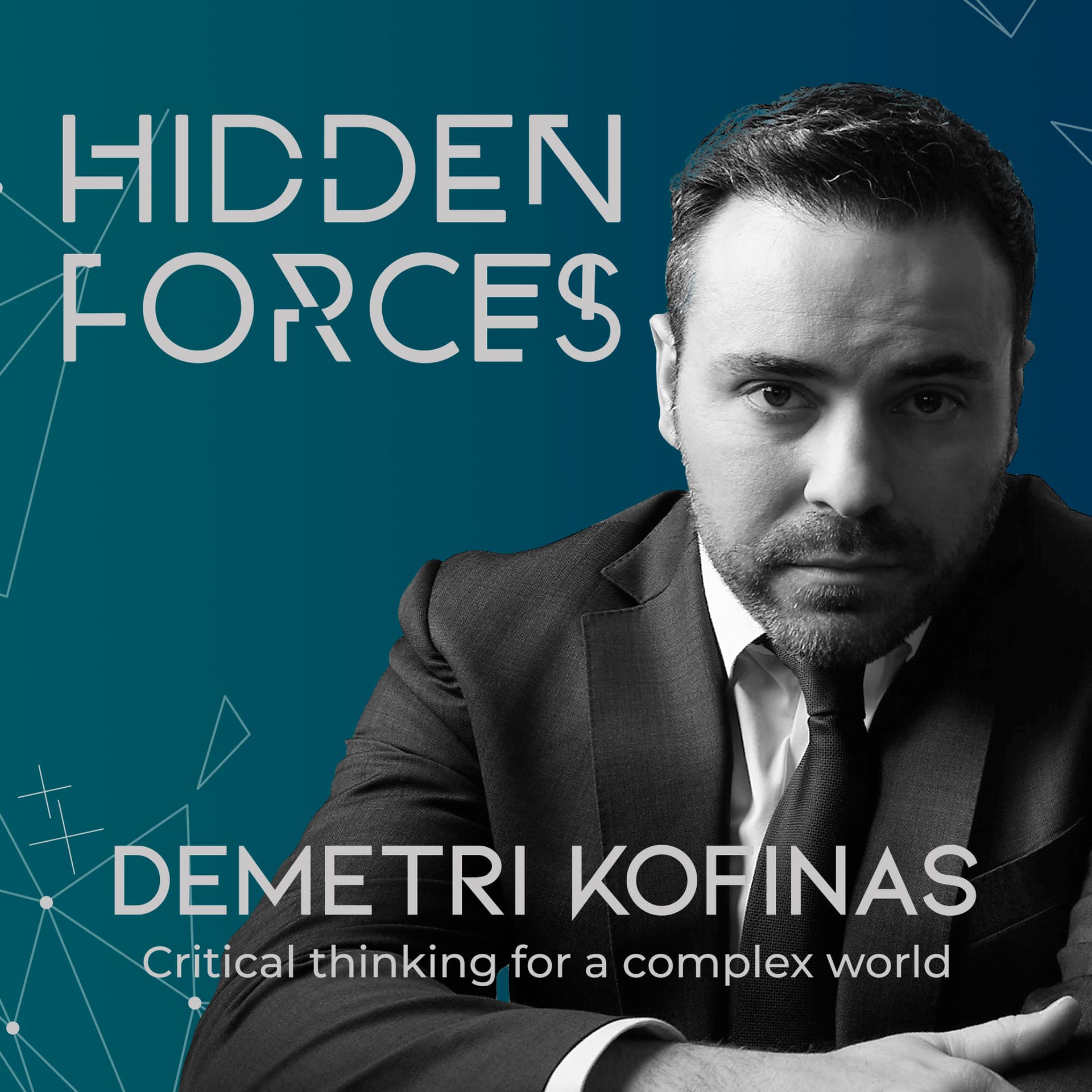
Automatic transcript. May contain errors.0:00Demetri Kofinas:What's up, everybody? My name is Demetri Kofinas, and you're listening to Hidden Forces, a podcast that inspires investors, entrepreneurs, and everyday citizens to challenge consensus narratives and learn how to think critically about the systems of power shaping our world. My guest in this episode of Hidden Forces is John Burn-Murdoch, a columnist and the chief data reporter for the Financial Times, where he applies an epistemic approach using statistics and graphics to dig into and tell stories about the most pressing issues of the day, covering everything from trends in demographics and housing, to the affordability crisis, the decline in fertility rates, the rise in mental illness, and the profound impact that AI is having and is projected to have on our societies and economies.
0:47Demetri Kofinas:John and I spent the first hour of this conversation discussing his path into journalism, the questions that animate him, and the frameworks he uses to analyze and communicate complex social, economic, and technological trends. Our discussion then turns squarely to the subject of artificial intelligence and to the central question animating much of the current discourse, specifically, what is AI going to do to the economy and to our jobs? We look at what the data tells us about which jobs are most exposed, what the latest research reveals about the decline in entry-level hiring, particularly in software development, and why it matters that this trend predates the arrival of large language models.
1:26Demetri Kofinas:We also draw on historical analogies from the ATM to the internal combustion engine to the internet to think through how AI is both similar and different from previous waves of automation and explore what personal qualities, experiences, and innate talents are likely to determine who thrives and who struggles in an AI-augmented economy. The second hour turns to AI's implications for education and journalism before broadening into a conversation about the deeper social and demographic trends John has spent years investigating. We examine the widening ideological divide between young men and young women, what is driving it, what role technology and social media are playing, and what it means for the future of relationships, fertility, and social cohesion.
2:13Demetri Kofinas:We also discuss the growing phenomenon of economically and socially disengaged young people, the concurrent rise in mental health diagnoses, and how the so-called affordability crisis is compounding all of these trends, creating some of the most extreme demographic distributions of wealth and opportunity in history. If you want access to all of this conversation, go to hiddenforces.io slash subscribe and join our premium feed, which you can listen to on your mobile device using your favorite podcast app, just like you're listening to this episode right now. If you want to join in on the conversation and become a member of the Hidden Forces Genius Community, which includes Q &A calls with guests, discounted access to third-party research and analysis, and in-person events like our intimate dinners and weekend retreats.
2:59Demetri Kofinas:You can also do that on our subscriber page. And if you still have questions, feel free to send an email to info at hiddenforces.io, and I or someone from our team will get right back to you. And with that, please enjoy this fascinating and thought-provoking conversation with my guest, John Byrne Murdoch.
3:24Demetri Kofinas:John Byrne Murdoch, welcome to Hidden Forces. Thank you so much for having me. Dude, I'm stoked to have you on. How long have I been pursuing you as a guest? It's been years. I was looking, yeah, a couple of years, I think. I think that's partly just my bad inbox hygiene. I don't know if you know this, because how long have you been a journalist? Coming up for 15 years now. Okay. You guys are notoriously difficult to wrangle. And the way your deadlines work and everything else, you're always under pressure. So actually, I can tell you that it's not uncommon. So I was trying to think about how to introduce you and I don't have a good way to introduce you.
4:00Demetri Kofinas:I mean, you're an FT journalist, but that's not really what makes you interesting. And usually when I bring journalists on, it's because they've covered a specific story or there's a specific beat that they're on. And while it's true that most recently, the beat that you've been on, you and your colleague, in fact, Sarah O 'Connor, have a newsletter that you publish on artificial intelligence. I think that'll probably be the bulk of what our conversation is about. You first came on my radar, I'm pretty sure, because of all these really interesting data visualizations that you've done on demographics and the gender gap and the wealth and income gap.
4:32Demetri Kofinas:I would bet that the vast majority of my listeners have come across your articles in the past. Before we get into anything specific, I would just like to know about you. How did you become a journalist? And then how did you become this resident data geek at the FT who kind of just owns that entire space of interesting articles that try to reconcile people's perceptions with what the underlying data tells us about the world? Sure. And look, I should say at the outset as well, there's a whole team at the FT who do this kind of work. And so while my stuff might be what people are most familiar with, there's all sorts of others doing the similar stuff.
5:09My route in is kind of circuitous. I started out at the Guardian newspaper in 2011. That was after just having done a master's degree in journalism. My undergraduate was actually in climate science. So that I kind of look at as a bit of a grounding in terms of being a focus on doing data analysis and visualization to test and validate theories. but really I think you could almost go back to my parents so my dad was a high school math teacher and my mom's very creative I'm a teacher as well and so I think it was that combination of quantitative chops and creativity that has landed me where I've ended up so yeah I've been at the financial times now for about 13 years and through that time have been really gradually evolving my role.
6:00So I came in as someone who did data analysis and charts to support other reporters' work, and then gradually worked my way up to the point where it's supporting my own work. And I guess I tried to follow a goal of social science on deadline, which is actually a quote I'm stealing from a US journalism professor called Steve Doig. But that's the idea. So come up with questions about the world, try to use data to answer those questions, and then try to is chance to really present the clearest version of that answer. So how do you come up with those questions? Honestly, sometimes I struggle to tell you, which feels like a problem for my own workflow optimization.
6:42But no, look, it's a combination of trying to read very widely, trying to talk to a lot of people in different areas. Yeah, just consume as much information as I can from as many varied sources as possible, and then just let that turn over in my head. So these days, I've got a little kid now, which of course ends up squeezing the amount of time you have just for kind of blue sky thinking. So I've had to build in that time and really think about where the ideas come from and how to get those, because that really is the currency. How old is your kid?
7:12Demetri Kofinas:He is 19 months. Wow. I have a son who's also 19 months. That's crazy. So how do you feel that AI, I mean, we mentioned AI, it's something we're going to talk about, but how do you feel like AI has actually, or your willingness to adopt and the extent to which you use AI has changed in part as a result of the fact that you're a new dad? That's really interesting. So there've definitely been times when I felt like it's an amazingly convenient timing for this to arrive. Because as a new parent, there are so many times when you think, right, I have got some work projects going on, but right now for the next three hours, I need to be with my kid and I need to be fully dialed into my kid.
7:53And the fact that, I don't know, even a year ago before Agentic AI, that was just, you had to choose one or the other. Whereas now I can set, say, Claude code up with a task and then go and fully immerse myself 100 % with, I don't know, crawling around some soft play with the 19-month-old. And then I come back and that work has been done. Progress has been made. So yeah, I do think the multitasking that is facilitated by the Agentic tools has been pretty amazing for new parents.
8:19Demetri Kofinas:I'm so excited to talk to you today, John. This is fantastic. I mean, I also feel like, well, actually, so let's make this a question and I'm getting a little bit ahead of my outline here, but do you feel like people like you who are, I mean, you're probably a very curious guy by nature, right? Would you say? Yeah. And someone who has really the freedom to explore that creative space of curiosity. Do you feel like individuals like you are especially advantaged in the world of AI? AI? Because I guess, well, I would be curious why you would agree with it. I have some hypotheses, but I mean, would you agree with the general sentiment that people like you are actually most likely to benefit from this new technology?
8:56It's interesting, right? So in general, yeah, I think curious people, AI, especially the agentic tools are essentially a tool for transforming curiosity into insights or answers. So there are all sorts of questions that someone might have had about the world a couple of years ago where they would have just thought, well, you know, I'll wait until someone does some research into that. And now via deep research agents or setting off your own pipelines and scripts, you can get those answers yourself. So for a hundred percent, I think it's like a curiosity. Well, it increases the value of that skill.
9:32But for someone like me, it also kind of goes both ways. So if you'd asked me 18 months ago, what I thought the specialist skills that I had within my industry, within the industry that set me apart from others, I would definitely have said the ability to write code would have been one of those. And now I would say that has become largely automated. I'm now writing just natural language to get the code written. And so in a way, that means I can transform my ideas to answers, my questions to answers even more quickly. But it also means other people in the broader journalism and writing industry who previously had the barrier of, well, I have a question, but I would need to write code to get the answer and I can't, they can now execute on that.
10:20And I see this already, right? I see some great writers out there who are now starting to produce charts and analysis in their work. So yeah, I love where we are with this technology. I can just set so many streams running, but I definitely feel that the number of people who I would consider to be competitors in terms of data journalism and journalism with charts has increased.
10:45Demetri Kofinas:So we'll have a chance to revisit this particular thread of the discussion because I'm very curious to hear more about what you think in terms of who is advantaged and who isn't, what are the skills that are coming into relief as a result of using this technology more and more. First of all, how much engagement do you get from your readers? Do you get a lot of people emailing you on a regular basis? Yeah, yeah. Look, it's one of the most privileged things about being in this job, especially being somewhere like the Financial Times, is the volume of feedback we get, of emails that we get, but the quality and the depth of those things.
11:19I will often get several hundred word emails from readers who are sharing real insights. I get the six word emails as well, which are often less polite. But the quality of stuff that comes in both below the articles at somewhere like the Financial Times, because you've got to be a paying subscriber to be in that community and into the inbox and also on social media. So there the barrier to entry is lower as it were, but that's something I've always leaned into as well. A lot of my ideas have come from feedback, either within the FT readership or broader people who engage in my work.
11:57Demetri Kofinas:Is there a certain set of common curiosities, questions, or concerns that animate these emails that seem to pop up more often than not from your readers? I think it's really, really broad. There's everything from people just saying that something resonated with them or the opposite, saying that they think I'm barking up the wrong tree on something, people sharing their own experience of something I've written about, people sharing relevant work that they've done. So it's hugely varied. But yeah, I think part of that comes with the territory of what I write about. I try to be quite wide ranging in what I touch on as well.
12:34So yeah, it feels like there's a really nice sort of natural ecosystem there where people are seeing some value in what I'm doing, but they're also contributing thoughts and suggestions.
12:43Demetri Kofinas:What about when it comes to AI? How many of the questions are business or investment related? And how many of them are actually social, cultural, political, really concerns about life and civilization and humanity, existential questions, in other words? Yeah, I'd say there's a bit of both. Since Sarah and I have been doing this newsletter for the last few months, we're definitely getting really interesting reader emails coming in where people are pondering some of the stuff we've written about or even suggesting new things. This is clearly something that a lot of people are turning over in their heads every day at the moment.
13:14And I think our emails, our reporting just sort of acts as a magnet for some of those thoughts to come to. So it's been super interesting. And certainly it's a mutually beneficial relationship. We get ideas of things to write about from what people are saying to us. But yeah, it's super broad. There are people, I would almost say, relative to the broader FT, the response that I get and that we get to the stuff we write is probably more into that broader socially relevant space, society, culture, as you say, existential stuff. So we definitely get the sort of core market-driven stuff as well. But the nice thing about almost trying to write about these spaces in which economics and finance intersect with wider society is we do get those much more sort of meandering and thoughtful and broadly curious emails as well.
14:06Demetri Kofinas:So before ChatGPT35 came out, to the extent that I spent time thinking about AI, I was really around existential risk questions animated by these thought experiments, like those laid out by Nick Bostrom in Superintelligence. Since then, especially in the last year, my focus has been much more, I mean, the questions that just keep popping up in my head really have to do with my own work. What's going to be replaced? What isn't? Where can I lean in? What can I automate? What if I'm advising my kids or the kids of other people or some of the younger listeners who reach out to me who are about to go into university?
14:41Demetri Kofinas:How do I advise them on what they should do or what they should study, et cetera? How much time do you spend thinking about that? The sort of jobs, will AI take away my jobs component of the story? Oh yeah. I mean, loads, almost an unhealthy amount, I would say. I feel like there's been, and I think this is true of a lot of people in the quantitative and coding space over the last few months, especially since the Agentec Tools came out, is there's just this kind of looming cloud at the back of your mind somewhere where you're constantly re-evaluating what it is about your job that is valuable, what it is that you most enjoy, how are these shifts that we're going through changing your employment status almost within the broader field that you're in.
15:26And as I say, it is a background thing. It's not like for sure for my job, I'm often thinking about that question very, very directly. But there is just this sort of low key background fuzz as well, where I'm just, it feels like there's something there ever since I started around Christmas, around the holiday period a few months back, ever since I started using the agentic tools, there's been that background question of what does this all mean in a broader existential sense.
15:50Demetri Kofinas:So it feels like there's sort of a first order question, which is what types of jobs can be automated, can be automated now and can be automated later. What are the sort of defining characteristics that we can identify? And then the second order question is, will those jobs be automated? Will there be something else that's holding them back, whether it's a regulation, whether it's culture or something? How do you think through? I mean, have you tried to develop a framework for thinking about what types of jobs, what qualities, what variables, et cetera, need to be examined when trying to think through the disruptive effects of artificial intelligence?
16:28Yeah, look, I feel like this is the thing I'm kind of thinking about all the time. And my answers are evolving all the time. But yeah, you're right that there are so many ways of thinking about this. And I think a lot of the, or some of the discourse around this, I think tries to flatten things a bit too much. So you've got all sorts of AI exposure indices, which are putting a number on the extent to which different jobs are exposed to AI. Now, straight away, there's an issue there where what does exposure mean? Exposure could be positive, it could be negative. If parts of your job could be done with AI, that could be either disempowering or empowering.
17:08It all depends on whether the automation of a particular task within your job takes away your job or devalues your job, or whether it makes you even more productive, right? So coding is a really interesting one. For a lot of people who write code, it turns out, I think a lot of people have been coming to this realization over the last few months or year, that the coding, the act of writing code was actually this kind of routine and manual task that you had to do in order to execute on your ideas or the ideas that you were being asked to execute on. And a lot of people, I think myself included to a point, We thought of that as our specialist skill, but it turns out that automating that just means we can execute on our ideas even quicker or we can execute on more ideas.
17:53But even there, there are two ways in which that can go, right? The way I think about this is, do you write the spec for your code or are you writing code to spec? So if someone else is determining what your code does and you're just the one who writes the code, then that feels like a problem. because suddenly that person can ask Claude or Codex or one of the other tools to write that code instead of you. Whereas if you are someone who has been coming up with the ideas that you then use code to execute on, suddenly you can just execute on more ideas or execute on them more quickly. So for me, as someone who is almost always writing code to my own spec that I've set, it's making me much more productive.
18:35I think to senior software developers who are often putting a lot of thought into what they are coding, Similarly, it augments your skill set. It allows you to do more and do things more quickly. For people in the scientific community, economists, researchers, similarly, they've always been writing code in service of their own ideas. And so again, that's kind of enhancing what they can do. Whereas for a lot of the junior people in these industries, you're almost by default on day one or month one or even year one of your job, you generally are writing code to fit a spec that someone else has given you.
19:10And if that code can now be performed by AI, then suddenly that's a direct competition for what you were doing instead of augmenting it. So straight away, I think that's just a good example of how there are so many facets at work here. And even within the same occupation, the same technology can be a multiplier for someone, but can be sort of erosive for another.
19:31Demetri Kofinas:So the data seems to paint a mixed picture when it comes to AI displacing junior level and entry level hires. What do we know about what's currently happening? Again, I think one of the things that you've pointed out is that the drop in hiring at this level started to show up right before ChatGPT 3.5 came out. It was actually maybe a result of redundancies built up during COVID. So what does the data tell us and what does your intention tell you about what's really happening here? Yeah, sure. So there's loads of work being done in this space, both by data journalists such as myself and by huge numbers of economists, especially in the US.
20:10So the most consistent story that we're seeing now, and I'm mainly leaning here on work from people like Eric Brynjolfsson at Stanford and from some economists at Harvard as well, like Guy Littinger, what we're looking at is an impact specifically on the youngest workers in the most AI exposed industries. And by AI exposed there, we're mainly talking about people who write code. So there are several things that show up consistently in the data. The first, as you've said, is that that initial drop in employment or hiring in these jobs seems to have been more to do with the rise of interest rates.
20:47So that suddenly made new hiring more expensive across the board. Tech companies were especially exposed to that. Some other things happened at a similar time in terms of changing to the expense of R &D, which again made new hires relatively more expensive. So that seems to be something which happened in mid-2022 on the hiring side. And the employment number effects of that showed up about six months later, coincidentally, when ChatGPT emerged. That, I think, is important to say straight out of the gate, because it always felt implausible to me that when the earliest versions of ChatGPT emerged, that that would suddenly lead to changes in hiring decisions on a scale that would show up in the data.
21:27So it looks like that was indeed a coincidence to do with the unwinding of the post-COVID hiring boom, the interest rates, that kind of stuff. But nonetheless, in the year or two or three after that, this shows up most consistently around 2024, we started to see a new thing, which was that even within the tech sector, you started to see employment for older software developers hold pretty steady or even grow, but employment and hiring for younger software developers started to dip. So this has now showed up in multiple analyses of multiple data sets. It shows up in a few countries, but I think it's strongest in the US.
22:07And so that is really, I think, what is the strongest evidence at this point of something actually caused by AI. So you had this coincidence in 2022, but a couple of years later when the technology was maturing, when you had tools like Copilot and various other coding specific tools really coming online. And then more laterally, when you had the agentic products coming out, at this point, you've got tech bosses probably looking around and starting to say, we are starting to see productivity gains, or at least we're pretty confident that we're going to see productivity gains pretty soon. They then pull back on the hiring.
22:42And again, to our earlier point, they pull back, especially on those entry-level roles, because 30-year-olds, 35-year-old software engineers probably have a lot of broader expertise now that is multiplied and magnified by AI, whereas those 23-year-old, 24-year-olds who are broadly writing code to spec are suddenly looking less valuable.
23:02Demetri Kofinas:So I feel like this revolution, this general purpose technology of artificial intelligence is going to be disruptive in, I think, a very different way than the internet was. That's my intuition. But I'm curious, what do we know about how previous technological revolutions have disrupted the economy and changed the workforce? and how closely do you think AI will parallel and why? Yeah, it's interesting. And there are different examples here, right? So again, there are so many variables to consider. So people often talk about the invention of the internal combustion engine and the impact that had on the use of horses.
23:37And that was pretty sudden, right? Very dramatically, you suddenly had motor vehicles and a huge decline in the use of horses for transport. We're talking that a precipitous fall over like a decade or so. But it sounds silly to say so, but horses didn't have unions. There was less regulation. And it was this very straightforward automation of something that was done to spec, to the extent that horses did things to spec. So that, I think, is actually quite different to what we're looking at right now. And we shouldn't necessarily expect things to happen at the same scale or the same speed. but if you do look at other instances of sort of occupation specific automation so people have looked a lot at bank tellers for example when the atm came out you do see something that's maybe a bit more similar to what we see today and i think the atm example is a really nice one because you see two distinct phases so in the first instance people often like to talk about how atms did not kill the job of bank teller and that's true right there were for many decades after atms came out there were still very large numbers of bank tellers.
Read the full transcript
24:43In fact, employment of bank tellers in the US was broadly flat. But what that message is before ATMs came out, the employment of bank tellers was trending distinctly upwards. So in that first instance, you had something that's maybe similar to what we're seeing with software today, where there were not mass layoffs, but there was a significant slowdown in employment growth in that sector as the more junior people, especially were the ones who you would simply not hire, you get the machine instead. But it wasn't until several decades later that you start seeing employment of bank tellers actively decline.
25:16And there's a brilliant writer called David Ox, who has a great essay on this on his Substack, about how what caused the employment of bank tellers to decline rather than just stagnate was the invention of the iPhone. Because that was a much bigger paradigm shift, which suddenly put finance on the internet and in your pocket instead of in physical buildings. So you can have these two distinct things happening at very different times, which can have quite different impacts. So it may be, for example, that we do see a long run slowdown in the hiring of new software engineers over the next decade, for example.
25:53but there may still be a lot of software engineers for some years to come until something more dramatic and perhaps even unforeseeable happens, which leads to a complete shift, which reduces the need, for example, for any code to be written at all.
26:08Demetri Kofinas:So you think it's too early to speculate on what some of those complementary technologies could be that would accelerate AI's adoption? I think it's very, very interesting to contemplate those, but it's not something I've put a huge amount of time into myself yet. I would love to read more from people who are just really doing big picture thinking about what are some completely novel uses of this technology that we may see a few years down the line, which could completely change the nature of jobs or even industries. Yeah, I think it's fascinating, but it's not something I've put too much time into.
26:41Demetri Kofinas:So software development is a perfect example of a field that didn't exist before the IT revolution. Web 2.0 and the mobile internet is responsible for the influencer economy, which is something that's totaling you today. What kind of thought experiments would someone living in 1995 or 2005 have had to have run in order to imagine the kinds of jobs that would eventually be invented? And can we run some of those thought experiments today to think about what types of jobs might emerge as a result of AI? And yeah, look, it's absolutely fascinating. I should probably read more of what people were speculating in the 90s about what we would see now.
27:18I'm certainly not aware of much writing about the idea of influencers and creators and that kind of thing from, say, 15 years ago. I mean, in terms of AI, one thing I wonder about, and certainly this is already happening to an extent, is whether we will come to a point where the AI labs themselves are really hoarding the sharpest minds in all sorts of domains where the best economists, researchers, scientists, lawyers, that kind of thing, start getting hired by the AI labs in order to train better and better models of what those professions should look like. So this is already happening at a more, say, junior level.
27:59So there are companies, I think Mercore would be one example that some of your listeners might be familiar with, where the idea is exactly this, to bring in domain experts to train AI models. Because one of the issues we have with AI, of course, is that these models are trained on what's already out there. And if we simply come up with slight efficiency gains over the years for regurgitating what's already out there, then that, of course, slows progress. So what I wonder about is whether we will start to see a real active effort to generate progress from the sort of elite knowledge worker humans.
28:38And there will then be competition between the labs to bring them in to make their AI tools even better and even more advanced. So that's about as far as I got with thinking of the immediate future for this.
28:48Demetri Kofinas:That's so interesting. It makes me think of a parallel, which was the giant sucking sound of Wall Street sucking up engineering jobs to go into financial engineering. Are we going to have AI firms basically suck up all the physicists and mathematicians and all the smart people to just basically train AI? Is that what's going to happen here, do you think? Is that one possibility? I think it's a possibility, right? Because for me, one of the differences between AI and say the wider tech boom of like 15 years ago, and then as you say, the finance boom before that, is that this, as you say, it's a general purpose technology.
29:23It's much broader, right? It's finance, you're bringing the best mathematicians got sucked into that industry with tech. It was mathematicians coders quantitative minds and anything else again that could be immediately useful in those companies but i think now that pool is much broader both in terms of who would be useful to generate new insights and information for these companies and models but also in terms of the appeal to skilled white collar workers so with finance and with the previous tech boom The deal was largely come and work for us and we'll give you loads of money. With AI, it feels like it's come and work for us, we'll give you loads of money, and you will have unlimited numbers of tokens to use to multiply your skills.
30:08I think we're already starting to see that. Places like Anthropic are bringing in more and more economists and people from broader fields. Again, I don't think those people are just being brought in to say, hey, do some interesting work with our data for lots of money. It's just come in and figure out what's going to happen to economics over the coming years. So it's a little bit hand wavy at the edges, this theory, but I wonder if we're going to see something like that.
30:35Demetri Kofinas:So putting aside the employment of specialists within AI firms, do you think AI is more of a threat to specialists and people working within corporations than to entrepreneurs who have to wear many hats, and need to work within capital and cost constraints to build a company. It seems like just like the internet and the software revolution created these capital light, low employee, high multiple companies, AI just feels like an accelerant to that. Would you agree with it? Absolutely. Yeah. I think we're already seeing that there are notable examples of companies that have spun up with very, very low headcounts over the last couple of years, and that are starting to turn that into real results.
31:17Yeah. So I certainly think AI is an advantage for entrepreneurs. Whereas, yeah, for experts, sort of existing incumbent experts, I think it depends on how broad one's expertise, how multifaceted it is. I think having narrow specialism right now feels risky because it could be the next thing that AI cracks, right? So my own perspective on this is like a couple of years ago, So there was a point when I used to think, you know, I've become more and more of a multidisciplinary person over the last few years. There was a point where I could have doubled down on coding and become more of an interactive graphics designer.
32:00And a couple of years ago, I thought, you know, maybe I should have done that. I did the process of having a kid. It would have been nice to think, right, I've just got my skilled trade and I'm just going to keep earning money off the back of that. Whereas of course now, I'd have been way more vulnerable if I'd been a narrow specialist in front-end development. So for incumbents with significant expertise, I really think it comes down to how narrow is that expertise? And then with the jagged frontier of AI, is your expertise in one of the areas that AI is currently very good?
32:30Demetri Kofinas:So what about when it comes to soft skills? This is actually interesting because in your writing, it seems that this is also an area where the data is somewhat muddled, the picture is not as clear. I would have assumed we have these people like Peter Thiel and Elon Musk that come to mind of sort of Asperger people, spectrum-ish people who have made a lot of money, been very successful as a result of these subsequent bubbles and booms in technology and IT and software. But actually the data seems to suggest that actually people with soft skills have actually done quite well during the last 20 years.
33:03Demetri Kofinas:And so my question is really, what exactly does the data say about people with strong social skills or collaborative character traits? How have they done? And how do we expect them, people with these types of skills to do in a world where AI becomes an increasingly dominant general purpose technology? Yeah. Look, the data generally here says that the jobs that have done best over the last few decades, and this is as true over the last five years as the previous 20 years, is the jobs that combine strong quantitative technical skills with strong soft skills. And by soft skills here, this is very broad.
33:38We're talking about creativity, communication, collaboration, project management, all of these things that can really enhance and multiply those technical skills. And on the surface, yeah, it can sound strange to think that the story of the tech boom is not one of simply rising returns to technical quantitative skills. But for me, when you take a step back, it actually makes a lot of sense. So I think about soft skills versus technical skills as a bit like height in basketball. So being really tall kind of gets you into the door as a possible basketball player. But then among NBA players, the correlation between height and performance excellence kind of goes away and it becomes more about everything else that you do with that height, as it were.
34:23And I think for me, it's something similar with hard skills versus soft skills. So you don't go into a tech company unless you have sufficient quantitative expertise to just understand what this technology is, what it does, what can be done, what shouldn't be done. But then it's often having the softer skills within those fields to apply thinking from different disciplines to what you're doing with code, to manage increasingly large and complicated projects and teams, to think creatively about these technologies that maybe don't exist today but might exist in five years. Those feel to me like the traits you see in your Elon Musk and Peter Thales, and you don't necessarily see in your cracked coders who just sort of sit with a hoodie in a dark room.
35:06So yeah, the quantitative skills are absolutely still necessary. It's just that the application of softer skills to those quantitative skills, I think is the sweet spot.
35:16Demetri Kofinas:So I know I'm putting you a little bit on the spot here, but what are some of the other qualities? We mentioned curiosity, curiosity, creativity, self-motivation. What do you think some of the most important ones are? Do you rank them a bit in your mind? I'm just curious, and I know I'm totally putting you on the spot, and these are not necessarily well thought out answers. I mean, I think creativity is a huge one, because for me, that goes hand in hand with risk-taking in that if you can't even come up with the 1 % short at a billion, then you don't even get to the point of whether you're willing to take that risk.
35:48So being able to come up with ideas that other people aren't, I think is really advantageous. It's easier and easier to execute all ideas in the age of AI, but coming up with those ideas is still critical. And for now, at least, it seems like creativity is not one of AI's strengths. So that for me is a big one. Agency, it's interesting, right? Agency is still, being a highly agentic person, and somebody who goes out and does things, I think is still incredibly valuable. And I wonder at a moment what AI does to that, because it's suddenly easier to execute on ideas. But we are seeing from the AI usage data so far, that it's highly agentic people, highly ambitious people, highly skilled people who are making more use of AI.
36:31So it may again be that high agency AI acts as a multiplier on that. The other one I think is really key is teamwork and just being someone who other people want to work with. Because whether we're talking about raising money, whether we're talking about building a team, these things are still going to be important, even if the teams are going to be smaller for startups to date than they were 10 years ago. I think that that quality of being someone who is good to work with, both in terms of it being a pleasant experience and that you achieve good results in a team, I think both of those are going to be super important.
37:03And you raised the question earlier of what we talk to our kids about in terms of the labor market of the future. And for me, in a way, it's been quite liberating to think, right, for now at least, I'm thinking less about what specific occupation am I going to try and encourage my kids towards. I'm thinking more about, I want you to be someone who is a creative thinker and is a lovely person to work with. That for me just feels like a nicer, healthier thing to say. And the fact that that also is maybe evidence-based is kind of cool.
37:35Demetri Kofinas:For years, I've been telling people, first of all, I always tell people you should follow your passions. You should do something that really feels like it's interesting and exciting because it takes a lot of work to be successful and you're not going to do it if you don't like the work. You're not going to be successful if it's a drag. But to the extent that people find the fields of philosophy and history interesting, I think those are two invaluable categories because philosophy, especially epistemology, teaches you how to think and history gives you a set of data from which to draw inferences and insights.
38:07Demetri Kofinas:And we're talking about creativity. I mean, I don't have an answer top of mind here when thinking about where creativity comes from, but I do feel that exposure to more experience and reading history, I think that can inspire one to be creative. I mean, do you have any thoughts on how to cultivate creativity beyond it just being something that you're born with? I think you're exactly right on that. And there's almost this sense to which AI does two things particularly well. One is it is very good at anything quantitative because it's deterministic, it's right or wrong, it's easy to optimize. And so that, as you say, increases the relative value of the humanity subjects.
38:47Philosophy and history, I think I completely agree with you, are probably the two which now have the most value in this environment. Well, the other thing AI is very at is bringing everyone towards the average of what's already out there, which again, I think is what makes creativity especially valuable. I've certainly seen the argument made as well, that as AI models get better, they also get even closer towards that average, as it were. AI models, a couple of iterations were actually more creative and out there than ones today. I think, again, humanities and creativity are the key. In terms of fostering them, I do think you can foster and encourage creativity.
39:23But again, a lot of it comes down to just consuming a lot of information, a lot of experience from different places. I think someone who has traveled a lot and read a lot is, I don't know whether you would say they are more creative, but they have a bigger reservoir of possibilities to draw from than someone who is not. Maybe that's more helpful. Instead of talking about this ineffable concept of creativity, it's about broadening your pool of experiences and references as wide as possible so that you can then plug that into AI as it were.
40:00Demetri Kofinas:And stoking your curiosity. I mean, we as parents of young children now have an enormous responsibility on our shoulders here because so much of what they're exposed to results from us, whether it is again, stoking that curiosity, whether it's exposing them to experiences and also being somewhat courageous and willing to be a bit risk-taking when it comes to parenting and not necessarily doing whatever worked in the last 100 years, the last 50 years, and being willing to take some risks in how we educate and raise our children. Also, when you talked about high agency, something else that AI can't do is it can't go out there and build a network of people.
40:35Demetri Kofinas:You have to do that. You have to build those relationships. You have to create trust and goodwill and inspire people. That's not something you can outsource. I think that's also very powerful and important. If you're an entrepreneur, you got to be out there. You're meeting people, you're building networks, you're creating opportunities. So I think as we see more and more AI adoption, I feel like more and more of what is valuable comes into stark relief. And creativity is certainly one of those things. I think, again, curiosity is one of those things, what we just talked about here are. Let's talk a little bit about how AI is going to be adopted across different geographies.
41:12Demetri Kofinas:So what are we seeing in terms of, like you've written, for example, how this could be disruptive of the economies in India, where a country that's become a global hub for outsourcing IT-related services. What do we know about EM versus DM, emerging markets versus developed markets when it comes to AI adoption? Who are looking like they're going to be the early winners and the early losers of this technology? Yeah. So far, it is the US that seems to be adopting this most rapidly. And that makes sense when you think about the occupational mix of different countries. The US has disproportionately large tech sector, especially with software development.
41:48That is where we've seen the fastest uptake of AI in general. A lot of this just is compositionally countries with large existing software sectors are adopting AI most quickly. On EM versus DM, it's interesting. We've got a colleague we spoke to in a previous newsletter about what this looks like in India. India is at a different step of the food chain in software. They are generally, the Indian software companies are positioning themselves more as middlemen who will sort of manage, provide and manage services rather than creating new technologies and products. And in a way that makes them more vulnerable because managing existing services is more easily automatable than creating new ones just on a very simple level.
42:32So I do think there's a potential risk that some of the emerging markets that have done well over the last decade of positioning themselves as outsourcing hubs for these sort of mid-level software and tech roles and functions, I think there's a risk that they could find the rug being pulled out from beneath them, as it were. The flip side of that is that some of them are trying to now position themselves as the humans who will handle the AI transition. So certainly that's the case for a lot of Indian companies who are saying, right, this new technology is emerging, it's making everything, it's moving incredibly quickly, we will hold your hand through this as you being a legacy incumbent in one of these industries.
43:14That's an interesting bet, but there's certainly a chance that that doesn't pay off and that what would actually be more beneficial for the emerging markets here is to try and move up the food chain and become creators and initiators. So broadly speaking, that's the kind of pattern we're seeing. And I also think some of the US advantage comes from a general sort of optimism and greater appetite for risk taking here. So what we see when we look at individual level data is that there are a lot of gaps in AI usage which map onto people's general risk aversion when it comes to new technologies. So a common pattern that we see in most countries is that men have been slightly more likely than women to adopt AI so far.
43:55And that has been the case for quite a lot of technologies, not all technologies, but a lot of digital technologies over the last few years. I think this is especially the case of AI when you think of, there are a lot of risks in using AI. I don't mean necessarily the catastrophic ones. I just mean it can get things wrong. It can hallucinate. If you're naturally more risk tolerant, then you maybe weigh those downsides differently. So yeah, I think the broad pattern we're seeing so far is that AI is mapping neatly onto existing inequalities and gaps in the extent to which new technologies are taken up.
44:29Demetri Kofinas:Just one really quick question here. I don't want to get stuck on this question, but isn't there a lot that we can do to determine whether these models are hallucinating? I suppose if we're dealing with agents here, it's a different story, but there's a lot that can be done. So I don't know, how fair is it to really describe that as a risk? I guess it's more of the perception of the risk right so yeah i mean look i use these tools every day extensively and the rate of hallucinations in my experience is incredibly low the rate of hallucinations has also been getting significantly lower over the last few years so i think what i'm talking about there is more that there are a lot of people who tried these tools when they first came out maybe that was about a couple years ago they dipped their toe in they went on to chat gpt and asked some questions and they thought, this seems to hallucinate.
45:14I don't like it. I'm not going to use that. So yeah, I'm not necessarily saying that the sort of risk reward trade-off is entirely evidence-based, but certainly anecdotally, and in some of the surveys that we've run and looked at, there is a sense that, well, these tools still can't be relied upon. They're still hallucinating. And so that's why the more risk averse people are not taking them on.
45:36Demetri Kofinas:Now, you also are someone who has a very epistemic approach to thinking about stuff. Most people don't. I think that's a huge advantage too, because even in areas where you don't already know, it's not a topic area that you're familiar with where you can say, oh, actually, that's not correct because I already know that it's incorrect. You also have a framework for trying to get to what is a consistent chain of reasoning or interrogating the model to understand why it's coming to the conclusion that it's coming to. I think most people don't, my sense is most people don't have the intuition to question the model, to question the answers, to really try and hold the model accountable.
46:16Demetri Kofinas:So, they're more likely to get tricked by a hallucination. And I think that's a skillset really. It's a skillset that people need to learn. And I think for those who have that skillset, they're definitely advantaged. So, what do we know about how AI is impacting the hiring and recruitment process for workers and students are like? Has it begun to alter, at least at the corporate level, how employers evaluate potential hires? Yeah, I think the consistent finding here is, again, just the overall hiring rates are down. And this is true in the US, it's true in the UK, it's true across the board. This is an objectively bad time to be someone newly entering the labor market.
46:52I emphasize newly entering the labor market there because I think some of the, well, a lot of the discourse around AI in hiring, focuses on college graduates. And I think that's largely just because a lot of the people who set the direction of the discourse, as it were, are college graduates, and that bad hiring markets for college graduates are especially unusual. However, when you look at the detailed data on this, it's just as bad a time, if not worse, to be entering the labor market as a non-graduate. So the broad picture at the moment that we see across time and space is just that companies are just really reluctant to hire right now.
47:31And again, this is maybe especially true for early career software roles, but it is true across the board. So part of what I think we're looking at right now is that firms, all sorts of firms, not just software firms, are thinking we're in a huge state of flux right now. For many reasons, AI is one of them. And so we're almost in this limbo phase of, well, we can see that these new technologies arrived. It's getting better almost every month. Do we want to hire a bunch of people now that in a year or two years we might not need? So I think when we look at the impact of AI on hiring and on the labor market, we're blurring together two things.
48:07You've got the very precise fine-grained thing, which is maybe early career software or specifically being automated away, but you've then got the broader thing of a lot of companies thinking, is it wise to hire today given that we may not need to make as high as tomorrow.
48:24Demetri Kofinas:So actually what I was trying to get at is how does it change the way that companies go about hiring? So for example, or let's take education as an example. When I applied to colleges 20 years ago or more than 20 years ago, I don't remember going to interviews for all of those colleges, but I do remember writing essays for all of them. So what's going to become more important? Are essays going to become less important because now presumably it becomes easier and easier to fake the essay or to get help from AI. Not that that's necessarily a problem. Again, people that put out AI slop, that's obvious.
48:59Demetri Kofinas:Using AI to help your writing, as long as it's still your writing, I don't know that that's necessarily a problem. In fact, it may be just be consistent with where the world is going, so you need to develop those skills. But it certainly seems like in-person evaluations are going to become more important. And so that's my question is essentially, are we seeing any early signs for how employers, recruiters, et cetera, are going to change their evaluation processes in the face of the adoption of this new general purpose technology? For sure, yeah. So there seem to be some pretty consistent patterns here.
49:28So one is, as you say, it's become much easier now to write a pretty solid job application and cover letter and to do that at scale. So that means several things are happening. One is that there are just far more job applications now per job and per candidate, which itself can be quite demoralizing if you're someone looking for jobs because the simple fact that there are far more applications means there are far more rejections. So even if the labor market conditions were the same today as 15 years ago, the typical candidate would be getting more rejections. That's not fun. On the other end of that, if you are the recruiter or the hiring company, the company doing the hiring, you're getting inundated with a lot of pretty good or at least pretty good applications.
50:11Now, again, some firms here, I imagine, who have been thinking about this for a long time will maybe be running these applications immediately through some of the AI detection algorithms. There are tools like Pangram, which I think are especially good at this, as a first pass. But again, what do you do there? Because you don't necessarily want to say, right, we're going to throw out everything that may have been written partially by an AI, because that's increasingly becoming the norm. That's happening with content produced within companies as well, but it's really leveling the play field in a way that is actually not a huge amount of fun for anyone involved.
50:42So there've been a few studies have done, which has shown that essentially companies used to be able to treat the length and general quality of a job application or cover letter as a signal of the candidate's ability and intent. If someone's put a chunk of time into something, then you know they're serious about wanting the job. And if the cover letter is pretty well written, then you know that they're a suitable candidate. Now, suddenly, having a reasonably long and passably good cover letter doesn't really tell you anything. What that means is firms have a much weaker signal on which to base that decision to either hire or at least to push someone through to the next round.
51:24It means that if you are a really strong candidate and you took the time to write that reasonably long and eloquent cover letter yourself, suddenly your relative chances of going through to the next round or being hired have gone down. Whereas if you're someone who was maybe less talented, less able on some measure, less suited to the job, your chances of getting through to the next round have gone up because your application looks like everyone else's. So yeah, it doesn't seem to be a hugely good outcome for anyone involved in the process.
51:54Demetri Kofinas:So I've become increasingly bullish on in-person everything. Whether it's in-person evaluations here, I think those are going to become increasingly important. Whether it is in-person events, services. I mean, I just think that is one area where it's becoming increasingly obvious that there will still be enormous amounts of value. So I would guess that when it comes to education, those will become more important. And one of the interesting consequences of that is that the last 20 or 30 years or whatever has been one of chasing scale, right? Because the software revolution made it possible to keep your costs fixed while just increasing, in some cases exponentially, your revenues, the zero marginal cost economy that we're familiar with.
52:39Demetri Kofinas:It seems that what AI may end up doing is by driving costs so ferociously down in those areas, it will create the real economic opportunities will be in the less scalable, less profitable in-person type experiences. So kind of, I mean, an interesting parallel would be like what Napster and these distributed file sharing systems did for the music industry where artists were selling albums and they ended up doing concerts. My sort of flippant, half serious, half joking answer to one of the jobs of the future is personal trainers and chefs. Yeah, things that are pretty hard to scale and provide real value to the person on the receiving end.
53:18And the other thing I was just going to say as well on hiring and that whole process is, it feels to me like what the internet from, let's say, the 2000s through to 2021 did, it genuinely did level the playing field of professional opportunity. So both skill acquisition, but also the ability to, for people who were previously disadvantaged by not having gone to the right school, not living in the right area, they could suddenly apply for jobs and have a genuine chance at getting these jobs. Similarly, social media elevated those voices that had previously been marginalized for a long time. I think there's a chance that AI actually flips out of its head.
54:00As you say, more and more emphasis becomes on in-person stuff. You get to a point where hiring is done more on who knows this person, who can vouch for this person. Now, that inherently means going to the right school, being in the right professional network, living in the right part of the country is going to become more important. I hope it doesn't play out that bleakly, but it does feel like one way for companies to solve this issue of dealing with a deluge of identikit job applications is for them to rely more on those references that are more likely to reinforce pre-existing hierarchies. Of course, one way around that is to just say, we're just going to do a lot more in-person interviews.
54:39You maybe try not to make it cronyistic, but you are going to need to add in those quite expensive face-to-face layers to ensure that you're recruiting the best humans and not just the best AI generated applications.
54:51Demetri Kofinas:Yeah. So I actually, just to add to this point that I'm going to move us to the second hour, John, I think that AI, as long as it doesn't kill us, is going to make us more human. That's sort of my general feeling on it as I've tried to think about this as objectively as I can. So the area that I'm most excited about when it chemistry AI is its impact on education and learning across the board. This is the area that I'm most interested in. It, of course, is what I do. I'm in the business of education. That's really what this podcast is about and the community and everything that Hidden Force is about.
55:19Demetri Kofinas:It's really about continuing education. So in the second hour, I want to start with that. Also, how you think AI might impact or is impacting journalism and media and how we come to understand the world and stay up to date on what is true and what is not true. I think that probably wraps up most of the AI specific questions, though there's a lot of crossover between what we could talk about when it comes to AI's impact and a lot of the other stuff that you've written about that I also want to talk to you about, like the wealth and income divide, the gender gap, mental illness, demographic trends.
55:50Demetri Kofinas:I mean, this is the stuff that introduced me to your work. Like I said, demographics, the gender ideological divide, you've focused in on so many important subjects. And this thing of the wealth divide and the affordability crisis is a great example of where the data says one thing and then people's subjective experience says another. And how do we reconcile that? So, I think that's also something that I'd love to talk to you about in the second hour, John. For anyone new to the program, Hidden Forces is listener supported. We don't accept advertisers or commercial sponsors. The entire show is funded from top to bottom by listeners like you.
56:26Demetri Kofinas:If you want to access the second hour of today's conversation with John, head over to hiddenforces.io slash subscribe and sign up to one of our three content tiers. All subscribers gain access to our premium feed, which you can use to listen to the rest of today's conversation on your mobile device using your favorite podcast app, just like you're listening to this episode right now. John, stick around. We're going to move the second hour of our conversation onto the premium feed. If you want to listen in on the rest of today's conversation, head over to hiddenforces.io slash subscribe and join our premium feed.
57:00Demetri Kofinas:If you want to join in on the conversation and become a member of the Hidden Forces Genius community, you can also do that through our subscriber page. Today's episode was produced by me and edited by Stylianos Nicolaou. For more episodes, you can check out our website at hiddenforces.io. You can follow me on Twitter at Kofinas, and you can email me at info at hiddenforces.io. As always, thanks for listening. We'll see you next time.
From the publisher
In Episode 475 of Hidden Forces, Demetri Kofinas speaks with John Burn-Murdoch, columnist and chief data reporter for the Financial Times, about AI's impact on the economy and jobs, the widening ideological divide between young men and women, the global decline in fertility rates, the rising rates of depression and anxiety among 18-34 year olds, and the affordability crisis that is creating some of the most extreme demographic distributions of wealth and opportunity in history.
The first hour covers Burn-Murdoch's path into journalism, the questions that animate his work, and the frameworks he uses to analyze and communicate complex social, economic, and technological trends. The conversation then turns squarely to the subject of artificial intelligence and to the central question animating much of the current discourse: What is AI going to do to the economy and our jobs?
They look at what the data reveals about which jobs are most exposed, what the latest research reveals about the decline in entry-level hiring, and why it matters that this trend predates the arrival of large language models. They also draw on historical analogies — from the ATM to the internal combustion engine to the Internet — to think through how AI is both similar to and different from previous waves of automation, and explore what personal qualities and innate talents are likely to determine who thrives and who struggles in an AI-augmented economy.
The second hour turns to AI's implications for education and journalism before broadening into an exploration of the deeper social and demographic trends that Burn-Murdoch has spent years investigating. They examine the widening ideological divide between young men and young women — what is driving it, what role technology and social media are playing, and what it means for the future of relationships, fertility, and social cohesion — as well as the growing phenomenon of economically and socially disengaged young people, the concurrent rise in mental health diagnoses, and how the affordability crisis is compounding all of these trends, producing some of the most extreme demographic distributions of wealth and opportunity in history.
Subscribe to our premium content—including our premium feed, episode transcripts, and Intelligence Reports—by visiting HiddenForces.io/subscribe.
If you'd like to join the conversation and become a member of the Hidden Forces Genius community—with benefits like Q&A calls with guests, exclusive research and analysis, in-person events, and dinners—you can also sign up on our subscriber page at HiddenForces.io/subscribe.
If you enjoyed today's episode of Hidden Forces, please support the show by:
-
Subscribing on Apple Podcasts, YouTube, Spotify, Stitcher, SoundCloud, CastBox, or via our RSS Feed
-
Writing us a review on Apple Podcasts & Spotify
-
Join our mailing list at https://hiddenforces.io/newsletter/
Producer & Host: Demetri Kofinas
Editor & Engineer: Stylianos Nicolaou
Subscribe and support the podcast at https://hiddenforces.io.
Join the conversation on Facebook, Instagram, and Twitter at @hiddenforcespod
Follow Demetri on Twitter at @Kofinas
Episode Recorded on 04/08/2026