Ask ChatGPT


 How I AI
9 Nov 2026 · 39m · 18 chapters
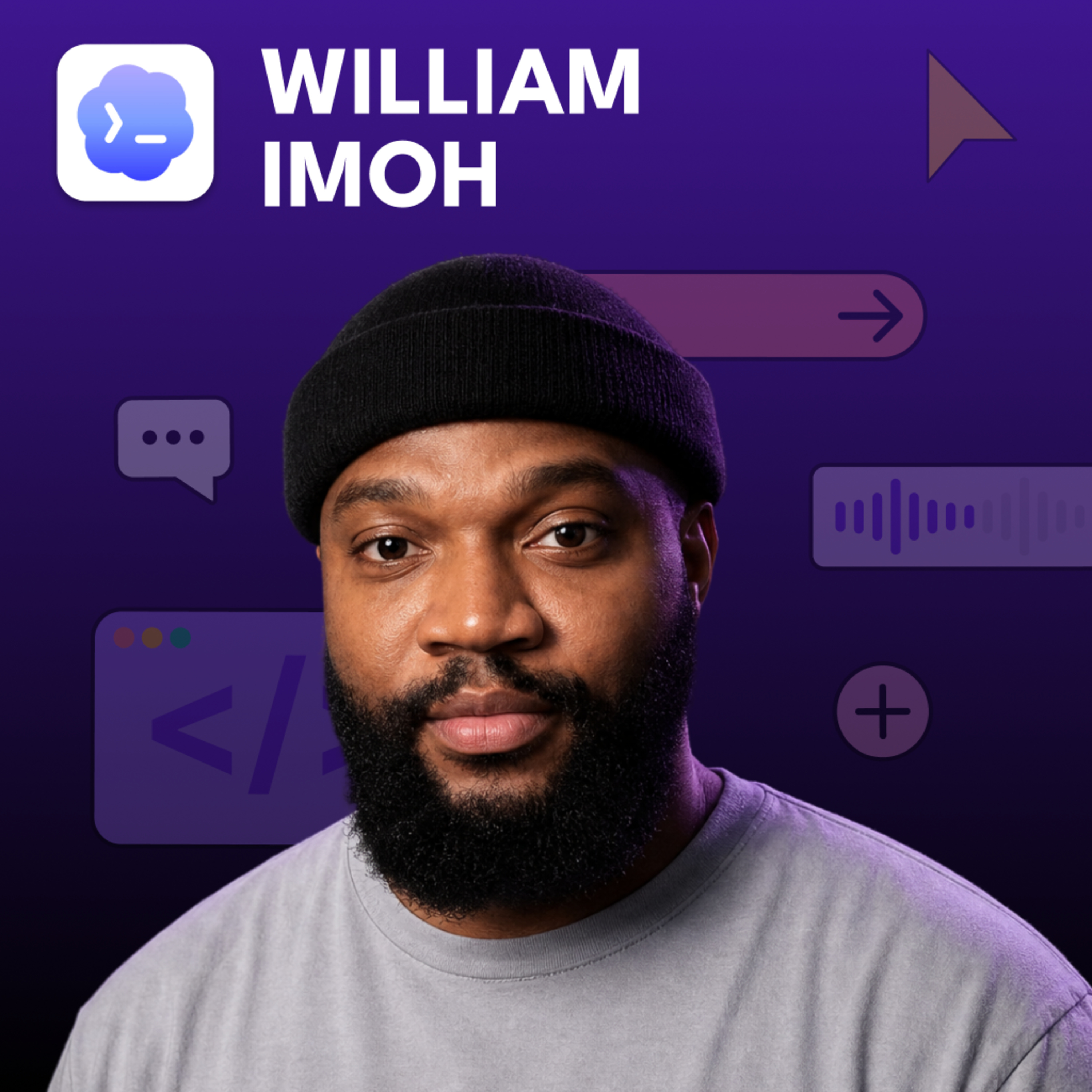
William Imoh (Hackmamba founder) explains how he built Mural Chat, a real-time Norwegian speaking app, using AI (Codex/GPT Live) and how he runs his solo business with agent “GrokBots” (Lord of the Rings-themed roles) plus Codex/Cursor workflows.
Chemical engineering degree; taught himself web development; product manager for 4 years; has not written Swift before building a native iOS app; lives in Norway and learned Norwegian via exams and short grammar course after a Duolingo streak.
Language learning is solvable with the right feedback loop; AI can replace knowing the programming language; design/product “taste” comes from specific references and user-journey articulation; agents can run lean operations if access is carefully scoped (no bank access).
“Phone-call” Norwegian practice with speech + captions; rejected dark mode; GPT Live voice conversation; GrokBots named Gandalf/Frodo/Gimli/Legolas/Eowyn; “3 pipes” HR tool that ingests candidate info and scores/ranks.
Written by AI. May contain mistakes.
William discusses his motivations for developing a language learning app.
“The only thing it doesn't have right access to is the bank.”
Exploration of how AI and Codex enabled William to build Mural Chat.
“Tools are helping teams write better code, analyze customer data, and even handle support tickets automatically.”
William shares insights on user experience and design in app development.
“So I invited you on the podcast because I saw this app that you have up, I think it's Mural Chat.”
Discussion on the unique experience William aimed to create with Mural Chat.
“to something first that wouldn't judge me and something that would correct me.”
William explains how he used prompts to guide AI in designing the app.
“So we're like, well, we know a bunch of people that can write Python and we know a bunch of people that can do this.”
Discussion on the importance of design language and articulating user journeys.
“So I've learned to work in epics and user stories, right?”
William shares the response to Mural Chat and his reflections on user feedback.
“I described also the experience I wanted.”
Learn how the speaker developed a language learning application focusing on user experience and real conversations.
“but I also saw a lot of people that had similar applications.”
Understand the speaker's transition from using Duolingo to creating a personalized Norwegian learning tool after passing language exams.
“I recently introduced flashcards, for instance, in case I want to practice like the words.”
Explore the importance of a growth mindset and how AI can facilitate learning new skills without fear of failure.
“There's been a lot of impressive things.”
Learn about GPT Live and its applications in language learning and app control through real-time interaction.
“This is this is so it's like giving me so many ideas.”
Discover how the speaker uses AI tools to manage business processes efficiently without increasing headcount.
“Well, what I'll also say is that it's less expensive than a one-on-one tutor.”
Learn how GrokBot enhances workflow and collaboration through role assignment.
“We go from content ideation all the way to distribution in Bokey.”
Discover the importance of granting AI access to resources for improved productivity.
“And then I asked Gandalf to create everyone else.”
Explore how internal tools streamline HR processes and candidate tracking.
“And then for chat GPT, like for Codex, I just enabled computer use and browser use.”
Understand the key skills needed for effective AI integration and management.
“I talk to a candidate and I just say to my group bot, hey, I just spoke to this person, get them into three pipes.”
William shares his strategies for managing AI-related challenges and frustrations.
“And then you use just like skills very precisely, like very specific ones.”
Learn where to connect with William and how to reach out for collaboration.
“I just add Tebow straight, you know, for not fixing codecs.”

Get the gist, explore an idea or ask about something said.
 Claude
On How I AI, what are the key points of this episode?
Searching your listeningAutomatic transcript. May contain errors.
0:00I tried building this app, but it just wasn't a great experience. Bombed the hackathon. I think I probably came in last with it.
0:06William Imoh: The meta skill that you have, which is like a growth mindset, which is I can learn Norwegian. Like I can learn something. If you just have this confidence that this thing is a solvable problem, learning a language is a solvable problem, building an app is a solvable problem. And if you can just ask the right questions and get the right feedback, you can get there. I wanted to speak Norwegian as someone to something first that wouldn't judge me and something that would correct me. Now, I know it's counterintuitive in some parts and some conversations that you want to be skeptical about what AI has access to.
0:41For me, I just let all that fly out the window. The only thing it doesn't have right access to is the bank.
0:47William Imoh: You run a business and like me, like to keep that business lean with agents. So tell me a little bit about how you run your business with agents. I don't get frustrated. I get scared because I'm so dependent on agents now that I fear for myself. What if these agents go to zero tomorrow? What am I supposed to do?
1:08William Imoh: Welcome back to How I AI. I'm Clara Vo, product leader and AI obsessive here on a mission to help you build better with these new tools. Today, I have William Imo, founder of Hackmamba and creator of Mural Chat, a real-time language learning app that he built for himself to learn how to speak Norwegian of all things. William's going to show us how he went from knowing nothing about native development to hacking together one of the coolest native apps I've ever seen, plus how he uses an army of Lord of the Rings-themed Grokbots to run his business as a solo founder. Let's get to it. This episode is brought to you by WorkOS.
1:47William Imoh: AI has already changed how we work. Tools are helping teams write better code, analyze customer data, and even handle support tickets automatically. But there's a catch. These tools only work well when they have deep access to company systems. Your copilot needs to see your entire code base. Your chatbot needs to search across internal docs. And for enterprise buyers, that raises serious security concerns. That's why these apps face intense IT scrutiny from day one. To pass, they need secure authentication, access controls, audit logs, the whole suite of enterprise features. Building all that from scratch?
2:25William Imoh: It's a massive lift. That's where WorkOS comes in. WorkOS gives you drop-in APIs for enterprise features, so your app can become enterprise-ready and scale up market faster. Think of it like Stripe for enterprise features. OpenAI, Perplexity, and Cursor are already using WorkOS to move faster and meet enterprise demands. Join them and hundreds of other industry leaders at WorkOS.com. Start building today. William, welcome to How I AI. Thanks for joining. Thanks. Thanks, Claire. Thanks for having me. So I invited you on the podcast because I saw this app that you have up, I think it's Mural Chat.
3:09William Imoh: And I just thought it was such a cool use of AI and something that, you know, a year or two ago would have been sort of like unimaginable for someone to build on their own, like almost impossible. And you've shown that you can build this amazing app with this really interesting use case and do it all by yourself with AI. It's just, it's kind of unbelievable to me. So tell me what brought you to building this app. Like what problem were you trying to solve? What was driving you? Yeah, I think you're also correct that a year ago, it was technically impossible. It was possible to build the app, but with a poor experience, because I tried.
3:49I was a hackathon in San Francisco. And it was, I think it was another thing to add, hackathon. I tried building this app, but it just wasn't a great experience. Bombed the hackathon. I think it probably came in last with it. And the main motivation behind this is I live in Norway and I wound up and moved from Dubai to Norway because I wanted an adventure. I didn't know what to expect. I just hoped everyone spoke English. As soon as I got here, I learned that people actually speak Norwegian. And to make it by, I mean, a lot of people speak English, but you need Norwegian to get by. But then the Norwegians are also very polite in the sense that if you try to speak Norwegian to them, but it's poor, they'd speak English back, unlike the French.
4:38So they speak English back to you. So this might, I couldn't learn Norwegian, right? And then I tried using Duolingo. I had a thousand day streak. On Duolingo, I was always like chasing the streaks. And, but I wanted to speak Norwegian to someone, to something first that wouldn't judge me and something that would correct me. But also I wanted to experience that felt like be thrown in a Norwegian village where you have no other option but to speak Norwegian. That was just the experience I wanted.
5:08William Imoh: I love this because in our house, we are trying to, we, my husband and my kids, are trying to learn Italian. And they're doing it this like very classic language learner way, which is a combination of Duolingo and like listening to like basically these like tapes, these audio lessons. And so they're in the car and they're like, you know, hearing somebody speak Italian and they repeat it. But the only way you can really learn a language is immersion. And I love what you call out because it's so counterintuitive, which is you said you can't learn this language because people are so polite. They will respond to you in English.
5:48William Imoh: And so you can't actually get that reinforcement loop of like, did I say it right? What am I supposed to hear? And so you built this app to give you that experience. Tell us a little bit about like, are you an iOS developer? Are you like a fancy developer? So first, I have a chemical engineering degree, but I taught myself to code to do some web development. So I did a lot of web development over the last five, six years. I can write some front-end, and then I can write some back-end code to save my life. Building a mobile app, I can do it with something like React Native, for instance. But I wanted today, at least when I built Mural, I wanted a native experience.
6:36So I wanted like a premium feel to it because I felt like I could build anything, but I wanted to optimize for the best user experience possible. And I wanted to use like all the better iOS features. so I decided to build in Swift well it wasn't going to be me building it I needed Codex to build it so this is building Swift for iOS and Kotlin for Android I guess when we have AI agents building stuff like the language doesn't matter like the language I know doesn't matter anymore I just choose the best possible language for the tech that I'm building so that's why I went with Swift and Kotlin even though I I haven't written a line of Swift in my life.
7:21William Imoh: You know, what's really funny about this is, you know, over 10 years ago, I did a like a venture funded startup, a real startup. And we picked the language we built that application in based on who we knew could write that code. So we're like, well, we know a bunch of people that can write Python and we know a bunch of people that can do this. And so we're just going to build our app in that language to optimize for humans we knew, knew how to write that code. And now I love what you said, which is you can just pick the best language for the user experience, the thing that you want to build. And it doesn't matter if you have somebody on staff that knows that language or not, because you have our friend Codex on staff.
8:07William Imoh: Speaking of codex, do you mind pulling it up and just showing us how you, how do you get organized around a Swift? I've actually never, don't tell, sorry, we're doing admission right here. I have not built a native mobile app ever. Even in the age of AI, I have not built one. So I am learning as we go. How do you, how did you kick this off? How do you, you know, how do you work it? Oh, background, because I have some software engineering background, I understand how to architect the apps. I understand what's required if I need to make the front end, the back end. Also the experience that I want.
8:42I think that was the most important piece here is the experience I wanted for this app. I used to be a product manager as well. I was a product manager for four years. So I've learned to work in epics and user stories, right? Because those are closely tied to user problems. So that's one way I've found I've had the best results when building AI apps. So how did you start? I first started with a very long prompt. I was very specific. And this prompt opened with literally, I want a very aesthetically pleasing application. Like this is my equivalent of make no mistakes, but is I want an aesthetically pleasing iOS application that I can learn Norwegian with.
9:26And I described the experience I want, which was basically, I want this application to run on GPT Live 1 because GPD Live 1 was just released, I think, a week after. So GPD Live 1 was the technology that I tested that enabled me build this. I don't think I'll be able to build this without GPD Live 1 today. So I specified we need to use GPD Live 1 and then we needed to use GPD 6 Luna for any other AI tasks on it. I described also the experience I wanted. So I wanted an orb that was, you know, a pulsating orb that I could talk to that felt like a phone call, like a familiar interface that we would use.
10:12And then I went on to describe the style. So I wanted something warm. I literally wrote, I want something that feels like fall, like autumn. Use fall, fall colors. And again, it should be really beautiful. follow design best practices like you were a senior designer at Apple. So I'm just giving it, I'm just giving you references of like, because I needed to get the taste that I wanted. Because I live in Norway now, I love to adopt like a very minimalist style. So I was like, make it, like it should be really minimalist. No element on the screen should exist unless it absolutely has to. and if something isn't necessary, remove it or put a toggle for it.
11:03So this was like the base experience. And then I requested that it reviews the design after it's done. Now, the first design it produced was shit. It was in dark mode. It was in dark mode. I was like, no, this isn't going to work.
11:20William Imoh: Maybe that feels like autumn in Norway, right? It starts to get really dark. So, yeah, I had to refine it before I was like, first, this shouldn't be in dark mode. Not everything belongs in dark mode. It should be light mode. Use light, warm colors. Explore gradients. And I'll use liquid glass as much as possible as well. So I want to pause really quickly because what I think is so interesting about what you just said in that prompt and our conversation so far is, look, you don't need to know Swift. Like you just don't. It's none of your business. You don't need to know. You need to know that maybe that you should use Swift, although AI could figure that out.
12:03William Imoh: But what you do have that I feel like a lot of people haven't invested in their own skilling is design and product language. Like truly the ability to describe what you want with specificity and when people talk about taste do they talk about taste all like what is taste we need taste and really what you need is design language and references in the world that you can point to you need to know what liquid glass is you need to know what minimalism is you need to know what a gradient is and and I think the more rich your reference set is when it comes to design the better and And then on the product side, the more you know how to articulate a user journey in a way that anybody can execute on, an engineer, human engineer, an AI engineer, the better that workflow will be.
13:06William Imoh: And so, you know, when people ask me, like, how do you develop taste or how do you get good at work? I'm like, describe websites, like use your words to describe what makes brand A versus brand B special or what makes website A or app A better. And the more you practice that, I think the better you can be at prompting agents to do a great job. Yeah, I agree. I look at and as soon as I put this out there, I didn't intend to share it with anyone because I wanted to build this for myself to use just by myself. And then I put out a tweet out here. I made this thing. I think it's really cool. I'm not going to share because I don't want the burden of having to maintain it and having to like deal with users expectation.
13:49Everything has to be a business. I already have a lot of problems running the business. I don't want another one. So I put it out there and people loved it. And not just people liking the experience, but I also saw a lot of people that had similar applications. And then I looked at the difference between what I built and theirs and I noticed a lot of it just had to do with the experience, like how it felt when you looked at it, right? A lot of it was also in dark mode. Like I rejected first. It had a lot of features, right? For me, I just wanted speech and a caption. A caption would be the only way you would understand what's being said if you're just hearing the language for the first time.
14:35That was my opinion, and that was the only thing I wanted.
14:38William Imoh: Can you show it to us real quick? We're going to put your Norwegian to the test.
14:44Yeah, can do her, am I?
14:58Can you speak English?
15:04Yeah, please, please just speak English. I understand, but I speak in English. What do you speak about in your meeting? Yeah, we can speak in English. Great. How are you in your meeting? Yeah, I'm on a meeting with my friend. You're on a meeting with my friend. What do you speak about? I'm talking with my friend.
15:39i am one really impressed i'm very impressed um at your norway i mean i know nothing about
15:50William Imoh: norwegian but it impressed me and two i totally get it like i get why that's the way you need it to learn like need to learn so can you just walk me through what that conversation we just heard kind of like was like what were you talking about basically i was trying to first i was like um hi and because um euro starts with hi and then figures out your level of language learning of speaking um so i said hi back and then he said something complex and i said something mildly complex back and I said um I'm doing all right and it's it Miro asked me so what am I doing I said I'm in a meeting with a friend and Miro said something but I ignored that and I said please can you speak English and Miro said no I cannot I cannot speak English back I have to speak Norwegian so I think I can pull up the the past conversation yeah yeah I want to see Yeah.
16:55So it was like, hi, like, what do you want to talk about today? I was like, oh, yeah. I was like, are you ready to start or do you want to think a little bit? I was like, hmm. And I said, can you hear me? And Mira said, yes, I hear you. What do you want to talk about? I said, yeah, I'm in a meeting. And I said a meeting wrong. I said, but that's the wrong tense. So it says, it's called et mûte, not en mûte. So it corrected me as I said that and then asked, what's happening in the meeting? Then I said, can you speak English? And Rocio said, I'm only going to speak Norwegian. What are you doing in the meeting?
17:42I said, oh, please just speak English. And then Rocio said, I understand, but I'm going to speak Norwegian. But what are you talking about in your meeting? And then I gave up.
17:56William Imoh: Quick question. When did you start learning Norwegian? Like how long? So I started learning Norwegian. I mean, I had a thousand day streak on Duolingo. Okay. So you had a little bit of a head start. Yes. But I could have this kind of conversation. I wouldn't know what to say. I'm stuck at I'm a man or this is a phone, you know. So I wouldn't be able to hold a conversation. And then I took the Norwegian, I took the Norwegian language exams. And I took a course for like a week, like a short course for a week, just so I understood like grammar. I took the exams, I passed. As soon as I came out of like the exam hall, I deleted Duolingo because I was like, nah, this is just completely useless.
18:48and I tried and that was my like my motivation to build something like murals started after that so murals just helped me get better at practicing my Norwegian in different like settings and you know this is I could talk about like the weekend I can also see like the words that I've learned and how well I've, you know, I've gone with like with each one. I recently introduced flashcards, for instance, in case I want to practice like the words. Yeah, exactly. And I also have themes because at the end of the day, you want to be able to speak these languages within a particular setting. And I can also take like a random theme about like maybe AI or something in the world today.
19:38It would search the internet and come up with a conversation about that. But at the end of the day, it all lives on the talk screen. I just go here. I start a conversation with Neuro and I just talk about stuff, whatever. And it just keep nudging me further and correcting me as I go. and it wouldn't stop correcting me until I say it properly.
20:02William Imoh: As AI adoption grows, so do your company's security risks and requirements. New frameworks, audits, and vendors keep piling on, but your team isn't getting any bigger. Most compliance tools promise automation, but you're really stuck doing all the work by hand, chasing screenshots, validating controls, and playing catch-up when audit season comes around again. Vanta works differently. Their agentic trust platform is built to scale with you, not slow you down. With over 1 ,400 automated tests across 400-plus integrations, Vanta collects evidence and monitors your controls year-round, cutting your audit prep by 82%.
20:39William Imoh: Plus, you can access the Vanta agent everywhere you work, whether your team is in Vanta every day or living in tools like Claude or Cursor. Want proof? Over 16 ,000 fast-growing companies like Ramp, Ryder, and Harvey save time and resources while scaling fast with Vanta. My listeners can get$1 ,000 off by going to Vanta.com slash HowIAI. That's V-A-N-T-A dot com slash HowIAI for$1 ,000 off. Okay, so we've had a lot of impressive people on HowIAI. There's been a lot of impressive things. One, let's put aside that you've I-Coded this whole thing, which is awesome. Two, let me just say the meta skill that you have, which is like a growth mindset.
21:26William Imoh: which is I can learn Norwegian like I can learn something and I feel like this is the skill that really helps people go very far in the age of AI which is like if you just have this confidence that this thing is a solvable problem learning a language is a solvable problem building an app is a solvable problem like these are solvable problems that you have the tools and if you You can just ask the right questions and get the right feedback. You can get there. I think that is just like, that is the skill of the, and also I'd say being really low ego, which is like, I'm okay getting it wrong as long as I can be corrected.
22:10William Imoh: And I think AI is such a great teacher because I tell this to people about learning to code. I say it is an infinitely patient, private tutor. Like it's not going to make fun of you. It's not going to say you're stupid. It's not going to be embarrassing. So like the ability to use AI as a tutor for any topic and let it be patient with you and let it let you make mistakes. I just I think it's the skill that is a real signal that somebody is going to be very high impact in this in this next phase of the world. And so that is what I'm observing of you at a higher level. No, thank you. This is this is so it's like giving me so many ideas.
22:52William Imoh: The other thing I just want to pause before we go into a couple other workflows is GPT Live. So for people that don't know what GPT Live is, it's OpenAI's like kind of real time voice model. And it does really good with real-time experiences and interruptions, which make it great for this kind of language testing. The other thing GPT Live is really good at is voice control of apps because it's so fast. So I think we did an episode, I'll have to dig it out, of voice control through GPT Live in your app. um so i i i think gpd live is a totally slept on model that people don't appreciate how much you can do with it the only thing i have to ask you a question is this expensive to run so the honest answer um yeah but i just chugging into like my token budget right um i made it open source so anyone can run it and uh it currently costs around it cost about $5 to chat with Miro for I think for 30 minutes yeah so for about 30 minutes it's going to cost$5 in now it's going to cost between$3 and$5 for 30 minutes but then I'm building this for fun so I'm just I put$1 ,000 on my OpenAI budget and just let folks burn it to the ground.
24:32I think it's remaining like$100 now.
24:36William Imoh: Well, what I'll also say is that it's less expensive than a one-on-one tutor. And you can't call your tutor to your house in the middle of the night and say, I'm ready to practice some Norwegian. So it's so cool. Okay, we're going to do a couple more workflows. We'll get you out of here. So aside from building cool apps and learning Norwegian, you run a business. And like me, like to keep that business lean with agents. So tell me a little bit about how you run your business with agents. Yeah. So first of all, sometime in June when we started planning Q3, I put together a mandate internally. And I called it 100x.
25:21And this was a way for us to go 100x. our current like revenue goals and the way we're set up as a company without drastically increasing headcount and this meant that we needed to use ai as much as possible without using ai to generate content or seeding any of our creative work to ai tools um so first of all i had to figure out everything i you know i currently do i put together a list on notion that was my first step at least had everything. So as the founder, and I'm a solo founder, so I do a bit of customer success. I handle most of the inbound sales. Currently working, I think, about 11 to 15 deals in parallel at the moment.
26:08I handle the product team as well because I used to be a product manager. And I do a bit of like accounting, HR interviews, like hiring, so just talking to folks. and we're a team of around 25 people internally. So I wanted a way to be able to manage a lot of things. First, I wanted to hire a chief of staff. I tried hiring someone. They didn't start. They quit on like just before they started for some reason. I think that was like Hail Mary for me. So I decided to adopt AI tools. And I tried different tools, right? I tried Claude first. I got used to Claude co-work. and then for some reason my account got banned.
26:52I don't know why. I skipped it. I went back to ChadGPT and installed work and I decided to use projects as I currently have on here. I set up projects for everything basically because I just wanted a siloed way to manage individual things I do. My company is called Hap Mamba. So for every critical piece that I work on directly, I create a project for it. I have a project for hack number operations. This is where I manage things like, you know, invoicing, campaigns, not just, and if anyone sends me a message on Discord, this is where that would likely fall into. And that task will be run from here.
27:36I have stuff for growth. So this is like, I also get like an operator brief every Sunday night of the week. So what's something we should start doing? what's something we should stop doing and stuff we should keep doing. I also ask you for like the three highest impact activities I would conduct this week. So that's a routine. So I use routines a lot as well. We built an internal tool for growth. This is what we use with our customers. We go from content ideation all the way to distribution in Bokey. I also support with the growth for Bokey and content creation. So I created a project for it. For sales, I did the same thing for our website.
28:21This is my podcast, Everything Outside Code. I manage like interview briefs and all that in there and just every other thing. So I use projects a lot with Codex. Now for Codex, I kind of reserve like the complex work. So for instance, Miro, having written Swift, So I kind of like wanted Astra to work on Miro. So I wanted Frontier Model on that stuff. That's what I do on Codex. But on the flip side, I found GrockBot. And instantly, I think it was amazing. Like it was a game changer for me because it gave me colleagues. Whereas with ChatGPT, I got, and like Codex, I got folders. and on Grubbot, I got my fellowship, as I like to call them.
29:14If you've seen a lot of the rings, you know what the fellowship of the ring is. So I just, I was first asked to create a chief of staff. I just called him Gandalf, straight up, straight up. And then I asked Gandalf to create everyone else. I needed other bots for engineering, marketing, project, product management, account, sales, and customer success. And kind of the personas are, you know, very close match, you know, like Legolas is, you know, pretty Legolas. He's the marketing dude. Euron, the elf, runs engineering. I have Gimli, the boss with the coins in accounts. our gone recruits everyone and you know sells the fellowship he runs sales um and sam always plays support so his his customer success uh for this one and yeah our frodo is in charge of getting the ring uh has basically the product owner in this case so our further runs pm and yeah so this i set up the fellowship and with with my ai workflow what i do first of all after setting up the fellowship and not just on grub bot but also on codex was to give it access to everything now i know it's kind of intuitive in some parts and some conversations that you want to be skeptical about what ai has access to and what it does and what you know it has read or right access to.
30:46For me, I just let all that fly out the window. The only thing it doesn't have right access to is the bank. So I'm like, anything else can go wrong. I mean, I don't have access to customer data, right? So that's safe as well. But the bank and customer data, aside from that, every other thing is up for grabs. So I give it access. I'm like, who's sweet? I give it access. I just look at my browser window. I have like 15, 16 tabs open and I just give you access to everything that I could, you know, I could see from linear, notion, my calendar, pipe drive, QuickBooks, everything that I had access to, I give you access.
31:30And then for chat GPT, like for Codex, I just enabled computer use and browser use. So if it cannot find it via MCP, just use my computer. That's all right. It's fine. whatever I just give it access it's like allow once I'm like no allow always that's you know just use it so setting those up that was like the next thing and that just instantly changed a lot of things for me right so I wasn't giving it information I would just like I could even put a typo in the input box I would just like give it my like a thought like I've been hiring and talking to like a lot of candidates um i built a tool internally called um three pipes so and the reason i built it is because i have a firm belief that at the end of the day we're going to be left with systems of record like a custom database that is designed around a problem that's what's going to be left and an ai interface so um i would build these tools internally and they just become systems of record.
32:39Three pipes is for people and HR. So now I just tell my group bot, and the good thing is I don't need a skill for this. I talk to a candidate and I just say to my group bot, hey, I just spoke to this person, get them into three pipes. It goes, scours my email, my calendar, looks at meeting notes, collects all that information, puts it in three pipes, gives me a summary. It's all done. And then scores the candidate as well and says, you've spoken to 15 people. This person ranks number seven on that list, just so you know, like FY. And I skipped on it, then I can switch context to something else, the sales.
33:16So that's like the one piece. And then the final piece of how I use AI and how I'm set up kindly would be the skills that I have. So there are a couple of important skills that I do have. And I call this important because over time, while I've made a lot of skills, the models have gotten a lot better that I don't need these skills anymore. So there's just very few that stop. A skill I use for growth marketing, like to create a growth marketing strategy based on what we know at Hackmamba. A skill to create a content strategy also based on what we know. And then my content de-slop skill.
34:02William Imoh: Critical, critical skill in the stack. Exactly. I just, I think this is so useful. I mean, for folks that have stuck around this long, the episode, you've gotten like true gold, which is you have codecs for complex tasks, codecs projects to keep everything organized. GrokBot, as you do this very similar to me, where like GrokBot has roles. So it's like your marketing role, your HR role, your sales role. You need an eye of Sauron that looks across everything for things going wrong. That's the last one. I have Sauron. And then you use just like skills very precisely, like very specific ones. William, this is one of my favorite episodes.
34:44William Imoh: I've done a lot of episodes. This has been one of my favorite, one of my favorite ones. I'm going to ask you our one question we ask every guest and then I'm going to get you out of here to back back to all your awesome work. But when your Grokbox, your Codex, your Norwegian agent just is not replying to you, doing what you want, what's your prompting strategy? Are you polite? Do you yell? What's the real truth? So first, I just restart the agent. She's reboot. I just reboot. I reboot. And I try again. and if it doesn't work, I try to be a bit more specific, right? Because I know how to do it already.
35:29I just don't want to do it because it's like low level work. So I get very specific on do this first, test this first and also review what you've done to be sure this is what I ask for. So just ask you to like go over it again. and more recently I've had my GrokBot drive my cursor agent. So while the cursor agent would do like some random stuff that isn't really accurate, my GrokBot is sort of like that agent that goes and reviews all that again and improves it also. So that's been like one way, but the agents have just been like really good that if it doesn't get it, I just go on Twitter and I blame Tebow for not fixing.
36:19At Tebow. That's exactly right. I just add Tebow straight, you know, for not fixing codecs. Like, yeah, I try. Or I just switch the agent and use something else and wait and update it. But yeah, that's typically my strategy. I don't get frustrated. The frustration I feel is if he eventually doesn't get it at the quality I want. I get scared because I'm so dependent on agents now that I fear for myself. I'm like, what if all these tanks, what if these agents go to zero tomorrow? What am I supposed to do? How am I supposed to manage 15 different like sales opportunities in a week in tandem, having all these calls, still doing like hiring, doing all these things at once?
37:09That's the only like panic attack I get because I'm like, this goes down, I'm screwed. What am I going to do?
37:17William Imoh: What a perfect end to our episode, William. This has been super, super fun. For our audience, where can we find you and how can we be helpful? Yeah, I'm on LinkedIn. I'm on X at iTrillo. William Emo on LinkedIn. Just find a dude with, I put on headphones. I fly small planes and off days. So that's a way to find me. And if anyone's interested in growth, especially if you have a DevTool product and you want to reach the next 5, 10K users, I'm always happy to chat about how we could do that together, basically. Amazing. Well, thank you so much for joining HowAi. Yeah, thanks. Thanks for having me.
38:05William Imoh: Thanks so much for watching. If you enjoyed this show, please like and subscribe here on YouTube, or even better, leave us a comment with your thoughts. You can also find this podcast on Apple Podcasts, Spotify, or your favorite podcast app. Please consider leaving us a rating and review, which will help others find the show. You can see all our episodes and learn more about the show at howiaipod.com. See you next time.
William Imoh is the founder of Hackmamba, a developer marketing company, and the creator of Mural, a real-time voice app he built to learn Norwegian after moving from Dubai to Norway. He has a chemical engineering degree, taught himself to code, and spent four years as a product manager, but he had never written a line of Swift. In this episode, William shows how he used Codex and GPT-Live to build Mural natively for iOS and Android, then walks through the Lord of the Rings–themed Grok Bot “fellowship” that helps him run a team of about 25 as a solo founder.
What you’ll learn:
—
Brought to you by:
WorkOS—Make your app enterprise-ready, with SSO, SCIM, RBAC, and more
Vanta—Automate compliance and simplify security
—
In this episode, we cover:
(00:00) Teaser
(02:52) Introduction to William and his language learning app
(05:58) William’s tech background and how he started building
(08:07) The first prompt
(11:09) The importance of design language and articulation
(14:38) Live demo: a Norwegian conversation
(21:11) Having a growth mindset
(22:48) Why GPT Live works for this
(23:34) What it costs to run
(24:50) Running Hackmamba with agents
(26:58) Codex projects for organization
(28:47) His Lord of the Rings Grok Bot fellowship
(34:05) Recap
(34:54) Prompting strategies
(37:21) Where to find William
—
References:
• Mural on GitHub: https://github.com/Chuloo/mural
• Codex: https://chatgpt.com/codex
• GPT-Live: https://openai.com/index/introducing-gpt-live/
• Grok Bot: https://grokbot.com/
• Cursor: https://cursor.com/
• Boki: https://boki.io/
• Notion: https://www.notion.com/
—
Where to find William Imoh:
LinkedIn: https://www.linkedin.com/in/william-imoh
Hackmamba: https://hackmamba.io/
Hackmamba Podcast: https://hackmamba.io/eoc-podcast/
Mural: https://mural.chat/
—
Where to find Claire Vo:
ChatPRD: https://www.chatprd.ai/
Website: https://clairevo.com/
LinkedIn: https://www.linkedin.com/in/clairevo/
—
Production and marketing by https://penname.co/. For inquiries about sponsoring the podcast, email [email protected].