
 Ask ChatGPT


 In Good Company with Nicolai Tangen
8 Jan 2025 · 42m
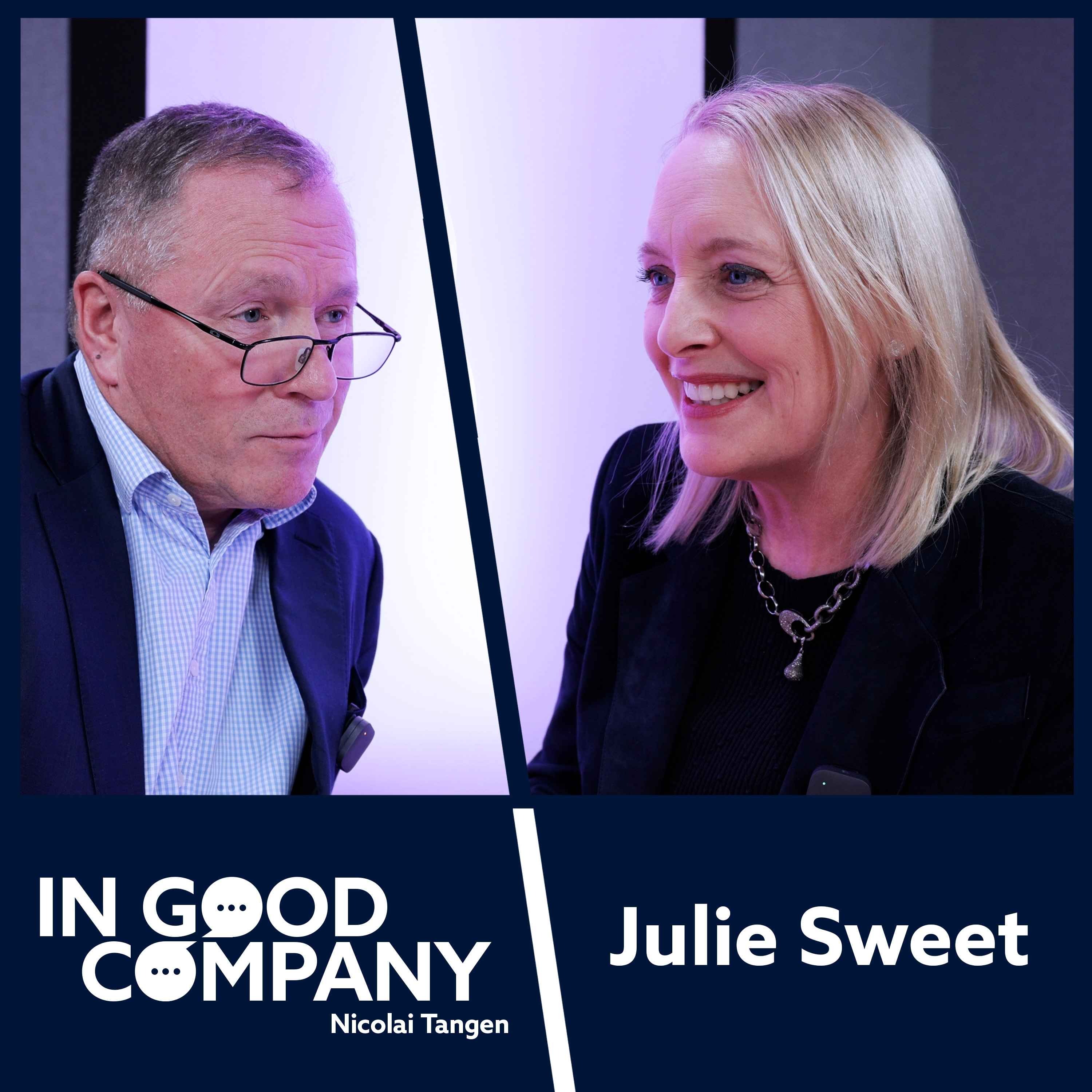
Description: Nicolai Tangen, CEO of Norges Bank Investment Management, interviews global business leaders to uncover their strategies and leadership principles.
Julie Sweet discusses her role as CEO of Accenture, emphasizing digital transformation, AI, and her leadership philosophy which combines excellence, confidence, and humility. She also shares insights into effective communication and her personal journey from lawyer to CEO.
Written by AI. May contain mistakes.

Get the gist, explore an idea or ask about something said.
 Claude
On In Good Company with Nicolai Tangen, what are the key points of this episode?
Searching your listeningAutomatic transcript. May contain errors.
0:00Hi everyone, I'm Nicola Tangen and today I'm in really good company with Judy Sweet, the CEO and chair of Accenture, which is one of the world largest and most influential professional services. company. And under her leadership, Accenture has led the way in digital transformation, innovation, and helping businesses worldwide to harness the power of technology. And we are lucky because in the fund, we own more than 1 % of the company worth more than$2 billion. So welcome, Julie. Thank you for having me today.
0:37now you employ more than 700 000 people which is more people than in the whole of oslo and so how do you run a company like that with a lot of help so i've got a great leadership team and uh and you know we have a really good way of operating so one of the things i first did when I became CEO was to actually change the way that we were organized so that we could be much closer to our clients and our people. Because as you scale, it's really important that your leaders are close to your people. Stupid question. What does Accenture actually do? It's a great question. So if you think about, we work for governments and for companies, but sticking with a company for a moment.
1:19So if you think about a company, we help our clients reinvent literally every part of their company using technology, data, and AI to do one of two things, to either grow more or to be more efficient. That's the very simple thing. So that means that we'll do everything from helping BBVA have their customers be able to join the bank in minutes instead of a week. So that's all about growth. To helping a company be able to take out major costs using technology and AI in their finance function, that's about efficiency. To helping clients who make things, so who manufacture things, digitize. So we helped Mars, for example, if you like Skittles, we helped make sure that you get the exact number of Skittles in your Skittle package, not one more or one less.
2:16And so, and all of those things at the heart are combining technology, data, and AI with deep industry knowledge. Where do companies need the most help just now? Well, top of everyone's agenda is how do I use AI? Yeah. And what I would tell you that where they really need the most help still is that most companies today are not as digital as they need to be. So they haven't built the digital core that allows them to use AI. So they start with, help me with AI. And then very quickly, we are helping clients understand what does it take to actually be able to use AI. But for you to help them, you need to learn it first, right?
3:00We have a very strong culture of learning. So for example, I don't know if you're familiar with the Gallup StrengthsFinder. So we use Gallup StrengthsFinder for Accenture. and that is something that helps people evaluate what their strengths are. So we have 700 ,000 people, over 300 ,000 people have used this tool. How does it work? And so basically it assesses you against 34 strengths. And the theory is that you should do things that are your strengths and do less of things that are not your strengths. So there's 34 different strengths. So they're neutral, like they're all strengths. It's just which ones you have.
3:36So we have over 300 ,000 people who've gone through the assessment. It's very rapid. Our number two strength is learner. And so our people are learners. They like the process of learning. The number one strength, by the way, is responsibility, meaning they say what you do. So if you think about it, my business, right, that's super important. And why do I say that's important? The learner piece is important is because when things change all the time, you have to have people who embrace change, who embrace learning. What's the key to get the speed up to work faster as a firm? Two things. One, a culture that embraces change.
4:17Two, a growth model, a way of organizing and operating that supports it. So when I joined Accenture in 2010, the CEO said we're all about change. That was our culture. When you think about what do you have to do to actually operate in different ways, when we set our strategic goals, we don't set them on a fiscal year because life doesn't move on a fiscal year. Now, I think in the past you were more like a fast follower and now you are a change agent. What does it take to install that type of culture in FM? So, well, it's interesting though. So when I joined Accenture, the CEO said two things. He said, I want to ask him about the culture.
4:58He said, we're all about change and we're fast followers. And so we then, that was in 2010. In 2013, we missed revenue for only, I think, the second time in our history. We knew that every business would be a digital business. And at that time, to be a digital business, you had to be an innovator. And so we were able to articulate that we wanted to keep the culture that embraces change. In fact, that would enable us to embrace digital. But we had to change the culture that was about being a fast follower. The most important thing I tell CEOs when they say I need a cultural changes. Can you articulate what you want to keep, what you need to change, and what you need to become?
5:39And so we said we need to move from fast follower to innovator. I will tell you, Nikolai, if you can just master that, you'll be able to change your culture. But what is the key? So now you come into a company, do you spend time Learning about the company, learning about the processes and so on. How do you attack that kind of thing? So if the question is, how do we help companies change? We do it in a couple of different ways. So one, we do have to deeply understand the culture and what we're walking into. Our top 100 clients have been our clients for over 10 years. So many, many of our clients we've actually worked with for a very long time.
6:18And so part of what we often bring is a deep knowledge of the company. But not always. We have lots of new clients as well. So you do have to understand that. But the other piece is a lot of what we're bringing our clients along is things that other companies have already done, right? So you're in a consumer goods company. Consumer goods companies face very similar cultural issues. Like there's always the tension between global and local markets, for example. That's true in every consumer goods company, right? So we bring a lot of industry expertise on both what are the challenges, what are the opportunities.
6:51And so a lot of what clients come to us for is that every journey shouldn't be bespoke. They want our help in making sure that they can learn from other companies' lessons. Are you surprised to which extent all the companies are struggling with the same things? Not surprised. I think that the more I do this, the more I say, regardless of industry, people are the same, companies are the same. It's a great part of what we bring is that insight. And so having now been global CEO for five years, not a lot surprises me. It strikes me that people generally don't particularly want to share information.
7:32They think a bit too short term. They think a bit too much about themselves. and your job as a CEO is to kind of stretch the company in different directions and people in different directions. But it just seems like all companies are struggling with the same things. They all talk about biddling down silos, sharing information. I think you're absolutely right. Companies are facing the same things. I love the example of silos. They also all have terrible data, and a lot of times the terrible data is because of the silos, right? And I think that's because companies grew up, there was a certain way of running companies, right?
8:10So everybody's gone to that. And one of the things that I think is hard is having that culture of real innovation that's not about product, but it's about yourself, right? So most of the time people think of innovation, they think about new innovative products. When was the last time people were saying, well, I want my finance function to be the most innovative finance function? I want to be the way we operate. And so a lot of what we're trying to help companies do is to understand that they need to reinvent every aspect of what they do, not just have the most innovative products, but to actually reinvent the way they're working and the way they're operating themselves.
8:48And the companies who embrace this idea of continuous reinvention of everything that they're doing and that mindset are going to be the ones that succeed in the next decade. But a lot of people don't particularly want to change. Yes and no, I would say. One of our leadership essentials at Accenture is the courage to change and the ability to bring people along the journey. And so oftentimes it's less about people not wanting to change and more about not having the leadership that helps them change. And what's the key to that leadership? Clarity. So now you're going to, we work together, how are you going to get me to change?
9:29So the first thing is to have clarity of where you want to go. And so what's the North Star? The second is putting people first, meaning understanding how a person is going to experience that change. If I'm telling you of a North Star that has nothing to do, like you're not going to benefit from it, you're part of the legacy business, so you're not going to the best business, that's not going to be very compelling if we're asking you to change. And so clarity of vision and then the ability to understand how each person is going to experience it and then message to that person.
10:13Now, you mentioned AI and how you are helping companies to change, but how is it changing Accenture? It's changing every part of Accenture. Our strategy has been three things. First and foremost, we focused our investments. We're investing a billion dollars a year,$3 billion total. We focused our investments on creating the solutions our clients need because we knew, right, we needed to be there for our clients. The second part of our strategy was to reimagine using AI how we're delivering our services, just like we did with the last round of intelligent automation. We're embracing it. We're moving fast to say, OK, how do we use this great technology to deliver our services differently?
10:53And then the third piece is how do we operate ourselves differently in our corporate functions? And we are really clear about our strategy and how we're investing against that strategy. So the$1 billion, how do you spend it? What is it used for? Most of that is used for either creating new services. So for example, we just announced a partnership with NVIDIA where we created on top of their technology something called an AI refinery. that actually works on top of their technology and all of the different hyperscalers. And that is technology. So we had to invest to create that solution, which we can now deploy into clients.
11:35So we create assets and solutions so our clients are not having to do everything bespoke. That's a big part of our investment. Another big part of our investment is in training. So we are creating, we want to have 80 ,000 data and AI, new data and AI people, total data and AI people by the end of 2026. We're already at 57 ,000. And so there's a big investment in training. So those are two of the big areas. And there's some other areas. How long training program do they need to go through? It depends on the role, right? So, and what you start with. So, for example, last year we had about 250 ,000 technology people take the first set of intensive training that was between 15 to 20 hours.
12:22Another 130 ,000 took level two training, which is like another 20 hours depending on role. And so what we've done is to look role by role and say, what are the data and AI skills that are needed? Or who can we re-skill to be data and AI specialists?
12:42Now, what are the other things you're looking for in consultants who you hire? So you mentioned the ability to learn. What are the other things? Well, just on the ability to learn, there's one question that we ask everyone, regardless of you're a consultant or you're working in technology or whatever you do, because we have a lot of different skills at Accenture. We say, what have you learned in the last six months? I share that with you because a lot of times people are asking me, well, how do I know if someone's a learner? And it's a very simple way to know. If someone can't answer that question, right?
13:13And by the way, we don't care if it's, I learned to bake a cake, right? If they can't answer that question, then we know that they're not a learner. So I wanted to share that because, you know, people are always looking for practical ways to assess whether someone's really a learner. Now, not unexpectedly, I'm going to ask you that question then. So what have you learned the last six months? What have I learned? Well, I have so much about Gen AI. I'm spending all of my time at work learning completely about Gen.ai. At home, I'm doing a lot of baking. I've never been a big baker, but I am learning to bake more.
13:49Do you bake bread as well? I'm not doing bread yet. I'm doing cakes. Okay. I make a really good butter cake. Sounds good. We'll bring you next time. Yes. Any other skills which are important as a consultant? In terms of interpersonal skills, just what type of people are you looking for? So we're looking for people who are leaders. And by leaders, I'm not saying I want them to be like the president of their class if they're coming from college, but to demonstrate that they work with others well, that they do get involved. You know, so one of the things that we look for are people who actually have different activities.
14:32And again, not that they needed to be the president of the club, but because if the only thing you do, say a kid who comes in school, is to study and get good grades, you're unlikely to be able to navigate the work as well. What do you think is next after AI? Well, first of all, I think there's going to be multiple versions of AI. So, gen AI is a big trend today, but we're already seeing different kinds of AI that will come. So, I think the AI revolution will continue in waves. I do think that quantum is going to be a big part of the technology landscape probably more three to five years out. But we're already doing work in that.
15:15So those are two areas, sort of continued evolution of AI and then quantum. And which industries are, in your mind, leading the development here and which are lagging? Well, interestingly, I think that every single industry has leaders in them. So there's no industry where you say like once upon a time, you'd say something like oil and gas was like totally lagging. Because we're in the middle of a digital revolution, and every industry has leaders, what we're seeing is that every industry also has leaders in embracing AI. I do think, though, that some of the usual suspects are not embracing it as broadly.
15:58So energy is a sector that is lagging, say, what you're seeing in anything that's direct to consumer banking, consumer goods and the D2C and retail. Now, just a bit more on how you develop talent. So you hire from universities? We do both. So we hire from universities and we also do experienced hires at all levels. So both managing directors and very senior people and also sort of people in the middle of their career. And how do you train them? How does a career path look like? So a couple of things that are important. We spend over a billion dollars a year on training. So training, an employee gets an average of 44 hours a year in training.
16:45So training and learning and development is something that is a part of every year at Accenture. We do have what we call core schools. And core schools are at different key points in your career. So, for example, when you are an analyst, you have a core school because you're brand new. When you make managing director, we have something called MD Momentum. momentum. And those core schools that occur at different key parts of the career are to get you ready for the next stage of your career. But then we have a lot of other training certifications, Gen AI. We had 500 ,000 people take our beginning Gen AI course last year.
17:22We had another 300 ,000 take the level two course. These are people other than the ones who are deeply technical. So learning is really embedded in everything we do.
17:38Let's change tack a bit and talk about your leadership. You mentioned that you have these programs where you map people's strengths. What is your super strength? Strategy. So that's one of my super strengths. And Achiever is one of my super strengths. And Learner is one of my super strengths. So those are all in my top five. Okay. And you were a lawyer by training. I'm still a lawyer. But yes, I trained as a lawyer. What does that do to you? Does it help you or hold you back? I love being a lawyer because lawyers are trained to process an amazing amount of information in a short amount of time.
18:19And then they're asked to make a judgment. And when you think about being a CEO, for example, at any given time, I'm processing a ton of information and I have to make a decision. right uh and so the legal skills have allowed me both to be a good just like the raw ability to process but also to rapidly and objectively you know weigh the information in order to make a good decision so i think it's one of the best trainings especially now with so much change that anyone can have it's not the normal route to become a ceo it is not the normal route it's particularly in non-regulated industries. You know, we're not a regulated industry.
18:59And I'm a big advocate of it, however. A lot of people come up through the finance way and CFOs and so on. Surprising if you through HR. Yes, yes. HR is increasingly important, in fact. If you think about, I think the best thing to be right now, one of the best fields is to be in HR because right after Gen.AI on CEOs' agendas is talent. and talent and how you train talent has to completely change. What does your HR director do differently than other HR directors? Well, our HR is skills-based HR. So we have over 700 ,000 people and we have a database of all of their skills. So for example, in the pandemic, when we suddenly needed a lot more people who could do cloud, we could run an algorithm and identify who had adjacent skills who we could train in just 20 hours to be able to do cloud work.
19:52And we believe passionately that all HR needs to be skills-based because if you think about AI, AI takes away tasks, not necessarily entire jobs. And so you want to be able to take someone whose tasks have now been automated and teach them new skills in order to adapt. And you've got big numbers. You can do HR analytics in a different way than many other people, right? Yes, we're extraordinarily data-driven. And so we really understand our people, what they're doing, what their interests are, and most importantly, the data around skills. What's the coolest thing you can read out of your analytics?
20:35What's the coolest thing? We have analytics that can predict if someone is going to look for another job. And what are the telltales? There's a bunch of them. So there's like 20 different variables that we look at, and it's incredibly accurate. And we use that to then make interventions if we see that someone is demonstrating, that is being kicked out of the analytics or saying, is this person maybe at risk? What do you do then? Give them a hug? No, we make sure that there's someone engaging with that person. They're checking in, that they've got a sponsor. we have a bit of a problem in europe because we have so strict ggpr but you don't really have that problem in the u.s we have definitely different rules so some of the tools that we can use in the u.s we can't use in europe yeah yeah now when you joined uh you were the general counsel right which is kind of the what would you say is like the head lawyer in the firm right yeah how how How were you groomed to take over the CEO role?
21:41What kind of guidance, mentorship did you get? I think there were two pieces to that. So one was the guidance. So the CEO, about a year after I started, we had a new CEO, Pierre Nantarim. And he went out of his way to make sure that I understood why things were the way they did. And he was part of recruiting me. He's actually one of the people that interviewed me. But I think that in large part, that was a reaction to my own attitude, which is I follow something called the why rule, which is I started when I was a young lawyer, is that if I didn't understand why something was happening, why a client said something, why we gave certain advice, I would go back as a young lawyer and ask the partner.
22:26So when I joined Accenture, I did the same thing. I would sit in meetings and I would sometimes sit there and say, well, why did that person say something? Why was this decision made? And then I would go ask my colleagues. So it's just I'm very senior then, you know, so that was different. But the premise was the same. And I think as a result of that, people would go out of their way to explain to me something. Oh, Julie, you may not understand this because you weren't here. Or, you know, you may not know this part about the business. And so, you know, one of the things I talk to a lot of people about in terms of career advice is that the why rule, it makes sense whether you're early in your career, whether you're taking on a new role or changing company.
23:05And then people respond to you being genuinely caring about why. When you mentor or are mentored by somebody, how often should you sit down together? I think that really depends on the person and the role. Some mentors like to spend a lot of time. Others, that would be annoying. And so I think what's most important when you're seeking mentorship is to be clear that what you're trying to do is be able to create more value for the company as opposed to it's all about me and to be genuinely connecting with someone and seeking to learn from them. I think a lot of people make the mistake of thinking like mentors means you're going to help me get the next job as opposed to networking for value.
23:56And people feel appreciated when you go to them and you're genuinely seeking to learn from them. Can leadership be taught, you think? I do think leadership can be taught. It was one of the eye-opening things when I came to Accenture. So I came from a law firm where we did no teaching on leadership. We did a lot of other teaching, amazing training on how to be a lawyer, but the actual art of leadership, completely absent. Imagine I show up at Accenture and, you know, as I said, we spend a billion dollars a year. We do a lot of leadership development. And I really began to appreciate that you cannot expect to have great leaders if you don't invest in helping train those leaders.
24:39But how do you train them? A couple of different ways. One is on the job training, right? We really believe in the role of apprenticeship and role modeling. And so when we promote leaders at every level, We have something called leadership essentials, which are eight leadership essentials. And we use those to look at whether or not the leader we want to promote is actually a role model for the skills and the characteristics and mindsets that we want for all of our leaders. So it's important that you're investing in training. You're making sure that your words and your actions match. So you're promoting people with the leadership characteristics so they can be role models.
25:23and that you're providing that sort of on-the-job training for leadership as well. When you look at your own leadership, how has that developed? I think I've... Well, first of all, how would you find yourself as a leader? How are you as a leader? Well, I think I'm pretty good. So always room for improvement. I will tell you that of our eight leadership essentials, there's one that I particularly introduce that I think has been very important in my own growth. And it is lead with excellence, confidence, and humility. And leaders with humility are learners. They create good teams because they recognize they don't have all of the answers.
26:10and they're willing to challenge themselves and change. And when I think about my leadership style, I do really try to emulate that idea of excellence, confidence, and humility. To which extent are you stronger now as a leader than you were five years ago? Well, a couple of things. Skills-wise, I work a lot on communication. And one of the advice that I give all leaders at every level is that you can have the best ideas in the world, but if you do not clearly communicate them in ways that people want to listen, then you will not have an impact. And so I work very hard at being an impactful communicator, and so I think I've continued to develop that.
26:56And then secondly, if you think about the last five years, they've been very challenging years. And I think I've grown as a leader in being able to just balance that things, you know, There's tough times and there are good times. And it's really important to be able to understand that things are, as someone once said, never as bad as they seem and never as good as they seem. And that creates more of a long-term view and less volatility in leadership.
27:32What do you think is key to good communication? Storytelling. so there's a great book that I recommend to everyone I should get a cut of it it's by a good friend of mine Andy Craig called Weekend Language it's very good I love it that's great I love that you read it and it really changed my communication style because people remember stories that's the way that you have impact and at the end of the day if they don't remember what you say you can't have an impact so the book is about how funny and interesting people are during the weekend when they are in dinner parties and that kind of thing. And they have anecdotes and details and all the interesting things.
28:12And people laugh. And then you come into the office on Monday and they are so boring. And there is something called the professional curse. What is that? That you just are dull, right? Because you're so professional and you use long sentences and difficult words and nobody really is hooked on what you say. And, you know, the book talks about how you win or lose people in the first two minutes. And I think about that all of the time. I think about it in a short conversation. I think about it in a presentation because, you know, it's so human, right? And we've all been there that, you know, oh, my God, that person is so dry, you know.
28:49So how do you train people in the organization? So everybody in the Accenture, you know, just running around, telling stories, being funny and charming? So it's interesting. We have done a lot of training of our leaders on weekend language. We actually use E &D as a coach. And now what we're developing really as a result of the age of AI is we're going to build in more structured communication training starting as a young analyst. And the reason for that is that as AI augments people and allows them to do things, you know, sort of earlier in their career, right, because it's kind of giving them superpowers, what it doesn't do is give you that time back that you need for apprenticeship and learning.
29:35And so we believe that we need to focus on communication skills earlier in the career. And so that's one of the things that we're working on now, really as a direct result of how we think the workforce is going to be impacted for AI and that we need better communication skills earlier. Now, do you think this was related to you did debating? You were on a debating team when you were at school, right? I did both speech and debate, and I absolutely built an incredible foundation. And if there's any young students who are listening to this podcast, they should absolutely do speech and debate. I agree entirely.
30:13Julie, why is storytelling more important now than before? We're in such a time of change that most of the companies I'm working with, what they're talking to me about is how do I help my people change? You know, how do you help me with change management? And so effective communication, being able to reach people emotionally, have them really understand what you're trying to do is absolutely critical. And storytelling is all about that. In fact, we actually bought a company called The Storytellers that built their entire company around storytelling and change management. So I highly recommend to CEOs that they invest in capabilities around change management, around storytelling in order to bring their people along the journey.
31:06What's the key to good storytelling? The key to good storytelling, having a story to tell. So that starts, keeping it short and not using any consulting language. Okay. So they use your consultants to make sure they don't use consulting language. Well, it's so important to be, and, you know, it's not just about consultants, right? One of the things that I see across industry is that people fall into jargon of whatever their interest of their industry is. And even if you understand the jargon, that is not compelling. And that's why it's so important, regardless of industry, to really get away from jargon and tell stories plainly and authentically.
31:55That's how you reach people. And how does this impact the way you communicate internally? Well, I start usually when I'm doing a presentation. I always I think about two things. I think about the first two minutes. So how is that going to go? and I think about what's the stories that I want to tell to illustrate the points. And I do that in a very structured way because I know that if I can give a beautiful speech and I can be very logical about the new strategy, but if I do not bring it to life, they will not remember. It'll be blah, blah, blah. And if I don't grab people in the first two minutes, they won't even listen.
32:37And do you use videos internally? I use a lot of videos internally. So we're sitting here in your studio, basically. Yes, we have a broadcast studio. It's awesome. We do it so much. We have it in many of our offices. Yeah. Now, one of the things which they recommend in the weekend language is not to use PowerPoint. You know, I am determined that someday we will eliminate PowerPoint at Accenture. You know, I will tell you that today on my finance meeting, so like when I'm doing a quarterly review, we use something called the Enterprise Navigator. So we bring up in real time our financial data, no PowerPoints.
33:16So we're taking baby steps to getting away from PowerPoints. Why are they bad? Why are they bad? Because they become crutches, right? Right. They, you know, people that are reading the PowerPoints, there's no stories on PowerPoints. So when I go to a client meeting, I will, you know, almost never use slides. I've actually had clients say, no, you must bring slides. We're a slide culture. Right. Because I want to connect with people and to be able to communicate with them. And people don't communicate by slides. If you had to bring a slide, what would it look like? What does a good slide look like?
33:56in your world? Very simple. So should have, you know, very simple graphics that you actually know what they mean. We are famous in consulting land for having graphics that do not make sense at first glance. And so, you know, we have to explain them in very few words. Yeah. And big fonts. And big fonts. I read a book which said that, well, which there is research showing that if you have bigger funds, it gives more trust. You trust more a person who has got big funds on the slide. That I have not heard of. I'm going to remember that.
34:36Now, I read somewhere that you have a plaque at home, which says, if your dreams don't scare you, they are not big enough. That's right. So roughly two years before I became the global CEO, when I knew I was, you know, up for being the CEO. My husband comes home one day with three plaques and he always likes these sort of kitschy sayings and that. And these were really not attractive plaques. And he wants to hang them in our house to inspire our daughters. And, you know, after a bit of a tussle, I said, finally, you can hang them at the back of a house in our mudroom. And he got the last laugh because one of them says, if your dreams don't scare you, they're not big enough.
35:15And, you know, during those couple of years when, you know, here I was, I was, you know, the general counsel, you know, trying to become the CEO. I mean, at that time, I'd worked as a North America CEO, but that's a big, you know, leap, as you said. I'm the first CEO that didn't start out of college. So, you know, at times, it seemed like a really big long shot. And so it was comforting to say, well, it's not that I'm not able to do it. It's not that I'm not qualified. It's just that I'm dreaming big that I feel a little bit scared about whether I was going to make it. And I use that now when I think about how to run a company, right?
35:50Because if as a leader, as a CEO, if you're complacent, if you're not worried about whether your strategy is going to work, then chances are you're not pushing the company and you're going to wake up and find yourself behind. And similarly, you know, I try to tell people that when you're, whether it's a young person taking a new job or someone mid-career moving jobs or moving companies, right, the fact that you're nervous doesn't mean you're not qualified. It just means you're dreaming big. And that's a much more inspiring way to think about the moves you're making. When were you last nervous?
36:26I am nervous absolutely every day because we are pushing ourselves, right? We are operating at the edge of technology, right? And, you know, our clients want us to have a healthy dose of humility, which is what I think about when you're saying nervous, right? The humility to say, I need to be extra careful. I need to recognize that we're doing cutting edge work and I need to put in place, you know, and really be mindful, right, and humble that this stuff's hard. Now, we've got several things in common. One thing is that we both had mothers who studied when we were young. Oh, that's wonderful. What did your mom study?
37:10She studied art history and a few things related to that. That's great. And you did too. Yes, my mom graduated my freshman year in college. She's super inspiring. Yeah. In what ways? She's inspiring because at that time, right, so this was in 1985, five. You know, there weren't a lot of women in college, certainly mothers in college. She was working part-time. She had three kids. And she had grown up on a farm, so completely different environment. And she, you know, went to school. There was not many people who were her age there, let alone women. And she just went after her dreams and didn't let anything stop her.
37:56And that's very inspiring. When people ask me how they should spend their money, I tell them they should spend a lot on their mothers. I agree. Absolutely. You also studied in China, right? I did. So I, you know, my parents didn't even own a passport. And I went home one day when I was a senior in high school and said, I'm going to go study Chinese. And I ended up spending a year between Taiwan and Beijing. And it was an amazing, very transformational experience. In what ways? It was the first time I was in a place where I didn't look like everyone else. And I didn't speak the language. You know, I was still studying.
38:34I had like two years of Chinese underneath my belt. And so I had to demonstrate a lot of resilience. And, you know, I needed to navigate. I didn't have a safety net. Back then, I'm really, you know, I'm 57. So back then there were no cell phones, right? There was not sort of the easy button. And it also just taught me to look at things very differently because I was navigating. I was the stranger in another culture and it helped me be able to put myself in different people's shoes and made me more empathetic as a person. How do you relax when you are not at work? I spend time with my daughters.
39:14I have two teenage daughters who I love and they are so much fun to be with. And that's really, you know, for me, family time is how I relax, how I really love to spend my time when I'm not working. And that's where you bake your cakes. Yes. Although they really like my chocolate chip cookies. Right. And what do you read? I tend to read like just murder, not murder mysteries, but like terrorism type books, you know, like David Baldacci. I like kind of escape, not particularly highbrow, you know, fiction that is really fun. Sounds good. Now, we've got tens of thousands of young people listening to this.
40:00What advice would you give them? I think two things. One of them is to live by this idea of lead your life with excellence, confidence, and humility. And I think it's so important. I learned that from my dad. And my dad painted cars for a living. And he always believed that we could do anything that we set our mind to do. And at the same time, he was always very frank when we weren't really leading with excellence, where we weren't performing with excellence. And so I think it's important to balance those two things and to have the humility to know what you don't know, to learn from others and to build great teams.
40:49I think that's just super important. The second piece is to think about your life in a way to not have any regrets. You know, I had breast cancer when I was 47 and I had two young kids at the time. And one of the things it taught me was that, you know, life can change very quickly. And I have this barometer in the way I live my life where I'll stop and I'll say, if tomorrow I was diagnosed again with cancer or I faced some kind of life-threatening illness, would I have regrets about how I'm living my life right now? And sometimes the answer is yes. Like, you know, I've committed to too much travel.
41:29I'm away from my family. And other times it's no. Like, I've got the right balance. But it's important to ask the question, right? Now, I'm always cautious to say, if you're a young person, you're going to have to work really hard. So yes, it's not about not working hard, but it's about making sure that you're kind of looking at your life in the whole. And it's something that I've learned and I'd like to share. Thank you. Well, thanks for sharing. And for sure, it looks like you have lived up to your own advice of excellence, confidence, and humility. And a big thanks for being here today. Well, thank you very much.
42:06so
Join Nicolai Tangen in conversation with Julie Sweet, CEO and Chair of Accenture. In this engaging discussion, Sweet shares insights into leading one of the world's largest professional services companies with over 700,000 employees. She reveals how Accenture helps companies navigate digital transformation and AI adoption, discusses the importance of continuous learning, and explains her leadership philosophy of combining excellence, confidence, and humility. Sweet also offers valuable perspectives on effective communication through storytelling and shares personal insights from her journey from lawyer to CEO. Tune in!
In Good Company is hosted by Nicolai Tangen, CEO of Norges Bank Investment Management. New full episodes every Wednesday, and don't miss our Highlight episodes every Friday.
The production team for this episode includes Isabelle Karlsson and PLAN-B's Niklas Figenschau Johansen, Sebastian Langvik-Hansen and Pål Huuse. Background research was conducted by Isabelle Karlsson.
Hosted on Acast. See acast.com/privacy for more information.


