Ask ChatGPT
 In Good Company with Nicolai Tangen
5 Jun 2024 · 51m
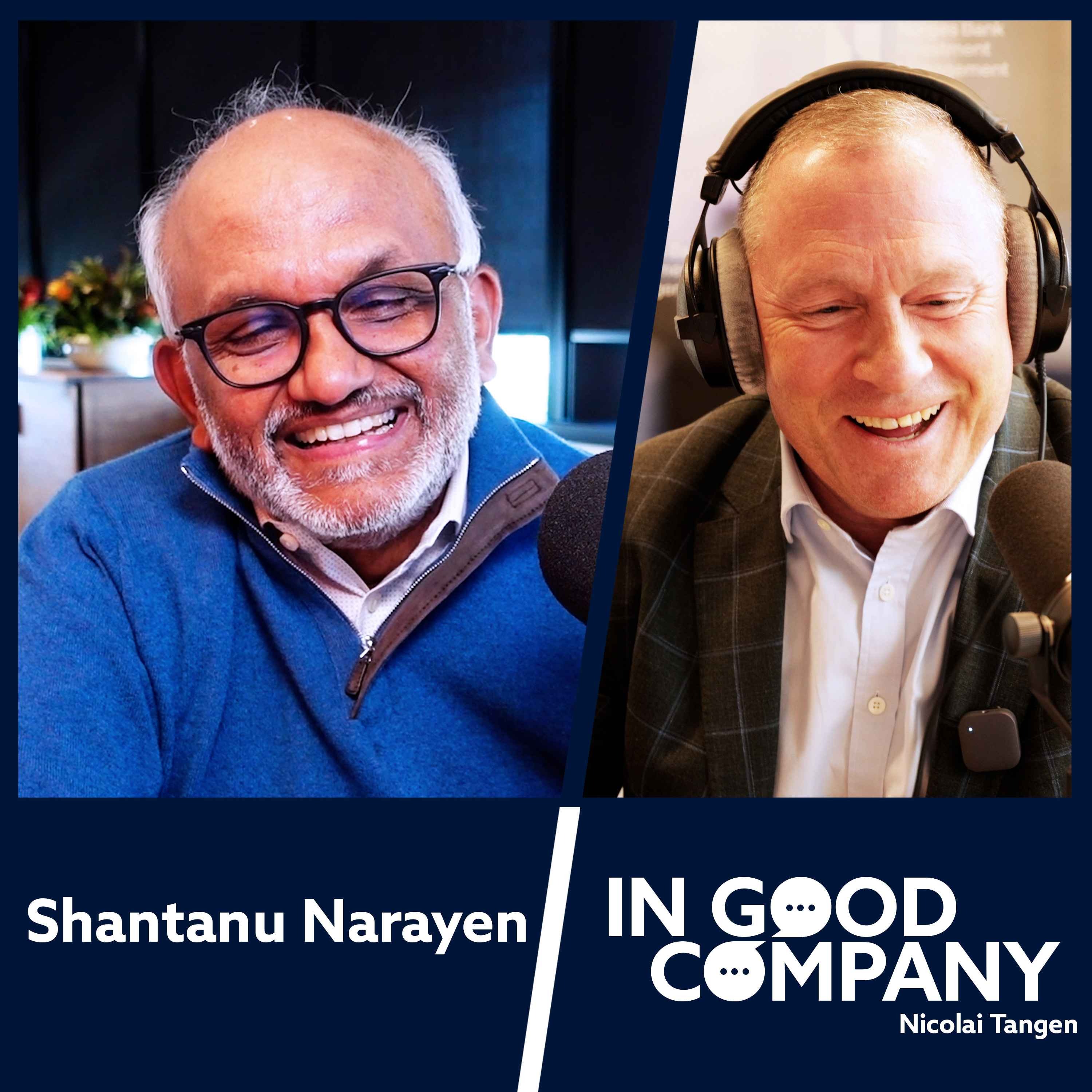
In this episode, Nicolai Tangen interviews Shantanu Narayen, the CEO of Adobe. The discussion centers around setting unreasonable expectations to drive innovation, the influence of mentorship, the role of AI in creativity, and the cultural foundations of Adobe.
Written by AI. May contain mistakes.

Get the gist, explore an idea or ask about something said.
 Claude
On In Good Company with Nicolai Tangen, what are the key points of this episode?
Searching your listeningAutomatic transcript. May contain errors.
0:00Hi everyone, today we are talking to the man that makes us all look much better in photos and enable us to open 400 billion PDFs yearly. Wow. Named the top CEO by Glassdoor, based on employee feedback. Please welcome Shantanu Narayan, Chair and CEO of Adobe. Shantanu, what an honor to have you on. Thank you so much for having me, Nikolai. It's a pleasure to be on your show.
0:32A lot of people have heard about your products and they use your things every day. But just very briefly, what are the main things that Adobe do? Well, Adobe's, you know, mission has always been changing the world through digital experiences. And, you know, the company was founded when we invented PostScript, which was the way that people actually printed. And, you know, subsequently, we've invented many groundbreaking innovations. But three real lines of businesses. We talk about creativity. So any piece of creative content that you see out there, we hope a piece of Adobe software was used to create it, whether it's packaging on a bottle of water, whether it's the video you're looking on a web, whether it's, you know, image that you're editing.
1:21The second business is, as you mentioned. So in there, for instance, you would have Photoshop as one of the products. Exactly. Photoshop is one of the products. Illustrator is one of the products for vector and artwork and logo creation. Certainly Premiere for editing videos. all the special effects is after effects. And so that's the creative business. Our newest product there is Express, which is enabling this vision for creativity for all. So anybody who has a story to tell, whether you're a K through 12 student or the largest enterprise in the world, that's the creative business. Probably we're best known for that.
1:55And as you pointed out - I have to tell you, I did a weekend course in Photoshop and I love that. So much fun. That's awesome. And we're making it better and easier. We just announced some really cool stuff at Max in London as it relates to how we use generative AI in that. The second business is everything to do with PDF, and we call that accelerating document productivity, automating inefficient paper-based processes. And that was, as I said, the PDF, it's called the document cloud as well. Perhaps the most recent business that we have incubated and created from scratch is enabling any business to engage digitally with their customers.
2:35So we call that the experience cloud powering digital experiences for enterprises. And that's close to a$5 billion business for us as well now, Nikolai. So three different areas of businesses that Adobe is in. Now, not many software companies have been around for more than 40 years. What's been the key to this? In our DNA, I would say at our core, we recognize we're a product company. and as long as you can innovate and create fundamental product platforms that stand the test of time, I mean, PostScript is still, you know, the premier way in which people print. Photoshop is the way in which people edit images.
3:11PDF is all about the document platform. And so I think, you know, the reinvention has always been part of the DNA. We went from a company that just licensed software for a few hardware manufacturers. When we did PostScript, we built an applications business. As you are aware, we completely transitioned and we were the first major software company to transition to the cloud. And then we created the digital marketing business. So I think it's a fundamental reinvention and a willingness to make that investment, to invest in deep technology, I think, has been key to our success. Now, what's kind of left in the company from the founders?
3:50Because you talk about the founders as being important mentors for you as well? Well, you know, it's interesting. Yesterday we had an event and we call it the Founders Award. And this was started about 20 years ago, Nikolai. And I think, you know, when John and Chuck started the company, the two things that really motivated them was the what. And, you know, how can you have impact with fundamental technology innovation, but also the how. And I think Adobe has always been a company that's been known for, you know, being a great place to work. And the Founders Award is given to people who represent not just what they do, but how they do it.
4:32And so I would say culture is, you know, their biggest contribution to the company. Very simply, they used to say something as straightforward as we want to create a company that has great impact and where great people want to work. And, you know, captured in that single sentence actually is such deep insight into how you build great lasting companies. How do you keep the speed up in a company? You know, I've seen some research on anthills. And during the 15-year lifetime of an anthill, the speed of action slows down a lot. So that when the neighbor anthill attacks, they basically take you over.
5:12So how do you make sure that the adobe anthill isn't killed? It's something that, you know, I think larger companies have to keep working on. Maybe I have, you know, the luxury and the privilege of having been here so long. But one of the things I would say is that, you know, I mean, software has an S-curve, right? And so there are things at the beginning of that S-curve where you're incubating or you're investing in new fundamental platforms. And there are other products like PostScript, which are more mature. So I think the first thing I would say as it relates to pace is you have to be aware of which part of that S-curve you are on.
5:51And not every one of them has to innovate at that pace because, you know, perhaps the customers are not willing to even welcome that kind of innovation. The second thing I would say is you have to be impatient, but it's important to be thoughtful about what you're impatient for. In some cases, you may be impatient for functionality and developing a product. In some cases, you may be impatient and the pace is all about customer acquisition. In other phases, it may be about revenue. And so I think pace, to your point, is a really important thing. But I'm not sure one size fits all in terms of pace.
6:29And so if everybody was at a frenetic pace, maybe you're not actually managing the company effectively enough. But when you need that sense of urgency, I think one of the ways in which you create pace is by inspection. I've always said, Nikolai, people do what you inspect, not what you expect. And so I think, you know, constant inspection and making sure that as leaders, we're removing the obstacles that allows people to proceed at the pace that they want. I would say the fundamental product person wants to go as fast as they want. And so I think bureaucracy sometimes comes in and potentially slows things down.
7:09And so our job is removing obstacles. And so for the things that require incredible pace, fast decision making, are we providing the environment that allows the people who are actually in charge of that to do that? Where is the border between inspection and control and micromanagement? I again, I don't think, you know, we control and micromanagement, but I think inspection is really important. I mean, I think that's the role, which is, you know, are we clear about, you know, what the teams are focused on, what the key objectives are? And, for example, yesterday, you know, AI, generative AI is certainly, you know, the buzz around the industry right now.
7:53And so, you know, when you're inspecting it, it's about having a conversation. So the word inspection may suggest, you know, more formalism. But I think having that conversation and having time and what is our most valuable commodity? Time is our most valuable commodity. And so when you're spending time as a leadership team, as well as with individuals, I think that's what you have to do as a company. And so, you know, this is not about micromanagement. It's actually about freeing people to innovate at the pace at which they want. But if decisions need to be made, what's the monetization? How are we going to go to market?
8:28Who are the potential partners? How do we think about, you know, how we get the message out? I think facilitating and enabling that is a big part of what you have to do. You mentioned AI, which, of course, is at the center of innovation just now. And intuitively, you'd have thought that working with the types of software you do, kind of the creative processes and so on, AI would be like a real threat. So how do you perceive it? You know, every single massive technology shift is either a phenomenal tailwind if you channel it effectively, or to your point, it can be a disruption or a threat. I mean, when, you know, the cloud came along and we said, oh, my God, this offers us such a different business model and the ability for us to have all this data that, you know, people can have access to their creativity wherever they go.
9:24When mobile came along, we said, hey, why is mobile just a consumption device? It should be a creation device. And let's enable creativity, you know, on a mobile device. And I think the same is true of AI and generative AI. I mean, the buzz, as you know, is all about generative AI. Adobe's been deploying AI in our products because if computers, what are they good at? Computers are good at pattern matching. Computers are good at automating mundane tasks. And when you think about creativity in particular, if you can enable somebody who has this creative idea, they're trying to create something, they're trying to communicate something, but the thing that they fear the most is the blank page, right?
10:06How do you start this creative process? And I think generative AI is this massive enabler to allow people, if you're ideating or if you're prototyping or if you're brainstorming, to start that. So I believe that AI will enable people to be more productive. They will eliminate mundane tasks. It will allow you to automate things that need to happen. And it will allow inspiration. And so used effectively, any piece of technology is going to dramatically expand the addressable market. I mean, this is now about when computers came and the fact that we democratized desktop publishing, you know, the market share and our install base went up dramatically.
10:48When we moved to the cloud and we said, hey, now you can have access to this at a monthly subscription, it expanded dramatically. When we added mobile applications, it expanded dramatically. And I think the same is true. I think you, I, everybody has this creative spark. And if we can use the product, you said you took the Photoshop lesson over a weekend. We just want you to be able to say, hey, I want to take this image. I want to remove this. I want to have a conversational with it. So do you think generative AI will increase the creative activity in society overall? Massively. I think there's no question.
11:23I mean, when you think about all these new media platforms that have emerged, Every one of them has dramatically changed it. Now, that introduces different challenges, which is now somebody who's doing that creative expression. How do you stand out? You know, how do you create a following if that's what you're trying to create? But the sheer volume of what goes on is going to massively increase. Where does Firefly come in here? That's one of your products. You know, when we thought about AI, first, you know, we said to ourselves, we represent the creative community. And if you think about generative AI specifically, we say there are three layers to how we should think about it.
12:04The first layer is the interfaces. What are people actually using and how do they use these products to accomplish their objectives? Because I think you and I and others wake up in the morning and we don't say, oh, I want to use the computer. We say we want to get something done. And so at the interface layer, what are we doing to enable our products to be simpler? The second thing we said is, where can we leverage other foundation models that exist? And where should we be creating our own foundation models? Because the foundation model is sort of the brain and it's the center of activity of what's happening.
12:38And so we said imaging, video, we need to create our own models because understanding that process of what the models really can enable somebody to do. When you do something like generative fill, perhaps the most widely adopted and accelerated adoption of a feature in Photoshop in the history of Photoshop, it means that we're thinking about how this product can be used to accomplish something. And then data. And the data is like, okay, how are these models trained? Where did the data come from? And so I think Adobe was very thoughtful about all three areas. We've innovated dramatically on the interface layer.
13:16You can now with Reader have a conversational interface. In Experience Cloud, if you're a marketer, you can say, hey, I want to run a campaign for this segment. And in Photoshop, you can do things in Express. You can do things like generative fill and an AI assistant that enables you to take what's in your mind. What are the underlying models you utilize here? That's a great question. And so on Firefly, for imaging, as it relates to Photoshop and for video, we've said, we're going to create our own models. And even phase one of that was Firefly, both as an ideation and a website where you can go and you can just prototype things and you can ideate and you can brainstorm and you can, in a collaborative way, start your ideation process.
13:57Firefly.adobe.com represents that destination that allows people to do, you know, it's a playground. It's a playground for creativity. The foundation models, we've created our own foundation models in imaging and video, but also at the National Association of Broadcasters show recently, the NAB, it's the big video show, Nikolai, we showed how we can actually integrate other models as well. And so we showed whether in Premiere, you can think about whether it's OpenAI Sora, or whether it's Runway ML, or whether it's PICA, you can actually create and integrate these models. And so that's why I like this taxonomy that we have of what are we doing at the interface layer?
14:37What are we doing at the foundation models layer? And what kind of data are we using to train whatever models? We were differentiated in that we said we will train our models only on data that we have license for. And so we can indemnify a customer like you. And so if you're using our model, we can indemnify you. But, you know, the world has other models and we have to be supportive of the other models that other customers might using. So Firefly specifically is about the naming for our models. And it's also this, you know, playground that we have as a destination site. We're using OpenAI for text.
15:15So when we use, you know, things like in PDF and you want to try and create a summary of a PDF or have a conversational interface, we will support it. But we've also described how other large language models, whether it's from NVIDIA, whether it's from Microsoft, whether it's from Google, whether it's from OpenAI, we will support those because, you know, Adobe is always one in recognizing that there's a heterogeneous world out there. You know, we supported Mac and PCs from day one. We support Android and iOS from day one. And I think our job is leveraging the platforms that exist. And AI is a new platform.
15:49So, Shantanu, so when now OpenAI comes out with ChatGPT5s, which supposedly, according to Sam Altman, who was on the podcast, says it's going to be 100 times more complex than four. How is that going to change the playground? Well, you know, I think, you know, clearly what OpenAI is on is this sort of, you know, ambitious agenda to do AGI, right? You know, general intelligence. And I think when you think about what will happen with the next version of chat GPT, you know, we've gone from, you know, sort of summarization and, you know, answering questions to reasoning. And so I think, you know, we're starting to tackle some of these hard problems of can computers reason?
16:36I mean, it's mind boggling to think perhaps that a baby born today for the first time, perhaps in civilization, a computer may be able to not just have more information than a baby, but also to be reason better than a baby. And so I think what will happen with the next version of, you know, whether it's OpenAI's models or Google's models or the Adobe models is you can start to do reasoning. What does that mean? What does that mean for a creative? When you're thinking about creating an image, it's in, you know, it's got a certain set of dimensions. When you say, I want to create a video and I want to see a person walking down a street and, you know, crossing the light, you have to understand physics, right?
17:16I mean, you have to understand physics so you don't go in the ground. You have to understand physics so you don't hit, you know, the building that you're walking into. And so I think we're going to start to expand on this model of, you know, thinking about reasoning, certainly resolution, certainly, you know, inference. And as you know, with AI, there's a lot of activity that's right now happening with training, which is everybody's training these models. The real value is going to come from inference, right, and how people use it. And I think financial services companies like you, you're going to use AI to do financial reasoning and perhaps, you know, faster investment, you know, decisions.
17:54And so I think we're walking up the stack from, you know, just being able to do something like a text to an image or, you know, a prompt creating a prose to how do I reason and how do I think about it? And it's exciting. But are you worried that there'll be one of these models which means that you don't need your overlay? I don't think so. What I always say is people who use AI will replace people who don't use AI. And, you know, I mean, everybody talks about this is going to replace humans. Well, the place where AI is probably the most advanced is in software writing, right? I mean, when you think about what's happened with the ability to say, I want to create a program, that's what's the most expansive.
18:37I don't know if, you know, at your institution, you're reducing the number of software engineers and developers. We're all saying, how do we make them more productive? How do we allow them to, you know, do more at the same cost? So there will be an efficiency increase. And I do think they're, like every generation of technology, some things will get disrupted, but overall it creates more opportunity. And I certainly believe that for creativity. I mean, creativity - How worried are you about deep fakes? I mean, you should be the world, you should be the world champion in deep fakes. That's a great question and I'll get to that.
19:11But the thing I wanted to say on that previous question also was that, you know, you need a soul for creativity. And, you know, I think that's the part where human ingenuity will always be good. DeepFix, we actually started when we thought about Adobe and we said, listen, we create the world's content. And it's really critical for us to also take responsibility for what's happening with content. And so we created this thing, you know, it's called content credentials. Think of it as a nutrition label, Nikolai. And when we started this, we said, we have one part in the chain, but we have now got thousands of partners who've signed up for this content authenticity initiative, as it's called.
19:57And what the content authenticity initiative is, camera manufacturers, when they take a picture, they're putting like a digital signature on that picture saying it was created with this camera at this time taken by Nikolai. When you edit it in a piece of software, we stamp that with, you know, what's happened. If somebody who's in the content distribution game, you know, whether it's Meta, whether it's New York Times, whether it's the BBC, they've all signed up to carry those credentials. So I think the plumbing and the infrastructure for deepfakes is all there. I'll tell you what the real challenge is.
20:33So when you talk about deepfakes, the ability to look at the provenance of a piece of content is all there. The question is, will a consumer want to see where that came from, who created it, who might have changed it? And so now we have this ability, we're working with the U.S. government, you know, 50 percent. I think it's 50 percent of the world's population is going to have an election, I think, in a 12-month period. Some of them have certainly happened. And so in that particular context, what we are saying is when you see a piece of content, you can see this label which says, you know, it says content credential.
21:12Think of it as a nutrition label. If you click on it, it will tell you. It will tell you who created it, when it was created, when it was perhaps altered. The question is how many people actually read the nutrition label when you're eating food? And it's the same issue with content. How many people are going to say, I want to know where that piece of content was created? So I would say the technology companies, the people distributing this media, we've all participated in the deep fakes, you know, sort of life cycle to understand how we can bring that value. Now the consumer has to say, when somebody that you know is saying, I want to see that piece of content, are they going to insist on evaluating the content credential?
21:53Because neither you nor I can come in the way of people creating content. It's the question is the consumer, how much do they care about where they came from? Hopefully that makes sense. Absolutely. The development in this field is, I mean, the speed is just unbelievable, right? The speed, the brain supplied here, unlimited amount of capital, you know, the curves are just exponential to a degree we've never seen before. So you and I, we are, of course, still very young and so on. But we, you know, we're not like 22. Do you think it's a disadvantage for us to really understand and grasp the possibilities here?
22:35Is our experience good or bad? Again, I think it puts more, you know, of a challenge for us. It for sure keeps us young, right? Yes, I think it keeps us young. And, you know, I mean, the best part of my job is when I can just sit down with 10 people that we've hired from university or people who are heading up this research and say, educate me. Right. I mean, educate me on that. And I think, you know, you have to recognize your role in the company, Nikolai, which is my role is not, you know, understanding to the minute detail the difference between a diffusion model and a transformer model and the math associated with that.
23:16But the implications of what that means and how do we channel, you know, people into, you know, align them into creating whatever objectives they are, and then how do we support it? And so I think our role changes as it relates to an organization leading it. And then as consumers, you know, we will see the benefits, right? We will see the benefits when we go to a website and somebody knows exactly who we are. You know, this is our experience cloud opportunity. I mean, the experience cloud opportunity. Experience Cloud Vision for Adobe was born with this insight that when we moved our entire business model from a two-tier distribution model to engaging directly with customers on the website, we were like, hey, we should build the infrastructure.
24:00Nobody has automated marketing, right? I mean, supply chain was automated. Finance was automated. HR was automated. But how many times do you go to a website, Nikola, and you're like, why doesn't it know everything that I've done with this website? And why do I have to enter my data? And why can't it tell me if I like this piece of content? Hey, give me five recommendations that are truly relevant for me. And so I think AI is going to be used. So as consumers, I think you and I will certainly experience a lot of the benefits of this. But as people running large organizations, I think our job is understanding the technology to a level so that we can actually appreciate what it can and cannot do.
24:41But then channeling that into, you know, really understanding how we evolve our businesses to take advantage of it and not have our head in the sand.
24:54you're a sailor so just to use a sailing term here let's change tack and sail back to india where you grew up now how do you think your indian upbringing shaped you well you know i i think growing up in india there were a few things uh that were true when i grew up that are again still certainly true i mean the first was uh the importance of education i mean i I was really fortunate. My parents emphasized very deeply the need for me to invest in myself. I mean, an investment in education is an investment in yourself. And so, you know, I think the first thing that was really inculcated in me, my mother actually taught.
25:31She was a professor of American literature. So I think they instilled in me this curiosity. My father was an entrepreneur. And so, you know, I learned from him, you know, how one, you know, has to innovate. And I think the other part of the Indian culture that has certainly served me well is we tend to take a long-term view. And so, you know, I think all of us running companies, yes, table stakes is executing on it on a quarter-by-quarter basis, but fundamental innovation takes time. So I would say the importance of education, intellectual curiosity, and, you know, taking this long-term view and outlook on how you build a business that is built for greatness.
26:14I think those were the two things that perhaps, you know, I was really influenced from my culture. Do you think that's something you have in common with the likes of Satya Nadella, I.J. Banga, and the other top Indian leaders in America? Well, the two that you mentioned, I don't know if you know, Nikolai, all three of us went to the same high school. I know. Yeah. And so I think we do. I mean, you know, the other, you know, it's so gratifying to see, you know. And it's pretty amazing. How many high schools are there in India? Oh, there are hundreds of. I mean, you know, the thing that India does have is a population, right?
26:49When you have a billion. But this was in a town called Hyderabad, which has now become the epicenter for, you know, a lot of technology in those days. And this was an incredible school. It was modeled after a British public school. They really emphasized an all-around education. But if you think about it, in that, you know, I came to this country in 1984, 60 or 70 % of my graduating class would come to the U.S. for higher studies. I mean, you know, the U.S. was this phenomenal place where it allowed people to come. You know, it was the land, it is the land of opportunity. And it gave us, you know, this gift of education.
27:30I would say today, not a lot of those people are coming, right? I mean, from institutions in India, maybe 5 % of people are coming because there's so much opportunity in India. I mean, you know, I think the economy in India is exploding. And I have said, if I was graduating right now, I'm not sure I would come to the U.S., given how much opportunity there was. But to answer your question, in those days, the entire generation of people who are now, you know, in the U.S., we all came here. We all came here to pursue a master's in computer science or a Ph.D. or an MBA. And we stayed because here's where the opportunity is.
28:06Now there's clearly a reverse, you know, migration. And then there was a time when you guys went through kind of the glass ceiling and certainly everybody needed to have an Indian CEO to be credible. Well, I was fortunate. I mean, I have to say I was perhaps one of the more tenured CEOs. And, you know, when I got my job in 2007 as CEO, I mean, it was an incredible honor for me. Nikolai. And it's so gratifying to see what Satya and Sundar and, you know, certainly Arvind and Tech and Lakshman and Starbucks. And, you know, every time you read about another Indian, you know, your heart fills with pride.
28:49You mentioned that you were long term, that you worked on strategy for a longer period of time. Satya Nadella, he talks about the importance of empathy. you talk about, you know, mentoring, coaching and so on. If you were to elaborate a bit on what being Indian means to leadership. I would say the thing growing up in India, especially people in my generation, you had to be incredibly resourceful. You know, there's this Indian expression, I don't know if you've heard of it called Jugaad. And what Jugaad means is, it's a way of, hey, people will figure things out. And growing up in India, not everything, I mean, there was so much bureaucracy.
29:31If you wanted to get anything done, you had to be incredibly resourceful. I don't take no for an answer. When I want something done, I'm like, okay, let's keep brainstorming. Let's keep thinking. And I'd rather aspire for something incredibly and fall a little short than try and just set your bar so low that you can easily cross said. Well, I'll tell you one thing, Shantanu. If I had taken off an answer, we wouldn't have gotten you on this podcast because you're not an easy man to get. Well, I apologize for that. I apologize. You said that if you were young again, you would probably stay in India.
30:09How do you see the development in India going forward now? I think it's just incredible. I mean, the investment in infrastructure that we've done, education was always important. I think you pointed out earlier, access to capital and AI. And, you know, I think the people growing up there, you know, the world is more flat. I worry nowadays sometimes that post-COVID people are building up walls again. But I would say the Indian entrepreneur today, when I grew up, the Indian entrepreneur was focused on making a market in India. Today, the Indian entrepreneur has global aspirations. You know, you have access to capital, you have access to talent, and all of them are focused on how you can create it.
30:51And there's something so natural about being in the culture that you grew up with. I mean, all of us as immigrants to this country had to adapt to the US. And so when I grew up, there wasn't really a tech industry in India. That's changed. There wasn't access to capital. I think when I grew up, when you took a loan from a bank to set up a firm, I mean, the interest rates were something like 18 or 20 percent. I mean, you know, prohibitively expensive to create businesses. The notion of equity and venture capital just didn't exist. And so but, you know, this is where I think it doesn't matter whether it's Hyderabad or, you know, Bucharest or other places.
31:35I mean, access to talent and capital has become a worldwide phenomenon. And I really hope that, you know, post-COVID, I know these supply chains, everybody has said, hey, we need to have our supply chains closer to us. But there's such a power of having free trade across the globe, which I hope we don't, you know, go away from that.
32:00What have you taken from sailing? You represented India in sailing. You know, sailing in those days was, you know, just an incredible passion. I mean, you were one with nature. And maybe one of the things you recognize is, you know, to some degree, when you're sailing, I understand you are also, you know, passionate about sailing. I mean, you know, you're with this force of nature and you recognize to some degree, you know, that you're a small, small cog in the world. But you're then trying to channel this wind and, you know, the waves. I mean, you know, sailing in Bombay where you're sailing in the waves was just this, it's this incredible rush that comes, you know.
32:38and competitively how you're constantly trying to improve. Sadly, I've given up sailing, Nikolai. When I came to this country, I said, you know, education was the thing I focused on and family and now golf is the thing. But I'll tell you what I like with sailing. You know, you can be in the lead and then the wind changes. Yep. And you are lost. Next race, you have to take the same amount of risk. And so let's say you think about table tennis. There are just no external factors. Sailing, max amount of external factors. And so I just think there's so much to learn from it. I agree. How often do you get to sail?
33:19Way too little because I'm in the office too much. Now, you are one of the most well-liked CEOs, and we see that from surveys at Glassdoor and so on. Is it important for a leader to be liked? you know i hope people would say they respect me more than they like me i'm also very transparent about the values that are important to me and we talk about creating the future we talk about being genuine we talk about you know owning the outcome and raising the bar and if i model those values then you know people hopefully at least say uh that you know he he's true to what he uh stands for. And I think people would say I'm approachable.
34:04And, you know, I like that. We are a very egalitarian company and it's the way Silicon Valley is. But, you know, every time you get that, I will say it's humbling. It's humbling to hear that the things that you do are appreciated by people. How do you coach people? You know, early in my career, I had this incredible mentor and And he challenged me a lot. I think in me, he saw, you know, a spark of somebody who would potentially accomplish something. And it was a different management style. And, you know, initially I struggled with it a little bit because he would ask me to do something and I get it done.
34:43And he's like, yeah, yeah, whatever. You know, that was yesterday. Why aren't you doing this? And why aren't you doing that? And he would always push me and challenge me. And later I realized that, you know, he saw in me something, hopefully, that he said, this guy is capable of more and my job is pushing him to do more. And I would say that influenced me a lot as my management style, which is my style is all about saying, how do you set unreasonable expectations? And people amaze you with the ingenuity. And so hopefully I'm providing opportunity to people. I believe in a management style with the leadership team, especially at the executive team, where, yes, they all wear a functional hat.
35:24You might run a business. You might be your CFO. You might be head of people. You might be your GC. But first and foremost, you're all people who represent as the executive team the company. And so that's been my management style, which is like I'm very, information in too many companies was deemed to be power. I have exactly the opposite leadership style. I believe you give people access to information and that's what makes them more productive. So I would say, you know, again, there isn't one style that works. I'm not, you know, arrogant enough to believe that that's the way one should operate.
36:01But if people know what your style is, then hopefully, you know, the people who embrace that style and resonate with how they want to be managed, they can thrive. And so that's how I would coach, which is like, I'm always available, I'm accessible. Hopefully people wouldn't say I'm not a microman. But, and somebody gave me this expression. So I will, you know, give credit to them, which is they said, management for me is a little bit of you have to have your head in the cloud and your feet on the ground. And I am in the details, Nikolai, as well, because I believe that But if you're not in the details and if you don't have, I don't know how you set a vision for the company without understanding a little bit of the details.
36:42And conversely, if you're only in the details and you're not, you know, setting a vision. So, you know, but my management style is evolving. And one last thing. But because you mentioned three things, plant the flag, road building and unreasonable expectations. What does it mean to plant the flag? I think planting the flag. When we started off, I'll give you an experience with this. You know, I'll give you the experience cloud business. When I took over in 2009, we bought this company called, in 2007 and 2009, we bought Omniture. Omniture was all about, you know, getting analytics. And we said, hey, data is going to be important and analytics is going to be important.
37:22And we said, you know, why is it that Adobe was always about the art? We allowed creativity, but we weren't about the science. You know, that old marketing adage, 50 % of my marketing is working. I just don't know which 50%. So we said, we should create the new next generation marketing stack. And why is it that digital marketing doesn't exist? We didn't really know at that point everything that needed to be done and how that will evolve. But you get comfortable with ambiguity. I think as leaders, you and I have to get very comfortable with ambiguity. And so that was for me planting the flag, which is saying, we're going to go create the stack.
38:01And how did you build the road then? Well, you build the road, you know, we said to our board when we actually acquired Omniture that this is going to be one of many. And we have to, through both organic innovation and inorganic acquisition. So, you know, we bought Omniture, then we bought Daze software. We built a real-time CDP completely from scratch. The Experience Cloud, you know, now a$700,$800 million business. We build that completely from scratch. And so you understand what the building blocks are associated with it, and you're ruthless about execution. And, you know, you keep going from the long range, what you're trying to accomplish in the short range.
38:40And that's what I say. And I was perhaps, when I took over, in all candor, I was probably better at the road building because I was chief operating officer and I needed to get my head around everything. But you realize when you're in a room and you're trying to motivate or inspire a room, 50 % of the room probably doesn't care about what they want to do tomorrow. They want to know what hill you want them to climb and, you know, what is the, you know, are you trying to win a World Series? What are you trying to do? That's planting the flag. The other half of the room doesn't care about where you want to go.
39:15They're like, hey, tell me what I want to do because I feel motivated by that. And so as leaders, we have to change our management style to inspire people to do their best. If we don't recognize that, then I think we are not recognizing what our jobs are, which is our job is making them productive. Our job is not saying, hey, you got to manage the way I want you to. And so I think recognizing that there are different people with different motivations, who get inspired by different things and can contribute in different ways. But you also say that part of your job is to set unreasonable expectations.
39:52Is unreasonable expectations the same as some kind of reality distortion field or what is it? I hope not. I actually hope not. I don't think it's reality distortion. For me, the unreasonable expectations is saying, if you can connect the dots from where you are today to everything you want to go. I mean, you talked a lot about generative AI. You know, our hypothesis with generative AI and our assertions are very clearly, hey, this is going to be a massive tailwind if we enable people to create. Exactly how that manifests itself in video, et cetera, we don't know. And so the unreasonable expectations are to say, I want you to create this video model.
40:32I want you to create an animation model. I don't know exactly how that's coming, but that's where the ingenuity of those developers and the engineers and the product people comes in place. And so I think reality distortion is different, which is you're in denial perhaps sometimes of what's happening. Whereas I think unreasonable expectations is about actually in many ways, at least for me, saying I have more faith in what you can do than perhaps you have in yourself. And I think that to them, they seem unreasonable. And then when we moved to the cloud and we said, okay, we want to add so many subscribers, people were like, I can't add up to that.
41:11And you're being unreasonable. I'm like, no, we should go for it. And we should figure it out. And then, you know, we greatly exceeded it. I mean, and this is where I, that's what I call unreasonable
41:28expectations. Who do you ask for advice? I have a great self-help group. You know, I was, I was in YPO when I, you know, at one point in my career, I'm neither Y, which is young, nor have my P anymore. But John Donohoe, you know, one of my best friends, John became CEO of eBay PayPal when I took over as CEO of Adobe. We were both the number two guys. And so having somebody that you can be completely yourself and talk about, you know, what needs to get done and, you know, learn from them over time. That self-help group is immense. Where do you meet? Where do you meet? Well, he and I have, you know, this passion for golf, but otherwise we get together for dinner.
42:14You know, we'll get together for dinner and we're just like, okay, we know or we call each other on the phone. And, you know, when I have something that I want to run by somebody, you know, the real thing is they're a sounding board for us, correct, Nikolai? And they're sounding both George Roberts, you know, the founder of KKR. I'm fortunate enough to have got to know George Roberts really well. And, you know, the advice that he gives and to see, you know, the passion that he has for driving business and staying, you know, very current and putting money to work. I mean, that's something that I've learned from him, which is like, I don't use the word risk.
42:54I use the word investments. We're paid, right in our jobs to make investments. Some of them work, some of them don't, but hopefully, you know, we have a better track record. So those are two among the others. There's Ramesh Wadhwani, who's an incredibly successful Indian entrepreneur. So I'm blessed. I actually probably create fewer friends, but deeper friendships. I'm not a big networker, but that's my self-help group. And I wouldn't spare it. And then, you know, your family, your family always is there, you know, thick and thin. And when you have, I used to say this, apparently there's some research that's been done.
43:30When you have young kids, they're more willing to, you know, tell you, you know, the truth than anybody else. And you have to seek out these truth tellers. And, you know, so your wife, my two kids, they will tell me like, they won't sugarcoat anything. And that's invaluable because unfortunately, as we get more senior in our roles, everybody's telling us how good the ideas that we have are. And you have to seek out those truth tellers. New college graduates, when you hire them, they are far more willing because they ask you the tough questions, you know, to say, why are we doing this? Why are we doing that?
44:06And so I think we all have the ability to do it. The question is, are we going to seek them out? And how do we put into practice what we learn from them, right? Oh, one last thing I'll say. One last thing I'll say. Serving on a public board, I serve on one board. Yeah, you're on Pfizer, right? I'm on Pfizer. What do you learn from being on the board of Pfizer? Well, talk about unreasonable expectations. When Albert talked about moonshots and solving COVID, that was an unreasonable expectation. That was a moonshot. Investments. If you think about pharma, when people who are running pharma companies are making medicinal bets in therapeutic areas, chances are, you know, in many cases, you know, their successor might reap the benefits of it, right?
44:56Because of the timetable associated with, you know, medicinal development. And so I learn again, that long range view of what needs to be done, the global nature of, you know, what happens. So you're always learning. The question is, is your mind open to that learning? I mean, every experience that you have with everybody, when I hear these questions, I'm probably going to go back, Nikolai, and say, why did he ask me that question? And what was perhaps behind it? And what should I take away from it? You know, as somebody who is in the investment business and you're thinking about it, clearly you're trying to piece this picture together.
45:31So I think every interaction is a learning experience. You just have to be open to it. Talking about boards, you are both the CEO and the chair of Adobe. And as a shareholder, we generally think those roles should be split. why do you think the same person should have them and why are we wrong well i know in europe uh you know clearly a lot of the european investors believe in that and i think what are you looking for in that i would say what you're looking for in that is a couple of things one is you're looking for is there the right amount of uh whether you call it accountability whether you call it transparency that exists in a board so that, you know, there is the right amount of dialogue that's happening?
46:17And, you know, is that conversation happening? I would say to you as an investor, I would say a couple of things. First, is the board, you know, is there good board refreshment? Are the people on the board, people whom you would look at and say, hey, are these people who have, created tremendous value? And are they going to be people who are just yes people? Or are they people who are going to push back? I mean, Dave Ricks from Eli Lilly, one of our recent board members, you've seen the tremendous success. So I would say, and I do think the information asymmetry that's happening between people who run a company and the board, it's actually increasing, given how complicated the business is.
47:02And so if you have a lead director, and the lead director has the ability to, you know, engage with the board, you have the private sessions, you have the ability to, you know, create an alternate mechanism by which you're doing great corporate governance. And I think the U.S. philosophy is trust somebody until they're proven untrustworthy. And if I'm not, then, you know, what's the board's number one job, Nikolai? The board's number one job is hiring and firing the CEO. That's not making... It's kind of difficult for you to fire yourself, right? Right. Well, not really. I mean, the lead director can call a meeting and if the lead director is like whether there's ethical issues or performance issues, the lead director needs to be able to do that.
47:46And so, again, I realize the European style is different, but, you know, I believe that with speed that needs to be done, I have the ability to do it and I have to own it. I don't take it for granted. I will say that. And, you know, every year and when I was named chair, it was a massive honor for me. It's not one that I take lightly, Nikolai. And so hopefully you as an investor feel good about that. Okay, this is not a perk. It's an honor and it needs to be earned and it needs to be, you know, refreshed. Absolutely. Shantanu, if you are not allowed to say golf, in what other ways do you relax?
48:25Well, I love the time with my family. I love traveling. Where is your favorite place to travel to? Hawaii. The big island on Hawaii is my favorite place to travel in the world. It is a place where, you know, the plane door opens when you land in Hawaii and you breathe into that air and, you know, you can feel your blood pressure going down and you think your best. So Hawaii. And when you are on the beach, what do you read or what you read generally? I like to have three or four books that I'm reading. Actually, I'm a person that, you know, when I'm reading, so I'm reading, I like sports books.
49:01I like reading about, you know, people who have defied the odds. I like mystery. You know, I've read a lot of mystery growing up. I read less management books. If I read the management books, I typically skim them. If it's written by a friend of mine or somebody that I know, then I read it, you know. And I read a little bit about history, not enough. I mean, that's one regret, Nikolai. I don't read as much as I did growing up. And I really should get back to it more. I get great pleasure in reading, but I'm not doing as much as I should. You know, it's priorities, right? We all don't have as much time as we would like.
49:43Lastly, we have tens of thousands of young people listening to this podcasts. What is your advice to them? You know, first, I would say the world's your oyster, right? I mean, it is just an incredible time to pursue your passions. I mean, as we said, access to capital exists, you know, access to information exists right now with how much of, you know, that is being democratized. And so pursue your passions. I mean, I was fortunate in that I didn't follow the conventional path. When I did my MBA, everybody said, hey, you now have to go into product management or business management. And I'm like, I would like building products.
50:24I'm going to build it. And so I think people really do their best work when you come to work in the morning and you don't think it's work. You come because you have a passion. You can't wait to get out of bed. And so find something that gives you that feeling, which is like, I like being here. I like engaging with people. And if you're doing it because you think it's the right thing or it's a step along the way and you hate it, but you believe it's good for your career, it's not going to work. And so follow your passion. Well, you for sure have followed yours and your love and passion for what you do is coming through so loud and clear.
51:03So it's been really an honor to have you on here and a big thanks for taking the time. No, thank you so much for having me. and I really appreciate it. I look forward to maybe, you know, sailing together when we're both in the same city. That would be a blast. Absolutely. Can't wait. Take care. Thank you.
How can setting unreasonable expectations lead to innovation and success? In this episode, Shantanu Narayen, the CEO of Adobe, shares how early mentorship experiences shaped his approach to leadership. Nicolai and Shantanu also discuss the impact of AI on creativity, the founders' lasting influence on Adobe's culture, Shantanu's upbringing in India, the importance of education and how he never takes no for an answer. Tune in!
In Good Company is hosted by Nicolai Tangen, CEO of Norges Bank Investment Management. New episode out every Wednesday.
This interview was recorded April 30th 2024
The production team for this episode includes PLAN-B's Pål Huuse and Niklas Figenschau Johansen. Background research was conducted by Kristian Haga.
Hosted on Acast. See acast.com/privacy for more information.