
 Ask ChatGPT


 In Good Company with Nicolai Tangen
13 Nov 2024 · 53m
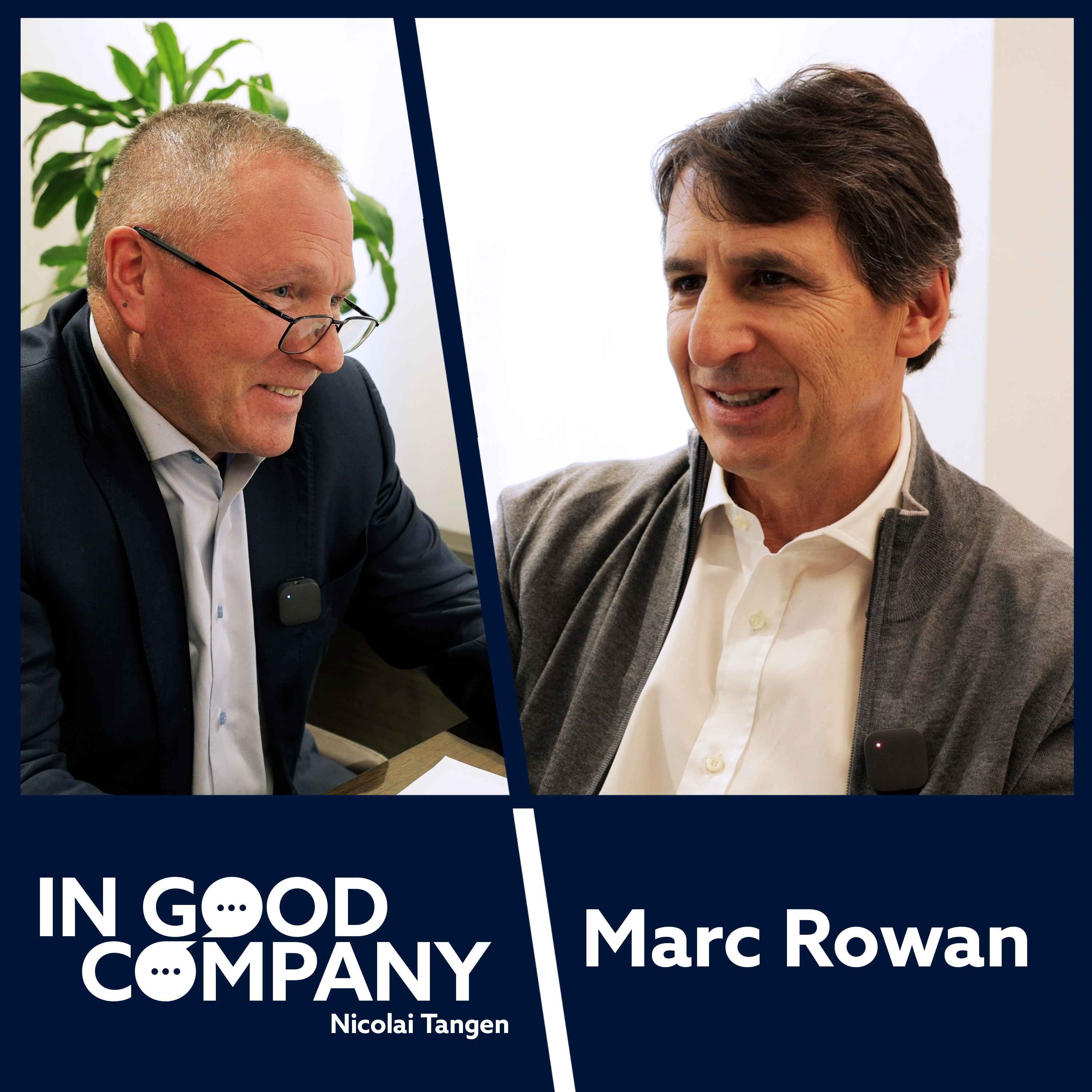
In this episode, Nicolai Tangen interviews Marc Rowan, CEO and co-founder of Apollo Global Management, discussing the dynamics of private markets, investment strategies, risk management, and leadership principles in the context of a rapidly changing financial landscape.
Written by AI. May contain mistakes.

Get the gist, explore an idea or ask about something said.
 Claude
On In Good Company with Nicolai Tangen, what are the key points of this episode?
Searching your listeningAutomatic transcript. May contain errors.
0:01Hi, everyone. I'm Nikolaj Tangen, the CEO of Norges Bank Investment Management Management, the Norwegian Summoner Wealth Fund. And today, we are joined by a true visionary in the world of finance, Mark Rowan, who founded or co-founded Apollo Global Management, which is one of the most influential alternative asset management firms in the world. Now, we are the lucky owner of just under 2 % of Apollo, which works out at just under $1.5 billion. Mark, thrilled to be here. Great. Thanks. Thanks for coming. And hopefully, you're a happy shareholder.
0:40Mark, in 1984, you said, God, I'm just too late. All the money has been made. You came out of business school. Now, a few years later, you have assets and the management at Apollo of 680 billion, and the market cap is more than 80 billion. So I think we can say that was not a very accurate statement. Well, I think it was accurate because it reflected the business at the time. Because not only did I say it in 84, I said it in 90. And I said it again in 2001. And the point being, in some ways, I was too late for the business that had been done. But the interesting thing, part of the interesting part of the job is it keeps changing.
1:24I mean, 2008, we were 40 billion of AUM. In fact, almost every other large firm in our industry today was roughly the same size. And then 13, 14 years later, we're now up to over 700 billion of AUM. Something changed. It's clearly not as a result of our skill and talent. We had to be in the mainstream. Well, skill and talent helps, right? Well, look, the skill and talent is to make sure we're positioned with tailwinds behind us by positioning the business the right way. But fundamental change is ultimately what powered our business. But if you go back to your first job, Drexel, Drexel went bust in 1990, and then you decided to found Apollo.
2:09Yes. What was the thinking? Well, it's founding a new company. A great motivator is to be unemployed. So think of 1990 as 2008. To be an unemployed investment banker in the middle of a recession, a financial markets collapse, New York banking crisis, Texas banking crisis, a fundamental change of the financial system was not a great thing. Fortunately, it was early in my career, and it was a great time to just do something entrepreneurial. What does it take to start a firm? It takes a little bit of luck. Look, I had spent the prior six years, from 84 until 90, mastering my craft. So clearly, I knew something about the business, but one has to be humble and actually accept that there's a fair degree of luck.
2:58Because I was actually quite happy doing what I was doing at Drexel Burnham. In some ways, the single best thing that ever happened to me was to be forced to make a change. Do you think it would take the same type of skill to set up today, or is it a different skill set required? I think it's, well, it depends on the scale of your ambition today. If you look at what's required today, I think it is much, much more difficult to set up a new financial services firm. In fact, I think the structure of the market today will result in firms that are very small and firms that are very large. I think it is going to be a very tough place to be in the middle.
3:34In a few sentences, what do you actually do at Apollo? If you look at the best way to describe what we do is to think about how we employ people. So if you look at the asset management business, we are 3 ,000 people in asset management. Then you look at the retirement services business, we're 1 ,500 people in retirement services. And then there are 4 ,000 other people at Apollo who do not carry an Apollo business card, but instead originate credit. What does that mean? Well, think about what the old GE Capital was 15 or 20 years ago. Certainly as I was coming up, GE Capital was thought of as the single best originator of senior secured private credit.
4:15They used their expertise in engines and medical devices and aircraft to become a really good lender. That's essentially what we've done. We have a fleet finance business. We have an aircraft finance business. We have a securitization finance business. It is all about the origination of credit because origination is the lifeblood of our business. So you say, what is Apollo today? Apollo is two businesses. On the one hand, the business that is not as well known is the retirement services business, Athene. 2008 - Would you set up? With partners, yes. But in 2008, we had an idea to set up a new financial institution.
4:54And this financial institution was an insurance company. And the insurance company did not insure people's life, people's health, people's property. It only insured their retirement. That business, which was initially capitalized with$16 million, is now, with its European affiliate, now$400 billion, growing$70 billion a year organically and is by far the largest retirement services company in the world. And it turns out what we did in that business, because if you think about what retirement is, it's essentially a fixed income business. People want guaranteed lifetime income or guaranteed income for a period of time or they're saving for retirement or their pension needs to be guaranteed.
5:34To be in that business, you have to be very highly rated because you're dealing with people's retirement. And therefore, you have to have very safe assets. What we needed to be successful in that business was investment-grade fixed income but with a spread. And we start with a baseline view that public markets, particularly public fixed income markets, offer no alpha. So if your entire business model is dependent on fixed income alpha and there is none, what do you do? Well, you build the origination capability to service initially yourself. And that's what got us into credit origination. And then you realize that you want to be diversified.
6:13You don't want 100 % of any risk you originate. You want 25 % of everything and 100 % of nothing. So we built a client business side by side. initially other insurance companies, endowments, pension funds, individuals, and a traditional client base. The capacity to originate investment-grade credit is at the heart of what Apollo is. So what are we? We're a retirement services insurance company, and then we're an asset manager. The asset management business, though, reflects pretty much what I've just said. Of the, call it$700 billion,$550 billion is credit, most of which is investment-grade, and$150 billion is equity in two flavors.
6:54One, a traditional private equity business, which is about$100 billion. And the other, a hybrid equity business, hybrid not in a sense of bank hybrids, but hybrid being the midpoint of risk between debt and equity.
7:12Mark, there's been a lot of focus on how you are replacing banks through direct deals with companies. What kind of business are you, in a way, taking away from them or doing instead of them? Well, I think it's actually a bit of a misnomer. The press likes to report on this notion of banks and investors fighting over private credit. But I think we have to start with a definition. What is private credit? Well, for most people, it means levered lending or direct lending, which is a below investment grade activity. And yes, it is true that the vast majority of levered loans used to be originated in the banking system, and now they are split between being originated in the banking system and being originated in the investment marketplace.
7:59And yes, we are engaged in that business, but it is a very small part of our business. I think generally financial pundits and other market participants are missing the bigger trend. To me, private credit encompasses This is almost every asset on a bank balance sheet. A loan to a customer, private. A loan to a company, private. A loan to a project, private. And so on and so on. And the vast, vast majority of private credit is investment grade. So we look and now say, are we replacing the banks? Generally not. You're also working with the banks, right? You just did a big deal with Citibank. This is the point.
8:35And again, it will mix and match. A bank is actually really, really good at doing some things. Think of it, a bank is funded short and lent long. A bank is not a great source of really long-term capital. And think about what we're borrowing money for today. We're borrowing money for infrastructure, for energy transition, for next generation data and power, all really long-term assets. These are not the ideal assets for a bank balance sheet. Typically, they would go to the investment-grade bond market. But they happen not to be great assets for the investment-grade bond market either, because Because they are generally complex projects or structured in some way.
9:14What we are doing is we are matching really long-term insurance liabilities with really long-term investment-grade counterparties in credit and becoming a provider of capital. Because in almost every financial system, there are only two sources of credit. It comes from the banking system or from the investment marketplace. There's no third choice. around the world, for whatever reason, regulators have decided that banks should do less and investors should do more. And of that piece that investors do more, the investment grade piece, particularly the piece that is not well suited to the IG public market, is what we have really come to do very, very well.
9:54What do banks do well? Banks are operationally intensive, shorter term, anything that is really operational or client centric. So if you think about - at picking credit, you think? I wouldn't think so. Our credit record stands up to, I'd say, any bank out there. But you would have thought that during 100 years of experience, they would have learned something that is not that easy to learn in a 10-year period? My guess is the same people who were there 100 years ago are no longer here, Nikolai. And these are all ultimately about people. And if I think, again, I think about the partnership that is evolving between asset managers and banks.
10:37The thing I say to banks, we do not want what the bank wants. We don't want the bank's client. Because if you think about the structure of an asset manager, we want the asset. We are incapable of providing the client M &A advice, equity advice, capital markets advice, hedging, derivatives, foreign exchange, payments, custody, credit cards. And this whole bundle of services is not something that we can provide, nor is it something we want to provide. So the bank wants the client. If they lose a client to another bank, they lose all the services. If a bank loses an asset, they just lose the asset.
11:15And in the new capital regimes, in many instances, the banks no longer want the asset. When do you think you'll be fully regulated? Why would we be fully regulated? Why would BlackRock not be fully regulated? Why would Norgis not be fully regulated? it. What is it we're actually doing that gives rise to regulation? And I'll come back. Do we take deposits? No. Do we do maturity transformation? No. Do we have access to the treasury? No. But don't you think at some stage you need to foreclose on a big company and the regulators will be quite upset and they would overregulate like they do in many cases?
11:51Foreclose on a big company. I don't really know what that means. So again, think about what we do. We're at the investment grade end of the marketplace. If we're foreclosing in the investment grade end of the marketplace, I assure you there is absolute chaos everywhere in the world. Foreclosing is something that PIMCO does, that BlackRock does, that Fidelity does, that everyone else does. It is not unique to Apollo's business model or what we do. And investment grade, you would expect it to be different. I meet with lots of regulators around the world, and I come back to this broader theme. credit can come from investors or banks.
12:26In the US, bank landing is down to less than 30 % of the overall market. In Europe, it's still 65%. In Europe, they are squeezing the banks harder than in the US, Basel III endgame, and so on. But at the same time, they have not liberalized on the investor side. It does not surprise me that Europe suffers from a capital deficit. The US is by far, this is the luckiest place in the world from a capital markets point of view. 50 % of the world's capital is raised here, the diversity of sources. So again, think about an investor. Every dollar that moves out of the banking system increases the resiliency of the system and reduces the leverage.
13:05A bank is levered 12 to 14 times. An investor is generally not levered at all. Reduction in leverage and diversity. A bank borrows short and lends long. Investors general borrow short, borrow long, and lend long. There is no maturity transformation. There is no guarantee from Treasury. There is no deposit. But the thing that always gets regulators, what percentage of a bank's balance sheet in the US, and Europe for that matter, is investment grade? 60, plus minus. For us, our balance sheet, better than 90 % plus investment grade. What about the business you take from the public fixed income market.
13:47I think I've heard you say that in a little while there will basically be no difference between public and private investment break credit. I think that is true. I think that's where we're heading. But you have to remember where we're starting from. So let's start with a general calibration. We used to have 8 ,000 public companies in the US. We now have 4 ,000 public companies. We have more companies going private than going public. Look, I don't think this is a short-term phenomenon. This is a long-term phenomenon. 80 % of companies over 100 million of revenue are private. What percentage of capital should be private?
14:22A vast, vast majority of it. So we're actually supporting the whole private company ecosystem. Do I think we're going to displace the public investment grade market? No, I don't think we're going to. I think it's important to put all of these things in size perspective. You have BlackRock at 11 or 12 trillion. You have the mighty Apollo at 700 billion. If we're really, really successful, we will be twice our size five years from now. My guess is you will have a series of asset managers in the US that are 20 trillion at that point in size. We serve an important but relatively small role in the economy.
15:01And it's kind of what I like, the notion that our industry is not an asset management industry. An asset manager, you can give any amount of money and they will invest it. We can only invest it if we can produce excess return, alpha. We're in the alpha generation business. Absolutely. Now, we are only in the public markets, right? It's not in our mandate to be in the private market. What are we losing out on? You're losing out on 80 % of the investable market. And if you think about it, public markets do not work the way we think they work. In fact, nothing works the way we think it works. So I look at public markets today and I ask really fundamental questions.
15:41Like in the US, which is the most developed of the capital markets, do we have price discovery in the short term? I don't think so. Think about what's happened in US markets. 80 % of volume, S &P 500. 60 plus percent of the market, passive. 10 stocks, 39 % of the S &P. Four stocks have determined basically profitability for the last four years. One stock is larger than every public market other than Japan. That's the universe you're going into. If you had price discovery. And so you're saying that the public market is very risky. I'm not saying it's risky. I'm saying it's indexed and correlated.
16:19And it is about capital flows now. It is not about price discovery of an individual security in the short term. Think about people who are supposed to be able to outperform the index. Active managers. How have active managers done? Well, basically 90 plus percent of the time for the past 20 years, they have failed to beat the index. Did they get stupider? No. The structure of our market has changed. It doesn't mean bad. It just means indexed and correlated. And so an investor, particularly an international investor who wants to express an opinion in the US, no longer comes in and buys a basket of securities.
16:58They buy the index. Now, you are also in the private equity industry or business and done really, really well. Now, what are the trends you are seeing here? The trends. So this is about reinvention. This is the business I was referring to where in 84, I was done in 90 and so on and so on. The business continues to reinvents itself, but I think we have to level set. The decade that has just passed, I think, is going to turn out to be very unusual and I don't think will be great for investors. I have forecast and I've said publicly, I think returns in traditional private markets on existing vintages of funds done over the past decade will be low.
17:42Why? People invested generally in the midst of the US printing$8 trillion following the financial crisis and then following COVID. And you had interest rates near zero. And so we have a very pro-cyclical approach to private markets investing. 60 % of, quote, private equity was actually growth. And many of the companies that were purchased, even if they were good companies, were purchased at relatively high prices with capital structures priced at very low prices that are now going to be refinanced at much higher rates, given that holding periods will be extended. All of that tells me that returns will go down.
18:23So why should we then go into private equity? Well, let's go back. The same is true for public markets. Public markets have had exactly the same, but private equity is not the same for everyone. You will find a core group of firms that over the past 10 years did not succumb to the benefits of low-cost leverage and reflect that in price. And I think we're going to have a bit of a shakeout in our industry. People who are giving you, in my term, private markets beta, I think are going to be smaller going forward. They will be less successful. And people who really stuck to what they do well, giving you private markets alpha, I think will continue to be very, very successful.
19:02I believe that we will see a shakeout. And again, my forecast for the industry is that you will end up with the large and the small. I think the middle is going to be a very, very tough place to be for a variety of reasons. What do you think will happen to transparency, ESG, and fees in the private equity industry? So fees have been remarkably stable over a very, very long period of time. And I expect fees to be remarkably stable over a very, very long period of time. I have said about the industry in its traditional form that I do not think it is a growth industry because our job, after all, is to produce alpha in private markets.
19:42It is very, we are, take Apollo for instance, we're a$100 billion plus franchise with a 35 year history in this marketplace with exceptional returns. We can't double the size of our business, nor do we even think about it. This business is run for rate of return. It is not run for growth. I think the vast majority of our competitors see the business similarly. That doesn't mean exactly the same. And I think the business will be roughly its size in a traditional private equity format. But I also think we're going to have increased demand for private assets. I think that demand is going to come from family offices.
20:18It's coming from individuals. And it may, in fact, come from retirement systems. And it may, in fact, come from 401k. It will depend on how the regulatory situation here evolves. My own view is a relatively positive view of private markets without regard to the product for a period of time. And I think about the industry's history. We basically grew the private assets industry, the private markets industry, side by side with institutions. But those institutions funded it out of the smallest part of their portfolio, a little office down the hall called Alternatives. All of a sudden, you have another source of demand.
20:59You have individuals who have almost no exposure to private assets, who are roughly the same size of institutions, who I believe will also participate in that marketplace. You then have retirement systems and retirement plans looking to provide retirement income who already have been big buyers of private assets, primarily fixed income assets, who are expanding what they do as the population ages. And finally, I think you have public markets and private markets convergence. It's happening first in the debt market, but I think it will eventually happen to some extent in the equity market. So institutions who historically have limited their participation in private assets to their alternatives bucket, that was done out of a mistaken belief that private was risky and public was safe.
21:49What if that basic conception is just wrong? What if private is safe and risky and public is safe and risky? Why does the asset allocation of private only and alternatives make any sense? Well, it doesn't. I think we will rethink the whole notion of asset allocation, and I can see it happening in real time in fixed income. Fixed income historically for institutional clients has been 100 % investment grade and 100 % public. I see institutions now dividing that same fixed income allocation between beta, public market IG, and alpha, private market IG. And it's happening in family offices. It's happening in pension funds.
22:31It's happening in endowments. It's happening in sovereign wealth funds. And the reason it's happening in fixed income first is you have external gatekeepers, rating agencies. They can actually tell a portfolio manager, your portfolio is an A. This is an A. They are of the same risk. Now you're just making a determination as to liquidity and how much rate of return you want for a little less liquidity. Oh, and by the way, there is no liquidity in public fixed income markets. And given that a lot of capital is moving over to the private market, what are the implications for the liquidity? And how will that pan out?
23:07Also, investment banks are using less capital for market making. You have different types of rules for banks, et cetera, et cetera. So the answer is the change has already happened. In 2008. But we haven't seen the implication. We haven't seen any really stress test. Oh, we have. We've seen it twice. We saw it in COVID where ETFs in fixed income almost broke, and we saw it in the UK in LDI. We should expect. So here's the setup. 2008, part of the regulatory reform was to penalize those who made markets and held market-making capital within the banking system, particularly for fixed income. There is roughly 10 % of the amount of capital for fixed-income market-making today as there was in 2008, and the market is three times its size.
23:49And so when will we see that? So let's say we have some type of crash. Yeah, but I mean in a bigger scale. The next time we get a significant risk off event, my own view is we should expect little to no liquidity in publicly traded fixed income. Today, in the best of times, in the most liquid market, it takes five days to sell an investment-grade corporate bond. What can we expect when it goes in the other direction? And so private markets today in investment-grade don't trade. Okay, you're going to see liquidity come into private markets. That will mean for private markets, everyday liquidity, everyday pricing, everyday price discovery.
24:30If you think about investment grade at least, you will have the same issuers, the same ratings, the same size, and you will have similar liquidity over time. My gut tells me over the next 18 months, investors will really coalesce around this idea of fixed income and dividing it between alpha and beta. Eventually, I don't think change is going to stop at fixed income. I think it's coming for equity as well. As I said when I was in Oslo, I think investors, including institutions like yours, you may not own private equity, but you will own equity that is private. You may, and many do already. They own Spotify.
25:11They own OpenAI. They own any number of tech companies that have remained private. Well, why should it stop there? I think there'll be 50 or 100 companies that are private for which equity can be raised. Maybe that is the new form of active management, active ownership of companies, or PE without the leverage and without the fund. That's a ways out still. The next five years is going to be about fixed income replacement.
25:42Now, you're a listed company, but your target is to generate returns for your investors. So how do you look at that kind of trade-off or not trade-off between generating assets, which is what the public market listing wants you to do, or generating returns? So I think if you follow the generation of assets and that is your only goal, you'll destroy the business. I come back to the basis on which we run this business. We run it, at least at Apollo, on three fundamental principles. The first is everything is one strategy at Apollo. It's all purchase price matters. In equity, we think of that as value.
26:23In fixed income, we think of that as protection of principle and getting return, not necessarily through credit selection or reaching down the capital structure, but through structure and origination. The second is we are not an asset manager. We are a source of alpha, excess return per unit of risk. We can only - I'm sorry, wouldn't all asset managers say that? I wouldn't think so. Someone who is a passive asset manager who has scaled massively in the ETF business, their job is to give you beta. Really efficient, really well run, really low cost, well reported beta. That is the vast mass majority of public markets today.
27:00Our job is to give you alpha. We are therefore limited in our growth by our capacity to generate alpha. If we take in too much in the way of assets, we will dilute our returns and ultimately create negative impact for our business. Let's spend some time on the alpha side. So is there such a thing as an Apollo investment philosophy? There is. And I've said it. It's purchase price matters. So what does it mean? So there are lots of strategies that one can employ. There's someone who's a great internationalist. There's someone who's a great macro trader. There's someone who's great at chasing growth.
27:38We are great at finding value. Sometimes that value comes from trading hard work for purchase price, as in our private equity portfolio and asset management. But if you translate it over to fixed income, it's finding excess return per unit of risk. So how do we get paid more for a single A rated company from a single A rated company than they could otherwise get in the public marketplace? Has the investment philosophy changed since you started the firm? It has not changed in a very, very long time. Do you think it will change? I do not. Has it ever been difficult to stay true to the philosophy?
28:15Oh, it's been very difficult, especially when the US is printing$8 trillion over a period of time and random companies have multi-billion dollar valuations overnight. So what do you do now then? What do you do then? You try to manage a lot of type A personalities and convince them that doing nothing is the best thing. And how do you do that? So you have some ambitions. You've been to the circus where they have the lion tamer. So you hire this person like straight out of, you know, Wharton, where we actually both went to school. They're very keen on kind of conquering the world. And there you are, Mark Rowan, holding the Mac.
28:51Yes. And how easy is that? It's actually quite easy because it's not just Mark Rowan. It's the whole firm. We've all grown up in this culture. We've grown up this way. It's not me against the firm. Actually, everyone has been around long enough to understand what our job is. And we accept that there are periods of time when we will not grow as fast. And there are periods of time that we will grow very, very fast. But fundamentally, this is about making your own luck. I'll come back to a different way of thinking about our business, which it'll be challenging for a second. How important is investment talent versus culture and system giving this?
29:29It's all part of something. There's lots of talented people, but retaining, let's go to a more fundamental, because you're getting at a more fundamental. What do we offer people? What do we offer a client? We offer them judgment. There's no secret sauce. There's no algorithm in the back room. It's judgment. How do you get judgment? I think you get it over a long period of time, seeing what we do and don't do in a variety of challenging and not so challenging circumstances. That implies that I need you to spend your career at Apollo. How do I do that? Well, I need to make this place the single best place to be a partner in financial services.
30:08And that is my North Star. Because if I do that, I will retain you for your whole career. There are 200 partners at Apollo, and I wish all 200 wanted the same thing. Unfortunately, they want 200 things. Some mix of merit, compensation, culture, environment, purpose, and 20 other intangibles. So you offer clients and your people judgment, right? Our people offer the judgment. Our clients are the beneficiaries of our judgment. You offer your clients judgment. Now, how is that judgment different from the Blackstone judgment, EQT judgment, KKR judgment? Everyone has a slight difference or more than a slight difference in the way they do business.
30:51The firms, although they're all in the, quote, alternative asset management industry, are actually quite different in terms of the deals they pursue, how they're structured. And over time, we've become more different rather than more similar. Our business today is one of one. No one actually looks like we do today. I'll describe the setup. Yeah, what is an Apollo deal? What does it look like? Let's start with a more basic. If we're$700 billion of AUM, which is approximately where we're at year end,$350 billion of that was our own balance sheet. $350 billion of that was client money. We are generally the largest buyer of everything.
31:27The person that is most impacted by growing too fast is us. It is a wonderful way to be aligned with your clients from a growth point of view and from an investment point of view. And that is the third precept. If the first is purchase price matters and the second is excess return per unit of risk, the third is alignment. No one looks the way we look today. That implies other things. We also manage a disproportionate amount of fixed income,$550 billion of fixed income versus$150 billion of equity. Our business is set up differently. What's been interesting about this is people, this industry started with private equity, almost for every firm you've mentioned.
32:10Private equity is a very expensive cost of capital. Think of it as a 20 % plus rate of return that is required. How many companies in the world with leverage are appropriate for that high cost of capital? The answer is a few, but maybe the pile is about this high. Over time, what we've done is we've taken our skill set, our ability to originate, our ability to analyze, our ability to source, our ability to discern, and we've extended it from investment grade to levered equity. We've actually lowered our cost of capital substantially over time. If you look at the average investment Apollo makes today, probably has a 6 % or 7 % cost of capital, very heavily tilted to investment grade.
32:54That's a reflection, now you're going to talk about, of where the world is. So I start with questions back. Is the world cheap today? No. Is risk being rewarded today? No. Spreads are tight. In a world with geopolitical risk, where valuations are high and spreads are tight, why would I want to take lots of risk today? There'll be a time to take risk. After financial markets correct, at some point they always do, that'll be a time when we want to take risk. But if you're looking for the Apollo DNA and Apollo philosophy, excess return per unit of risk. So this is a time where you're holding back a bit?
33:30We're definitely holding back and adjusting how we invest. Right now, we want return. So if I give you the credit market return, reaching down the capital structure and taking more subordinated risk feels like a bad idea today. Using your people and your resources to get paid for origination and structure, but being senior in the capital structure feels like a tremendously good use of time. And that's what we've been doing. So you're playing it safe, a bit like Warren Buffett who is raising cash. Last I looked, he's lived a long time in a very happy way. Okay.
34:05What are the main risks in these markets? And what could trigger something more serious? So I look at the risk today. Look, the risks in front of us in some way are obvious. We have geopolitics as one of the most overriding risks, but not even geopolitics, politics. I mean, right now in the US, I will tell you, things feel great. Not only do we have growth and we have very low unemployment, we have a backlog of fiscal stimulus that hasn't even hit yet. Three years ago, we passed nearly$2 trillion in infrastructure bill. It's still being built. Nothing's built yet. Two years ago,$52 billion for semiconductor plants.
34:47Not a single plant is open yet. A year ago, Inflation Reduction Act to encourage manufacturing of EVs and other things here. not a single plant open. Last three years in a row, we've been the largest recipient of foreign direct investment, and we're ramping defense production. All of those things are fiscally stimulative against a backdrop of no legal immigration. That is a pretty good setup. We've raised rates 500 basis points. What happened? Home prices went up. Stocks went up. Capital markets are fully liquid. This is a pretty good setup. Oh, by the way, we have a$2 trillion dollar deficit in peacetime with a 4 % unemployment.
35:28That's a worry. So one can look at geopolitics, one can look at politics or governance as another. And how big a worry is the deficit? To me, it's not a short-term worry, but it is ultimately a long-term worry. How could it turn into a short-term worry? Usually, these things turn into a short-term worry by bond market reaction. Eventually, the bond market tends to be the disciplinary for the world. How do we know that it's not going to kick in soon? We don't. That's why it's a worry. But let me come to another worry. These are things, how do you protect yourself in these environments? Well, you protect yourself by being top of the capital structure, senior security and credit markets.
36:11And you protect yourself in equity markets by trying not to buy into trends, not to pay massive prices for things that may in fact be supported by a liquidity bubble. But what else worries me? Indexation and correlation. Think about what's happened in the world. Everyone is now indexed to the same trade. We saw this in UK LDI. LDI was not some crazy thing UK institutions were doing. It's just that everyone owned the same risk at the same time in the same way and thought they would be able to sell their AAA and AA holdings to meet margin calls. Guess what? They couldn't. Isn't that the setup of the whole world today?
36:50The vast, vast majority of public markets? Daily liquid. Daily liquid seems to me to be the biggest imbalance that we have anywhere in the world. You're not daily liquid because you have a long-term point of view in what you do. We're not daily liquid because we manage for generally long-term institutions. But the vast majority of money that's out there is daily liquid. Think about what we've done with the largest pool of capital anywhere in the world. In the US, we have$12 to$13 trillion in 401. These are people who need retirement money, retirement savings more than anyone else in the world, returns.
37:27What do we have them invested in? Daily liquid generally index funds for 50 years. Why? Well, a belief that private is risky and public is safe, a notion that you need daily liquidity in a 50-year asset class. Things we do just don't make sense. and they don't make sense in the context of the financial market the way it exists today versus the way it might have existed years ago. As you know, as a student of history, public financial markets are a relatively new phenomenon in the history of mankind. Most markets were private over a very, very long period of time. I'm not saying one is better or worse.
38:05And clearly, private public markets have done awesome good things for the world. but indexation and correlation, I do not think are our friend in periods of volatility.
38:21Mark, changing tack a bit here. Let's talk about leadership. Now, if I asked your colleagues and employees about your leadership style, what would they say? Hopefully they would say nice things, but I also, I get an update on my leadership style every six months. And how do you get that? I get formal feedback. And the nice thing about the group at Apollo is they're not shy. They are very generous with their feedback. What do they say? They acknowledge my strengths and also my weaknesses. What are your weaknesses? It's a long list, Nikolai. I'm not sure. Look, we... What are you working on? I mean, what are you trying to improve with your leadership style?
39:01So let's start with what... Okay, I'll go there and sit. But what we have to do, I believe, as leaders, I'm a servant leader. You're a servant leader. You gave up what you were doing to be a servant leader. I gave up what I was doing to be a servant leader. I used to think doing anything. I was actually quite good at doing things. Now I do nothing. And that doesn't literally mean nothing. But I know if I do something, I have to do it again. Whereas if I create a culture of letting my team succeed, they get to do it. They paint my fence for me. My job is to make their job easier. And I've accepted that.
39:39So I look at what I'm trying to do here. Half my day is managing the careers of 200 people because I can't run this firm by myself. It is way too big a firm. I need the 200 partners of Apollo to run this firm. If I have them focused in the right direction and I have their buy-in, everything works. Because the people who are coming up in our firm and see 200 partners who are here for their careers, they realize it's worthwhile. Well, the young generation who are working really hard now have two amazing generations of mentors in front of them. It all works. If the 200 partners are not happy and we end up with turnover, it's very hard to run a knowledge-based business where knowledge keeps leaving.
40:19I think that's what we're seeing in lots of financial institutions today. So what am I working on? I never really understood how important the cultural side of this, the judgment side of this, the partnership side of it was. But boy, is it important. That's a big part of my day. The second, I had spent most of my career trying to avoid speaking to the press. I just never saw the utility of it. The notion of how you lead now, we have gotten to a size in our industry where we need to communicate. We even need to do podcasts. We even need to do podcasts. But by the way, a podcast is the single best form of doing this.
40:57Which is why it's becoming increasingly popular, right? Because you get time to explain. You get time to explain. And you also generally are talking to someone who is not pressed for time, who has had the benefit of looking at what you do and has the history and is asking questions and engaged in a dialogue, not just to flatter you. But it's interesting how it became very important in the U.S. election campaign. Yes. But communicating with regulators, communicating with our peers, communicating with competitors, and most importantly, communicating a clear strategy to our employees so that everyone knows what is expected of them.
41:29We've just come through an investor day. Really important process for us. Everyone who will join Apollo from this point forward will see the three or four hours that we've put together. And so the amount of time that we take to actually articulate our strategy, look, I wish I could keep our strategy to ourselves and keep it a big secret. But that just doesn't work anymore. No. Now, I'm not sure we really touched on your weaknesses, but hey, what are your strengths? Look, from a strengths point of view, I think I have done a good job positioning the company in front of tailwinds and really stepping back and trying to challenge coming into the office each day and just doing the same thing.
42:13Something tells me, and I tell the team, what got us here over the past 10 years is not going to be what gets us where we need to go going forward. We are going to have to accept the markets have changed that our role in these markets have changed That the products that we currently think of as immutable are not immutable Think about your career micro I started no how you bonds no leopard loans no ETFs and minimal securitization We take for granted that those products are mainstream Trust me we're gonna have in 10 years from now new products that we never thought of the history of our financial services business Are you going to invent them?
42:52I hope we have a hand in them. And boy, are we trying hard to really anticipate where we think markets are going. The terms that we've used, origination, fixed income replacement, these are now terms in our industry that did not exist before. Equity replacement, market making for private assets. We try to be at the forefront of everything that's going on. And I hope we are. Talking about working hard, what does a day look like? When do you wake up? I'm up at 5 almost every day. Right. What do you do? Well, if I don't exercise at 5.30, it doesn't happen. So generally, I try to exercise 5.30 to 6.30 and to be in the office sometime just after 7.
43:34Coffee before or after workout? Yes, both. And if I'm in the gym at home? I do. and if I'm in the New York office, I like to sit on a bar top just outside of our coffee bar. It's like doctor's hours. It's demystified speaking to the CEO. And your coffee bar has a cool name. It does. The Contrarian Cafe. The Contrarian Cafe. When you go to bed? Might be a little boring there, Nicola. I'm usually in bed by 10. Yeah. Like me. Energy. What do you get your energy from? You know, the answer is I don't know. I don't know, really. Do you think energy, do you think it's genetic? I don't know if it's genetic or otherwise because there's just no basis on which to know.
44:22But I will say that I wake up, I think I'm one of the luckiest people in the world every single day, and there is no shortage of things that interest me. Not just at Apollo, but elsewhere. There's so much going on in the world, and each of us has a role to play. Now, my day job is at Apollo, but as you know, I've been very active in what's happening on American campuses and our universities. And I probably should just flag here that we've been sitting at the warden board together, which is where I got to know you. But you also do restaurants. You have a lobster restaurant. Well, restaurants are easy because it's actually I don't know anything about running a restaurant, but I have an amazing partner.
45:04But if you look at, we now talk about hobbies, which is not only are we interested in philanthropy, we're interested, but we also need time for ourselves. One of my hobbies is building things. I collect nothing. No art, no cars, no wine, no nothing. But I like to build things. One of the things I did was I renovated a historic building out in the Hamptons on the main street in Sag Harbor. And I had as a tenant a restaurant. Well, that restaurant went out of business, and my space was dark for six months. I then had a second tenant, another restaurant, who also went out of business. It took me a year to realize I was in the restaurant business.
45:42I just didn't know it. So I formed a management company. I hired a terrific partner who actually knows something about running a restaurant. And I get to do the fun part. I get to do design, construction, menu selection, and concept. But once it opens, I'm a customer. A very happy customer, but a customer. Yeah. When you make decisions, are they analytically based or are they gut feel based? They're both. I'm an analytical person, but not everything can be analyzed. A lot of times we're making judgments on people and judgments on the source of information that we're getting. As you know, we live in a world of uncertainty.
46:22And so a little bit of each. How do you cope with stress? I don't find the job tremendously stressful. I know people find that weird, but I don't feel the stress from this job. I literally believe we are the luckiest people in the world to be able to do this. The slogan we have here is we get to do this. Anytime someone tells me in the firm they don't like what they're doing, it's time for them to have another job within the Apollo system or to find something else to do. If you come in pretty often and you don't think I get to do this, this is not the right job for you. I get to do this. So when you interview people for this firm, what do you ask them?
47:05What is key for you when you hire people? Look, you want some insight into who they are and how they think and what drives them. So whatever questions help you get at that, along with the basics of are they skilled to do their job? If they get to me, generally my team has already realized that they're qualified to do their job. The question is, are they going to fit? We are a harder place to integrate into, but I believe a better place to be as a career. What do you mean hard to integrate into? I'd say the following. We run a fully integrated platform. That means you are the beneficiary of lots of other information, lots of other resources that are not generally associated with your specific department.
47:49If we were the kind of firm where we were a series of silos, you could join our firm and get to know your silo really well. and be very successful. Here, because we are an integrated platform, you don't just have to get to know your silo. You have to get to know who does what across the firm. That makes it harder to integrate. But once you master that, the leverage you get in your job is unbelievable. And so is that for everyone? No, it's not for everyone. There are some people who just want to be left alone to do what they do, and they do it really well. They could be really successful, but probably not really successful here.
48:26On the other hand, people who are curious, who understand the mutual dependency of looking across the platform, understanding how everything relates to everything else, I think are ideally suited for here. How do you mentor your leaders? Look, it's an interesting thing. So I'll tell you what we're working on, and it'll give you some notion into mentorship. You take a firm like ours or anyone in our industry, we've been more successful than any of us ever thought we would be. Most companies who are successful eventually revert to the mean. People inside the firm, leaders, start playing not to lose rather than playing to win.
49:10If you want to innovate, you have to get the team to play to win. How do you do that? Well, in part, you have to make it safe for them to make a decision and to fail. So how do we do that? I try to emulate it for them, which is I let them know that if I'm right two thirds of the time, that's a lot. And I fail a lot, at least a third of the time, but I fail quickly. I acknowledge it. I fix it and I move on to the next. That's different. I'm not saying we do that with money or with investments, but in terms of how we run the business and who we hire, how we position the business, we are not going to be right every time we make a decision.
49:48Creating a place where people are not afraid to make a decision and are not afraid to fail and can openly say, I screwed that up, let's fix it and move on quickly, is a big part of what it takes, I believe, to be able to play to win and not just play not to lose. When did you lose last? We lose all the time. Specifically? Look, we have lots of people who have come and gone from Apollo where we made bad decisions, or we made bad decisions on growth or something else. If you were to try to abstract the type of mistakes you've made, do they have anything in common? They're people mistakes, they're difficulty of scaling mistakes, and a lot of times they're time frame mistakes.
50:38And successes, what do they have in common for you? Success is usually we've positioned ourselves the right way and the market came at the right time. Or we got there first. We believed something that no one else believed and we just went about and executed. For us, the biggest thing that we've done has been retirement services. We literally started with$16 million to a business that is now$400 billion of assets under management, where we have 100 firms who would like to emulate what we've done. And you managed to acquire big portfolios when other people sold them, right? The answer is yes, but we haven't acquired a portfolio for years at this point.
51:23We now do$70 billion of organic business, which is by far the largest amount of business versus established names in the marketplace. That's incredible. What do you read? I read mostly history. I like to read a lot about the Middle East. I find it just a fascinating place, not only because of what's going on today, but just because of how much change is taking place. I'm just back from the Middle East last week, and I come back incredibly hopeful. You have most of the countries in the region who we thought of two decades ago as mired and extremism, focused on bettering the future for their people, on commerce, on moving their societies forward.
52:06Very little in the way of extremism. I come away from a trip to the Middle East incredibly hopeful. Now, we have tens of thousands of young people listening to this. What advice would you give them? What advice would you have given to Mark Rowan in 1984? for. Look, so I spent a lot of time talking to young people. It's part of the fun part of this job. And I tell them all the same thing. Master your craft. Ultimately, you get to do more when you become a master of your craft. Once you do that, then you can pick your head up and you can look around and start to connect the dots. The second is be honest with yourself.
52:49All of these jobs are really hard. We should not be shy about this. These are all really hard. If you don't fundamentally love it, you will not be successful long-term in this business. Well, Mark, you have for sure mastered your craft, have positioned this firm to really benefit from all the wins. And congratulations. It's been amazing. Thank you. It's been a tremendous amount of fun, and I'm fortunate to have 200 people who make me look good. Very good. Thank you. All right. Thank you.
What does it take to stay resilient in a fast-changing financial world? How are private markets transforming the way we invest? And how does Apollo approach risk? Nicolai Tangen meets with Marc Rowan, CEO and co-founder of Apollo Global Management, to discuss the rapidly evolving world of finance and explore what it takes to stay ahead in an industry full of risks.
In Good Company is hosted by Nicolai Tangen, CEO of Norges Bank Investment Management. New full episodes every Wednesday, and don't miss our Highlight episodes every Friday.
The production team for this episode includes Isabelle Karlsson and PLAN-B's Niklas Figenschau Johansen, Sebastian Langvik-Hansen and Pål Huuse. Background research was conducted by Isabelle Karlsson.
Hosted on Acast. See acast.com/privacy for more information.


