Ask ChatGPT

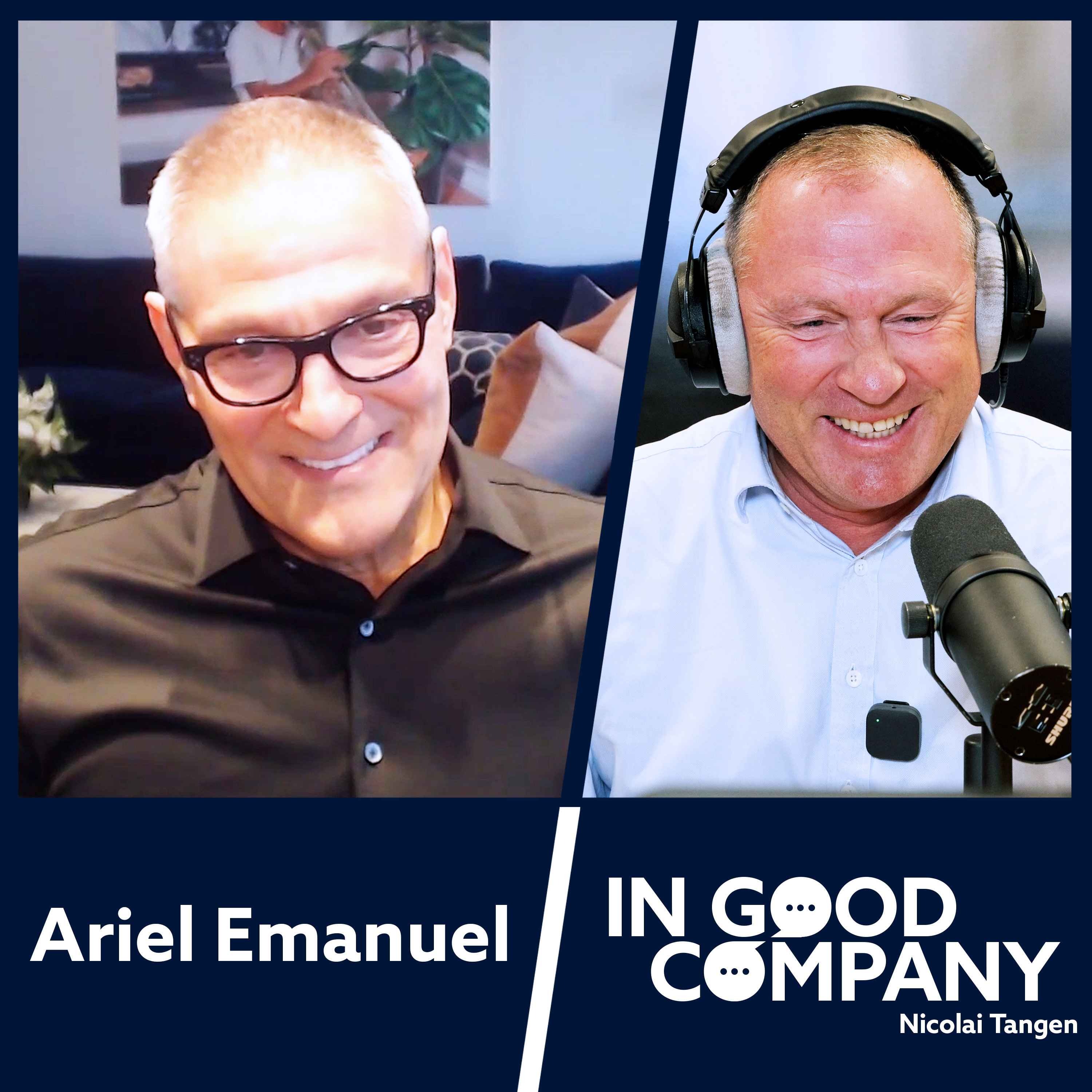
 In Good Company with Nicolai Tangen
22 Oct 2025 · 45m
Written by AI. May contain mistakes.

Get the gist, explore an idea or ask about something said.
 Claude
On In Good Company with Nicolai Tangen, what are the key points of this episode?
Searching your listeningAutomatic transcript. May contain errors.
0:00Hi, everyone. I'm Nikola Tangen, the CEO of the Norwegian Solland Wealth Fund, and today I'm in really good company with superagent and media mogul Ariel Emanuel. He's represented some of the biggest names in Hollywood and is now the owner of companies such as UFC and WWE. Ari, warm welcome. Hi, how are you doing? So how long has this been since you started doing this and why? It's like three years. You think it's going to be an interview you to me, I'm going to interview you. Let's see how it goes.
0:36so all right when i was researching this i was just astonished about how many things you do so just in brief what do you do you know um i started out almost over 30 years ago representing writers writer director actors then had a vision for where entertainment was going started, you know, merged, quote unquote, with William Morris, and then bought IMG, and then realized half my life was representation, half my life was ownership. Almost like, I mean, I don't know what you're, I know that you're one of the largest investors in the world of every single country and every single company. But we realized when we were in the representation business of entertainment and entertainment call takes from podcasts to owning sports, events, music, writer, direct, everything.
1:34We could look at companies that we represented or people or things, and then we could move them, the thought process to an ownership position because we could extract greater value because we were global. And if, if a company was localized, but had a global possibility, we could extract a great deal of value. And as we're negotiating deals between IMG, negotiating all sports rights on an international basis, we added content to that, and then we sold that business for a billion dollars. We had a very big playing field. And so we just started moving stuff to ownership from live events to sports.
2:13So we represented the WWE. We represented UFC. We represented bull riding. and we realized, you know, if we got involved, we could make all the broadcast deals, we could do all the, you know, marketing deals, and then we could extract more value with site fees and all the other tricks that we have. And so we bought them. And people thought at the time we were crazy with IMG and then they thought we were crazy with the UFC and it turned out we made the right position and then we merged it. and we just are on the field a lot. So we get to kind of move things around. So, Ari, we're going to kind of unpack one thing after the other here, but let's get off at the beginning with the endeavor.
2:56So you started in a creative artist agency, and how did you get the job? I gather you cold-called them quite a lot of times. Way, way, way before that, I started in New York with a kind of guy in the theater business by the name of Robbie Lance. after six months i realized kind of the business i had just moved back from europe where i'd been playing around my father told me to come back he was cutting off my bank account and i went into the mailroom and i was making 15 cents a mile that's how i made my living dropping in the mailroom dropping packages off became an agent and then i went to this company inner talent which was a small boutique that had started a spin-off of some of the big guys after three years, I think it was, they sold, they broke the company up.
3:44And I went to this company called ICM, which recently CA bought. Um, and a crazy thing happened. I got hit by a car and I realized life was not a dress rehearsal. You know, you can't just sit around and think it's going to, it's going to figure itself out. So I just, after 18 months of surgery, rehab, have surgery um i said i want to you know be on my own and go for it and so we started this company called endeavor in 1995 on my birthday march 29th who was the first who was your first client it's between amy lipman i think it was amy lemon and greg daniels and then there was a bunch of others.
4:27Why did they choose you?
4:32I don't think they wanted me to keep on calling them to beat them up to sign with me. So they just gave in. What's the most times you called a client to get them on board? To get them to sign with me? I think it was probably Larry David way back in the day. I don't know. It was unrelenting. I felt really bad for him. And I kind of said it to him, I think I said, I feel bad for you. Here's what's going to happen. I don't embarrass easily. So it doesn't really matter. What's the key to cold calling? You know, if I believe, like when I saw the UFC, that there was more value that could be created, if I'm looking at a client that I don't think is being handled properly, I will just pound on that issue until they realize, because eventually they're going to realize I'm right.
5:25I believe. I start the conversation usually with something like, are you happy? And I know where, I believe after analyzing where the trigger points are. And then I just pound away. What does an agent do for a client? Well, in this day and age, because there's so much distribution and there's, depending on the client, like all clients are different. Music clients are different than actors. Actors are different than directors. But if you're talking about a writer creator in the television space, you have multiple players going on, how you tell them what properties to buy to write or create on their own and then packaging them together.
6:08You're putting together kind of a package to go out to the marketplace. It used to be that the studios would be the composer of the content. It's now moved to the agent. And I always say to the people here, ideas matter more than ever right now as an agent, because you have to you you have to be full service. And what we've attempted to do by all the companies we've bought and put together is be a full service agency, whether it be licensing, marketing, books, all actors. how you put things together for a director, an actor, a writer happens inside our doors now, more than it does at the Sony's, at the Netflix, at the Paramount's.
6:53And what's the key to maintaining a good relationship with a client? Well, you have to just, you have to be, you actually have to be their partner, not their representative. You actually have to be their business partner and think about the world and where the possibilities. And, you know, you know it. There's bad things happen. You have to have an agent, I believe, that is willing, and I hope we've taught this, to have endurance and take the failures and kind of think through all the different possibilities and bring teams together to help you think through things. I think we've done that here.
7:33Not always great, but usually pretty good. And I think that's the requirement for whether it be a music client, a social media client, you know, a book, an author, an actor, a director, everything. You are known as one of Hollywood's toughest negotiators. Why do you think that is?
7:56uh um i have one uh why is that well i'm just uh you know i'm not gonna roll over because somebody thinks you know somebody's more powerful or whatever i'm not sure i'm the toughest negotiator i just have a point of view on something and i'll stick to my guns um i know when first of all i don't have to i don't when i i think when i negotiate i don't have to have all the chips off the table. Um, but I do have to, I think there was this line, there was this old, uh, lawyer at Warner brothers and my first deal. And he told me, um, and I said to him in the middle of the negotiation, the head of CA Bill Haber gave me a property to negotiate for him, uh, an underlying right.
8:41And he, and I told him in the middle of the negotiation, I said, this is not fair. And he was the senior lawyer at Warner brothers. And he told me to drive over to Warner Brothers. And I did. And I walked in and I said, Mr. Stolnes, hi, I'm Ari Emanuel. And he said, son, fair is where we end up. And he said, leave my office. And so, you know, in all these negotiations, I just always say to the people, fair is where we're going to end up. I might not be completely happy. You might not be completely happy. But it is the right number. If you were to give the listeners like a 20-second crash course in negotiation, What would you include?
9:22One is you've got to keep the negotiation within the – you don't go out of the – you don't negotiate in public. You respect your negotiator. You're tough and you can't – but you negotiate inside the rooms. You don't kind of – and every negotiation is different. There's not one negotiation. There's not one principle to a negotiation. Sometimes there's only one buyer. You've struck out. You have to get a deal done and you close. Sometimes there's multiple buyers and you drag it out as long as you can to get the highest price. So you just have to recognize the environment and the situation you're in.
10:05I think everybody does the same thing. You know, you have to be honorable. You have to keep your word. Whatever you're negotiating, it's not your last deal if you're talented. And so your word, your negotiation with that person is actually important because that reputation kind of precedes you and follows you. You once said that agents are like cockroaches. What do you mean by that? Meaning you can't kill us. We're going to be around in this business forever as much as people have tried to disintermediate agents. when I think I started in the business we were just in the television business and a little bit of motion picture business now we're in Instagram people podcasts we're in so many different areas and the agency business has constantly adapted and kind of transformed itself and what is required to be a good agent and representation you gotta have marketing in there you gotta have books in there.
11:05You got to have license and merchandising in there. And, you know, you just constantly are adapting your skill set, the agency at large to actually perform the best for the clients. And I don't think a lot of agencies have done that. That's why they haven't survived. We have done that. And I think that's why we're thriving. Many would have seen the series Andrew Rush, which is loosely based on you, I believe. How spot on is that? In my early days, it was, I'm sad to say, too spot on. But I've mellowed. So, yeah, I mean, in the early days of, remember, when I started the business, you had four, no, you had, yeah, you had four big agencies against us.
11:54And you weren't, there was no price differential that could distinguish you. It was all the same price. So, you know, I was difficult. Well. Yeah. I'm a lot nicer now. Why is that? You know, success. I don't have to constantly be fighting battles. The employees are doing a lot of the heavy lifting that I used to do by myself and with others. and yeah, taking on a lot of the battles that I don't have to take on makes life a little bit easier. And also my clients have reached a stature that it's a lot easier to move their careers around. And I have, I think, and you'll have to just ask the buyers, I've lived by my reputation and how I negotiate.
12:56Moving on to sports. So in 2016, you bought UFC. Yes. Was that a strategic transaction or an opportunistic opportunity that just came by? Well, we had bought before that PBR. We had proven that we could buy a company in the sports area and resurrect it. I think Silver Lake would say, as they thought about it, we negotiate every deal with networks on behalf of packages, etc. At that time, we did internationally all the sports rights. We knew how to handle UFC internationally and the value. We represented them and had already negotiated a lot of the broadcast deals. By owning it, running it properly, we could get 90 % of the value as opposed to 10 % of the value.
13:55When did you say that combat sport got into the mainstream? Well, I was just looking at the numbers and looking where sports was going to go and where I thought the distribution model was going and the requirement for SVOD and AVOD. And I did my calculation that Fox had to have the product based on where they were going with their business from the RSNs and et cetera. I didn't realize that they were going to sell, that Rupert was going to sell. But I did realize where the marketplace was going with regard to streaming. And sports has always been a huge driver in that space. And there's not a lot of sports to own.
14:37And I thought between international distribution, sponsorship, site fees, all the things that we did, production where we had global production facility in London in five different locations. we could take a lot of costs out and add a lot of value and it it rang true and we just let i mean we i have one of the great partners in dana white who could continue to do what he needed to do and i would do the business side with mark shapiro and and and if we had that combination it was going to be a lethal combination why is it a good business to own what what are the characteristics with that particular business or that particular sport?
15:19Yeah, one is it's a sport that happens over one day, six hours. The demographics are four quadrants, young men, older men, women now, I mean, and it's global. And the fights are 15 minutes or 25 minutes. They're action-packed. They're great for social. We're in every country in the world with our fighters. It was the dominant player in that sport. And so, and I just thought it had bigger and bigger upside because people want big events on a weekly basis. And, you know, it turned out to be true. You're going to have an event in the White House, I think, next year. Yeah, in June. I think it got announced, the president announced it last week.
16:10I don't know when this is airing, but yes. Tell me about the links between politics and martial art.
16:42And they've maintained an incredible relationship. And when the president was running for the second time, Dana helped him out with his strategy in social and was very helpful and has been helpful for the president for a long time. Do you think politics is increasingly becoming a bit more like combat sport? I would say the following. I hope not. uh, going to this Charlie Kirk situation. I hope that, um, this is a kind of watershed moment where people realize this is a very bad path for the United States and for the world. I think it's all over the world. There's a very combative, um, situation in politics.
17:32Um, but, uh, you know, I hope nobody gets choked out in politics. I just hope we kind of realign our thinking. I mean, I think, as Bill Maher said, it's very important to talk to everybody. And I agree with that. Because you have to understand them, and you have to be able to express your opinion so that there can be a middle ground. it's like any negotiation as i said to you you have to you can't take everything off the table they have to win some you have to win some then you bought wwe no we merged well you merged no you were i believe i believe you were a wrestler yourself uh in you know in your early years is that when you begin to buy it or no i also i represented um vince in the wwe for a long long time at Endeavor.
18:34And then, um, we didn't go public at the V like, uh, in, um, I want to say 19, I had approached Vince with, uh, my partner at Silver Lake Egon Durbin to kind of pull the UFC out and merge it with the WWE and create one entity. And we would like, we have now be private with Endeavor Vince, because we were just getting into COVID. I think it was in 2000. I don't remember 2020 2021 something like that vince didn't want to do it we then retook endeavor out with all of the the first time we went out we only had 51 of the ufc with we had negotiated a deal that kkr and silver lake would roll their their portion of it in we went public the market never really understood what i was trying to express that we cover every aspect of entertainment from sports to social to books, that conglomerate conversation never happened.
19:35We kept on selling off pieces. We sold off our academy. We sold off our production company. They just never got. And so, you know, we looked around after a significant time and other representative businesses were getting valuations of$7 billion. And this doesn't make sense. And that's, you know, the pure play was the right thing for the UFC and the WWE in bull riding. We first started out with just UFC and WWE. Vince, under circumstances, had to leave. We then realized here's the remaining portion of what sports is, which is distribution, production, premium ticketing on location, and we rolled in our last sport, PBR.
20:17And that is a pure play sports entity in TKO, and the rest is the representation business, and that's actually private. So now you have something like 350 events per year. And is it close to a billion viewers? A lot of viewers and a lot of events. Are there any challenges to having choreographed and non-choreographed content in the same company? One, Sports Entertainment. And this past weekend, I don't know when this is going to air. We had our launch for Wrestlepalooza in Indianapolis with ESPN. and ESPN realizes when you go to one of these live events or you watch it, it's sports entertainment and it is definitely competitive.
21:08It is entertainment, but the fan base is incredible. Again, like the UFC, it's global and it's a blast to see. You have said in the past that you'd love to go into boxing And then you had the Ali Act, which was kind of protecting the boxers. And now you have people who come out and say that they want to update the act. And so now you are going into boxing, right? Well, we had an event two weekends ago at Allegiant Stadium where the Raiders play.
21:46And there was 70 ,000 people in the arena. We had one of the great, on Netflix, one of the great boxing events ever. Um, actually in a legion, I think the records are with WWE and our boxing match for, um, live events. It was crazy. It was, it was incredible. Um, we are in the middle of kind of seeing if we can work with the administration and Congress about, um, kind of having, having an addendum to the Aliak, which I think is It's better for the boxers health-wise, money-wise, et cetera, creating an opportunity like we have with the UFC. And if everything works out, boxing is an area that we're looking at.
22:33We're also in jujitsu. So we will cover the full spectrum of combat sports. How large can boxing be for you? I, you know, the funny thing is we, again, we have Nick Khan and Dana White and Hunter Campbell. We have a great team led by Dana and Nick Khan. We have a good partner in the Saudis. And you see how big, I mean, I think on the event we had two weekends ago, I think there was 25 million consecutive streams on Netflix. I don't remember how many globally. It was a significant number. Boxing has been around for hundreds of years. I mean, UFC has been around for over 30, but not 100. And there's an understanding of it.
23:23If we can bring it back to the glory days and Dana and Nick can create the stars behind it, it can be as big as any of our other assets. You nearly bought Formula One at one point, I believe. You know, when we, so before the TKO merger, um, we had been working on, uh, CVC in the UK. They had owned it at the time, uh, to buy it because they were, you know, they had run its cycle. And, uh, Egon real, we had just bought three months before the UFC. and it was a$9,$10 billion chunk. We had not gone into our execution of the broadcast strategy yet. We were starting to cut costs and do all the things that we were doing.
24:18And I just think it was, you got to remember also, you had Brexit, so we had a banking issue. We didn't have a relationship with you so we could get infinite money. and I think it was just a little bit kind of thought through hard to kind of get I think looking back and we both looked at each other, we're probably going to regret this. Regardless, we've done very well. If you could buy another sport, what would it be?
24:51Well, first of all, I'm not thinking about that right now. We have to execute on everything we have now. we have to uh get jujitsu up on its feet we got to continue to execute slowly our boxing strategy um there's a lot on our plate um we've just finished the majority of the broadcast deals domestically internationally things come up um every year so we got we still got integration with the WWE and UFC savings that we have to get to, I got a big plate. So I appreciate me wanting to kind of keep on going, but if I just do what I'm doing, it's a great business. Philosophically, how is the way people consume and think about sports changing?
25:47How do you see this in 10, 20 years? You have to have a... To keep it young, you have to have a really thought-out social strategy with your fighters, with your sport, to keep the demo young. And I think we have some of the youngest demos in the business across our platforms. You then have to be on your distributors domestically, internationally about their marketing strategy. and then you have to kind of, with your sponsors, you have to do integrations with them appropriately for your sports as the events come up. And if you do all three of those properly, then you can have a pretty successful business.
26:38And we're in an enviable position. We have very young sports. and they're consumable on this thing, you can have a knockout, boom. So Ari, when you do a deal, how do you do the research? How much is analysis and how much is gut feel? No, no, no. Like when we presented the WWE or the UFC, when we're taking our rights out for market, we have a whole research team that does, here's our demo, like on Netflix or on Amazon or on Apple. Here's who you're not touching. Here's the people that want to sign up for your place. And if you get them, here's how much we believe we do a huge, you know, 100 page decks about the value creation by being in business with our assets are like the NFL does the NBA does, et cetera.
27:33And yeah, I mean, that was you don't go into these things like. where do you think the winds no there's a huge presentation and then you know because each one of them has a different strategy with the wwe and espn they wanted a big launch they needed another thing to kind of drive people into their new service netflix wanted to get to an advertising base each one of them have different reasoning for what why they want an asset and so So you have to tailor your presentations to those assets. And we have a ton of people doing that for us. And you have a lot of different people in this process with different voices.
28:16Why is that important? I think it's important for leadership that if you are a good leader, one is you want a lot of voices inside the mix to come to the right conclusion and not make a decision that your opinion is the right opinion. so there are many executives that we sit around constantly going back and forth about deals you know what we can ask for what we shouldn't ask for places we should be growing the business um we have calls every week on the ufc calls every week on the wwe jiu-jitsu bull riding and i think that's, um, you know, um, important for leadership, um, to get to the right conclusion.
29:02You always know you're going to make mistakes, but you want everybody that is running the operations for your company at every level to have a voice in it so that when the mistakes come, we can at least mitigate them a little bit and then have a path forward. And you constantly have to be reviewing this stuff um as you as as you as you operate your business um i don't know how other people do it running a sport is like anything else but we have the added um situation that you're on the wwe they're employed you know they're signed contracts on the on the ufc they're independent contractors. That's why it's very difficult for a media company like a Disney, a Comcast, a Warner Brothers, a Netflix to own a sport.
29:54I think they would hurt the operate because it's a very kind of fluid situation. And that's why you need a lot of voices in that can tell you all the different things going on. Because it's not only how you run the business, it's how your superstars and athletes are thinking about it. And that's a very dynamic situation to kind of constantly be reviewing as you're trying to run the business. What type of leadership does it take to run this type of fluid situation? A democratic dictatorship. And that's what you have? Well, we have multiple leaders in the democratic dictatorship. Yeah. Now, on the, you know, Triple H runs WWE with Nick Khan.
30:44Dana runs, you know, kind of making the fights and everything, UFC. Mark and I run the business side of it with multiple people underneath us. And then there's that coordination between, you know, the people that are creating the storylines, creating the fights, and us about where we're going with it. So, yeah. You seem to have very close relationships with your management. How do you balance? Do you think there's work-life balance? No, I don't think so. I don't either. No, no, I don't think that. No, I don't think. I'm not asking how you balance your life. I'm just asking how do you balance professional and personal relationships?
31:19You know, I've known Dana for 30 years. I've known, you know, Nick Kahn was an agent at CAA. We tried to hire him as an agent here, have a very close relationship with him. I've known Triple H off and on for a long time now, very close. You just have to stay close, know what's going on in their lives. I mean, you're in business with somebody, so therefore you have to know a lot about them and care about them.
31:54Now, moving on to a different type of entertainment, you recently bought the Friese Art Fair. Right. That's a new business. It's less violent. Well, here's what I concluded. So we took Endeavor Private. We spun UFC and PBR and on location and IMG into TKO. Silver Lake, as we took Endeavor Private, they wanted it to just be a pure play representation business. we had bought over time about 700 different events i have a thesis that um you know we're down to four day work weeks maybe three day work weeks europe you know um with ai and a bunch of other stuff covid started it and so if that's the case there's going to be more free time than ever we're social animals human beings and they're either going to go to a sporting event you're going to get a dinner.
32:52You're going to watch entertainment. You're going to live music. And I also think you're going to do live events. So we've acquired the tennis business, the participatory sports in collectibles, Frees and Barrett Jackson, our food festivals, a bunch of assets. And we've raised money, about$2 billion in equity. And we've bought these assets and we're going to hopefully create like live nation is in music. We're going to create a mini version because they're a great company, but in live events, a global live events business as this world kind of transforms itself with AI and freezes a part of that and freezes a part of that.
33:43And I think live is more important than it's ever been. And that's the marketplace that we're going to try and go capture. what kind of art do you collect i collect um artists i've worked with this gentleman by the name of jeffrey deitch i collect art um mainly at the beginning of my life it was all over the place and then i i've focused uh significantly on um black artists american black artists and south african um 1930 30 to now from Sam Gilliam, Mark Bradford, Noah Davis, Kerry James Marshall, Benny Andrews. It's a pretty nice collection. I've been doing it for now in this specific space. And anybody I didn't mention, please, nobody, Karen Walker, please don't be offended.
34:42It's a good collection. It's not perfect. But, you know, I got a lot of time. Where do you think your energy comes from? Well, I was hyperactive when I was a kid. I was one of the first Ritalin kids. So I was actually just having this exchange with Egon Durbin this morning about one of his portfolio companies that I'm involved with out of Silver Lake. And he was saying something and I was saying something. And I said to him, what makes us crazy? and we just had this tax exchange i really don't know but um i'm still intellectually curious you know and uh i love it i have uh uh you know i don't i i don't i don't i'm not tired i'm not i i love the every bit of the process now i'm not sure i i enjoyed the process before but it was a it was a means to get to you know to fulfill an idea now i actually love the process and the aggravation which part of the process which part of the process all of it i i realize there's going to be a lot of aggravating moments those are what it's required to do business um if you don't if you don't accept that which was at the beginning I didn't understand it.
36:08Now I've accepted it. It's great. The outcome is a different conversation. I think you said pressure is a privilege. Yeah. I think that's a good one. Actually, I have to admit I used it earlier today. Oh, you did? With what? No, just explain why we like to be where stuff is happening. Yeah. And you just kind of get a different sense of the world as opposed to kind of like being a bystander. I'm not, my parents were never bystanders. My mom wasn't. She was in the civil rights movement. My dad was a very pretty hard advocate. He was a pediatrician about, you know, kind of kids' rights. And you had two clever brothers.
36:55Yeah. Who's the cleverest of the three of you? In our respective fields, I think we're all pretty clever. I wouldn't want to have an argument about health care against my brother, Zeke, who's at Penn, as I said to you. And I definitely wouldn't want to have a political conversation against my brother, Ram, who hopefully he runs, hopefully the former ambassador of Japan and mayor of Chicago. Hopefully he runs for president. And I think he's the most qualified guy out there for the Democratic Party. Um, and, uh, they're pretty dynamic in their own specific fields. When do you wake up in the morning?
37:43Um, well, I flew to Indianapolis on Saturday, saw our launch of our WWE Wrestlepalooza on ESPN. Then I flew to New York, had dinner with the Amir of Qatar last night, flew back, got in at two, woke up at six here with you. and I'm flying back to New York on Tuesday because I have a premiere for a client, flying back here on Wednesday night, going to Aspen, and then back to Indianapolis on the following Tuesday. So I don't know. Whatever it is it is, it just does. How does your, what kind of fitness regime do you have? Oh, that's its own podcast with you. It's too long to discuss. Okay, one minute.
38:31no no it's way too long i mean i wake up at 4 35 o 'clock i work out for an hour and a half sauna ice i mean it's just it just it it is over the years it's gotten crazier and crazier do you drink anymore i have a glass of wine from time to time i don't i don't drink at all anymore but i'll tell you one thing before this podcast i did have an ice bath and a sauna see I have one every day do you do one every day yeah yeah yeah how long is your sauna well I'm not very long I'm uh I'm pretty quick how long do you stay in in the sauna yeah maximum 10 minutes so I do I do 20 minutes and I do three minutes in the ice bath okay every day that's good no I am a big believer yeah how long is your attention span you think I've been pretty good here yeah absolutely I'm I'm how long have we been going no no I had expected you to say, I have to go love you.
39:29Because I think that's how you normally finish your conversations. I can end it now if you want. No, no. Two more minutes. Learning from – I mean, some people call it failures. I think you call it something else. But learning from trials, mistakes. Listen, one of the biggest failures was not going public the first time. I didn't even understand it right but that enabled us and then COVID hit and so reading all the points of view of what wasn't good admitting that we screwed it up going back into the market but with a different strategy working with Morgan Stanley and Egon and really refining it.
40:24I had, you know, Mark Shapiro and team dealt with all the issues on COVID, which was, as you know, for a lot of your companies, significant how you handled it, doing the raise. You know, we just, you can't, I try and instill this with my kids, hopefully with people that work with me. You know, when you're running something, it's not how many punches you can throw it's how many punches you can take so endurance emotional endurance is a really key factor and failure really puts the light on that and being able to get up off the canvas and get back in the arena is crucial and there's all these great quotes about it and you know the tom brady's or everybody doesn't it just you just have to be able to get off the canvas.
41:15What's your, so what would be your advice to young aspiring entrepreneurs?
41:23And actually enjoy the aggravation. Enjoy it. Because that is what it's about. If you love what you're doing, and I still love it, and what I'm doing is expanded,
41:45then enjoy the hardship because the hardship is part of the process of the enjoyment how can you enjoy aggravation and how can you teach yourself that pain is good well you know doing three minutes in an ice bath ain't easy meditating in a very hot sauna you know one of my things in my in my, why I do these things for my health. You know, today I'm on a 24 hour fast. Every quarter, I do a three day fast, getting your mind, the ability for your mind to be able to handle uncomfortable also on, on a personal level for your health helps you in business too, because it, and you know, kind of putting barriers around yourself or what you can and can't do.
42:36And And that also helps, even though it's for your health, it also helps in your business decision making and your ability to kind of be the ability to endure the aggravation. And you realize this too will pass. And it's not going to kill you and you're going to work through it. You just have to work really hard. and if you kind of learn those things at many different levels sometimes it comes from business sometimes you see that you got through this or sometimes it comes from your personal life you can handle it it for me it started and I didn't realize this during the moments I was dyslexic it was not easy reading and it was embarrassing it was uncomfortable and being able to be comfortable in the uncomfortable enables you to handle aggravation and all the other things you need in business.
43:35And even at the time I hated myself and my inability to read, it has helped me now realizing that you have to be comfortable in the uncomfortable. And I think that's true for all business people. And what is your advice to young people? Be comfortable in the uncomfortable. Learn that and don't think that, you know it's just it just should just happen you actually have to work through all the pain to make it happen if you care and and i don't i don't you know people talk about i'm not sure that that is being taught now you know your parents can't coddle you and can't give you an award for coming in second and have to you know ground you and do certain things for you and then then you have to pick up the mantle as an adult and keep on doing it.
44:26And your parents have to be there all the way, but not giving you the answers. So hopefully I've done that with my kids. Sounds like it. It's been great having you on, Ari. All of us have luck with all your projects. Thank you very much. And there are lots of them.
This week, Nicolai Tangen sits down with one of the most influential people in global entertainment and sports, Ariel Emanuel, CEO of TKO. From building the talent agency Endeavor into a giant representing Hollywood's biggest names, to bold moves like acquiring UFC, WWE, and expanding into live events and art fairs, Emanuel has redefined what it means to be an agent and an owner. His legendary career even inspired the character Ari Gold in the popular HBO show Entourage. In this conversation, Ariel reflects on his relentless early days in the mailroom, how he negotiates billion-dollar deals, why he believes pressure is a privilege, and what it takes to thrive in industries that never stop changing. They cover everything from Hollywood myths and combat sports to leadership, politics, art collecting, and the discipline behind ice baths and early morning workouts.
In Good Company is hosted by Nicolai Tangen, CEO of Norges Bank Investment Management. New full episodes every Wednesday, and don't miss our Highlight episodes every Friday.
The production team for this episode includes Isabelle Karlsson and PLAN-B's Niklas Figenschau Johansen, Sebastian Langvik-Hansen and Pål Huuse. Background research was conducted by Oscar Hjelde.
Hosted on Acast. See acast.com/privacy for more information.