
 Ask ChatGPT


 In Good Company with Nicolai Tangen
5 Feb 2025 · 1h
Written by AI. May contain mistakes.

Get the gist, explore an idea or ask about something said.
 Claude
On In Good Company with Nicolai Tangen, what are the key points of this episode?
Searching your listeningAutomatic transcript. May contain errors.
0:01Hi everyone, I'm Nikola Tangen, the CEO of the Norwegian Soren Wealth Fund, and today we are honored to welcome Christophekristoff Fokke, the CEO of ASML. Now, ASML, it's the most important company many of you have never heard about. It produces the equipment that actually makes the computer chips. And it's basically the progress here which drives and decides the speed of the progress in health, electrical vehicles, communication, weapons, pretty much everything we do. So I consider Christoph one of the most important people in the world just now. Warm welcome. Thank you very much, Nikolai. It's a great pleasure to be with you today.
0:40I'm very much looking forward to a great discussion about this great industry. And we are very proud shareholders as well. We own 2.6 % of the company, equivalent to$7 billion. So it's very important for us.
1:03now um christoph if we kick off here um what do you actually produce well what we produce in isml are lithography system lithography system basically is a very important system in the entire semiconductor process, because this is a system that is going to print the image of the electronic circuit you want to get on a chip. So if you want, printing whatever our customer wants to realize. So this is what we have been doing for the last 40 years, pretty much. Now, you are the only EUV lithography printer in the world. now in one minute, what is EUV? So EUV refers to the light, the type of light we are using basically on those lithography machines.
1:57EUV means extraviolet, and this is a very, very short wavelength. We're talking about 13.5 nanometers. So you look at the very, very small wavelengths. And in lithography, the smaller the wavelengths, the smaller the feature you can print. So EUV is the light. and the reason why a lot of people talk about EUV is because being able to create that light in sufficient amount to industrialize a tool with it has been a challenge of many, many years. Why is it so difficult? What part of it is difficult? Well, it's two parts that are difficult. The first one is the light generation, what we call the source.
2:37You could see that if you want as the light bulb you have in your house that create basically the energy you will need to expose basically a wafer. And creating EUV light in high enough power has been a very, very big headache for many people and for many, many years. Even in ASML, we spent more than 20 years achieving basically 200 watts, which was, we thought, the first threshold to make EUV economically viable. Now, I'll tell you how we do that because it will also explain a bit the complexity. So in order to create EUV light today on the EUV machine, we have to hit a tin droplet. So it's a very, very small droplet of material with a very high, powerful CO2 laser.
3:28And when we hit that droplet basically with a very high, powerful laser, electrons start to go from one place to the other. And as they do so, you have the UV light creation. Now, to give you an idea, we hit a droplet 50 ,000 times per second. And to be honest, I was simplifying it a bit. We don't hit the droplet once. We hit it three times, 50 ,000 times per second. The first time to make the droplet bigger, the second time to make it look a bit like a gas, and the third one to really get the UV light out. And of course, being able to create that technology, to be able to control that technology is a major, major challenge.
4:15That's what ISML spent about 20 years of R &D doing a few years ago. And you are pretty much the only, well, you are the only company which does this in the world. Well, yes, we are the only company who can do it, I will say, in a way that can be industrialized. You have a lot of, of course, research center that can create UV light, but not in this amount and not, I would say, so systematically. I read somewhere that your latest machine is the size, I mean, it's not exactly pocket size. It's the size of a double-decker bus. That's right. And I saw somewhere that to transport this one machine, you needed seven planes and 50 trucks.
4:58Yeah, it's all correct. And the size of the tool is related to the second biggest challenge we have on UV, which is the optic itself. Because once you have the light, you need to be able to guide the light first to the reticle to take the image you want to print on the wafer and then to the wafer to print it. And in order to do that, you need to work in vacuum. You need to develop very complex material. I won't share what they are for obvious reasons. And that's also something that together with Zeiss, our partner this time, we also spent many, many years to bring together. So you could see EUV as a double challenge, the source and the optic.
5:40And the rest, you know, you could say is pretty much looking like a normal scanner. So you basically need this to make the chip smaller and smaller, which kind of brings us to Moore's law. Or what, just briefly, could you explain Moore's law? Well, I think you have many, many versions of Moore's law, if you listen to people. And that's one of the reasons some people tell you Moore's law is dead or has died already many years ago. The version of Moore's law I like is the one that said that you have to double the density of transistor on a chip every two years. And that's a load that have been executed and is still being executed.
6:26It's something that Logic customers are doing, companies like Intel, TSMC, Samsung. It's also a load that DRAM customers are following. And that need to double the transistor density every two years is key, basically to deliver performance, to deliver to the AI, for example, We have AI today because we have gone far enough on Moore's law so that we have enough basically computing power to start to train the type of model AI is looking at. And how much longer can this development continue? Well, so here, if you look at, in fact, that law recently, this has in fact accelerated because AI has demanded even more.
7:18So if you look at AI, people who do AI, they don't want to double the density of transistor every two years. Right now, they want to multiply it by a factor of 16 every two years. So this is a type of new law you're looking at when it comes to computing performance, high computing performance for AI. So you see, in fact, in this case, a strong acceleration of the performance need and demand. So, you know, you could say it's getting, of course, maybe harder over time to get this density. But so far, people have been creative enough to keep going. And I think we continue to see that. So the question, when does it stop?
8:04You know, I could say never. If I'm a bit less bullish, I will say it won't stop at least for another 20 years. And we'll see after that. But I think this is still a long term enough view. So I think we believe that the level of creativity in this industry, far beyond just ISML, by the way, is such that we will keep going for quite a long time. I'm sorry, just to get that straight. You think you can increase complexity by 16 times every two years for the next 20 years? Well, this is what our AI people want, right? This is what the AI company wants. Now, the problem with that today is that if we were to go on this path, cost is an issue.
8:49And as you know, of course, energy consumption is an issue. So that demand has to be, I would say, fulfilled through major innovation in our industry. Major innovation in logic, you know, again, Intel, TSMC, Samsung, in memory. So you hear a lot about high bandwidth memory today. but also major innovation in our domain in lithography to continue to basically enable our customer to get that type of density. This is why you talked about our latest equipment before, but this is why we continue basically to innovate and bring basically the ability to get more and more transistor per unit area with better lithography machine.
9:37How far into the future can you see? Well, usually we have a good view of the next five years. I think I would say, you know, the five years coming, I would call it the plan. I think we have a pretty good idea of what could happen in the next 10 years, maybe 15 years. But then you start to look at scenarios. So, you know, there is many options to get there. And after that, it's a bit more theoretical. But I would say when it comes to the next five to 15 years, there's quite some confidence that, you know, the continuation of Moore's law, the continuation of this industry is pretty strong. With a lot of challenges, of course, but that's always been true.
10:22When we talk about two nanometer chips, how small is a two nanometer chip? Can you put it into perspective? Well, the chip itself is not too small, right? The chip itself is still a few millimeters by a few millimeters. What's really, really small is the size of the transistor, right? Two nanometers is basically about 200 times the size of a silicon atom, right? So you start basically to look at dimensions that come close to atomic dimensions. So this is extremely small. And it means that the way those transistors are going to work is such that people start to count electrons as well. So we are getting as close as you can imagine to the limit of physics, or at least the limit of physics as we learn them at school.
11:17And this is what makes this moment in this industry so exciting, because this requires, of course, new innovation. now you um you spent i believe six billion dollars to develop this so a very long time frame more than 15 years just how do you how do you cultivate that type of long-term mindset yeah so we spend a bit more than that but uh you know what what is defining i think isml in many way. And if you ask me, this is maybe what makes ASML unique. We do things because we believe this is the right things to do. And when we look at EUV, you know, if you go back 20 years ago, we looked at different options that could be used for lithography.
12:11We had EUV, we had eBeam, we had what people call still today nano imprints which consists in getting the reticle in contact to the weather and each one of those options were very very difficult and we picked EUV not because it was the easiest one in fact EUV was less advanced most probably than e-beam or basically nano imprints but we picked EUV because we thought that this was the only technology that over time could scale to the point where we could provide the resolution, but also the productivity, meaning that we could also provide this at the right cost. And that's how it started. And we were convinced that the industry needed it, which I think has been proven since then.
13:02Everyone is aware of the story of TSMC going to 7, 5 nanometers with UV, Intel not doing that and what was the results of that. So we were convinced that the industry will need it. And then we invested in that to the level we could afford it, which if you look back 20, 25 years ago, ASML was not a very rich company. In fact, we went as far as asking our customer to co-invest with us on a program. But we did it because we thought that this had to be fixed. and I can tell you that that was not easy and for a long time I think there was not even the guarantee that this would work but there was we thought most probably an 80 percent chance that this would work because we still understood the physics we still understood the fundamentals and this is the reason why we went there and that could sound strange to a lot of people because Because people could ask, well, did you have at least a good business plan?
14:08And the answer at that time was no. I mean, we couldn't find a way to make the business plan look even reasonable, right? Because the challenge was such. But there was this belief that if we get it done, and if this allowed the industry to move forward, this would be good for the industry. This would be, of course, good for us as a resource. And I think we truly believe in ISML that as long as we are contributing to extend this industry by one more node, as long as we extend basically more slow, then we generate a lot of value for everyone. I mean, the value chain here in this industry is really fascinating.
14:52So you talked about getting financing from your customers. They also took ownership stakes in you. Yeah, at some point they did. How important has that been for the corporation? This was important for two reasons. The first one, maybe the most important part, it was showing also the commitment they had on the technology. So I think it was very important for us to have this alignment with the key players to know that EUV was important for them. And I think that their co-investment was the proof of that. And, you know, again, at a time where the ability for ISML to invest in R &D was for sure less than it is today, this also gave us enough fund practically to accelerate the development of EUV.
15:39So I think this co-investment program most probably accelerated the whole EUV program by, let's say, three to five years, which, you know, is significant. And again, we had partner, you know, we had people that days after days, night after night, were walking with us. We're together on the same trip to get UV to walk. And that's very important because if you are going to do something that difficult, you know, you feel better if you're not alone, right? Absolutely. Talking of which, you also work very closely with size on the optics. Tell us about that relationship. So this is a German optics company.
16:22Well, so, you know, when Zeiss and ISML talk about the relationship, we say this relationship is worse than a marriage because we can never get divorced. Right. We have created a level of interdependency between the two companies, which is extremely high. and the reason for that is we made the choice from the very beginning to focus on what we were good at and Zeiss is extremely good on optic they have become excellent over time of course they have gone also through their learning for more than 30 years and their learning has allowed them to be able to do something like EUV or even INA today while in parallel we were doing the same learning basically on everything else that lithography has to provide why don't you merge well because i think you know you you need to want it and i think this has never been the case and and there you know you you touch to culture you touch to history you touch to business model and what we have learned over time is that even if you don't merge you can develop model that i will say can become almost even maybe more effective than if you were to merge because in the way we work everyone does its own things with its own culture its own mind and i think this has been a strength to be honest over time it's very good to have a partner that is also different from you and that therefore not only is able to work with you but is always able to challenge also the way you do things.
18:05And I think that's part of the great relationship we have with ICE.
18:14Where do you see AI developing over the next few years? I mean, we're seeing you know, XAI putting like 100 ,000 GPUs to form Colossus. Just an incredible development just now? Yeah, so I think it's a very, very important question for this industry. And if I start with the end, I'm a true believer of AI, of what AI can do basically for, I would say, for humanity. And the reason for that is if I look at what we have been doing in as well as the most important part of the AI and the most important part is R &D. I think the strongest potential value of AI is to be able to accelerate our learning cycle.
19:13So in some way, accelerate R &D and improve our product. And all of that can be done because in the past few years, the amount of data we have been generating, to develop our product, but also the amount of data we generate once our product are running at our customer is enormous. So there is a huge untapped potential of making good use of this data. And AI can do that. But now what we also see is that to trust AI, to do that, the models that are needed have to be even better than what we see today. So the number of parameters that model will have to use is going to grow very quickly, most probably also exponentially.
20:02So there's another low also there with AI. And that requires even more high computing power. So we will first see a huge demand of high computing power with more advanced technology. So 3 nanometer, 2 nanometer, and we'll go to Angstrom type of node. all of that, I think we will find a lot of appetite from AI people to use it. So that's the first part. And this will, I would say, create huge opportunity. The second part is how are those opportunities going to play or roll out in the next few years? And I think that's the most difficult question. So a lot of us, I think, are very convinced about the huge potential AI has to offer.
20:45However, I think none of us know exactly at which speed this will come basically to the market, if I may say, because at some point of time, AI has to be more than just, you know, an activity around research and development. This has to be translated into product. Who is going to be the winner here? well i think at the end of the day you know i always believe that when it comes to model software you will have a lot of people who can do that i believe that the way you will design your hardware the way you will architect basically the chips is very very important this is why a company like nvidia amd you know a few more most probably moving forward will really fight for that because I think that product enables whatever algorithm people may think on top of that.
21:44And of course, those products can only exist if a company like TSMC, Intel, Samsung provide the technology to create a chip. And those companies can only do that if they continue to use our lithography tools. So you will have, I think, quite some winners. And you cannot pick one because if you were to take out any of those names, everyone loses. That's the beauty also of this ecosystem. We need each other, right? Talking about which, the superscalers are now designing their own chips. How good are these chips? I think they are very good. And I think they will get better over time. I think today the chips that are being used both for memory or logic were not even necessarily designed for AI.
22:42I think people have just taken the best chips available at the moment, which is GPUs and high bandwidth memory, for example. But I think both in logic and in memory, we will see major design change to optimize chips further for AI. I think this is most probably happening as we speak. I think that those chips are pretty good, but I think there is still major improvement possible. And, you know, this will also have an impact on the type of chips our own customer will manufacture. So I think that's one of the very interesting things with AI. AI is changing the industry. You know, it's not that you only see new product.
23:32You see those products becoming the most important one for the industry. So for a long time, this was mobile. Today, it's AI. And it means that the roadmap of a lot of people, including our roadmap, will shift basically with the idea that we want to serve this new opportunity. But I think those chips are good, but they will be a lot better in a few years from now. When I prepared for this podcast, I conferred with Chris Miller, who wrote the book The Chip Wars and who is one of the leading experts in the world. And he was just wondering, given how much of the development and R &D and so on in the world, which now depends on getting smaller and smaller chips, how do you feel about having this incredible weight on your shoulders?
24:26Well, I think it's a huge responsibility. I think that's the first feeling you get because, well, you know, you said it in your introduction. We used to be this company no one knows about. I think this has changed quite a bit. I think we are today a company that a lot of people rely on, basically, in order to be able to create their product. And I think that's a huge responsibility. And this means for us that more than ever, we have to continue to develop our products so that, you know, we never become the bottleneck to this industry. We need to make sure we can produce them in enough capacity, whatever the capacity will be needed so that everyone can play.
25:15So, you know, we serve the market in a very fair way. and you know this of course create a lot of of pride for every isml employee you know i think if you are an engineer and you tell an engineer that what you do nowadays is is at the core most probably of any major innovation moving forward i think it's a it's a lot of pride as well so you You have responsibility, you have pride. And I think this also put us in a place where I think we understand we have to play our role. So I think this has changed a bit, I would say, the way ISML has been looking at the world. And I think you have seen our involvement as a result a lot more strong, a lot stronger than it used to be.
26:11Changing tacks a bit, the geopolitical tensions that we have now between the US and China, what are the implications for you? Well, I think there are many, many implications because, you know, we went to a former world where we were looking at, you know, very, very open, collaborative world, right? I think the idea a few years ago was that, you know, we are going to do business everywhere. Everyone can work with everyone. and this has supported, I will say, the development of our industry quite significantly because every part became important. And we go from that view of the world to a view of the world where people more and more are looking at potentially decoupling things.
26:58And this changed, of course, everything because the way this industry was designed, the way this industry has developed was based on the previous rules. It was based on a completely open market. It was based on the idea that you can basically use the revenue of more advanced products, sorry, the revenue of less advanced products that you have developed a few years before to fund the development of more advanced one. So you had this balance, which I think is a bit being put in question. So this requires quite some adjustment. And I think we see two main risks on that. The main one is cost, you know, because if you get less revenue, you have less ability to do R &D except if your cost increase.
27:59If you are limited in geographic area to produce things, cost could also go up. I think we are all very much aware that, for example, that when it comes to build, to manufacture chips, the US, Europe are a lot more expensive than Asia. That's also most probably slow down a bit, the innovation, because, again, we used to have this very open ecosystem. And this may be also a question. So this makes things, of course, a bit more difficult or potentially a lot more difficult depending on how far you push, basically, the decoupling model. So it's very fundamental. Yeah, no, absolutely. How far behind is China here now?
28:48Well, I think I've said that a few times publicly, I think a few people have said that. So China doesn't have access to EUV and EUV is critical for advanced logic. I think this has been demonstrated in the Western world. I can go back again to the TSMC Intel story. You know, EUV was introduced for R &D around 2016, 17, started to go to production around 2018. And this means that China is at least, I would say, 10 years behind and most probably a bit more because as we were looking back in 2016, 17, they were already a couple of generations behind. So 10, 15 years is most probably, if you look at logic, where they stand.
29:41And it's very, very difficult to do advanced logic without EUV. You can, of course, make a few chips over time, a few transistors, but you cannot do it in volume. You cannot do it at a cost that is reasonable. So you cannot do it in a way that is economically viable. Taiwan is in the middle of this whole value chain. How risky is that? Well, I think that it's a very difficult question. I don't know, to be honest, because you can speculate on that. You can only have an opinion. there is always a risk, of course, to have the supply chain concentrated in one place. I think no one can argue with that.
30:34But then I would say we present a similar risk for the market in this sense. You know, guessing what's going to happen on geopolitics is difficult because anything happening with Taiwan will have major implication for the entire world, clearly. So I'm not one of the people who are very much looking at a very bad scenario to Taiwan. I think those are very unlikely. But again, that's more of a personal opinion than anything else. I'm sure you have your own. But I think what is for sure certain is that the tension could raise over time. And how fast do you think one can ramp up chip manufacturing in US, Japan, South Korea?
31:23Well, I think the manufacturing part is one thing. The R &D part is another thing. I think when you look at chips, you need to have R &D first. You know, if you don't have R &D, meaning if you don't have somewhere, someone that provides you the next generation of chips, it's a matter of time, even if you have manufacturing, that you manufacture things that are not very relevant. I think the access to R &D is very, very important. And I truly believe that when it comes to advanced chips, you only can do those things if you have the history. It's a bit like the story I gave you about ISML and Zeiss.
32:09I think we can do EUV today because we have done everything before. We believe it's very hard for anyone to start from scratch and do EUV. I think it's the same for chips. I think the idea that someone could just create an R &D center and be able to do, you know, a 2 nanometer or 1.4 nanometer, I think is, from my point of view, extremely difficult, if not impossible. And that's, you know, that's where you see those cooperation, even, for example, Japan, of course, is looking at doing 2 nanometer logic, but this is using technology from IBM, right? So you cannot just come out of the blue on those kind of things.
32:52So if you don't have it, I think it takes a very, very long time. But yet you have cheap acts in various countries. You have it in the US. You've got similar things in Japan, UK, EU, just really huge amounts of money.
33:13So how do you view this? Well, it's huge, but the problem is it all depends on the scale you're looking at. And I think chipped acts, from my point of view, are good to motivate people to restart the engine or to do some initial investment. But I know I said it a few times already in discussion, cost is very important for this industry. You need to get it right. And the problem with chipped hacks is that they don't solve that. Chipped hacks can help you to put a factory, to buy some tool, to get going for OneNote. But what's very important, it's a discussion we have with many governments, is to also make sure that you create a condition where you can compete on cost and on flexibility.
34:07Because, you know, subsidies are usually something that do not last forever. and if over time you don't solve structurally competitive disadvantage you may have on cost or flexibility the fact that you know you boost for a while the r &d or the construction of new fab is in no way a guarantee of success for the future so i think that's the part i think that is very important to understand this industry is very competitive very sensitive to cost chip tax I think have helped to recreate a bit some activity and some interest and give a chance again for some country to restart in semiconductor but all those countries will have to make sure that they become competitive and I think that's a very, that's mostly a more difficult part Of the 50 largest technology companies in the world, only 4 are in Europe So a naive question here.
35:11Why is that? Well, I think, you know, it's a very tough question in Europe. And, you know, if you knew the amount of time we spent having this exact same discussion. But, you know, I already touched on some of that. You know, I talked about flexibility. I talked about cost. This is very important. I think access to capital is also very, very critical. You need to be able to invest. I think today, access to capital is a lot stronger in the US than it is in Europe. I think you know that very well, right? But a lot even of the capital usually being used to invest in Europe come from the US. So that's something people underestimate that's very important.
35:58Access to resources, to electricity, power, the price of the power, all of that are very, very important things. And you see a lot of those debates happening today in Europe. These are discussions we're having, of course, with our government. You know, we made the decision to extend ourselves, you know, in the Netherlands, because that makes sense for us. But we only can do that if we have the infrastructure, if we have the energy, if we have all those things. So the reason why you have less company in Europe than maybe other places of the world is because those things today are just more difficult.
36:37And, you know, Mario Draghi just published a report in Europe, which I think described that very, very nicely. And now what's important is to have the political will to reinvest in the future and basically create opportunity. I think that's very, very important. And are we going to see this? Well, I think it's almost, you know, a matter of life or death at some point, because what if you never see it? Yeah. So what is left in a few years from now? So I think you see more and more people talking about this in more and more countries because I think it's a will for the people to really be able to have those interesting companies, those interesting jobs.
37:27You know, I was talking about SML. I was telling you about the pride of our employee. I mean, any educated person in Europe wants to have a chance to work in a great company. Yeah, but it's fine. I mean, it's fine to talk. But are things happening? I think they are happening. I think we could easily agree they are too slow. I think that the dialogue between politics and industrial is most probably increasing in Europe. The challenge most probably will be to make sure we bring the entire population on board because those topics are not always easy to explain. and these are not the topics that maybe are the easiest for politicians to pursue to get elected.
38:14Now, Veldhoven is a small town of 45 ,000 people on the Dutch-Belgian border. It's not the obvious place for one of the most important companies in the world to be situated. How come you ended up there? Well, I think we used to have a bigger brother called Philips. You know that Philips used to be an extremely successful company. And Philips created, you know, back 40, 50 years ago, a lot of basically startup. And a lot of those startup became significant companies. So, ISML is one of them. I think, you know, ISM International is another one, right? So, we come from the same roots in some way.
39:02and Philips also had developed this culture of innovation so you know SML is sitting in an area that we call the the brand port and the brand port is still a very lively area in Europe when it comes to innovation I think that's still built on the old concept of Philips so that's why we are here. And I think over time, you know, we have developed a very strong ecosystem. We talk a lot about, you know, ISML, we talked a bit about Zeiss, but our supply chain is critical, of course. You know, we talked about the optic, but mechatronics is very important. And all of that is also done in Europe, in Netherlands, in Germany.
39:48So there's a lot of critical companies that are also contributing to our success. Of course, they are a lot less known than ISML, so they are still a bit obscure, most probably. But they have been growing with ISML. I think the whole supply chain around, you know, Veldhoven, even in Veldhoven or Eindhoven, which is the bigger city on the side, are very critical.
40:19How would you describe the corporate culture at ASML? I think, you know, what people usually say first about HTML is that this is a non-political organization, meaning that people don't do things basically in order to gain credit for themselves. They do things for the good of the company. And I think that's something that is very, very strong. And this creates both a style of management, but also a style of interaction between people. So I'll give you an example. Our employees feel very natural to challenge us on anything. I'm the CEO of the company. It doesn't mean that people don't argue with me.
41:11No, you know, when we engage on any topic, technical, non-technical, there will be a debate because there is this belief that the debate has to take place to really create and bring the best possible decision. So that's a bit ASML. And that culture has been very, very solid for many, many years. Of course, we've been growing. So we also have to make sure that this culture doesn't go against, you know, inclusion of the people joining us. So It's sometimes a bit also rough. People thought in the past this was a bit rough. But the very high focus on doing what is right for our customer and therefore for the company, I think, is at the core of ISML.
42:01And as a result, you see a very open, very lively company. It still feels like a family company also. It's pretty big nowadays, of course. We have 44 ,000 people, so you could say it's pretty big. But the way I know my colleagues, the way I know the leadership, we still feel this is not a very big team. And that's very interesting. So we have kept, I would say, the essential of the DNA while, of course, finding ways to scale to the size we have today. In your mind, what's the key to good leadership? I think, you know, it's humbleness. Humbleness, I would say that's the first word that comes to mind.
42:47I think you have to humble. I think you have to remember that you are serving a bigger cause. I think it's very, very important. You need to be authentic. People have to see you for what you are. I think there should be no artificial discussion or there should be no attempt to try to please people or to convince people. I think you have to be very authentic. You have to be direct. I think you have to work hard, lead by example. I think you have to stay on content. You know, sometimes when people get to bigger hole, they sometimes believe that everything can be solved by processes. I think processes are very important to make things happen at scale.
43:40But content is essential, especially in this industry. You need to know basically what is happening so that you can anticipate what could happen next. You need to be strategic. So you have to be able basically to dream. I think being able to dream is very, very important for leaders. And at the same time, you have to be able to explain that dream in a very simple way, very clear way so that people can translate it into things they can execute on. So you see, there's a lot of things. and I don't know in which order I brought them to you. Let's do two of them. How do you stay on content? Well, that's easy because I don't know how to do it differently.
44:27So for me, if I don't have content discussion with my engineer, my operation people, my sales people, my customer, my supplier, I feel I do something wrong because I feel that I lose the connection to what is essential. You know, I often tell the people in XML, if our customer trusts us, if we do the right product for them because we understand them, because we listen to them, I think the rest will be fine. We have to manage the company in a very good way, but we will be fine. In fact, we'll be more than fine. But those two things, customer trust, having the right product, that's content. You don't have that if you don't have content.
45:17And therefore, for me, if I don't have access to this information for a bit, I will very quickly feel that I'm mostly not leading the company in the right way. Why is storytelling important? Storytelling is important because you need to be able to explain people why things are important. And the only way to do that is to simplify. I could tell you EUV is very complex. I prefer to tell you EUV is very simple. You ask me to explain EUV in one minute. I think that's the right question because you need to be able to explain what you do. And if it takes you too many words to do that, then you don't explain it ever.
46:05So I think it's very important to, the story stating is very important. the simplification, the clarity around what you do, I think is very important. Where did you learn it? I think you learn it over time. You see people doing that. You also see the effect of having a simple story versus a complicated story. And I think you need to have affinity for it. I think that there's part of it, which is your own character. I think, you know, there are things that most probably you are born with, I will say. and that's helpful. But I think if you pay attention to it, and I invite usually my employee to do that, if you pay attention on how far you will go if you give a simple story and people understand it, if you can make your case, I think making your case is a very important thing.
46:56I always say you cannot convince people. You have to give them the elements so they convince themselves because it's a lot more powerful. But if you practice that, I think you realize that this is powerful and maybe over time you get better at it. But this, for me, is very, very important.
47:18What is driving you personally? I think, you know. If you are to go really deep psychologically. I think solving problem. I think, you know, I always say, if I look at the different job I had in my career, I think they have this, they have a few common points. Solving problem is one of them. So if you're an engineer, you know, you have a problem, you look at data and then you come to a solution. I think the same is still true if you're a CEO. Of course, the problem is a bit different. You look at the problem is mostly what does this industry need in the next five years? Second problem is how do we make it happen?
48:01Third problem is how do we fund it, et cetera, et cetera. But these are still problems you have to solve. And I think you have to make the problem, again, simple so that you can have a solution. If you think the problem is complex, you will never solve it. Right. That's the way it works. So solving problem drives me. I think the contact with people is a major driver. I, you know, I feel blessed in this industry. I mean, everyone you meet is just inspiring. I mean, you go have a talk, a dinner or a meeting with anyone in the semiconductor industry. It's just a blast because people have great experience.
48:42They are pretty humble. I think they share this need to bring something positive. And again, maybe this need to solve problems together. And I think the connection to people has been always a very, very, very motivating factor in my career. still today and you know the last thing I will say is I enjoy what I do very much so I take really great pleasure in doing what I do in SML and you know this is true today but it's been true for the last 25 years in this century there's not been one boring day good for you so Christoph if you were to go a bit deep why do you work so hard is it a particular person you want to prove wrong?
49:29or does it come back to some type of inferiority complex that we all had when we were younger? Or what do you think? There is a time in your career. I think you have to be honest. I think the first part of your career is about proving yourself. I think I truly believe that. And I truly believe that because I still remember the day I felt I was down with that. There was a day I say, okay, I think I've proven what I wanted to prove to myself, maybe to my friends, my family. And then you look forward and say, okay, what's next? And I think what's next after that is, okay, what can I do to help? And where is the place where I can do something that matters, that can really help?
50:18And when I became the CEO of XML, when people asked me to become the CEO of XML, this was one of the two questions I really had. The question was really, if I'm going to do that, can I really bring something? This company is great. You know, with Peter, Martin, before they have done something extraordinary, even intimidating for most people. So if I do it, am I going to do something that could be, you know, really good? And it was very important for me to be able to answer yes to that question in all honesty, you know not uh but very fundamentally i think it's for me that when you don't have to prove anything anymore i think it's very liberating so i wish everyone that this come as early as possible in their career and then you have more space basically to really think about what can i do to be useful or what can i do to to help tell me about the day where you felt you had no more to prove well it was you know i always wanted to uh either run my company or or run what I would call a company within a company.
51:22And this happened in ISML. In fact, when I took one of the product units, this was the application product unit, which was a very new unit. I'm looking back now 2011 or 12, I forgot exactly. So it's more than 10 years ago. And this was really what I wanted. I never wanted to become CEO. I never wanted to be part of a board of management i i wanted to do that and then i had it i did it and it went well and then i i after that most probably i was more free than ever and i think in many ways this most probably what also allowed me to to come to to where i am today how do you relax well i don't get stressed so that's the best way to relax is you know i was just explaining to one of my employees today that you know stress is not a good friend so I'm you know I don't know if this is surprising or not but I don't feel stress even being an ASMR CEO so that's one thing and when I want to do something that I really like you know I like to go to the opera that's one thing I like, I like music a lot so you know I put some nice things with technology nowadays you put the airport and you can be in your world with your music.
52:48I like to do that a lot. I like to sport when I have time. I love to be with my family, with the kids, because what is nice with children is they force you to forget everything. Simple things, I would say, very, very simple things. I find them very healthy. And by having them all the time, for me, I think, you know it never brings me to a place where I feel stress How do you make sure you don't get stressed? Is it genetic or is it something you have trained? I think most probably something I have trained because well I would not say my parents were not stressed so I think most probably something I have trained maybe also as a reaction to that but I I like you know when I need to think, when I need to decide I like to feel that I'm calm.
53:39I feel that usually it's a much better state of mind basically to make decisions. So I think it's practice. You know, some people do yoga or things like that to reach that. I don't do that, but that's more in a, and notice breathing is very important. You know, the way you breathe in life is very important. I always tell people when you're going to make a big presentation, you have to watch the way you are going to breathe for the first 30 seconds. Because if you breathe too fast, your presentation will go wrong very quickly. So you have little things like that. But I think it's practice, most probably.
54:20When do you go to bed and when do you wake up? Well, that depends entirely. I would say, you know, in a normal day, meaning when I'm at home, and I would say I'll sleep seven hours, maybe six, seven hours. When I travel, that can go down to three, four hours and that doesn't disturb me. So the energy level, my energy level is usually pretty high and I need to rest usually short time. So sometimes I can fall asleep in a car. It's happened very often between meetings. And 10 minutes can get me back to the max energy level. So, you know, it's one of the challenges, I think, with this life. And I think physically you have to be able to take it, but you don't have a rhythm.
55:15You have to learn to live without, you know, a rhythm. Because if you want to have a rhythm, I think it's completely there. So you have to learn how to sleep in the plane, sleep in the car. All those things are important. Where does energy come from, you think? I think it comes to what I said before. I mean, you know, doing what I do today is an unbelievable privilege. I mean, being the CEO of ISML is, you know, there's so many good, interesting, exciting things happening every day that the energy just flow. You know, it's like coming from all parts. I told you about the people I meet. I mean, every time I go see customers, suppliers, the discussion we have are so deep, right?
56:03So exciting. I mean, we talk about so exciting stuff. I mean, you know, when you grow as an engineer, you know, I study science, right? And you work in a company that pretty much allow you to do any of your dream as long as they become a product someone can use in a factory. I mean, you know, did we dream about anything different when we were engineers? I don't think so. So that gives you a lot of energy. What do you read? I like to read literature, you know, novels, because I like to kind of move away. So if I have free time, I'm not going to read business books. I don't like business books. Sorry for anyone writing them, but I don't find this inspiring at all.
56:52I like novels. I like people that create. And that's what you see in novels, right? People who... Has there been a novel which has been particularly important for you? Well, there's a French writer I like very much. It's called Camus. I don't know if you know him. He wrote a book. It's called The Stranger. He has a lot of very good books. I like also André Malraux. So they are contemporary writers. I like the style. I like the modernity of it. and also the creativity. So it's very interesting. It's both creative, but not in a very obvious way, like maybe older literature. I like a storybook also.
57:32I like to read a lot biography because you learn about people's life, which sometimes can be also very inspiring. So that's typically the kind of things I will read. Last question. What advice do you have for young people? Well, I think, you know, is find something you really like. You know, I think don't think too much about your career. I see too many young people who come to see me and they want to be CEO. And they ask me, how do we become CEO? And I try to explain them in the nicest possible way that this is a, this is almost an absurd question. This is not the right question. The right question is what am I going to do tomorrow that really get me excited that really bring the best out of me because if you go and do that every day yeah there may be a chance you become CEO most probably a bigger chance that you don't but you will equally end up doing something that brings you joy energy and most probably also bring that to the people around you so I think it's very important to enjoy the moment but really find something you like I I think it's even start when you study.
58:50You have to study something you like. Of course, I will advise them to take a look at this industry because I think this is a great place. But, you know, I also don't know everything. So I will not limit it to that. But I think it's very, very important for them to not think too much. I think it's one problem when society gets so smart over time, right? People think too much. I think you have to be able to enjoy the moment, even if you are very, very smart. Well, Christophe, it's very clear that you are enjoying your job as CEO of ASML. Incredibly important job. And so please, on behalf of all of us, keep shrinking those chips so that the world can continue to move forward.
59:36We'll do our best. Wonderful. Big thank you. Thank you very much, Nikolaj.
59:47Thank you.
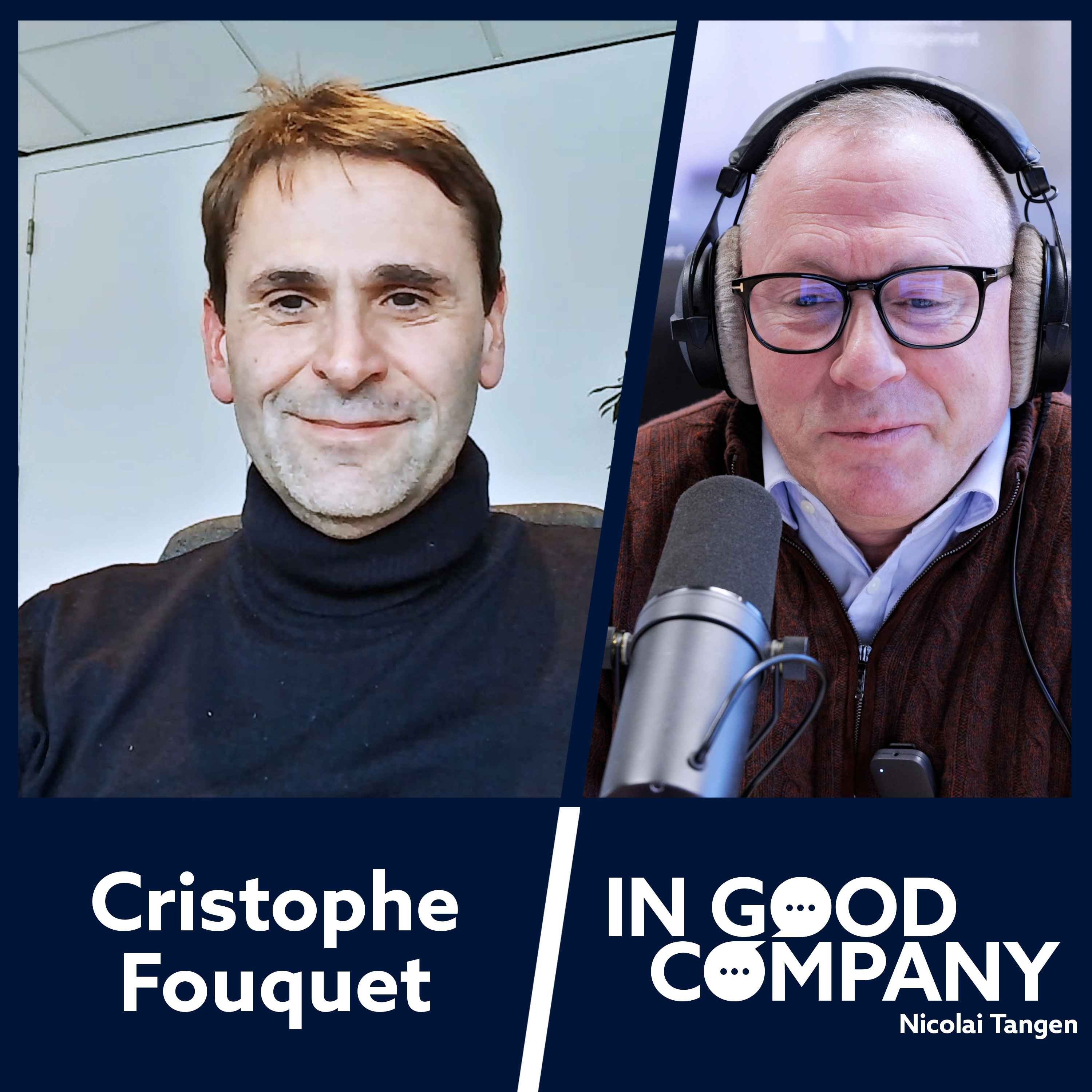
In this episode, Nicolai Tangen speaks with Christophe Fouquet, President and CEO of ASML - the company that makes the ultra-sophisticated machines needed to produce the world's most advanced computer chips. They discuss ASML's groundbreaking technology, the future of semiconductors, geopolitical challenges in the industry, and Fouquet's approach to leadership at one of the world's most strategically important companies.
In Good Company is hosted by Nicolai Tangen, CEO of Norges Bank Investment Management. New full episodes every Wednesday, and don't miss our Highlight episodes every Friday.
The production team for this episode includes Isabelle Karlsson and PLAN-B's Niklas Figenschau Johansen, Sebastian Langvik-Hansen and Pål Huuse. Background research was conducted by Sara Arnesen.
Hosted on Acast. See acast.com/privacy for more information.


