
 Ask ChatGPT


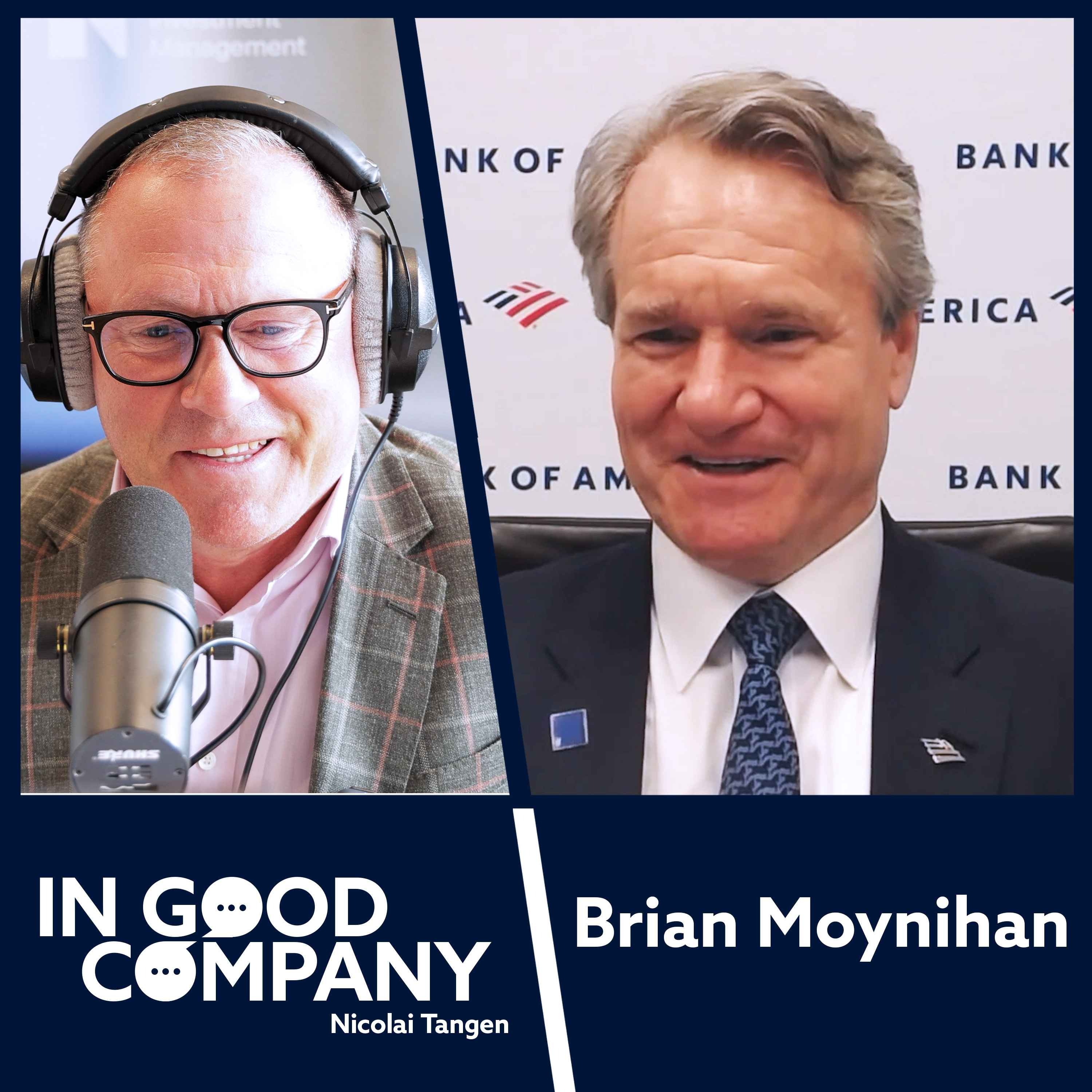
 In Good Company with Nicolai Tangen
13 Aug 2025 · 46m
Written by AI. May contain mistakes.

Get the gist, explore an idea or ask about something said.
 Claude
On In Good Company with Nicolai Tangen, what are the key points of this episode?
Searching your listeningAutomatic transcript. May contain errors.
0:01Hi, everybody. I'm Nikolaj Tangen, the CEO of the Norwegian Sovereign Wealth Fund. And today I'm thrilled to have Brian Moynihan with us. Brian is the chairman and CEO of Bank of America, one of the world's largest financial institutions. And we own 1.5 % of this great company. Brian has led the bank for 15 years, steering it through the aftermath of the financial crisis and transformed it into a digital powerhouse. So, Brian, wonderful to have you here. It's great to be here. And thank you for your support to our company and look forward to a great session with you today.
0:41Brian, you sit on the top of one of the world's largest banks. What's happening in the world? Well, I think there's a little bit of bifurcation between what's happening in various segments of the world, but you can add it all up to the world. But I think largely what's being driven now is the United States change and its policy from an economic basis, leave aside a geopolitical basis, But on an economic basis, a major change going on is that U.S. has changed with respect to four policies, trade tariff type policies, immigration policies. This is more domestic in the U.S., but the taxation, budget policy and then deregulation.
1:20And you're seeing that play out in the U.S. and obviously as a world's large economy and the biggest trading partner with most countries, you're seeing that impact around the world as we go through that change in the set of policies with the new Trump administration. So when you try to get a feel for where the world is moving, what are the indicators you are looking at? So when you look around the world, you look at a lot of indicators. But again, bring our additional perspective on the U.S. We have a great research team, which your firm and others benefit by. That's a major investment, a half billion dollars a year annual investment in research.
1:58And they have the world growing a little bit less than 3 % for this year. They have the world in terms of slowing down a little bit based on all the discussions we could have about trade and tariff policy. But when you look at the U.S., what we look at is not only what that research team tells us, which the U.S. will grow at 1 % fourth quarter of 25 versus 24, to give you a sense, annualized. You know, when they give us that kind of projection, no recession, Fed's not going to cut rates. Then we look at our actual customer data. And if you look at our customer data, we have great insight in American consumer, 70 million American households we do business with.
2:35We have great insight as largest small business lender and middle market lender in the U.S. And those basically are telling you interesting things. That's what we look at. Then as broader indicators, I look at, and we can go into what they're telling us, but in broader indicators, I also look in the U.S. importantly about new claims for unemployment, continuing claims for unemployment, because frankly, that's a leading indicator of what businesses are really doing versus what they're saying. Have you any private kind of secret indicators that you are particularly keen on that nobody else is really looking at?
3:06Well, if you look at the American consumer, the discussion of public domain was as consumer confidence factors went down after Liberation Day, April 2nd, and went back up, all the back and forth. what we did saw was no break and no change in activity so how what are we talking about the the bank of america consumers 70 million will send out their accounts about four four and a half trillion dollars this year into the economy year to date it's almost two trillion because we're almost halfway through the year if you look at that it's up about four and a half to five percent of the first part of 25 versus the first part of 24 if you look at the month of june four or 4.5%.
3:48When you look at that amount of money going in the economy, that means the American consumer is participating heavily. When you look at their balances and accounts, stable to growing, bouncing around, the core consumer kind of stable and the higher end consumer money went into the market funds and other instruments that are in interest, but the amount of cash they have is actually at record highs. And so they're in pretty good shape. Unemployment's 4.2 % or whatever. The prospects for being unemployed are relatively low. So you put that aside, and then you have to balance that against what consumers are saying they're feeling, which is negative due to all the change and all the activity going on, meaning what's that mean?
4:25That means the tariff war. That means immigration. That means the reading at the economy is slowing down. And so what we see is U.S. consumers doing pretty well. We look at small, medium-sized businesses. Brian, are you surprised that the consumer is doing so well? No. Given the uncertainty? And it comes down to, Nicola, the thing people miss is that the unemployment level is 4.1 in the U.S., which is 100 basis points per low full employment, number one. And number two, wage growth is actually exceeding inflation and the aggregate across a period of time. Now, it ebbs and flows. Inflation came first and wage growth cut up to it, and now they're running more in sync.
5:00And then, remember, the U.S. consumer is a beneficiary of America's oil independence, and that allows us to have a more balanced view when oil prices move around. but as oil prices came down that's a big benefit to the American consumer because that just gives them more money to spend on something else so I'm not surprised by it consumer credit is very strong I'm not surprised by it at all I can understand why the people are surprised by it and that's because they're reading survey data and that's what a consumer is on the couch that's what they're telling you how they feel I always say look at what they're doing not what they say they're feeling why are they doing things differently than what they feel because they have money and are employed and they're pretty good at spending in America.
5:43And so that doesn't mean that won't stop. It just means that earlier this year, when everybody said the American consumer was being broken by all this stuff, a year and a half ago, an American consumer was supposed to be being broken by all this stuff. It never happened. They just kept spending and spending and spending. The stimulus payments that came through in 2021, people thought they were going to spend those down. They really didn't. The balancing accounts kept going. basically came down a little bit and then started growing again. And so it all comes down to the American economy is in okay shape.
6:16It's slowing down. And this is the trick. The trick will be balancing the impact of all this uncertainty around the business community, which gets hit by higher rates faster, especially small, medium-sized businesses, and also is confused about what the rules of the game are, that they need straightening out tax policy and trade policy and immigration for those in certain industries. They need those workers. And if that doesn't clear up, then I could see people starting to actually really adjust their cost basis. And that would affect the American consumer because they'd be more worried about not having a job.
6:47Are people with one political affiliation spending more than the people with the other political affiliation? I mean, are they feeling better about life? We don't really see. That's a little hard for us to tell in our spending because we don't have that data for our people. But if you look at it more broadly in the surveys, you see that people who in the Michigan survey, you can see in other surveys, you can see it's split by party affiliation in terms of their views of the future path of inflation, of the future path of the economy. When it averages all out, because America is a 50-50 split by and large, it kind of averages each other out.
7:20So people, I think, overplay that because they're trying to make a political point. But I always say don't look at what people say they're going to do. look at what they're actually going to do. Whether it's a person on credit, are they going to pay it? It's not whether they say they're going to pay, it's whether they are paying. And a person on spending, it's not whether they say they're going to spend or not, it's what they're doing. And I think the consumer has adjusted their spending around, but it's pretty good. Now, if you go to small, medium-sized businesses, this is where the Fed's rate structure really, really pinches.
7:46And people are writing more about that, but it took a while for people to understand that because large companies go to the markets and are not affecting a flat rate curve, allows them to go out the curve and actually secure longer-term funds. The problem is a person who's running a$50 million,$100 million,$200 million revenue company, they're borrowing on the lines of credit. And that base rate went from 25 basis points to 50 basis points up to five and now down to four. That change is a huge change in the rate paid. And that slowed the businesses down in terms of making decisions. And you can see it that they aren't using the lines of credit at the level they were pre-pandemic.
8:25And sort of why not? The economy is growing well off. The opportunity for demand fulfillment is out there. And it's because they're worried. They aren't buying a piece of equipment. They're not making a change. And that's what we cite when we talk to the administration in the United States and say, you really need to settle this in so that group of small, medium-sized businesses will get more aggressive. And as the Fed brings rate structure down, they'll feel better. Is it the level of rates which is the main concern for the business clients? or is it other types of uncertainty, you think? Well, our survey of small business customers over the last year has shown different elements.
9:04First, it was rates and inflation because that was preoccupied. And then it shifted back to workers. When I say back to workers, it was at that during the Great Resignation a couple of years ago in the United States. And what they're saying is the inability to get enough employees that can do the jobs that they have. That is being exacerbated by a lot of discussion you hear from them about the impact inflation. And if you're in construction and all its related parts, you're a cement company, you're a delivery company, you're construction, actually building the buildings, the impact of the immigration policy is causing people not to show up.
9:38If you're in the hotel and leisure farming, it's impacting you. And so I think in the broad-based employees, that's why you're hearing the administration saying, we got to sort this out to make sure people know they're going to have the workers to be successful and being agriculture and travel and entertainment and other types of industries because it's not that the activity is affecting a lot of them it's the worry about the activity that's going to affect them that causes the workers not to come so they went from being all about inflation all about rates to wait i can't get the workers again and can i get those workers so everything everything's on their mind but uncertainty about some of these topics is critical to them what about supply chain disruptions.
10:19Is that a main topic for your clients? Yeah, it is. I mean, I fit that more in a tariff. And look, at the end of the day, we all learned something during COVID, which is the world's supply chains became extremely efficient. The problem was they weren't extremely resilient. And so as these tariffs go on, people are seeing sort of, I've got to be able to move my supply chain to places where maybe more favored as a trading partner in America, if I'm bringing my goods into America. The real short-term thing is if I'm getting my goods from certain countries, if I have the same good manufactured in a country with tariffs of 10%, 15 % versus 30%, 40%, and I'm going to supply to the same store to sell, guess what?
11:03Whose is going to get sold at a lower price unless I just eat the tariffs? So going back to Liberation Day, that's what sent the shock to the system. The market went way down, the reaction to it. as it became clear that they were going to get deals done and try to mitigate the overall size of the tariff that happened. But the companies have two things they're thinking about supply chain. One is, what is the tariff architecture, trade architecture, non-tariff barrier architecture? And then secondly, what is the plain facts about the ability to have a supply chain that if something happens in a narrow, in a very specific place, it doesn't affect them.
11:41That we learned in COVID. Surgical masks, certain types of medical equipment, certain types of formularies, leave aside the high tech and chips and chips and everything. This is just basic stuff. You couldn't get it out of the country because of a particular area was going through a stress. That's not resiliency. And I think a lot of supply chain managers said, whoa, you're telling me I can't get this at any price? And they're saying, yes. They're saying, well, fix that. And that means you have the Vietnams and others, Mexicos and others will benefit by the supply chain sort of spreading out.
12:15Moving, topping a bit, many banks are closing their branches. You still seem to be a great believer in your branches. You got close to 4 ,000 of them. Why do you have a different view on branches than many other banks? Well, we believe in high touch, high tech, and we follow the customer. And the customer shows us they like to do all of the above, right? And so whether they like the phone channel, they like the branch channel, they like the mobile channel and online channel, they like all the different ways that are faced with the company. And if you look at what's happened over time, we've gone from 6 ,000 branches to 3 ,700, 3 ,800 branches today.
12:53We've added branches in new cities while we still have gone down. We've gone from 100 ,000 people working in our consumer business to about 60 ,000 today. that's a massive reduction due to the digitization customer behavior change but between the next today and tomorrow you know 24 hour period a half million 350 000 people will come down to our branches and so and who and who are these people are they mainly everybody says it's a you know it's a older cohorts and stuff it's just not true it's it's a whole bunch of people it's small it's entrepreneurs who want to open their accounts it's people coming in from investment advice largely what's big transformation is a lot of the routine activity.
13:32The strategy of branches starting 30 years ago was to basically take variability out, to make it a machine operation and make it very process-oriented. And so we did that. That made them efficient, say, from 30 years ago to 20 years ago. Then we said, wait a second, a lot of these transactions can actually be done by the customer themselves, depositing a check. and that can be done through a mobile device. It could be done through the ATM and suddenly we're able to move activity out. What that then left behind is what really is important, which is in those 60 ,000 people today, we have probably twice the relationship capacity we did back then because people tend to come in for more difficult issues.
14:16My mother died. I'm trying to figure out how to get the power of attorney so I can work with accounts. I need a mortgage loan. I just got my first bonus and I'm a younger person. I want to figure out how to invest it. And we have 2 ,500 FAs, we call them, financial associates, in the branches that will help them start with Merrill Lynch. So the complexity of the branches have changed to be much more relationship-oriented. That's why the visit time is much more schedulable and understandable as opposed to people coming in and doing routine transactions. That principle applies to all cohorts of age.
14:52There's no difference. If my mother died and I'm 60 and my mother died and I'm 30, the issue is I've got to figure out how to handle her accounts. So there's not as much distinction on those types of issues. Brian, you've been pretty vocal when it comes to regulation of banks. And we love people who are vocal about what they really believe in. So tell us, what is your take on bank regulations today? Well, if you look at it today, it's a classic case of the pendulum swung past the point and also became sort of unreconcilable with each other. So if you go back to the financial crisis, Dodd-Frank in the United States, Basel III implementation on a global basis, all these things were meant to basically look at the core things that they thought were inadequate after the financial crisis.
15:44One of the core things that was inadequate that people forget about, there's a lot of companies that caused the stress and financial crisis. We're not in the banks. In the system, we're not regulated. First, you brought the companies in. Then it was capital, liquidity, range of activities of those companies, get them out of private equity, more principal activities, and more into supporting clients like yourselves. Let you guys make the investments. Let the private equity firms make the investments. Don't compete against them. So, it was a range of activities. And then it went down the road, the models and how to build models and things like that.
16:14But what happened in that timeframe, especially in the United States, is the way the rules kept changing is going back when we thought that the capital ratios and banks of 7%, 8 % would be adequate under the first after Dodd -Frank. And that was still 25%, 30 % increase probably from where people were to there. And people said that would be enough. We now went from 7%, 8 % is adequate to 11 % is adequate. And the risk in the industry has actually, quite frankly, probably come down on a relative basis or at a time. So if you look at all the regulations, where are the worst over-regulations? Well, first of all, in 2018, 2019, the capital industry was sufficient, and it's gone up by 25%, and now they say it's sufficient.
16:58So I think what they have to do is get the capital rules set. They have to get Basel III implemented in the United States, but on a fair basis because we use a different standard. We've got capital rules set. We've got to get rid of some of the overlapping liquidity rules, which you're seeing with this supplemental leverage ratio change. And we've got to get clearer about our ability to engage in more modern commerce. That's around stable coins and things like that because it wasn't clear before. And then you've got to let banks go out. And this is appropriate for Bank of America because we're not allowed.
17:28Let the mergers take place faster because there's 4 ,000 banks in the United States and there'll be changes in that system. and they've got to not try to over-regulate that change for purpose that have nothing to do with the merger. So I think capital liquidity, merger rules, and then, frankly, the consumer regulation stuff just got much more penalty-oriented, much more fine-oriented, much more beyond what consumers want and got away from consumer choice. That's already swung back too. And there's high hopes this administration would get it back to balance. Anything which is not regulated enough?
17:58I think we always have – Like private credit, alternative providers of credit, and so on. Where do you see that? So the principle that's getting lost a little bit, Nicolai, in the last chunk of time here is the banking regulators being sort of what their charter is across the world. Always only look at the banking system and then try to regulate the outside of the banking system through the banking system. As opposed to saying, wait, if you make loans or take deposits, you're a bank. Whether you're a stablecoin provider or whether you're a private capital lender, you have to be regulated, a mortgage lender, etc.
18:38So the Consumer Bureau in the United States was meant to expand by activity, not by charter, as they call it. Activity meaning I make a mortgage loan, charter, I'm a bank versus non-bank. So it went to do that. That was a good thing. Unfortunately, it bollocksed up in different ways and got away from its core charter. But that's a good thing. That's not happening in the commercial space. In other words, there's lots of entrants in the system who are not regulated in the same way as other entrants. And what that means is you start to get into regulatory arbitrage, so-called, right? If I can do this outside the system, and that's where the banking system, if you look in the United States, where it's simpler to describe because of the depth of capital markets, half of every asset class, meaning commercial loans, consumer loans, or more, is outside our banking system.
19:23And so, you know, and you're saying, is that a good thing or a bad thing? You could say it's a good thing as it spreads a risk, but it's not a good thing if the activity goes on in a different regulation. So if we're allowed to do leverage of X for a company and that looks like good credit, why can somebody just put it in a different place and do more leverage? They may be right, but then why can't we do it? You shouldn't have regulatory leakage cause a problem. That piece got lost in the banking regulation principles that Dodd-Frank came in and around the world. all these institutions came into the banking environment, were regulated by the ECB, by the PRA, et cetera, et cetera.
19:58Now they're leaking back out, and that's the question. You are in many different countries. Outside of the U.S., which countries are you the most excited about? Well, we continue to be excited about what's going on in the Middle East in terms of inward development now. In the days where people wouldn't say, you're making money, give us your money to go manage. It's a different world and different... possibilities for banking. We've been in Dubai for 60 years, so it's not like a new thing to us. But what's going on in Saudi Arabia, what's going on in the UAE, and helping those companies grow and prosper, that's kind of very interesting.
20:34Asia will always be interesting. It ebbs and flows where it's interesting. We have a great franchise in Australia, which continues to grow. We've got a good business in Japan, which has a newfound shareholder discipline and stuff, which ought to be good for investment banking capabilities. And then Europe, we believe that we have lots of market share to gain. It's not Europe grows at 1%, but we think with our products and services, our capabilities, whether it's in the corporate investment banking space or in the market space, we just have a lot of room to grow. And the UK and Europe, I put together in that case, and all of the European sort of broader set of countries.
21:11And so we feel there's growth opportunities everywhere. In fact, our international business, just to give you a sense of how big it's, how much our companies change because our name is Bank of America. Everybody thinks of America. Our international business, we went from approximately$20 billion in outstanding loans 15 years ago, about$130,$150 billion today. So it's grown dramatically and has keyed us to take those multinational clients across the world and help them navigate all the economies. India is another good country. We've been there 60 plus years. We've been in these countries a long time and we keep investing and they're all good opportunities, especially when you have a world is very disaggregated market share like it is in banking.
21:49You reminded us that your name is Bank of America. And of course, this is a bit of a sensitive question. But, you know, in some parts of the world, the view of America has changed a bit lately. Do you think, is Bank of America a good name to have? It is. It's a great brand. We do a lot of research on it. And so the great positives It comes with, obviously, in a world where people want to take a position about America, say something about America, your Bank of America. People confuse us with the Fed. We're not the Fed because in certain countries, the Bank of X is the central bank. We're not the central bank.
22:24And so you get some interesting, fun happenings around that where people write a letter to me acting like I'm setting interest rates or something, which I'm not. But, you know, it's a great franchise, a great brand. And we have Merrill for the financial advisory business in the U.S. because it's distinctive. But outside the U.S., we basically operate as Bank of America, except where it's not legal to do that because we do a securities business and then we operate Bank of America, Merrill Lynch or some other configuration. But it's a great brand and we take its pluses and minuses. And, you know, at the end of the day, we've been around this country since George Washington was president in the oldest parts of our bank.
23:02So it's been a good ride.
23:08moving on to technology how will ai transform the bank it it's already started um so it's going to transform the bank around a couple dimensions are different and it's started in earnest first it enables you to have replace uh human interaction with to human interaction. Second, it replaces your, it helps you analyze what we call text-to-text. In other words, big amounts of information. How do you pull them together and have them come out the other side so somebody then can take that and utilize it differently. It also can help you with testing and checking things. We file literally millions and millions of reports a day and it helps you not only prepare those, but more importantly, to test those to make sure they're accurate and helps you find out ways to improve them.
23:59So, you know, if you back and it helps us in computer coding, we're already using it. 18 ,000 plus programmers already use it and stuff. So let me give a very concrete, straightforward example. So this product, this technique we called Erica. So Erica is the way a consumer can have a virtual assistant at Bank of America. You're hearing a lot about agent bots and all that stuff. We've had this now for five, seven, eight years. We started about 10, 12 years ago. And what we had them develop is we looked at the search technology and it just wasn't going to work in financial services. So we had them develop a new natural language processing predictive model, which today we call a small language model.
24:43Back then, nobody would have called it that because it was a different world. We had them build that for us. And then we used it and trained on our own data, and it can answer questions. And now 20 million Bank of America customers use Erika each quarter about 200 million times to ask questions that it can answer. Now, Erika has a lot of room to go in refinements and improvements and doing it, but we know it works. And those 200 million interactions would have been a phone call, a text or an email, or walking at a branch. So 200 million times a quarter, we're moving. We're heavy digitalized already.
25:16We have 50 billion consumer interactions a year. So it's a massive amount of activity. It's heavily digitalized. But the room to go to digitalize more with AI is different than with the machine learning and other types of models we had. And Erica shows us that bridge. And when you benchmark your usage of AI and technology against other banks, what do you see? This is where you get in the question of what people say they're doing and what we're doing. We see Erica out there working. We don't see any product that's actually – we see certain products are just emerging that could do that. We've seen what we've done in coding and other people are talking about it.
25:55We have 18 ,000 people literally doing this today. So we feel we are a company of applied technology in just massive, massive amounts. So we spend about$4,$4.5 billion a year on technology initiatives, we call it, which is new code and new work. We apply that relentlessly. We're one of the largest patent holders for all kinds of technology, including AA technology applications in the U.S. And so our view is we're state of the art and beyond. But what we are doing is announcing things which don't stick to the ribs. We're very much a company that says we'll tell people after it's already operating and drive it through the system.
26:33And so with coding, a lot of people talk about I'm doing this. What we say is let's get people going. And we're saving about, there's 21 steps in a project to go from business initiation to endpoint. Five or six of them are capable of being enhanced by artificial intelligence. We're using it, 18 ,000 people. We're saving about 30 % of those five steps, which gets about 10 % overall. And so we're much more an applied driver of it. And nobody has anything like Erica in size and scale. Nobody has the automated underwriting. We do things like that. But the real question is, how do you keep driving this to new places?
27:09And so our teammates in an investment bank are preparing pitch books. We just started, implemented that. They all still have people in front of them to make sure they're right and how they work, but it gives them a leg up. And so we're applying this daily customer interactions in the markets business. They're all driven by artificial intelligence off the base of our research, not grabbing stuff from all over everywhere and throwing together and making mistakes. It takes our research and organizes and delivers it out in a more comprehensive fashion. to our clients and so the maestro every day shoots that out to everybody so we believe in applying this technology so when you have um deployed all your user cases and all everybody else have deployed all their user cases and you have you know the humanoid helping us on the on the blue collar side what what is society going to look like well i think this is one of the great questions out there but but you can talk from experience so our company uh you this is my 16th year having the honor of running the place and we've driven a lot of change.
28:14In 2010, we had 285 ,000 people. Today, we have 212 ,000 people. So that's all. The numbers of customers are larger. The numbers of interactions are through the roof. The numbers of size of the loan book is bigger. Size of the deposit book is almost threefold bigger. Numbers of consumer transactions, blah, blah, blah, blah, blah. Trading transactions, quotes, everything. It's a hugely bigger company, but 30 % less people. That was all by applying technology. What this gives you is a chance to go to places you couldn't go before. And so what we did is we took the company and took compensation levels, AI susceptibility, the one axis compensation levels, the other axis AI susceptibility, and then dots for how big the numbers of people doing those activities are.
29:05And what you're looking for is dots that are susceptible, that are highly paid, that are big volumes of people. And that's what you're trying to go after. So that's different than the automation we went through 15 years ago. It was more processing teammates and things like that. We only have 25 ,000 processing teammates in a company, maybe 30 ,000 out of 200-some thousand. So as the work has already shifted, this allows you to go to different places, to our risk teammates, our finance teammates, our HR teammates. The HR team uses some techniques in terms of resumes and things like that. That's the difference here.
29:40And so what's the societal impact of that? I'll give you the last half full, half empty. In 1969, America employed 80 million people worked in America. In 1960s, the advent of computers, the advent of technology, the idea that all the jobs were going to go to Japan, Inc. At that point, it was before China emerged. The idea that the U.S. was going to be more abundant employment. Today, we have 160 million people working. And so something happened as all that technology, I think, from the late 60s now came on stream, that we were able to employ twice as many people in this country. And so I think, simply put, the world has a way of working, a way around us.
30:17This goes to different places. I can understand why people are a little concerned. But on the other hand, you know, at a firm like yours, which is a brainpower firm, and that's what you do, it'll help people be more effective. It'll make, and over time, you may be able to trim your aggregate headcount. But it doesn't mean you're going to – it's going to be a long time and maybe someday people can fantasize about it before we have no people left.
30:44So, Brian, you became CEO in 2010 after the financial crisis. What's the toughest decision you made during your tenure in the bank? Well, the toughest decisions all ran around how we got through the aftermath of financial crisis and how we had to be so resolute on resolving issues. So we had a quarter where we settled lawsuits, the$20 billion lawsuit, etc. Those are tough decisions. It wasn't necessarily the financial decision. That was tough enough. But it was the people on vacations of deciding to take a completely different position in the mortgage business. And from a company that was doing one in five mortgages, we had to go down to where we got to 5 % share because what we were doing was not directly with consumers.
31:30Those were hard decisions because they affected people's lives and our ability and had to retrain our whole brainpower in the company. All the decisions that are toughest are about people and disrupting other people's lives. So downsizing people, changing people. And that's why we frankly worked very hard to do headcount management to avoid layoffs. And we've been pretty good at it the last 10, 15 years. In the early days, we had to do some layoffs. And to me, that's the toughest decision because you're basically walking into somebody who was a great worker, worked for the company and say, you know what, we just can't use you anymore.
32:03And that's going to our AI conversations, why we're managing headcount so carefully and trying to figure out how to make sure that we aren't overstaffing and then having to take people out. The other tough decision - Do you tell anybody yourself or is it delegated to other people? Oh, I never start a process like this unless I'm willing to change the people who work for me. So actually, ironically, in the first downsizing we did as a financial crisis, I lost my job. And it was before I was CEO. I was running integration and I decided that one of the positions they had to eliminate was mine. And I was almost out of the company and they offered me a different job and I stayed.
32:43So I believe resolutely that you have to start from the top. This is not a bottoms-up thing. And I also believe resolutely that management has to be careful on staffing to ensure that they don't disrupt the broad base of employees. And this has come from a guy for 25, 30 years who spent his life doing M &A, merger integration, relentless takeout of costs. as you went to organic growth company, you have to be much more careful because when you're doing a merger company A, company B, people know that there's going to be changes. When you're an organic growth company like we are now, people don't anticipate there's going to be those kinds of changes.
33:22So you have to manage in performance management, et cetera. So yes, I had to tell myself and I would expect that of all my direct reports cascade through, you know, at those times, had to take action. We basically run the company so we don't have to do that again. You mentioned M &A and many other banks have kind of pivoted into wealth management, fintech, acquired things. Now, Bank of America has maintained a very steady course. Why is that? Well, there's one I don't want to go to jail because it's illegal to acquire banks in the US if you're above 10 % deposit. It's not criminally responsible, but it's just against the law, honestly.
34:07And so we cannot acquire another bank with deposit unless that bank fails. And so - Yeah, but lots of other stuff you can buy, right? You know, wealth management. Let me go to wealth management and other stuff. A lot of it has deposits in it, and so we've been careful about that. But let me step back. In the end of the day, we have such an organic growth capability in this company. So our highest market shares are in the low, you know, 10%, 13%, 14%. we got a lot of room to grow and we have the brand capability uh the the teammate capability that you know the product capability you can just drive the organic growth so when people say we got out of the asset management business because we thought it was inconsistent being the biggest distribution house we have four and a half trillion dollars in wealth management assets you know we take great companies and manage money and get them into our investors we didn't need to make the product, honestly.
34:58And so we got out of, we sold that, but that doesn't mean we don't have a huge stake in wealth management. It's one of the biggest in the business. So that happens. And so we're always trying to think through how do we, our basic principles, we have eight customers, businesses, we go after the customers directly. We don't do indirect business. So we try to really focus on that. And that led us to saying our best thing was to be giving financial advice to the customer, whether it's automatically through Merrill Edge or personally through the private bank or Merrill rather than, you know, basically it's a wholesaling asset manager product.
35:32So as we look forward, we bought companies and payments, you know, and payment technology. So we bought companies and medical payments in other areas. And we will continue to do that to add products and capabilities in the payments area. And we've also formed companies. So Zelle, which had a predecessor, was formed by the industry. We formed companies to help drive that. We'll continue to do that. So, you know, our view is we're, again, a growth company, and we've got to be focused here. And then if we see a market opportunity, like in the 401k business, we invested, you know,$100 million in our business and drove it because with a, you know,$65,$70 billion expense base, an incremental$100,$200 million rather than doing an acquisition.
36:14If you can even find a company and figure out how to reconfigure it, you could just drive it and drive it through the sales force. So we've learned a lesson about how fast we can drive things in the world to spend the money to support it. How would you describe the corporate culture in the mic? The corporate culture? Look, I think it's embedded in the phrase, the question we asked, what would you like the power to do? Our culture is to help serve our clients, to help them achieve their financial goals, and do that and serve all our constituents. Our clients, our customers, help them meet their goals.
36:45Our teammates help each other meet their goals. Our shareholders help them meet their goals. And our communities, because at the end of the day, we have to make sure our communities are strong and resilient because that's the core base of the economy of which we make our money. Do you think the corporate culture in your bank is very different from other banks? Or is a banker a banker? I think the products and services are more commodity. The way you deliver them is not. And so delivering on a customer-focused basis, direct to the customer, not having those places that are indirectly customer businesses, et cetera, That is different, but in our products, our brand, and our capabilities, our talent, the fact we're global, the fact we're nationwide, those are all very unique things.
37:31There's only a couple of us can do what we do on a global basis for corporates and investors around the world. There's only a handful of companies. So those are very unique. But you said a checking account is a checking account. But how you deliver that checking account on a customer-focused, integrated rewards basis, that takes a philosophical difference. And then how do you position yourself and our customers, our teammates, how they desire to help the customers put our brand at the best, just keeps going up and up and up in terms of satisfaction in all our businesses. That's unique. That focus, I think, is unique.
38:06Okay. So now we're coming into one of your 3 ,700 branches, okay? I'm 52 years old, got a checking account. How can I feel that Bank of America is different from other banks? Well, I'll tell you a story. I was sitting next to somebody that I didn't know, and they turned to me, and they said, you know, we went in with three generations in my family a day, my father, me, and my son, and we all had business. And the people did such a great job. Her father, who had been a leader in the military, said they brought a pretty good unit on the way out the door, which meaning the execution was strong. But all the customers felt that way.
38:52She said they took great care of my father. They took great care of me. My son was excited to open his first bank account. That's what we want to instill is that at the point of time, that happens over and over and over again. And by the way, my email is in a public domain. If a customer doesn't get that experience, they're not feel for letting me know. And so they can send an email directly to me and to our other teammates at the top of the house. So we hear about anything goes bump in the night, and we try to figure out why and re-engineer it. That's the process side of running this huge enterprise.
39:23You leave nothing to chance. But the feeling side you want is that customer who came just unsolicited to tell me, to your point, I walked in your branch and I got this experience. And that customer didn't know me. Other customers know me will tell it, but that customer I'd never met in my life until I sat next to him at a thing that was unrelated to a bank. What do you think is the key to building a high-performance culture? Look, at the end of the day, you've got to get great people. You've got to coach them. And the number one thing is they've got to believe the company is in it for them. So they continue to seek development.
39:54They continue to seek advice. They continue to learn. and they feel that the culture not only will help them do the day-to-day, save, protect their family, keep their family healthy, that stuff. They really want to know, this company is going to help me do something here I can't otherwise do. And so in areas where we're recruiting against the biggest, best firms in the world that you can describe in technology or cybersecurity, the people come here because they know they can do special things, but they also know that we're going to do it the right way. And I think that's the key to getting that talent.
40:26You got to get that talent, but you've got to make sure that talent thrives. And so we take an employee survey and we just got back the results and it continues to increase and up a couple of points since last year. But 180 ,000 people felt that survey. And we asked them, what do they think about the company? And 48 questions and we've been doing it for 30 years and we can look at the nuances. But you want them to say, I believe my manager is going to make me better. And I believe I can do anything I can do with this company and I can seize on that opportunity. That's what gets that culture going that you want because that then means the best advice will come stay and prosper where do where do you personally seek advice i look i get my advice from doing what i suggest i i read a lot from a lot of sources a lot of sources that i might may or may not agree with and then i have you know i always am watching what other companies do and what other ceos do and whatever ceos in the past have done and it's not like i go to x and say what do you think it's more, you get a panoply of X's and say, how do you think about how they thought through these questions?
41:31So I've had the luck of having great mentors along the way. But every time I sit in a session, I'm always trying to figure out how some of my peers analyzed a problem that I made out of thought to what they're thinking about or other companies, what they're thinking about or listen to clients. And so it's just, you got to be a learning machine. And that's the trick about being a CEO or anybody in our society today is the information is curated to you and you have to avoid curation. You have to seek beyond that. You have to try to find out different things. And then in an industry where you're the leading company, one of the leading companies, you also have to look outside our industry a lot to what is important.
42:11So when we think about our brand, yes, in financial services, et cetera, but what are the best brands that ever existed and why? and when did great brands make mistakes. That's where you think about Jim Collins and the great business writers and why they might fall and all these different things. You're always trying to figure out from all that sort of – What are the best brands which ever existed? We look at them all, all the big consumer brands, all the big institutional brands. People have grown market share organically across periods of time and we're citing them, and I won't name them because that's not fair to them or to the ones I wouldn't name, but you'd have your usual suspects.
42:48But you're always in a different business, so you can't just say they did this, we do that. You have to sit there and say, what were the principles by which they did this? What are the biggest reasons for failure that you are trying to avoid? I think, A, complacency. B, you get stuck in bureaucracy and progress, a large company. How do you break through that? C, you don't get ahead or get ahead of a trend. And this is where AI is kind of interesting. We've got to utilize this and drive it. But if you get too far ahead, you can bet the company in a way that may not work. And so that's the source of failure.
43:22People will get too far ahead of a trend or don't keep up with the trend and or don't keep the brand fresh. You don't think they're doing well when they're not doing well and willing to poke at it and ask questions. So while CEO always has to be optimistic, you know, in the heat of the night, you have to be very sort of what am I? What are we doing wrong? What can we do better all the time? But you have to make sure you translate that into action, into process, so it gets done. And that's tricky. How do you remain a learning machine? I get up early in the morning and I just start reading multiple papers, multiple new sources, multiple research papers.
44:01And you're just listening out there. You're always listening and trying to learn. And by the way, we talk about young kids today. one of the fears I have is the curation of the way they get fed, the way we all get fed. I shouldn't say it's young people. It's everybody. The way we all get fed through news feeds and the algorithm and stuff narrows your scope as opposed to improves your scope. But there's a book written by a fellow named Brian Grazer, who's a great movie producer, writer, et cetera, called A Curious Mind. I always recommend that to the young kids because they say it talks about his career.
44:36It's a fun story. He's a wonderful human being and done wonderful things. but he did it a lot by just asking questions, learning a lot. And, you know, I said to people, that's the way to pattern your life. I ran into that book, you know, 10 years ago or so. But, you know, but you look at that story and that, I suggest your listeners read that book. It's 275 pages, but it just keeps reminding you that if you keep trying to learn, you'll be a powerful engine. And, but if you stop learning, you get curated. That's a, that's a problem. So I get information from lots of sources, But the key is how do you keep making sure that aperture stays open and doesn't get closed?
45:11Because every time you look at X, Y, and Z, it starts to shove into that corner under the modern techniques for information delivery. Well, I think that's a great place to end because normally, guess what? We end with advice to young people, and you've already given it. It seems like you have to read that book to remain a learning machine like you have. And it's for sure very impressive what you have achieved. So big thanks for being with us today. Thank you.
What does it take to steer one of the world's largest banks through unprecedented change? Nicolai Tangen speaks with Brian Moynihan, the CEO of Bank of America, to explore the global economy and what lies ahead. They discuss how AI is transforming banking operations, the future of physical branches, and why Brian believes regulatory pendulums have swung too far. The conversation covers international expansion, the resilience of American consumers, and his philosophy on building high-performance culture. Leading 212,000 employees and serving 70 million households, Brian shares insights on leadership and staying curious in an ever-changing world. Tune in for an insightful conversation!
In Good Company is hosted by Nicolai Tangen, CEO of Norges Bank Investment Management. New full episodes every Wednesday, and don't miss our Highlight episodes every Friday.
The production team for this episode includes Isabelle Karlsson and PLAN-B's Niklas Figenschau Johansen, Sebastian Langvik-Hansen and Pål Huuse. Background research was conducted by Torgeir Rimstad.
Hosted on Acast. See acast.com/privacy for more information.


