
 Ask ChatGPT


 In Good Company with Nicolai Tangen
28 Oct 2026 · 53m · 21 chapters
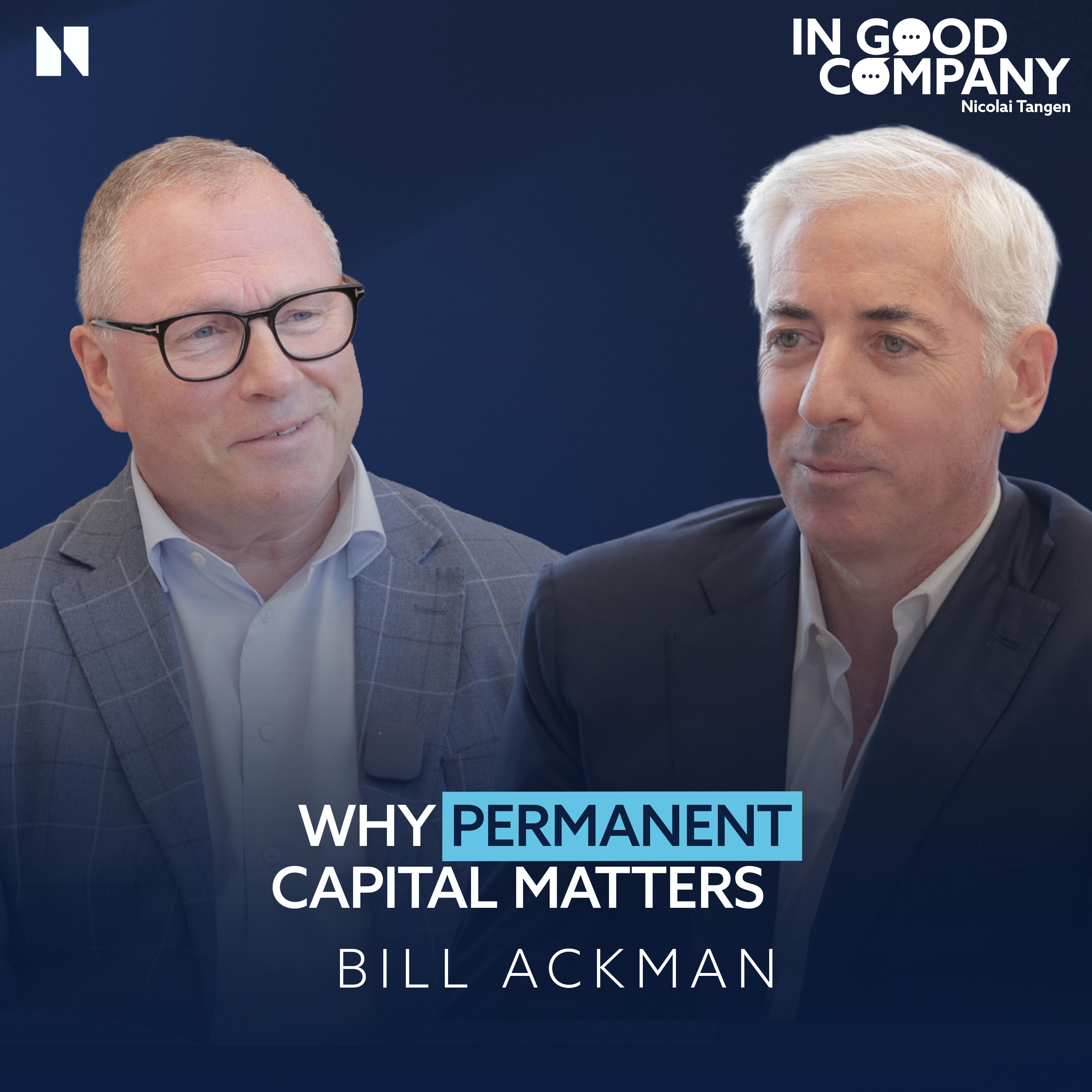
Bill Ackman (Pershing Square) explains how he seeks conviction in concentrated, long-term investing using “all-sides” debate, permanent capital, and a checklist for predictable, durable businesses; he also discusses AI’s market effects, why he’s less activist now, shareholder rights, and his family’s brain-hemorrhage tragedy and related brain-computer interface optimism.
Bill Ackman is founder of Pershing Square, known for concentrated holdings (about 9 investment professionals; ~48-person firm). Nikolaj Tangen is CEO of the Norwegian Sovereign Wealth Fund.
Great companies are predictable cash-flow businesses that can be modeled 10–20 years; conviction comes from rebutting the best short-seller arguments; permanent capital enables dispassionate investing during crises; AI accelerates short-term trading by instantly parsing filings; activism is less needed when owners can engage quietly; shareholder control matters for long-term discipline.
COVID insight from health passion; investments in Brookfield (after it shifted toward asset-light royalties), restaurants/franchise models, McDonald’s as real-estate/franchise; Microsoft/Meta/AWS as AI-related; Pershing Square’s move toward an insurance/float model inspired by Buffett; Carl Icahn dispute and later Herbalife short; daughter’s AVM brain hemorrhage and planned brain rehab/BCI institute.
Written by AI. May contain mistakes.
Learn how to build conviction in investment ideas through critical analysis.
“What's the best way to get conviction and investment idea?”
Understand what constitutes a great company and the industries they belong to.
“A great company is a business you can buy today.”
Discover how to uncover investment opportunities and the challenges involved.
“But we sort of built a library of companies we admire.”
Explore the sources of information that informed Bill Ackman's investing strategy.
“He's cultivated investors that have given him kind of long term backing.”
Learn about the investment principles and team structure at Pershing Square.
“Like news comes out and you learned it a week ago.”
Delve into the thorough due diligence process before making investments.
“You're like just under 50 people in the firm.”
Explore how AI influences investment decisions and market dynamics.
“You know, you can, a 10K gets published and AI can read it instantly.”
Learn about the changing nature of activism in investing and its effects.
“It's going to give almost everyone access to very low cost, very high intelligence.”
Discover Bill Ackman's experiences with Carl Icahn and the lessons learned.
“The only thing I think that's happened in terms of market dynamics, it used to be that a really high quality business that somehow disappointed the stock might drop three or 4%.”
Discuss the decline of shareholder rights in modern companies.
“And I sold him an interest in a company called Hallward Realty Partners at a big premium to where it was trading, but a big discount to what it was worth.”
Understand the advantages of having permanent capital in investment.
“I would say passion, intelligence, energy, and overall good leadership qualities.”
Explore the concept of permanent capital in investing and its implications for long-term strategies.
“But you can't be dispassionate if your clients are just going to pull your money.”
Discuss the transformation of the real estate business and investment philosophies inspired by Warren Buffett.
“company, reinvest the capital in the insurance operation, and then compound the capital in the insurance operation at a high rate over time.”
Examine how social media influences public conversations and personal perspectives.
“also I think I got most verbal something like this as my how people thought of me back then did you get very little attention from your parents when you were little?”
Bill Ackman shares his thoughts on free speech and academic freedom at Harvard post-October 7th events.
“I don't know that society is going to the objective truth.”
Bill Ackman discusses the challenges and progress in his daughter's recovery from a brain hemorrhage.
“Because something very important to me, I watched it diminish in a meaningful way.”
Discover advancements in brain-computer interfaces and optimism for recovery.
“You know, biggest challenge right now is the optic nerve damage from the pressure on the brain that has caused her to lose, you know, probably 98 % of her vision.”
Explore Bill Ackman's views on personal failure and daily gratitude rituals.
“doesn't have a parent or a sibling or someone who's had either an accident, a stroke, you know, gone to war and, you know, got taken a bullet or, you know, Alzheimer's or cognitive decline.”
Understand the philosophical insights from John Rawls' 'A Theory of Justice'.
“absolutely what's the one thing about you that people don't know I'm like the most transparent guy in America.”
Examine perspectives on America's global influence and military power.
“the basic constitutional rights, Bill of Rights type things that we've been offered.”
Learn Bill Ackman's advice on character, relationships, and personal development.
“So in this complex world, what is your advice to young people?”

Get the gist, explore an idea or ask about something said.
 Claude
On In Good Company with Nicolai Tangen, what are the key points of this episode?
Searching your listeningAutomatic transcript. May contain errors.
0:00What's the best way to get conviction and investment idea? Find the best short seller in something that you own and hear their arguments. If you can rebut each of their arguments, then you can feel more confident in your investment. And the same thing should be true for your other views. Find the person who makes the best case for why you're wrong. The best hope we have to get to the truth is hearing from all sides and then sorting through who's got the better argument.
0:34Hi, everyone. I'm Nikolaj Tangen, the CEO of the Norwegian Sovereign Wealth Fund. And today I'm in really good company. I'm in New York with Bill Ackman, the founder of Pershing Square. Bill is one of the best known investors in the world. And he does it in a very unusual way because most funds own hundreds of companies, but you own very few. Compounding very strong at 16 percent, and you've been doing it for a long time. So great to have you here. Thanks for having me. What's a good company? Good or great? Great. A great company is a business you can buy today. The markets could shut for 20 years, and you know with an enormous degree of certainty that you'll own something that's enormously valuable to enter 20 years from now.
1:18And what kind of industries are they in these great companies? You know, I think it's less industry-specific than the structure of the business. They're amazing businesses in many different sectors. And so what kind of structure does it need? We love businesses that look like royalty collecting companies, like annuities, where you can be very confident that the annuity will grow at a high rate over a very long period of time. And the cash that's generated from the business doesn't need to be reinvested in the business. Actually, Pershing Square. I'll give you the pitch. We'll talk about that a bit later.
1:54How many of those companies are there in the world, you think? The answer is there aren't a large number of big ones. So from the perspective of Pershing Square, we're allocating not the kind of capital you allocate, but writing pretty big checks. That's why we're concentrated because, one, there's a limited number. There are probably actually a couple hundred to three hundred really great businesses. But it's not so often that a really great business becomes available at a price that makes it a great investment. So that's why we're concentrated. How do you come up with the ideas? Where do you find these things?
2:25Just, you know, we love investing. We love learning about businesses. We read the newspaper, so to speak. But we sort of built a library of companies we admire. And, you know, business that has great economic characteristics, high rates of growth, managed by good management teams, they don't often become available at prices that offer the kind of returns we're looking for. Why don't more people do like you do? Because I think it's just interesting, you know, Chris Horn has the same philosophy, Warren Buffett, and you talk about how you do it. And yet, so very few people manage it. So part of it is structural.
2:59Well, many investors want to get rich quick. And this is not sort of a get rich quick strategy. You have to have kind of a longer term view. And then I think most of the capital in the asset management industry is inherently short term, available for redemption on a minute by minute, day by day, or quarterly or annual basis. It's hard to think long term if your investors are going to be judging on a very short term basis. Or the person you work for, you know, think the Citadels, the Millenniums, firms where very short term oriented use a high degree of financial leverage. You can't absorb a high degree of volatility in a strategy like that.
3:38Whereas you need, Warren Buffett's had permanent capital. Chris Hahn has been in the business for a long period of time. He's cultivated investors that have given him kind of long term backing. You need that in order to implement the strategy, and that kind of capital is very scarce. Tell me a bit more where you get your information from. What do you read? Personally, I read Wall Street Journal, FT, Economist, occasionally the New York Times when I can stomach it. No, it's a good newspaper, but all media have biases. I spend a fair amount of time on X, actually. It's probably my most important source of information because you can follow people who have very much diverging views on the same topic.
4:24And I think it's a very good way to get to the truth. That's become increasingly a big source of where I get my media. Who do you follow? I follow probably a thousand people over time. It depends on the topic. I've got lots of different interests. And, you know, interestingly, some of my, you know, the firm's best investments, my personal best ideas have just come from particular passions. You know, health being an important passion led me to an insight about, you know, COVID. I started seeing COVID emerge in January, got concerned about a pandemic. And my interest was not driven by an investment perspective, but it led to an interesting investment opportunity.
4:59You know, now a family tragedy is, you know, causing me to spend a lot of time learning about what's going on, AI and bringing computer interfaces. And, you know, it may lead to some interesting investment opportunities. So it's, you know, once we find something that's interesting, due diligence is driven by, you know, fairly conventional looking at public filings and then talking to, you know, using expert networks to talk to people. We'll come back to your tragedy. How much time do you spend on X? My wife might say too much. What is that? I don't calculate it. What do you think? An hour a day or more?
5:39I would say it's usually in the morning and the evening, not during the business day. But it depends on what else is going on in my life. But I can spend – actually, an interesting thing is people who are on X versus people who rely on conventional media, you generally feel like you're a week to two weeks ahead. Like news comes out and you learned it a week ago. So it's very much a real-time source of information. You made a lot of money in restaurants. Why have they been good investments? Simple, predictable, free cash flow generative businesses. We've kind of focused on, for the most part, kind of the franchise business model.
6:19Again, royalty, collecting companies. But I think over time you build a domain expertise in an area. It's just that my daughter runs a cocktail bar and it's not an easy business. It's not. But again, it's less the sector than the structure. McDonald's is an amazing business. But it's really, people think of it as, historically thought of it as a restaurant business. And in its core, it is. But it's also a real estate business. And it's a franchising operation. How much do you depend on your pattern recognition or your gut feel, the fact that you've seen these things play out before? I don't know.
6:58I think it's very valuable to have experienced lots of market events over time. you know we've kind of i think it's but importantly for us actually you see that little tablet over there we we took our kind of core investment principles and we created what amounts to a checklist we have a framework and so i think that's i would say that framework it helps us see the world in a way which every once in a while surfaces an interest interesting investment opportunity so we'll uh now look at this uh thing here uh and we'll uh zoom in on it afterwards but just what are the most important things there?
7:35One, it's a business we can predict with a very high degree of confidence, right? The value of a financial asset is the present value of the cash it will generate over its life. If you can't build a model of the next, you know, reasonable period of time of a business, 10, 15, 20 years, I don't think you can come up with a value for it. You know, a lot of money is managed based on people believing a stock will go up or down based on a new piece of information coming out, but it's inherently a short-term, You know, is the company going to meet, exceed, or miss earnings? A huge amount of money is moved on that basis.
8:08Or an expectation of an event or a news event that will cause a stock to move in a certain way. We kind of ignore that, right? What we're doing is we're building a financial model of a company over a long period of time. So the business has to be inherently – there are many businesses that we have no idea what they're worth. We just don't even look at them. Or once we conclude they're not – we can't predict their certainty. So I think predictability is important. And obviously, to have predictable cash flows and revenues over time, the business has to have the proverbial mode around it. So business quality, durability, I would say, critically important.
8:41We want companies that are not exposed to what we call extrinsic factors we can't control. So we don't really invest in commodity-sensitive businesses, interest-rate-sensitive businesses, regulatory-sensitive businesses. So we keep it simple. Well, at least your principles are set in stone, right? That was intended to be. I told the guy on the team to make it stone. We came back with a heavy plastic. How do you use the analysts? You're like just under 50 people in the firm. I would say a firm is structured differently from Chris Hahn. Yeah, we're 48 people. We're nine investment professionals.
9:13And it's not me and a team of analysts. It's actually an investment team. You know, Ryan Israel became our CIO four years ago. But a typical structure of a hedge fund is you have a portfolio manager. I guess that's nominally my position. who's responsible for allocating capital among a team of analysts who are working on kind of different areas. And the best idea is when, and people are compensated based on individual P &Ls. We're not structured that way. One portfolio, 12, 14 investments, no one is compensated based on individual P &Ls. Everyone's compensated ultimately based on how the overall portfolio does.
9:51So everyone has, their interest is not getting capital allocated to them. Their interest is making sure our firm's capital is allocated and our investor's capital is allocated in the way that makes the most sense. So how does it work? So you sit around this table here? This is not, we have an investment team room, which is smaller than this, about half the size. Okay. So there you are, you meet every week or how do you? The team has a formal meeting every week, but we have lunch together almost every day, the full team. So very high degree of interaction in the team. Typically, someone identifies an interesting idea.
10:27It could be me. It could be Ryan. It could be a member of the team. Hey, XYZ stock, a company we followed for years, is now available at a 40 % discount because they missed earnings. Let's update the file. We pull out the file. The team that has done the most work on the name will dig in again, update their work, typically a two-person team. Ryan and or I will effectively oversee that team by doing some amount of work. So I'll read the annual reports, the proxy, the conference call transcripts, maybe some news articles. The team doing the deeper dive will speak to many industry experts. We'll do a kind of deep dive.
11:09Will the whole team work on one idea at the time? Two people will work on one idea and go deep. Two people will have done some work. That's Ryan and Rai. And then the rest of the team will have done no work on the name. And then that whole group will form a view as to whether the team who leads the work will build a PowerPoint presentation and present to the team why they think an investment is interesting. And then we'll make a collective decision. But actually, an important dynamic is the typical hedge fund structure in such a way your only incentive is to get capital allocated to you. which sort of causes you to kind of lean in to wanting an idea to be in the portfolio.
11:47In our case, we'll have two people who have done the work in a very profound way, two people who have done some of the work, and a group that has nothing invested in terms of time. Do you need to have consensus?
12:02If there is an objection or someone raises a concern, we do more due diligence to address the objection. Ultimately, I have the final say, but I can't think of an investment in the last decade that we didn't have. really a collective view on. So let's take an example like you own Brookfield. Yes. How does that work? How long time does it take from when you start to look at it until you make the investment? So we got to know, I got to know Bruce Flatt and the senior Brookfield team working on a transaction. So FYI, Brookfield is the private equity Canadian group. Yes. So I met Bruce Flat in connection with the bankruptcy of General Growth, where we ended up partnering with them and doing a restructuring of that company.
12:45Got to know the team really well, had enormous respect for, you know, came to have enormous respect for Bruce and Cyrus and other members of that team that today still run that company. But we never invested in Brookfield. Then we, you know, the company over time restructured and became a bit more of an asset-light royalty collecting business. And then we began a due diligence process a number of years ago. And it was probably, Brookfield's actually quite a complicated company. That's one of the reasons why it's attractively valued. They've been simplifying the business over time. But it was probably a several-month due diligence process that led to that investment.
13:23Is it more difficult to beat the market now than it was when you started? I don't think so. I would say we don't try to beat the market every month or even every quarter or every year. But I think managing a concentrated pool of capital and having the ability to have a longer-term view, I think gives you a big competitive advantage in terms of beating the market over the long term. But the market's been an amazing competitor, if you will, the index. Yeah. Now, what is AI doing to the market? I think it's making market participants increasingly shorter and shorter term. You know, you can, a 10K gets published and AI can read it instantly.
14:06There's a huge amount of capital invested in looking for a short-term edge. And AI, I think, enables that. The type of investments you have which are AI-related would be, I mean, you've got AWS. Anything else? So, you know, Meta is a big investor in, well, I would say every business today is either AI-related or should be, or is going to be disrupted by AI. So I think that's the assessment that you have to do. We purchased Amazon after Trump announced Liberation Day tariffs. We acquired Meta after they disappointed people by committing a large amount of money to CapEx, and the same with Microsoft.
14:46It's sort of an interesting environment when you have a company come out publicly and say, we have enormous demand for our service, therefore we have to invest well in excess of what we expected in CapEx just to try to meet the demand from our product and then stock price goes down. And that's what led to an investment in Microsoft. But it's probably those names represent about a third of our portfolio today. What is AI going to do to the world? It's going to give almost everyone access to very low cost, very high intelligence. So if you think about, you know, if intelligence is a competitive advantage in the world, and we think that it is, and then intelligence becomes a commodity, it's sort of a very interesting to think about what the implications are.
15:40I sort of make the argument that what's left when everyone has access to low-cost superintelligence is sort of creativity, right? What LLMs can do is they can read everything they came before and be incredibly knowledgeable about that. But it's not clear to me that AI can be creative yet. Einstein's light bulb moments, E equals MC squared over theory relativity, I don't think that anything that came before Einstein that AI would have read would have come out with that formula, if you will. And so I think the space that's left for human beings is, but I do think it could lead to abundance. I think there's going to be an explosion of entrepreneurship.
16:27And I think there can be an explosion in overall GDP or global growth.
16:36Now, you are known as an activist investor, you know, buy stakes and force them to change. But you don't do that all the time. I used to be known. Sure. So tell me, why were you an activist investor then, and why are you not so active now? I think we're very active now. The difference is we don't have to break down the door to get into the room. Right. Is that because you are older and nicer? I think a couple of things have happened. One, activism in the early days was not something taken very seriously, and you had to literally break down the door. as activism became more successful as a strategy, as we built our own reputational equity, as I got to know every CEO in America, people realized, you know what?
17:16These guys are actually thinking about the long-term interests of the owners of the company, investors in the business, the employees. You know what? They behave themselves on boards of directors. They can add significant value. Why don't we just work with them and be open to their ideas as opposed to having to run proxy contests? And I think, so our last activist investment we launched in 2016, a decade ago. That's actually about the 10th anniversary of that investment. And today we buy a stake in the business and we generally get a thank you note from the CEO for taking a stake, which is a very different message that we got years ago.
17:52We might not even gotten a return phone call. And that enables us to be a helpful investor. The only thing I think that's happened in terms of market dynamics, it used to be that a really high quality business that somehow disappointed the stock might drop three or 4%. to this stock could drop 30 or 40 % on a miss. And I think that's driven by the increasing kind of indexation, which is reducing float, and the increasing amount of leveraged short-term capital invested in markets that is creating a lot more volatility. And what that has done is it's made the occasional, amazing, high-growth, durable company available at a discounted price for a period of time based on a short-term disappointment.
18:32So our portfolio today is filled with businesses where we have enormous respect for the people running them. They don't need much in the way of an activist. We're happy to be a quiet owner that occasionally has an idea. Do you think it's something that happened with you as well? In what sense? Either with age or becoming part of the establishment or just somehow becoming a nicer person or wealthy or I don't know. I've always been a nice person. The media may have portrayed me as otherwise. But, you know, look, I'm the generation of people that are running many sort of businesses. I know every CEO in America either directly or one person removed.
19:14And so, you know, it's pretty easy to get a read on what we're like as owners, as shareholders. And again, we haven't made an activist investment in 10 years. How do you assess the other activist investors? You know, it depends. First of all, I think it's very, very healthy for markets, right? The risk of increasing indexation and passive ownership is it can lead to, without shareholders holding management to account, if you look at the history of activism, J.P. Morgan, Carnegie, these were not activists, but they were major shareholders of U.S. steel and railroads back then. and they cared about how the businesses were run.
19:52As Carnegie, when he passed away, became, he was a philanthropist, gave away sort of all of his assets, the rise of Fidelity Investments, Vanguard Indexation. There was this dissemination of controlled companies. Europe is still comprised of many controlled businesses. There are fewer and fewer other than sort of technology startups of the last whatever period. And it led to a period of meaningful underperformance in the 70s and the early 80s. And it was actually Mike Milken that enabled not quite activists, but a group of entrepreneurs like Carl Icahn and Nelson Peltz, the ability to actually, you know, put companies in play.
20:33And you had Marty Lipton invent the poison pill that stopped green mail activity and other green mail sort of became illegal. and then these ability to take companies private without the board having the ability to negotiate was sort of disintermediated by the poison pill. And then we had a period of meaningful underperformance until I would say activism became more of a thing over the last 20, 25 years. You had a bit of a run-in with Carl Icahn. I did. I did. Yes. Tell me about it. So I did a transaction with Carl Icahn. This was in 1998. And it was a very small deal. And I sold him an interest in a company called Hallward Realty Partners at a big premium to where it was trading, but a big discount to what it was worth.
21:24and he as part of the transaction he gave me what he called schmuck insurance which said that if he sold the stake or transferred it anytime in the next three years at a premium i would get 50 of his uh profit uh over a i think a 10 return and he made a bid for the company but he didn't win someone else bought the company and he sold within two years and he owed us like four and a half million dollars and he refused to pay so i had to sue him so you got a bit angry i didn't get angry i just you know carl was known for this so that's why i had a very simple agreement it was an eight-page document i put in a little mathematical formula and i i described sale or otherwise transfer i give a very complete definition but he you know he likes uh he likes the battle.
22:13He likes the battle.
22:17Herbalize. Yes, that led to Herbalife. So basically what happened was we won the case. Now, the way Carl operates, we sued him. We won. And then you can appeal within 180 days. He would wait to day 179 and then appeal. And then we went on appeal. And then he would appeal again. He appealed to the Supreme Court. And again, it was a relevant case. But he delayed us for like, I don't know, six, seven years. Meanwhile, we were earning 9 % interest because that was under the terms of the agreement. And eventually we won. And he called me, says, Bill, congratulations. And I said some fairly strong words back to Mr.
22:53Icon. And he didn't like that I did that. And he sat in the weeds. And then we did short a company called Herbalife. And then Carl, without doing any due diligence in the business, basically figured he would squeeze us. And he very effectively did. Yeah. So. And you lost a billion. We did.
23:13How do you assess the decline in shareholder rights that's happening just now? You're referring to companies going, SpaceX going public, for example. Those kind of things with fewer rights to the shareholders, voting rights, ability to appoint boards, these kind of things. I think the, you know, if you look back, I'm a big believer in founder-controlled companies in terms of their ability to make smart long-term decisions. I mean, the problem of a market that's become increasingly short-term, the company is not a controlled business. You know, CEOs feel pressure to do things to make the numbers, if you will, in the short term that can diminish the long-term value of the business.
24:00and what, you know, we've got, if Warren Buffett or Sam Walton, or I would argue Elon Musk, you know, in control of the company, you know, I view that generally as a very good thing. But I don't know about the next generation. What you don't want to happen is, you know, the next, you know, Elon Musk's, I don't know whether his son or daughter, you wouldn't want that person handed the control that the parent has. So I like one share, one vote. We generally don't like to invest in controlled companies. But if the controlling shareholder is a phenomenal CEO, then I can be comfortable investing in a controlled business.
24:41But our strong preference is to avoid controlled companies because I do think there's a certain discipline that comes from a shareholder having the ability to weigh in on occasion. What makes a good CEO? I would say passion, intelligence, energy, and overall good leadership qualities. People want to follow that person. How important part of the equation is it when you invest? It's less important to us generally. I would say the business quality, growth, durability are the most important factors. If it's the wrong CEO, we can play a role in recruiting a better one. So it's less important to us.
25:29Of course, we prefer a great business with a phenomenal CEO, but that doesn't happen that often at an attractive price. Usually, it's a great business that gets to an attractive price because management has made a series of mistakes. You mentioned the importance of having long-term capital, and now you have permanent capital. So just tell me about that. If you look back, I'm a sort of Warren Buffett disciple. He started a hedge fund. He was an activist investor. He doesn't talk about it now. Actually, today he just announced that he's stepping down as the chair, becoming chair emeritus of Berkshire.
26:10He was running a$100 million hedge fund in 1969, and he had a right to receive 25 % of the profits over a 6 % return. He gave up that promote and he gave back the capital to his investors and took control of a pretty shitty business. Textile mill. A textile mill or a series of textiles mills at a time when the Chinese were becoming more and more competitive. And he took a$100 ,000 salary and no incentive fee. And why did he do it? Because he realized, doing the math on compounding over time, that his ability to create value would be impaired by a capital base that could disappear overnight or even disappear in the relative short term.
26:52So he traded permanent capital for much less favorable economics. And obviously, it's worked out well for him. In a world where the vast majority of other investors have capital that can leave tomorrow, it's a huge competitive advantage to not have to, you know, we were able to go into COVID and the world's melting down and we could be very aggressively deploying capital because we weren't worried about redemptions at the end of the month. And, you know, among the things that create the best opportunities in markets is the fact that the vast majority of asset managers have capital that can get pulled.
27:27And, you know, the human nature, I think going back to, you know, the early days of man, right, when you're in the savanna and all of a sudden animals are running in that direction, it means something very frightening is behind them. So the human nature is, you know what, I want to go where they're going because otherwise they're going to get eaten by the lions, right? I think that's still inherent to human psychology, which is why when markets implode, people are selling, quote unquote, at the bottom because it's just that fear. And one of the important disciplines is a kind of a dispassionate view of volatility.
28:07But you can't be dispassionate if your clients are just going to pull your money. And if you can set yourself up in such a way that you're, I mean, Norway's done a pretty good job with this, but absent being a sovereign wealth fund, there's very little capital in the asset management industry that's permanent. And that's a huge competitive advantage. Time arbitrage, as some people refer to it, the ability to be a long-term investor in a short-term world really exists for us because of our capital base. But you have a permanent capital base, but you're also now setting up an investment vehicle, which is in a way, well, you're trying to replicate Berkshire.
28:43Is that the way we should look at it with an insurance company and so on? So we had our version of a textile business. It happens to be a much better business than textiles. Howard Hughes. Howard Hughes. But it's a business that is, I would say, the market assigns a high cost of capital to the business, and it's hard for us to exceed that cost of capital in a real estate operation. It's a very good business that over decades will generate a huge amount of cash. Basically, it's a business of sort of building and developing these small cities. What we're doing is we're transforming that business.
29:15What did Buffett do? He took control of Berkshire. Over time, he exited textiles, took the cash from textiles. He bought an insurance company, and he did something different from other insurance operators. That is, typical insurance company invests nearly the entire collection of assets in pretty high-grade fixed-income securities, and they focus on making a profit on the liabilities, i.e. writing insurance. What Buffett did is he, over time, focused more on running a profitable insurance business, but he took 100 % of the float generated by writing policies and reinvested, put that capital in short-term treasuries and took the surplus of the insurer invested in common stocks.
29:57And that enabled him to run a 20-plus percent ROE insurer that's built most of the value of Berkshire over time. So what do you think Howard Hughes will look like in 10 years time? So in the next several years, and hopefully on a more accelerated basis, we're going to take as much capital as we can out of the real estate operation, turn it into an asset-light real estate company, reinvest the capital in the insurance operation, and then compound the capital in the insurance operation at a high rate over time. So I would say in a decade from now, it will be 80 plus percent insurance company and maybe 20 percent real estate.
30:32And then we recruited, we believe the best insurance team in the industry. A guy named Mark Grandison ran a company called Arch Capital Group. And then his protege, David Gansberg, Lucy Faito, she was the former vice chairman and general counsel of AIG. We have a team that you would normally put into a$50,$100 billion insurance operation running a not quite$2 billion capital insurance company. And we think we can do really interesting things with that team. We think we We could run a very profitable specialty insurance company. And then Pershing Square is going to manage the assets much the same way Buffett has done.
31:11We've taken 100, you know, the moment we closed on the insurer in June, we sold all their fixed income kind of intermediate and longer term fixed income assets, invested the money in short term treasuries. And then we took a portion of the equity the insurer invested in a common stock portfolio, again, some of the best businesses in the world. There are very few examples. One interesting question is why hasn't someone replicated what Buffett has done before? Well, I guess Apollo. No, very different. Very different. So we're doing something very different from Apollo or even Brookfield or KKR and others, ARIES, for example.
31:47Apollo bought a life insurance company that issues kind of fixed annuities and has used it sort of as a financing vehicle, right? issuing fixed cost, low cost liabilities, and then investing the money in, you know, opportunistically in private credit, using a decent amount of leverage and, you know, taking that spread with some leverage and generating an attractive return on capital. We've bought a specialty insurer and reinsurer that actually takes insurance risks, property casualty and type risks. And we're, you know, we're not, it's not a leveraged spread business. It's a business of taking on various profitable, hopefully profitable risks, and then using the permanent capital of the insurer to compound over time.
32:38But much, much lower leverage than one of these credit strategies. Now, you mentioned X earlier. You are very public and visible. Why is that a good thing? One is just sort of inherent to who I am. you can go back to my high school yearbook it said a closed mouth a friend of mine wrote this little epithet it said Bill Ackman a closed mouth gathers no foot so I was always also I think I got most verbal something like this as my how people thought of me back then did you get very little attention from your parents when you were little? no I got plenty of attention it was more that they would say I never listened than whether it listened to me.
33:27But it was always important. My principal driver in life has been I wanted to get to a place of independence so I could do what I wanted to do, so I could say what I wanted to say. And so always free speech was kind of important to me. I went on X. Actually, Steven Pinker, the intellectual Harvard professor, I met him at a dinner party. And he's like, Bill, you have to be on X. And I'm like, why? He says, well, actually, there are incredible conversations happening on X. This is where I could learn most of my information. I follow a group of interesting people. And so I went on X more to learn.
34:05I did my first tweet at some point. And then I noticed I had 25 ,000 followers. And I had maybe done one tweet. How many have you got now? Just shy of 3 million. And then I started getting, you know, I was always passionate about issues or politics or events. but I started sort of sharing them. And it's actually very valuable. You have people who agree with you. You have people who don't. And you can learn from both. And I use X in kind of an interesting way in that I try in every issue to find the most articulate, thoughtful person on one side of the issue and then the same on the other side of the issue.
34:43And I think it's very difficult to read. Every owner of a media property views the right of ownership to kind of shape the zeitgeist in some kind of way. So every media, I don't know that there's any media property where their intent is, let's just come out with the absolute truth. Usually, the owner has a political bias or agenda, which is why it's actually quite powerful to have an open playing field where you can select who you want to listen to. Now, most people, I think, psychologically like to hear from people who agree with them. I like to hear from people who agree with me. I also like to hear from people who disagree.
35:24So I've actually found it from an investment perspective. It's been one of my best sources of ideas, understanding what's going on in the world. And then from just being a citizen of the world, understanding important issues and hearing different perspectives. So I like it. And then I'm now part of the conversation, which is - So I agree with you. I also think there is something like the objective truth. Do you think philosophically the society is going in that direction or what do you think? I don't know that society is going to the objective truth. I think that the social media, unfortunately, is – I mean, why is the world so divided?
36:00I think the answer, I mean, we probably have to blame Facebook and other social media because, you know, the dopamine is released and the advertising profits are released based on the amount of time someone spends on the app. And what people figured out is that, you know, triggering people is a way to keep them engaged. and the nature of social media today tends to push people to believe even stronger in whatever views they came to the the app with uh you know i've encouraged elon on twitter a couple times maybe i need to push him a little more privately i do think there should be a button on every every time you read a tweet you should be able to push a button to find the best argument you know who's the most followed person who's had the most articulate or maybe the most liked alternative of argument for the same subject.
36:51So I think it's very helpful to people to hear people make the case for the other side. Unfortunately, people tend to go to, you know, they'll go to Fox or they'll go to CNN or they'll go to whatever they're... What's the key to keeping an open mind? You have to believe that it's important. I am never convinced. I always want to hear the other side. Do you take it in properly? Yes. And investing, by the way, what's the best way to get conviction and investment idea? Find the best short seller in something that you own and hear their arguments. If you can rebut each of their arguments, then you can feel more confident in your investment.
37:36And the same thing should be true for your other views. Find the person who makes the best case for why you're wrong. And then either they convince you and you're wrong, or you can carefully rebut each of the various arguments. So it enables you to get to, I think it enables, the best hope we have to get to the truth is hearing from all sides and then sorting through who's got the better argument. Why were you so upset about the situation at Harvard? So one, you know, you spend a meaningful part of your life at a university at a kind of pretty important time. So, you know, I went to Harvard College.
38:10I also went to Harvard Business School. Now, that's six meaningful years of my life. Some of the best, every year of my life is a great year, but, you know, It's a critical time. So you have a certain affection and a loyalty to a university. And I show up on the Harvard campus a couple times a year. I meet students, teach a couple classes, things like this. So you're giving them some money too? Giving them some money too. And then October 7th happened. And then on the morning of October 8th, while there were terrorists still on Israeli soil killing people, 34 Harvard student organizations came out and said that Israel was solely responsible for the acts of Hamas of the last 24 hours.
38:56And 34 student organizations signed this sort of letter. And I'm like, well, this doesn't. I was sort of very puzzled by this. And I went up to the campus to try to understand, you know, sort of what's going on. And the kind of more I dug on the topic, I started learning about this oppressor, oppressed narrative. Very naively, I had not even heard of. They started talking about, you know, how DEI is sort of part of the web of this conversation. And then, you know, professors behind closed doors would tell me, Bill, this is not a place where you can speak freely. I would say among the top professors at Harvard would say this to me.
39:43So I'm like, what kind of education can you have if the professors are afraid to speak their points of view, the students are afraid to speak their points of view, and there's certain accepted points of view. And then Harvard is starting to admit students without kind of giving up on meritocracy and excellence, which is also not a good strategy for a best-in-class university. So I would say why do they get upset? Because something very important to me, I watched it diminish in a meaningful way. You mentioned that your family went through a tragedy earlier in the year. Is that something you want to talk about?
40:20Sure. So my daughter, my 26-year-old daughter, had a brain hemorrhage. She had a weakness of something called arterial venous malformation. something we could only have been aware of had she had an MRI, which she never had because she never had really any symptoms. And it happened early in the morning when she was alone in her apartment and we didn't discover her until late at night when she wasn't responding to repeated attempts for us to reach her. And, you know, large brain hemorrhage, a lot of pressure on the brain for almost 19 hours. You know, most people die. And even the ones you save, you know, they die later in a nursing home because, and sort of made it my, one of my important life goals to bring her back.
41:10So that has been a big overhang in the last seven months. Yeah. But you're funding some new initiatives in this space. You know, the first focus has been her, but the more I learned about brain rehab, recovery, strokes, rehabilitation, the more I realized how little we've done in this area, because many neurosurgeons and neurologists are sort of nihilists. They don't really believe that they can do much for patients. And there's so much that can be done. And, you know, my daughter who, you know, lost pretty much, you know, basic function, ability to walk, ability to speak, ability to see, is, you know, regaining function.
41:51She's cognitively, as far as I can tell, fine. She's relearning how to speak, and she's learning, again, how to walk. And I'm confident we're going to get her back. You know, biggest challenge right now is the optic nerve damage from the pressure on the brain that has caused her to lose, you know, probably 98 % of her vision. But even there, I'm optimistic. You know, I've spent a lot of time in the last few months meeting with all these sort of brain-computer interface companies, obviously Neuralink being the most famous. But there's some other very promising lower intervention technologies. And this will be a period, you know, AI is going to enable us.
42:31We're going to be able to get more signal from the brain. And we're going to be able to interpret that signal much more effectively than we had before. And, you know, the blind will see again. And people have not been able to walk. You know, so to speak, paraplegics, I believe, will walk again. And that's going to be, it's a matter of not months, but years, but not too many years. So tragedy, you know, I have optimism that she's going to recover and I have, I'm excited about the potential. And, you know, one of the fortunate things about my day job is it's enabled me to, one, learn about lots of things.
43:11Two, I've got certain skills that apply, real estate and otherwise. and we've been able to assemble a 3.4 acre site in New York with a 400 ,000 square foot biotech building. And then I put out a tweet, the power of Twitter, and I'm recruiting incredible people to run this institute. There are a lot of people who've been, I mean, there's almost no one who doesn't have a parent or a sibling or someone who's had either an accident, a stroke, you know, gone to war and, you know, got taken a bullet or, you know, Alzheimer's or cognitive decline. I mean, I mean, this is something, you know, the brain is sort of everything.
43:47And we've not spent enough time, energy, resources. And there are lots of constraints in the way the funding environment works for science. So we're going to put a lot of resources into answering these questions. And actually, New York City is a good place to do it. Yeah, sure. Well, thanks for sharing. I'm a father of three kids and the same age. But I don't think I can imagine what you've been through here. It's been, it's a big deal.
44:12Bill, what's your biggest personal failure in life? Biggest personal failure? You know, I'm sort of a person who I'm very happy where I am. So I kind of view failures that I've had over time as, you know, if you think about the events that caused me to sit across from you today, you know, had I gone left at one point instead of right, I probably wouldn't be here. Do you have a systematic way of being grateful? not systematic. I'm just inherently that way. I would say I'm inherently... I have a ritual I go through every morning, which has really changed my life. Okay, interesting. So you make a list of like...
44:49Yeah, I just go through the things I'm really grateful for, and it takes like one minute. And it totally reframes my day. Yeah, but I feel that way every day, obviously. But I'm an optimist. Interestingly, and you interview a lot of people. have any of the people you've interviewed who are successful are they that are they pessimist i don't think there's one no okay so i think optimism is really important right and i'm also you know grateful appreciative i don't do it systematically but it's part of my yes i i love every day absolutely what's the one thing about you that people don't know
45:32I'm like the most transparent guy in America. I don't know what the what is the one thing about me?
45:42I'm actually a really good volleyball player. I thought you were a tennis player. Yes, I'm a good tennis player. I don't know. What's the one thing? I don't know what it is. That's a good question. When you look at the books you read, which book has taught you the most? I don't know if there's one book that's taught me the most, but there's one book that had a very significant impact on me. A Theory of Justice by John Rawls, which is a book that sets up a framework for how to think about the world and obligations and things like this. Basically, the premise of the book is everyone should do a thought experiment.
46:19kind of go back to before you're born and you're about to be born. Is your mother a drug addict in the Bronx? Are you born in sub-Saharan Africa? Are you going to show up in Iran? Or are you going to grow up on the Upper East Side of New York and dad's an investment banker? in that you don't know where you're going to land, how would you organize, what's the fairest way to organize the world before knowing what your personal outcome is? And I think it's a very interesting way to think about how the world should be organized. People tend to frame things based on their personal perspective. How should the world be organized?
47:09I would say so far, capitalism is the best system that we've come up with. You know, I think, how should the world be organized? That's a pretty big question. Yeah. Look, I like our system. You know, I like, you know, the basic constitutional rights, Bill of Rights type things that we've been offered. And I think it's really important that we protect them. You know, I think it's very important that the most powerful country in the world is a benign actor. Yes, I think America first is... Is it a benign actor now? I think the president of the United States is actually trying to do good. I think a lot of people have objected to any wars where it doesn't impact U.S.
48:05soil, but in a world where people can get access to nuclear weapons. Iran was getting closer and closer to a place where we couldn't do anything about their nuclear capability. North Korea, we allowed North Korea to get to a place where we couldn't do anything about their nuclear capability because we allowed them to build a, you know, their proximity to South Korea enabled them to, you know, effectively scared us from trying to intervene in their nuclear program. You know, Iran has sort of made it very clear that they're not operating with any of the same kind of life, liberty, pursuit of happiness principles that we operate under, the way they treat their people, their women, etc.
48:42You wouldn't want someone like that to get, in fact, absolute power. AI creates the same challenge. I don't know that we can slow down on AI because imagine if one of our enemies gets to superintelligence. So I think it's really important. I think ultimately the US is a benign actor globally. Imperfect, but I think our goals and principles are good. I think it's important we maintain our preeminent military AI and nuclear capability to deter people who want to kill us. I think Western ideals are better than some of the radical Islam, I think, is a real threat to the West. So in this complex world, what is your advice to young people?
49:43My advice is it really matters who you hang out with when you're younger. You tend to become or be inspired or otherwise by the people you hang out with. I happened to, when I was in high school, I hung out with kids who were kind of competitive about lots of things, including school. And as a result, you know, partly explains why I was a good student because I wanted to, I was inherently sort of competitive and I wanted to get, I don't know, good grades. that was helpful to me in getting into a good college. But yeah, you learn the most from the people that you're closest to. So I think that's a really important thing.
50:18I think it's interesting, how has AI become so powerful? The answer is they've basically read a lot of books and read a lot of content. That's what training a model is. I think the human brain is kind of similar. And the way you train a human brain is by consuming as much information as you can. So reading and pursuing what interests you so that you train the model. You know, I think how do you get to super intelligence? I don't know any very intelligent person that hasn't read a ton. So I think that's a good place to go and focus on what you're passionate about. I mean, if it's cars, fine. If it's, you know, military, if it's history, you know, so I think that's really, really important.
51:01And then get interested and understand nutrition, health, exercise, sleep. Don't consume a lot of alcohol. In fact, if you can just skip it, it's great. Sugar is poison. Weightlifting is a really good thing to do. It's good for confidence. It's good for appearance. It's good for health. So I would say, yeah, your circle, oh, you know, operate in such a fashion that, you know, when Warren Buffett came to speak at Harvard Business School, he said something that I thought was really, really good advice. He said, basically, if you want to be successful, there are a certain number of qualities that you need to have.
51:45Think of the people that you go to school with that you admire the most. other than, you know, your ma or, you know, some Olympic athlete who's had to just focus on, you know, or, you know, Michael Jordan, you know, basketball in order to achieve the greatness. Success depends on having certain human qualities, you know, showing up on time, you know, responding to people who reach out to you, doing the right thing when no one's watching. All of these human character traits are things you can have tomorrow. It's just a decision you make. I want to be a good person. Whereas being Michael Jordan is going to be, you know, first of all, maybe, you know, an N of one, but it requires enormous amounts of work to achieve it.
52:36Character doesn't require really any work. It just requires sort of a decision. And I thought that was a really, really good advice. So you want to be a person that other people admire, you want to be a person of character, you want to be a person that is noticed by your boss, these qualities are ones that are totally achievable. So I think those would be a few things I would give. Oh, and then when you're, one of the most important decisions you make is who you're going to spend the rest of your life with, like your partner, your wife, your husband, be very thoughtful about that decision. And don't rush into it, but don't take too long to make it either.
53:11Great place to end. Bill, thanks. Thank you. Thank you.
Bill Ackman has become one of the best-known names in investing by doing something unusual: running a concentrated portfolio of very few companies, with a long-term view. Speaking with Nicolai Tangen, the founder and CEO of Pershing Square explains what makes a business truly great, how Warren Buffett’s example shaped his approach to long-term capital, and why he no longer has to break down doors as an activist. They discuss how AI is changing markets and why Bill is so active on social media, where he finds fresh ideas and hears views that differ from his own. Bill also opens up about the family tragedy that struck earlier this year, and what it has led him to focus on. Tune in for a conversation about big bets, open minds, and what matters most!
In Good Company is hosted by Nicolai Tangen, CEO of Norges Bank Investment Management. New episodes every Wednesday, and don't miss our weekly wrap-up on Friday’s.
The production team for this episode includes Isabelle Karlsson and PLAN-B's Niklas Figenschau Johansen. Background research was conducted by Une Solheim.
Hosted on Acast. See acast.com/privacy for more information.


