Ask ChatGPT
 In Good Company with Nicolai Tangen
12 Feb 2025 · 56m
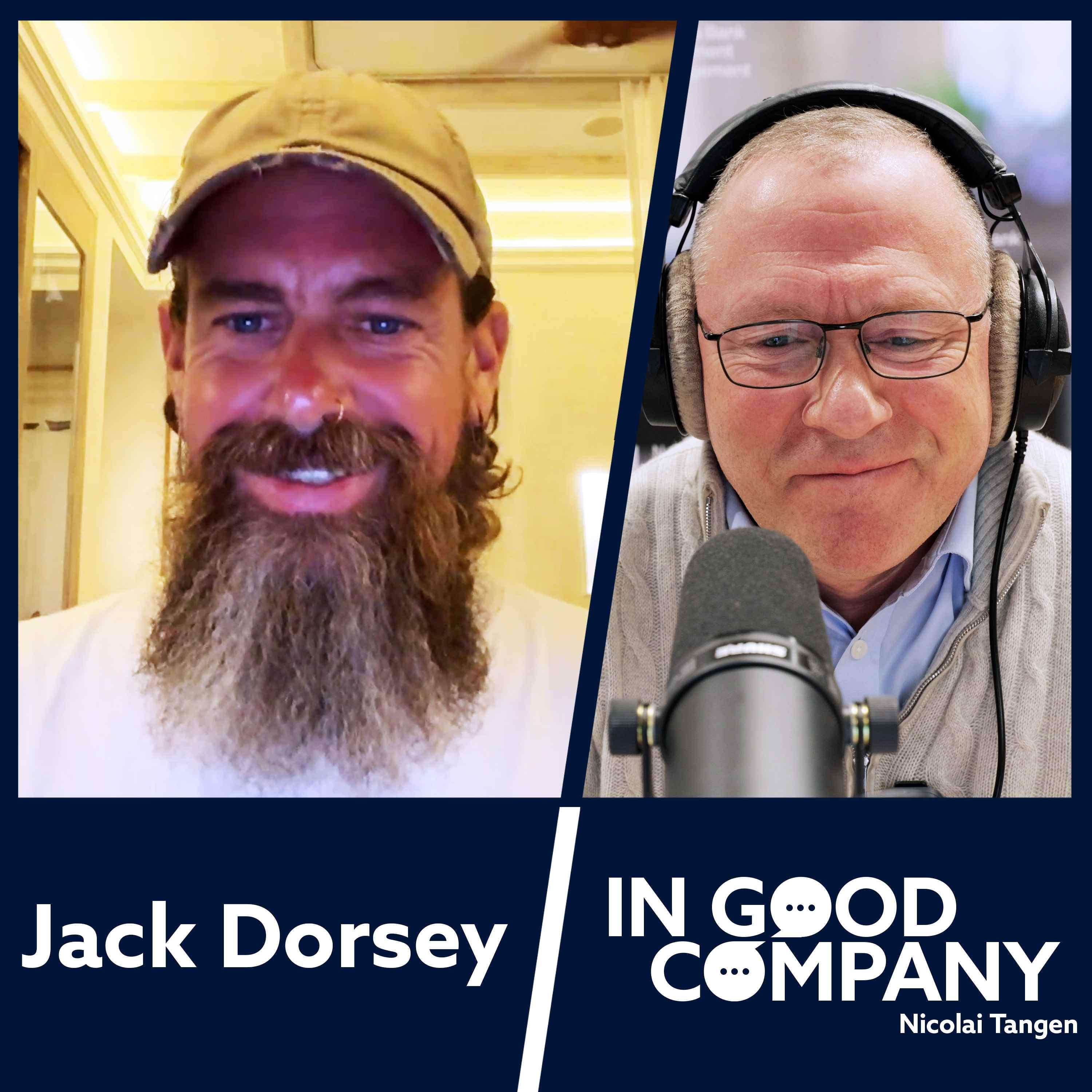
In this episode, Nicolai Tangen interviews Jack Dorsey, co-founder of Twitter (now X) and CEO of Block. The conversation explores the evolution of social media, the future of digital finance, and Dorsey's vision for Bitcoin as the Internet's native currency.
Written by AI. May contain mistakes.

Get the gist, explore an idea or ask about something said.
 Claude
On In Good Company with Nicolai Tangen, what are the key points of this episode?
Searching your listeningAutomatic transcript. May contain errors.
0:01Hi everybody, I'm Nikola Tangen, the CEO of the Norwegian Sohund Wealth Fund, and today it's an honor to welcome Jack Dorsey, one of the most visionary entrepreneurs in the world. Jack is the co-founder and CEO of Block and also the co-founder and former CEO of Twitter. So Jack, you really put the stamp on the world. Welcome. Thank you so much. Thank you.
0:30If we could go back and kick off with Twitter, who is now, of course, renamed X, where did the idea come from? Well, it was a long time in the making. When I was a kid, I was always fascinated by how cities worked, just how these things that were so large to me at the time actually, like, functioned. And I got into maps and just I would obsess over them and stare at them and try to understand what was happening in any one particular neighborhood or area. And that led me to programming because my dad brought home a computer one time and I wanted to draw a map on the screen so that I could start playing with it.
1:15And I taught myself how to do that. I figured it out. And little by little, I worked my way to a field called dispatch. So dispatching taxi cabs and ambulances and police cars. And it was a way to put information on the map, information about the city. And I eventually ended up working at the largest firm in New York. I had this very rich map of everything happening in New York City. But it was missing one thing, which were the people and what they were doing, where they were. And that's really the question that started Twitter was if I could see and visualize what the people were doing and what they were thinking or where they were going, it would help me understand the city a little bit more.
2:09And it took probably about 10, 15 years for the right time and the right technology to really make the idea something worth pursuing. But in 2006, it did. And I was working at a podcasting company that kind of lost its weight because it suddenly became competitive with Apple when Apple decided to get into podcasting. And we had this great team. We started a hack week. I brought up the idea for this thing that you could update from your phone and other people could follow it and see what you're doing and what you're thinking and where you're going. and I was given another programmer in two weeks and we built it and we fell in love with it.
2:55And little by little, we took more and more resources of the other company and we eventually spun out and took venture capital. What was your vision at the time? What did you think it could become? I didn't really have a vision. I wanted to play with it. I mean, ultimately, I wanted to understand what was happening in the city. That was the original question. and I thought this was a way to answer the question. But I just wanted to use it. I wanted to be able to see what my friends were doing. I wanted to share what I was doing. SMS was just becoming big in the U.S. You all in Europe had it for 10 years prior, but the U.S., because of our different protocols for carriers, Verizon and AT &T, GSM versus CDMA, We didn't have text messages that actually worked together, so we didn't have text for quite some time.
3:50But when we did, that was the technology. Like, oh, I could have this cheap little Nokia device and I could send a message and it would fan out to all the people that cared about what I was saying or what I was doing. That was super cool. and we just launched it and we invited our friends and they invited their friends and so on and so forth and then it continued to roll and we decided as people were using it that there's something that resonates here there's something interesting and now it's up to us to really pull the thread on what that is and what's interesting about Twitter is it wasn't really us who determined where it went it was the people using it we saw them try to converse with each other and address one another.
4:39And I took three days over breakfast, or three hours, and I wrote some code. Anytime someone tried to address someone else, it would be linked, and it would be filtered into a replies tab, is what I called it. And that started conversation on Twitter, and it's public conversation. whereas I originally was thinking oh this is just a way to update my friends or what I'm doing, see what they're doing but people wanted to talk and they invented this syntax the at symbol to talk and then they invented another syntax, the hash for grouping topic, grouping tweets by topics and then they invented another thing called the retweet which is rebroadcasting someone they're following to their following to the people following them So little by little, as we observed what people were doing with it and we made it easier, it spread and it made the service much bigger because more and more people got value out of it.
5:44And it was just an interesting way to co-create with the people that are using your product, and I learned a lot from it. That's amazing. So the way it developed, what does it tell us about people's needs? What does it tell us about people generally? I think people don't want to just consume, they want to help. Participation means creation. And they want to leave some mark. They may not intend to do that, but when you use something like Twitter, you develop this feeling for it, and you want it to last. last. You wanted to succeed and you become very emotional about any changes that are made that you think go against the way it should be or the way it's used.
6:32And we saw so many of those. When we tried to do a thing that we thought was important, the network just like threw up on it and said it was wrong. And as we observed what they were trying to do, we had much better insight into what Twitter wanted to be. As we got more new audiences and audience types, that density of information would grow even further. When did you realize that it was really taking off? When Obama was elected 100 days after he took office, he got up in front of the country and did the State of the Union 100 days after. And we had a number of senators and congresspeople on Twitter already.
7:15And I was watching the speech and the camera panned around and there were people on their phones. And in that moment, I got a tweet, my pocket buzzed. I pulled on my phone. I got a tweet from my senator from Missouri. I'm from Missouri. And she was tweeting about Barack Obama giving his first address to the nation. It was like, whoa, like, it's fast. I'm watching this thing unfold in front of me and I'm feeling it physically in my pocket. And it just really shortened the distance between something that can be very abstract and feel far away, which is how our government operates and works, to it now being in my hand.
8:03And having this sense of like, wow, this tangible humanity. Someone typed this out, it buzzed my phone, and now I'm reading it, and I saw it, and they're thousands of miles away. What did you feel then? I felt excited. I got back to work right away because it was like, oh, man, this feels great. I mean, that's what you want in terms of building any product. You want to see people use it in a way that you can see that there's value and you can feel it. it feels electric and you feel like tingly and you're like, oh, I'm going to keep going. I'm going to keep going. When you see how important social media platforms have become in election campaigns, what are your reflections around that?
8:45These things aren't important by themselves. We make them important and we choose to, by giving them attention, give them importance. and it spoke to a gap that I think existed before Twitter, which was everything was entirely scripted. It was behind a media wall. The information that you got was through another point of view, typically a corporate point of view, corporate media point of view, paid for by advertisers and seen on television or radio or whatnot. podcasts were the first to, in my experience, to really break that wall. But they weren't talking about newsworthy stuff at that point.
9:35They were just doing like interviews and whatnot. And they matured eventually. But Twitter kind of pierced through it very, very quickly. And it pierced through that wall of abstraction, media abstraction. And I think for elections, again, our political process, our government can be extremely abstract. And when you have something that you know is nine times out of ten coming from the person's thumbs directly, which is connected directly to their brain, it's authentic, it's unfiltered, and it's open to your interpretation. instead of being filtered by someone else's interpretation. So it was less about Twitter providing that.
10:23It was more like that was the need and that was the desire. And anything at that time that could fill that would have taken off. I think we had a lot of luck. We had a great product because it was simple. It was straightforward. It was easy to use and it was accessible. But it also was the right time. like the frustration with the media wall was at a peak, at a high, and there were cracks in it. And people wanted more of that. They wanted more authenticity. They wanted more directness. They wanted more realness. It's very concentrated, right? So I believe 10 % of people generate 80 % of the content.
11:1080 % of the organic non-reply content. Like there are replies too. And that's not often counted in that number. So me just sending out a tweet, yes, you're right. But I think the real power of Twitter is the conversation underneath that. And it's not necessarily about, you know, what is the news of the day? Direct from the source, it's like, what are people talking about it? What do people think about the news of the day? That's the power. And that is extremely large. And then there's the, yeah, like Twitter X has a bunch of influential people on it and people want to listen to them. and such that these tweets were being broadcast on television.
11:59And we were unable to count the impressions of CNN or Fox putting a tweet up. But we knew the reach was much larger than our analytics and our measurements accounted for. So that was pretty interesting, pretty special.
12:20now two years ago um alan musk bought it and renamed it x anything um you regret not doing with twitter before it became x um i mean there's a lot of things i would do differently in retrospect um i think i think we became we i i wasn't there at the time running the company but we raced to monetization way too quickly. And we force-fitted a monetization path that created a bunch of issues for us, which was advertising. Google had an advertising business at scale. Facebook had one that was growing. Twitter's goal at that point was to grow and go public. Being public meant you had revenue. So we copied the model of the day, model of the internet, which was advertising.
13:21And that just set up a bunch of issues in terms of growth, in terms of competition, in terms of how we were valued. It didn't really express Twitter's true value, that model. and I wish we took a little bit more time to figure out a better model or that we had multiple at once. The second thing is, in the early days, Twitter felt like a protocol. It felt like HTTP. It felt like SMTP. Yet we owned every single part of the stack and I think that was a mistake because I don't think a company can necessarily control this without having some sort of choke point that makes it open to manipulation of some way.
14:13So if you have a open protocol for social media, which I think Twitter could have been instead of just a company, it could have been both, you have a lot more freedom and you have a lot more agility to do the things that the platform actually needs to do and the protocol needs to do. But if you wrap all that up into one company, you create a lot of issues for yourself, including heads of governments and advertisers wanting to dictate content policy or get the numbers of journalists who are critiquing them or shut you down because you won't take content down in their country. if it was a protocol instead that was owned by the public and you're building a business on top of that you couldn't do those things this is where i learned a lot from bitcoin do you think it could have existed without advertising oh yeah yeah definitely and financed in what way there's tons there's subscription there's commerce um the uh you know because because the internet didn't have, was not born with a native currency protocol, advertising was the way to subsidize free services.
15:36And it was taken as a given that these internet businesses had to be advertising businesses in the early, early days. Netflix showed a different path. Obviously, others, eBay, showed a different path. But for an information tool like we were, advertising was it. It was a way to get the biggest network because you could offer it for free and subsidize it. But the reality is, the people that are using it are truly the product. And your customer is the advertiser. And your customer is dictating where the product should go. You are still a large owner in X. What do you think they should do with X now?
16:22Experiment as much as possible. I mean, like keep pulling the thread on what people want to use it for. I'm a big believer in, I think it's less about free speech. I think it's more about do we get to choose how the algorithms are programming us because the algorithms are definitively programming us. And it's very, very hard to tell what an algorithm is going to do and predict what it's going to do. And that's where the danger comes in. But if I can choose what algorithm filters my tweets and what I get to see, and I have instead of like an app store, an algorithm store, where I get to put these on my timeline, then I have a lot more agency in the content and the experience.
17:12and I think it ends up creating a much healthier relationship with the technology. And I'm not just speaking about Twitter. This is for YouTube and for financial technologies. We are being programmed. These algorithms know our preferences better than us. That's only going to increase. How do we increase agency at the individual level? It's by choice. It's by being able to turn off the algorithm. It's by being able to choose different algorithms. by being able to make my own algorithm on this giant purpose. So, Jack, what kind of algorithms are you thinking of here? Well, I mean, a simple one, like if I were more left or right-leaning, I could choose a more right or left-leaning algorithm.
17:57If I hated politics and I only wanted to focus on science and arts, I could choose an algorithm that filtered everything out but those things. I could go deeper into that. I could only do physics. I could only do quantum physics. And you might say, well, you can do that through taxonomies and categories, but there's just too much information at this point for those to really be useful. you have to get into the algorithmic aspects of it and really effectively create these agents that go off and fetch the information that you're truly interested in and deliver it back to you and take feedback on whether it was useful to you or not if you learned something from it or not or you interacted with it or not.
18:41Right now, most of these internet companies and most of these internet services the algorithm is driven towards one thing which is maximizing impressions to maximize advertising revenue. That is not maximizing my experience, my learning of the world, or aligned with my goals as an individual. But if it shows you what you have shown to be interested in, is that not a good thing? Oh, it's a great thing, but I want to be able to choose that. And you can build a great business around that. You can sell the algorithms, you can subscribe to them. You can put more directed topical advertising on these algorithms because they actually are programmed in a way that you're actually interested in the outcomes.
19:26They're not just random. And they're not trying to guess. They know. So, like, I think it lends itself to a much better business. But you have to have companies and individuals who are willing to let go of the secret sauce, which is the algorithm, and democratize it a little bit more. How will generative AI change the way we use this? I think we're seeing the extent to that right now. I think we're at the edge of one horizon. I think the next horizon for these tools is probably around agent systems and software that I task to do things for me. And they work with other agents on the internet to complete those tasks.
20:16So I'm more interested in that. I think the generative AI stuff, especially the large language models, have the ability to obviously create a bunch of information. And it becomes important, like, what is real? What is reality? What is truth? What is fictional? And these tools are going to get so good that, like, you won't be able to tell. And we'll truly feel like we're in a simulation because it looks like and we perceive that anything literally can happen or could happen or did happen because these tools are so realistic and feel so authentic. So I think the only way around that really is to just have more information and better filters, which leads to agents and that they be directed by me, by the individual and do more of that work.
21:19So I'm less interested right now around LLMs and generative AI because I do think we've hit some horizon on it. And more interested by how you take this intelligence and make it mobile and make it something that people can send off and actually it can do work for them. Given what we talked about in terms of algorithms and generative AI, what are the implications for journalism? him?
21:49I mean, I'm not a journalist, but I think having more information, more perspective, and getting better tools to get more information and better information and distill it only helps your craft. I think it does become more and more challenging because you, again, have to sift through what's real and what's fake. But, you know, people have been lying since the dawn of time and the dawn of language. And journalists have to figure out what's the lie and what's truth. And they need different perspectives. So I think the only thing that changes here is velocity, nothing else. Velocity and breath. What do you think about content moderation?
22:36I think the best content moderation is an algorithm. And I should be able to determine my own algorithm and what I see and what I don't see. I think there should be a corpus of content that exists that only the author of it can delete, and they have the sole right to do so. But I have the right as an individual to filter out what I don't want to see or filter up what I do want to see. But that's all dependent upon whether I get to choose the algorithm. If a corporation is choosing it for me based on advertising, maximizing advertising revenue, then it's not truly serving me. Not useful.
23:18I guess this leads us to Blue Sky and you helped create this decentralized social platform which is called Blue Sky. So could you take us through the thinking here? Yeah, about three years before I left Twitter
23:40I realized that like what we were talking about earlier, a company cannot be all parts of the stack for social media. It'd be better if we were built on top of a protocol that was shared between multiple companies. And what's an example here? HTTP, the protocol that runs the web, the protocol that we're using to talk right now and record this podcast. It's a common understanding and an agreement that this is how we transmit data in a very particular way. And then you have browsers on top of it. I'm using Safari. You might be using Firefox or Chrome. These are built by different companies. These companies can build business models on top of that, but they're using the same protocol, and they don't control the protocol.
24:31They can't influence the direction of it as a single entity. It has to be done through this consensus model.
24:42So if we have that for the web, if we have that for email, if we have it for file transfer, for video, why not have it for social media? Why not build a protocol that any company, whether it be Facebook or Google or X or open source tools, can use around this concept of social media? And that was the idea. And we called it Blue Sky. And we took about a year to find a leader for it. We found a leader in this woman named Jay. And she built a team and actually built it and built the protocol and built a client. And, you know, it's working. There's another one, another individual from Brazil. I don't know who this person is.
25:28It's a pseudonym. him. He created this other protocol called Nostr, N-O-S-T-R, had a different take on it, which was he kind of looked at every single one of Twitter's failings as he saw it and built his own protocol. And what was interesting about that protocol, I found it about a year and a half ago, was that not only did it address what I perceived on every one of our problems, but it was completely open in terms of the development model. Blue Sky was effectively this corporation building the API and building the protocol. Noster was just a bunch of individuals building the protocol and building their clients on top of it.
26:13And I resonate a lot more with that because I think that at the protocol level, It has to be done not through a corporation, but through a collection of interested and obsessed individuals. And that's what Nostra was. So eventually I stepped off the blue sky board and really focused a lot of my efforts, which amounted to funding this ecosystem around Nostra. Nostra is still very small because it's a lot more technical at the moment. But I have a lot of hope for it because of the way it's built. It follows the way that Linux was built. It follows the way that Unix was built. It follows the way that the C programming language was built versus these other cathedral-type models, which tried to achieve perfection, but actually no one ended up using because they were built by these companies and these companies had these particular agendas and there was no real individual drive behind them.
27:13So Blue Sky is a very different model than Nostra. I think the Nostra model lasts longer and wins, but it's good to have multiple experiences. And there's others. There's Mastodon and there's Matrix and there's what Meta is doing with Threads. All these things are kind of competing with each other, but one of them will eventually win. Why is Blue Sky growing so fast now, you think? I think people are running away from X rather than running to something on Blue Sky. And that's not a great way to build a product, unfortunately. We want people that are running to us for a particular thing that they couldn't do before.
28:02Now, Blue Sky has built something that I wanted it to build and I'm excited about, which is this algorithm store, being able to choose your own algorithms. So that is the reason why people will run to it eventually. And I think why people will run to these services eventually, because they get more agency, more control. But it's not something that people care about right now. What they care about right now is not being an ex for whatever personal reason. And again, that sort of behavior kind of comes in waves. You have to want to stay there for a reason. You can stay there because you have moved your entire community over, which is rare.
28:43But when we have these different factions of social services, if X represents the right and blue sky represents the left and they can't actually talk with each other, there's going to be crossover naturally because people are going to keep their accounts because they want to hear what the other side is saying. It's just natural. Only way to solve this, one protocol. Different views, different algorithms on top. This can be the right. This can be the left. different business models. This one works, this one doesn't work as well. But we need a common protocol. And that's the whole idea. What's going to make Nostra take off?
29:21Time. I think it's better technology. I think it's a much healthier developer ecosystem. I don't think it's just social media, like Blue Sky is trying to do. It's more of this ecosystem of apps with a common protocol. So people have built Twitter-like things. They built spreadsheet, like Google Sheets-like things. They built GitHub-like things. And it's really amazing because what it does is it allows you to really prove authenticity because it's a public-private key pair system. It's not an email and password. I have a public key and I have a secret key and I maintain the secret key. And every message I send on Noster, I'm signing with my secret key.
30:15So, you know, it's actually coming from me and my device, which is very unlike a Twitter or a Facebook where you don't actually know. It could be intercepted. It could be the company doing it on the in the worst case on the person's behalf. but because I control my key you know anything I write or anything I post is coming from me directly Five years from now, what does social media look like?
30:47I hope that it's a lot more agent driven I hope that it has a lot more agency and being able to choose how I filter content how I promote content I hope that all content exists permanently, effectively, because it gives us the greatest learning opportunity. And I think there's business models that are more aligned with the interests of the individual and not just the company. so and there's going to be a lot more bots on it and i think they'll be helpful not distracting or uh providing you know misinformation but actually useful where do you think uh regulation of online platform is going i don't know i i the the problem i i see there's a bigger problem which is i think regulation generally is becoming more and more fragmented.
31:48And it's really, really hard on companies to build for a fragmented regulatory environment. California has a very different regulatory understanding than the European Union. And you look at like internet regulation, States are now considering internet regulation. Australia just banned social media for anyone under 18. It's the responsibility of the social media platform to make it so. And that's different from Europe, and that's different from the US, and that's different from the entire rest of the world. So now you have to have a team that's dedicated just to Australia for this one restriction.
32:34And if the rest of the world follows with their own specific regulatory aspects, then you can't build a company. It's just you can't build a company that serves the world. You can only build companies that serve very particular markets. And that goes against the spirit of the Internet. So this is why I think, again, protocols are important, is protocols don't have to correspond to these regulations. They're not owned by any one company. They're not owned by any one individual. They're untouchable by a government. You look at Bitcoin as, again, the biggest scaled example of this. That's how you get around these issues.
33:15And to me, that's the biggest concern.
33:23Let's talk about Bitcoin. You started something called Block. Tell us, what is Block? We originally started a company called Square and changed the name to Block because we have multiple businesses now. And if you make a square three-dimensional, it's a block. So Block is focused on economic empowerment, building tools to empower people into the economy. We started with sellers, so enabling sellers to accept credit cards was our beginning. And then we added another business called Cash App, which allows people to easily move money between two people or businesses with their mobile phone instantly.
34:10That is becoming more and more a bank in the form of an app. and today we have two massive ecosystems at scale, Square and Cash App, that serve sellers and individuals and give them very simple financial tools to do things that they want to do in the economy whether that be send money to their friends and family or get a debit card, go to an ATM, set up an e-commerce shop or do customer relationship management. When do you think these things are in five years time? Well, the other thing that we wanted to do is like our business is constrained right now by that fragmented regulatory environment.
34:58For us to launch Square in any market, or for us to launch Cash App in any market, we have to have a partnership with a local bank. We have to pay attention to different regulatory approaches within that market, within that country. And it's a very, very heavy cost. So we have to weigh that cost versus building new features for the markets that we're currently in. And what allows us to move faster? If the internet had a protocol for moving money around, enter Bitcoin. Bitcoin is a protocol for moving money around. And if Bitcoin is used not just as a store of value, but as a currency to move money around between people or between businesses and people or businesses and businesses, as that becomes more and more a thing, which I do think it becomes over the next five years, then we can launch up.
35:54We can launch Cash App and Square in every single country that has the Internet. And that allows us to serve more people better, faster. and because bitcoin is open it's not controlled by one company it's not controlled by any one government it's completely transparent people can see what it does and we can solve all the problems that we would task with governments and companies to solve by doing it transparently and by doing it openly because again it's the internet and it goes to internet principles So I'm hoping these financial systems take on more internet principles and we can truly be an internet company instead of going market by market by market, which is just a really slow way to build for the world.
36:43You can't build for the world. You can only build for these particular markets that you happen to be approved in. And again, you have to be approved by another company. You have to be approved by these things that don't have your interest or even their customers' interests at heart. So what needs to happen for Bitcoin to function more effectively? I think it's happening right now. More and more people see that it's valuable. Every time that number goes up, people get more interested in it. I don't believe in Bitcoin and its final stage is just a store of value, but I think it's a necessary part of the path to get to, I think, the next big one, which is remittance across border, moving money between businesses, moving money between people across borders, which is happening in many countries outside the United States and Western countries today because there's no other options.
37:41and then it gets to currency. As people get more comfortable with it, as they see that it's not going away, Bitcoin is over close to 16 years old right now. It's never gone down. It's never had a security issue. It has no leader. It has a completely open roadmap and it's determined by a consensus development model. these are all really incredible ways to trust it as a currency. So as it becomes more understood and it feels like it's going to last, I think people will trust it more and more as like, oh, this is the way I'm moving money to my family now. And this is the way I'm buying coffee now.
38:28And this is the way I'm buying computers or whatever. It's a deflationary currency, so it doesn't encourage spending. It does encourage savings. But I think it has a really interesting path and provides a lot of interesting business models for the Internet. If Bitcoin existed before we started Twitter, we'd be in a much different state. And I think we'd be in a much better state and we wouldn't have all the issues that you see with social media today because it's not a tax on the system. It allows for a business model that's aligned with the people that are using it every single day. Why would social media be better if you had Bitcoin?
39:13Because you could get to commerce right away. You could get to subscription right away. You didn't have to get permission from Visa and MasterCard. You didn't have to wait for the security of such payments on the Internet by virtue and by the grace of Visa and MasterCard to build it. it's built into the internet and it works at massive scale. So if we had that tool and we had commerce at that scale, we could build a pretty phenomenal business. That's like all, all communication is exchange of value. Commerce is exchange of value. If you pair currency with communication. You ease commerce and you ease buying and selling of things.
39:58And the internet wants to create efficiencies there. But the biggest friction in that creation of efficiency were the payment networks and the banks and the way we currently deal with money. So Bitcoin upends all that and changes it and provides a completely different path, which is, in my view, far more exciting and allows us to build a much bigger business, more valuable business. Jack, what are the implications for the payment systems and companies like MasterCard and Visa and so on? You know, Visa, at least, started in a very unique way. And I'm sure you're aware of the story with DHOC and started as a co-op.
40:38And it kind of started like a protocol. And little by little, it got more and more corporate and change. And I think if Visa and MasterCard were to adopt open protocols for moving money around the internet, they could still build a really phenomenal business because these technologies are hard. And when you build on protocols, what people value is convenience and removing friction, and they'll pay for it. And there's much evidence in this on the web and on email. And we can do it with payments, too. There's a lot built on top of payments and built on top of money. that you can build a phenomenal business upon that doesn't require you owning the payment network itself.
41:20So being able to see beyond the current reality and let go a little bit and have a common protocol that every company can use increases the total addressable market. It increases the number of transactions you can see and you can participate in. It increases the number of people who can participate. And if you have something that's creative on top of it, you build a phenomenal business that's world changing. So there's so many lessons in the Internet. And all those lessons have to do with open protocols. And anyone who ignores these lessons, I think, is not long for the world as a company. It's just a matter of time.
42:03The Internet is still very, very, very young. but it will teach all of us, especially as more of these agent systems come out and we realize that these agents are working on our behalf by virtue of us having a highly hyper-connected internet that they can roam freely upon. And if there's any friction along the way, they're not going to become valuable.
42:31I'd love to spend a bit of time on being an entrepreneur. What do entrepreneurs have in common?
42:40Well, they're all different. They all have different paths. I think, like, if I think about that word and the concept, it's my experience, my path. I never wanted to be a CEO. I never wanted to build a company. I never wanted to be an entrepreneur. I could care less about it. I wanted to build. I wanted to build, and I wanted to use what I built. And I wanted other people to use what I built. and I realized somewhere along the way that in order to sustain the thing that I built, I needed money. And that's where building a business came in. So I had to learn about building a business and running a business and being a CEO.
43:19But the spirit of all that is you do whatever it takes to make it work. I learned how to program because I needed to understand how to build things on my computer in front of me. I needed to learn how to be a CEO. I needed to how to raise money. I needed to learn how to hire people, how to fire people, how to build cultural frameworks, how to build systems, investment frameworks, feedback mechanisms. All these things that I had no desire to do or to build, I had to do and learn because it was the only way to take the idea to the next step. It was the only way to enable more and more people to use the thing that I wanted them to use and to mature it.
44:02I've heard you say that entrepreneurs are a bit like artists. What do you mean by that? I think it's expression. Art is expression. It's knowing when to end something. It's knowing what the chapters are and where the piece begins and where it ends. And that's very much a product. That's very much a business. Like you could do everything and it becomes this mess that no one knows what to do with. or you draw the lines and draw the box and the shape and the inputs and the outputs and suddenly it becomes something that is an expression of an idea that's accessible and that's manageable and someone can actually use.
44:41And doing that and determining what those boundaries and those lines are and what the end and the beginning is, is very, very challenging. And that's where I think the art part of it comes in. Even though business people aren't necessarily concerned about that, the founding of a company, the founding of an idea when it starts as an idea, not I'm building a business to do X, Y, Z, but an idea and how do I sustain the idea? That's when I think the art comes out. And not everyone starts that way. There's some entrepreneurs who start like, I want to build a healthcare company. I need to go find a problem to solve, yada, yada, yada.
45:20And they do something interesting. But I think the truly interesting and truly world-changing things are more ideas and then like how do I make the idea bigger? And building a business around it was the way to do that. How do you deal with rejection? Rejection? Yeah. Well, I kind of take on this mindset that everything I encounter, everything I experience as a teacher. and they have some lesson for me and it's up to me whether I decide to learn from it or not and then there is no rejection it's just like well I choose to learn from this or I don't and if I don't then it feels terrible and I it's a waste of effort and I feel bad if I do I own it I'm better because of it so there's no rejection so I just choose to learn from every single person that's put in front of me every single mistake every single challenge every single encounter I have.
46:21It's a teacher. And like, what is it trying to teach me? No matter how small or how big it is, it's trying to teach me something. And if I ignore it, or if I decide not to learn from it, that's the reaction. That's the diminishing thing. But if I choose to learn something from it, even if it's tiny, I own it. And there's no hard feelings at all. Where did you learn these mindsets? experience just doing it um not wanting to feel bad um i took a lot of meditation as well um and uh one of the things you learn in this practice called vimpasana is that you know you you spend all this time observing pleasure and pain in the body and you observe the pain and you observe your reaction to the pain and then you realize it's a reaction to the pain and when you understand that and you understand that the pain is temporary and you're having this reaction of suffering over something that's temporary you're like what am i doing i'm i'm choosing to suffer over this thing that eventually will go away um so i can change the reaction because it is a reaction i i get to decide that reaction and it's a very very physical this meditation is a very very physical practice and it's the hardest thing i've ever done mentally and physically because you're in actual real physical pain but at some point you observe this pain and you observe your reaction and it just clicks and the pain dissipates it's amazing and um how often do you meditate i was i was doing a 10-day silent meditation retreat every year for five years before covid and then uh i i there was 10 days of like you don't speak you don't uh all you do is meditate from four in the morning till 9 p.m no phone no communication no exercise whatever um so during covid all the centers closed and i haven't gone back yet but i i meditate every day for like an hour when i get up or attempt so uh pain pain is good what's the optimal pain level what's the optimal pain level anything that teaches you something new teaches you about yourself teaches you about your capabilities is this a very lonely journey
48:54um i guess it could be of like um again that's a feeling right that's a decision you make I choose to be diminished by this reaction to being lonely? Or what is this experience trying to teach me? Like, what am I supposed to learn from this? I think all these things are ultimately decisions, but it takes time to realize that and it takes time to hone the tools to act on the decision. Is this how you come up with your lists, the do's and the don'ts? Yeah. Perhaps you want to explain these lists. Yeah. Every day I write down what I want to accomplish and what I don't want to do. I think we often focus on what you do want to do.
49:41And we focus on these very large goals. And if I've learned anything, it's to make the goal very, very small and repeat it and iterate it as quickly as possible. So you see momentum. Like if you wanted to meditate, a lot of people start with this New Year's resolution. New Year's is coming up, right? New Year's resolution. I'm going to meditate for one hour a day. They do it one time, never again. If instead you say I'm going to meditate for a minute every single day for two weeks, one minute, I can definitely do one minute. And I stick to it. And I don't go past one minute. I do only one minute, one minute.
50:18And then after that one minute, I did it. So now I'm going to move it to five minutes. And then I'm going to move it to 10 minutes. And then I'm going move it to an hour and that progression makes it not feel like work it makes it feel like an uh uh an understanding like i'm i'm getting it and um so it's it's really important to write down the small goals that you have for the day and then more importantly what you don't want to do because we never focus on like i'm not going to do this so i'm not going to get distracted by politics or like tv or whatever so jake what's been on what's been on your list today what's been your to-do list today i'm learning uh more about quantum physics right now so i'm doing some study and uh one of the things i want to do is spend like again i moved from like 30 minutes to an hour every day of reading and watching videos around quantum physics and um i'm also doing some language learning.
51:20I'm learning Italian. So an hour with that as well. And then I'm doing some programming learning as well to keep my skill high and in the field of AI and agents as well. So I dedicate one hour to that. And three hours of learning in the morning when I want to do the hard stuff so that the rest of the day feels like a win. Those are the things on my list. and what is on your don't do list don't get distracted by the news because it's kind of all fog of war right now um don't get distracted by the politics don't get distracted by entertainment at the moment because i really um i i want to learn how to learn better i want to learn how to learn faster and and deeper so i'm i'm experimenting with like these three different subjects at once in order to figure out what the patterns are in my own learning so that I can achieve like some novice or mastery skill and multiple things much faster.
52:30And what do you think is the key to faster learning?
52:37Observing for quite some time and then doing. But I think people skip the observing phase too often. I don't think people are good listeners. I don't think people have honed their ability to observe the world and observe nature and observe how things work. And I think they try to act too soon. And I think the observation part is critical. And I think it mirrors what we do as babies as we're acquiring new skills. We spend a lot of time observing and we're just inundated and immersed in all these things happening around us. And then around age two or three, we get the ability and the tools to do.
53:17But it's come from a place of massive immersion. And I think as adults, we skip the immersion part and we skip the observation part. And we try to do, and it gets to the thinking, and the thinking removes the ability to truly act in an intuitive way based on all the information that's constantly coming into your system. Jake, why do you eat only once a day? I like to, back to learning, I like to learn by going to extremes. So I've tried every single diet you can imagine. I got very interested in my health and maintaining my health span. And one of the things someone was doing that felt interesting was they had this one meal a day thing.
54:02And I tried it and I only ate dinner and then I only ate breakfast and I only tried lunch. And what was amazing is like I got all this time back and it felt like a superpower. All these people spent all this time eating breakfast and eating lunch and dinner and all this ritual around it. And I had all that time back. I had literally two or three hours back to do something else or to have a real conversation that's not interrupted by food. and then I realized I didn't need that much food. Like we overeat. We definitely overeat, especially in the United States. So it's just looking at like what needs are and what desires are and separating those two things.
54:42And I felt like my health increased, my energy increased and I give myself all this time back to do things that I really wanted to do. And when I did eat, it tasted amazing. I regained taste and I regained appreciation for food not just as entertainment, but as sustenance. What is your advice to young people? Observe. Observe everything. Take everything in. Love information. Love receiving information. Don't worry about reacting to it. Don't worry about memorizing it. Don't worry about doing anything with it at all. Just be open. And when you need to do something with it, it'll come. Very good.
55:26Jack it's been it's been an honour having you on here big thanks for sharing your thoughts truly truly fascinating thanks a million thank you so much thank you for the time
In this episode of In Good Company, Nicolai Tangen sits down with tech pioneer Jack Dorsey to explore the evolution of social media and the future of digital finance. The co-founder of Twitter (now X) and Block shares his insights into how Twitter emerged, why he believes open protocols are crucial for social media's future, and his vision for Bitcoin as the Internet's native currency. Dorsey discusses his entrepreneurial philosophy and the importance of algorithmic choice in technology. What would social media look like if Bitcoin had existed when Twitter started? Tune in for a fascinating discussion where technology, money, and personal development come together.
In Good Company is hosted by Nicolai Tangen, CEO of Norges Bank Investment Management. New full episodes every Wednesday, and don't miss our Highlight episodes every Friday.
The production team for this episode includes Isabelle Karlsson and PLAN-B's Niklas Figenschau Johansen, Sebastian Langvik-Hansen and Pål Huuse. Background research was conducted by Sara Arnesen.
Hosted on Acast. See acast.com/privacy for more information.