Ask ChatGPT
 In Good Company with Nicolai Tangen
18 Sep 2024 · 29m
Written by AI. May contain mistakes.

Get the gist, explore an idea or ask about something said.
 Claude
On In Good Company with Nicolai Tangen, what are the key points of this episode?
Searching your listeningAutomatic transcript. May contain errors.
0:00Hi, everybody, and welcome to In Good Company. I'm Nikolaj Tangen and the CEO of the Norwegian Wealth Fund. And today we have an incredible guest, Robin Seng, the founder and CEO of CATL, the world largest battery producer.
0:24Now, it's not only the world largest, it's got a whopping 40 % of this mega market. Wow. Robin, how did this come about? No, no, not yet 40%. Okay, to be correct, 37.5%, something less than 40%. But I think the most important is the right products. Definitely the market needs a lot of the right products to do the immobility. So the right product, you need the right technology. So in our world, it's more like right chemical, right material, which really have good products. So this good product is a fitness to the purpose of the consumer. That's why consumers really love it. That's why the customers, OEMs, would like to make these products and put this product into their car.
1:17That's why we can power millions of cars. So despite your incredible market position, there may be some listeners who don't know what your products are. So just very briefly, what type of products do you have? We have two major products. One is the battery. We call it battery for e-mobility. So you can have the product in people like Tesla's car, Model 3, Model 1. so in all the Chinese car makers are also in many of OEMs cars so this battery we call to power the whole car so it's a BEV another product is we make a battery for the energy storage you know all the renewable energy like a wind turbine and solar cell that's why you need a storage battery who can storage regulate the unstable renewable energy supplies, which make this energy supply become very stable, very predictable, and very fit to the industry use and other use.
2:26What's been the main steps from going from kind of zero to 37.5 % world market share? What's been the important steps here? How long has it taken you? Yeah, we take almost 12 years from zero to this 37.5%. It's not because of this, only this 12 years, because our team have been working on this industry for now it's a quarter century. 25 years ago, we started a business with this lithium ion battery, which is definitely for the mobile phone, for the notebook, for all the consumer electronic applications. So we have a similar technology from 25 years ago. Who do you consider your competitors? Today, I think the competitor is ourselves because we still have a lot to do, especially on the electrical, chemical side.
3:25You know, the material today, we're still in case of material like lithium-ion phosphate and NCM. and the materials still on the graphite or some silicon. Most important is the new chemistries we have to invent. So only invent new chemistries that can also fit more usage, more requirements from consumers. For example, low temperature performance. You say that your competitor is yourself. Are you not worried about any of the competitors? I don't consider them as competitors. Actually, we love to have more people join in this journey, which really can have the inventions. It's not a copycat. It's the inventions which can help to make the consumer and make the customer happy with their real good performance of the products and technologies.
4:19Because only the competitions in the invention, competitions in the creativity, which can help this industry very healthy to grow in the future. And how important is state support in getting to that type of position? In China it's more complicated because Chinese try to make a lot of products which fit to the consumer usage. So Chinese OEM are more like we call it hearing more requests from the consumer. then they make a good design faster than anyone else in the world. That's why they can roll out a lot of good products. So in order to support the Chinese OEM on this aspect, Seattle has been well-trained to how to quicker, faster grasp the needs and how to quicker, faster to landmark the production to support the cost, performance effectively and high-quality products to our customer.
5:27That's the whole story that makes a difference. Yeah, it's complicated. That's why it's good that you have a PhD. But how many people have you got in research and development? Yeah, we have more than 20 ,000 people, engineers, very good talents in my area because they need to focus on many aspects. But I mean, 20 ,000 is nearly as many people as live in my hometown. So what do they do? This 20 ,000 people is... Some people focus on basic material structures. Some people focus on the side relations. Some people focus on the inter-reaction of the materials. Some people focus on the future chemistry.
6:11For example, we call it AI for science. We need to use artificial intelligence to try to find out the next revolutionary material and chemical system beyond the lithium ions. We need to have some research guide on the battery management systems and software. All together, like 20 ,000-21 ,000 engineers. They have several hundred PhDs and many, many masters. So those young kids have been working here for average more than three or five years. They have become very good talent, and I hope they can have more innovations in the future to help the human climate changing focus on these renewable energies.
6:59The talent pool you have is incredible, right? I saw that two out of three widely cited papers on battery technology came out of China, only 12 % coming out of the U.S. Also, you in China have more than 50 graduate programs in batteries, compared to only a few in the US. So how can the rest of the world possibly compete with you? You know, almost 12 years ago, when Angela Merck visited China, we had some discussions among that. In that time, German people were already thinking about why they cannot make good batteries because they make very good engines, they make very good gear bars. So, you know, German people think they can make very good batteries.
7:48That's why when we have some discussions on that, I told them, fortunately, unfortunately, China has a lot of universities still working on electrical chemicals. So usually electrical chemistry is a very low end, people looking at that. Because if you graduate from electrical chemistry, you cannot find a good job, you know. You can only find people for the less abilities. You can only find a job for the antique closions. So all these kind of low paid jobs. That's why they're being very old theory. But I know United States, a lot of good universities and the students, they don't want to focus on this.
8:39They want to focus on finance and focus on semiconductors. Yeah, they need to get a higher pay from this. But China, there's a lot of students who have to go into university. That's why they found more study on electrical chemistries. That's why we have a lot of talents compared to the US, compared to Germany. So if the US and Germany want to catch up or want to overtake in the battery side, probably they have to start from education. Have you got a view on the amount of talent we have in Norway? I think all 20 ,000 people in your hometown is all talents. So we need to find out what kind of talents to fix what kind of use.
9:30It may not be electrical chemistry.
9:38What's the most difficult thing? Is it to invent a battery or is it the scaling of battery production? Is it more difficult to make one or to make a thousand? So, most difficult things is understanding of electrical chemical system in the real world. And other things is follow is like, as I mentioned, you have to last 20, 25 years. Let's write how you predict that. And accurately, acceleration test to indicate it's ready to reach that kind of level. It's another difficulty in the reliability. and scale up productions and low cost. Everyone is looking for very low cost batteries because they always compare the batteries with the gasoline engine internal combustion engine which you have developed for more than 100 years, optimized and optimized.
10:33That's why they push too much burden on the batteries. It just seems like in Europe there is such a problem scaling up production. Is there one common thing that's particularly difficult here? Not only that. I talk to many people, European battery makers, CEOs, why they cannot make good products. It's because they have a wrong design. And secondly, they have a wrong process. Thirdly, they have a wrong equipment. How can they scale up? If they want to scale up a lead, they will have a yield problem, utilization problem. And later on, they will have a reliability problem. and two years, three years later, there will be a safety problem.
11:16So almost all mistakes together. So I don't know how... That doesn't sound so good. But if we start with the first one, when you say they got the wrong design, what do you mean? Yes, start from the wrong design. It means if they don't understand the electrical chemistry or the side reaction, as I mentioned, the design will be wrong. They never cover the risk of the future risk. That's why the performance and the testing in one day looks good. Then you want to scale up. They want to put the process in there. The process never cover what you need in the future. What are the implications for European battery production then, given what you're saying?
11:54Where do you think Europe is going to be in 10 years' time? For the battery application side, we just talk about e-mobility and the boat also, and Iwoto also, even the bullet train. Since Norway, it's definitely a very advanced nation for this renewable energy. Maybe we can work together to make a planning to make Norway, the whole Norway, become a zero carbon society. So I have confidence how to map it up. Electricity, zero carbon is important. you have almost 90 % hydro power, right? Then you add up another 10 % maybe from the wind turbine, from the sea. And another size is e-morbidities. Your passenger car penetration, you know, already 90%, 95 % for the new cars.
12:55Then we can also can help you to make these trucks to be zero carbon by our swapping battery system. And also we can make the port electrifications. and also can help also even the vessel with what we call the energy standard. So we can plan together to make a whole Norway as number one in the world to be the zero carbon technology renewable energy nations in the world. I think it takes around 10 years in 2025. We work together, we will make it. And also you will be very happy to have a lot of income from all these kind of different things. Well, sounds very interesting. Unfortunately, it's above my pay grade.
13:44It's not my decision. I only invest money, you know, and of course we are happy that we have invested a lot of money with you. Now, you've been doing batteries for a long time. Do you feel that innovation is accelerating or decelerating? I don't see too much. It's actually an acceleration. You know, when the industry is small, when we start from mobile phone, the technology is growing like a line. It's not acceleration. But when we put more money, more people inside now, everyone is looking for innovations. So innovation is big, it's an accelerate. and we believe there will be another new industry, new chemistry come out.
14:31That's why when we put our product, when we invest our production line, we have to put the production you know, the production line have to depreciate faster. The depreciation have to be five years. Otherwise, we want it. So new things come out. so a lot of companies push kind of solid state batteries as a game changer what are the showstoppers here? well I have been taught this for many many times of the different people the basic showstopper is still there still is the interface solid and solid interface whenever cast on material with the electrolyte so solid electrolyte, solid powder So, you know, material or solid powder.
15:22Solid interface is definitely the problem with diffusions. The speed of diffusions is almost two orders less than liquid electrolyte. That's why people have to put the pressure, to put the two solid powders together, very heavy pressures, then make it work. But in real application days, how can you get the heavy pressures? So that's why it is a fundamental science and technology issues. But we have to overcome by different things, different new invention of materials, new invention of the process. So it takes time. So in terms of technology readiness level, I put it at a level four. You are also in sodium, ion and condensed metal batteries.
16:14How do you view these technologies? The sodium ion is quite mature now. We already have the production, small production to some of the car makers. The only problem is a little bit lower energy density compared with the ion phosphate today. That's why when the ion phosphate is cheaper, people tend to select the ion phosphate rather than sodium ion. But we have developed a second generation of sodium ion, which can be very good compared with the first generation. So we believe it will be 20 % to 30 % replacement of lithium ion phosphate in a smaller car on a shorter range of cars at the initial stage.
17:01That's all the condensed matter batteries. I'm proud of that because it is very good in the Emoto application. It's very expensive today. And we are working hard on that. Try to make it maybe two times compared to today or 1.5 times. So we can use this battery to the very high-end car, which needs energy density for the speed and the higher range.
17:36When you look at your process and so on, what's the key to your successful supply chain? I mean, you, for instance, own your own lithium mine, right? What are your advantages when you look at your supply chain? For the supply chain, usually people have to look at the supply chain by the applications. For example, several years ago, people said, wow, nickel, cobalt is very important because the battery will go into big applications. That's why you need to invest in nickel, especially in the cobalt mining. But they don't understand that we can have making the structure change innovations to reduce the cobalt applications.
18:20So cobalt from 33 % reduced to 3%. And also even now we can remove the cobalt, then we use the ion phosphate, then the cobalt becomes zero, nickel becomes zero. So the only technology people who understand the trend of development applications in the future, who to know, who to choose what kind of mining is a good mining investment. That probably is our advantage. So we have to very carefully understand the advantage of the different materials, especially the chemistry system, who will be the winner. Then we can judge. And how do you benefit from this when you set up factories in Europe? Yeah, I have two factories in Europe.
19:05One is in Germany, now one is in Hungary. Now the supply chain, we established the supply chain gradually. Now still majority from China. That's why, for example, in Norway, we definitely can work together because you have a very low cost of hydropower. So we can make graphite together. So, you know, graphite is one of the most important is energy consumption.
19:36Changing tack a bit, energy storage. How do you see that market developing? Energy storage, in my mind, is similar, or maybe half, maybe half size of transportation. But energy storage is more difficult than transportation, you know, because they're lasting, they need to last 20, 25 years. But many people think this is easier, because they say this is stationary, don't move. Yes or no? Number two is the energy storage usually is a huge pack. For example, one gigawatt battery pack, the whole system, it contains at least 1.5 million cells. If you think about 1.5 million cells plus all the electronics, mechanical, thermal management put into the system and plus in this software, the whole one gigawatt battery's energy storage system contains maybe 7 to maybe 9 million of the components, similar as the Boeing 787.
20:45When you control your quality in one hour of the PPM, that means every day you have the components of a problem. You have to maintain that, you have to repair that, you have a lot of maintenance costs in the future, and also degradation is different. Consistency is very, very difficult to control. That's why for CETL, we want to put the battery manufacturing quality up to PPB level, 25 parts per billion. So three orders increase the quality level to fit for the usage of this energy storage. So it's difficult. If everyone tells you it's good, 10 years later, they would pay, maybe five years later, they have to pay a lot of money.
21:41How much time do you spend on the corporate culture at CATL? What do you think defines the culture compared to other companies? Our culture is, we have a vision. We try to be a very innovative technology company in the world, especially focused on renewable energy. and try to do an excellent contribution to the human society in renewable energies. On the other hand, we try to create a platform which helps the individuals to fight to grow their spirit and material well-being. Actually, it's money. So we need to give them more stock options and also help them to really fighting for their growth, especially innovations and also the confidence by themselves to become a better man.
22:38The focus on renewable energy. So people believe very meaningful in this journey, especially working in Seattle. Now it's 15 million cars, 15 million cars in the world powered by Seattle batteries. So think about that. It already helped to reduce a lot of carbon. On the other hand, we keep on doing these innovations to help climate change and also sustainability for human development. We try to gain the same vision. And also we are using also Chinese culture. We call it refine. So everyone has to refine themselves and enable others. Then to drive innovation. We always, how to say, successfully introduce Chinese traditional thinking of refine, enable, and strive innovation.
23:42And Robin, how are you still trying to refine the way you work? For me, there's two ways. One is my philosophy. I don't want to be the rich guy, the richest guy or whatever. It doesn't mean it. So I want to share this rich or wealthy to many peoples to try to create a good society, especially for sustainability. This is number one refined from my view of my wealthy. Second is I need to refine myself to be more stronger body, you know. Otherwise, it's always tired. You cannot fight. The passion is very important. Otherwise, it cannot last for longer. The third thing is I'm now trying very hard to find the successors.
24:30So this is three things in my mind now is my more top priorities. So, Robin, I believe you and I, we share one thing in common. We both sleep a bit in the middle of the day. We take a little nap in the office. Yes, this is a long time. Usually we sleep maybe 30 minutes in the office. When during the day do you sleep? 1 p.m., something like that. Start sleeping maybe 30 minutes. It's good enough to recover. And what does that do to you? You become more, you know, energetic. Maybe the body is physically needed. No, you grew up in rural China, right? in Ningde. What do you think that has done to you as a person to come from a rural place, move in, being very successful?
25:17How has it helped in your business? We have very difficult economics and my hometown is very poor. For me, in day one, I think we have confidence because we believe we can overcome all the difficulties once we have a chance. Number two is we have a very strong mind. We are not easy to be beat anywhere because we have experience. Number three is we are not too much looking at the wealthies. Because we have experience so poor and we have no problem on that. So we say that if we, people almost told me, they say, Robin, why don't you enjoy your life? You know, you can buy a yard. For me, there is not much joy, you know.
26:19We have to overcome the difficulties to do something great to support people, poor people, and also support the least renewable energy in the world. You will be very happy. So usually I like to invest the manufacturing plant in a related poor area. What kind of projects do you support? For my donations, I usually go to these very, very poor children. We donate some money for them to, they can have some people to care, just talk, touch or, you know, play together. so I joined some international program for the children so I believe if we can see it okay invest the manufacturing prime in some poor area so their family no need to move out to come come out to the you know big city to work to leave the children in the hometown so that's why we invest the manufacturing place in Guizhou, in Henan, all these areas.
27:29To help them, they can have a family there. So such kind of things for me is much happier and maybe more stronger in the rural area. When you meet young Chinese people, what advice do you give them? My advice is strive. Be patient, strive. If you were to give advice to young people in Europe and the US, what would you tell them? I think it's similar. Usually today's young kids, they want to become rich very fast, right? So be patient, but strive. Everyone have a chance, I believe. Very good. Robin, it's been tremendous talking to you. It's incredible what you have achieved. and I have to say I am pretty happy I'm not your competitor.
28:23Thanks a million.
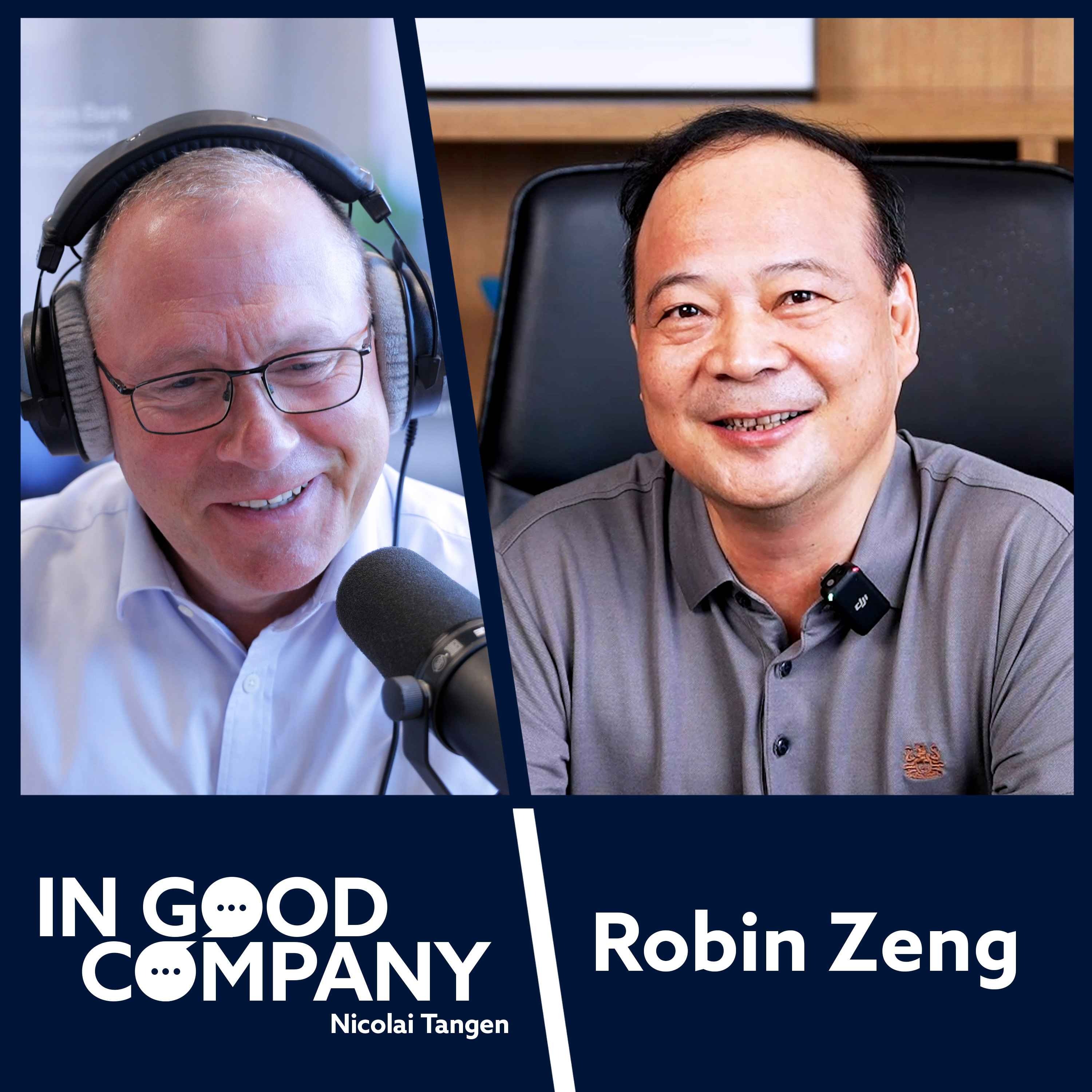
In this episode, Nicolai is joined by Robin Zeng , founder and CEO of CATL, the world's largest battery producer. The company has a staggering 37.5% market share, and CATL has revolutionised the battery industry, powering millions of electric vehicles and contributing significantly to renewable energy storage. But how does a Chinese company view differences between their home market, the US and Europe? Tune in learn more from Robin about the importance of understanding consumer needs, the innovative technologies behind CATLs success, and the companys vision for a zero-carbon future. This episode offers a true deep dive into the challenges and triumphs of leading a global battery powerhouse, the complexities of scaling production, and the critical role of research and development in driving sustainable energy solutions.
In Good Company is hosted by Nicolai Tangen, CEO of Norges Bank Investment Management.
New episode out every Wednesday.
The production team for this episode includes PLAN-Bs Pål Huuse and Niklas Figenschau Johansen. Background research was conducted by Kristian Haga and Arnab Seal.
Hosted on Acast. See acast.com/privacy for more information.