
 Ask ChatGPT


 In Good Company with Nicolai Tangen
2 Oct 2024 · 46m
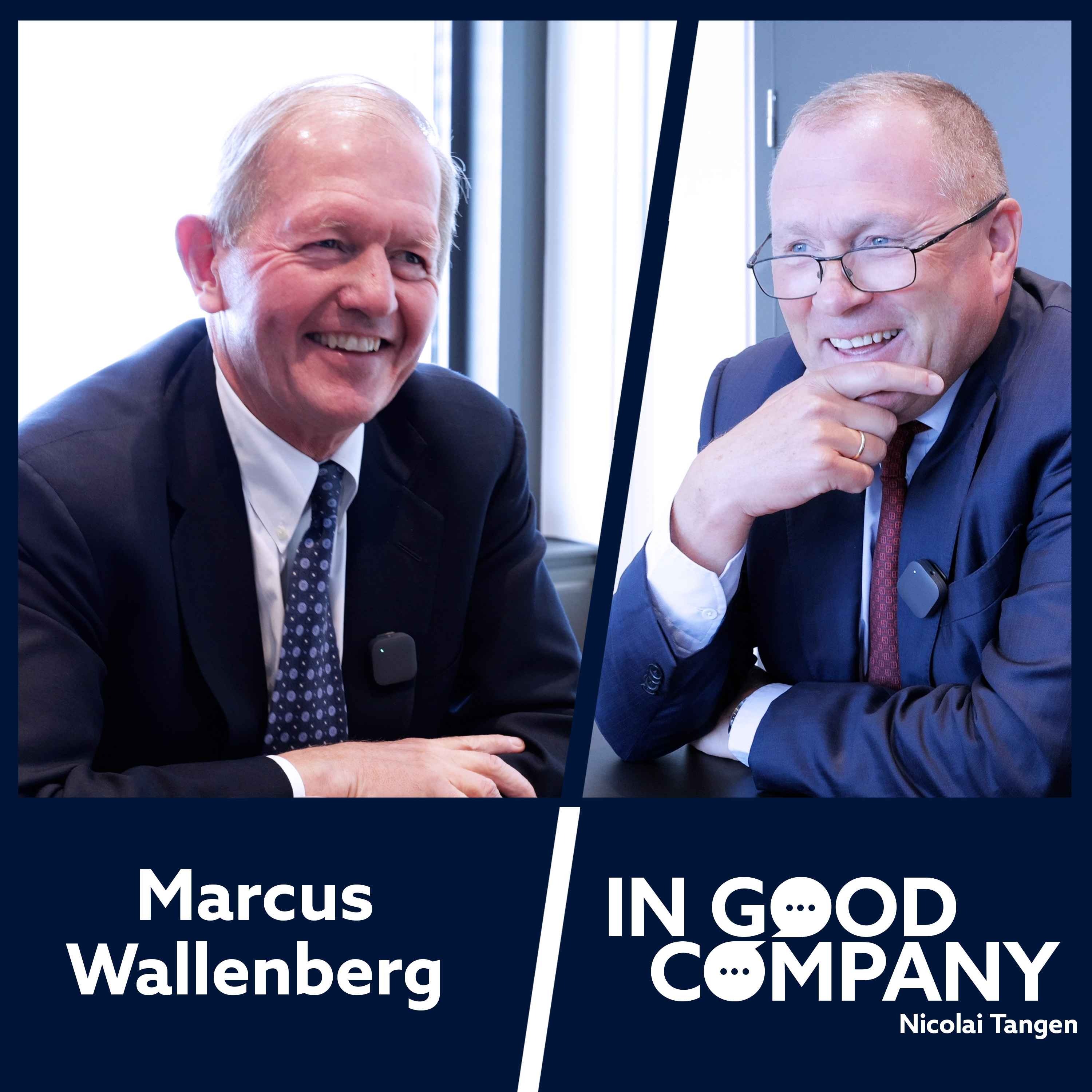
In this episode, Nicolai Tangen interviews Marcus Wallenberg, exploring the Wallenberg family legacy, their adaptability in the face of technological changes, and their long-term stewardship approach in business. The conversation delves into the family's influence on Swedish industry, their significant investments, and their efforts in driving innovation through research and education.
Written by AI. May contain mistakes.

Get the gist, explore an idea or ask about something said.
 Claude
On In Good Company with Nicolai Tangen, what are the key points of this episode?
Searching your listeningAutomatic transcript. May contain errors.
0:00Hi everyone, today I'm in a seriously good company with Marcus Wallenberg who is the chair of SEB Banken and vice chair of Investor AB, both really important companies in the Wallenberg family. Now, for those of you who are not familiar with the Wallenbergs, they control and have influence over companies such as Ericsson, Atlas Copco, Electrolux, Astra, ABB, SE Banken. And this journey started back in 1850. Incredible. So, Markus, what a pleasure to have you here. Thank you. It's great to be here with you.
0:43What's the key to survive for 175 years? Well, there are many aspects, of course, with that. But perhaps the most important thing, or one of the most important things, would be that you are ready to adapt with the times. I think that is a very important part of it. And what's been the most important adaptions you've done, you think? Well, you know, I think that if you think about 175 years back, you will, of course, very quickly come to such things as dramatic technological change. Gone through the times of the steam engine, the electrification. Now we have the Internet that we just passed. Now we're in the age of AI.
1:32the wish and the drive to change for the times is a very, very important aspect. What part of the Wallenberg legacy are you the most proud of? The fact that we are able to be here as a family, to work together in our family, is very important. I think that is perhaps one of the things that we can be proud of, that we've been able throughout the generations to do that. I think also that we have the possibility to not only work with companies, but also to support research and education is an important aspect of what has been done. capitalism looks very different in the nordic countries so in denmark you have foundations in no way the state is very important uh with part ownerships and in sweden of course you and a couple of the families are very important for long-term ownership so how do you how do you look at yourself you know are you an owner do you feel like more like a prime minister just how do you how do you look at yourself i mean you're much more important than the prime minister no i would not say so in these times i would tell you that democracy is an extremely important thing that we should be guarding carefully i think about it as two dual tracks from an ownership side being a steward of corporations that we try to work very closely with where we have a financial interest in order to create value over time and develop them be close to them so that we can see that they they stay competitive in a very dramatically changing world.
3:34On the second track, doing what you're saying about the foundations, supporting these foundations who are giving a substantial amount of money to Swedish universities primarily for the betterment of Sweden, which is in turn, I think, helps Sweden as a very small country in the view of this large world to try to stay competitive in certain fields. How important are these foundations for you personally and for the people who work in all these companies? I think there are many of the colleagues who actually are quite happy with that the dividends that come out of these companies actually go back for a good cause.
4:32And for us in the family, it's very important. It helps us to stay a bit closer to what goes on in science and technology to see what is about to come, which I think is, when you think about it, in that you're adapting with the world, that is an important input to that equation. You have a saying that you want to do things without being seen publicly too much. Es non videra, to be, not seem to be. Yeah. What's the thinking behind this? It was my great-grandfather who adopted that saying. I think he pointed to what is something we think is very important namely we should really work as a family to do things that will have a good impact but the most important is perhaps not that you're standing in the front line but that you actually support that these things are happening well you're on the front line now in this podcast yes uh i am and uh i think you are doing something uh quite interesting since you're using your time to spread the word about different companies and individuals that's an interesting aspect of your job yeah and we are very keen to learn from how you're doing things because i do think we need to extend the time horizon for planning we need to be more long term and act more like owners rather than investors, which is why we are here.
6:13Now, how would you characterize the Wallenberg culture, or is there such a thing as a Wallenberg culture? We hope there is a set of values that is very important to us as a family. You just mentioned the long-term aspect to stay with the companies, try to be supportive of them for a long time, see a change in these companies to be really competitive. We talk a lot about the future-proofing of companies, which basically means today we're looking very much at the people question. We think that is extremely important. We look at companies and their ability to innovate, and not the least also with sustainability.
7:02and last but not least, I would say the demands on all companies to understand their data and AI and cyber strategies. Now, you run this in a way together with your cousin. How were you groomed to take over this? For instance, we had John Alkin on a while back. He was told that he should take it over when he was like 22 or something, right? Yeah. Now, how old were you when you knew that you would have this incredible responsibility? Well, I think that we, in our generation, we were always told by the older generation that just because your name is Wallenberg, you don't get a free ride. so a lot of focus for us was on learning on doing work within different companies over time work hard be interested do a good job very important who told you this i think both Both my grandfather and my uncle was very strong in that.
8:20So it's really about learning. It's about showing that you have the interest and also to perform. Is it a burden? If you don't like it, it can be a burden. What is it that you like? A lot of satisfaction getting when you see that companies are developing. then when we can see that actually the work we do with universities is actually moving things forward. And if you can add to both these companies and to society. Now, I always admired Swedish companies because they are just very, very impressive. What do you think? What is it with Sweden which explains this success? Or is there something Swedish in it?
9:09I don't know if it's a Swedish trait, but I think that as a country, Sweden has always been very dependent on trade. If you want to do trade, you have to be competitive. If you want to be competitive as a small country, you have to innovate. So this is something that I think Swedish companies have been forced to understand and to deal with over a long time. We're small countries. That means that you cannot assume that you'll get all the attention that maybe you would like. So you really have to build the trust. You have to be cost effective and you have to innovate. But you managed to create some world leaders initially in relatively small niches and then they have expanded the niches, right?
9:57Yes, absolutely. Expanded their technologies, expanded some acquisitions as well, of course, over time. being very international. Most of these companies have less than 10 % of their business in Sweden. And that means that you really have to understand the international markets. You have to rely on free trade, which is perhaps not an obvious question today. No. And that you can, as I said earlier, stay competitive in the sense that you can adapt to the different markets and their needs over time. When you look at the Norwegian industrial base, what reflections do you have? I think that countries have a tendency to work more and more with things that come natural to them.
10:53You have very strong industries in terms of your natural resources and fishing, for example. I'm sure that there are other areas that Norway could and will develop over time. Such as? For example, I'm involved with the private equity business EQT. They're quite active here. There are a number of startups in Oslo or in Norway that are very interesting companies. So there are definitely possibilities.
11:33Marcus, can there be such a thing as too much responsibility in too few hands?
11:43Yes, you're touching something that is very, very important. Because your responsibility, of course, has to be adapted to what can be done in a good way. So the question is relevant. I would say that we in the family carry and have carried a lot of responsibility. But when you talk about if there is a culture or a value base in our family, coming back to that question, I would say that if you look through the years that the family has been active, one of the key questions that I can at least detect is that the family has worked with fantastic people. And it is a team play. It's a team sport. One person, a couple of persons can't do this yourself.
12:44You have to rely on people that share your value base. And they have to take their responsibility along your own responsibility. And that in itself is a responsibility to find these people and to work with them for a long time and really understand that you share these ideas and the values of what you're trying to create with the businesses. How do you work with the next generation of owners? There are about 30 of them in the next generation.
13:23and we have for a number of years more than 10 years worked with them in different ways introducing them slowly to each other and to the businesses and to the foundations and what the family wants to do some of them have said that they're interested to work in the business some of them said that they would like to work with the foundations some of them said that but I'm a happy family member and that's fine. And I think that is a very good way of doing it. There is always a balance with hoping that they will get the interest, understand the necessary things you need to do as an owner. But I think we're also very mindful that this is something, if you work with these things, you will have to spend a lot of time.
14:22There's a lot of demands on your time and so on. So you really have to like what you're doing. So gradually, I think they will take more responsibility. And that's something we're in very close dialogue with them about coming on. Well, that's going to be exciting to follow. A little while back, Sweden went through a period with a lot of wealth tax, very high taxation, And a lot of very prominent Swedes left the country, whilst you guys didn't. Do you think that would have been different if you hadn't had the foundations as an ownership structure? You never know, of course, what would have happened then.
15:04But in the case of the largest foundation, K.A. Wallenberg, my great uncle, and his wife Alice, a Norwegian opera singer, they had no children. So for them it was a natural thing to go for a foundation. Then came the tax question, as you said, which we're now, I think we're close to 15 of the family foundations. So many have now decided to start foundations over the years. One of the important things here is that, as we all know, the Nordic way of doing foundations, nobody owns the foundation, which means that when you go from one generation to another, you're not quarreling about any money because the money will never belong to you.
16:01So you actually work for the good of the foundations and for the companies based on your interest and it's not there to fight or have a big discussion about how to find the money here. I think that has been extremely important for our family because those of us who decided to work with the family, we have done that because we have a keen interest in doing so. and we've been lucky that throughout the generations there have been very qualified people in the family who's been able to be there and develop the business
16:52moving topic a bit here um investment philosophy if you were to kind of distill down what you think a great company is what characterizes a great company what would you say are some of characteristics? Management, market position, ability to innovate, stable finances, some of those important things. What are the most innovative companies in your portfolio, you think? I hesitate to mention names because I think that all of them have to be innovative. If you are going to be successful in the pharma world, you have to be extremely innovative, such as AstraZeneca. If you're going to compete in the telecom world, you have to be extremely innovative to stay ahead.
17:53But also when you look at the traditional engineering companies, such as Atlas Copco, they have a huge pressure on themselves to innovate and innovate and innovate. So I think most of the companies in our portfolio have that pressure on them. And that is something that they are keenly aware of and something that they are actually really trying to put more and more emphasis on over the years. Now, the foundations fund research in areas, I mean, really kind of basic, groundbreaking research, which in many countries will be taken care of by governments and public funding. Do you do that because you think it will be beneficial for the companies eventually to have that type of progress?
18:43Or what's the thinking behind the fields you are choosing? You're right that we are funding primarily basic research. And sometimes high-risk research, right? With a very uncertain outcome, you back people rather than projects, right? 50 % is backing people. 50 % are some large projects like AI, quantum, very long-duration projects. And there are not that many institutions which think that way. I mean, Howard Hughes Foundation is one that comes to mind, where they also do this kind of binary outcome backing people. We're trying to focus on excellence. And we're really pushing that. The research that is being performed is open research.
19:29It's for everybody. The Swedish system is such that the researcher owns the IP. So it really is an open question. And of course, this comes along very much in line with what I tried to describe earlier, namely, if you think about yourself, that you have to innovate and future-proof the whole time. And also being in a country where research and education is a very important part that works very well in our book in how to think about adapting with the times and looking around the corner of what is about to come. How does the geopolitical situation influence the way you think? I mean it's hard to say that we are living in the most difficult times that you should not do but I think one can at least conclude that we're living in extremely complex times yeah and it's not only geopolitics it's also the advancement of science it's a climate change it's so many things that we have to think about in our generation and I guess we're all keen to give something to our kids that is in good shape.
20:55So that impacts our thinking a lot about the surrounding world. When I take from a bank perspective, it's always been around the credit risk and the market risk and the liquidity risk and so on that on the balance sheet things. But today if you're a banker, there are so many additional risks that you have to consider. Cyber, regulatory, political, climate. But there are so many different risks that are now coming into the equation. So we are living in a quite complex world from that point of view. So we spend a lot of time in the family and the people that we work with to try to understand to our best ability, I should say, what is actually about to happen and how it could impact what we do.
21:43So these things cause a lot of volatility sometimes. Yes. Yet you are not really utilizing that volatility to scale up your positions in various companies. For instance, did you make a lot of big active changes during the financial crisis? I think that we have, you mean buying more shares? Well, we have bought in certain companies. I think we have been taking a very step-by-step approach. Do you think we should do more of this? I think that if you look at, for example, the privately owned business of Investor, which is called Patricia Industries, we have been investing quite a lot there in the last 10 years.
22:31So, yes, we are participating in that. so in the other holding companies if you look at EQT they have been extremely on their toes and have created a very big business in the past 10 years so I think that we have been quite active perhaps we have we're known to deal with some of the very large public corporations. And as you know, since you're an investor as well, it's not that easy if you are a very major shareholder to move your ownership position in these times. So we have made a number of investments over time, and I think we're quite happy about that. Most recently increase the ownership part in Ericsson.
23:25You mentioned EQT, which is, for those of you who don't know, a very, very successful private equity company, which in a way you started up. How did that come about? It came about that we got through contacts in the United States. there was a group called the AEA investors and we got to know them and understood that they had a big contact network with CEOs of large or US corporations who at the time when they were leaving their company still had a lot of mileage left in them and they used them to develop the companies in the AEA portfolio from an industrial point of view. And that became also one of the principles when we started EQT, when Conor Johnson and Klaus Dahlbeck and the teams started EQT.
24:30And that has also followed their legacy over time. And I think that they've done a fantastic job. When they listed EQT as a company, they've also been able to, with shares, to get into new businesses, such as Baring Partners in Asia and so on, which have actually given them a much broader and much bigger platform in different parts of the world. So they have done really well over these years. And how do you see, because the Norwegian Soberen Wealth Fund is in a way in a somewhat similar situation. We have large listed holdings. And then the question is, should we be allowed to go into the unlisted market?
25:19What do you think are the arguments for having the two in tandem? I think that we have both learned from it. they have been operating quite independently, but we always have had in our communication from both sides, we have always talked to the relationship as a very good one. I think that operating, I think what we have learned from them is how do you operate in a private setting and what are the important things there. I think they have taken a lot of the values that the way we have been owners in the public companies with them as well and stand for the long-termness and trying to really push innovation etc etc in them so I think yes it has been good to be side by side from from my perspective it's been really good and I think that you know the the question of learning is so important because Because you really have to see, and what has taught us one thing with EQT, is that you can do things in a different way.
26:34And you can, being in a private setting, you can also be more nimble in your relationship to the companies and stay much, much closer to them than if you are a minority owner in a big business. You talk about learning. I'm just curious, you are a presence at the Royal Swedish Academy of Engineering. Yes. What are you taking from that and bringing into the system here? I take that you could say we call it IVA, this IBA. This organization has, it's the oldest engineering academy in the world. they have a very, very strong membership group with immense knowledge in it. Everything that is being done in that group is done on a pro bono basis.
27:34By doing this, this organization has the possibility to help out in Sweden society when difficult discussions are there about the future. I mean, for example, how should we think about our energy situation? What other policy measures do we need to do to make sure that Sweden stays competitive? Questions like that. So we engage in different projects, and our members can and will give other free time to help out in and do that and then we have the possibility to have discussion with government and give our input into the political debate so it really we often think about in sweden we talk very much about triple helix namely the relationship between government business and academia and you could say that this organization eva is really at in the middle of this discussion what's the key to creating this helix between government, private and academia?
28:46I think one of the key aspects is to be open, open to the discussion, open to that you try to bring in competence around certain questions that can actually be helpful for the development of the country. And having that openness towards listening to each other and taking some advice, hopefully, into the process of decision making, for example, in politics.
29:21Moving on to leadership. Marcus, you are widely considered the person in this part of the world with the biggest Rolodex. And many of the people who listen to this call wouldn't know what a Rolodex is. but it was something in the old days which we had at our desks and you stuffed your business cards into it so you could easily find them. So basically another word for having a tremendous network. Why is network important? Number one, of course, opportunities that you may be introduced to. I think that the network and to understand what is actually happening around the world is for us, since we are close to businesses with global businesses, it is a very essential part that you actually have people that you can talk to in different parts of the world.
30:21ask for advice, listening to what is actually their viewpoints. This is very hard to do over a Zoom call. You have to spend time getting to know these people, getting to know them in times when you maybe not need their help because one day you may need their help with something. And then it's very good to have that network. And what's the key to maintaining it? It's like everything else, Nicolai. It's like just hard work. But you also have to like that part of it because at least that is something, you know, getting to know people with all these abilities is extremely stimulating. What is it that you like with it?
31:17the challenges in my mind the whole time the challenges in my mind who are some of the most surprising fun people you've met lately
31:31oh many I met a composer the other day a young composer in Sweden I met one of the founders in Mistral, which is the French AI company, which is one of the most forward. I'm a lucky person from that point of view. What do you take away from these things into business? Do you get inspiration from a lot of non-business related? One thing that is you know, we spoke about geopolitics. That's a necessity to hear what's going on. That's one side of it. But I also believe that in this era of dramatic technological and scientific change, you really have to understand that the ability to use these technologies across different fields of interest.
32:46is something that is very, very important. If you're not out there listening to those people who do this on a daily basis and also see the same thing, it's difficult to understand that you do need to change and you do need to advance things. I've heard you say that good leadership depends on the situation you lead through. Yes. But is there a common denominator when it comes to good leadership? Sure. I mean, the engagement, the energy, the knowledge, the judgment, the strength to carry on also in difficult times and lead people through difficult times, but also lead people in times of great expansion.
33:44That's why it's so important to have people in leadership positions who is also there at that particular time for a certain company because sometimes companies need to go through a very difficult period that may be a very different leader from somebody from a company who are in a strong, strong expansion phase. Has good leadership changed, do you think, over the last 10 years? Does it take something else to be a good leader now? I'm not sure, actually. I think that leadership, the qualities of leadership still remains to most extent. But I think that the way you apply it has probably changed. In what ways?
34:31No, but I mean, think about some of these multinational corporations. They can actually do, they don't have to do all staff meetings by going to certain countries. They can do three all-staff meetings over Zoom without moving, and then they cover all the time zones. So it helps you to run the companies in a very different way. You can use the corporate version of Facebook or whatever to communicate between different groups that work with different projects in multinational corporations. So yes, you can apply these things in a very, very different way. Do you think it's tougher to be a CEO now than what it was in the past?
35:16I think it's, for a multinational corporation in a, for example, high technology company, I think it's, the demands have gone up, yeah. What part of it is tougher? I think the speed of change is a very big factor here. But also, running a bank or running a pharma company, you have to keep your energy going. What's the toughest time you've ever had personally?
35:51In terms of businesses, I've seen a number of crisis situations. Personally, loss of family members is usually a tough thing. how do you cope with it I have learned that you have to realize it's part of your life you have to deal with it as it is and you have to think positively because there are so many positive things in life so it's a very very important part of that to think positively and to see the many, many good things and what goes on. It takes a strong mindset to have that attitude. How do you think about developing leaders within the Wallenberg sphere? Moving people from one company to the other company?
36:48This cross, yeah. This cross-fertilization. Very important. Extremely, if we can do it, I think some of the great leaders or those who have the ability to have seen different things. You can see, for example, Burje Ekholm, who's now running Ericsson, did a very good job at the Investor before that. And if you look historically into our group, the people who have been very helpful in helping the family over the years, They all did a multitude of things. Atlas seems to be some kind of CEO of factory. Yes, they've done really, really well. Why? What is it with Atlas? One of the aspects, I think, with Atlas is that they, in their corporate structure, they have pushed so much responsibility into different parts of the group.
37:48They're really very firm on people, even for small businesses, to take full responsibility. And that has created many good leaders in that company. And for those of you who haven't heard it, we have also done a podcast with the ex-CEO, where we talk about these kind of things. Matt Romsen. Absolutely. Really, really fascinating. And then you move them on to become chair after a while. How does that work? That's been generally a very, very good thing. Because having worked with some of these CEOs over many years, then we've gotten to know each other. we know that we share values which is very important when they take on chairs chair what makes a chair effective what's the best chair you've seen apart from yourself of course
38:43i've seen i've seen many fantastic chairs what makes them effective i think the presence they're you know applying their wisdom and experiences really forward-looking also knowing where things can go wrong and see to you know to address those subjects with the management when you say presence what do you mean i i believe that good chairs usually engage themselves with the companies quite a bit even in the setting I mean this of course depends in which jurisdiction you're working but in I think because in many many jurisdictions many capital markets chairs are much much closer they're almost half executives but in the Swedish or the Nordic way of doing it then of course we have non-executive chairs but those chairs who stay very close to the companies to the managements i think tend to do very well in our part of the world we split the chair and the co role yes is that important i think that has worked out really well for us and why does it why do they still keep the other way of doing it in america for instance
40:11well it's interesting question because they seem to be doing quite well as well and and so there may be not any colombo egg here but i i think that um i think what speaks uh to our model which is is very good is that also a CEO needs somebody to talk to. And I think those relationships where CEOs and chairs have that relationship because running a company can also be quite lonely. Absolutely. And therefore, I think that model works. It also works because chairs can both challenge and support. when they get close but that you know that of course demands that the chairs have enough time to spend with the companies and really understand what's going on now in in our fund we have the view that one share should have one vote but you don't quite share that view could you do you mind just explaining how you how you look at it i look upon it this way that it happens i mean at the base of it.
41:30It's a contractual right. These companies that have it have made an agreement at one point in time to have that. It has very often been situations where companies have been developed by entrepreneurs who needed to go for more capital and doing so found that their presence and their possibility to influence was very, very important. And the investors at the time thought that was also a very important idea. I think that in our part of the world, we have a very, very transparent system around this. You are free as an investor to buy the type of share that you want to buy. You can decide if you want to buy into that company or not.
42:28I realize that some people may not want to invest in that kind of company, but I think there is a very big question of contractual rights and how you look upon that as an important factor of doing business. Well, we typically vote against these kind of things, right? But in the case of the Wallenberg companies, we don't, because it was in place when we bought the shares and we went into it with open eyes. And so, you know, so we are not making too much noise here.
43:04Now, rounding off, we have a couple of ways of relaxing in common, sailing and cross-country skiing. Yes. Tell me about it. I know you have a smile on your face here. It's about the vast expanse, isn't it? It's the vast expanse. being on the ocean or being up in the mountains. And I find that to be very good for my mind at least. So I read a book on architecture and one of the keys to good architecture is the combination of repetition and variation. And I think both the sea and, you know, cross-country skiing area have that. I agree. And in addition to that, I think that some sports or some activities actually helps your mind to think about something different than what you usually do.
44:07And I do believe that is maybe the most important way to refresh your brain is that you keep your mind on something different. What do you read? many different things actually history current situations I'm actually reading right now a book on Swedish Finnish relationships back from the 1800s to now very interesting especially in a time that we live in right now and what's your advice to young people stay curious
44:56work hard
45:01follow your interests get a good boss sounds like a good plan and sounds like the people that you know the the Wallenberg companies have a really good boss in you. Big thanks for being here. It's incredibly impressive what your family have achieved over the last 150 years. Thank you, and thanks for having me. It's been a pleasure. Thank you.
What is the key to sustaining a 175-year legacy in business? How do you adapt to dramatic technological changes over generations? In this episode, Nicolai sits down with Marcus Wallenberg, Chair of SEB and Vice Chair of Investor AB, to delve into the remarkable history and enduring influence of the Wallenberg family. Since 1850, the Wallenberg dynasty has played a pivotal role in shaping Swedish industry, with stakes in global giants like Ericsson, Atlas Copco, and Electrolux. Marcus shares insights on the importance of adaptability, the family`s unique approach to long-term stewardship, and the values that have guided them through
generations. Discover how the Wallenberg foundations are driving innovation through cutting-edge research and education and learn about the challenges and opportunities in modern corporate governance. This episode is a deep dive into the principles of leadership, the power of a strong network, and the future of Swedish innovation. Tune in!
The production team for this episode includes PLAN-Bs Pål Huuse and Niklas Figenschau Johansen. Background research was conducted by Isabelle Karlsson and Eirik Omre.
Hosted on Acast. See acast.com/privacy for more information.


