
 Ask ChatGPT


 In Good Company with Nicolai Tangen
11 Sep 2024 · 43m
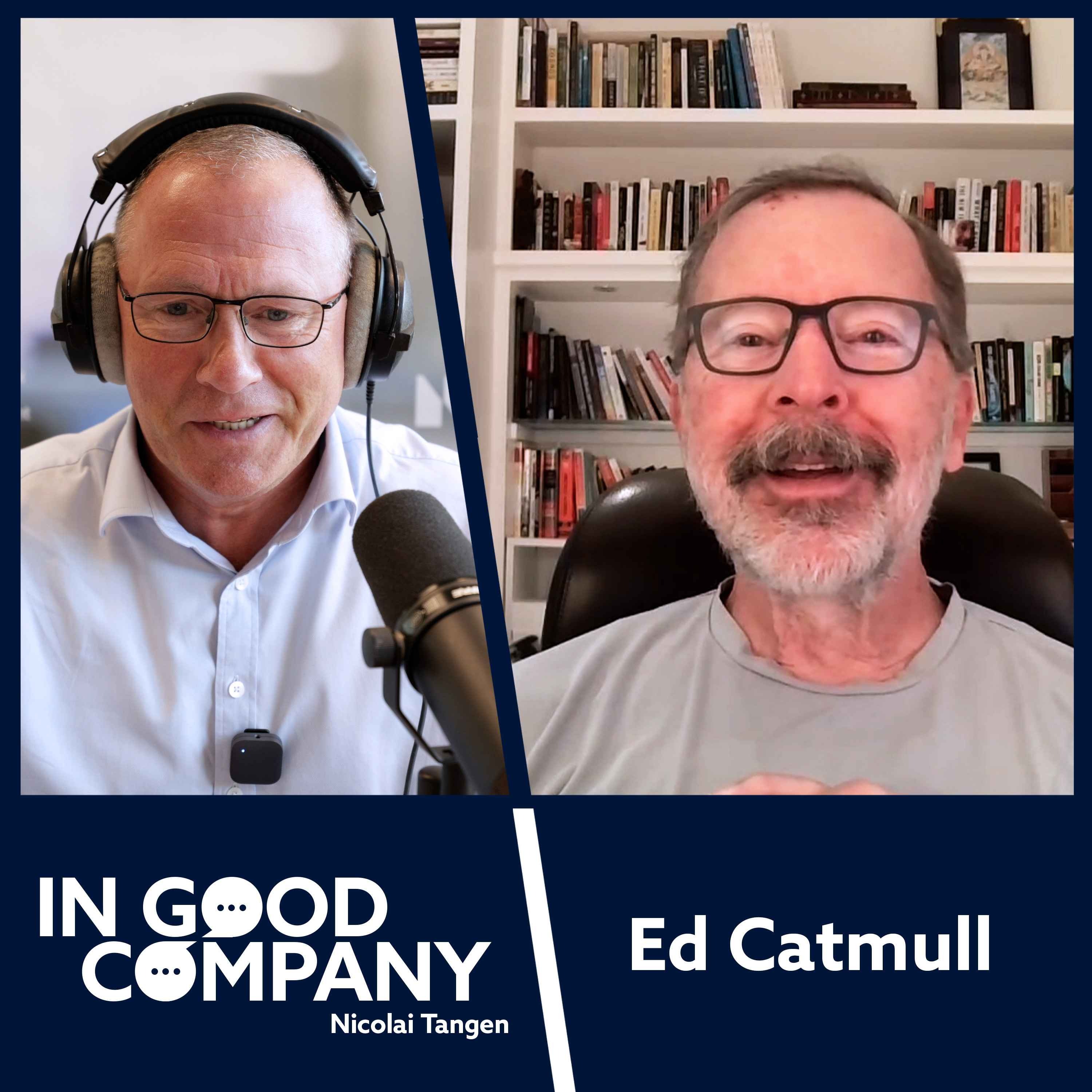
In this episode of In Good Company with Nicolai Tangen, Nicolai interviews Ed Catmull, co-founder and former president of Pixar Animation Studios. Ed discusses his journey in the animation industry, his leadership philosophy, and the unique culture at Pixar, while emphasizing the importance of creativity, learning from mistakes, and the impact of technology on animation.
Written by AI. May contain mistakes.

Get the gist, explore an idea or ask about something said.
 Claude
On In Good Company with Nicolai Tangen, what are the key points of this episode?
Searching your listeningAutomatic transcript. May contain errors.
0:00Pixar has dominated the world of animation with titles like Toy Story, Finding Nemo, The Incredibles, Cars, Monsters, Monsters, Inc. The firm has won 27 Academy Awards, and today we are in the very, very good company with Ed Catmull, who started it with Steve Jobs and John Lasseter. Now, Ed also wrote the best book I have ever read about creativity, namely creativity.inc. If you haven't read it, you should run out and buy it. So Ed, what an honor to have you on the podcast. It's my pleasure to be here.
0:39Ed, when you started Pixar, what was your vision for the firm? Well, initially, the vision was just to make the first animated film. In the process of doing that, I and we transferred from a technical vision to a management and a cultural vision. And it took a while to figure this out. many years of observing other companies, making mistakes and learning, but also finding that managing for me personally was extremely interesting. So I went from being a technical person to a manager, but it evolved over time. No training. It's just all learning as you go, observing and learning from mistakes. As you observed this and as you worked, what kind of cultural vision did you have?
1:41Well, I was fortunate in that when I started off in graduate school, my first two teachers later received the Turing Award for entirely different reasons. One of them was Alan Kay, who pretty much ingrained in me the notion that things were going to change at an exponential rate. But the other one was from Ivan Sutherland, who was basically saying, it doesn't matter what your big vision is, you got to solve the problem now. So these are the two sides of it. But one of the more important things was that when I was at in graduate school, I loved the culture. It was supportive. Everybody was in this together.
2:28There was no real class structure. And when I left, I just said to myself, this is the kind of environment that I would like to have for the rest of my life. One of the things you talk about in your book, we'll actually talk about three important points in terms of getting collective creativity. One is that you should put the creative authority in the hand of a project leader rather than an executive. Why is that important? Projects need leadership with them. But at the same time, if everything is top down, then that means the person who is at the top of the company is making the decisions. But the person at the top of the company actually often doesn't know exactly what's going on.
3:16From my point of view, it meant that the people who are running, and this included Steve Jobs, too, who was our chairman of the main investor, was that we didn't pretend to be filmmakers, that you have filmmakers there and they have to make the decisions. But we also know those decisions are hard, they're tough. You essentially have to trust them because nothing works when you start. And if you don't do that, then they're not solving the problems. You don't want to become their problem. You want them to own the problem of making the film. You also talk about the importance of sharing work in progress, which is for many people quite difficult.
4:03Tell us why it's important to just share your work. I think this is true with life in general and with projects, is that if you're taking on anything that's important, then it requires a lot of people. They're all participating in it. and you have to think of them as co-creators. And if you're going to treat them like co-creators, then they have to be engaged in the problems, which means that since you know you're going to have problems at the beginning, that I can't even judge whether or not something is good because it has problems. The only judge that I had over any project was whether or not the team was functioning well together.
4:51If they're functioning well, if they're laughing and they're struggling with each other, then they are much more likely to solve the problems. and if they're not getting along with each other, the leader loses the trust in the people, then they're not likely to solve the problem. So the measure is the health of the group, not whether or not the project's working because the project is the problem. So they may struggle, and I'm not looking at the fact that they're struggling. It's are they working together? You also talk about the importance of dismantling natural barriers and silos and so on. Tell me about that.
5:38Well, the natural tendency in organizations is to optimize something and make it work groups. In other words, even though they don't like silos, people tend to make them. It's just a natural tendency in organizations. And so if you point this out, that they're doing something that they don't actually particularly like, then they're more open to breaking down those doors. And what it means is paying attention to little details. In the case of the Pixar building, which I believe is the best building I've ever worked in in my life, was the middle of the building was an open space where people crossed and had to cross to get around the building.
6:25So it was designed to have all the community things at the center. Our theatres, we had three theatres to show films in process. Our eating area, our meeting rooms, our bathrooms were all at the centre. So everybody had a reason to cross. It's just paying attention to those kinds of details which cause inadvertent encounters to take place. What were some of the other things that you liked with the building? the decor was clean but at the same time all the walls like the walls of the animators were painted white and the reason they were painted white was they were encouraged and allowed to do whatever they wanted to these buildings i mean to these rooms and they just did strange things some of them cut holes in the walls and facilities supported that so nobody was saying don't touch this or don't paint this.
7:27And I was like, knock yourself out. And they did. They did some of the strangest things. And it gave an organic feel to the building, but organic in the sense that the people working in the spaces were the ones who made the changes. The original Indy Facilities Group was saying, don't do that. Their job is do that. And the only requirement is don't break fire code laws.
8:01now you mentioned steve jobs um when you compare him with other ceos what set him apart over the course of my life with him and i worked for steve longer than anybody else um when i first knew him he was like that kind of person who got kicked out of apple which was not a good behavior. So I knew him when he was there. And that's what people write about and make the movies about. But Steve was so smart that I watched him learn from his mistakes and he went through an arc in his life. And probably in the years of 1991 through 95, he dramatically changed. His son Reed was born. Pixar made its first film and was successful.
8:54When Pixar went public in 95, it was his first success since being forced out of Apple. And in the process, he became empathetic. And after he changed, the people who were with him stayed with him for the rest of his life. so that's sort of like the arc part of the story but the other one was the sheer brilliance and the understanding of change so as i mentioned he didn't tell us how to make the films at at pixar never did nor did he ever tell me how to do technology or what computers to use, what software to use. So that was my domain. He was just a fierce protector of what we were doing. And we were very different than Apple.
9:56But the other thing, which I don't think people realized was Steve's relationship with the people around him. This is where the mythology about Steve actually isn't matched up with the reality. So as an example, at Pixar, we were a public company for 10 years. During that 10 years, Steve fired two members of the board of directors. And the reason he fired them was they never disagreed with him. And he said, if they don't disagree with me, they're not bringing any value to the company. Hmm. His people favored the phone over the iPad. And they disagreed. And they convinced Steve. They think, well, he was always making the right decision.
10:52The right decision was to have strong people who disagreed with you, but you all had a common interest in mind. How important has it been for you, Ed, to have people around you who disagree with you? Well, it's one of those things that has been emotionally one of those gratifying things I had at Pixar was when I go into a meeting, then I was just one of the people throwing out ideas. We'd have these intense discussions. And the reason it was emotionally gratifying was even if we didn't solve the problem and we didn't agree, when I walked out of that meeting feeling like that all of us own the problem, they weren't looking at me and saying, what should we do?
11:42You're the leader. Make the decision. We're all in this together. I mean, we were together for years and years and years because, in fact, we felt like a squabbling family, but a family that was holding together on solving difficult problems. What's the key to creating that kind of family and that kind of atmosphere where people can disagree in a constructive manner? Well, I think part of it is genuinely appreciating the contributions of others and setting up an environment where they're all that way too. That is, they want to hear what the others have to say. So when we set up our brain trust, which people find kind of interesting, but there are a few keys to the brain trust.
12:42One of them is the brain trust actually doesn't have any authority. Explain what the brain trust is. We understood at the beginning that you get lost in your own project, you lose objectivity. So it's very important to have an outside force who understands the business or the project and will question what you're doing. But at the same time, they have a vested interest in your succeeding. So we started with our first few films. There was a person down at Disney's, Tom Schumacher, who was that outside force. He would just challenge what we were doing. We often didn't agree. Didn't matter. He was the outside force.
13:31But we appreciated it. But at some point, he was going to go. He went after the theatrical and Disney back in New York. We were going to lose the outside force. So we thought we need to make our own outside force, which was this group of the leaders who could then challenge other people's films. All right. That didn't work. The reason it didn't work was we're all in the building together. We're not really outside. But what we did find in the process of doing that, that it was remarkably effective at surfacing problems. So we just evolved to figure out how to do this. And one of the rules we realized right away was that this group couldn't override the director.
14:22All they were was giving feedback and notes. But by removing the power from the room, it was now about the discussion of the project itself. And my role there was actually to look at the dynamics of the room. My job was, is this group working well? Are they being honest with each other? And why, if they aren't being honest, why? Are people afraid to say what they think? Do they not want to look bad in front of others? Are they trying to impress each other? But there are all kinds of things that are human reactions that can get in the way. Okay, well, what are they and how do we address them? And we ended up with a group that in general was extremely effective at focusing on the problem, giving their notes, and then moving on.
15:21then the team that's over the film later has to go back with those notes and think about what they mean and figure out how to address the problems. But they don't have to take the solutions that were offered. You never call anything a failure. You just say that it doesn't work. How come? Well, one thing to note is the word failure is really loaded because it's got two meanings. One of them is that you screwed up, you didn't work hard. And in business and in government, failure is used as a bludgeon with which to beat opponents. So there's actually really negative consequences that can come with failure itself.
16:14But there's another meaning of failure, which is that we all fail, we all learn from it. But it's almost impossible for people to separate these two meanings of failure. But if you look at the learning part of it, which is what we're really trying to focus on here, what it really means is you tried something and it doesn't work. And if that's your mindset, then you're just saying, okay, let's try this. that didn't work. Calling a failure doesn't help. The other thing is that once in a while, we do have failures. Like something has really got screwed up. But you reserve the word failure for a real failure, not for the fact that you're just, everybody's trying to do their best to solve the problem.
17:06And they don't need somebody, they're going to get bludgeoned with it. and they actually need the confidence that let's try this and I'm not going to get damaged by it. But if you do have a proper failure, how did you deal with it? Well, a proper failure would be, as an example, where after trying and trying to fix something, like we've got, let's say, a leadership problem on a film. So people are having a problem with a director and they don't feel the director is listening or responding. We do everything we can to protect the team, but if the team loses confidence in the leader, then that's a problem.
17:48So then we try to shore them up. We will add people to the team or make some changes. But in the end, if it can't work, then we will replace and have replaced the director on the film. The truth is when you put somebody in the role and you think they can do it, you are always taking a risk, but you need to do that. You need fresh voices. You need new viewpoints. But you're also giving them a role they've never had before. Some rise to it. Some don't. Honestly, I can't tell ahead of time, which means every once in a while, you've got to go in and figure out or put a new leader.
18:38In your book, you talk about periods where you guys were just working insanely hard. And for instance, for Toy Story 2, you finished that in record time. What's the kind of key to managing people during those super stressful times? Well, the key is that everybody really wants this to work. They have a vested interest in the company. and I and for me it was one of the most important things is that it wasn't like we as the leaders are saying this is the insane goal it's like we've got an insane problem we have to solve and we all need to get together to solve this problem so they come in with a mindset and part of the insane work was that they were working hard to solve the problem in fact that one was pretty insane, well actually it was too insane because it was just physically hard on people but there are a lot of films after that where we had to put restrictions in place because people would overwork because they were trying to impress or they're trying to do more than was necessary for the film.
19:58That wasn't good for them or good for the film. So it was a tricky balance, but I like the fact they really wanted to do great work, but we were in this for the long haul. So there's another side to this, which is people overworking when they shouldn't be overworking. Ed, you have created some of the most memorable characters in the history of filmmaking. What is your favourite character? It's not so much a character. The first thing to note is that because I was there during the making of the films, I don't see them in the same way that other people do. I can't. I'm not the objective outsider.
20:46So every one of these films has a story behind it. And there are probably like four or five films which rise to the top for me, not only as films, but also the story behind them. So one of them, of course, is Ratatouille, which is such an unlikely story. It's also one where the original director is a lovely man. He's the one that conceived the idea. he designed the characters he designed the set but he was stuck and we had to replace him and we replaced him with brad bird who basically was a is a brilliant writer and he solved the problem of of the movie so if you look at the final movie it's the realization of the original pitch, which came from somebody else.
21:48But it would not have been that great movie without this insight that Brad had and his incredible sense of dialogue. And then it took it to an utterly different level. What is the key to good storytelling?
22:08Well, storytelling in general, if you think about it, it's like if you read a book to a child, what's the important part is you're holding the child in your lap and you're reading to them. It's a personal connection. And we see stories throughout our life. Some are well-written. Some are just, you know, schlocked off, filling a requirement. When you're doing podcasts, we're essentially telling and hearing stories. and stories are one of the most important things we have to communicate with each other. So if we're telling a story, whether books or movies or Broadway plays, is we really want to communicate with people.
22:58Now, I know some stories are just to inform, some are to entertain, but the best movies are the ones which connect to people. But you walk out, you will have had a good experience, but you also walk away with something that you've connected with. What's the key to create that connection? Well, I believe that it's a couple of people who are leading this, like the director and the writer, who have got a concept that they want. but the reason you have other people involved in it is you want to have the experiences from other people. You want other people around there telling stories from their own lives or their own experiences or things they see.
23:56And there's a richness with gathering each of these and then figuring out, okay, what is it that's going to make this unique? But good storytelling also and good movie making requires that it also be engaging. So one does have to pay attention to the entertainment. And since we have family films, there's got to be some humor involved with it that holds people long because you want to have all ages. you're combining the adventure, the humor, the looks, the appearance, the lighting, all of these elements which are part of good movie making, something which conveys a few ideas into an hour and a half.
24:48And when you develop characters, what is the key to developing memorable characters? Well, we have character designers who are trying to make the characters appealing. Even the villains are meant to be appealing, just at a visual sense. So that's one level of the character, and the other is how they're animated. You look at the animation and say, well, they're just moving around, But the animators have got incredible senses of vision. That is, they're seeing things that most of us don't see at a conscious level, like where our eyes look, the twitches on our face. Our body language is something that we do see, even if we're not aware of it, consciously aware of it.
25:44we're still subconsciously reading what's going on with body language. And a good animator does see that and puts that into the character. I'll give an example. Let's go back from Toy Story 2 where the girl Jessie is talking about her life, but she's taking the braid and she's twisting it. almost nobody consciously remembers that she was twisting her hair but when you see that you know that that's a sign of her anxiety that's what what animators do is to see things that are it catches at a different level so at a movie you've got three different levels of communicating you've got the body language you've got uh the actual uh animation itself you know the motion and then you've got the words that they say and what it's interesting when those different levels are actually at odds with each other like if you say that you're happy but you're doing physical actions with your body which says you're nervous or you're afraid, then your brain picks up and says, okay, now it's interesting because what they're saying doesn't match what they're doing.
27:15But that's true in life. It's like reading body languages is like, okay, I can tell that what they're saying is not what they really mean. Why? What's the best way to develop talent in a creative organization? we published everything we did. We had some competitors who didn't because they thought they wanted secrets. And our view was we want to participate in the community. And it wasn't because we were, you know, religious believers in open source. It was because it's all a talent play. is if you participate and you are the place that people want to go to, then you bring in the best talent. So we went to Lucasfilm, and it was the same thing.
28:12George completely supported the fact that we wanted to publish everything, and we brought in even more great talent. And then Steve Jobs came in. Steve is known for being secretive, but he never questioned my decision. to publish everything because he understood that everything we did was about bringing in good talent. Well, then we reached the point where we brought in John and John understood that this was all about getting talent. So his first two hires were Pete Docter and Andrew Stanton who are incredibly talented. So essentially, you've got two groups who start off with the notion of this is all about getting good talents.
29:06We need to bring in extraordinarily good people. Now, when you're doing good work, then you're more likely to attract good people. I just love how you used openness and transparency to attract talent. and how that is more important than keeping secrets. I'm just a really believer in the same thing. You say sometimes that smart people are more important than good ideas. What do you mean by that? The first thing is just to acknowledge my own limits. I learned early on about half of my decisions were a crock, half were good. I don't actually have a way of measuring that, but I think it's important to understand that we are wrong more than we think we are.
29:57If you're wrong a lot, then how do you get to a good place? Well, you bring in people who know things that you don't know, which means you're picking people, and you can't even judge whether or not they bring value. So you're measuring their ethics, their work, but you're also taking a risk. But the success rate, if you approach it this way, is actually really high. So the number of people who rise to the occasion I've always found is very good. You have to be trusted. Most of them really want to succeed. They don't all succeed, but most do. So if they're smart, and I'm referring to that in a fairly general sense, They're just really talented.
30:49And you're looking for the potential. And you hire based upon potential, not upon whether or not they reached a certain level. Level thinking is they've crossed the bar, they can do the job. No, it's what is the potential, because the potential is good. Actually, they'll catch up to what they need for the job very quickly. How do you hire for potential? How do you screen for potential? Well, in the case of Pixar, for instance, The Bug's Life, their second film, the leaders of the film hired people who could do the job. We had more hiring failures from that film than any other. Because that was their criterion, could they do the job?
31:41So I talked with them a lot about it. No, you hire for potential. Now the question is, how do you hire for potential? So I said, well, let's put together an intern program. So they took eight interns the first year. And they were amazing. Seven of those eight, after they graduated, came back and joined us. They're still there. And they're phenomenal. But they worked. They did real work. They weren't trainees in the sense they're watching as they came in and said, well, let's give them real projects. So they went back to school and said, I get to work on a movie. So the next year, more people applied.
32:25And, you know, I lost my check. There were like 10 ,000 applications for most 100 positions. So right to begin with, you're hiring people who come in as a result of other people having been given real work and having had a good experience. So now you can select from pretty good people and then you observe them and then you see whether or not they work. So the first filtering process is actually pretty easy because we got off, I think, to a good start on that. It's why I love graduate and summer intern programs because you just see people who've got tremendous possibilities and abilities, and they just deliver things that you never thought was possible.
33:13I mean, you're right. I don't know why people are resistant to it, but it's an awesome way to look at people and find people. Incredible. And as you point out, they just bring something new and fresh to any organization.
33:35You are the most humble person we ever had on this podcast. Have you always been this humble? I don't know the answer to that, actually. I was easily intimidated. But even though I was intimidated by people in authority and in power, it never affected whether or not i thought something was right or wrong do you need to be humbled to be successful in the creative industries i think it's very important to understand i think i did understand to begin with is that i really am wrong a lot of the time and i think if you sort of understand that you're wrong more than you think you are and that you need other people that you're in a better place.
34:28And if you're successful, it doesn't mean it's because you made all these right decisions. It's because there are a lot of people who were there making this work. And I, you know, I, frankly, I have seen people who think that it was them who did it. And it's, you know, it's a, it's a negative, it's a poison in the body to think that your success is because you did it yourself. Well, that's a very profound observation. How do you think AI will change animation? The one thing that's happened over the course of my life is that while Moore's law has been a great key indicator, the more important number is the compound annual improvement of performance per price.
35:27So for 60 years, the annual compound rate has been 40 % per year. All right. That's mind-blowing. And that's continuing, even though Moore's Law has essentially tailed off. and the actual rate has increased because with the use of GPUs and so forth, the amount of computing is incredible. Now, if you look at the last 10 years, the aggregate computing in the world has increased by a factor of 1 million in 10 years. And in the next 10 years, it's going to increase by 1 million. the the amount of computing available in a either your portable device or your desktop will increase by a factor of 40 to 100 in the next 10 years so when you look at that rate which is kind of what we've lived through you know for me it's been the the last 50 years is it's going to change things dramatically for good or for bad.
36:36So the answer is, will it affect animation? Absolutely. It's also highly unpredictable. That's also been the course all along is that, is it going to change things? Absolutely. When the internet came along, you could see it was going to change everything, was going to democratize information. It also democratized disinformation. We are going to go through dramatic changes without a doubt. It's just that it's pretty unpredictable. And I think that with something like this, our values matter, how we treat people matter. And those other things, which aren't just about the technology, but they're about our humanity and the way we work with people, are going to be crucial, as they've always been.
37:29Some people are good at it, and some don't care. Talking about humanity and focusing in on other things, you go on silent retreats from time to time. What are they about? Well, I was on one last week. Initially when I did this, it was kind of scary, because that part of the brain, which is always chattering and talking, I always thought was me. And it was actually in slowing that down or stopping it to realize it isn't true. It's a tool I have. But when I slow that down, it's a calmer place to be. So I've done two of them that have lasted for a month. and some people do it for a very long period of time.
38:24And it's a hard to describe state. A lot of people are afraid of the concept of being quiet. And so part of it is to realize, oh, there's nothing to be afraid of. What do you feel like when you come out of a month of silence? Essentially, it's a calm. I typically have things I need to return to do. but I can go at it with more equanimity. We have a lot of young people listening to this podcast. What is your advice to young people? You have 78 years of experience. If you were to synthesize this down to a few pieces of advice for young people. The one thing I've paid attention to recently is that some people want to get rich quick.
39:23And for most people I know who've done, it wasn't their goal. It was actually to have a personal goal, which is one they feel good about. It has nothing to do with wealth or anything like that. It's like, I want to make a contribution to the world. And I know a lot who are that way. They want to address some of the serious problems of the world today. And we know that we've got very serious or extremely serious environmental problems that are coming. We've got unknown consequences of our newer technologies with AI. we can see the upside for them which is going to happen we don't fully know the downside and so what are the ethics or the values that people have to bring to these changes which are coming for those who are young they're entering into a time of significant change so it's an opportunity but in that opportunity, which is one of dramatic changes, to make sure you hold on to some core values while you do it.
40:45And to think about what are values and what do you want to do and what do you not want to do? And how do you keep from getting lost? And the other is to value other people's talent because you are entering into a space where there are the people who are very talented, but you also have colleagues with you. How do you establish relations with others? And it was one of the, my community that I was growing up with actually is not the entertainment community. It's the SIGGRAPH community, which is the group that developed computer graphics, which had such a profound impact. Those are my friends. And they're friends because when I was young, I joined with other people, to solve other problems.
41:37And, you know, we remained friends. We participated my entire life. I value that. So when I said to younger people, because I don't know what's going to happen, you can't even repeat what I did. You can't repeat the past. You learn from it. You observe. But what you take away is, okay, how do we approach becoming changes and what are the challenges that are meaningful that we want to work on? Well, Ed, we can't repeat the past and for sure we cannot repeat what you have done. So a big thanks for being on the podcast, but an even bigger thanks for creating all the characters and fairy tales and for making our lives so much richer with what you've done.
42:28So a big thanks from all of us. Well, thank you, and I've enjoyed talking with you, Nikolai.
In this episode, Nicolai Tangen is joined by Ed Catmull, co-founder and former president of Pixar, and author of the highly acclaimed book "Creativity, Inc." Pixar has set the gold standard in animation with groundbreaking films like Toy Story, Finding Nemo, and The Incredibles, earning 27 Academy Awards.
Ed delves into his journey from a technical expert to a cultural leader, sharing his philosophy on creativity, leadership, and the unique culture at Pixar. Discover the secrets behind Pixar´s Brain Trust. The former Pixar president also reflects on his experiences working with Steve Jobs and the profound lessons learned along the way. Tune in to gain valuable insights into managing talent, building creative cultures, and the future of animation and AI.
In Good Company is hosted by Nicolai Tangen, CEO of Norges Bank Investment Management. New episode out every Wednesday.
The production team for this episode includes PLAN-B´s Pål Huuse and Niklas Figenschau Johansen. Background research was conducted by Kristian Haga.
Hosted on Acast. See acast.com/privacy for more information.


