
 Ask ChatGPT


 In Good Company with Nicolai Tangen
18 Mar 2026 · 47m · 26 chapters
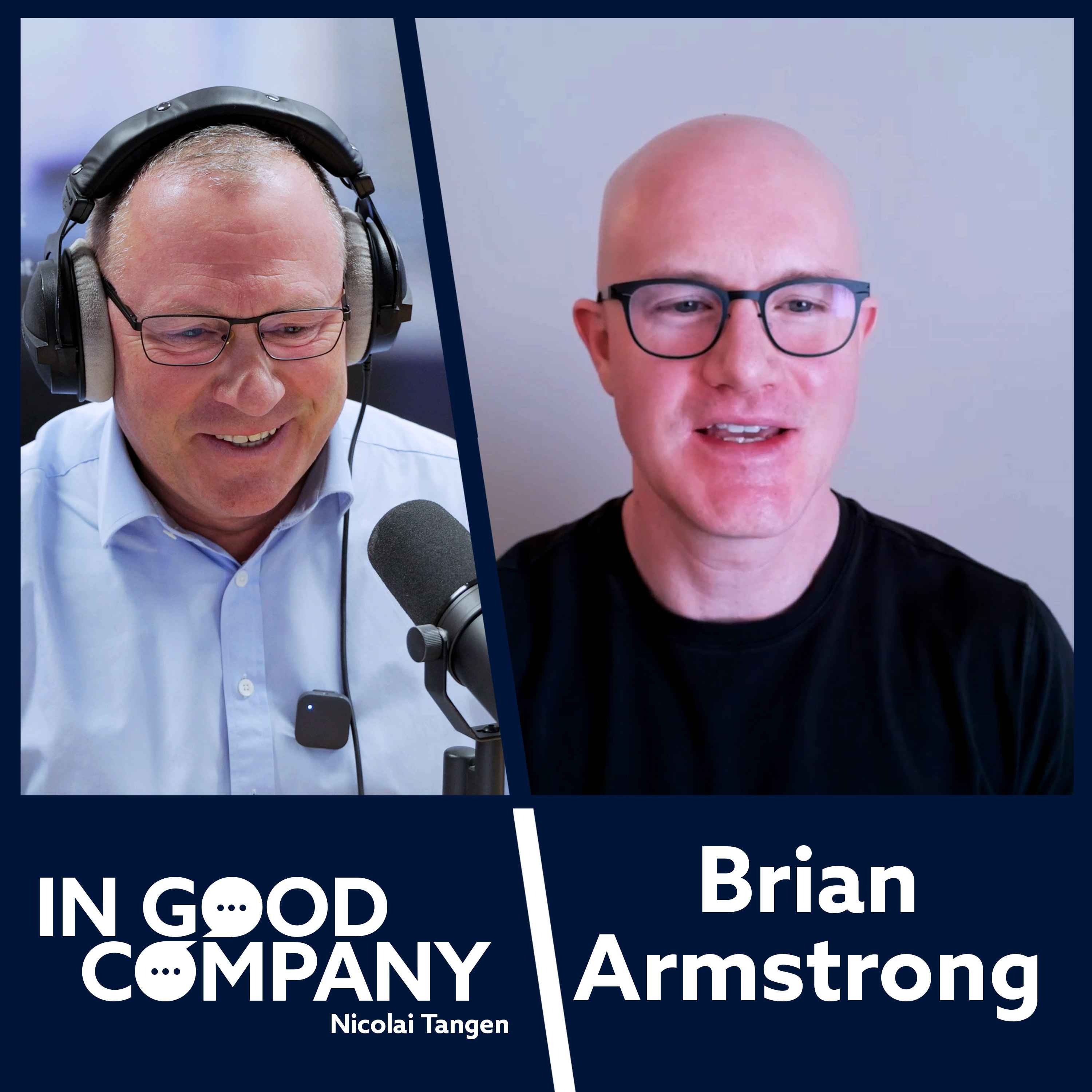
In this episode, Nicolai Tangen, the CEO of Norges Bank Investment Management, interviews Brian Armstrong, co-founder and CEO of Coinbase. They discuss various topics surrounding cryptocurrency, the evolution of financial systems, and Armstrong's views on future technologies, particularly in the realm of AI and longevity.
Written by AI. May contain mistakes.
Discussion on the evolution of cryptocurrency and its impact on financial systems.
“the world, kind of like the internet was for moving information, but this was for moving value.”
Brian shares his experiences at Airbnb and how they highlighted financial system inefficiencies.
“So there was a few pieces like that that helped me see the potential of crypto.”
Brian discusses the significance of Bitcoin and its implications for digital scarcity.
“Now, you call it the everything exchange.”
A look at how crypto is transforming traditional finance and the importance of trust.
“So as that regulatory clarity has emerged, it's created a larger base of holders, and I think that's decreased the volatility.”
Explore the implications and public sentiments surrounding central bank digital currencies.
“There's one other aspect of central bank digital currencies, which is that I'd say they're somewhat polarizing because some people really have concerns about the privacy aspects of that.”
Discussing how the rise of stablecoins affects the demand for government bonds and treasuries.
“to privately issued stable coins that follow a regulated standard Can they coexist?”
Analyzing the race among countries to establish clear regulations for stablecoins.
“to create more demand for their treasuries, but also export their currency around the world so it has more use cases.”
Understanding how banks are integrating stablecoins and crypto into their operations.
“But I'm sorry, but you don't want to call it interest because you don't want to upset the banks.”
Exploring how tokenization could transform the business model for asset managers.
“You know, there's the risk-free rate, right, by short-term government debt.”
Examining the need for clear regulations regarding commodities and securities in the crypto space.
“It's going to reduce a lot of the back office fees and costs to operate that type of business.”
Discussing the implications of the US positioning itself as the crypto capital of the world.
“The US has declared itself the crypto capital of the world.”
How cryptocurrency transactions are monitored to prevent illicit activities.
“Now, as this crypto matures, how will you hand, I mean, how will sanctions and financial and financial crime be handled, you think?”
Evaluating the potential impacts of quantum computing on the future of cryptocurrencies.
“What is quantum computing going to do for crypto?”
Explore how quantum computing might affect Bitcoin's future.
“So there's actually regular meetings already happening in the Bitcoin development community, for instance, about the next algorithms that the Bitcoin network could upgrade to.”
Discuss reasons behind Bitcoin's price fluctuations and resilience.
“And a lot of people were buying Bitcoin as an inflation trade or something like that, an inflation hedge.”
Learn about the quick adoption of AI technologies at Coinbase.
“Do you have a theory about why Bitcoin came down?”
Discover how AI agents are beginning to use stablecoins for transactions.
“About 60 % of our customer support tickets are being answered with AI.”
Examine the growth of machine-to-machine payments and its implications.
“So that's been an exciting area as well.”
Understand the strategies used to increase AI tool adoption among engineers.
“Did I read somewhere that you, in order to get people to really adopt AI in the company, just said, hey, either you use it within a week or you're out?”
Discover the intersection of crypto operations and political engagement.
“Coinbase apolitical, but by 2025, you were one of the most powerful operators in Washington.”
Learn how innovation in the crypto space interacts with government regulation.
“What reflections do you have on running a company in an industry which has become so political?”
Explore the challenges and benefits of operating a public crypto company.
“And so I've gotten to know lots of people in DC, and I actually find it quite interesting and enjoyable at this point.”
Understand the motivations behind investing in longevity biotech.
“But I also want to think about how to use this capital to accelerate progress in the world.”
Exploring the potential of medical advancements in longevity and lifespan extension.
“And so they're on track now to get their first drug into clinical trials next year.”
Discussion on how AI and new technologies are impacting medical research and therapies.
“of the trends that I see happening, right?”
Insights and advice for young people looking to make an impact through perseverance and initiative.
“young people who want to do amazing things?”

Get the gist, explore an idea or ask about something said.
 Claude
On In Good Company with Nicolai Tangen, what are the key points of this episode?
Searching your listeningAutomatic transcript. May contain errors.
0:01Hi, everybody, and welcome to In Good Company. I'm Nicolai Tangen, the CEO of the Norwegian Sovereign Wealth Fund. And today I'm joined by Brian Armstrong, the co-founder and CEO of Coinbase, which is America's largest crypto exchange and increasingly one of the powerful forces shaping global finance. So, Brian, warm welcome. Thank you for having me.
0:29Now, 13 years ago, nobody trusted crypto. And today, nobody can ignore it. And so, what happened really? Well, you know, I first read about Bitcoin in December of 2010. And it was describing how there could be a decentralized network to move value around the world, kind of like the internet was for moving information, but this was for moving value. And, you know, it was initially didn't get much attention. Only people that were computer science PhDs or, you know, libertarians or anarchists were excited by it in these small forums on the internet. And it slowly grew over time. And of course, Bitcoin was the first asset that got created kind of like this digital gold standard.
1:09But quickly, the technology evolved to be, you know, blockchain is a broader concept. And so people made all kinds of things, they made ways to trade other asset classes like commodities and equities. They made stable coins for better payment rails. They made prediction markets. And so now I think we're in a world where crypto is actually updating all aspects of the financial system. It's not really just about Bitcoin. It's about payments. It's about borrowing and lending. It's about capital formation. And how can this technology actually make financial services more efficient and more global, more fair and more free all over the world.
1:45And so it has increased in trust quite a bit. I think the things that have helped that have been number one, regulatory clarity, which we're seeing emerge now in Europe and another in the United States. We got legislation recently passed for stable coins. We're also seeing adoption by the largest institutions in the world. So, you know, there's lots of Bitcoin ETFs now and funds like BlackRock and Apollo have come out and said they want to tokenize all of their funds. Companies like Visa and JP Morgan are running experiments with how to do stablecoin payments. And so I think these trusted institutions coming in has also been another factor in addition to the regulatory clarity.
2:21But I mean, you worked at Airbnb back in the days and you watched the cross-border payments fail, and then you figured out you needed to change the whole system, right? Yeah, that did give me a front row seat into how broken the global financial system was in certain situations. At Airbnb, we were trying to move money to 190 countries around the world, both collecting payments from guests, but also paying out to the hosts, people who are listing their homes. And in many countries, it was very difficult for Airbnb to route money, like to do payouts to Uruguay or somewhere like that. It might cost 7 % to 10 % in fees, take three to five days to get three to five business days to arrive on the other side.
3:02And so working as an early engineer at Airbnb certainly gave me a front row seat to that. I had also spent a year living in Buenos Aires, Argentina, and I had seen that country go through hyperinflation, a little bit at least. And it gave me a profound sense of how much that changed the culture of a country and really held back progress. You know, high inflation can really hurt the poorest people in society. So there was a few pieces like that that helped me see the potential of crypto. So when you first read the Bitcoin white paper, what was your immediate reaction? What do you think? you know i it really captivated my attention i remember having this thought like this might be one of the most important things i've read in a long time and i didn't fully understand it the first time i read it it's it's only about 10 pages long you could any you know anybody can go read it it's actually i think it's worth people going to read it it has some math it has some computer science so it's not the easiest thing to digest it took me a number of times to reread it and really go try to implement the protocol myself to fully understand it but it was a true computer science breakthrough.
4:01And it showed how you could have provable scarcity in a digital world. And previously, that was not possible. So if you have a photo on your phone, you can send a copy of it to someone else. And in the digital world, infinite copies are kind of the norm. And this algorithm really showed how you could have provable scarcity. So if there was a unique digital item, it was provably unique mathematically. And you couldn't have people just make more copies of it willy-nilly around the world. So that allowed, the initial use case was Bitcoin, this kind of digital gold. But then people applied that same technology to tokenizing the dollar, tokenizing stocks, tokenizing meme coins, NFTs, and all the kind of crazy stuff that happened in crypto too.
4:47I mean, just to say it, I think crypto attracted a lot of kind of bad actors as well. And that created reputational issues early on. But what does it feel like to bang on about something that nobody believes in? Well, I think that's the nature of entrepreneurship. You have to see something early and be right. But it can't be a consensus view at that time. Otherwise, you're too late, right? Like now everybody is very excited about cloud computing, or even like, I would say AI or whatever. These are just very mainstream views at this point. It's probably too late to start one of the foundational AI companies.
5:19It's too late to start one of the foundational cloud companies. So as an entrepreneur, you're always kind of looking to things that are early, that are not well liked and not well appreciated, and sort of seeing is there actually much more here than most people are recognizing. And if you see that gap between consensus view, then you have an opportunity to go commercialize it. So for me, you know, I've always, I guess, this is partly why I think, you know, some entrepreneurs are like a little on the spectrum, you know, they just they don't care as much about social cohesion. Are you on the spectrum?
5:54I would say so, yes. I've never been formally diagnosed, but I've taken various tests and things like that just myself. And I score somewhere on the spectrum for autism, yes. And I think that that is overrepresented in entrepreneurs. Why is that? Well, autism can present itself in many different ways. But I think one of the ways it presents is that you care a little bit less about social cohesion. You know, sometimes I'll be in a meeting and I ask a question and I know people might think it's a dumb question, right? But I genuinely don't understand it. And so I'll ask them, I'll say, well, actually, why do people buy that product?
6:37You know, and everyone, oh, it's obvious. Like, you know, this brand is loved and whatever. I'm like, but is that really, you know, so I'm okay asking dumb questions, looking a little silly. I just I'm more interested in finding unique insights and advancing civilizational progress by trying to build cool things in the world like that's that's what really motivates me and I just I find it fun and so anyway yeah if you look at some of the not all entrepreneurs obviously are on the spectrum but I think it is overrepresented yeah well Mark Andreessen told me that he thought you were one of the cleverest people you ever met so you must be quite clever but I feel that way about him too.
7:14So, thanks. That's a good compliment. Now, you call it the everything exchange. So, stock trading, crypto, custody. So, are you building a bridge to traditional finance or is this the end of traditional finance? No, I think it's an evolution of traditional finance. So, we are building the everything exchange, which is bringing every asset class into one tradable platform. So, you have not only crypto assets, which there are millions now, but you have stocks, commodities, FX. I think prediction markets is another big category that's taken off. And I think you'll actually see all capital formation get changed in crypto here relatively soon, where it's easier to raise money and then go through the process of being a private company, eventually being able to go public totally on chain.
8:06And then, of course, it's not just trading. Crypto is actually updating these other categories of finance as well, right? Payments and borrowing and lending and everything. So yeah, it's a pretty broad technology. Now, there are other crypto exchanges too. Why should you win against them? Yeah, well, we've tried to differentiate really by being the most trusted brand in crypto. And that's allowed us to then custody more crypto than any other company in the world. And by custodying more crypto, we then try to connect more products into that custody. And it makes the product sticky. It gives us a certain amount of margin, pricing power.
8:44We can use that to go build new products. So it really comes from that trust. That comes from taking a compliant approach, following the law, being good at design, customer support. There's lots of areas that trust can come from. Being based in the United States, being a public company with audited financials, we've benefited from all of these things to build the most trusted brand. We're the largest provider to institutions as well for crypto services. And then, yeah, that trust has allowed us to now store about more than 12 % of all the crypto in the world, which is more than any other company we're aware of.
9:16That's been growing over time. And again, connecting more products into those deposits, and then we can actually generate more revenue from that and reinvest it. So that's been our expertise and strategy so far. Why is crypto so volatile? Well, Bitcoin is volatile. you know not all but of course like stable coins are very stable right so you know bitcoin was especially volatile early on because it was so new and there was only a relatively small number of people in the world holding it now it's gotten a lot less volatile over the last 10 years as the market cap has grown and i would say it was probably the best performing asset of the last 10 years by most measures um and so it went through like it's a little bit like the internet right the internet went through these bubbles and crashes as well, because people oscillated between this is the future of everything to, you know, despair.
10:09And every cycle that crypto or specifically Bitcoin has gone through, it's gotten a little bit less volatile, like the peak to trough has been a smaller percentage, because more people in the world are holding it now, you know, there's large ETFs, there's a lot of institutional holders, there's now a strategic Bitcoin reserve for the United States government, other sovereign wealth funds are holding it. So as that regulatory clarity has emerged, it's created a larger base of holders, and I think that's decreased the volatility. Now, why are stablecoins more important than people think? Well, I think a digital dollar is very still underappreciated and could grow 100 or 1000x from here.
10:49The reason is that payments are still relatively high friction around the world, right? Now, you know, in certain countries, like I'd say in Brazil with PIX or in India with UPI, they've managed to get payments to be quite fast and cheap, but they work only within that one country. Other countries, like in Europe, they have instant bank transfers that are free essentially. And that's a really good feature. But if you look at most payment methods, whether it's credit card or SWIFT or anything, and you kind of look at these three dimensions, like the cost, the speed, and then the global reach. So they're, you know, let's take credit cards, for example, like they have pretty good global reach, but they have high cost two to 3 % on every transaction.
11:34And they're quite fast, right? If you look at Swift, it has good global reach, but it's expensive. And it takes like, I think what two to three business days or something like that. And so if stable coins are the only payment rail that checks all three boxes, it's fast, cheap and global. So you can now send stablecoins instantly at less than one second anywhere in the world for less than a tenth of a cent US. And so payments are like water. They kind of flow to the path of least resistance. And I think that's why we're seeing such enormous growth in stablecoins. I think it grew about maybe 100 % year over year last year.
12:12And more and more of global GDP, I think, will run on stablecoin rails. Who are the big users of this now? Well, some of the early adopters of it were for B2B cross-border payments. That seemed to be an early use case that was least well served by the traditional financial system. You can imagine many companies out there, they're sourcing goods from Asia or Europe and these wire transfers. And there's FX risk, there's settlement counterparty risk, and they take sometimes five days if you're moving cross-border payments for your company. So that's been a huge emerging use case for stablecoins. We're also starting to see it be used in e-commerce and peer-to-peer payments, like people sending money home to their family in other countries is an example of that, like with remittance.
13:01And yeah, I think that eventually it should eat more and more of every payment category, right? Credit card payments, e-commerce, but the B2B cross-border payments have been the largest driver so far. What's the practical difference between a stablecoin a central bank digital currency? Well, this is a big debate. So when I go meet with other central bankers, they often tell me they would like to create a central bank digital currency. And I tell them, okay, that's great. You know, we want crypto to be adopted by everyone. What I've noticed is that they often don't end up launching it though. You know, governments are really good at setting policy and they are not as good at building software, right?
13:44And so they can sometimes work with an outsourced vendor. The government can hire a technology vendor to come in and build that. But what typically works best, I've seen, is that if the government sets the policy, the private market can go provide those solutions. And so that's what we've seen happen with stablecoins so far. The largest have been privately issued, but in the US at least, following a regulated standard. There's one other aspect of central bank digital currencies, which is that I'd say they're somewhat polarizing because some people really have concerns about the privacy aspects of that.
14:18That if the government is issuing a central bank digital currency, it could end up with some kind of social credit score where you get your money turned off by the government. And so China, for instance, has created a central bank digital currency, their digital RMB or digital yuan. And they see it as a tool for control, in my view. the Chinese people are very excited about decentralized cryptocurrencies but the Chinese government fears it as a way of losing control so they've been much more advocating for a central bank digital currency that they control, the digital yuan I think the rest of the world needs to figure out which side they're going to be on in the US right now it's leaning very much more to privately issued stable coins that follow a regulated standard Can they coexist?
15:05Yeah, I don't see any reason why they couldn't coexist And I think there's going to be certain segments of the market that will only trust a central bank digital currency. There's going to be other ones that lean into the private ones. And the private ones will just move faster, I think, and innovate faster. So if stablecoins scale massively, what are the implications for a government bond market? Well, stablecoins are going to create a lot of demand for government bonds, T-bills. And today, I think the total stablecoin market cap is about$300 billion or so. I think last time I looked, maybe stablecoins writ large are about the 16th largest holder of U.S.
15:42government debt. And so if you're the Treasury Secretary, that's probably a good thing. You want more demand for U.S. treasuries. And then what's interesting is that because those short-term treasuries, like under the U.S. regulation, you can only hold short-term U.S. treasuries underlying stablecoins that are 93 days or less. So it's very short-term treasuries. It's low risk, designed to be very low risk. And what we're seeing is that a lot of stablecoins now, they can pass along some of the rewards from holding those short-term U.S. treasuries to the actual customer, which is a nice benefit for them.
16:17So I think overall, I'd say U.S.-backed stablecoins are very good for the dollar. like if there's a euro-backed one or any country. Most countries are racing to have one of these now. They all see it as a good way to get their currency, to create more demand for their treasuries, but also export their currency around the world so it has more use cases. Do you think Europe will get one? Yeah, so actually Europe has one. There's one called EURC that we work with and support. and 97 % of all the stable coins are backed by the dollar right now. So I think that the race is on where most of these other countries really need to start to create clear regulatory environments and then push the adoption of it to compete with.
17:02From a U.S. lens, they like the fact that it's dollar-backed mostly. They view it as a key tool to preserve the reserve currency of the dollar. But I wear many hats because we operate in many countries. So when I talk to different folks, I encourage the folks in Europe, for instance, to continue to promulgate good rules around that and accelerate adoption. But do you think it will happen? Like it's very small for the moment. Yeah. I think the key thing that would drive adoption of one versus another right now is the payment of rewards. Basically, can the customer earn the rewards from holding those short-term government debt underneath?
17:38And then there are certain... So basically paying interest. Yeah, we don't use the word interest because that legally is associated with having bank deposits that do fractional reserve. And in this case, there's no fractional reserve happening. It's 100 % reserved by short-term debt. But that's a legal debate that's happening right now. So we call them rewards. But I'm sorry, but you don't want to call it interest because you don't want to upset the banks. Exactly, yes. We want to work with the banks to integrate this technology. And Coinbase is actually powering integrations for five of the GSIB banks right now.
18:08So we want to help. The smartest banks are all leaning into this as an opportunity. We hope that that continues.
18:19But you say you work with the banks. Are they your partners or are they your prey? There are partners, yeah. I mean, first of all, we work with them today for on and off ramps and we do lots of our own corporate work with them. But I think all of the smartest bank CEOs right now, the large banks, etc., are leaning into stablecoins and crypto generally. They're integrating stablecoin rails because they're faster, cheaper. They can save them money with swift fees and move their client funds around faster. They're also using crypto to tokenize their various funds and assets. And then they're providing crypto trading to their clients, like in their high net worth clients and things like that, who want access to these assets.
18:59So we have a product called Coinbase Prime and Coinbase Developer Platform that helps any institution integrate crypto services, whether that's wallets, trading payments, etc. And we are the leading provider of that for institutions. But banks say that yield on stablecoins could drain deposits and hurt consumers. So how do you argue against that? Yeah, so I think this tension already exists in the current financial system. You know, there's the risk-free rate, right, by short-term government debt. And people can put money in money market funds, for instance, or buy short-term government debt. Or if they want to attract a greater return, they can just choose to lend out their money.
19:46And so there's already a tension between this. you know, actually the large banks right now are holding about$3 trillion at the Federal Reserve just to get the short-term rate from the government themselves. They're not actually lending out the money. So I think that if you look at the order of magnitude here, there's about like$7 trillion in money market funds. There's$3 trillion the banks are holding at the Fed, getting these short-term rates. And stablecoins are only about$300 billion, right? So it's $300 billion is a tiny drop in the bucket for stablecoins. The money markets and the money they're holding at the Fed, it dwarfs it.
20:20So it defies credulity in my mind to say that stablecoins are a threat to these deposits. I think that the reality is that there's a large percentage of deposits that are interest rate insensitive. And people are going to continue to hold them at banks. If people want to hold stablecoins at a crypto wallet or a crypto company and they can earn more rewards on that, that's a nice marketing tool. The banks over time may have to compete on that and choose to share more of the economics. But I actually don't think it'll be a huge impact to them in the medium term or short term. So we own stakes in big asset managers.
20:57What's going to happen to their business model when funds are tokenized? I think it's going to be great for them. I think it's going to create more demand for their funds and products. I think it's going to democratize access. It's going to reduce a lot of the back office fees and costs to operate that type of business. It's actually, you know, broadly this term tokenization, right? It's basically this idea that you have an underlying asset and then you make a digital token that one-to-one represents it. So the first case we've seen this take off is with stable coins. That's a dollar held, you know, in a T-bill or wherever and then a digital dollar.
21:33And that's tokenization of the dollar. So that took off and is doing great. It's a huge growth area. we're now seeing the tokenization of all these other asset classes, like you mentioned. And this can happen in real estate and private credit and the funds that BlackRock and Apollo and these firms put out. So I think it's going to just create more demand for their products, essentially. If you could change one thing when it comes to US regulation, what would you change? Well, right now, the US is on the cusp of passing what's called market structure legislation. So So the first bill already became law, which is around stablecoins.
22:10This second bill is clarifying all the non-stablecoin assets in crypto. And in particular, it's answering this key question of what is a commodity and what's a security. In the US, we have two different federal regulators for commodities and securities. So this is a big question that in the past, it created a bit of a jump ball between the two agencies we were kind of caught in the middle. And so clarifying this question in the US is very important. just interestingly in other markets where like in the uk or singapore there's only one federal regulator for both commodities and securities so it's a total non-issue there but um yeah so if this becomes clarified in the u.s i think that it'll be another huge unlock for you know crypto securities like how capital formation works um how the the commodities how can an asset become sufficiently decentralized to be a commodity and that would create a lot of clarity so we're working hard on getting that legislation passed, hopefully at some point in the US.
23:08The US has declared itself the crypto capital of the world. What's that going to mean for US competitiveness, you think? Yeah, well, President Trump, yeah, he said that he wants the United States to be the crypto capital of the world. So he's very much embraced this technology trend and tried to help it be moved back on shore. I think he has a fear or a concern, I should say, that too much of it has moved offshore due to the lack of regulatory clarity. And, you know, that shift in tone from the United States government has created a shift in tone in other countries around the world as well, who have started to compete for that talent and that industry.
23:46You know, it's a complicated question, like the geopolitics are interesting. I mean, there's, right now, there is several financial hubs in the world, right? New York is the largest, but you could look at London and Dubai and Singapore. And I think all of them are trying to think about how they can not just maintain their share with that, but try to grow it. And I find it interesting as a CEO, you know, in any given moment, there's some parts of the world that are leaning into this technology, and there's some that are hesitant. And so we basically just try to go invest wherever there's regulatory clarity and a friendly environment.
24:25And then, you know, typically, often people, you know, politicians change and cabinets change and every four years or eight years, depending. And so if it flips the other way, then we go invest somewhere else. And so there's been moments where we try to just minimize the fines in a country. And then there's moments where we actually try to grow in that country. And we're always kind of just evaluating the political landscape. Yeah. Now, as this crypto matures, how will you hand, I mean, how will sanctions and financial and financial crime be handled, you think? Yeah, very much the same way it is today in the sense that there are regulated financial institutions or intermediaries.
25:03Coinbase is an example of that. So we follow all of the anti-money laundering laws and know your customer laws. And we've been a great partner to law enforcement on that. So whenever they're trying to track down some bad actors, we have a great team that can help them do blockchain analytics. There was kind of this misconception early on that Bitcoin or these digital currencies were anonymous. And it's now become very clear that that's not the case. It's actually a public ledger. And so it's trackable what's happened. And then, you know, people are, they go through their know your customer process where you have to upload your ID when you open an account like at Coinbase, just like you would with a brokerage or a bank.
25:42And we do transaction monitoring on that. And so if some sort of illicit activities happening. We report it. If we get a subpoena from law enforcement, we work with them on that as the law requires. So I think that bad actors have started to realize that it's a really bad idea to try to commit crime using crypto. It's actually more traceable than cash. And so today, cash is still the preferred method that crime is committed in. And yeah, that's something that we often have to go educate the folks about because there is still a perception that crypto is somehow used more for crime. The reality is that about half of 1%, it's a little bit less than half of 1 % of all crypto transactions are for illicit purposes.
26:29And the US dollar cash is about 4 % used for illicit activity. So it's actually far more of a safe environment than cash. What is quantum computing going to do for crypto? Well, quantum computing is a big trend that's going to affect, of course, lots of different areas of cryptography and technology. And so if for some reason a, you know, I don't know, 100 qubit quantum computer were just available today, it would affect lots of things much beyond crypto. I mean, all transactions in the financial system, for instance, but also every login and password, all encryption data. So it's a much bigger topic.
27:12Will it be the end of crypto? No, it won't be the end of crypto. The reason is that all systems will need to upgrade to post-quantum cryptographic algorithms. And so just like in banking or, you know, in how Google stores data or anything, all these will have to be upgraded in that environment. And so what we've done at Coinbase is we've made a big effort to get ahead of this. The important thing is you don't want a rush at the end. You want to get ahead of these kinds of issues. So we put together this advisory council of cryptography experts to make sure that we're making progress towards the upgrade of the Bitcoin network and the Ethereum network.
27:51And, of course, we don't control those networks. They are truly decentralized, but we can try to help where it's helpful and make sure that the industry and the community really comes together with these upgrades. So there's actually regular meetings already happening in the Bitcoin development community, for instance, about the next algorithms that the Bitcoin network could upgrade to. And that will be quantum resistant and it will require the network to upgrade, essentially. Do you think part of the reason why crypto has been weak is because people are worried about what will happen with quantum computing going forward?
28:30You know, well, yeah, the Bitcoin price did come down about three months ago. And a lot of people were trying to figure out what the root cause of that was. There was a lot of, you know, theories being promulgated, like, you know, maybe Kevin Warsh as the Fed chair is going to be more of an inflation hawk. And a lot of people were buying Bitcoin as an inflation trade or something like that, an inflation hedge. Another theory was this one around quantum. Personally, I think that the quantum thing requires a lot of diligent effort, but it's not existential to Bitcoin. I think that with good work that we can make sure that lands in a good place.
29:07I think that inflation is still a major issue around the world. So to be honest, I, you know, there's obviously various macro events like the wars and all kinds of things that have caused the market to pull back. But, yeah, I was surprised at how much Bitcoin came down. And I think the fundamentals underneath have not changed very much in my point of view. So sometimes the markets, people are trading based on what they think other people are going to do, not what they think the reality is. So, yeah, that's more your domain than mine. But, yeah, I should ask you, actually. Do you have a theory about why Bitcoin came down?
29:39I'm not the specialist there. You are the specialist.
29:46You moved very fast on AI adoption in your company. Tell me, how did you do it? How quickly did you get people to take that opportunity? Yeah, well, as these AI models got better over the last few years, we certainly recognized that we needed to make a big push internally to stay ahead of this. Every company does. So we were already using AI in a variety of places in the company to detect fraud. We were using it in our compliance programs. But we started to really try to move to an AI-first mentality throughout the company. So for instance, on our software engineering team, we now have more than 50 % of the code is being written by AI.
30:30About 60 % of our customer support tickets are being answered with AI. You can, of course, still reach a human if you need to. and with our compliance automation we've started to see some really impressive potential savings, cost savings the most interesting thing that we've seen now is that AI agents are increasingly transacting using stablecoins there's this kind of emerging area called agentic commerce and if you believe as I do that eventually there will be more AI agents than human beings AI agents can't go open a bank account which still requires you to know your customer and have a government-issued ID for a human being.
31:08But an AI agent can absolutely have a stablecoin wallet. And so we've built some really great infrastructure and tools for AI agents to spin up their own stablecoin wallet, and then they can begin to transact. So they can go get work done on your behalf. Like if you ask your AI agent to book you a trip, they can go pay for tickets and hotels and things. If you're asking a software developer AI agent to go build you some website, they can register a domain name or spin up resources on AWS or GitHub. AI agents can transact with other AI agents, which is fascinating. So we're having this kind of machine-to-machine type payments.
31:46And because stablecoin payments are so fast, cheap, and global, I think there'll actually be several orders of magnitude more transactions every day, maybe smaller dollar values, as machine-to-machine payments really start to take off. So that's been an exciting area as well. How prevalent is that now? Well, I wouldn't say that it's like a material percentage of global GDP, but it's early but growing fast. How fast? Well, just as an example, we put out this protocol called X402, which makes it easy to attach a stablecoin payment to any web request between agents or in other situations. And we just put that out maybe about five months ago, and it's done 100 million transactions now.
32:31and it's shown really good growth over the last few months. So, yeah, it's so early that this is all happening in the last six months. It could be, my guess is it would grow 2 to 5x per year or something like that over the coming years. We don't know. It's really starting to get a lot of attention, though. Wow. Did I read somewhere that you, in order to get people to really adopt AI in the company, just said, hey, either you use it within a week or you're out? yeah i mean these stories always get um they get better every time you tell them but um what i did do is i said hey i want we want every engineer to onboard to this tool you know cursor and clod and these different things and at least try it right like this was about a year ago now now almost all the engineers are using it every day but um at that time i think there was just like anything people were a little hesitant it's a new thing i have the thing that i know how to do every day.
33:24Why are you telling me how to do this? And what I told them was, I want to see everybody sign up and at least try it out. You don't have to switch your entire workflow every day. But if you haven't at least signed up and tried it out, I start to question your eagerness to learn the latest tools in your career and your profession. And so I was watching the numbers of adoption of this inside. And it was like, okay, we got 60 % of engineers to try it and 70%. And at some point, I just got impatient. And I said, I just sent a note to the engineer. And I said, like, everybody just sign up and try this out by the end of the week.
33:55And if you can't, I'm going to host a meeting on Saturday with the CEO for anybody who hasn't tried it. And I want to hear from you why you haven't tried it. And if you don't have if you don't show up for that meeting, or you don't have a good reason, you know, I, I didn't say this in the message. But you know, about I think maybe only one person got fired, actually, because they refused to sign up for it and they didn't come to the meeting and they didn't have a good reason like they weren't on vacation or parental leave or something like that um they just refused to do it and i so i was like hey you're not a good fit for the company so i think only one person got fired but it did it did create a very clear tone from the top that we need to stay on top of these things to be relevant as a company i call that a very clear tone from the top yeah um in 2020 you declared Coinbase apolitical, but by 2025, you were one of the most powerful operators in Washington.
34:48So what happened there? Yeah, well, so in 2021, we put out a blog post saying that we're a mission focused company. And there was an important distinction I made there saying, we are going to be focused on our mission, which includes some of our policy work around the mission. But on all other issues in the world, we are not going to bring that into the workplace, because we all have different points of view and it can be a distraction. And we as a company came here to focus on one mission, not the other one. So I think it was consistent for us to continue to focus on policy efforts related to our mission of increasing economic freedom in the world and crypto adoption.
35:24And so we did realize at a certain point, especially just during the last administration in the United States, there was an SEC chair and one particular senator who was very anti-crypto and they decided to create a lot of lawsuits and lawfare. In our view, in my view, they tried to unlawfully try to curtail or kill the industry in the United States, even though that was not the will of the voters and the people, and that was not the will of Congress writ large. And so we did end up engaging in some litigation. We started to build more of a policy muscle, both with a grassroots movement of voters in the US that we helped fund an organization there.
36:03There was a super PAC that we put some money into. And, you know, my preference, honestly, I'm an engineer by background. And as a CEO, what I prefer to be doing is working on products and engineering. But if you start to see the limiting factor to the growth of the business is regulatory clarity, and there's parts of the government love it, parts of the government hate it. How do you start to build that policy muscle with something we got very good at during that time period. And, you know, the job is not done, obviously, but I think that we did develop a very strong policy muscle and that's helped us grow the industry in the US and now in these other countries.
36:37What reflections do you have on running a company in an industry which has become so political? Well, you know, my preference always would have been to not engage too much in politics. But my observation is that if you're doing anything innovative, it eventually intersects with the government, right? I mean, if you look at like Uber and Airbnb, they became very hot button political issues. You know, obviously self-driving cars, space, you know, AI is like a huge political issue right now where a lot of the AI companies have actually come to the crypto industry and said, how did you do it? You know, teach us because right now the popularity of AI on both sides of the aisle is very low.
37:22And so, you know, they need to somehow try to win hearts and minds. And, you know, I initially was kind of reluctant to go engage more in DC. This was like maybe seven years ago or so. And I felt like I really just wanted to focus on product engineering. But people like Mark Andreessen, actually, who you mentioned earlier, he's on our board. And he's one of the people I really credit for convincing me that he was like, you know, this industry is just, it's not going to achieve its full potential unless you start to take this seriously as the leading company in the US. And I found a way to actually enjoy it in some ways.
37:57Whatever is moving the company forward, the most important thing I can be doing in any given moment to move the company forward, I can get excited about it. It doesn't really matter what it is, as long as it's the most important thing to create progress, I find that motivating. And so I've gotten to know lots of people in DC, and I actually find it quite interesting and enjoyable at this point. Talking about motivation, how do you react when the value of your shareholding goes up and down by like$10 billion? Yeah, well, we grew up in a world of crypto volatility. So in some ways, the public markets, we were well positioned for that.
38:33But I don't love it just in terms of creating predictability in the business, right?
38:41For better or worse, we went out as a public company in 2021. And I think that that had a lot of benefits, like it allowed us to be the most trusted brand and to land a lot of these institutional clients, it made it a lot easier to raise convertible debt and do do lots. So we kind of became like the grown up in the room, which was great. I definitely, you know, don't love sometimes the volatility of the public markets and sentiment can just swing very wildly where as a private company, you can kind of hold on to your last mark for longer than you should at some point sometimes. So anyway, I'm glad that we went out first and we still are building our, you know, I'd say like the base of long-term holders, right?
39:22Actually getting added to the S &P 500 last year was a major forward step there, where I think we've actually brought on a lot of institutional holders through that process. And that's been great.
39:36you mentioned long term on the side you are running a longevity biotech company is that in order to be properly long term that you do that well I do I do think very long term the person running it every day is Jacob Kimmel who is a brilliant scientist and operator of that business but I you know I co-founded it I put some of my own money and as an investor, I'm on the board, you know, I helped them early on get it off the ground. But yeah, just to give you maybe a sense of why I did that, because it may be atypical, you know, when, when Coinbase went public, and I got some liquidity from that, you know, I decided, all right, I want to be continue doing doing this for a long time as a public company CEO.
40:18But I also want to think about how to use this capital to accelerate progress in the world. And, you know, actually, a little bit, a little bit like Elon, right, with PayPal, he got some liquidity from that. In the world of software, it's sometimes a little easier to create your first business. And it's a little more forgiving than the world of atoms where you're moving things around in the physical world. And so what I did was I started to think about what are the big technology trends that would change the future in the coming decades. And I'm sure you think about lots of them, right? There's AI and there's cheaper energy, fusion energy.
40:51There's space, there's brain machine interfaces. You can go read Ray Kurzweil, right? He talks about how he predicted a long time ago that we'd have artificial general intelligence around 2029. He seems to be on track with that prediction. He's also said that he thinks we'll hit longevity escape velocity in 2030 to 2035 as AI and single cell multi-omics, things like that, kind of come down in cost. Anyway, long way of saying, I felt like there were good people working on a lot of the other big technology trends, but I didn't see a great company or team in the longevity space. In fact, there was a lot of kind of snake oil and kind of less serious companies.
41:31And so I hosted a series of dinners, was lucky enough to find the other co-founders, Blake Byers, Jacob Kimmel, and Greg Johnson, who helped create the company in the early days too. And yeah, put some money in. And I think it's doing something very exciting, which is called epigenetic reprogramming, which essentially it's reprogramming your cells to restore function they had when they were younger. And New Limit is, yeah, it's gone faster than I thought. I thought it would have been, you know, five, six, seven years of kind of basic research. But within three years, they were able to demonstrate successful reprogramming of human cells to restore function they had when they were younger.
42:06And so they're on track now to get their first drug into clinical trials next year. How old are you now? 43. How long do you think you're going to live with this new technology? With new limit and epigenetic reprogramming and just broadly, yeah. Um, well, none of this is guaranteed, obviously. I think it requires a lot of hard work, um, and good things. It's going to take hundreds of companies doing things in this space. Um, but I think that within our lifetime, um, we'll, we'll reach, I think there's a good chance. I don't know if it's like guaranteed, but it's 50 % chance that we could reach what's called longevity escape velocity where for every year that you live, um, medicine and science advances enough where you could add another year of life.
42:53And then the things that would take you out at that point would be like, you know, accidents and getting hit by a bus and things like that. It's not, you don't become immortal, but you know, I do think there's a possibility at least that within our lifetime. Now that's probably an aggressive point of view, like Ray Kurzweil would put that view out. I think most people, if you talk to in big pharma, they would say, oh, it's, it's, our generation won't be the one, but maybe the next, you know, our children will be the ones that could live forever indefinitely. So if you are lucky and you stay out of the burst lane, you think you potentially could live for a couple hundred years?
43:30I think it's possible, yeah. It's certainly not guaranteed, but with hard work, I guess I'll give you a little bit more of the trends that I see happening, right? So of course, AI is clearly a trend that's happening. That's going to have downstream effects. Like an example of it's going to be people are creating now these virtual models of the cell, where how can you simulate not just like protein folding, like a single protein, but how could you simulate the entire model of the human cell that would allow you to start to run something like clinical trials or approaching clinical trials in software in silico, right?
44:01So you could dramatically accelerate the number of experiments you can run in silico and then take the most promising ones to actual clinical trials. There's something called like single cell multi-omics, which is like getting a readout of the entire state of a cell, that is following a cost curve similar to Moore's law. So the cost to read out the entire state of a cell is falling in, cutting in half every 18 months or, or, or faster actually. So it's allowing companies like new limit to do these massive pooled screens where we can test tens of thousands of different hypotheses now, where before you had to kind of manually do like, you know, one at a time.
44:39And then, yeah, there's a couple other trends like that that are happening where I think, you know, we could potentially have really breakthrough therapies in the 2030 to 2035 timeframe. Incredible. Yeah. I mean, that's what gets me excited is just how do we, how do we accelerate progress with science and technology? So, I mean, there's, by the way, there's a whole other tech tree happening here with brain machine interfaces too, right? Like that's the other way that people may merge with AI and actually upload your brain, so to speak, which, is a whole other sci-fi topic. But anyway, I find these things.
45:13Are you involved with that as well? No, nothing directly. I mean, I've invested in a few of the brain machine interface companies because I think it's interesting, but I haven't, I'm not building anything there. Brian, lastly, what is your advice to people who want to do, young people who want to do amazing things? Well, you know, just like any skill set, it takes a lot of iteration to get better at it. I started a company in college that was lots of hard work and it was not really that successful. And I tried a couple more ideas. I went to go join a startup. If you're excited about whether it could be anything as an investor, this is true.
45:51If you want to be a great musician, this is true. If you want to be an actor, whatever it is, you kind of have to just show up for a decade and keep trying a lot of things and it's not going to work that much early on. So action produces information. Like if you have an idea, go try it. Don't just sit around thinking about maybe what if this and that. There's a certain amount of agency and initiative that's required for people to step into the unknown, be willing to look foolish, to be a beginner, to fall flat on your face. And most of the things I've tried in my life, they didn't work the first time or the second time or third time, but I'm stubborn and determined enough and okay looking stupid that I just kind of kept going.
46:30And some of the things I try now have worked and not all of them will. So I'm going to always try to stay hungry and foolish, as Steve Jobs said, I guess. Well, you for sure have shown up, tried a lot of things and for sure succeeded. So it's been great talking to you. Incredible story. Big thanks. Yeah, thank you. I appreciate it.
Are AI agents about to become the biggest users of crypto? Nicolai Tangen sits down with Brian Armstrong, co-founder and CEO of Coinbase — the largest crypto exchange in the US — to explore how digital assets are rewriting global finance. They discuss why stablecoins could grow 100x or even 1000x, how AI agents are already transacting on blockchain, and how Coinbase pushed back against crypto's political headwinds. Brian also shares his bold bet that longevity escape velocity is within reach — and why a few hundred years of living might not be science fiction. Tune in for an insightful conversation!
In Good Company is hosted by Nicolai Tangen, CEO of Norges Bank Investment Management. New full episodes every Wednesday, and don't miss our Highlight episodes every Friday.
The production team for this episode includes Isabelle Karlsson and PLAN-B's Niklas Figenschau Johansen, Sebastian Langvik-Hansen and Pål Huuse. Background research was conducted by Tobias Hyldmo and David Høysæther.
Hosted on Acast. See acast.com/privacy for more information.


