
 Ask ChatGPT


 In Good Company with Nicolai Tangen
8 Jul 2026 · 44m · 21 chapters
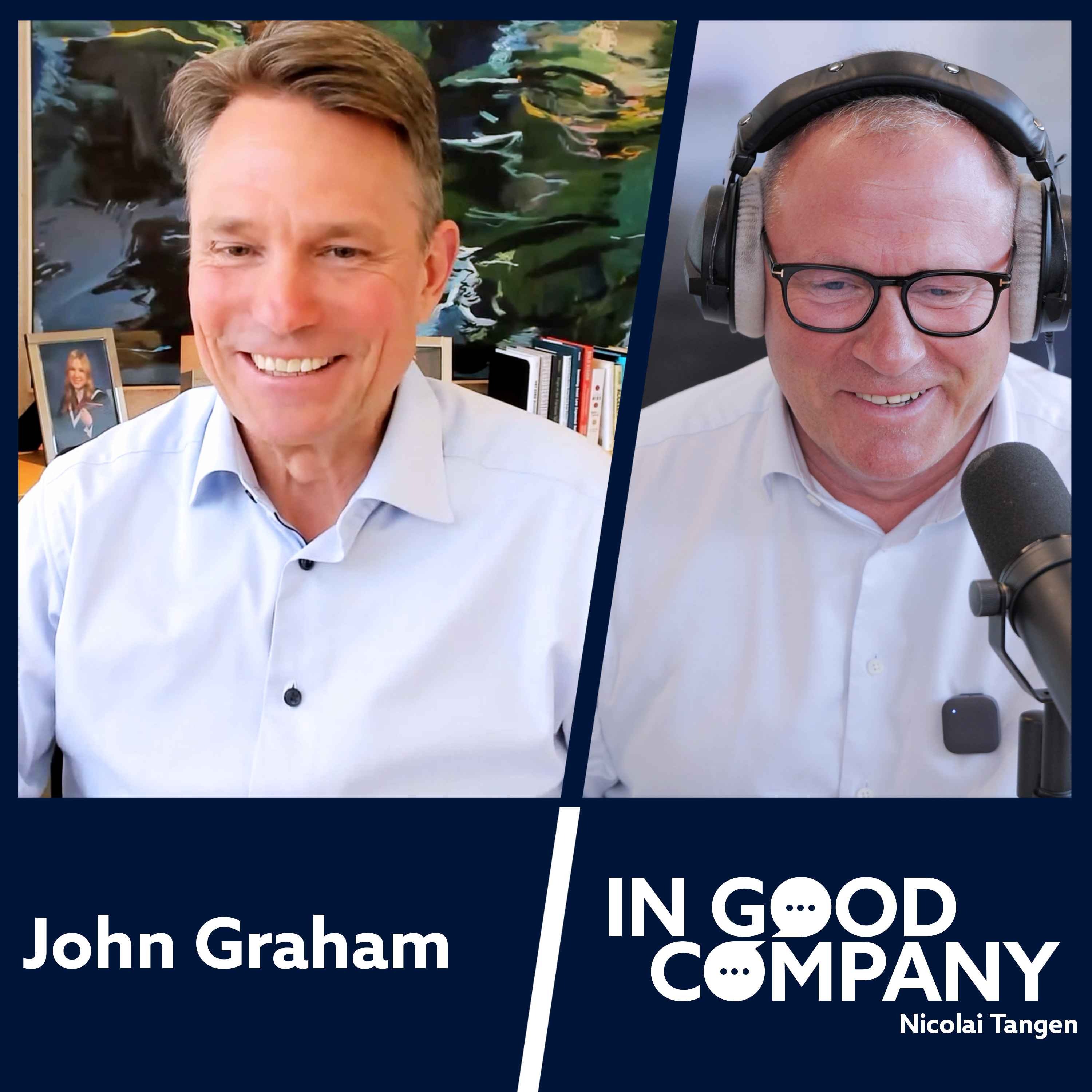
CPPIB CEO John Graham explains the Canadian pension model (CPP) and how CPP Investments manages about $800B for 22 million Canadians, focusing on public vs private investing, governance, risk, diversification, transparency, geopolitics, and AI-enabled operations.
John Graham is CEO of CPPIB (CPP Investments), described as “a scientist first” who moved into finance. Nicolai Tangen (host) is CEO of Norway’s sovereign wealth fund.
CPP is a mandatory defined-benefit program; CPP Investments manages surplus funds and is independent for investment decisions but accountable under the CPPIB Act to “maximize return without undue risk of loss.” The Canadian model’s “Maple” governance and optionality (public/private, active/passive, domestic/global) are central. Investing is “quantitative art” requiring judgment; AI may improve efficiency but its impact on decision quality is TBD.
“Maple 8/9” pension funds; 70% of CPPIB returns from investment income; Canada ~12% allocation, US ~45–50% managed; no direct crypto; continued oil & gas investment; private equity via partnerships, co-investing, and co-underwriting; AI rolled out via LLMs and training to all employees.
Written by AI. May contain mistakes.
John Graham explains the structure and purpose of the Canada Pension Plan.
“Now, first of all, could you help us understand just what the Canadian pension plan is?”
Discussion on how CPP Investments was formed and its operational independence.
“How hard is that to protect that independence?”
John discusses governance structures and the flexibility of Canadian pension models.
“I've never been a huge fan of the Maple Lake concept because I think one thing it does miss is that we're all a little bit different in that we all have different liability streams.”
Insights into how CPPIB allocates assets and chooses investment strategies.
“How do we thread that needle of taking our time horizon?”
John elaborates on the importance of diversification and managing risks in investments.
“whether that be real estate or infrastructure or credit, and to build portfolios in their asset class.”
Discussion on the performance of private equity and current market dynamics.
“I think for certain companies at certain times in their life cycle, private ownership makes a lot of sense.”
Explore the blend of internal and external investment strategies and their implications for returns.
“Yeah, and the way I describe our approach is it's a partnership model.”
Discusses why transparency is crucial for CPP Investments and how it benefits Canadians.
“Now, John, Canada and Norway compete in ice hockey, but let's not talk about that.”
Analyzing geographical investment distribution and the nuances of the Canadian market.
“So let's spend a few moments on geopolitics.”
Examines CPP Investments' approach to investing in China amidst geopolitical complexities.
“It's the most competitive capital market in the world, and it's been delivering the best returns.”
Exploring how AI is shaping investment strategies and organizational efficiency.
“Talking about that, how does AI change the way that you run your organization?”
Insights into leadership adaptability and the challenges faced during uncertain times.
“But what I do see is we can add hundreds of billions of assets without really adding a huge amount of cost or people.”
Explore the importance of situational awareness in leadership styles.
“is every leader has a certain kind of, call it a preferred habitat.”
Learn about the inevitability of failure in investing and its lessons.
Understand the significance of assembling an aligned and competent team.
“So certainly some of the investments I've been actively engaged on have not turned out as planned.”
Dive into the purpose-driven culture of CPP Investments and its impact.
“and say this is exactly who I want with me at this point.”
Discover strategies for embedding a long-term investment mindset in the organization.
“But investing is a lot about individuals.”
Examine the balance between bureaucracy and empowerment in organizations.
“And we have a lot of amazing ex-colleagues.”
Learn how leaders recharge and find balance outside of work responsibilities.
“I am sure if you ask some of our colleagues, they would give you very different views on how bureaucratic we are.”
Discover how the guest unwinds by listening to podcasts and audiobooks.
“I will put in my earbuds, take the dogs for like a 45-minute walk at night, listen to podcasts, listen to audio books, and just in some ways kind of disconnect a little bit.”
Learn key career advice on continuous learning and career ownership.
“So I have two children they're 23 and 20 so I always give the advice that I give them so So this is the same advice that I give my own children who are really just starting their professional career.”

Get the gist, explore an idea or ask about something said.
 Claude
On In Good Company with Nicolai Tangen, what are the key points of this episode?
Searching your listeningAutomatic transcript. May contain errors.
0:00Hi everyone, I'm Nicolai Tangen, the CEO of the Norwegian Sovereign Wealth Fund. And today I'm joined by John Graham, the CEO of CPPIB, which is the Canadian pension fund, basically looking after the savings of 22 million Canadians. Now, CPPIB is one of the most respected pension funds in the world, and the Canadian model has become a blueprint globally. Now, what makes John stand out is that he is a scientist first, who found his way into one of the world's great financial institutions. And I'm really curious to dig in what your scientific mindset brings to investing, John. So big thank you for joining us.
0:40Well, thank you for having me. A lot to cover. Absolutely.
0:52Now, first of all, could you help us understand just what the Canadian pension plan is? Just how is it different from a fund like ours? Sure. So CPP Investments were the third-party asset manager for the Canada Pension Plan. The Canada Pension Plan is the mandatory program that all working Canadians contribute to. So it'd be somewhat similar, people in the US, to Social Security. So it's meant to provide an inflation-protected defined benefit for working Canadians. How big is it? Today, the fund, the CPP fund is around$800 billion, but it actually is a hybrid plan. So just one of the things I think is important to appreciate because it really has a big influence on how we manage the money is about 30 years ago, the Canadian government realized that the CPP at its current contributions and benefit rates was on a path to be exhausted.
1:57and this was because it was a pay-as-you-go program money comes in immediately goes out and demographics were changing you know you had a aging population you had people having fewer kids people living longer people living longer is obviously a good thing uh but the plan was on a path to being exhausted so they restructured the plan they increased the contribution rate modified benefits and they created CPP investments as the money manager to invest the funds, the surplus funds that aren't immediately needed to pay out benefits. And I think when we started out, that plan was about 15 % funded.
2:40So really, it was still a pay-as-you-go plan. And over time, our very first check was$12 million. dollars. So we got a check for 12 million dollars about 27 years ago. Today the plan sits about 800 billion and the plan is partially funded. And you are independent from the Canadian government. Yeah. How hard is that to protect that independence? Yeah we're created to be independent with respect to investment decision making but we're still accountable. We still have accountabilities because we're accountable to all Canadians and I think this is something that the Canadian government's recognized as important to have both independence with investment decision making.
3:23And that's enshrined in federal legislation. So when we were created, the CPPIB Act basically enshrined our mandate to maximize return without undue risk of loss. And you ask the question, how do we differ from, let's say, a sovereign wealth fund? And I think the big difference is we're a pension plan, which means that we have liabilities. So when people try to replicate the Canadian model, what is it that they get wrong? What if they get wrong? Yeah. First, I think the first important thing is governance. And pretty much all the Canadian plans have some similar level of governance in that there is independence around investment decision making, but obviously accountability to the key stakeholders.
4:08And that independence around investment decision making provides the flexibility to build an investment organization that has a lot of levers to pull for driving returns. Public versus private, active versus passive, domestic versus global. And I'm a big believer in optionality and having those various levers to pull over the long run drives value. And we will get back to some of them. But just in the meantime, you've got eight pension funds in Canada, right? sometimes called Maple 8. So how did Canada develop this approach? Yeah, there's definitely more than 8, but there is a term, Maple 8, that really captures probably the 8 biggest.
4:53There's now Maple 9, so there's another plan kind of coming in to Maple 9, and sometimes it's Maple 10. Is it good to have so many pension funds? It's good, it's good. And I think they're very well run. They have had good governance, good performance. I've never been a huge fan of the Maple Lake concept because I think one thing it does miss is that we're all a little bit different in that we all have different liability streams. We're all pension plans. So we all have liability streams. At the end of the day, we're investing the money to meet the pension promise. So in Canada, across 22 million Canadians, a promise has been made right so at every paycheck you have a deduction that says cpp and what you get in return for that deduction is a promise a promise that when you retire you're going to get a pension and our job is to make sure that we meet that promise so so in order to meet that promise you need to invest well right so here you are 800 billion uh just how do you how do you decide where the money goes?
6:02How do you decide how to split the asset classes? So we are very linked to our mandate. Our mandate enshrined in federal legislation is to maximize return without undue risk of loss, accounting for the factors that impact the funding of the plan. That's our mandate. And so you've got to invest the money, maximize return, try to grow the funding ratio of the plan, and make sure that we can meet these obligations or these promises that have been made. And you don't have, like, we have a mandate which the ministry gives us, which tells us, you know, how much shares, how much bonds. You don't have that.
6:44We don't have that. Literally, our mandate is maximize return without undue risk of loss, taking into account the factors that impact the plan. So, you know, here you are, John Graham, 800 billion go and see what you can do with it well it started as 12 million and now it's 800 billion so and of that 800 billion 550 billion investment income it does show the power of compounding right so 70 of the fund is uh investment income and so we only you know quote unquote own the entirety of the investment process so to be a little bit technical we take that and think there's kind of three big decisions we make and we take a total portfolio approach and fundamentally we try to maximize the total return of the total portfolio.
7:32So the first big decision, what level of risk are we going to take? What level of risk will maximize return without undue risk of loss? How do we thread that needle of taking our time horizon? So recognizing, and I think this is really important. We're a pension plan. We're not a wealth maximizing vehicle. What's the difference between the two? That we will at times, and I would actually argue we may be in that time right now with the concentration risk in the markets. There will be times when we are not looking to fully participate in the market, in parts of the market where we feel there might be an undue risk of loss.
8:11So we are not always maximizing. when we think about the upside and the downside, there are times when we may give up a little bit of upside to protect the downside because we think at this moment in time, that's more important for thinking about the liability stream or the liabilities we have to meet. So risk, what level of risk are we going to take? That's number one. Two, asset classes. How are we going to diversify? And you'll hear me say this probably a few times. Diversification is an act of humility. We don't know. And we do firmly believe in diversifying across asset classes and geographies as ultimately a risk management tool.
8:56The third decision is security selection. Which companies, which assets do we want in the portfolio? Now, you don't operate in asset silos, is there, right? Just how do you think about the various assets? Yeah. So in the total portfolio approach, we definitely try to do our best not to get totally siloed into thinking about asset classes and having fixed hard allocations into asset classes or into geographies. We think in factor space, we think about what's the real economic exposure we're bringing into the portfolio, whether it be duration, inflation sensitivity, whatever it may be. Knowing that asset class labels can be a little bit misleading.
9:39I mean, personally, I don't view public equity and private equity as different asset classes. I view them as different kind of ownership structures within equities. And they have different ways of behaving through this cycle. So we try not to get hard allocations into asset classes, hard allocations into countries, because that can lead to some strange behavior when you're trying to rebalance the portfolio. but think about what are the correlations between the different asset classes. That being said, we are organized by asset class. So we do have kind of soft allocations into asset classes. And we do ask people into the execution side to really understand their asset class, whether that be real estate or infrastructure or credit, and to build portfolios in their asset class.
10:29What are the kind of things you don't do? We don't do. Well, we don't do. There's very little we don't do at$800 billion. It's probably similar for you, but there's very little we don't do in that we also believe that we do not follow a path of blanket divestment. So take oil and gas. We have continued to invest in oil and gas. We have continued to support the oil and gas industry. We never take a path of blanket divestment. So there's no industry that's offside for us. Now, there's some things we make a deliberate choice not to do. So take from a geography perspective, we probably have exposure to 50 countries around the world, but we're probably only really active in 12 because we just can't really be experts in every country around the world.
11:26So we will prioritize and decide that we're going to really focus maybe in on 12. With respect to asset classes, we've chosen the big ones. But one thing we've never done is crypto. We've never directly invested in crypto. And I don't know how much time you want to spend on crypto. Well, that's been pretty good lately, not to be in that one. But one asset class where you are where we are not is private assets. So private equity, private credit. Now, you have one of the largest private market portfolios or anybody in the world. And so what is your view on that asset class just now? Yeah, so I think we take a long-term view.
12:01And private equity undoubtedly has had a more challenging couple of years. We can get into that. But if I look over the past 10, 15 years, it's been one of the biggest drivers of return for the portfolio. I personally continue to be a believer in the private governance model. I think for certain companies at certain times in their life cycle, private ownership makes a lot of sense. Getting out of the scrutiny of the public markets, having the investors be very actively engaged from a governance perspective on the board of directors. I think there's at certain points in time, private ownership makes a lot of sense.
12:42So we continue to be constructive on private equity, recognizing that right now, you know, the returns has been well documented over the past couple of years. have not been at expectations. But if I look over 10, 15 years, it's been a big driver of value for CPP investments. And you measure your returns against kind of a benchmark portfolio, which consists of, is it bonds and equities? Yeah. So we have a benchmark portfolio that basically matches kind of the big asset classes that we invest in. So it's bonds and equities, but there is also some sector-specific indices in there. whether it be real estate, credit, infrastructure, energy.
13:27And I think right now, looking at private equity, one of the challenges we have is the public markets, especially the broader markets, are just very concentrated and very concentrated into a handful of US-based technology stocks, which is not what our portfolio looks like. No, no. No, no. This is a challenge for most active managers these days. Now, you manage a lot of your private exposure internally. How do you make the choice between outsourcing that versus actually managing it yourself? Yeah, and the way I describe our approach is it's a partnership model. So for Take Private Equity, we do invest in private equity managers around the world who we think are the best and the best investors in their space.
14:22And then we do co-investing and co-underwriting with them. Some other programs like infrastructure and energy, historically, we may have been a little bit more direct, but we certainly do have some kind of external relationships. And here's a case for me, though, that these are choices. these are choices the organization makes. And I come back to what we're solving for. We're solving to maximize the total return of the total portfolio. So we see value in having direct and fund relationships. Exactly how much we have of each, it's just going to be based on where we get the best returns. Who does better, your external managers or your internal guys?
15:07Well, you have to think about often why you're doing the internal. So the internal, you often have co-investing and co-underwriting at kind of advantageous economics. So you're not paying the full fee and promote or carry the performance fee. So I think it's hard to say who does better because your internal teams are benefiting from the origination and the asset management of the external teams. So they're not totally separable, right? They don't compete with each other. The internal teams are actually building off of the external managers. So I actually think what's important is to mash them together and look at the blended returns of top two as opposed to think of them as two separate competing investment strategies.
16:00Absolutely. Now, John, Canada and Norway compete in ice hockey, but let's not talk about that. Oh, really? We do. Well, so I gather. But we also, but more importantly, we compete in transparency, right? Because there is, just FYI for the listeners, there is a world championship in transparency. And you guys and us, we typically, you know, together are at the top of the league table here. So why, in your mind, why is transparency important? Yeah, and I will concede, I think you've gotten the gold medal the last couple of years. Well, I think we're both doing really well here. So for us at CPP Investments, transparency is something that we take very seriously.
16:46And part of it comes back to our purpose and who we are. We're a mandatory retirement program that all Canadians contribute to. We manage$800 billion of what is largely a public good here in Canada. So we have taken an approach to disclose at a level that isn't even beyond what is required under the CPPIP Act. With a view that Canadians should understand how the money is being invested and how the cost base that we have within CPP investments. So within our quarterly statements, we release pretty much every investment we make. So we have transparency there. And we provide a lot of information on how we run the fund, our various frameworks for running the fund.
17:41And we think it's important because of who we are.
17:48So let's spend a few moments on geopolitics. How much of your investments are in Canada? We have about 12 % of the portfolio in Canada. And what about the US? It kind of ebbs and flows again. We don't have hard allocations. 45 % plus or minus a few percent. It can get up to 50. Look, you're probably similar in that the U.S. has been an incredible market over the past 10 years. And one of our biggest challenges is if we don't manage it, it'll just keep growing and growing and growing as part of the portfolio. So we actually, it's one area we do try to manage around that 45 to 50-ish percentage range.
18:29Is there any kind of political, what should we say, not interference, but any political indications in terms of trying to get you to reduce your US exposure? No, no. I mean, certainly, I think the people would like to see us invest more domestically in some areas, especially right now. And I will say from a Canadian perspective, Canada is looking more interesting than it has in years. and and part of that why is that yeah and part of that is the ambition you know there's an ambition at the provincial level at the federal level to build things and to build big things and pension funds like us like infrastructure we like big assets that are cash generative so there's definitely a lot more kind of curiosity about investing in Canada than there has been in uh in years.
19:26So people certainly would like to see us invest more in Canada. And we're actively looking at investment opportunities, but we'll always do it with our mandate in mind. The government is trying to attract foreign investors. Do you think you would always get kind of the goodies, the best bits? No, I don't. I actually don't. And I think this is, I think this, I look at the U.S. the US is the most competitive market in the world. It's the most competitive capital market in the world, and it's been delivering the best returns. Competitive capital is a good thing. The ambition this country has in Canada for building things, it's going to require domestic and foreign capital.
20:13And we're a big advocate that we should see competition for capital. It'll drive the cost of capital down and it'll ultimately lead to to better investment opportunities you'd ask about the u.s i mean people appreciate that it's a it's from a market cap perspective i think it was what 70 65 70 percent of the the global equity markets so even at 45 there's an argument that we're actually underweight the u.s what about china yeah it's an interesting question and china China is a market where we've been active for quite a while. My predecessors were incredibly knowledgeable and well-connected into China.
20:53Our exposure to China has declined over the past few years. Part of that is because the rest of the portfolio has grown around it. There hasn't been a – we haven't been selling assets per se, but the rest of the portfolio has been growing around it. We maintain a reasonable, I think, allocation into China. My personal view is if you want to be a long-term investor, you have to have some level of investment in the world's second largest economy. You also have to have a certain amount of knowledge about the world's second largest economy because it has influence, real influence around the globe.
21:34So we've maintained our understanding, our relationships in the in the market. I think for China, it's always a case of how much of the portfolio and then how what industries, what sectors do we want to invest in? And knowing that there's some areas, like obviously be very sensitive to get into defense or to get into dual use technology. So you have to think about how you want to invest.
22:03Yeah. Talking about that, how does AI change the way that you run your organization? That's a good question. That's a good question. I mean, I think we're figuring it out like lots of people and probably go through lots of peaks and troughs and thinking about the impact of AI. As an organization, we certainly have prioritized literacy and fluency. Certainly prioritized trying to have a employee base that is very fluent in the tools and the technologies. So we have rolled out multiple LLMs to every single employee in the organization. And we have provided training. We've provided courses. And in fact, we have these kind of boot camps that employees can sign up for.
22:59So we've seen pretty good adoption, pretty good, you know, I think actually very good adoption at the grassroots level from AI. More senior level, there's probably half a dozen processes we're thinking through on where can we really embed AI to do it more efficiently, more effectively, but a little bit more from the operations side. Has AI made us a better investor? Have we made better investment decisions because of AI? At this point, TBD. At this point, unclear. here, but we are dedicating a lot of time and effort to figuring that out. When you see 10 years out, how do you think it would change the way you work?
23:52Yeah, that's one thing too that as we think about AI, and I do believe the organization has really tried to adopt it, and we've given people a lot of license to try to use it in their daily life and encourage them to just be more efficient. And I don't know if this is AI or just good old-fashioned process optimization. But over the past three, four years, we at CPP Investments, we have fewer employees than we did three years ago. Not by a lot. Let's call it basically flat. But we have about 300 billion more of assets. So I think we're more efficient. And has AI contributed to that? Probably AI has contributed a little bit or at least it's kind of put a fire under people's feet to think about efficiency.
24:3810 years from now where my mind is like i'm not in the place of we we should stop hiring juniors i think it's madness to stop hiring juniors because i think i agree i agree because 10 years from now they're going to be the future leaders of the organization and you know unless i've made terrible life choices i won't be here 10 15 years from now so so we're going to keep hiring juniors what i think this allows us to do is just get operational leverage i don't see the organization from a people perspective being a lot smaller. But what I do see is we can add hundreds of billions of assets without really adding a huge amount of cost or people.
25:20And will it help us make better investment decisions? I think I'm still TBD on that. I don't know what your perspective is. I'm still TBD as to it'll help us make faster decisions, yes. Will it help us make better decisions? TBD. I would disagree with you.
25:46Let's spend a few minutes on you as a leader. How do you think your scientific background has formed you as a leader? Yeah, and probably formed from an investment perspective. there's not many things I know in life with certainty. But one of the things I know with certainty is I'm not a scientist anymore. Investing is not science. Even though I'll see these incredibly sophisticated models, these incredibly quantitative approaches, investing, I believe, is not science. And the reason I... If it's not science, what is it? It's a little bit of art in science. It's a quantitative art. And what kind of art is it?
26:39It's an art that requires judgment. It's an art that requires experience and an art that actually does require, I think, and that's a little bit of why with AI that I'm cautious on whether it'll help us make better decisions. I don't know. It may. Is in science, and I was an experimental scientist, right? We could do an experiment in Toronto or in the States and someone could replicate that in Japan and they could replicate it in five years from now and 10 years from now. Investing is this living ecosystem that's changing every day. and our models for which we're cbb investments i describe as a very evidence-based probably quite quantitative organization and i believe it's the right approach and that it helps us think through it but at the end of the day they are just they're our best guess at how the the world is going to unfold and until someone gives me data on the future we are still trying to forecast out the future with a certain amount of uncertainty.
27:44And to run a company in that environment, what are the most important leadership principles you have? Yes. One of the things I've learned and probably learned the hard way through my career, and I do believe this, is every leader has a certain kind of, call it a preferred habitat. Every leader has a style that is really reflective of who they are and how they want to approach a problem, whether you're a super empathetic leader, whether you're a pace setter, a taskmaster, whatever it is. I have learned that at certain times, you need to be situationally aware. And whether it's what's going on at the time, or whether it's sometimes the individual and being able to flex the leadership style a little bit not losing sight of the of the mandate not losing sight of the mission and where you want to go but being able to flex a little bit on what you're um how you're going to approach it you know i tell me tell me about tell me about a time you really flexed it sure i'd say covid um when people were scared huge amount of uncertainty people were worried about their health worried about their um jobs and i think we needed to lean into empathy at that time um and and i think we did lean into empathy now did that come naturally to you well i'm probably a little bit more of a pace setter i'm probably someone else who's a little bit more like even coming back to go but i'm definitely someone who is more of an in-office person who believes that we need to be in the in the office and i've had to you know modify my approach a little bit to make sure that um we still give people agency and we still give people a feeling that they have that they're empowered to make decisions around their around their careers now our uh listeners are uh when we um when we kind of poll them and ask them how they want to what do what do they want to have more of in the podcast they say they want to hear more about failures you know you only talk about successes and everything is so great and uh you know tell me about some of your biggest mistakes in life so my big failures yeah okay well i think as you know when in in investing you you you do have the opportunity to have failures and you you you have the opportunity to be humbled and any investor who says they haven't been humbled is probably not either taking a lot of risk or is not being overly truthful.
30:29So certainly some of the investments I've been actively engaged on have not turned out as planned. So what have I learned from that? One of the things and one of the things I try to tell our younger colleagues too, which I do believe is you can't diligence a bad investment into a good investment. Spending another week is not going to turn a fundamentally bad investment into a good investment. And in fact, you may just convince yourself that it is. And sometimes you have to know when to quit and you have to know when to back away from from an investment. If I think about where mistakes I made and failures I had, just this belief that if you just did more work, if you just structured it, or you could take a bad investment, if you could just structure it a little bit more, you could turn it into a good investment.
31:27What's the worst one you had? I'm not going to name the name of it. What about on the personal level? What about like a personal mistake? the biggest failure on the personal level yeah i think the one thing we all learn too in uh in in in in leadership roles that getting the right team around you is the most important is one of the most important things having a senior team that is aligned to where you want to go that is as bought into the vision and the mandate of the organization and will truly act as team one. We'll be there to support each other and be there to support the organization. And I think you also have to realize that when it comes to hiring people, when it comes to the teams, you never get it perfectly right.
32:22And so I think one of the most important things is to make sure that you get your right team in place. And were you too slow in doing that? I think like most people, you end up being too slow. If I ask leaders what are some of their biggest regrets, it's that they waited too long to get their team in place.
32:48And guidance I give new CEOs is this is one of the first things you should do. When that one-year anniversary hits, you should be able to look around your senior team and say this is exactly who I want with me at this point. because one thing I've also found is I've been in this role for over five years. It has gone by in a blink of an eye. Absolutely. Same here. I've been close to six. It's just like bang, as if it started yesterday. Now, tell me about the culture. How would you describe the culture?
33:22I would describe the culture of CPP investments as very purpose-driven. So who we are, right? Like it's not lost on anybody, the important work we do for Canadians. And every time we do, which I'm sure you do, employee engagement surveys and various kind of employee suggestion kind of surveys, the one thing that always comes back that is pretty much always our highest score is that people believe in and are are really motivated by the purpose of the organization and i think the culture has largely formed around that the kind of the purpose-driven nature of the of the organization how do you set the expectations right and what i'm thinking about is
34:21the expectations beyond which you perform well above expectations and the proportion of who you think needs to improve, just where you set it. Yeah, yeah. And I think this is one of the challenges for organizations such as ours. We are ultimately investing as a talent-based organization, as a talent-based business. and so I think we have to be very rigorous on talent. One of the things that I will tell the senior leadership in the organization is at the end of the week you should be able to look at yourself in the mirror and answer two questions. One, that you help drive performance and two, that you help develop the next generation of leaders.
35:02So every single leader, performance and people are two of the expectations to be a leader at CPP investments. So I think we take talent development very seriously, ensuring that we really do have the best people working here. I think one of the needles we have to thread is we're this enduring institution similar to you in that we have to be here 50 years from now. We have to be here 75 years from now. We are almost by definition the exact opposite of a founder organization. We're almost the exact opposite of a founder-led culture. So we have to actually, in some ways, institutionalize the culture, institutionalize the investment process.
35:55And it can never be about the individual because that's not how you build a durable, sustaining organization. It has to be about the purpose. It has to be the mission. It has to be about the mandate. But investing is a lot about individuals. Right. And investing is a lot about these great investors. So what we can have at CBP Investments is a star culture. We can't build investment programs around individuals. We have to build investment programs around organizational strengths and advantages. What are the parts of the culture you're trying to improve? Trying to improve? The, I would say a little bit on just what I mentioned.
36:43and it's ensuring that everybody really understands why we're here. We have one fund. We have really kind of one mandate to maximize return without undue risk of loss. So how do we really embed that owner's mindset into the organization? How do we really embed that one fund mindset into the organization to ensure that everybody is thinking long term and everybody is thinking about how do we maximize the long term returns of the portfolio? And investing is an interesting, it's a fascinating business to be in. a lot of organizations it's very much about the individual they're selling almost an individual it's kind of je ne sais quoi with investing and here at cpp investment saying how do we get people to really buy into that one fund mentality and to really think about how do we compound the value of the platform how do we make this organization a more valuable platform five years from now than it is today do you think do you think the culture is a reflection of your own personality i actually don't i actually and why and where is it different from you well well i'm not sure if it's different because i don't think you can lead this organization if if if you because i think the culture is that it's very purpose-driven so yeah but you are so are you yeah exactly so i think people who aren't purpose-driven will either self-select out or be selected out you know i i I think when people exit this organization, it's often because they just aren't aligned to the purpose of the organization and want to do something else.
38:41And we have a lot of amazing ex-colleagues. So I think from a culture perspective, I think the – it's terrible to say, but I think you've got to conform to what the CPPIB culture is if you want to be a leader here. And one of the things I find amazing, and I do find this amazing, we have seven offices outside of Toronto, and we all get it. We're the Canada Pension Plan. It's in the name, right? Like we are managing the retirement savings of 22 million Canadians. But we have colleagues in London and Sao Paulo and New York and Hong Kong and Mumbai. And the culture there is remarkably similar, remarkably similar.
39:26Like they are motivated by the purpose. They get it. We spend a lot of time talking about it. And I bring people to our offices around the world. And one of the common things they say is like, wow, like we're in Mumbai or we're in Hong Kong. But you would have thought we were in Toronto the way they were talking about the purpose of the organization. How do you make sure it doesn't become bureaucratic? Well, that's a very good question. And I would say that is a constant and requires constant effort because most bureaucracy is put in place for very good reasons and made sense at the time. And then it just kind of takes on a life of its own, like a little Frankenstein that grows over time and gets fed and becomes unmanageable at some point.
40:20I am sure if you ask some of our colleagues, they would give you very different views on how bureaucratic we are. I think it's something that we try to thread that needle sometimes well, sometimes not as well as how do we empower people to delegate to people so they can make decisions? I am a big believer that decisions should be made by the people who are closest to the information. so how do we delegate to people let's say on the investment side into the various geographies and asset classes so they can make decisions but ensuring that they are aligned you know delegation without alignment leads to chaos so how do we make sure they're aligned and they understand what we're solving for and then um i have to periodically you know i found in this job like once every so many years, kind of hit a pause button and do a decluttering of the bureaucracy because I've also learned that it only goes one way.
41:22Absolutely. You will not naturally, you know, debureaucratize. It'll just always add, always add, and then every once in a while you've got to slam that pause button and just start purging some of it out and then let it just start accumulating again. How do you switch off outside work? Yeah, probably not well. Probably not well. But I think we learn things about ourselves. We learn what recharges our batteries. It probably speaks to whether we're introverts or extroverts at heart. How do you charge? How do I charge it? I actually charge. I have learned this, and you can ask my friends and my family.
42:02I have three dogs. I will put in my earbuds, take the dogs for like a 45-minute walk at night, listen to podcasts, listen to audio books, and just in some ways kind of disconnect a little bit. It's not the best way when you have to recharge by basically being alone for 45 minutes at the end of the day. But I have found in this role that it's probably what charges the battery the fastest. What do you listen to? What do I listen to? So I don't listen to fiction. I don't read fiction. I like to listen to podcasts on history, a lot of podcasts on history. I came across one recently that was an older one called The History of Rome.
42:47I think it had 170 episodes that I listened to. I loved it. it's a lot on history and a lot on business whether it be the Financial Times or Bloomberg, the various business or investing podcasts Now we've got a lot of young listeners what would be your advice to them? So I have two children they're 23 and 20 so I always give the advice that I give them so So this is the same advice that I give my own children who are really just starting their professional career. And the advice I give them both of them is keep learning. Just always keep learning. Keep learning about your job. Never stagnate. This is one thing I've seen in my career is people go into cruise control and they become complacent.
43:43And jobs evolve and jobs will evolve away from them. So keep learning. keep learning about your job keep learning about other jobs that people are doing in your organization don't be complacent and you are going to have to take some ownership of your career and think about what you want to do and make sure that your value to the company is only increasing well John that seems like really sound advice it's been really great talking to you please keep up all the good work on behalf of 22 million Canadians Great. Thank you very much. I really appreciate the opportunity to share the story. Thank you so much.
44:21Take care.
Canada's pension funds have become a blueprint for institutional investing worldwide, and John Graham runs the largest of them. Nicolai Tangen sits down with the CEO of CPP Investments, manager of $800 billion on behalf of 22 million Canadians, for a conversation spanning strategy and leadership. They explore the celebrated "Canadian model" and what imitators get wrong, why Graham calls diversification "an act of humility," and how CPP weighs private markets, the US, and China. A scientist before he was an investor, Graham reflects on leading through COVID, AI's uncertain role in investment decisions, and his belief that investing is "quantitative art" rather than science. Tune in!
In Good Company is hosted by Nicolai Tangen, CEO of Norges Bank Investment Management. New full episodes every Wednesday, and don't miss our Highlight episodes every Friday.
The production team for this episode includes Isabelle Karlsson and PLAN-B's Niklas Figenschau Johansen and Jørgen Sviland. Background research was conducted by Isabelle Karlsson.
Hosted on Acast. See acast.com/privacy for more information.


