
 Ask ChatGPT


 In Good Company with Nicolai Tangen
10 Sep 2025 · 51m
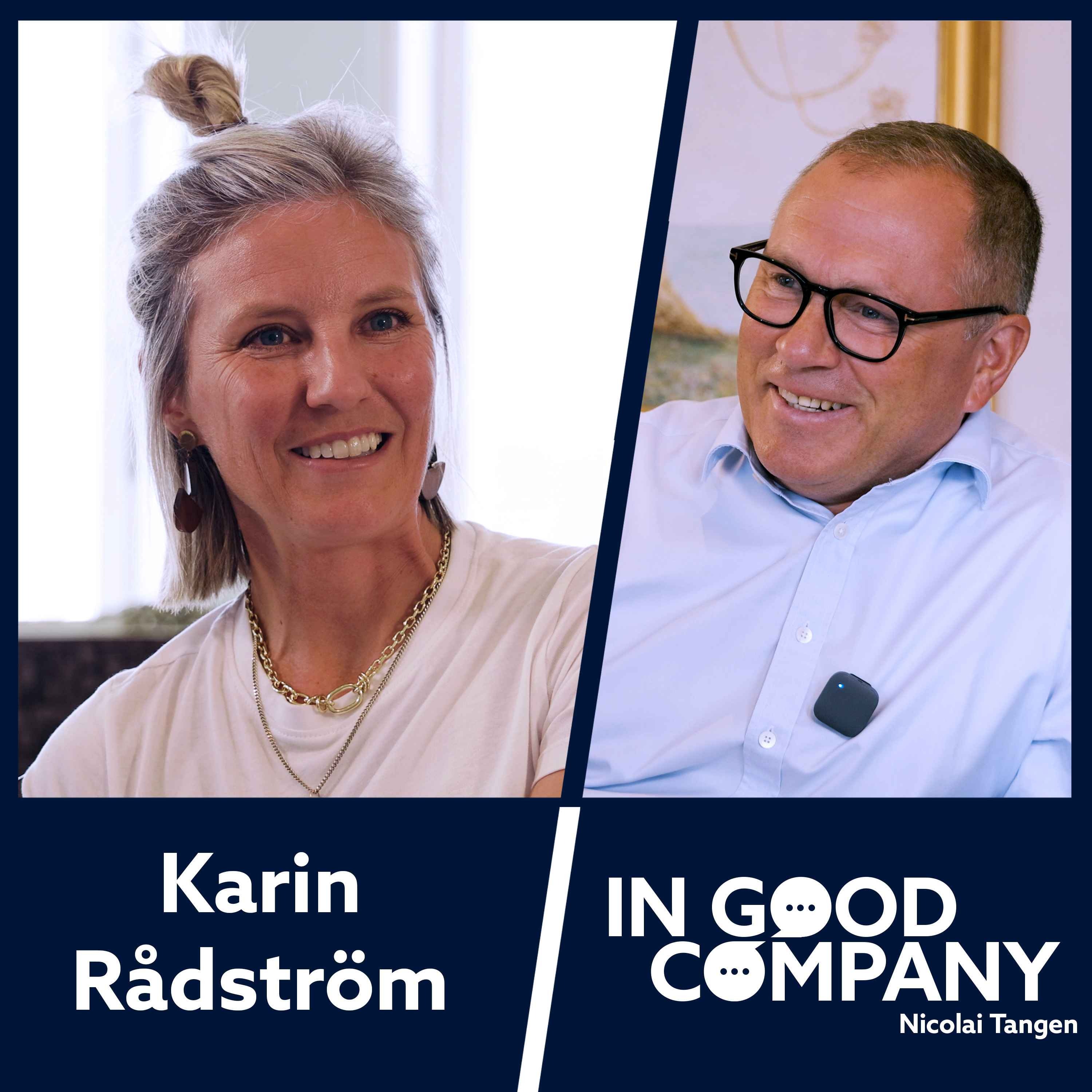
In this episode, Nicolai Tangen interviews Karin Rådström, the CEO of Daimler Truck, a company transforming itself from a legacy diesel manufacturer into a leader in sustainable, software-driven mobility. Rådström shares insights into the challenges of transitioning to electric and hydrogen vehicles, the development of autonomous trucks, and the necessary cultural changes within the company.
Written by AI. May contain mistakes.

Get the gist, explore an idea or ask about something said.
 Claude
On In Good Company with Nicolai Tangen, what are the key points of this episode?
Searching your listeningAutomatic transcript. May contain errors.
0:01So today we are in very good company with Karin Rolström, the CEO and president of Daimler Truck, which is the largest commercial vehicle producer in the world. Karin has recently been named Sweden's most important businesswoman and Daimler truck. And at Daimler truck, she's driving the conversion of legacy diesel champion into a future ready mobility powerhouse. Now, Karin, you combine engineering background, your Scania background with a background in elite sport. So a warm welcome. Thank you.
0:38so now you and i we are going into a truck okay you are sitting in the in the driving seat i'm sitting next to you and now you're going to tell me what what makes a good truck what what do you look for uh well the cab is like the driver's living room yeah so that's what i look for basically is it practical is there storage space how's the bed of course also how do you interact with with the truck um yeah but i honestly i was thinking it didn't really change so much with all the new trends with electrification digitalization it's it's still a living room and a working office so when when um when people buy a truck uh what do they look what what are the decisive elements what is it that make you win the the purchase um well i think it depends who which perspective you take so now we started with like the driver perspective which is the cab and the living space but of course also that the truck does the job and i think they're still kind of old school so they want to go faster up the hill than their colleague with the other brand so that's still important but then of course usually the people deciding which brand to buy are the owners and they look for the whatever truck will give them the best cost of operation because they're running a business so is there a big difference between the two views so the driver and the owner sometimes yeah but generally i think if you have good cost of operation means you invest into R &D you have a good engine good powertrain generally the same brands also do more for the drivers so yeah you split it into segments of light medium and heavy and where so where are you positioned so we mainly focus on heavy duty but we we are a full liner with some of our brands so for instance with our Japanese brand Fuso we are very strong on light duty with Western Star and Freightliner.
2:49We have both heavy duty but also some medium duty so but I would say globally probably 50-60 % at least heavy duty. How do you make money? Is it by selling the trucks or is it by servicing them or repair or what is it? Hopefully both but for sure like one of the upsides that we have as Daimler truck compared to some of our competitors is we can get even better with services. Where basically in the old structure that we had in Daimler, which was a big conglomerate, you know, with Mercedes-Benz cars until three years ago, a lot of the service stuff was done through the mothership. So that's something I think we're catching up and we're developing right now and growing.
3:36How cyclical is the market? I mean, what are the drivers? What do you look at? In which times are you selling more trucks? Generally, it runs pretty much in parallel with the overall economy. So, you know, when people are investing into building projects, construction, they need trucks. If people are ordering more goods to parcels or whatever, you need trucks to bring them to the people. So I would say overall, it just generally really follows the... Or even I would say sometimes we know early how the general economy is going to develop because we see how much the trucks are running and we see the buying and purchase behavior of our customers.
4:19So what are you seeing just now? Yeah, it's not looking so great, unfortunately. So it's a pretty slow market. Why is it slow? I think in the US at the moment, a lot of uncertainty about where the economy is going to go. And I think uncertainty is never good for our customers. Then they rather just run the fleet and they wait. Because it's a big investment, right? Yeah, it's the most important investment they do in their business. And in Europe, we hear a lot of positive things. Like, for instance, in Germany, we have the infrastructure spending, a lot of defense initiatives. But so far, we don't really see it in the market.
5:04Why do you have so many brands? You've got Freightliner, Mercedes, Fuso, Western Star. Is it easier just to have one? Yeah, we have even more, actually. But it comes from history, and they all stand for different things for the customers, I would say. so if I give an example on the coach side we have Cetra which is actually positioned higher than Mercedes-Benz and that's something we acquired now many years ago so that has a higher brand value than Mercedes for a coach customer and why why would you take that away or Western Star in the US that's a super strong brand for like heavy duty timber construction so it makes sense to to keep most brands and then of course sometimes we buy stuff where we might consider changing the brand too.
6:05Now we're seeing in cars but also in trucks the trend towards more technology more software and so on. How is it to change a 100-year-old company into a software company? It's not easy. I mean, I don't think we will become a software company per se. But for sure, one of the biggest tasks I have as CEO is to drive culture change to make. I mean, we talk a lot about in Daimler Truck about simpler, faster, stronger, which is what we, especially simple faster is something we need to do and we need to have in mind in everything we do which will hopefully then make us stronger our processes are developed for product development and for kind of slow cycles you know like a diesel engine takes like five six years to develop so we have to challenge everything right now and I think that's the most difficult but also interesting part of my job actually to try to drive that change and how and how do you do that I mean Stuttgart is not exactly Silicon Valley right so you know in just in terms of attracting the talent and yeah I mean I think we I spent a lot of time actually thinking about how to drive culture change.
7:28And I think we found kind of a good method, which is if you look at culture, it's actually just, it's a bunch of different practices that you have in a company. And in order to change practices, you need to look at like acknowledge or kind of what's the target picture? Where do we want to go? And I talked about this simpler, faster. So that's like addressing just the awareness of the people, kind of, you know, putting the posters on the wall in the elevator or like, you know, you bring everyone a t-shirt that says simpler, faster, stronger. But then to really drive change, you also need to look at like which processes and methods do we have.
8:12So that's like the structured things and how do we want to change those. And then I think the third thing you need to look at, which is maybe the most important, but also the hardest to grasp, that's like all the behaviors that exist that are not written, but that are part of how we do things. That's the definition of corporate culture. Yeah, you have to grab them and you have to very, I think, persistently address and change some of the kind of key topics. You have to look at all of those. How long time do you think it takes to change corporate culture? I mean, how long is a string? It's, I think, really hard to answer because it's also not about you've been running in one direction and you move everything 180 degrees.
9:05That's not what we want to do, and I don't think we will be successful. We don't want to be like a startup from Silicon Valley because we're not going to be successful if we try to be that company. But I think to really make a step change, you probably need four, five years. I mean, we're also a global company, 105 ,000 people. So obviously in a smaller company, you can do it faster. Yeah, but it's still tough. I mean, you know, our company is 700 people and it's not done overnight. But what part of that cultural change do you think is the toughest?
9:47I think being in this German context, we have a lot of pride in our attention to detail. So I think over time, that has also been part of our success in the past. But to dare to let go a little bit, to try new things and to push things through a little bit faster is difficult for people. So that's something quite challenging. But we also see that we cannot work at the speed that we have done if we want to be competitive in the future. I mean, you are at an incredible time in your business, right? Because, you know, you have a trend towards, you know, battery, focus on climate, digitalization, connectivity.
10:43uh geopolitics uh software yeah absolutely you know the whole software development so how do you prioritize yeah i would say those are like the general things happening but then at the same time we're just three years old four years old as a company soon so we are just becoming like a standalone independent company um and we're driving culture change and we need to improve our performance um so how do you prioritize i think it's not that different from in normal times you have to write down what are like the top five things i need to get done in some perspective i usually do it like half year cycles and just make sure to really get the most important things done and that also means sometimes some things have to wait that are also important um well Let's unpick it a bit.
11:39Let's start with the software. What are the kind of things you are developing on the software side?
11:46If you look at how the truck looks today, for sure a lot happened over the last couple of years. I would say it's still pretty old style. We have a lot of ECUs, like electronic control units, a couple of hundred in the truck. and they all steer different functions. So that makes us kind of slow because we also co-design with our suppliers and every time we want to develop a new function, you need to touch the hardware and the software. So what we are doing now, we just formed a new company together with Volvo actually to do the basic layers together. And what we want to do is to have a couple of high-performing computers and then independently develop the software.
12:38So it's very much following what the car industry has been moving towards, but it's a little bit different for trucks because we need just different functions. So when you are done with this work and it's kind of totally software enabled, what is different? What you can do is you can do a lot more things software only. So you don't need to touch the hardware in the truck at all as much, which makes you much faster. And the sensors in the truck can be dumber because you have the compute really centralized in one unit. Do you think there'll be a time where you sell uptime and instead of selling the truck, you do sell?
13:17I mean, we are moving in that direction. We do it to some extent today because we do full service lease contracts. So we're definitely going in that direction. And I would say already in some city bus tenders, we have an uptime guarantee of how much the bus should be running. And I think it's an opportunity with electrification because it brings so much uncertainty for our customers where all they want to do is take down risk. And if we can manage that risk better, then we should be able to offer them uptime. So, yes. Tell me about the trend towards autonomous vehicles in the truck business. Yeah, well, I don't know if it's a trend, but it's obviously something where we invest a lot.
14:10We believe the best place to do it is in the US. Because, I mean, first of all, the driver wages are the highest. And also, they drive extremely long distances. so we have our own company there called torque which we own to 93 percent where we're developing this where the software to drive autonomous and then of course you need to do a lot on the truck side you need to have every system needs to be redundant so in case there is a failure you need to be able to switch over to redundant braking or steering. So that part we develop within Daimler and the software we develop in torque. But we also work, I mean, we've worked with Waymo, for instance, for many years until they stepped out of trucking.
15:05Yeah, so is it very difficult to make a self-driving truck compared to a self-driving car? Very good question. I'm asking all experts that. I'm getting kind of into this myself. So on the one hand, it's easier because it's, you know, mainly driving on highway. So you don't have all these edge cases. But on the other hand, it's driving, you know, 90 kilometers an hour. And if something happens, the accident can be pretty severe. So in the end, I'm still looking for the answer. When you think, when you... But I mean, we see robotaxis already today running in some cities. and we don't yet see autonomous trucks.
15:46When will we see it? Oh, I think 27, 28 in commercial lines. I mean, there's already some tests. We do a lot of driver out stuff, but we still have the safety drivers sitting in the chair. So it's not that far off. No. What about the new competitors coming into that area?
16:12yeah i mean i think we see the opportunity because on the one side you have the hardware and we're going to develop that and that's also going to be a competitive advantage if you have a good redundant chassis and there we believe we are super well positioned so we could work with new competitors like aurora or kodiak or or other players but then of course with torque we compete with them but we believe that because we have that close because we're working closely with Daimler and Torque that's an advantage for us which should help us.
16:53Another thing is of course the decarbonization kind of dilemma you just how are you going to get to zero emission? Yeah, it's a good question. So we have developed electric trucks, so we basically can offer electric trucks in almost all use cases. In the US, we see environmental legislation kind of rolled back. So we believe it will just slow down significantly now. And it will probably take to beyond 2030 before we see it picking up again. While in Europe, we have very tough legislation that pushes electrification. I think the challenge there is that for our customer to transition from diesel to electric, there needs to be three things in place.
17:48And we usually say like an equation. So you need to have the truck and that's obviously we have one available so do our competitors. You need to have TCO so cost of operations needs to be competitive and there it starts to get there I would say in some use cases especially if you drive longer distances because the truck is always going to be more expensive to buy electric than a diesel but then the running cost is lower and we also see like in Germany we have the road toll system the which has an advantage for electric trucks which is around 30 cents per kilometer so it's like the cost of operation starts to be comparable and then the third part of the equation is the infrastructure to be able to charge in the depot or along the route and I believe that's the most difficult challenge to solve.
18:49And then maybe coming back to where we started, as you know, if you have an equation and one part is zero, nothing happens. So where we really need to see more initiatives and more speed is on the infrastructure side. So how do you cope with this situation where Europe is full speed ahead and the US is kind of pressing on the brake? you know yeah well there were some projects that we planned uh to have as global projects like battery platforms and stuff where we are now looking like can we do more with partners can we de-risk to buy for a longer time things that we were planning to develop ourselves um so i think that's kind of stepwise looking at because there's also in europe uncertainty how quickly it's going to scale.
19:41And like in everything we do, we try to think of the low volume scenario and the high volume scenario. So as an example, when we were integrating the electric trucks into the production line, we do it on the same line as where we're producing the diesel. And that way we can really balance depending on how the demand develops. What are your thoughts on hydrogen? Well, we really believe hydrogen is necessary if Europe is serious about decarbonization. Because we see already today when I think this year to date around 3 % of trucks registered were electric. And all the struggles our customers already have on the infrastructure side to get electrified because of grid challenges, because of not enough green electricity in Europe.
20:35So if you look in a longer perspective, there is no way you're going to have 6 million trucks in Europe all running electric. And that's where hydrogen plays a role. Some people say that hydrogen won't, like it doesn't make sense because it's less efficient than diesel, which is true in a sense. But I believe it's an answer to the wrong question. Because Europe is going to need to import energy and a good way to do that will be as a hydrogen molecule and then you might as well use it in a truck and that's a pretty efficient flow and actually also building hydrogen infrastructure when you scale it is less expensive than to try to scale electric infrastructure only so there will be a point where we will need hydrogen so you are developing both we are developing both.
21:33Yeah. If you were to put your money on one of them? Well, electric is more here and now, and hydrogen is still some years off. But if we're serious about decarbonization, it won't work with just one. We need both. When you look at China and the electrification we are seeing in the trucks business, I mean, CATL was just out and said that by 2028, they expect 50 % of the new trucks to be electric. When you see that kind of statement, what are your reflections? Well, I think it's not so far off where we need to be in Europe if we're going to deliver on the CO2 targets. So my reflection is we need to speed up.
22:18We need in Europe more initiatives to build the infrastructure. And I also think we have a unique opportunity in Europe because we are still leader in this space. If you look at the big global companies in the trucking space, three out of the four big ones are European and we're leading in technology. So I think there's still time, but we need to start moving faster. And it's not just about the companies. It's also about legislation, infrastructure. I think we spend way too much effort and money just to fulfill, let's say, sometimes I say stupid regulations that we have in Europe, instead of investing into innovation and really moving to stay ahead.
23:10And to give you an example, we're also right now investing in Euro 7, which is the next level diesel regulation. it would be much better it's a small difference between euro six and euro seven to start with so the current diesel standard and the coming one so if we could have invested those couple of hundred millions into electric infrastructure it would have been much better for europe and for the companies and for our customers how fast is the the build-out of a kind of battery swap stations compared to what it needs to be? Well, it's not so easy for trucks because, you know, each battery weighs like one, two tons.
23:53So we actually don't really think that's the path for trucks. But that's what they think in China, right? I think it started like that. I think it's moving a little bit away from that. I think they're trying both. So we're obviously following that we do some small stuff also with with batteries swap in japan so some pilot projects and stuff so learning about the technology um but i think it will not be feasible at least not for heavy duty trucks but let's see how do you see your development in china well we are in a joint venture there with with photon and we've been for 12 years i don't think it's a secret that we haven't quite developed as we would have liked.
24:39And that's something we're currently discussing with our partner. Like, how can we turn that around? How can we be more successful? And is there a way for us as Daimler Truck to be also profitable in China?
24:56Karin, I'd love to spend a bit more time on the cultural issues. So you spent nearly two decades at Scania before moving to Germany. What was the biggest kind of cultural surprise? Surprise? Correct. Sweet to come to Germany. Well, actually, I was super surprised just when they called me if I'm interested in the job, because I was not just a Swede, but also a woman. I didn't speak German. I'm not a doctor. I was younger than most of the other people in those kinds of jobs. So actually, when they first called, they thought they just wanted a CEO for Sweden. And then they're like, no, no, it's the global job.
25:44So why do you think they called you? I think they wanted to have an outside perspective. They'd realized kind of somehow they needed to shake the system a little bit. I think the biggest surprise was I thought it was going to be a little bit maybe more stiff and more old school. So I was even, you know, talking to my husband, like, do I need to buy suits now? And like, actually, today I'm wearing a suit, but that's really unusual for me. And then so I came in and it was not like that in a positive sense. I think the other thing was, obviously, I knew especially Mercedes-Benz trucks as a competitor.
26:32And I always viewed them as like super strong. You know, we have this exhibition every two years called the IAA. And we would always have a little bit of a stand and, you know, some trucks and have some coffee with customers. And then you walked into the Daimler part and they had a whole hall. It was like a kingdom. You could walk up the stairs and you could stand and look at the Daimler kingdom. So I thought people would be a little bit like that style, a little bit maybe overconfident and not really interested in other perspectives. But that was very wrong in a positive sense. So when I came in, I found a lot of curiosity.
27:23I felt very welcome. And I think that was kind of a prerequisite, obviously, to get in and get stuff done. We tend to think that Germany is very, there is a lot of hierarchy in German organization structures. How did you experience that? Well, I think there is much more than in a Scandinavian company. but I also have the experience like in the end I had another cultural experience because I worked in Sweden many years and then I moved to Kenya and I did this cultural training and they said oh now you have to be different you cannot do this consensus and blah blah blah you have to be more directive and you have to tell the people what to do and then I came into this Kenyan business and I found you know people want to see the purpose of what they do they want to be part of a bigger context they want to see appreciation for what they do they want to spend their time like they want to feel when they're in the office or in the factory or on the workshop floor that what they do is meaningful and that they're spending their time in a good way so I think very similar to German companies.
28:43It's like there is some hierarchy, but in the end, people want to do meaningful things. They want to contribute. For sure, there were more things coming to the CEO level. I was really surprised in the beginning at like all the things I had to sign off. And, you know, I had to, one of my first meetings when I came in, I was going to go look at the new cab, the one we just launched now a couple of months ago. And I went to our design center and were looking at it and then I said oh that's nice and then they were all looking at me waiting for something and they're like you have to approve it formally and if you do that you're going to be like the first one who's not like everyone always comes and they want to change a little thing or two and then I'm like well I'm not a design expert on cabs so I trust that you guys did your job.
29:35And I'm not going to approve this because I'm not a driver. I'm not buying these trucks. So you should be asking our customers. So I think stuff like that. Are there a lot of decisions you have pushed down in the system? Yeah. What about, Sweden is consensus driven, but in Germany you have very high union participation, right? In decision making and at board levels. Is there a difference there? Yeah, sure. This is obviously something I had to learn coming into Daimler. And I probably made some mistakes in the beginning, just being super rational. So I remember there was one example where we had these people sitting in each of our spots in Germany or where we have factories, receiving parts, like quality defect parts and analyzing them.
30:30And I said, you know, let's just move everything to one place because then these people can work together. And I totally underestimated, you know, it matters for these different standorte or like the places, these towns to keep the work. So that's something where I think I learned a lot and I have today a very good relation, I would say, with our union and works council. For sure, we have really tough, that's something I like with Germany. You know, it's in Scandinavia, you have to be a little bit careful how you debate with people. In Germany, you can go head to head and really say your opinion, but it's not personal.
31:14So I think that's something where I learned a lot with the works council. We have super tough discussions, but with the people in Daimler Truck representing that side they also just want what's best for the company and in the end we have sometimes different perspective on how to get there but we're all working because we want to be successful and we want this company to exist in the longer perspective in the 50 and 100 years from now. So I think we find good solutions And I don't think it's as complicated as people outside Germany tend to make it. It's just another group that you need to make sure you align with and find solutions with.
32:07I mean, if you really think about it, it's an extraordinary situation that Heather is a young Swedish woman coming in to run kind of a big, well-established German male-dominated industry. What do you think is the key to build trust with people when you get into that kind of situation? I mean, for me, I was also the first woman in many different roles and so on in Sweden. Yeah. So I'm kind of used to it. But I think it's to come in, obviously, competence speaks for itself. So to show that you know what you're talking about. I also had the benefit coming into my old role running Mercedes-Benz trucks that we had really good development.
33:06So I could show that I'm delivering. Um, we, we went from, I think 4.8 % return on sales my first year, then 8.1, then 10.1 last year, a little bit of a setback due to low markets, but it's really been moving in the right direction. And I think that's the best way to, to build trust. But then I think also when you come in from another company to really try to avoid, this is how we did it in Scania or this is how Scania does it like to there is usually a reason why companies do things the way they do so it's better to listen and to understand why and not try to copy whatever worked in another company because people get so tired I think of this is how we did it this is the better way so rather listen to understand the context of why things are the way they are because that gives you also a better platform to change it in the direction it needs to go what are your most important leadership principles someone who worked for me some years ago she she described it quite well tough love she said and i thought that was good because i'm quite demanding it's maybe one of the things i still need to work on like i'm never really or it's not like I'm unhappy but I always want to take it to the next level so we reached like a milestone I'm already thinking about the next one and I could probably get better at showing appreciation but I'm tough so always pushing forward but hopefully I do it in a way that I also show that I care about the people and I want them to grow and I try to push them a little bit to do things they didn't dare to do, take decisions, as we talked about, making them really accountable.
35:05So that's the one part. And then I rely a lot on the team, probably more than other CEOs. I spend a lot of time consciously building the team, also getting to know each other. Maybe not, we don't have to be privately, you know, best friends, but personally, really understanding the driving forces and getting to the level where you can be vulnerable with each other and kind of get power from the team so that's important for me if we were to look at those two things given that you have been on the national rowing team in sweden for several years yeah and rowing in you know world championships and so on the first thing about setting new goals and pushing to new standards and so on.
35:54I'm sorry, this is a leading question. But I'm sorry. Sorry, let me just rephrase it. How do you think your background in sports has influenced your leadership principles? If you do the first one first, setting new goals and that kind of thing. It's pretty obvious. So I think that's where I learned it. And it's like, that's what professional sports is all about. It's like about constantly pushing yourself to the next level. And for me, it was like, I never thought I would, at first, my dream was to win a Swedish championships. And then I reached that very quickly. My brain is recalibrating. I want to make the national team and then I want to row in the World Cup and stuff.
36:38So I think that's just how I work. And I think it's also a prerequisite to get there. and in the day-to-day it's even more concrete because it's like you know you do something brutal like the worst thing as a rower I think is intervals on the rowing machine because it's very digital so it tells you exactly so I would do a really hard workout and by the end you know you're falling off the machine lying on the floor basically and you know exactly how you perform And then you go back next week and you can actually do it a little bit better. And I think that's, so that comes from there. And that, I think, made me, that's also what makes it fun.
37:28You can always step by step. Also in Daimler Track now, we do small things. And then when you zoom out over time, you see we're really moving. So that comes from the rowing, I think. And what about the team aspect? Yeah, I mean, obviously I raced actually both. It's a very good sport rowing because it's both an individual sport and a team sport. I think more than most other sports because you're racing in a team boat. So I raced a lot in the double. But then maybe later in the day, you're racing in the singles against each other. So you're both competitors and teammates. and one thing I learned very clearly is if you're racing in a team boat you have to be both physically and mentally fit because it doesn't matter how well prepared I am if someone else is sitting in that boat and is not ready and I think a lot about that also as a leader that my job is really to enable everyone else to be fit mentally and physically and to work efficiently.
38:38That's much more worth than me spending another two hours in the office, you know, making ideas or writing notes about something. It's much more important that the organization is healthy, working and being efficient. I listened to a podcast you did, I think it was five years ago. And you talked about the fact that your boss had seen the potential in you before you saw it yourself. Yeah. And that you tried to do that with other people. What's the key to doing that? I don't know. I think it's honestly one of my superpowers. I just, I mean, one key is obviously not to think too much about the CV.
39:22And I just realized I do that much less than most others. so I put a lot of value in this personal interaction and it seems a lot of the time I'm able to I actually don't know where it comes from maybe it's you know I lived in a lot of different places and learned a lot about different cultures and different kinds of people so I I just get a good feeling like this is a person who'll get it done or who will influence this organization in a positive way. And I use my gut feeling really a lot. And also thinking more about what could they get done than what are they bringing that they have done. How do you work with your gut feel?
40:10I think I consciously listen to what it's telling me. Of course, I don't do everything. Do you have a good gut feel? Yeah, I guess so. So far, so good. Could fail me one day. Who do you turn to for advice? I have a lot of different people. So definitely different people on my team, depending on the topic. I have a good chairman, Joe Kesser, who I think also compliments me because the stuff he's really good at is the stuff I'm not so experienced with, like public affairs, now capital market and all the investor stuff, a lot of M &A that he did also during his time in Siemens. So him, I ask for advice.
41:01I have some others. Actually, Jim Snape is one. He used to be the CEO in Germany and he's the chairman in Siemens. so he understands also this perspective of a Scandinavian in the German context so he might can ask about stuff and then I mean Atlas Copco so asking other board members there for advice so I think I reach a lot out you know for the people who don't know Atlas Copco it's one of the finest Swedish engineering companies and we have everyone knows Atlas Copco well you know we have people across the world and we have done a podcast with uh with them um now you are also uh part of a women's leadership network yep why is that important or is that important yeah it's important I mean first of all I think it's also being kind of one of the first women not just in this job but but in a couple of jobs I see it as part of my role and I sometimes think in a positive way like If I succeed and I deliver, it will open the door for other women.
42:13Because, yeah, and I see it. I mean, I was, for instance, the first woman to run the bus business in Scania. And after me, only women. So I think it just opens people's minds. But I also, I did a really good training with only women a couple of years ago called Women for Leaders. And first, I was super skeptical. because I never did stuff with women and I wasn't even used, you know, I never really worked a lot with women. But it was probably there that I realized truly that I need to be myself. And it's this kind of, you know, leadership advice you get from, oh, just be yourself. Don't try to be someone else.
42:59So it's not like that was new, but I think that's easier said than done. and I think during that process is when I realized the strength of being who I am and it gave me I think also some kind of context where I was more a norm and realizing also the strength of my leadership and my way of thinking and leading instead of having that but always still trying to do all the other stuff that I saw different colleagues do.
43:38So on the podcast, I normally never talk about gender when I speak to leaders, but you mentioned it several times. So just as a follow-up, what do you think are the advantages of being a woman at the top of a big company? I have no idea. I mean, I don't know what it would be like if I was a man. I get this question actually quite often. I bet you do, but you normally wouldn't get it from me, but just since you mentioned it. I mean, what other person, do you think there are some gender, particular gender qualities? It's hard to answer without generalizing, but what I, I think I'm, maybe it's easier for me not to feel like I have to know everything and be like a superhero.
44:25I found a lot of male CEOs. I don't know if it's a German thing, I don't think so, but like feeling like you have to have all the answers. For me, it's pretty easy to admit I don't and to really, truly listen to what experts think. Like this example with the design of the cab, you know, for me was... But it also takes a lot of confidence to admit that you don't know something, right? Yeah, maybe. You talk up your colleagues a lot. I do that too. I think it's very, very important. I think they all deserve it, but not everybody does. What are your reflections about that? I think it comes very natural because the key, apart from finding the talent and pushing people to go beyond what they thought was possible, that's what makes a company successful.
45:27is the people.
45:32So it makes a lot of sense to give them credit when we accomplish something. I also think I'm not maybe a person, I don't strive for being famous or having a big, I don't know, being a name after I finish my career. So maybe that helps. It's not about me. It's about the company and the people in the company and building a good future for the company and, of course, for the customers and so on. I've never reflected on it, actually. Now, we talked about batteries and infrastructure. What is your personal charging station? The mountains, I would say. So I told you I'm actually on holiday right now.
46:24I just came from the mountains. so absolutely but also i mean that's one of the things i love about living in south germany so we are two hours from the alps i go there almost every weekend um why is that important for you first of all it's family time um second of all being in the mountains i mean i do sports So now I'm doing a lot of trail running in the winter, cross-country skiing or touring. That both makes me recharge because I get to move physically. And also just being in nature. I think there's something special about that. It makes you not think about work. And I believe that actually that's also one of the learnings from rowing.
47:19is this balance between performance and recovery. That's the same in CEO life. And I think a lot of people underestimate the recovery part. But actually, that's probably as important as delivering and being on when you're on the job, is recovering and recharging when you're off the job. I think CEO stands for chief energy officer. And so you also need to charge to be able to deliver that. now I believe that you have a weekly ritual of self-reflection yes how does that work so every either it's Friday night or Saturday morning I sit down and I write what happened what did I feel what did I learn and I share that actually with someone who I did this training with Charlotte and we've been doing that for years and I think it's a good way both to really be aware of like what happened during the week did I accomplish what I what I planned also what did I learn and it's also a way to let go of the week to get into the weekend in a good mood and I yeah but it works for me very well.
48:36What do you do with the notes? I keep them. And I don't know. Sometimes I go back and read, but not very much. So I have like some big books at home with reflections. I know one other person who does this, and this is Albert Bene at Geberit and Lonsa. And he's made it into a book, which he has given to his daughter. Oh, yeah. So perhaps that could be something for you. For my sons. Maybe they will be interested one day. Absolutely. What is your advice to young people? I think one advice I would have needed to hear myself is to just believe in yourself. I don't think I realized that I could make a difference in the world.
49:23So, and also coming in, both applying for my first jobs and coming into my first jobs, I didn't have the self-confidence to believe I could contribute. so even when maybe this gut feeling was telling me things I was holding it back but I think that's this energy and the clear-sightedness of young people we need in business so believe in yourself speak up go for it and and really dream big anything is possible usually it's yourself stopping your mind don't make those limits just think big I think that's a wonderful place to end you are for sure one of the most impressive people we ever had on this podcast and very very personal and I could easily see why you are you know why you are considered the most important female CEO in this country it's been an absolute pleasure big thank you thank you Thank you.
How do you transform a 100-year-old trucking giant into a software-driven, zero-emission company? Karin Rådström, CEO of Daimler Truck, joins Nicolai Tangen to discuss the massive changes reshaping the trucking industry. They explore the shift from diesel to electric and hydrogen power, the development of autonomous vehicles, and the cultural transformation needed to accelerate innovation in a traditional German engineering company. Karin also opens up about her leadership philosophy of "tough love," her background as a Swedish national rowing champion, and what it's like being the first woman to lead a major truck manufacturer. With 105,000 employees worldwide, Daimler Truck is steering toward a sustainable future. Tune in for an inspiring conversation!
In Good Company is hosted by Nicolai Tangen, CEO of Norges Bank Investment Management. New full episodes every Wednesday, and don't miss our Highlight episodes every Friday.
The production team for this episode includes Isabelle Karlsson and PLAN-B's Niklas Figenschau Johansen, Sebastian Langvik-Hansen and Pål Huuse. Background research was conducted by David Høysæter.
Hosted on Acast. See acast.com/privacy for more information.


