
 Ask ChatGPT



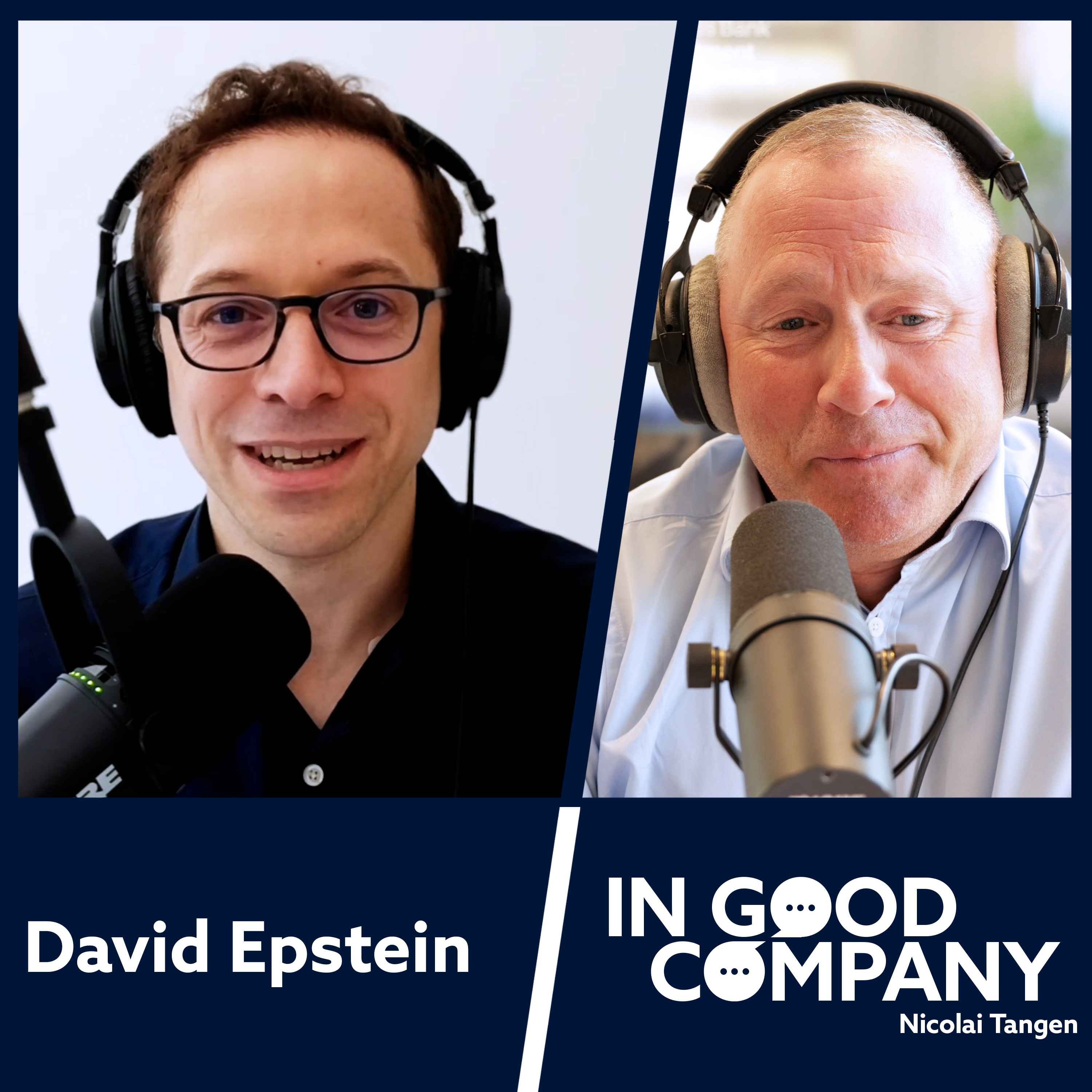
Host: Nicolai Tangen, CEO of Norges Bank Investment Management
David Epstein, Author of Range
In this episode, Nicolai Tangen interviews David Epstein, who discusses the advantages of being a generalist in a world that increasingly favors specialization. Epstein’s insights, drawn from his book Range, challenge conventional wisdom by emphasizing the importance of diverse experiences and flexibility in professional and personal development.
Written by AI. May contain mistakes.

Get the gist, explore an idea or ask about something said.
 Claude
On In Good Company with Nicolai Tangen, what are the key points of this episode?
Searching your listeningAutomatic transcript. May contain errors.
0:01Hi, everybody, and welcome to In Good Company. Today, we have a very special guest joining us, somebody who has basically reshaped how we think about success and achievement. His book Range has challenged the conventional wisdom and showing us why generalists often thrive in a specialized world. David Epstein, what a pleasure to have you here. The pleasure is mine. Thanks for having me.
0:32I'm just going to start with a kind of a stupid question, given that we are going to talk about generalists and specialists for a bit of a time here. So what is a generalist in your view? Yeah, that's a great question. I mean, there's some semantic aspect to it, right? Like when I think about my own career, I was, I used to be training to be a scientist and then I got off that track and became the science writer at Sports Illustrated magazine. And so when I did that, my science colleagues suddenly thought of me as a generalist, whereas my sports writing colleagues suddenly thought of me as a specialist because I had this science background.
1:05But I think broadly speaking, it's someone that at certain points or at a certain point, sacrifices increasing depth to broaden themselves and sort of connect knowledge and broaden their own toolbox as opposed to just kind of going with what tends to be natural momentum of getting deeper and deeper and more narrow as you progress. And why is this a good thing? What are the advantages of being a journalist? Yeah, I think the advantages particularly stand out because the world is getting more specialized. And I think that made kind of a lot of sense for a good portion of the 20th century. But in fact, now what we see is that people are largely working in what the psychologist Robin Hogarth called wicked learning environments.
1:47So to give just a quick background of that, Hogarth kind of reconciled this conundrum in expertise research where some people studying expertise saw that people get better with narrow experience and others saw that they not only don't get better, they get more confident but not better, which can be a really bad kind of scenario. And what Hogarth said is, well, it depends on the type of environment that someone is working in, in a kind learning environment, which is next steps and goals are clear, rules don't change, patterns repeat, feedback is quick and accurate, people get better reliably with narrow experience.
2:23On the other end are what he called wicked learning environments where next steps and goals may not just be given to you or rules may change or patterns don't just repeat. Feedback could be delayed or inaccurate. Lots of human dynamics are involved. Basically, work next year may not look like work last year. And in those kinds of environments, which we're increasingly thrust into in our work because the workplace changes more rapidly than it ever has before, it's people that have this sort of broader set of skills that allow them to pivot and to create kind of generalized, flexible skills and mental models who are really able to adapt over time.
2:56And that's the situation more and more people are in. So I think - Why is the world becoming more wicked? I think it's, well, so there was a period for much of the 20th century, at least, where we had a model that actually worked quite well, where people could have kind of a discrete period of training or education, and then a discrete period of working based on that training or education. I mean, I'm simplifying it, but more or less. And companies didn't go in and out of existence as quickly. Technological innovation didn't tend to change the workplace quite as rapidly. And so you can see through the 20th century, like the number of different jobs that people have starts to increase in the latter half of the 20th century.
3:38And even when people are staying in the same jobs, the stuff they're actually doing is starting to change at a much faster pace. And they're having to learn new tools and all these things if they want to kind of stay competent. And so I think it's, you know, part technological innovation. It's part globalization. But it's just for most people, that model of period of training followed by period of working has been replaced with relearning and retraining and having to sort of reinvent over and over and over. Now, in your book, you talk about some things that you need to do to get there. You need to embrace diverse experiences, focus on learning, be adaptable, seek out interdisciplinary collaboration and so on.
4:19what are the most important things you need to do in order to become a really strong generalist? One of the things I think is really important is what scientists tend to call the sampling period, where, and I don't want this to sound like you only need to have this at the beginning of your career, but the sampling period is this idea that we don't know as much as we could about ourselves, our own interests, our own abilities, our opportunities until we've actually tried something. And so I think a lot of successful people tend to go through this sampling period where they try some things, they dive into it, they get sort of feedback and signal about what their interests and abilities are, and then they pivot based on that knowledge, as opposed to just kind of staying heads down and staying on a path just because they started on it.
5:02So for example, in the book, I write about this project at Harvard called the Dark Horse Project that was studying people. I mean, many of them were like very successful in all sorts of traditional metrics. You know, they had made a lot of money and things, but the dependent variable was really their sense of fulfillment, actually. The reason it's called the Dark Horse Project, actually, is because when they brought in these subjects, just for sort of to orient them to the study, the people would say, well, you know, don't tell people to do what I did, because, you know, I came through this, I started on this one thing, and then I pivoted.
5:31And so I was, and Dark Horse means like someone who came out of expression, it means someone who came out of nowhere. And that turned out to be the norm. It wasn't everyone, but it was the very large majority had sort of followed this path where they started down one route and said, okay, this actually doesn't quite fit me the way I thought, but I'm gonna take what I learned and here are my kind of interests and opportunities right now. I'm gonna do this one for, and maybe a year from now I'll change because I will have learned something about myself. And they keep doing this pivoting until they get to better what economists call match quality, which is a degree of fit between one's interests, abilities, and the work that one does.
6:07And so not only are they kind of triangulating a better fit in their work, which turns out to be really important for your sense of fulfillment and for your performance. But they get there with this broad kind of array of background experiences that they bring with them in this broad toolbox. And so I think having that habit of mind where you're always kind of, what did I learn from this? What can I take to the next experience? And continually triangulating better match quality through the course of your career is a really important kind of habit of mind for someone who wants to be a so-called good generalist.
6:37Now, you also do a lot of work on sports. What are some of the examples where people have tried different types of sports and ended up in a better place? Yeah. You know, let me tell you one that I, that really surprised me because at one point when I was doing some of this, I used to be the science writer at Sports Illustrated. And when I was talking about some of this, just giving a short, you know, 15 minute talk about some of the sports data in a crowd that included Serena Williams in the audience. And she sits in the second row and I'm kind of freaking out because, you know, I'm going to talk about the benefits of diversity.
7:11and as far as I know, she's like the opposite story of that. And you can marshal all the scientific data you want, right? But if the goat stands up and says you're an idiot, it's going to be a bad day for you, I think. It perhaps would have been worse if you had to play against her in tennis. Yeah, you know what? But that would have been an acceptable embarrassment on the tennis court, whereas this was like I was the one on stage, so this would have been worse embarrassment for me. but she stands up afterward and says like to raise her hand for the first question I'm like oh man and she says I think my father was ahead of his time he had me do track and field taekwondo gymnastics ballet learn to throw a football for the overhand motion for a serve and and took me and my sister off the traveling tour when he thought it was getting too intense so we could also focus on school and family.
8:06And I was a senior writer at Sports Illustrated, and I had never heard that story, right? Even though that is what a now mountain of scientific research suggests, that this diversity early actually sets people up to have these generalized skills, what some people call physical literacy, these generalized skills that then scaffold later technical knowledge. With the opposite path, the one that I thought, you know, that Serena didn't do, I didn't know that she had done all these other things. There's actually a fundamental trade-off. This gets at what I think is kind of the underlying theme on every page of range.
8:42There is this trade-off between optimizing for short-term performance and long-term development. And so there are now these just tremendous number of studies in sports that show that the way you make the best 10-year-old performer is not the same way as you make the best 20-year-old performer. There's actually an inverse relationship when like national development pipelines are studied between optimizing junior performance and optimizing senior performance. If you want to optimize senior performance, you want this kind of sampling period where people do a variety of things. It causes them to build these generalized models and generalized skills that are then flexible and they then more rapidly learn new skills going forward.
9:21It's kind of like people who grew up with multiple languages. They actually have a little bit of a delay, but that delay doesn't last. And they then are advantaged for learning any subsequent languages. It's actually like the same exact mechanism, really. It's interesting. In Scandinavia, there is a great belief in play in sport early on and, you know, avoid or delay serious competitive pressure. Yeah. Well, I mean, I would say to me, without a doubt, the best sports country in the world, I think right now is Norway. I mean, you know, more medals than the United States and China combined, I think, in the last two Winter Olympics.
10:01I think in one of those Winter Olympics might have even outdone the US, China, and Germany combined, winning things in summer games that we don't usually associate with Scandinavia, you know, like beach volleyball. I think you may exaggerate a ton a bit, but I think the general gist of it is correct. But David, how does this stack up against the 10 ,000 hour rule and the concept of deliberate practice, which some people is advocating. My first book, which criticized some of the research underlying the 10 ,000 hour rule, because the original research came out of a study that was done on 30 violin students at a world class music academy, the top 10 of whom had been found to have practiced, spent 10 ,000 hours by the age of 20 on average in deliberate practice, which is this effortful, cognitively engaged, focused on correcting errors practice, you know, not playing around, not experimenting.
10:56And there were a lot of flaws in that study, one of which is that nobody actually did 10 ,000 hours. There was like some who did way less and some who did way more in that tiny group. And it averaged 10 ,000 hours. But I think the issue with the 10 ,000 hours rule, which, and I can tell you about after I criticized it, Malcolm Gladwell and I became running buddies, so we have these arguments on our own time, but we've come to pretty much the same ground. The idea was that this is the only thing that matters. You're accumulated deliberate practice, and so you should start as early as possible in as narrowly technical practice as you possibly can.
11:29And except for certain very simple activities, there's a mountain of evidence that suggests this just isn't right. There's almost nothing that actually works in favor of But you really want, again, if you're trying to optimize for the short term, sometimes that might make sense. But if you want to build both physical and cognitive models that can be flexible for future problem solving, a better rule to think of than the 10 ,000 hours rule, which is very splashy, is this classic finding that comes out of cognitive psychology that can be summarized as breadth of training predicts breadth of transfer.
12:09So transfer is a term psychologists use to mean taking your skills and applying them to a problem that's not exactly the same as the last one, like your ability to adapt to new challenges and new tasks. And what predicts your ability to do that, which is what we in modern work rely on every day, what predicts your ability to do that is the breadth of problems you faced in training. So when you face a really broad sampling of problems in training or lots of different activities, it forces you to build these generalized models that you can then kind of slot in to whatever the new challenge is, as opposed to just being the opposite, where the 10 ,000 hours approach often leads to what psychologists call the Einste Lung effect, which is where you've solved a problem a certain way so many times, you'll continue doing that even if it's no longer the solution.
13:00So when is it good to be a specialist? I mean, clearly you don't want to have a generalist brain surgeon operating on you, would you? No, absolutely not. I mean, so, so, okay. So I gave a talk a little while ago to a group of surgeons that were like so specialized and, you know, I wanted to be a little provocative, but also I'd written quite a bit about poor medical practices when I was an investigative reporter. And so I brought up some of the data that showed that specialized surgeons have fewer complications in their procedures. Not only, even if you control for the number of times that a surgeon has done a procedure, still the surgeons who identify as more specialized still have fewer complications.
13:40So there's something above and beyond even just the number of repetitions they've had about being specialized. But the data also show that they are much more likely to do those procedures when they're unwarranted and to continue to do them, even if data has shown unequivocally that they aren't right, that they don't actually work or they can even be harmful. So it's sort of this double-edged sword. It's not that we don't need those people who have such great motor memory that they've automated the important parts of the task in their brain, essentially. But it's really a double-edged sword. So I think the challenge is in places where you have, you know, areas where you just need skills that are so thoroughly automated in the brain that someone really, you know, has perfected them, a pilot, a surgeon.
14:21How do we balance that need with the Einstehlung effect, basically, where the inability to see that this isn't the right solution anymore?
14:34now let's move on to the educational system and how that promotes or hinders generalism education i mean obviously a broad uh a broad remit but i think again is is um there's an analogy to the research we see in sports here again so again to give a concrete example just because i think it's easier to think about concrete examples take a study that was done again i'm you know, more in tune with the literature in the United States. So this was done in the United States in California, where middle school, you know, this would be like very early teenagers, basically. Classrooms were randomized to different types of math instruction.
15:17Some of them got what's called blocked practice, which is like if you took problem type A, A, A, A, A, A, practice, practice, practice, then B, B, B, B, B, practice, practice, practice. Others were, and the students, they make progress fast. They like it. Feels good. Great. Rate their teacher. Great. Everything. The other groups were randomized to what's called interleaved practice, where instead of getting A, A, A, A, B, B, B, B, B, B, it's as if you took all the problem types, threw them in a hat, and drew them out at random. So now the students get more frustrated. Their progress, initial progress is slower.
15:49Sometimes they rate the teacher more poorly. but instead of learning how to execute procedures, they're learning how to match a strategy to a type of problem. And the problem is if you're struggling, that's not a sign that you're not learning. If you're not struggling, that's definitely a sign that you're not learning. And then when the test comes around, those interleaved, the students who got interleaved practice blew the block practice group away. It was like on the order of moving the 50th percentile kid to the 80th percentile, because in the test, everyone has to face new problems. So now they have to do that transfer where they take some of those skills and apply it to a new problem.
16:27And they were much better equipped to do that because again, that mixed practice forces you to kind of build these generalized models. So in the David Epstein super school, you just mix and mash throughout the whole day, all types of things. Yeah, definitely. I would definitely broaden it, but I think I would also have a curriculum that was more sort of more interdisciplinarily cohesive because we already have, We already have curricula that are interdisciplinary in the sense that a kid goes to different subjects all day, but there's no cohesion between them. And so I think like some ways to, you know, we focus on certain things like we like it when kids learn how to read really early.
17:05And obviously it's important for kids to learn how to read, but there's no evidence that learning something that everyone is going to learn a little bit early really makes a difference. So we often, a lot of our intervention programs focus on what's called closed skills, which are things that everyone's going to learn. It's like teaching a kid how to walk earlier than others. Like it might seem impressive, but it doesn't matter in the long run. So I think I would make, to make this interdisciplinarity more cohesive, I might organize a curriculum around like the progression of human ideas. Because I've found in my, just my own learning, you know, in any given era, art and chemistry and biology and technology and economics and all these things are interlaced in a given era.
17:45And I think I would try to have maybe, and the way that those ideas progress off one another, I think is very useful for kind of getting a grounding in human progress and human thought. And so I might orient the curriculum around that, about whatever the discipline is in teaching people that kind of progression of human ideas and how we got to where we are today. and that might have sort of some linkage between the disciplines. So it's not just like, oh, I'm done with math class. Now I go to history class, which is a totally different thing in history. Math have nothing to do with one another because obviously that's right.
18:16Disciplines are a necessary evil for making the world comprehensible and giving people career trajectories. Someone has to put the world back together again at the end of the day to solve problems. It seems, well, the data seems to support that boys are scholastically kind of properly ready for school later than girls. Should boys start later in school? Gosh, that's a tough one because, you know, it's not just boys. I mean, that's true. But there's also the whole relative age effect in general, which is the kids who are, and this shows up in sports also. Actually, I think it was discovered first in sports where kids that are born later in their age cohort, in their school cohort.
18:59I think that may have been your friend, Gladwell. He's written about that. Yeah, he's written about that in the sports area. Where in, yeah. And, but like in Germany, for example, they did some research where they saw that kids and especially boys who were born later in the age cohort. So they're effectively nine, 10, 11, 12 months younger than kids that they're in school with were far more likely to get diagnosed with behavior issues or ADHD and medicated and things like that, or to get, you know, put down a level if their class is tracked. Um, and the problem was just as sports coaches mistake early maturation kids for potential, just because they're bigger, because they're 10 months older or whatever in school, you know, when kids are seven, eight or nine or 10, being 10 months younger is actually a big deal and it shows up in their behavior.
19:51And so we mistake this sort of talent or potential or whatever for just biological maturation. And so I do think, you know, I do think we should try to do something about that. I don't know how we would fully correct that. Like kind of one, I think, and I think there's some countries, particularly like Finland does a great job of making sure that when kids are young, they don't get tracked down. So there may be a kid who's relatively younger, but they put a ton of emphasis. They don't put as much emphasis, I think, as maybe the research would suggest on tracking people up when they're ready for it.
20:23But they put a lot of emphasis on not letting people get tracked down, which then puts them on this trajectory where they're kind of stuck forever. And so I think some of that emphasis, more oriented toward not letting those kids who are often boys get tracked down until they can kind of catch up maturationally, would be really important. But also, you know, we know that like movement has a huge impact on kids who have trouble sitting still and especially boys and especially young boys. And so I think we only view some of their behaviors as maladaptive when we ask them to sit still for 10 hours in a row.
20:54And so I think we should kind of reorient some of the school environment to what we know about developmental psychology.
21:07Moving on to careers and jobs, what are your findings? What are the implications for how we should structure our working life? We should be expecting change, right? We want people to figure out what they want to do. And we're usually pressuring people to do that kind of maybe in their early 20s, at least in the United States, like right when they're getting out of college. and I think that's increasingly ill-suited I guess to um to the reality of the workplace so there's this this thing this psychological finding called the end of history illusion it's this idea this finding that when you ask people have you learned a lot about yourself you know and and what you're good at and what you want to do and what you're bad at in the past and people say like oh yeah of course and then you ask well will you learn more in the future Sure.
21:56People say, not so much. Now I'm pretty much done. And at every time point in life, people say, I learned a lot in the past, but now I think I'm, now I think I've arrived. So we're like works in progress, constantly claiming to be finished. And this continues throughout our life. But the fastest time of personality change, which is again, what you think your strengths and weaknesses are, what your values are, what you like in friends, et cetera, is about 18 to the late twenties. And that's the time when we're telling people you have to have sort of, you know, figure it out. And that's not to say people shouldn't dive into stuff.
22:26You should dive into stuff because that's how you get a signal about whether you're doing the right thing or not. But I think we need to be prepared for change and kind of keep dabbling and keep doing some of that experimenting. There's a fascinating study that came out too recently for me to get into my book. It was by researchers at Northwestern. It's got Dashin Wong who just says it's incredible. It's like people will do a study of 20 careers and Dash Nguyen will do a study of 20 ,000 careers. Like it's just, his work is just on another level. And so he and his colleagues did this analysis of, I think it was 26 ,000 career trajectories.
23:06I think a lot of them were like artists, film directors, scientists. And what they found was that there was actually this kind of universal, first of all, they found that most people do their most impactful work in their life in a so-called hot streak. Like their best work tends to kind of cluster. Now, sometimes those clusters can extend for quite a while, but there tends to be a cluster. And that doesn't mean that they aren't doing failures at the same time, but the hits tend to be sort of clustered. And sometimes people have two, sometimes people just have one. But what they found was reliably before a hot streak, people spend time in this period of experimentation.
23:41And it really jives with this big body of literature on what's called the explore-exploit trade-off, where explore is searching for new knowledge, trying new skills, trying new projects, trying new collaborators. Exploit is taking stuff that you already know and people you already know and digging down on that and making the most value out of it. And what they found is that this explore phase always precedes like a successful exploit. And when I've talked to Dosh, and I think part of his concern is that in the race to kind of find a specialty, because we all specialize to one degree or another at some point or another, unless we just become complete dilettantes forever.
24:23What his concern is that people are rushing past the explore straight to the exploit, which undermines the chance that they'll ever have. So what does his explore period look like? What is it? Yeah. So let's take, for example, when he was looking at, you know, scientists, I read a lot of science about science, and scientists like to do it because they're interested in themselves. But there will be a scientist who's getting involved in different areas, right? They're starting little projects, and usually with smaller groups or on their own. They're trying a bunch of different things, and then they'll maybe find one area that seems more fruitful, and suddenly they'll then start ramping up.
24:58It's almost like personal R &D would be for a company. It's like they're sort of like prototyping different lives that they could have or different careers they could have. And then when they find one that seems better, then they expand the collaboration network. They put more resources into that and go forward. Or for artists, sometimes it was experimenting with like a bunch of different styles and then merging something from those different experiments into a new style that they then really drill down on. So I think it's this sense of, as I think of it, of sort of prototyping your possible lives and careers and taking a little bit from these little experiments and saying, all right, now it's time to kind of drill down, put more resources off and putting more of a network.
25:39And in some cases, when the careers were in business or in science, actually then gathering a much larger group of people to then work on the project. I mean, this is really interesting. But I mean, you have some people of course, like Einstein, he did his work in a pretty, I mean, the greatest work in a pretty short period of time, you know, Munch, same kind of things. But you got other artists, you know, Beatles went on forever, right? Picasso had one period after the other, went on forever, reinventing himself. What explains the difference here? I mean, those, I think, first of all, those are incredible innovators.
26:18And I think those, you know, I think looking at the career of Picasso, I think he had more hot streaks than the next person. Who bets? But he did continually go through these, like he would continually enforce these constraints on himself, right? Like his red period or blue period or whatever it was. Or sometimes he would paint the same subject over and over and over and over and over and over, but forcing it to be different kind of every time. And so I think he was just this relentless experimenter. And, you know, and there is also, when I think of Picasso, this pretty consistent finding that great creators just create more stuff.
26:51So they create a lot of bad stuff, too. You know, it's like the proverbial Thomas Edison, thousands of patents, most of which are completely useless, and some of which are like the mass-produced light bulb, you know. And so I think there's not dispositive evidence of this. This is me speculating. But I think one of the reasons that creating so much more is kind of a hallmark of these great creators is that that's actually really the only way you learn, that introspection, I think, has been oversold as a method for learning about yourself. And doing stuff has been undersold. Doing stuff and then reflecting.
27:25Is curiosity a choice? Wow, that's a tough question. I mean, I think there's, you know, my first book was about genetics and I think the so-called first law of behavioral genetics is that every personality trait that has ever been studied has a genetic component. So I think there is an innate component to curiosity. That said, I think that people are inherently more curious if they don't think it's disincentivized, right? Like I would even talk to some of the researchers I was interviewing for my book who were disappointed at their careers in academia because they felt that they had gotten into this world where it'd be the life of the mind.
28:09And yet then they were told, like, I remember interviewing this one researcher who she said she felt frustrated that she felt like she was maybe being held back in her career because she wasn't more specialized, because she wanted to explore more stuff. And I went and looked at her list of papers. Every single one, it was like 48 papers or something. Every single one had Aristotle in the title. Like from my perspective, she was very specialized, every single one. And so I think people want to be curious, but they often feel that it's disincentivized. And then sometimes people get to a level where they're sort of executives or in Silicon Valley, and then they get to be free and really curious.
28:43And I think you see some of the kind of flourishing when people feel like that's incentivized. But I think specific curiosity is important and underrated and that we need to encourage people sometimes to dive into problems that interest them or that they think are important that maybe are not exactly in their view every day. Like there's a guy who was the first named Ed Hoffman, who was a background source for me, who was the first chief knowledge officer at NASA. That's basically when NASA had some accidents. They created this position that was for a psychologist to make sure that they had institutional memory, make sure that they were learning from their mistakes and that those learnings were spreading across the organization.
29:23And now he consults with a lot of organizations. And one of the things he does is he goes in and he asks people when he's just sort of first doing his listening tour, what's something you're good at that we're not using? And what he finds is that people will often bring up some problem that's in their office that they basically know how to fix, but they don't feel incentivized or even allowed to do it. So I think there's like a lot of innate curiosity that if leaders or managers are willing to underwrite the risk of those curious people in taking some risk that would be basically unleashed. Whether or not we can just create a lot more innate curiosity for people, I'm not sure.
30:04But I think there's a lot that is suppressed that we could just kind of liberate. Is this something you can work on through mentoring, you think? I absolutely do. I absolutely do. And again, I think that issue of underwriting risk for people who are lower level or lower status. What does that mean when you say underwrite risk? What does that mean in practice? So let's say having someone do an experiment. Maybe they're working on a new project or working with a new team. So there's some places that do this with their 3M or Google with their things like 20 % time, where they say, no, we want you to go do this thing that will probably fail with 20 % of your time.
30:40Take on this personal project. And like Google's X, their sort of innovation engine area, they have these videos called It Gets Better, where people worked on these huge projects. And then the projects, you know, like floating high-speed internet on hot air balloons. And the technology worked, but the economics didn't work. And so they made a video called It Gets Better, where the people who put their lives into this, and then the project gets closed, talk about the period of mourning and grieving. and then the stuff that they learned that they then took and applied to some new project. So it's this, they're almost trying to valorize this idea that, hey, we took on something that was worth taking on, whether it worked or not.
31:18Like we had to figure this out. We had some lessons from it. And so you see these examples of people who then recover and go into other projects. Do you think this is why, it seems like older founders of companies actually have a higher probability to succeed? I do, yeah. And I know that's, for some people, a controversial finding. Like I know, you know, Paul Graham, who I think obviously is a brilliant guy, founder of Y Combinator, I think was not so happy that I wrote about that finding. But there's this finding with the, you know, I think that you're referring to, like with MIT and the U.S.
31:59Census Bureau in Northwestern that found that the average age of a founder of a fast-growing tech startup on the day of founding was 45, right? And we never usually— We had Reed Hastings on the show. He founded Netflix very late. And it's—but we usually don't, right? We usually don't pay attention. I think we put much more attention to the stories of like Mark Zuckerberg, who famously dropped out of Harvard and he famously said young people are just smarter. He was 22 when he said that, right? You don't hear him saying that anymore. Surprise, surprise. And so I think it's sort of counterintuitive.
32:32You and I, we're not saying it either, are we? No, not anymore. And maybe we did at one point, but we weren't recorded like Mark Zuckerberg, lucky for us. but no so I think that's absolutely the case that a lot of it comes through this pivoting and this sort of opportunistic and I think some of this belies the idea that you can just have this clear life course and execute according to plan and really a lot of this great innovation in people's career moves comes from being opportunistic and learning something about an area seeing an opportunity and then pivoting to take advantage of it as opposed to being part of some perfect long-term plan.
33:13I've yet to meet an entrepreneur who said, yeah, things went as planned. Never happens. They all say they nearly died three times. When we put all this together, what are the implications for how you build and organize a company? How do you think about range in an organization? I think one thing is getting a little more diversity in teams, right? So there's this like pretty compelling body of work that shows that when a team faces a problem, particularly an unfamiliar problem, you know, a difficult problem, their likelihood of solving it and the number of different solutions they come up with is in part predicted by the number and breadth of analogies that they can come up with to structurally similar problems in other areas.
34:02So saying like, is that like this? Is that like that? And what predicts the number and breadth of analogies is the diversity of the people in the group. And so in many cases, when you have everyone with a similar specialty, it's not that much better than having just one brain with that specialty. And some of these findings can even be quite like almost absurd. So based on this research, you know, there was research looking at teams. Okay, if you throw in someone with a different specialty, does that help problem solving? Okay, yes, it does. What if you throw in someone from a different area who's not really that competent?
34:35Still helps. And then it's, well, let's take it to the farthest extension. We'll look at remote teams working on problems, and we'll toss in AI bots programmed to behave randomly. They don't know our bots because this is just a remote team. And even that improved problem solving because it apparently gets people to de-anchor, right? Because usually the first solution that comes to mind is the one that we sort of get stuck on or anchored the first or second. And these random behavior would actually kind of knock people off of those anchored solutions. Because it turns out we usually anchor on a first solution and it's usually not our best one.
35:13So there's a thing called the creative cliff illusion. That's like, we think good ideas come either quickly or not at all, when in fact, actually they tend to come later in your thought process. So I think mixing cross-functional teams, And I think saving some room for people that seem a little different, like some of the, I think, sort of most kind of progressive companies I've been around in the sense that they disrupt themselves instead of waiting to get disrupted, will put some effort at least into hiring. Sometimes they just need to put a square peg in a square hole today. But other times they'll save some efforts for sort of looking around and saying, okay, here are things we're really good at that we can teach people how to do.
36:01There's some other things we want that we're not good at or that we couldn't show people how to do. So let's go look for people who have those things, bring them in, and then we'll teach them the stuff that we're good at teaching. So I think the farthest extreme of this that I encountered was Bailey Gifford, which I think is like the most successful investment company in Scotland. where they would not hire anyone with an MBA. I think that's a little overboard, but maybe part of their culture. But they would say, let's just go look for things that we want in here, and then we can teach them the finance stuff.
36:32And so I think that's kind of extreme, but it comports with like the work of Abby Griffin, who studies so-called serial innovators, these people who make repeated creative contributions to their organizations. She finds these people are, just to almost directly quote from her work, They have a wide range of interests. They read more and more widely than their peers. They have a need to communicate with people with expertise outside of their own. They connect information from different domains. They repurpose old things that are already available. They're systems thinkers. All this stuff. And they have more different type of friends.
37:06They have more different type of friends. That's right. They use their social networks to diversify the inputs they have coming. At one point, she says, they often appear to flit among ideas, which doesn't really sound like a compliment. But I think the danger is those people, they can just seem like they're scattered. I talked to Adam Grant, I think our mutual friend, about this a little bit. And I think he said, well, can you create these serial innovators? And I think the answer is not sure. My intuition is probably not that you can't just create them. But I think absolutely you can stifle them from becoming if you don't allow that sort of broad networking and broad thinking.
37:47What does artificial intelligence do to the need to specialize? Do we need more or less specialization? That's a great question. I think a lot of that is unknown at this point. But don't we have all the information in the world at the top of our fingers? Do we really need to study seven years for a PhD? Yeah, I think there's truth to that. that there's more information available than ever and that people need to, we need to start thinking, teaching people how to integrate it and how to evaluate evidence and all those sorts of things. So I think, first of all, everyone should be using these tools, right?
38:21Like I use, I'm on like Claude, Perplexity, ChatGVT, Everyday, and one for scientific research called Sight.ai. And so everyone should turn on a little bit of their technological anthropologist brain and be using these tools to figure out where do they go right and where do they go wrong? because my experience has been they're very often wrong and yet very useful. So it's interesting to get used to a tool that's very often wrong but also useful. But in the larger scheme of things, I think whether technological innovation of this magnitude leads to shared prosperity or increasing misery has a lot to do with whether people have opportunities to and are able to adapt to sort of new roles that move them to a bigger picture scale.
39:09So to give a sense of what I mean, when I was looking back, I was kind of doing some research on the introduction of the ATM, like a cash machine in the US. And it first came online in the early 70s. And the news coverage at the time was really apocalyptic. It's like there were 300 ,000 bank tellers at the time said they're going to go out of business overnight. And instead, over the next 40 years, instead of, as there were more ATMs, there were more bank tellers because they made each branch cheaper to operate. So banks opened more branches. So fewer tellers per branch, but more tellers overall.
39:43But even more interestingly, it fundamentally changed the job of one from someone who's doing repetitive cash transactions to someone who's like a marketing professional or a customer service representative or a financial advisor, this much broader mix of more strategic skills. And I think that's kind of emblematic of when technological disruption sort of goes well for society at large is it moves people back to this more strategic level of thinking and takes over stuff that, you know, it might be scary that it's taking it over, but it's like less of the place where we kind of add value. And so I think, you know, people need to be experimenting with these tools and starting to think about how we can liberate them to spend more time on the strategic side, the bigger, the bird's eye view picture of their work.
40:29So you boiled this all together and translated into an advice for young people. You are 18, 20, 22. I mean, how do you think about your life? First of all, I think realize that there's very, very little chance that you're headed for a life where you're going to be doing the same thing for decades over. So you should be oriented toward learning, growing. That means continual experimentation. That means broadening your network. I would advise for someone in that age group, there was some cool kind of MIT research on this, that because if you just let your social media go on its own, kind of, you'll end up following people who are all following each other, basically.
41:08So you'll have this real echo chamber. You should be constantly pruning and adding people who are more different from you to diversify the sources of input. And I think you should be doing purposeful experimentation. So I keep something I call a book of small experiments where every, you know, borrow from the scientific method. Say, here's something I want to learn, or here's something I want to learn about. Here's my hypothesis for how I'm going to do it. Here's how I'm going to evaluate the outcome and do that over and over and over and over. So, you know, to give a concrete example of something that's relevant to my life, like, I felt like I was stuck in a rut with writing.
41:38I said, I need to learn some new ways to structure writing because structuring information is the major challenge for me. So I took a beginner's, I said, well, where's there more structure? Okay, fiction. So I took a beginner's course in fiction writing, and it was a total revelation for me. Like there was one exercise where we had to write stories with only dialogue and with no dialogue. And the no dialogue one was so much better. And I realized I had been overusing sort of dialogue. I went back and changed it, you know, like basically every page of range. And so I'm constantly doing these experiments where it's make a hypothesis, find a way to test it, reflect back on what you learned and take that forward.
42:16So I think more purposeful experimentation mindset is a really crucial one for, you know, and may come naturally to some people who are just like incredibly curious, but not to most people. But I think it's really crucial in a world where like you should not be feeling entitled to stability of the thing that you're doing for years on end. Well, this has been a truly fantastic dialogue about one of my absolute favorite topics in the world. So a big thanks for sharing your thoughts and all the best with the rest of your research. That's an absolute pleasure. Thanks so much for having me.
In this episode of In Good Company, Nicolai welcomes David Epstein, author of the book Range, which challenges conventional wisdom and illustrates why generalists often thrive in a specialized world. David shares his insights on the advantages of being a generalist, the importance of a sampling period, how embracing diversity and unconventional thinking can help teams and organizations innovate and stay ahead, and much more. Tune in to discover how being a generalist can benefit your personal and professional development! In Good Company is hosted by Nicolai Tangen, CEO of Norges Bank Investment Management. New episode out every Wednesday.
The production team for this episode includes PLAN-B's Pål Huuse and Niklas Figenschau Johansen. Background research was conducted by Arabella Graves and Isabelle Karlsson.
Hosted on Acast. See acast.com/privacy for more information.


