
 Ask ChatGPT


 In Good Company with Nicolai Tangen
10 Dec 2025 · 53m
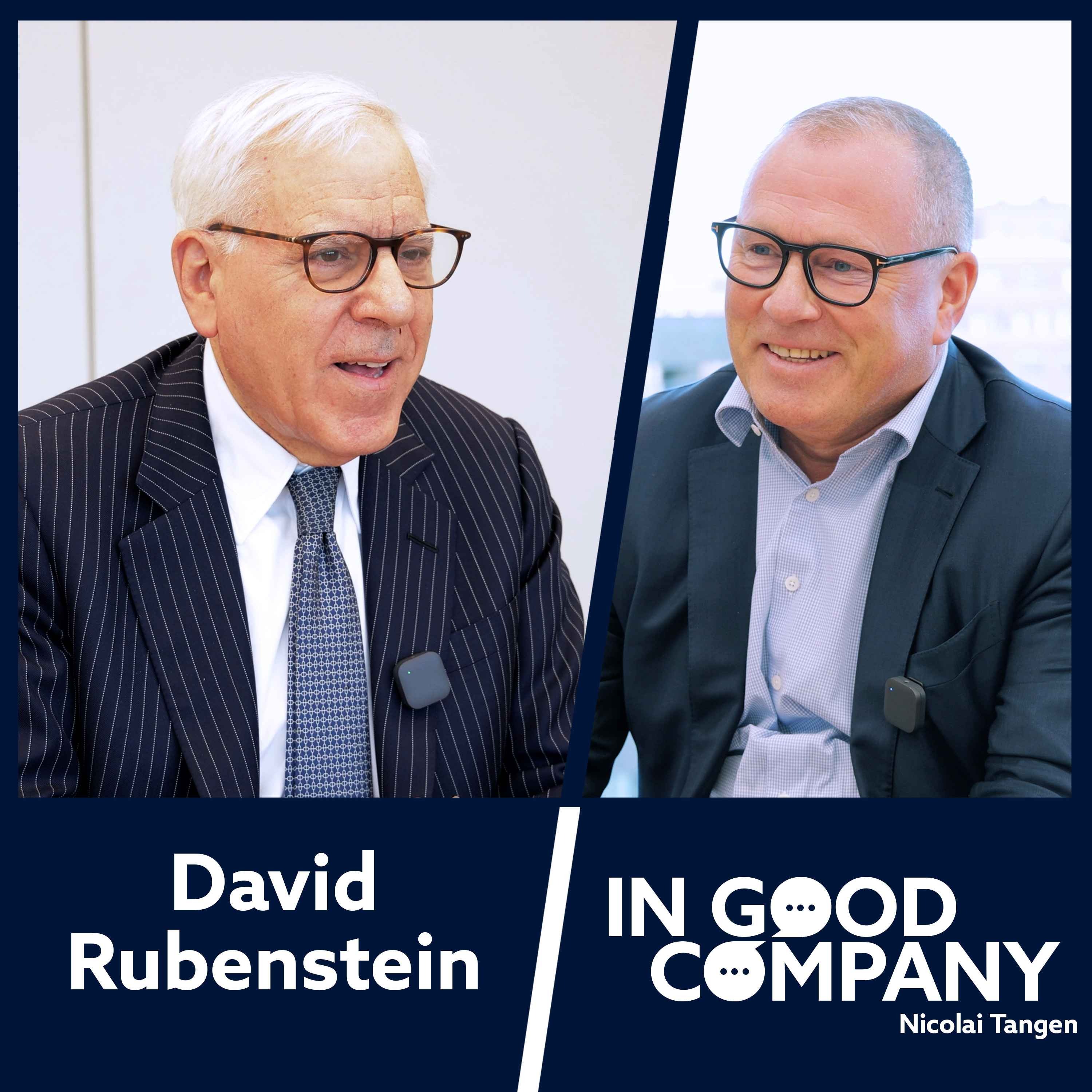
In this episode, Nicolai Tangen interviews David Rubenstein, discussing the essence of great investing, the importance of humility in leadership, and Rubenstein's unique experiences in the realms of finance and politics. They explore various themes, including the backgrounds of successful investors, the significance of historical preservation, and the nuances of effective leadership.
Written by AI. May contain mistakes.

Get the gist, explore an idea or ask about something said.
 Claude
On In Good Company with Nicolai Tangen, what are the key points of this episode?
Searching your listeningAutomatic transcript. May contain errors.
0:01Hi, everybody, and welcome to In Good Company. And today I'm here with David Rubenstein. David is the founder and chairman of the Carlyle Group, one of the biggest private equity firms. And he also hosts the David Rubenstein Show, where he interviews prominent leaders in business and so on. And earlier this year, I had the pleasure of being on your show. So this is like revenge time, actually, David. Well, thank you for inviting me. And you were great on my show. And anytime you want to come back, please let me know.
0:34You sometimes talk about people being like brands. So what's the David Rubinstein brand like? I'm not quite sure what it is. Maybe it's just too busy to do anything very well because I'm doing so many different things that I don't really have as good a brand as I maybe would like to have. But the truth is, I spent 30 years, I'm now still in private equity. I spent 30 years building a firm. It became one of the larger private equity firms. But I find that I'm better known now for the TV shows I do. or the interviewing I do or for my philanthropy. I have a lot of philanthropic things I've done, and people talk to me more about that than anything I've done in the investment world.
1:12So I guess my brand is that somebody that can't do anything well. I do many different things, but none of them that well as I would like to be. Well, we're going to get through it, and you for sure do a lot of things well. But you were an advisor in the White House at age 27, and now you're here. Just what are the highlights in your life since then? I mean, briefly. Well, briefly, I came from very modest stock. My parents were not graduates of college or high school. They both dropped out of high school. They were married young. I was their only child. So I grew up in a blue-collar setting. And so if you grow up in that setting, you have to make it on your own.
1:48So there's a plus about that. My own children have had some advantages that I didn't have. But I was only interested in politics and government at the time when I was young. I had no interest in making money. In the days of the 1960s or so, there were no hedge funds, private equity funds, tech startups. There were no billionaires. And you didn't aspire to be a billionaire. And my family was Jewish. If you were Jewish and you wanted to go into business, you wanted your family's business. Your family might have a business. If you didn't have a family business, you became a lawyer, a doctor, a dentist.
2:18And that's what your mother, my mother, inspired me to be. And you became a lawyer. I became a lawyer because I wasn't that good in sciences. And I thought I was interested in politics. And being a lawyer, you could go into politics. And my role model was John Kennedy's advisor. John Kennedy was a charismatic person, became president of the United States at 43. But his role model, his advisor and my role model was a guy named Ted Sorensen, who had been his speechwriter and great intellectual blood bank at the year 31. So at 31, Ted Sorensen was writing the inaugural address and every other great speech that Kennedy gave.
2:50And I thought, I'm not a charismatic figure. I don't have any money, but I could be like Ted Sorensen. And so I attach myself - And you became a Ted Zerns in his 27. Well, I did. In effect, I wasn't as prominent as he had become because he was more senior. But at 27, I did become a deputy domestic policy advisor to President of the United States. I wasn't qualified for the job. But, you know, White House staffs are often filled with people aren't qualified. So I did got the job. Right. But unfortunately, I got inflation to 18 or 19 percent. So, you know, I didn't last. Carla didn't get reelected.
3:21You started Carlyle in Washington. and everybody else were in New York. And, you know, that wasn't so fashionable for time. But now everybody's going to Washington to do business, right? I mean, all the big business leaders. So you were like nearly 40 years ahead of time. Well, what happened was I was in Washington. I had worked in the White House. I didn't have the credibility to go to New York and start a private equity firm. I didn't have an investment banking background. All private equity firms were really started by former investment bankers at that time, with very few exceptions. I didn't have an investment banking background.
3:51And I lived here. And there's a famous senator in the United States who once said, if you're getting kicked out of town, get out in front and pretend you're leading a parade. What does that mean? Take advantage of the situation you find yourself in. I'm in Washington. So what do I do? I say I understand companies heavily affected by the federal government better than the guys in New York. So what was heavily affected by the federal government? Aerospace defense. So we did a lot of aerospace defense deals early on. And people in New York said, well, these guys in Washington, they know it better.
4:16So it helped us a bit. And, you know, in hindsight, if I had to do it all over again, I wouldn't change it. because when Washington, there was nobody there then doing this. Now everybody wants to have an office in Washington. Everybody wants to know what the president thinking or so forth. And when I go around the world now, people don't say, tell me about your deals. Tell me about the deals you've done. They say, what's going on in Washington? What's Trump doing? What's Congress doing? People are really fascinated by what's happening in Washington. But I do keep up with government. I spend a lot of time on keeping up with government officials.
4:44So I do have some sense of what's going on in government. But I can't tell you that I'm the leading expert on what's going on in the government. But I know enough so that when I go to Abu Dhabi or Dubai or Korea, I know a lot more than they do about what's going on in Washington. How many days a year do you travel seeing these investors? In my peak, when I was running the firm, I was the principal fundraiser. And I was probably flying about 800 hours a year, which is a lot. I'm probably now down to about 400 hours a year. But in my peak, I was going to the Middle East five times a year, Europe about six times a year, Asia about four times a year, and then Africa one or two times a year and South America maybe twice a year.
5:21It was a lot of travel. Got a lot of frequent flyer miles. Well, eventually I got out of the frequent flyer world. But in the end, I learned to fly. And I fly on my plane. And I'm not the pilot. But eventually, when I first started, I said, wow, great. I'm going to be in a fly business class. Then I said, I can fly first class. And then I said, hey, I'm going to come back from Europe on the Concorde. And then I started chartering planes for a little bit. And then I started chartering planes for a little bit longer. And then eventually, I bought a small plane, then a bigger plane, a bigger one, a bigger one.
5:55And I got used to it. So I do fly on a private plane. And it's my most favorite possession. I own the Magna Carta. But that's nothing compared to my plane. I tell my family, bury me in my plane. I'm never so happy as when I'm in my plane. Well, we're going to come back to happiness. Now, you have interviewed many of the best investors in the world. And just coming back to that, what you say here is that many of them come from middle-class background, just like you did. Why is that? Well, I think people that grow up in very wealthy families may not have quite the hunger and the drive to put yourself through the torture you have to do to learn how to be a really good investor.
6:30And investing is a very tortuous business because you're going to be wrong a lot of times. And so I think a lot of people who are really great investors came from middle-class backgrounds. They tend to have these things in common. They're pretty good in math generally, not maybe a math superstar, but pretty good in math and arithmetic. They have a certain degree of humility because when you're trading or you're investing, you're going to lose money a fair bit. You have to get used to that. They also have the ability to make a decision to get out of something relatively shortly after they find out it's not going right.
6:58In other words, some people have egos that are so big, they say this position is right, the market's wrong. If you have that position all the time, you're probably going to be wrong a lot because the market's going to go against you. So really good investors say, look, I made a mistake. I'm getting out of this position. Also, you have to know how to get along with people. And I think a lot of investors who are really good get along with other people. You have to motivate people to want to work for you. You have to motivate people to want to tell you information. And so I think getting along with people is a pretty good skill.
7:23Do you think rich people are less good at getting along with people? Well, the richer you get, I think the bigger your ego usually gets. Obviously, not always the case for some humble people. Warren Buffett is pretty humble, but also very wealthy. But it's a general rule of thumb. If you want to find people that are low ego, don't look for the richest people in the United States or the richest people in the world. Because when you get a lot of money, and I mean money but being worth$100 billion or more, you're generally going to say, look, I'm pretty smart, and I'm smarter than the average person, and your ego tends to get bigger.
7:52So how do you cope with that? Because you've got kids who are investors, and they are not from the middle class anymore. Well, I have three children, all of whom are in private equity. They all have their own funds, and they've seen what I've done. and it's going to be difficult for somebody to replicate exactly what I did, but they will maybe do something better or do something different. There's no doubt that the children of very wealthy people have a disadvantage in a sense that if they accomplish something great, people say it's because you're a father or a mother. And if you fail, people will say, well, what do you expect?
8:22Because in the end, they're probably not going to be as highly motivated as somebody who grew up in a poor family. The wealthiest people in the United States don't usually build great businesses. They tend to come from middle class backgrounds or maybe lower class backgrounds. So you can't say this publicly, but if you grow up in a wealthy setting, it's a big disadvantage to try to really accomplish something on your own. Because even if you do something on your own, it's impressive. People won't give you credit for it. Which is, we come back to that, which is probably why you decided to give away a lot of your money.
8:50I decided to give away essentially all my money. Bill Gates called me when he was studying up the giving pledge. And you're a signer as well. And there were 41 of us in the beginning. and I said, look, I started with nothing and I'm going to end with nothing. But I wanted my children to read all my speeches about giving away all my money so they wouldn't think that when I die, they're going to get a lot of money. I wanted them to all have their own careers and get their business off the ground and then not feel that if they got a lot of money from me, that was going to be something that people would say to them, you don't really earn the money.
9:22You didn't really earn it yourself. So I'm trying to get my children to be on their own and I am giving away basically the bulk of my money. I've given away a large part of it already.
9:35Continuing on on what makes a good investor, how important are good academic results? Good academic results can indicate you're pretty smart. And being smart is better than not being smart. But the best investors are not the superstar students of all time. Warren Buffett got rejected at Harvard Business School. He tried to get into Harvard Business School. He got rejected. So he must have been an OK student, but not a superstar. A lot of people have dropped out of college. They were smart, but they didn't have great academic records. Bill Gates was smart, but he dropped out of Harvard. Mark Zuckerberg, smart, dropped out of Harvard.
10:08A lot of people are very smart, but sometimes they're either too smart to want to go through the college rigmarole and get all the grades and all that. There's no doubt that being smart is better than not being smart, but being lucky is better than not being lucky. And a lot of people have luck. Yeah, for sure. What is a yenta? A yenta. A Yente is a Yiddish word that means wants to know everything, a busybody. And that's what your mother called you when you were little. My mother called me a Yente because when people would come over for dinner, I would always ask them lots of questions. And I would say, tell me this.
10:39I'm asking questions all the time. I want to know everything. My mother said, don't be such a Yente, which means you shouldn't know everybody's business. But now, as an interviewer, I am always asking questions. Maybe I got it from when I was a little boy. I was always asking people questions. I wanted to learn stuff. Are you still a Yente? I'm always interested in interviewing people and learning more. And I try to read as many books as I can and try to interview as many people as I can. And so I guess so. Yeah. Why does a good investor have to go against conventional wisdom? Well, conventional wisdom, if you did what conventional wisdom would be, you're doing what everybody else is doing.
11:13So if you do everything everybody else is doing, how are you going to be ahead of the pack? So you have to do something that conventional wisdom says is not the right thing to do. And so the best investments generally are against conventional wisdom. Of course, the conventional wisdom is when the market goes up, what do people do? They jump in. When the market's going down, what do they do? They jump out. Why is it so difficult? Why is it so difficult to go against conventional wisdom? Because generally, people want to be liked by other people, respected by other people. And if you tell people you're doing something nobody else thinks is a good idea, they're going to tell you you're stupid, and nobody likes to be told you're stupid.
11:45Yeah. So when you look at yourself, what are your strengths as an investor? Well, I wasn't the investor that other people in our firm were. I sat on all the investment committees, but I wasn't driving the investment process. So I wouldn't say I'm a great investor. I was probably better at building a business than being an investor. But I would say my strengths were that getting along with people and probably picking talent was probably a reasonably good thing and figuring out how to persuade people to do what I wanted to do. Now, all of life is about persuasion. You're persuading your parents to do what you want them to do, your children what you want to do, your business partners.
12:21Everybody has to learn how to persuade other people. And you persuade people by talking well, by writing well, or by leading by example. And so I tried to lead by example by working hard, and therefore other people would follow me, and I learned how to try to talk reasonably well so that people would want to follow what I said. If I talked in a very poor way or I couldn't really articulate myself, people probably wouldn't listen and they might tune out. So let's continue on that. Let's talk about Rubenstein, the leader, right? So you, on your show, talk to leaders across the world, but mainly in the U.S.
12:53Why don't you like leaders in other countries? I love leaders in other countries, but here is the challenge. I have a day job, and I'm still co-chairman of Carlyle, and I chair a lot of non-profit organizations like University of Chicago, the Council on Foreign Relations. So I don't have the luxury of traveling around the world to do as many international interviews as I would like. and I found that it's tough to get people overseas to want to do as many interviews as I might want to do. So I'm always happy to do interviews for people overseas, but I haven't really had the time to really focus on doing it.
13:26So if I had no other job, I would say, I'm going to take my shows, I'm going to go to Europe for a week, go to Asia for a week, Africa for a week, but I don't have the time right now to do that. Now, you categorize leaders into various categories and you have one which you call visionaries. Right. So what have you learned from the visionaries? Well, visionary leaders are people that have an idea of something that nobody else has really thought of. And like take Bill Gates. When Bill Gates was thinking of the computer revolution occurring, you know, that was pretty visionary. Many people didn't think there would be personal computers everywhere or there'd be software, need for software.
14:02And so many people, or take Elon Musk. Elon Musk, you know, thought about the importance of space travel before many other people. Then he built this incredible space company, SpaceX. And then he also thought about how you could actually make electric cars actually viable. And so he was pretty much of a visionary, I would say. Talking of two visionaries, because I think you did one interview together with, well, both Bill Gates and Jeff Bezos in the same interview. Yes. One time, it was Bill Gates had his annual Microsoft conference. And right before the conference actually started, Bill Gates and Jeff Bezos allowed me to interview both of them.
14:39But they wouldn't let me keep a transcript of it. So there's no transcript of it. and they had never been interviewed jointly together at the time. It's quite a lineup. It was pretty impressive, I would say. And look, think about it. Jeff Bezos drove out to Seattle because he admired Bill Gates and what he'd done out there. He drove out there in his car with his then wife and they started his company from scratch. And we were involved in the beginning in helping him a little bit at Carlisle and then we didn't really take the stock that we could have had. We would have owned a lot of stock at the time.
15:09But we didn't. No. I mean, you win some, you lose some, right? Yes, but I always think about, like, for example, when Mark Zuckerberg was at Harvard, my now son-in-law was his classmate, and he told me about this company, and he said, look, Mark is looking for$30 ,000 to get this thing off the ground and so forth. And I said, look, it's a dating company. It's not going to go anywhere. I'd seen dating companies before. Well, the guy that actually put in the$30 ,000 was one of his college classmates who now has that stock and never sold it, and it's worth$50 billion. $50 billion. Eduardo Saverin.
15:40$50 billion. So I wish I had made that investment. I wish we had stock in Amazon at the beginning, pretty much, and we sold it right away. We didn't think it was going to get anywhere. So I've made a lot of mistakes. I wish I had held on to some of these things. Well, you also backed a lot of winners. Now, another category, you talk about builders, Ken Griffey and Jamie Dimon and so on. Just what are these people? Well, builders are people that take an organization that might already be there. Let's say J.P. Morgan. J.P. Morgan has been around for a long time. It's a very famous bank. But when Jamie Dimon went there after his bank that he was then running, Bank One, was bought by J.P.
16:19Morgan, he built it into the most powerful bank in the world. Now, therefore, he didn't start J.P. Morgan and he didn't start Bank One, but he built an organization that was quite impressive. Transformers, what are they? Transformers are people that take an organization and change it dramatically from the organization that they might have found. A good person in that category might be Steve Jobs. Steve Jobs started Apple, but he was thrown out of Apple. He was out of Apple for 12 years, running Next. And then Next was sold to Apple. He went back to Apple, and he transformed it from a company that was almost going bankrupt into a company that became worth about$4 trillion.
16:59Commanders? Well, commanders are people who take great leadership skills and really learn how to get people to follow them in some ways. And I'll give you an example. A military leader can be a great commander. Norman Schwarzkopf or Colin Powell is an example. Colin Powell was the chairman of the Joint Chiefs, and he really was a great leader, a commander of people, and knew how to get the most out of people in a military context. And then we've got two more categories there. We've got decision makers. People who have to make really tough decisions all the time, and then they do reasonably well.
17:36Very often you've got a CEO who's making tough decisions about how to build or grow a company or a president of the United States or other leaders of a country who have to make decisions all the time. When you're, let's say, the CEO of a company, you get decisions coming to you all the time. A president of the United States is going to make decisions. Really good ones are making good decisions. And then the last one is masters. Well, masters are people who, you know, people greatly respect. They have a command of the subject matter that is so significant that people really want to listen to them and really want to follow them in many ways.
18:09You could say what, take the founders of Google, for example, the two founders of Google, they had a concept and they grew the company in a way that was quite impressive, helped by Eric Schmidt as well, who was the CEO for a long time. So masters are people that master a subject very well. They know it inside out. In the case of Google, it was the system for search engines. But there are many people who master a subject and know it inside out, upside down, but don't actually build great companies. Some do. Which category would you put yourself in? Well, I wouldn't say I'm all that skilled in any one thing.
18:46I'd probably maybe more of a builder because while I started Carlyle, I really built it in many ways because it was my vision. My vision was to have two things that had never been done before in private equity. Private equity was always a mom and pop business. They're very small firms. When KKR did the RJR deal in 1989, they had about seven or eight, nine people. That's very small. That's because they had one fund, a private equity fund that did buyouts. I decided I would have a business that did buyouts, but then I have a growth capital business, a real estate business, and a debt business, and so forth.
19:15So I have multiple products, and then I would globalize it. So at that time when I was starting Carlyle, nobody had a buyout business in Europe that was an American company. or nobody in America had a business that was an Asian buyout business. But I decided I would have different funds all over the world. So I would both have many different disciplines and then globalize it. And that was the vision I had. And I did it, but I could have done it better than others. I could have done it better than I did. Some have done it better than I did. In your book, you talk about, why do anybody want to be a leader?
19:49And is there a common driver here, you think? Most people in the world are leaders in one way. You're a leader of a family, let's say. You're a parent. You're a leader of the family. But most people don't say, I want to be a leader of a country. I want to be a leader of a large company, so forth. So some people have a drive to do that, maybe to prove that they're worth something, that they really achieved something in their life. So everybody doesn't say they want to do that. Many people are very content to be just going along not being a leader. In fact, the happiest people in the world are not leaders.
20:20Now, happiness is the most elusive thing in life, probably. Very few people are truly, truly happy. But very often, the happiest people are people who don't have a lot of money and aren't leaders. They're just people that are living their life. They might have a nice family, but they're not trying to change the world. People that try to change the world have such a drive sometimes, and they're never going to get to where they really want to be, that they're going to feel that they're inadequate in some ways. And therefore, not as happy as they might want to be. Have you never met a happy leader?
20:48when they retire sometimes they get to be happy but happiness is very elusive Thomas Jefferson talked about it in the Declaration of Independence he wrote the sentence it became the most famous sentence in the history of the English language we hold these truths to be self-evident that all men are created equal that they're endowed by their creator with certain unalienable rights and among these are life liberty and the pursuit of happiness but he never actually defined happiness and nobody really knows exactly what creates happiness but clearly some people have a happiness and when you talk to them you can see they're happy with their life And some people are just bitter and they're not happy with their life.
21:20And maybe for personal reasons or professional reasons, very few people actually achieve their goals in life. And if you're very ambitious, it's very difficult to get to your goals. Is it a goal to be happy? I think, what is life all about? I think life is probably about creating happiness, probably more so than anything else you can say. What do people really want? What they want is generally to have a family, not always family, have a good relationship with a partner, and have children that grow up happy and healthy and that you leave a legacy behind for your children to kind of follow. But happiness is very elusive.
21:57And, you know, psychiatrists make a fortune because there are not that many people who are happy. And pharmaceutical companies make a fortune because so many people are on all kinds of medications. So happiness is elusive, but I think it is probably the ultimate goal. Are you happy? I'm always trying to do more. And I always say, I wish I could have done this. I wish I was a better athlete. I was a better business builder. I was a better writer, a better interviewer. I always, I'm pretty critical of myself. So I wouldn't say I'm happy, but I'm happier than I thought I would be 30 or 40 years ago when I didn't think my career would really go where it went.
22:32Why are Jewish people outperforming in nearly everything? That's a more complicated subject. When you think about it, there are roughly 8 billion people on the face of the earth, and there are roughly 13, 14 million Jews, relatively small population. And they've survived for 2 ,000 years, more or less, because of a lot of different factors. But Jews seem to be, with some exceptions, and you can't always say that what I'm about to say is always true, but they tend to focus on education. They tend to focus on philanthropy. They tend to focus on strong family units. and those things over thousands of years, when you have the DNA all staying within a certain gene pool, it tends to produce those kind of results.
23:15Now, obviously, when you say that Jews are happy and they make a fair amount of money and they're in philanthropy, you do produce some anti-Semitism too. And today, anti-Semitism is clearly on the rise. Yeah, yeah. One of the things you need to do as a CO is to convince people. What are the important things when it comes to the art of convincing people? there are three ways you can convince people to do something, in my judgment. One is you learn how to talk. You say to people, I want you to do this, and here are the reasons. And if you can talk persuasively, that can be helpful. Now, you don't have to be Martin Luther King at the Lincoln Memorial giving a great speech, but you can be persuasive without giving that kind of speech.
23:54Another thing is you write well. You don't have to be Abraham Lincoln writing the Gettysburg Address, but you can write well. So people today, people are getting memos or emails all the time. If somebody writes something that's persuasive, that can be helpful. If you talk well, that can be helpful. But the most effective way to persuade people to do something is to do it yourself and be a role model. If you say to people, I want you to work hard, but you're working three hours a day, that's not probably going to be the right way to do it. If you work 10 hours a day, 12 hours a day, people are going to see you who work for you and they'll say, well, that's the way to get ahead.
24:25He's the role model. I'm going to follow him or her. You kept in touch with all the American presidents since you were 27 years old. So for 50 years, what's the key to keeping in touch with the presidents? Well, probably giving to their libraries probably helps. But for all presidents in our country these days, they have libraries and they all build libraries and they're always looking for money for it. But to be very serious, I have kept in touch with them because I've interviewed them at events and so forth. And I try to be supportive of some of their causes. And generally, a lot of them have admired my philanthropy.
24:59A lot of it, my philanthropy is preserving American history. and a lot of them helped to make American history. So it's a number of different ways. But I know some presidents better than others. And I enjoy it, I guess, because I've always admired the presidency and wanted to be around it. That's why I worked in the White House. So I've had a special interest in knowing presidents and maybe hanging around the White House or doing things that preserve American history and particularly the White House history. What do presidents have in common? Presidents have in common ambition. There are some presidents who became presidents without ambition to be so.
25:32Calvin Coolidge, a long time ago, really didn't really want to be president. But generally, remember, to be president of the United States, you have to put yourself through a hellacious process for roughly two years or so to kind of go from a primary, work your way up, win the primaries and the general election. It's a very complicated process. And you have to say, why do they want to do that? Because they want to, they're ambitious. This is their profession, politics. The top of the profession is the presidency. But think about it. John Kennedy was assassinated. Lyndon Johnson, driven out of office.
26:01Richard Nixon driven out of office. Gerald Ford couldn't get reelected. Jeremy Carter couldn't get reelected. Ronald Reagan almost was assassinated. George Herbert Walker Bush couldn't get reelected. And so you say yourself, why do these people want this thing? You might be getting assassinated or maybe assassinated or you have a scandal or you're almost impeached. I mean, Donald Trump was impeached twice. Bill Clinton was impeached once. So why do people want this job where it's so difficult? That's because at the top of the totem pole in the politics world is being president. And so people want to be at the top.
26:36Now, you're at the top of a popular TV show. So how did you decide to do that? Well, what happened is, like most things in life, it's by serendipity. If I'd said, I want to hire McKinsey and how can I get better known? They wouldn't have said, well, you're a shy person and why don't you take interviewing up? They wouldn't have said that. so I what happened was at Carlisle I'm trying to get a lot of people to come to the events because we're trying to market funds and to get people there I would get former presidents of the United States or secretaries of state and I'd pay them a fee as part of the legitimate fee business and then they would be speaking but they were boring very often so I went to the speaking agent and said look I think I have a good sense of humor maybe I could make them a little more human if I interviewed them they said if the fee is the same we don't care as long as the fee is the same we don't care so I started interviewing them I made some let's say dry personalities funnier and more human So then I became the head of the Economic Club in Washington, and all I had to do was get business people to come in and speak, and I found that they were terrible.
27:32Their CEOs were terrible. And then the questions from the members were terrible too. So I said, I'll tell you what I'm going to do. I'm going to junk this format, and I'm going to just do interviews, and I can use my sense of humor. And all of a sudden, Bloomberg gave her a couple years solid, and said, let's put it on TV. And then they said, okay, that's a good show, and let's have one more on business, and then it led to other things. So I've learned how to do interviewing because I now do a lot of it, and the reason I enjoy it is, one, you can get to see almost anybody in the world. If you say you've got a TV show or some kind of broadcast, people might be willing to go on it.
28:04Secondly, it gives me a chance to read a lot because I want to read and to prepare for the interview. So I do a lot of the reading, and that helps my brain, I think. And also, it's a way to connect with people because, you know, you're going to get to meet people that I might otherwise get to meet. So let's suppose I had no interviews. I probably wouldn't spend that much time with former presidents of the United States. They'd probably say, why do I need to talk to you? How does it help your business? It helps in ways I did not anticipate. It's hard to believe. I built Carlisle with the help of others, and I've been almost 40 years.
28:34When I go around the world, people don't come up to me and say, David, you have a really good rate of return on that deal. Or, David, that was a really clever deal you did. They say, I saw you on TV. I love your interview. When can I go on one of your shows? So it's amazing how many people watch these shows. Now, Bloomberg is seen all over the world because Bloomberg is all over the world. And so it helps me, gives my visibility. I guess at my age, I'm now an age where many people my age have retired, but I enjoy what I'm doing and it keeps me young to kind of be able to keep doing this. But also, you know, when people come up to you, young people all the time and say, I watch your interview shows and I like it, you know, it's a good feeling.
29:13Tell me about this thing. How do you prepare for these interviews? Because I totally agree with you. It's amazing to have, you meet somebody and you don't want to look like a fool. You have to read up on what they do. You see what they've done before. You read the books and so on. I read all your books. Well, I apologize for forcing you to do that. It was great. So I learned a lot about it. What I do is if somebody has a book, I always read the book. And rarely do I read a summary of the book because I sometimes might not have the time, but I always want to prepare. And then what I do is I prepare questions in advance, and that helps me think it through.
29:46And then I kind of memorize the questions a bit because they're my own words. If somebody prepared the questions for me, I probably couldn't remember them. And then I often do another technique I've been using lately is I will read the book, but sometimes the books are not as good as I want them to be, and sometimes the person is not somebody I didn't know or they might not have had a book. So I watch interviews that they've given on YouTube. And so I very often can now spend time watching some YouTube interviews that other people have given that I'm about to interview, and it gives me a sense of their personality, the kind of things they like to talk about it or not.
30:17So that's how I prepare. And I always think that I remember what Jim Baker told me. Jim Baker, a former Secretary of State, was in our firm for 15 years, one of the most successful Secretary of State, White House Chiefs of Staff, Secretary of Treasury, very impressive guy. He told me as a young man, his father said to him, prior preparation prevents poor performance, the five Ps. Prior preparation prevents poor performance. And I always realized if you're prepared, you're probably going to do reasonably well. If you're not prepared and just wing it, you probably won't do as well. But you don't use notes, so I'm really impressed because I have notes.
30:51But I don't have your memory and your experience. You have a great memory, but let me put it this way. If I took those notes away from you today, right now, you would do the same interview. You do as well. It's a little bit of a crutch. And the reason I don't use it is for this reason. I do have a good memory. There's no doubt I can probably memorize some of the stuff. But if I prepare 30 questions and I only get 27 of them, nobody's going to know except me. So nobody will really know I missed something. It's not like you're reading Shakespeare and you forgot a couple lines and people know you forgot the lines.
31:21Secondly, I feel that the eye contact is very important. So when you have the papers in front of you, very often you look down. As soon as you look down, you lose the eye contact and it makes it look less more of an interview than a conversation. That's why I do it this way I do it. But I'm not perfect. And sometimes, you know, I'm always, you know, thinking that I have the right questions. I forget something. but every time I'm listening to a person, I'm always thinking of the next question as well. But it's important to listen. And when I interviewed Oprah Winfrey once, she said, I said, Oprah, you're a really good interviewer.
31:52She said, no, no, I'm a good listener. I listen. And that's the key to interviewing. Listen to what the person says. You know, for example, when the FBI agents come by to interview me on a background check for somebody, they have a checklist of 10 things. And I can say, well, actually, this person is an ax murderer. He's killed a couple of people. They won't actually stop and they just go to the next question because they just want to get their things done. And I won't mention his name, but there's a very famous person in the United States who is considered a brilliant person, one of the most famous intellects and professional people and very famous guy.
32:23If you had to say his name. I'm not going to tell you his name because I don't want to embarrass him. But he was a college champion debater. And he but every time he got to the finals, he lost to this one other person who was also a champion debater and not as famous a school. So finally, after losing four or five times, he went to this person and said, tell me, what am I doing wrong? How come I'm losing to you all the time? And he said, you know what? It's debate. You're supposed to listen to what the other person says and then respond, but you're never listening. You're just making up statements that you already had cooked up in advance.
32:56Listen to what the other person says, you'll do better. And I think it's very important as an interviewer to pivot. You listen to what the person says, they say something you didn't expect, then pivot and follow up. What's the key to good listening? Well, the key to good listening is, you know, actually not focusing so much on the next question, but listening to what the person is saying in that question. And then try to, you know, get people to talk about their favorite subject, which is themselves. Everybody's favorite subject is themselves. And if you let people talk more about themselves, they generally respond positively.
33:29And what I have found over the years is that what people like to talk about is their upbringing. if it was a harsh upbringing or a good upbringing they like to talk about it their relationships with their parents very often they like to talk about it, sometimes they're not and then generally the mistakes they made people like to talk about the mistakes they made and the difficulties they had in overcoming those mistakes and that's what I find people most like to talk about and a lot of good people have self-deprecating humor, some don't you know Your humor is more English than American, right?
34:01I have what people call a dry sense of humor And also it strikes me because you're a pinstripe, so it's a bit English, the whole thing, right? I have a dry sense of humor. Where does that come from? You know, it may be a self-deprecating style. I'm not quite sure, but I'll give you an example. I interviewed Bill Gates one time, and I've known Bill for a while, but I wouldn't say I'm that close to him. I interviewed him one time for my Bloomberg show. I think it was maybe one of the first ones I was doing, and I went to his personal office. And I said, Bill, tell me this. if you had you know had a college degree you think you could have been more successful in life well it went right over his head he didn't he gave a serious answer when I gave that question to him another time I interviewed him in front of an audience the audience laughed and then he got the picture that it was a humor humorous thing so sometimes people don't have senses of humor and if you ask him a dry sense of humor kind of question they won't get it but you know Jeff Bezos I interviewed him in front of a large audience.
35:02When I ask him humorous questions, he got the point. But I like interviewing people in front of an audience. And the reason I like to do it is because the audience reaction is something I can play off. If people laugh, that's good. And it also loosens up the person you're interviewing, I've found. And also, I like to make people happy. And when I'm interviewing people, I can make people enjoy it because I tend to use a fair amount of humor. and by the humor, people kind of, they might not remember the substantive things. They always come up to me and say, that was a funny thing or that was a funny line.
35:36And I just have a good sense of how to do that, I guess. Yeah, no, I listened to a lot of your interviews at the Washington Economic Club or Economic Club of Washington and you do that really well there. I hate to bore you for that. I toned down the humor a little bit there. Do Americans have a sense of humor, you think? We need a sense of humor given where some of the things are going on. But yes, I would say I don't know Norway as well, obviously, as you do. But I don't know whether there's a sense of humor in Norway that's more typical than it might be in the United States. In the United States, a sense of humor is not atypical, probably.
36:09Well, I guess England is the best place, right? Probably so. Yeah, maybe so. But Norway has a lot of pluses. I've spent a lot of time there, I should say, over the years with talking to various pension funds and so forth. And I've enjoyed it. It's a country, you know, small country. And when the Nobel Prize was set up, I was doing some research on it recently, and it turned out that Alfred Nobel, for reasons he didn't describe, he gave the Peace Prize to a committee of five people of the Norwegian Parliament. And it said that he thought that Norway was more peaceful than Sweden. Talking of which, why do you want to interview the Pope?
36:44The Pope, well, the Pope doesn't do a lot of interviews, maybe virtually none. And to somebody whose last name is Rubenstein, probably not going to give an interview. But the current pope is an American. He actually, I'm the chair of the board of University of Chicago, and apparently he took a summer extension course or something or another one time at University of Chicago. But I don't know if that's going to enable me to get in to see him and do an interview of him. Have you tried? Not yet. But I'll tell you, the first time I met a pope, I was at the White House in 1978. Pope John Paul II came, and he was a revolutionary figure.
37:16Remember, he came from Poland, first non-Catholic, first non-Italian pope in a long time. and I remember when I went to go in the receiving line, you shake his hand or something like that, I saw his hand he put it out and he had a Casio watch on, like every second he didn't know what's going on, I'd say, hey I assume you'd have a Roman numeral kind of watch and you don't really care what the time is because you're not in a big hurry, but he had a thing telling him every tenth of a second I always think I should have asked him, but I didn't want to embarrass him
37:49Let's talk a bit about value Why is humility an important virtue? Well, I value humility because I think that arrogance, the opposite of humility, is something that is not an endearing trait. And to me, the leaders that I most admire are people that are humble. Abraham Lincoln won the Civil War. Can you imagine Abraham Lincoln walking around the White House saying, hey, just won the Civil War? Yeah, pretty impressive, aren't they? Or can you see him signing the executive to the executive order that outlawed slavery, the Emancipation Proclamation, and holding it up and going like this so everybody could see Abraham Lincoln?
38:24You can't picture that. He was a humble man. And I think humility is a real virtue. Now, there is false humility, of course. People pretend they're humble, but then they tell you how great they are. But I think humility is something that is a good virtue to have. And, you know, I try to be as humble as I can. I'm not trying to brag about myself unduly. But obviously, I'm not perfect. in this regard. I put my name on buildings. If I put up money for a university building, I put my name on it. And the reason I do that is I try to show people, and particularly in Washington, D.C., where my name is on something, that somebody who come from a poor background can rise up and they can do something useful for the country or university by giving money that helps other people, presumably.
39:03And so that's why I often put my name on buildings if I give them money to help a building get off the ground. You talk a lot about history and you have a lot of historical references. Why are you so interested in history? I guess as a student, I wasn't as great in the sciences as I was in history. So I did well in history in high school and college. And it's something I can understand. History is, you know, it's about reading and writing. And those are skills I have. I'm not probably as good in the math as I am in history, reading and writing. But also, my view is that history is something that teaches you about the mistakes of the past.
39:35And the theory behind studying history is that if you learn about the past, you learn about the good things that you should do in the future and the bad things you should avoid. And so I think it's very important for people to have a sense of history. And I think presidents of the United States particularly should have a sense of history too, or leaders of organizations, because, you know, people have made mistakes over the years. And if you're going to make the same mistakes, you can avoid them if you learn about history a bit more. When you look at the world today, do you feel that we are learning from history?
40:01No. I think that today we have a lot of wars going on. People haven't learned from the history that wars usually result in a lot of people dying, not necessarily making humans better off. I think people tend to ignore history or they rewrite history. Some people are like President Putin, likes to talk about the history of Ukraine and Russia. It's a history that many people or scholars think is not quite accurate, but he, and I hope this doesn't result in anybody coming after me from Russia, but I don't know that his history of Russia and Ukraine is quite as accurate as many other scholars would think it is.
40:42But that's his view of history. And he cites history as the reason for doing what he's now doing in Ukraine or trying to do in Ukraine. You spend a lot of money preserving U.S. history, right? You bought Magna Carta. Yes. Restored Lincoln Memorial and so on. What kind of ideals are you trying to preserve? All right, let me try to describe. I didn't hire McKinsey or BCG, as I said earlier about something else, to give me an idea of how people can remember me. I stumbled into it. What happened was I went to an auction one time in New York. It wasn't an auction. I thought it was a viewing. And it turned out it was going to be an auction the next day of the Magna Carta.
41:17And they told me, a very clever curator said, the Magna Carta is likely to be sold tomorrow. It's the only copy in private hands. There are 17 of them. This is the only one in private hands owned by Ross Perot. And it'll probably be sold tomorrow. And as somebody, the likely buyers are from Russia and a couple other countries didn't seem like very favorable to the United States. And I said, okay, I know it was the inspiration for the Declaration of Independence. We should keep the one copy that's in private hands in the United States. So I went back and bought it the next day and gave it a permanent loan to the National Archives.
41:42$20 million. I paid$21 million for it. But, you know, at the time, I just thought it was a good thing to do as a gift to the country. Later, when the Washington Monument had its earthquake damage, I called the head of the Park Service and I said, how long is it going to take to fix it? And he said, it's going to take a couple of years because Congress is going to have hearings and all this. I don't have the money from that right now to do it, and it'll take me a while to get it. I said, forget that. I'll put up the money. And I didn't think it was that big a deal. It wasn't that much money. But it got a lot of attention because people can't imagine or couldn't imagine a private citizen putting up the money for the Washington Monument.
42:12So the reason I like to do this is this. Let me try to explain.
42:19The human brain is an incredible device. And when humans showed up on the face of the earth, let's say as Homo sapiens 400 ,000 years ago, It wasn't evident to the gorillas or the tigers or the lions or the elephants that we were going to dominate the world. Because we weren't as fast, we weren't as big, we weren't as hairy, we weren't as strong. But we dominated the world. And why we now can kill any animal and we dominate the world. Why? Because we have this human brain. And the human brain is an incredible device. You know, it can create a Picasso painting, an Einstein theory of relativity, all kinds of things that are incredible that the brain can do that no other animal on the space earth can do.
42:54But it has a couple disadvantages. and one of the disadvantages is because in the early days of human history people weren't sure that somebody coming along might be interested in killing them and so you had to recognize friends and foe relatively quickly to see whether somebody's a friend or foe and so you have facial recognition and you could recognize somebody's face and that's why, and that was for hundreds of thousands of years names are a couple thousand years old so sometimes as you get older you're not old enough yet to know this problem you might forget people's names people recognize their face.
43:26So the human brain in that way is not perfect because when we've kind of got the history of people look different than us, we get mad at them or potentially, that's why there's a lot of racism and other things. If people worship differently or look differently, we'd have a natural ingrained instinct to be against them for whatever reason. Obviously, not perfect situation. Another thing that the human brain doesn't do as well yet, and maybe it will later, is if I show you a computer slide of the Magna Carta, you push a button, you'll go to the next thing. If I say you're going to come see the Magna Carta, well, you might get excited about it.
43:58You're going to see the original. So you might read about it before you go there. When you get there, our curator is going to explain it to you. And when you go home, you're more likely to take some literature. And so more likely you're going to have more of an experience of seeing the original of the Magna Carta or seeing the original of George Washington's home, Mount Vernon. And so by preserving them, we have, as long as the human brain is still better developed in seeing things in person than it's seeing on a computer slide, it's more likely to educate people. So in other words, maybe in a thousand years from today, seeing a computer slide of the Magna Carta will have the same impact, exactly the same as seeing the original.
44:29But today it doesn't. And so since it doesn't, I want to get more people to go to see these historic things so they can learn about it and therefore hopefully learn more about history. That's why I try to preserve things. Partly because of this, but also because of a lot of other things. You recently got the Presidential Medal of Freedom, which is the highest distinction of this country, right? Highest civilian. What did it mean to you personally? Well, I regret that my parents weren't allowed to see it because my mother would have said he deserved it. But I would say, you know, look, everybody likes to be honored by the president of the United States, I suppose.
45:02And so the highest civilian honor you can get, there's a military honor, Congressional Medal of Honor. It's a different thing for people in combat. You know, I'm sure it's a highlight of my life to get it and be recognized. but you know in the end um you know i i my children came to the event and i i wasn't sure why they all flew in from the country around the country to be there but i think it was because magic johnson was also getting one and i think they wanted to meet magic johnson or some of the other people getting the events getting the award so i'm not sure they came to see me i think they did why are there more old tycoons now than in the past just all business people who are doing really well i mean they're just hanging in there for a long time right i mean It's Murdoch.
45:44I mean, you name them. They're going strong. Okay, there's a couple reasons. I mean, you are 78? I'm 76. 76. I look like I'm 78, but I'm 76. Warren Buffett's 95. Yeah. Why do people keep going for longer? A couple reasons, I think. One, it used to be that humans didn't live as long. In 1900, the average American lifespan was 49. 49. In 400 ,000 years ago, the average lifespan was 20, 400 ,000 years ago. Now, in 1900, in the United States, 49. Today, when the Social Security system was set up in 1934, the average lifespan was 65. So you could retire at 65, but you're probably dead by 65, so you don't have to pay out a lot of benefits.
46:27Now, for white people born in the United States 70 years ago, they might have a pretty good chance of living to mid-70s, maybe early 80s. People born today in the United States from a good zip code, good ethnicity, and so forth, probably going to make it to their late 80s, early 90s. So people are living longer. Now, another, so that's one thing is, so people are living longer. So it used to be you retired and you kind of died a few years later. Now people are going to live longer. Secondly, the baby boomers have been the center of attention ever since they were born. You're young. You're not quite a baby boomer.
47:00You're younger. But baby boomers were born, let's say, in the late 1940s and the early mid-50s. they've been the center of attention their entire life and they don't want to get off the center of the stage they like being the center of attention because our entire lives we've been the center of attention because we were the biggest generation now all of a sudden people say get off the stage and now we don't want to get off the stage do you really think that's the case well i love what i'm doing and if i stop doing what i'm doing now i worry that um a phenomenon might happen that is medical professional cell use can sometimes happen.
47:34If you're going steady and you're working hard, your body is quite used to it. Sometimes you'll see that somebody retires and as soon as they retire, they go out and play golf, they drop dead of a heart attack. So I'm afraid that all of a sudden, it's like the body is in here, inside my body, people are saying, I've got to keep working, keep working, keep going. And then if I say, okay guys, turn off, I'm just going to go chill out for another five years, I think they're going to say, I'm going to go to sleep and maybe something bad will happen. I think I've heard you say that you are spurting towards the finish line.
48:02Yes, I am sprinting to the finish line because I don't want to just slow down and go to Florida and just play shuffleboard every day. I want to keep doing things. I enjoy what I'm doing. When you enjoy what you're doing, it's not work. Do you think the world is more interesting now than it was in the past? Oh, sure. In what ways? More interesting. Yeah. Oh, sure. Because now you can connect with anything in the world at any time because of smartphones and computers and the internet, you can get so much information, you can know so much, and you can do so many different things that you couldn't do before.
48:32So sure, the world is much more interesting than it used to be. And I don't want to, and I love what I'm doing. I just wanted to, I could, you know, I was younger and I wish I, you know, had the health that would get me to an older age. Why did you buy a baseball team recently? I was not a great baseball aficionado. I played baseball when I was a little boy. But then I realized I wasn't a great athlete at the age of eight or nine or 10. I realized I wasn't going to be that good at it. And then I started doing other things. I came from Baltimore. Baltimore is a blue collar town in the United States.
49:08When I was growing up, it was the eighth or ninth biggest city in the United States. Now it's not in the top 20. It's lost a lot of population, had a lot of crime, a lot of problems in the city. And I thought by buying the most important baseball team in the city and buying, you know, one of the most important sports teams in that whole region, I could help revitalize my hometown. I felt that I hadn't done enough for Baltimore. I basically left Baltimore when I graduated from high school. And so for more than 60 years, I've been giving away a lot of money in other parts of the country and doing things in other parts of the country.
49:41But I just kind of ignored Baltimore. And I just felt Baltimore gave my parents a place to grow up, and that's where I was born. My parents were married there. My parents are buried there. I'll probably be buried in Baltimore. And I suspect that I should have done more for Baltimore. So I thought by buying the baseball team and hopefully improving it, that I could contribute to my hometown, that it gave me a good public school education. That was the reason. Sports is one of the few places where people actually agree these days. Look, sports is something that is universal all over the world. People love to see sports teams compete, and they obviously want to vote for their own team to win.
50:17I'm not quite sure why. I'm writing a book now about why people want to be sports owners and why sports is so important to people, but I guess it's a kind of a reflection of their self-worth. For example, why should people who live in Baltimore care whether I buy the team and the team does well? If the team does well, how is the life going to be better for somebody in Baltimore? It's not necessarily going to put more food on their table, but it's just they have a sense that they're part of something bigger than themselves, and if something bigger than themselves does well, it makes them feel better about themselves.
50:46What do you read? I read a lot of books. I try to read over 100 books a year. And the reason is I have a lot of TV shows where I'm interviewing authors and I feel it's a courtesy, as I mentioned earlier, to read the book. Sometimes I can't get to it because of too many other things. But I tend to read nonfiction. I'm not very good at fiction. My theory is if I'm reading a fiction book, some of that's not going to be true. So I want to get as many facts into my head or things that are true as possible. So I read a lot of nonfiction, a lot of biographies and so forth. So I love biographies, politics books, business books, and history.
51:21Those are the kind of things I like the most. Last question. What is your advice to young people? Well, the most important thing is to figure out how you're going to enjoy your life. So you're on this earth for a relatively short period of time, 60 years, 70 years, 80 years, 90 years. Maybe it'll be in the future 90 years. You have to figure out how to enjoy your life or what's the point of having a life. So figure out what you enjoy and try to pursue that. And I tell people to experiment. You know, people graduating from college aren't going to necessarily know what they're going to really like.
51:51I've had many jobs before I got to doing what I'm doing now and some things I didn't like. I didn't like practicing law. I wasn't that good at it. And so in the end, experiment, try different things and then ultimately develop the skill set in areas that you think you're going to enjoy the rest of your life and then try to do something useful with your life. You're only on the earth for a short period of time and you're going to feel much better about yourself if you feel you've done something to contribute to humanity, to make your parents proud, and if you have children, make your children proud.
52:16Now, it's easier to make your parents proud than your children proud. Your children are never going to be proud of you probably, but your parents might be proud of you. And if you're lucky enough to have your parents still alive when you achieve something, that's a great feeling. Yeah. Well, David, it's rare to see somebody enjoying life as much as you do. Well, I enjoy it, but talking with you is a pleasure because I admire everything you've done. And, you know, look, you could be running your hedge fund in Europe and not have to do this. Congratulations for what you're doing to help your country.
52:44I'm having a great time. Thank you. Thanks a lot.
Nicolai Tangen sits down with David Rubenstein, founder and chairman of the Carlyle Group and host of the David Rubenstein Show. They explore what makes truly great investors, why going against conventional wisdom matters, and the critical importance of humility in business and leadership.
David shares insights from his time working in the White House and from building one of the world's largest private equity firms, discussing different leadership styles, his philosophy on wealth and giving, his passion for preserving American history, and why staying engaged—rather than retiring—keeps you young and fulfilled. Tune in for a sharp, insightful episode you won’t want to miss!
In Good Company is hosted by Nicolai Tangen, CEO of Norges Bank Investment Management. New full episodes every Wednesday, and don't miss our Highlight episodes every Friday.
The production team for this episode includes Isabelle Karlsson and PLAN-B's Niklas Figenschau Johansen, Sebastian Langvik-Hansen and Pål Huuse. Background research was conducted by Oscar Hjelde.
Hosted on Acast. See acast.com/privacy for more information.


