
 Ask ChatGPT


 In Good Company with Nicolai Tangen
8 Oct 2025 · 51m
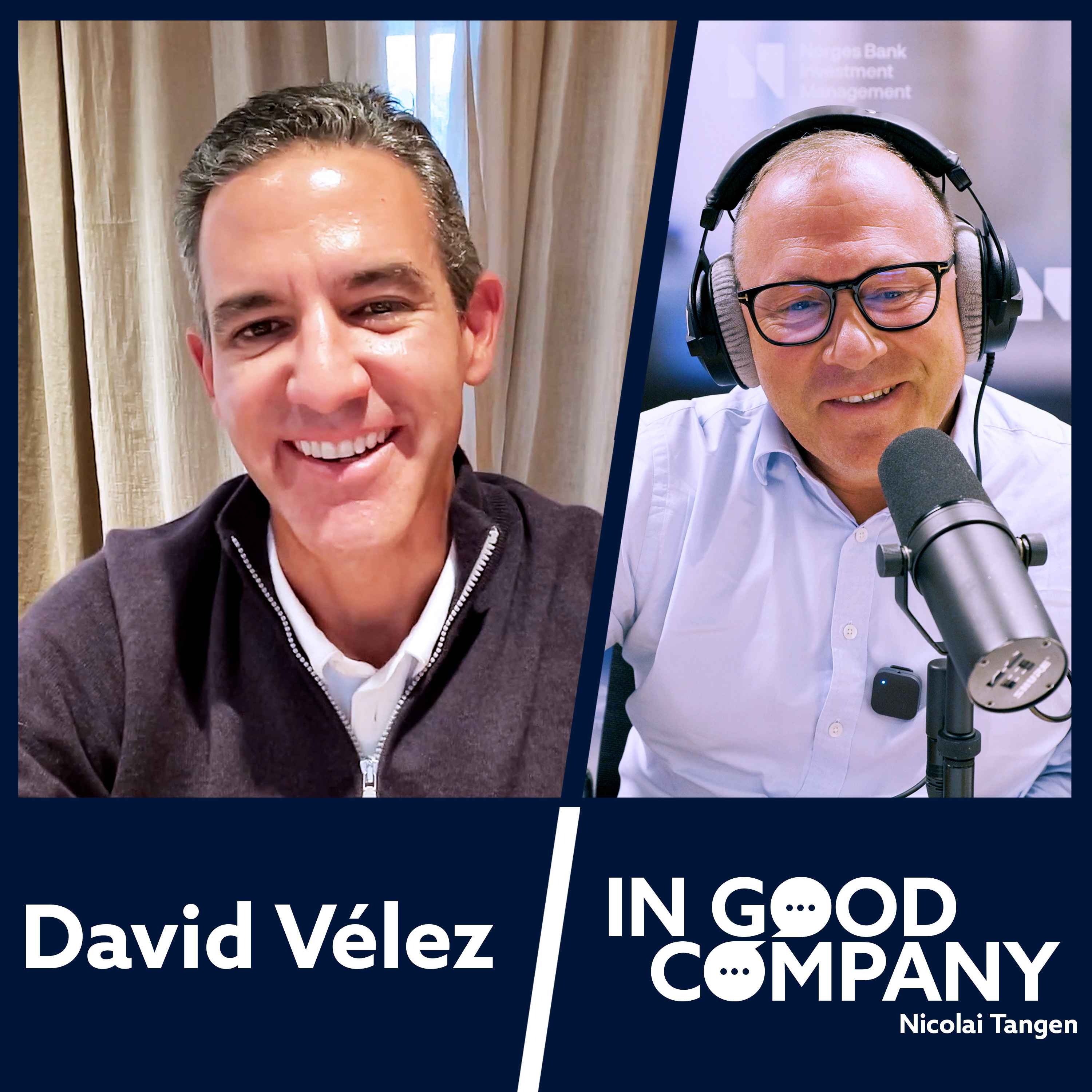
Host: Nicolai Tangen, CEO of Norges Bank Investment Management
David Vélez, Co-founder and CEO of Nubank
Nicolai interviews David Vélez, discussing the revolutionary banking model Nubank offers across Latin America, its growth, customer loyalty, branding strategy, and the importance of financial inclusion.
Written by AI. May contain mistakes.

Get the gist, explore an idea or ask about something said.
 Claude
On In Good Company with Nicolai Tangen, what are the key points of this episode?
Searching your listeningAutomatic transcript. May contain errors.
0:00Hi, everyone. I'm Nikolaj Tangen, the CEO of the Norwegian So1 Wealth Fund, and today I'm joined by a true fintech pioneer who has transformed banking in Latin America. David Veles is the co-founder and CEO of Nubank, one of the world's largest digital banks, serving something like nearly 120 million customers in Brazil, Mexico, and Colombia. And under David's leadership, Nubank has grown from a startup to one of the most valuable banks in the region. So David, a warm welcome. Thank you, Nikolai. It's a pleasure to be here with you.
0:43now um take us uh uh take us back to the beginning like how did your upbringing shape what you're doing now sure so uh i don't come from a family of bankers at all but i do come from a family of entrepreneurs uh i'm originally from colombia grew up in a in a family where uh my dad had 11 siblings my dad had my mom had five and they were all micro entrepreneurs still had their own business, my dad as well. So what did you guys talk about around the dinner table? Yeah, so the understanding was that you had to go and build your own thing. And if you were about to get a job or you were going to try to manage something, that was Luke upfront.
1:27What was cool in the family, the DNA in the family was starting your own thing and solving a bunch of problems. Is that a DNA you are buzzing on to your kids? Oh, absolutely. Yeah. I mean, I think it's, you know, under the entrepreneurship thing, it's all about finding a problem and building the solution for that problem. And I think it has this kind of mentality about having agency and solving problems and not just sitting down and complaining and victimizing and hope that somebody else is going to solve it for you. You went to school in the U.S.? That's right. I started reading a lot about computers and technology when I was growing up.
2:08I was growing up in Costa Rica. My parents moved to Colombia in the early 90s. And I got enamored about Silicon Valley and technology, what entrepreneurs were doing over there, and had the good fortune of being able to make it to Stanford. And I wanted to start a business there, but nothing really showed up. And I ended up taking the finance route and doing some finance for a few years in New York. Yeah. Well, it wasn't particularly bad, the kind of stuff you were doing. I mean, you were working at Goldman's, Morgan Stanley, General Atlantic, and Sequoia. It doesn't get much better. So when did you decide to leave all these incredible places to start up NewBank?
2:51How did it come about? Yeah, I mean, there were phenomenal places. But I found myself that in every meeting I had with an entrepreneur, be it first as a banker or then as a private equity investor, I secretly envied the person on the other side of the table. I just found that what they were doing was so much cool, actually building the company and hiring and growing and expanding. And I found myself to be in a position where I was supposed to give them advice as a venture capital investor. But I had no idea what I was doing. I had no operating experience. I had no operating background. And it felt a little bit like a farce.
3:28It's like, what gave me the credit of telling this entrepreneur what they should do with their business if I've never had that experience? And I kept connecting that back to the family environment of being the entrepreneur and putting the entrepreneur in the center of the action. And so initially, when I left GA to go back to business school, I was expecting to use the business school vacation to figure out what business idea I was going to focus on. But that's when Sequoia called me and said, no, come back, help us figure out if we want to open an office in Brazil. And I did that for two years, flying back and forth.
4:05And eventually they decided that they didn't want to open an office to invest. And for me, that was the moment where I said, OK, fine, I have to stop delaying the building a business. And that was the moment. A number of different things kind of aligned with each other to decide ultimately to let's go and pursue this idea. So what's the first thing you do? So you decide, okay, now I'm just going to go for it. I'm going to start a bank. What do you do? Who do you call? What do you think? What kind of stuff do you have to do? Yeah. So I had spent a lot of time looking at financial services as an investor.
4:45and I had realized how amazing, how interesting and attractive this industry was from a business model perspective. When you look at Brazil, Mexico, Colombia, and frankly, almost all countries, the biggest companies are banks, especially countries that don't have technology, large technology companies now, as you would look at the US. But in Brazil, the five biggest companies are banks, in Mexico, the same, but you look at Africa, you look at emerging markets, it's always banks having significant market cap. And then you look at the market structure and you realize that four or five banks generally have 80 to 85 % market share.
5:19And so it's an oligopoly that then generally always means bad products, lower quality products, as I said, for consumers, lack of access, very high interest rates, very high fees, and a significant percentage of the population left out. So without offending the Brazilian banks too much, how bad were they? They were pretty bad in 2012. I remember we looked at this list of the top 10 most hated companies in Brazil, and the top five were banks and the second five were telecom companies. Now that's not the case. I think we like to think that because of the significant competition we brought to the market, now banks are actually very well placed in that list.
6:04And that has been an enormous impact that we've been able to create through bringing more competition. But at that time, it was an oligopoly that hadn't really seen competition for a very long time. It was a very attractive industry. And then there was a why now question, which is this digitalization of the economy, smartphone penetration was beginning to boom, and that enabled the possibility of imagining competing with the big banks fully digitally. And then I had a personal experience at that time. As I said, I'm Colombian. I'm not Brazilian. I had moved to Brazil. I went to a bank to open a bank account.
6:36And it was the most painful experience I could possibly imagine. It was super frustrating. an hour and a half sitting in the banking branch. I was corded out because I had my laptop in my backpack. A lot of different fees. It took me about five months at the end to open a simple bank account and a credit card that charged 1 ,200 % interest rates. It's interesting when you go into a banking building. You know, the bank buildings are constructed so that you feel intimidated, that you feel small, and they feel powerful, right? That's exactly right. I mean, we concluded that entire experience I always described it as almost going to jail, right?
7:16Literally, because you would go into these banking branches. The first thing you would see is you see several security armed guards looking at you. You had to go through a bulletproof door that had an alarm. If you had any metal, you had to grab your backpack and leave it in a locker outside the branch, then wait for hours to get service from somebody that would just throw stuff at you. They were not there to serve you. They were there. It almost, you had to ask for a favor to get a service. And so the entire experience seemed like you were taken hostage. You were a prisoner in this entire environment.
7:49And so from a consumer perspective, it made it a really interesting opportunity to reinvent. And that was the opportunity. How old were you when you were launching this? I was 32. Okay, so here you go. You are, here this guy comes along, launches this purple credit card, right? 32 years old, taking on the big banks. So what did they think about you? Yeah, so I didn't finalize answering your question. The first thing I did once all of this kind of, when I was excited about the idea, was start talking to about the experts and the industry experts, right? So here it is, a Colombian in Brazil, walking around, talking to the former presidents and CEOs of banks.
8:30And it was amazing to hear that out of maybe 30 conversations I'd had with former consultants and experts, the entire consensus was this was not doable. It was impossible. You have no idea what you're doing about here in Brazil. You cannot compete with these big banks. The regulators won't let you. You won't get licenses. These are the most powerful families in Brazil that you're trying to compete with. All these arguments about why this was impossible to do. But ultimately, I went back to the experience. And it was like, how can consumers be accepting this experience? And then I went one by one trying to refute those arguments, including, for example, regulation.
9:07I went to the regulator and asked, can we get licenses to compete with these big banks? And the response was, yes, we want more competition, and it would be great to see more people competing in this market. Did the big banks try to crush you? Well, sometimes we summarized the entire evolution of the past 12 years for us, as apparently Gandhi used to say. There is in the internet a phrase apparently from him. It says, first, they ignore you. Then they laugh at you. Then they fight you. And then you win. And we've seen that evolution. First, we were completely ignored. They had no idea that we'd existed.
9:49And we tried to keep it very quiet. We did not want to make a lot of noise. We launched our purple credit card, consumer obsessed, fooling the smartphone. And we started growing vitally like crazy, trying to keep it very, very no marketing, all word of mouth. Then some of them start to wake up and then they start laughing. They said, well, it's impossible. You don't have branches. People are never going to trust a new brand. People are not going to give you any savings and you need funding. You're going to, your credit models don't have any data, so you're going to blow up. They laugh and laugh and laugh and ridicule for a very long time.
10:21And I would say over the past couple of years, now they're fighting and we're definitely in the fighting zone. We're not competing. And it's a very fair competition, right? It's competition for whoever offers the best product for consumers. So we like that. Did you ever fare for your life? No, no, I never got to that point.
10:42Why this purple card, right? I mean, I've seen many columns, I've seen many credit cards, but, you know, black and platinum and all that kind of stuff. But purple is a bit different, right? And that was exactly the idea. When we were in 2013 and we looked at all the bank's offerings, which, by the way, obviously were a banking branch, they all looked exactly the same. It was the typical completely red ocean commoditized market. All cars look the same. All branches look the same. All communications look the same. All products look the same. There was no differentiation. And so I think what we wanted to do was to break that commoditization by creating a completely new experience.
11:20And the question we asked ourselves on the branding side was, what is the most anti-bank color we can possibly come up with? And that was purple. When we showed a couple of people the purple color, it created very passionate responses. Some were positive. Some were extremely negative. There was like, you never, that color, brand can use all about trust and brand building and legacy and being around for centuries. And you guys bring this modern color that is very different than the red or the blue. But we wanted to create that emotion. We wanted to create some passion. And so from that perspective, we launched it and it has become a very, very good decision as we position this color and this branding as a very anti-bank.
12:05In fact, when you look at our logo, it's new bank, new is symmetrical. The trick we always add is you would flip it around and it says own bank. And I think we do offer products and financials, products and services, but then everything else we do, we do it differently. We think ourselves as a technology company, not a bank. We're a very horizontal organization. We're not a hierarchical. We don't use any titles. We are very agile. We really are from a number of different dimensions. We are the anti-bank as we've executed this business plan. But it's pretty incredible that an anti-bank manages to get 60 % of the adult population in Brazil as customers.
12:45I mean, it's just like incredible. How is it possible to go from zero to 60 % of a country? Yeah, I mean, I think what was amazing is it was all word of mouth. barely driven our customer acquisition cost has been two, three dollars over 12 years, getting to over 120 million customers. I think ultimately what we were able to do is we found a clear consumer pain. We were able to identify that consumers were readier than everybody expected to embrace a new products and services. The fact that it was fully digitally in the moment that the entire economy was digitalizing, that every consumer was getting a smartphone in their hand helped a lot.
13:25So we got the timing just right of writing the entire wave towards smartphone penetration. And we were able to create a product that really talked to consumers, used the right language, communicated almost like a friend, like the best friend of a consumer versus the experience that banks out of prisoners. And the fact that we had a fully detailed business model meant we don't need to charge all those fees. Our cost structure is 20x more efficient than banks, so we don't charge all those fees. We charge no fees. We have lower interest rates. So ultimately, it's a better, it's a superior value proposition for consumers.
14:03And at some stage, there was a shortage, right? So not everybody could join. Is that right? That's right. One of the key decisions we made was starting with credit first. When you look at digital banks around the world, a lot of startups and digital banks have also seen this opportunity of digitalizing financial services. But one of the things that we did differently was starting with credit first. And that was a key decision because on one end, it's a riskier decision. You need funding, which as a startup was really, really hard to get to. And you need to get your credit models right. If you get them wrong, if you miss, you're dead.
14:40You won't get a second chance. Investors will be not forgiven if you get it wrong. But the pros of that strategy is this is the hardest thing to get right. And this is 70 % of the profit pool of financial services. And this is where the biggest pain point exists with consumers. They ultimately want credit. And a lot of people don't want to provide credit. But one of the things we realized is as we launched the credit card, the first credit card with no fees, there was so much demand, we could not approve everybody. And so we created the concept of a waiting list. and instead of telling people no you cannot have the card we said we don't know yet we don't have our models are not mature enough give us a couple of give us a little bit of time and if you get invited by your friends you'll get priority and we started using that data of invitation as one of the most important variables in our credit model and that ultimately enabled what was a scarce product to become even scarcer because people were in a waiting list and they wanted it more It's a bit of a nightclub strategy, this, no?
15:41Exactly. People want to go to whatever place has the biggest waiting list. And we had over a million people in the waiting list for a very long time. Wow, that's incredible. Now, our mutual friend, Mala Gaonkar, who's an extremely accomplished investor, said, I need to spend some time to talk to you about Net Promoter Score because you are supposedly just totally obsessed about it. So, David, just first, what is Net Promoter Score and why is it important? Yeah, it's a metric we've always used and now a lot of consumer companies use to measure the probability that somebody will recommend your product.
16:17And so it's a metric that has a lot of correlation and causation with viral growth. It's very clear. Obviously, if people really like a product and they recommend it to their friends, then you will be able to grow virally. You'll create this kind of recommendation engine that has been. So you basically ask people, would you recommend this product? And then you take the people who want to and subtract the people who don't want to. And then you get a number, right? Yeah. From 1 to 10, what is the likelihood that you would recommend this product? And you get the promoters and then you subtract the detractors, the one that would not recommend this product.
16:50And what number did you have? And so when we launched, we had an NPS of 90. This is 100. This was one of the highest NPS of any consumer products that we've ever seen. once in a meeting, somebody told me that Tesla had a higher NPS than our purple credit card. And I was really bumped until we launched our credit card in Mexico. And then that had an NPS of 94. So our credit card in Mexico had the highest NPS of any consumer product in the world of any category. It's crazy to think about that a credit card can have a higher NPS than a Tesla or than an iPhone. But that just tells you that the level of consumer pain these consumers were in and the ability to create a product that truly matches the needs of these consumers.
17:36But I also heard that, for instance, you apologized to your customers because you had overcharged them. That's a great story, yeah. I mean, we... But it's true, no? It's true. It is true. And it's a story that we tell our employees or tell our friends. Our number one mission as a company, our number one cultural value is we want customers to love us fanatically. We think that in the long run, consumer love is correlated with value of the company, with financial returns. In the short term, that might not be correlated, but in the long run, those two things go in the same direction. And the story you're mentioning is one day there was a bug in our system and we stopped reminding customers to pay on time.
18:16And so they overpaid a couple of days of late interest. And it was very easy for our team to know what we needed to do. We had to put back those emails reminding customers to pay on time. but then also go back to the customers that we had forgotten to remind them, give them their money back, and apologize for not having reminded them to pay on time. And if you think about it, well, then, yeah, we're making less money in the short term, and that's true. But in the long run, what is the value as a customer if somebody proactively tells you, sorry, we didn't remind you several times to pay on time, and here's your money back.
18:48What are you even noticing? That's kind of ultimately the bet of the company, is that we think that those type of experiences will drive long-term value creation and loyalty with consumers for a very long time. What kind of responsibility do you think a bank has towards the society where it operates? I think it has huge responsibility. I mean, financial services is one of those core services that anybody in any society, in any country needs to have access to, to be able to operate and form part of the economic life. If you have a bank account, in most countries you are completely marginalized.
19:22If you don't have access to credit, your potential for value creation or to start your own business or to start your job, you get significantly handicapped. Or if you cannot invest in good products, your opportunity to create wealth for a very period of time is going to be really hindered. So we think it's a critical value in society. And if we can bring more competition to the banking markets and more efficiency through our business model and give more access, We think there is huge societal impact as we do the job that we do every day.
19:58Okay, so now you have the purple card. You've conquered Brazil with the card. What do you do then? So just how do you think about more products, more geographies? Just what's going on through your mind here? Right. So the end goal was always to build a fully digital bank. It was not a digital credit card. The issue, though, is we had to create this tactical plan where we would launch credit card, would figure out how to fund that credit card growth and in parallel, try to get a banking license. Getting a banking license was very hard in Brazil. It took us over four years to get one. Just to give you one data point of how protected this market was, Brazil is only one of the few countries in the world where it's in the constitution of the country that foreigners cannot invest in banks.
20:47So it required a special presidential exception to get a foreign to have a bank. And that happened. Obviously, there were some foreign banks operating in Brazil. But for us as a startup, it took us four years to navigate the entire political environment to ultimately get to get that presidential decree, get the banking license, and then launch a savings product. And our savings product was very simple. We paid 100 % yield to any consumer deposit. and we gave real-time free payments, transfers between accounts. It was amazing how, again, that simple design created a huge viral growth in the market and allowed us to go from something like 50 million customers at that point to 60, 70, 80 million customers in about two, three years, becoming today the largest bank account in the country and the largest primary bank account.
21:40So once we have savings and credit, then we've been growing in two vectors. The first one has been more products. We've launched consumer loans, an investments platform, crypto, insurance, and now we're expanding also to small businesses. And the second vector has been internationalizing to Mexico and Colombia. And for now, we're very focused on these three countries, as this is a model that requires a lot of focus and requires to go very, very deep in the countries that we operate with licenses, with credit. So when should a company expand into a new country? We had a checklist of things that needed to be true to expand.
22:22This is, again, I think there are some financial services products that are easily internationalizable, that requires little localization. But doing banking with banking licenses and credit requires a huge amount of localization. So for us, it requires first to be profitable in our core market. We have to be profitable and demonstrate to investors that we could generate earnings in Brazil. Second, have the banking license, which meant having the right funding to continue growing our credit book. And third, being able to do it in a way where our credit and our technology platform allow us to launch a new country without needing to dedicate half of our entire headcount.
23:01So you could effectively make it as a call option on a new market versus investing the house on winning the new market. How different are these markets to operate in? There are some significant differences. So, for example, Mexico, as we launched Mexico, and similarly Colombia, Colombia is more similar to Mexico. The story in Brazil was there was a big banking population, and we were able to offer a product that was lower cost to the bank customers. And then there was a smaller unbanked population. When you look at Mexico and Colombia, credit penetration or credit card penetration is 12%. So 88 % of the entire market doesn't have access to credit.
23:45And cash is very much still available and it's a lot of informal economy. So in markets like Mexico, we have to go a little bit slower in creating a payment infrastructure and building our credit models that will allow us to increase the size of the pie, the size of the credit pie. Brazil is a very different story. But there are generally some commonalities, though, of the business model. At the end of the day, our competitors are cash and the big incumbent banks that are operating in branches. And once we compete, we know branches. We have this cost structure advantage that allows us to give lower products, better products at lower cost.
24:23And those first principles apply to all of these markets that we operate. So some commonalities, some differences. When will you enter the US? We're not there yet. and we're still trying to figure out what comes out of these three markets. But certainly over the next five, 10 years, we want to expand beyond these three markets, beyond Latin America. And this is a really big market. It's the biggest market in the world. It's very competitive. So you would have to figure out exactly what would be the edge, what would be the entry path. But we're in the process of figuring out that internationalization strategy.
24:57So what would be your edge? I mean, how much better service can you offer? So that depends. We're figuring out what are the niches that have that consumer pain, any of those existing in the U.S. or other countries. Not fully ready yet to talk about our internationalization strategy beyond the three countries that we operate. But, yeah, we think over a 10-year horizon, this is a model that should internationalize and should be the opposite or should be the alternative to traditional banking markets. But how much fun. It is. How big is Nubank in 20 years? Well, you know, I think it's 10 to 100 exercise that we have right now.
25:43Financial services is the biggest segment of the world economy today. So we're$8 trillion of profit. And still 99 % is still dominated by banks with branches. Even though there's been a huge amount of progress in technology and there's crypto and there's stable coins. and everybody talks about these technologies, most banking today is still done in banks that are using physical cash and banking branches. And you still have 3 billion people outside the banking system in emerging markets. You still have 3, 4 billion people that are completely left out of the banking market. They don't have access to credit.
26:20They're not investing. They're not buying crypto products. They're not even in the formal economy. So this is today the early, early, early minutes of the game. And the bet is that in 20 years, this entire market will digitalize and there'll be digitally native technology companies dominating a lot of these markets. And we think we are extremely well positioned to take a very significant percentage of this market. You mentioned that you were 20 times more efficient. And of course, when you started up, you didn't have any of these really expensive legacy systems, which big banks have. but 10 years from now isn't your system going to look a bit old-fashioned or how do you just how do you how do you work on this yeah i mean i think there are two sides of the efficiency the first one is is the distribution model is the third the fact that we're fully digitally from day one even digital banks today or or traditional banks that have digitalized some of our competitors in brazil for example they have digitalized a lot but they have a hundred million customers with 100 ,000 employees.
27:26We have 100 million customers with 6 ,000 employees. So there is the cost structure advantage and that's the efficiency side. And then there's a technology point that you mentioned. Given we are cloud native and all our products and services are fully in the cloud, yes, of course, there'll be a number of different systems that need to be re-architected and we scaled. Right now, we're in the middle of that as we're becoming internationally and ready to go to more countries. But it's just much easier to continually be updating your own tech stack when you're fully in the cloud versus when you have to spend five to ten years to put your entire core banking system in the cloud, which is what most banks, more traditional banks around the world, are still trying to do.
28:06When you look at your tech stack, what opportunities, when it comes to AI, are you the most excited about? So the one I'm the most excited about is probably the one least talked about, which is the way financial services is going to be reimagined in the AI world. Because the way I think about it is mobile and the Internet solved almost all banking inclusion, at least for banking services or payments. Almost the entire population today of the world has access to a payment wallet. it. But that doesn't mean that they've solved banking for the 99 % of the world population. They still don't have access to credit.
28:49They still don't have access to true financial advice. So the way we think about it is if mobile put a bank in everybody's pockets, AI is going to put a bank and a banker in everybody's pockets. You're going to be able to have the most sophisticated financial expert handholding the hand of every single person on earth. And if you think about what that means in terms of optimizing people's wealth, of allowing people to invest in the right products, to be financially sophisticated, of making banks compete to give the lowest cost loan, of providing advice or should you buy insurance or not, there is so much wealth to be created for a very significant percent of the population that I get very excited about that potential for AI.
29:35So that's on the user interface side and still a few years away, I believe. And then there's obviously some of the, all the applications that most companies talk about. Part of that is going to be customer service, but also significant opportunities around improving credit models as you use neural networks in using credit underwriting, fraud applications, collections applications, optimization of capital, optimization of KYC, AEML. So effectively, every single thing that a bank does can be optimized through AI, and that can become a core part of the entire bank in the cloud. How worried are you about some big tech companies, Google, Apple, and so on, about them entering the financial services?
30:24I think this is an area where they will likely enter at the end if they ever do. And if they do, they will just be trying to possibly grab some payments, profit pools, or more of a marketplace environment. But this is such a regulated environment. And we've seen it over the past 10 years when a lot of the big techs have tried to get a little bit into India. They've tried to got a little bit into the U.S., a little bit in Brazil. They never really went all in because the moment they went all in and they need to get a banking license, they get incredibly regulated. You even see it with Apple as they launched Apple Card in the U.S.
31:03where they just relied on banks as partners. So I think they'll play somehow. They will want to be activated. It is very possible the new bank AI agent will be in Gemini or will be in ChatGPT and you'll be able to buy your travel tickets using a credit loan enabled by our AI agent inside one of these big platforms. But I don't see them giving credit. I don't see them grabbing savings of a customer. There is a line here that I think the miner will cross.
31:43Moving on to leadership and just how that has evolved. When you started, you were a founder and a CEO. Now you are a CEO in very big companies. How have you developed as a leader? It's been a long road about learning how to figure it out. I think the leadership aspect of the founder was easier. I think the founder sets up a vision and motivates the team to pursue that vision. And that continues in respective of the size of the company. So the leadership task to be done as a founder, I would say, is much clearer. What I personally have found harder is what the CEO does and the difference between the founder and the CEO.
32:28Where does the managing come in? I find that going from a founder to a CEO of a large company, it's a harder transition to be made. What's hard about it? What's the difficult thing here? I think for a long time, I thought that what that meant was I had to become a better manager. It was the management capabilities. It was doing the one-on-ones. It was the coaching aspect of being a CEO. And a lot of times, I don't think that comes naturally to a founder, because I think the founder, by default, is less patient, is more action-oriented. They want things now. they don't want to create necessarily processes and sometimes the company in certain processes.
33:09And so it almost required creating a number of new skill sets. And I think for a while, for a few years, we tried to create all of those skill sets. We brought more professional managers into the organization and we try to instill the practices of bigger companies. But I actually realized over the past year that if you instill the practices of a bigger company, you become a bigger company. And that's actually not what you want. You want to maintain the sense of urgency, perhaps impatience, the kind of the buy for action of the startup, but then you also want to be integrated with certain light processes and with very strong people that allows you to execute a larger organization.
33:53So today, I don't think the answer is you need to become a very big manager of a large organization. I think the answer is more about you need to do a little managing, but ultimately leading with a vision and bringing a great team and maintaining an organizational structure that is very horizontal and very agile is the highest priority action to maintain the company young and active. Why have you been a successful founder? I think it's, I think I have the vision. I can, you know, I can articulate where we want to go and the opportunity we have as an organization. But I think I've been able to also bring phenomenal people around me that fill a lot of the gaps that I have from my experience.
34:44So I said, I was an immigrant, Colombian immigrant in Brazil that never worked for a bank, that never did a credit card, that never necessarily was a technologist, that built a technology company in Brazil with banking. And to be able to do that, it required the ability to bring a lot of great people that had that skill set and create an environment where they all could do the best job of their lives. And I think I've been able to do that effectively. I think the last thing I would say is just actively realizing that you make a lot of mistakes, that I make a lot of mistakes, and having the humility to recognize that we don't have all the answers, that I'll make mistakes, but we'll learn from them, and sharing that with the team so that we create an environment in the organization where we can take risks, we can make mistakes, where there is as low ego as we can possibly have, and there is a lot of learning across the entire organization.
35:33What are the biggest mistakes you made? I think generally has been related to building the team. Um, one of the, maybe the hardest thing I found as we've scaled over the past 12 years has been realizing that the, the number one job I have as the CEO is figuring out if everybody around me in that team is the right person, given the challenges of the organization. And one day I look around and I have any kind of conclusion that, yes, I have everybody. everybody here is the right setup. But when you are doubling or tripling or quadrupling in size every six months, six months after you look around the room, and that's not true anymore.
36:19And because companies grow exponentially and we humans grow linearly. And so at some point, the exponential complexity is above our human capacity to learn. And that means bringing your talent into the organization. Bringing that talent consistently and having that bar has been, I think the hardest thing to do and making the right assessment around the right people in the team has been the hardest and where I perhaps have made too slow of a decision of making a change or not made the right hire nor made the right setup in terms of the team. It's a bit of an apprenticeship business, you know, being a venture capitalist, I think.
37:05And you trained at Sequoia. What did you learn there? I think I learned and I think that ultimately were lessons that took me as an entrepreneur and not as an investor. The first thing I learned is that I did not want to be an investor. I wanted to be an entrepreneur because I really wanted to be in the arena building it with my own hands and I found that it was too easy for the investor to provide that advice. But beyond that, I think there were a couple of key questions from an investor angle that are very important for the entrepreneur angle. The first question was, is this an attractive and big market to disrupt?
37:46The investor has to answer that question. The entrepreneur has to answer that question. Because as an entrepreneur, you're investing, you're going all in. You're not just writing a small check out of a portfolio. You're completely concentrated. There is no diversification. And not only you're investing your money, you're investing your time. The scarcest resource you can possibly have, it is your time and your energy and your focus. And so the entrepreneur's investment decision is the ultimate investment decision. And once you make it, you might be doing this for 10, 20 years. So finding an attractive large market was a key question.
38:25Is this the right team? And what does it require to be able to execute this strategy? That's something that the investor has to be answering actively. actively and the entrepreneur has to be answering actively. Obviously, then there's a number of questions around the financial model, unit economics, ability to win, moat that the investor has to answer and the entrepreneur has to be actually answering. So I find that there is a lot of similarities in some of the questions that the investor has to be asking and the entrepreneur has to be asking continuously. What's the corporate culture at NewBank now?
38:58What is it like? I think it's a culture that is still very much energized by the purpose that we have as an organization, by the mission that we have about bringing this financial inclusion and financial competition to the next hundreds of millions of customers around the world. We are very energized by what this means in terms of disruption possibility, the fact that it's still not visible for most investors, how this very big market is about to change. and we can be one of those catalysts for that change globally. So it's a company culture that is very driven by that mission of people that are great team players, that look to work with people that are very different from them, that are all about the team winning.
39:45It's not about individual success, but it's about team success. It's very horizontal in nature, very agile. It's a culture where we truly try to create an environment of intellectual honesty and debate where we love different people bringing different ideas and having this clash of ideas where the best idea wins, irrespective of the title or of the ego or how long I've been here or whether I'm an engineer or an analyst. We try to ultimately create this diversity of point of views and let that operate. It's a culture of a lot of frugality. We like to be very efficient with the resources that we have, be it people, energy, focus.
40:30We like to try to do a few things, but do them very, very well versus being spread too thin across doing a number of different countries and a number of different things. And I would say at the end, it's people that like to work really hard and that bring their entire lot of energy into the organization and like to be all in, like to be part of this big mission. So these are all great things and often part of a young, small company startup. But these are difficult values to keep over time, right? So how do you do that? Yeah, you're totally right. I always tell the story that the best interview filter for these values was our first office, which was this very crappy house in Brazil, in Sao Paulo, where people would ring the bell and they would see this house.
41:20And there were two possible responses. One would be the nice person with their nice suit and tie, and they would look at this house, and they would say, these guys are crazy. What do you mean you're competing with the biggest banks in Brazil? I'm out of here. And then there was a second type of people that would go in, and they would sit on the floor, and they would see this dog coming around, and we would tell them the mission that we had, and they would say, I love it. I mean, I'm here on Monday. So that experience, that interview, was a filter for the right type of DNA. But you don't have that filter anymore because you've got a nice headquarter where you haven't got any dogs running around, biting them.
41:57You got it. We still have the dogs, but we have a nice headquarter. We now have a brand. We're a public company. So it's harder. It's harder to filter for that DNA. So how do we do it? First, there's an interview process where we try to assess finding what we call the missionaries, not the mercenaries. We try and look for people that see themselves as, that have a high amount of agency that are problem solvers, which means they are attracted by the mission. They're not necessarily attracted by the paycheck. That doesn't mean that we pay well. We think people should pay enough so that compensation is not an issue on the table.
42:33And then people can focus fully on the mission. But they're not necessarily, we're not the highest pool. They're not attracted necessarily by those monetary rewards. They're attracted by the missions, the purpose and working with great people. Once they pass that recruiting process, we spend a lot of time talking about these cultural values. One thing that I continue to do that I've done every single month since April 2023, 2013, when we started the business over 12 years, is I do a culture presentation for 100 % of the people that begin at Nubank, where I talked about our cultural values. and this is something I don't delegate.
43:11It's a way for us to leave the values as I spend the time discussing with people what they really mean and try to answer all the questions. And then we do our performance management very much aligned to people showing these cultural values. And so - If you were to, in three words, what would these cultural values be? I think it's consumer obsession. It's people that are truly putting customer first and they're creating products for consumer obsession. Is that we're owners, not renters. is this point about having high agency and not just blaming and having this victim mentality. We're smart, efficient.
43:46So it's people that show that they can create product and value efficiently. We have to be efficient so that we can pass the efficiency to our end customer by charging less and less and less. So we have to be frugal. That's the frugality aspect I mean. We build strong and diverse teams. This is that value that I was referring to of we like bringing diverse people that come from diverse backgrounds and they can work in teams and debate actively. We're hungry and challenge the status quo. There's this vision around, we bring people that have high ambitions and they like to challenge that internal and status quo and external status quo as we build new products.
44:30What keeps you going? I think it's this purpose. it's been exciting to build this story for 12 years but I think the challenge of now taking this to more countries is going to be really exciting. For me personally the fact that there's so few, maybe really very few Latin American companies or Brazilian companies playing at the world stage and that we have the opportunity to be one of the few ones ever gets me really exciting and the possibility to show that we can play at a world class in competing with some of these bigger companies around the world. It gets me very exciting. And the innovation aspect of it is this question around financial inclusion advice and how we can use our product and our people and culture to reinvent an entire market.
45:21The challenge and difficulty of that, it's something that gets me going every single day. so David you said you had sat around the dinner table and your father said you had to go out and be an entrepreneur I mean you kind of over delivered a bit on that one no? yeah I mean I think I'm happy that my parents are now customers because for a very long time they couldn't really understand what I was doing they're not in Brazil and they were not able to understand what a bank without branches really meant now they're customers now they use their products but yeah I think they we've delivered that for now that's good how do you when do you wake up in the morning i'm a very early bird uh i like waking up around five uh i like exercising every morning and then i like a couple hours in the morning to have no meetings so i can really focus on on on we have distractions on some of the big questions that we have but it also means that i get really tired very early i'm really bad at dinners I go to bed very early I'm in bed by 8.30 or 9 they really like to get those 8 hours of sleep I don't work well if I don't get 7 to 8 hours of sleep and I have 5 kids so I love spending time with them I have breakfast with them every morning I have dinner with them every night put them to bed every night if I'm not traveling that part of family and kids it's super important for me Why is philanthropy important for you?
46:50because you and you and mariel have signed the giving pledge yeah i mean we come from a region in the world uh me from colombia uh mariel my wife from peru where there is just a lot of poverty and a lot of people don't have access to opportunities and we were very lucky we we had we were lucky to get a lot of opportunities be in an environment where our parents they were not necessarily rich parents, but they put us through a lot of hard work into good universities and opened a lot of doors for us. And we've been able to create a company that has enabled the creation of a lot of wealth. But when we look around, we see still a lot of people lacking a lot of opportunities.
47:30So I think we feel almost like a moral duty to use a lot of that wealth to reinvest it back into society and giving people the opportunities that we also had. We think that we're able to do that. Not only it's a good, there is some level of ethics or morality that is good for society, but we also think he's smart because we think that one of the biggest risks that societies such as ours have is that there is so much wealth inequality that if it continues to go in this direction, this society will become unsustainable. There will be a protest. There will be a revolution. And when we can work through the capital system in a system where the money that gets created gets reinvested back into a society and enables our people to also create wealth, then it's a much more self-sustaining cycle versus a cycle that ends by massive accumulation.
48:27Both are capitalist system. We just think that the first capitalist system that enables reinvestment of wealth from successful entrepreneurs will be a long lasting, better type of cycle. So from thinking more about society in nature. We think that makes sense. And ultimately, we also kind of have a sense that we're not going to take this wealth anywhere else. We're all going to die at some point. There's going to be an end. And we also don't necessarily think the right thing is to give all this wealth to our kids. We want to love them a lot. We want to give them a lot of opportunities, but we want to also let them struggle and let them help them create their own life story and their own journey.
49:05And I think wealth can help a little bit, but then ultimately can also be a detractor to that. And as an extension of that, what would be your advice to the young people listening to this? I mean, I think one of the things that made me really proud of this Giving Pledge, and I've always told it, is the day we announced as we were signing the Giving Pledge, the amount of emails that I got from entrepreneurs in Latin America saying, one day I'm going to be also in that list was amazing. Because if you think about it, in one vision of capitalism, goal is to be in Forbes 500. In this new version of capitalism, goal is to be in giving pledge.
49:46In one, you accumulate. In the other one, you accumulate, but then you give back. And so I think this is kind of the beginning of seeing a new generation of entrepreneurs that are more tuned in with some of the needs of this society, especially in emerging markets in Brazil, again, where there is such a lack of access. and I think that would be my advice and I think people are very motivated. I see a new generation that is, that of course, creating wealth is great. There's nothing wrong with that and allowing their families to live a good life is great but then also give that back and create opportunities for other ones so that the circle continues for a very long time.
50:26David, this has been tremendous. Big congratulations on what you have achieved. It's just really outstanding and thanks for taking the time today. Nikolai, it's been a pleasure. Thank you so much for many great questions. Love the conversation.
How does one company redefine banking for millions? Nicolai Tangen speaks with David Vélez, founder and CEO of Nubank, one of the world's largest digital banks serving 120 million customers across Brazil, Mexico, and Colombia. They explore David's remarkable entrepreneurial journey and his mission to revolutionize Latin American banking, the strategy behind Nubank's iconic purple branding, and how the company built such incredible customer loyalty that millions joined waiting lists for their products. David shares his philosophy on customer obsession, the challenges of scaling from startup to major financial institution, and his view on the massive global opportunity as financial services continues to digitalize worldwide. With Nubank valued as one of the most valuable banks in the region, this anti-bank is reshaping financial services. Tune in for an inspiring conversation!
In Good Company is hosted by Nicolai Tangen, CEO of Norges Bank Investment Management. New full episodes every Wednesday, and don't miss our Highlight episodes every Friday.
The production team for this episode includes Isabelle Karlsson and PLAN-B's Niklas Figenschau Johansen, Sebastian Langvik-Hansen and Pål Huuse. Background research was conducted by Isabelle Karlsson.
Hosted on Acast. See acast.com/privacy for more information.


