
 Ask ChatGPT


 In Good Company with Nicolai Tangen
19 Feb 2025 · 56m
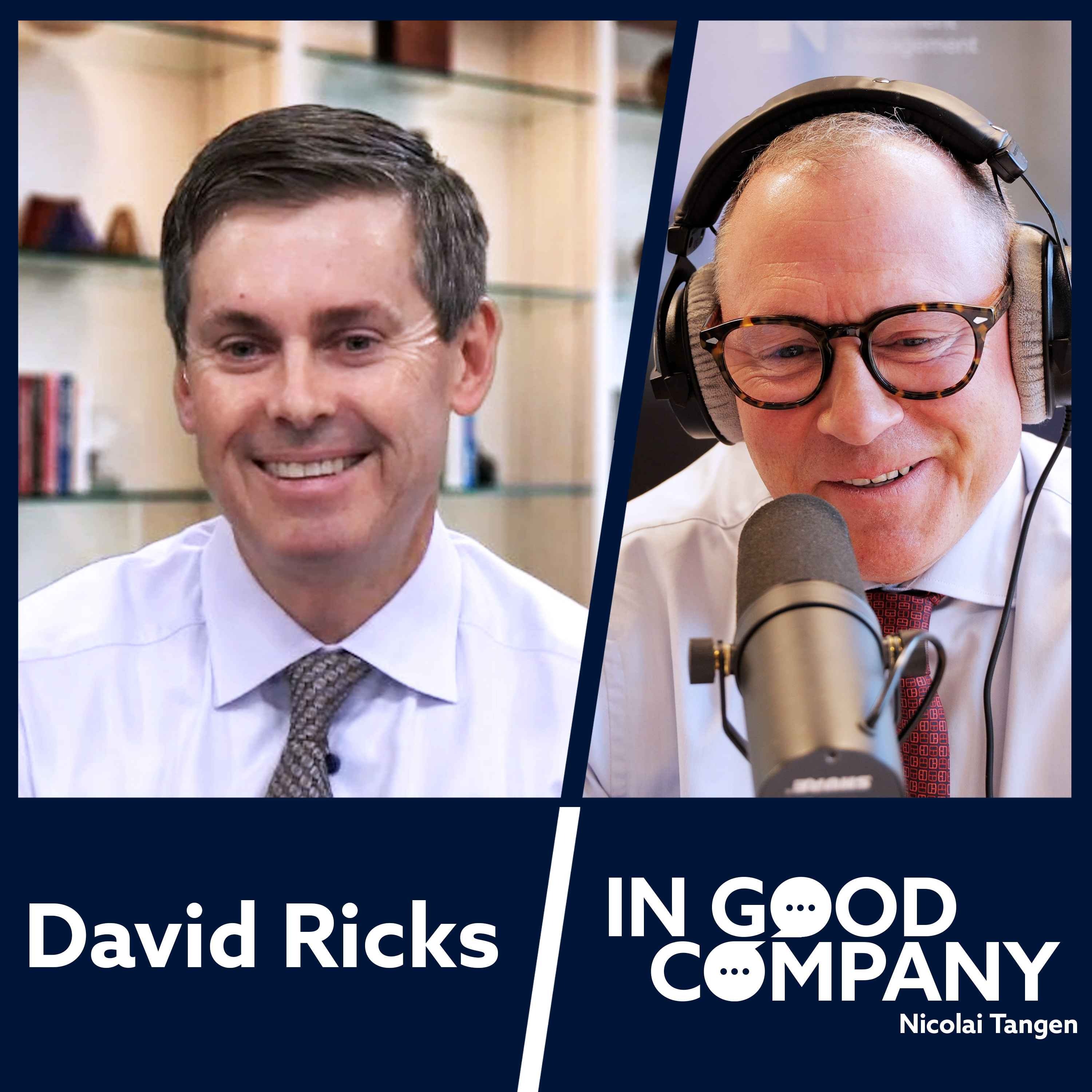
In this episode, Nicolai Tangen interviews David Ricks, CEO of Eli Lilly. The discussion centers around Eli Lilly's advancements in weight-loss medications, innovations in drug development, the impact of AI in pharmaceuticals, and the challenges the healthcare industry faces. Ricks shares insights into the company's journey, future prospects, and the evolving landscape of medicine.
Written by AI. May contain mistakes.

Get the gist, explore an idea or ask about something said.
 Claude
On In Good Company with Nicolai Tangen, what are the key points of this episode?
Searching your listeningAutomatic transcript. May contain errors.
0:01Hi, everybody. I'm Nikola Tangen, the CEO of the Norwegian Sohound Wealth Fund. And today I am in particularly good company with David Riggs, the CEO of the pharma giant Ella Lilly. Now, Ella Lilly is spearheading, as you may know, the weight-reducing drug revolution. We own more than 1 % of the company, totaling$8 billion. Big thanks for coming, Dave. Great to be with you.
0:32now um the glp1 drugs sends uh shockwaves through the world and now they seem to be curing everything from alcoholism to alzheimer's so why are these drugs so efficient yeah it's well it's certainly been an exciting time for the company, but also for medical science, because this is actually not a very new idea to stimulate GLP-1. Lily launched the first GLP-1 agonist in 2006, so almost 20 years ago. But it's, I think, a good example of how the technology in medicine works is that oftentimes we know the sort of the major theme, but making a molecule, making a medicine that behaves with properties that can achieve optimal outcomes, takes time and effort.
1:22And we're now on our, really our third generation of these drugs with trisepatide, which is a dual acting. So it's GLP plus GIP, two different gut hormones. You know, I think by making drugs that were flat and lasted a long time, and then we could dose a little higher, we've discovered that we are not just affecting blood sugar and other metabolism factors, but affecting probably the brain and the desire center. When you discovered it in 2005, 2006, it was more like a side effect, wasn't it? The weight reduction part. It was a positive side effect. In fact, the cover of our annual report in 2007 has a woman who took this medicine and she said, my diabetes is under control and I'm losing a little weight.
2:07People say I look better. So she noticed it from the beginning. It was not the design goal for that drug, exendetide. It wasn't even the design goal for the follow-on to that, which was a weekly medicine called Trulicity or Dulaglutide. It was a design goal for Trisepetide, which has these two actions for weight loss. And whether the weight loss itself has these broad effects, you mentioned dementia and Alzheimer's, and probably the effects there are more vascular, so similar to the cardiovascular benefits, probably reducing strokes and mini strokes. That needs to be proven, but those studies are getting done.
2:45Or this desire center where these hormones, our stomach, our gut secretes after we eat, tell our brain that we're full and that that is also affecting alcohol consumption, cigarette smoking, other kind of hedonic behaviors humans have. So we're also studying those things because probably in modern society, the things that harm us most are our own behaviors. So what are the other hedonic desires that it can prevent? Well, we know smoking is a very strong signal and you'll see Lily this year conduct large studies in smoking cessation, which is still a major problem, particularly in Asia. Alcohol consumption is something we immediately noticed in our studies.
3:32And if you go back and look, you do see people self-reporting pretty significant reductions in alcohol, which is also probably good for us. We're also studying street drugs. And so these are more complicated clinical studies to undertake for all kinds of reasons. They're illegal in many countries and dose control and so forth is difficult. But that, of course, is a scourge, particularly in my country, in the US, the whole opioid crisis has been terrible. The probability that works isn't as certain as something like smoking. But I think we need to give it a shot. I think that's what Lilly's for, is to take on big health problems.
4:09And obesity is a big one, but so is opioid addiction. So the blue skies are now ahead, 10 years from now. What could this drug do? Well, I think you can certainly see in our sights now. I think we have evidence from the last year that not only do you lose weight, and for most people who are overweight or obese can get to a healthy body weight on terzepatide. We have more medicines coming, by the way. We could talk about that for people with even higher body weight or to be more scalable or more convenient. But I think we can easily say that weight management will become more like a choice than an affliction.
4:46And that's good. We can also say that we've learned in the last 15 months that major categories of downstream disease of obesity are affected by weight loss induced by these drugs. That seems obvious in hindsight, but it is a key question is not do you just affect the kind of the precondition, but actually also the disease, cardiovascular risk, which has been shown, kidney disease, now liver disease, et cetera. So that's important because those diseases make up about 40 % of healthcare costs in developed economies. So that's a blue sky scenario by itself. The trick there will be scaling, right?
5:26Because right now, between Lilly and Novo Nordisk, we're maybe serving less than 20 million people on the planet. And there might be a billion people with overweight or obesity who are going to get these chronic diseases. Super question. But why are there as many as one billion obese people? Why is this increasing so much? You know, I think there's a lot of theories. It's a multifactored disease or process. But in many ways, like a lot of chronic illnesses we have today, were actually survival biases of our ancestors. And food and nutrients are obviously essential to life. So when our ancestors were running around in the ice ages and looking for food, being a hoarder of calories and preserving body weight was a survival bias in our genome.
6:18now that's actually hurting us because we live in a world of abundance. And so I think that's true around the world. And as developed economies rise and middle-income countries go to develop and so forth, food systems, food becomes more stable. It becomes more abundant. It probably is less healthy for us anyway than the foods our ancestors ate and more tasty. And it's harder to resist. So there's definitely something wrong in our food system. I don't think we should shy away from that conversation, but also abundance itself is part of the problem.
6:57I think you've said that it costs just under$3 billion and takes 10 years to discover a drug. Now, like in two minutes, how do you discover a drug? Yeah, well, maybe just a step back. What we do is we make new matter, new molecules that interfere with biology. The two classic problems in drug discovery are, do I know the target? Am I pointed at the right thing that is causing the disease? And then can I drug the target with maximum effect and minimum side effects? And that turns out, both those turn out to be very difficult things. We probably know 10, 15 % of all biology. So picking the targets is hard.
7:40And then drugging the targets is even harder. Most of the easy ones have turned into drugs already, and many of those were accidents of nature we discovered long ago and converted into commercial drugs. Creating brand new substances that behave like drugs against known targets is challenging. So there's a lot of attrition for both those reasons. Either the drug isn't good enough or the target wasn't exactly right. So we spend a lot of time and money, and there's a lot of failure. The biggest cost in drug development is failure. Most of the things we start don't actually work. But then we also need to pursue drug new medicines in a way that's safe, right?
8:18We can't market things that are unsafe. And we need to have a knowledge base that is evidence that these things work. And that takes time. And it's pretty serial. It's step by step. Do most pharma groups work the same way when it comes to drug discovery? Or have you got a secret way of doing it? In general, yes. Although, you know, in my tenure at Lilly, we've worked hard to do things a little bit differently to improve the productivity of R &D. You know, if we look at if we take out the weight loss companies of Lilly and Novo from the sector, the sector trades at like 12 times earnings. And that's really because ROI on R &D investment is close to zero.
9:02And we looked at that and we said, that's obviously not an equation. we're happy with and tried to control things we could control. It's hard to learn more about biology quickly. And it's very difficult to make new drugs just better than others. But we worked on two things. One was the time in which we take to make decisions and move. And the other is the asset allocation type discussion of how far do you spread your bets? How do you make decisions about when to quit? What kind of evidence is sufficient to keep going? And setting a high bar there for progression. So in fact, we're actually killing projects earlier than we ever did before and doing so with a higher standard and we're doing it faster.
9:47And I think - So what have you done with the time? What's the time spent now compared to when you joined? Yeah. So the industry averages, I can speak, and in 2015, when we looked at this, we were a little worse than industry average, is about 10 years in clinical development. So that's first human dose to approval in some market and about four or five years preclinically. So in total, almost 15 years of time. By the way, our patent cycle is we get a 20 year patent, but once we exhaust all that time, we end up with like 10 or 12 years in market. So this explains, I think, in large part why return on investment in our sector is so poor, because it takes you longer to develop a new thing than you get to harvest the benefit of the thing you just invented.
10:29So we sought to change that. We've cut the preclinical time roughly in half. It takes us about two and a half years to go from idea to first dose. And then about six years, last year, 5.9 years, to go from first dose to approval. So that's almost half the time of our peers, which is an enormous structural advantage we have if we can repeat it. And we think we've created a process that repeats it. What was the key to getting there? I mean, these are very big numbers. Yeah, two things. One is just good old-fashioned kind of process engineering, basically, doing everything you can in parallel. That puts some financial risk in our process.
11:06But just to give a small example, a lot of biotechs will wait till they get compelling preclinical evidence in animals their drug is working before they run production and figure out production to make doses for a first human study. And then that production scale part is on your critical path. We really don't do that anymore. We do that for everything, and then we just stop working on it if the drug isn't working in animals. So we basically pull timelines forward and do parallel processing versus serial. That's a big tool, and there's many other examples of that in the system of making new drugs.
11:42Another one is decision-making time. So we used to do an experiment and then all gather around and ask new questions and look at it and reprocess the data. and it was taking us sometimes nine weeks to six months to move from one step to another. We really don't do that anymore. Now we pre-specify what we need to see to advance, by the way, that improves decision quality. And if we hit that target, we just go the next day. If we miss the target, we pause. Sometimes we re-interrogate the data and we end up going, but most of the time it's sped up our decision-making. Is this all strictly analytical or is there an element of gut field to these decisions?
12:21There's judgment too, right? As I said, because we only know a certain amount of biology, human pattern recognition and experience is very important. On the experience side, I think Lilly does also have a structural advantage. You know, we used to get made fun of because we're based in Indianapolis and sort of far away from other drug companies. But one of the effects of that is people stay here a long time. Living in this part of the country is easy and people tend to, our average tenure for scientists at the company is over 10 years. that gives people enough time to see the process repeat itself and begin to recognize patterns versus jump to another company.
12:57I think that's helped us along the way. And then having great people like our lead scientists in the company, Dan Skrivansky and his team, who are just good at recognizing patterns and are very good at abstracting personal preferences from the process. And I think like all capital allocation, that's a key thing in your business. I'm sure you see that as well. You have to be dispassionate about ideas. And in big companies, particularly in our industry, that's been a problem. People want to work on the projects that they think the leaders like. And that ends up in pretty bad decision making. So how many like super key people would you have when it comes to picking the right projects?
13:41At the end of the day, everyone's key, but probably at the leadership level in Lilly Research Labs, there's 20 to 30 people that are making the core decisions across all therapeutic areas. How does AI help you or will help you? Yeah, it's already helping us in many ways. And I think I'm a really positive optimist about AI, not only in our sector, but in all sectors. You know, on the drug discovery side, there's a lot of hype about companies that are forming and say, we'll just turn on a computer and write some code and we'll invent new drugs. I do not think we're close to that. That wet lab validation and having really strong data sets to make predictions is critical.
14:27More likely, AI and what we're using it for now is a much more granular tool to predict individual experiments. In some cases, don't even conduct them because we don't think they're worth it. The drug won't succeed. And knocking things out earlier or enhancing experiments with synthetic data and enriching sort of how we look at those results. that's already happening now. But these are micro steps in drug development versus some sort of magic, turn on a machine and make it happen all at once. But that makes our scientists move faster and makes their laboratory experience more valuable. And I think both those things are helping us today.
15:10In the end, I'm excited about the use of generative and diffusion models to help our chemists. So chemistry is a particularly difficult part of what we do. The chemical space is vast, like 10 to the 60th. So it's more stars than are in the universe kind of possibilities. And humans are pretty constrained in our thinking. So like when you use a chat GBT or Dolly or one of these tools to make a silly image or something, and it comes up with something odd and creative. The machine does that with chemistry as well. That's not going to be a drug, but it gives our chemists new starting points that they didn't consider before.
15:52And I think that long-term is going to be very interesting for our sector. And then there's many other parts, like other industrial companies, we're already scaling AI and it's making a very large difference. One of the most important ones last year was in production optimization. So we're scaling our GLP-1s, as you know, and that's been a key constraint to growth of the company. With one small intervention we did introduced about an 8 % process efficiency and a key bottleneck in production. It allowed us to ship about 7 % or 8 % more product last year in that line. And as you know, that's worth hundreds of millions or maybe a billion dollars in revenue.
16:30So when you have implemented AI fully in all parts of the company, how much quicker will your process be? I think we could cut times in half again if we're successful. There are some things that are real constraints because like disease processes, many of the ones we study are slow and there is no replacing the watching of someone on a drug or not on a drug. Take like Alzheimer's disease. This is a seven-year process from diagnosis to death and we need to study a meaningful part of that to prove a medicine is working. There's no getting around that human disease process. But many of the other things that lead up to that final study, we could potentially do much quicker.
17:11And I'd be excited to see that happen. How much easier is the whole process to do in the US compared to Europe? Drug discovery and development? Yeah. It's not that different, actually, between the two markets. We have huge operations in Europe, as we do in the U.S. Those are our two centers for both production and science, clinical trials as well as discovery, probably more discovery in the U.S. and proportionally more clinical trials in Europe. The thing that's different is the market side. So the adoption of technology in Europe is super slow and in the U.S. is quite a bit faster. And that's a problem for us in terms of our interest in the European continent because we are on the clock with our patent life.
17:57And if a meaningful part of that is absorbed with the government processes to get a drug approved and get it on formularies in countries and then go through procedures at the hospital level to get it used. It's really a waste for us, but also for patients who can't access the medicine. So from you start a project until you start to sell the drug, what's the time difference between Europe and the US? Well, everything's the same up until submission. we typically submit in the U.S. first and then within a few weeks into Europe. It's normal for us to have approval in Europe three to four months after.
18:34This is in the EU after the U.S. And then a way to think about it is what's your average time to real patient access on the ground? And in Europe, that's a little over two years post-approval. So it's the four months plus 24 more months. So here we're almost out to two and a half years later. And that's painful because it's slow, but it's worse even than that because what that means is you have two and a half years less out of 10 to 12 years to commercialize your product. So it's really a drag on value creation for us and the healthcare system. We think the medicines we make are valuable for the healthcare system and patients.
19:12It's a tax on that as well. Is Europe doing anything to rectify the situation? There's discussions about it. We've had a lot of dialogue in the European Parliament about the access differences between the 27 member states. And most of what's come out of that are sticks, not carrots. We'd like to see incentives for countries to move faster. And even an idea that why don't we presume coverage and then eliminate drugs that are less valuable through the process and red tape versus the other way around. Right now, most European countries presume no value for new drugs and then go through process to see if there's any value.
19:50And I think that's the fundamental issue. Plus, it's a national competence running your healthcare system, and there's national differences that are difficult to work through. I wish I was an optimist about reducing European bureaucracy. I'm not. What about China? What's the situation in China? The reverse, frankly. So I used to run our Chinese business about 15 years ago. And at that time, the drug lag between the US and China, that's what we would call that patient access. So if it's two and a half years for Europe, at the time it was seven years for China. So medicines we were launching had been launched seven years ago in the US.
20:27Right now that lag is coming down to less than 12 months. So already China has leapfrogged over Europe in the drug lag. And their goal is to be the first place we launch things in the world. So they're ambitious as they can be. Um, their regulatory system has improved dramatically and almost harmonized with, um, the major other regulators like, uh, EMA in Europe, FDA in Japan, in terms of standards and review times. It's still a little slower on market access. It's a calendarized process. So if you launch on January 5th, um, you actually cannot get on the formularies until January of the next year.
21:05So that's a problem. If you launch on December 5th, you get, you can get on in a few months. So we'd like to see that changed. But they've made a lot of strides in kind of modernizing their health system. And what about the drug discovery coming out of China? Yeah, it's tremendous. Those are both collaborators and competitors for all major companies. And I pay keen attention to those developments. There are some scaled biotech companies there, many of which we are partnered with in China and outside of it. There are emerging small biotech clusters there, mostly working on known targets. So if you go back to what I said, what are the two problems in drug development?
21:45What's the right target? And then can I make a good medicine that only hits that target? They're mostly working on that second problem. And I think that leads to more me better, me too kind of drugs. And that's probably part of any country building an innovative ecosystem. Eventually, they're going to have to work on discovering new targets, which mostly happens in the West now. But, you know, I bet they'll be a leader in that, too. They have tremendous scientific capabilities.
22:19Now, you have a business background, right? Yeah. What do you think you do differently compared to if you had a pharma background? Well, I think the people say background. I mean, I spent four years in undergrads studying engineering business and then two years getting an MBA, but I've spent 28 years working in a pharma company. So I probably know a lot more about the pharmaceutical industry in all parts than I would about a general business thing just because I studied it in school. I'm a big believer in continuous learning, and I spent a lot of time on that myself. And I think curiosity is a fun fundamental leadership traits because it allows you to grow, but it also is infectious.
23:03People who work with me, I think, notice what I spend time learning and they want to learn, and that becomes part of the culture of the company. And I think a company at scale that can learn faster than others is going to be a better company. So there's a trickle down to that. And plus, I love learning. So I often, I think, surprise people when I'm sitting in scientific meetings asking detailed questions. I read ahead. I don't know. I don't have a fundamental biology basis, but I learn a lot about a few things that are highly relevant to our business scientifically. And I enjoy that. And I think that's helped us perform better.
23:37How do you permeate that culture of learning into the organization? I think, you know, like a lot of things at scale, it's a little bit of everything. But one of the things I've noticed in my career, whether it be leading a business, like our operation in China or even a smaller group earlier in my career as the CEO, is we can do a lot of things intentionally, but those aren't always the things that make the biggest difference. I think people pay attention in two other things. What are your daily habits? And the culture is not what's on the slide or the words in the lobby. It's what people do.
24:18And people notice what leaders do. And they particularly notice what leaders do when they're under pressure. When things are going wrong, what do you do? And so I think having that curious mindset, as Satya Nadella, my friend says, is a learn-it-all versus know-it-all kind of culture is one of those indirect things that flows through the company. And I think it also makes work joyful to me. So, you know, that that's something that we embodied here at Lilly and probably have well before I got here, but but have continued. So what does David Ricks do when he's under pressure? I drive speed. You've talked about that here.
25:02I mean, I think getting all the facts on the table are important, but then acting with some urgency is important. And no choice is a choice. And I think moving is important. I think it's important also to hear, I really value the direct knowledge. And so quite often people who work with me get frustrated because I'll ask to talk to the people actually doing the thing at the most basic level. and um often those people are they're very specific on their tasks but i kind of i really want to know what's happening and why and then you know i think it's important to get an outside perspective before you move forward and often i'll spend time i think particularly for ceos we have access to a lot of outside voices um and i spend a lot of time on that um but you know there's downsides to those things talking about outside voices you mentioned satya nadella uh who has been on the podcast and we recommend you to listen to that.
26:04But another one is the CEO of Adobe, where you are on the board. Yeah, yeah. Chanteneau to Ryan. He's a good friend of mine. And one of the reasons I joined that board is I have so much respect for him. And when I was a new CEO, just in joining another company board, one of the most important things to me was learning in the boardroom, especially, but even outside of that from a veteran. And Chanteneau had been in that seat for about nine years at the time. And one of the things, it's interesting, you know, in the US model, we have more of a chair-CEO combo roles, but I was much more equipped to be a CEO than a chair when I got that job.
26:41And I really had never run a board or spent much time in one. And he really helped me with that in a lot of ways. What are the other things you've learned from Adobe, which you have implemented? Tech cadence and the way tech drives business value through continuous improvement. Our industry is more about these tidal wave improvements, these big step functions. We talked about GLP-1, which is obviously a mega kind of innovation wave in the pharmaceutical sector. Tech has those too, like we've seen recently with AI, but they also are very good at grinding out lots of incremental wins and doing it at a cadence that is measured in months and weeks, not years.
27:21And I think that's something pharma could really learn from. And sometimes incremental improvements create a lot of value. And we don't set ourselves up. Our wheel is turning on that 10 to 14 year clock we talked about earlier, not on the six month. So we've tried to do some of those things, both with the product itself that you buy at the pharmacy, but also some of the old other tangential products. A good example of that is the service you get from procuring our medicine. We've stood up in the U.S. and now four other markets, a direct pharmacy model. So we're selling directly to consumers. And why are we doing that?
27:59Because that's actually people attribute that experience to the medicine as well. So we can innovate in a different way because it's not a medicine, a physical thing. It's a digital product. And I think that's helping change our company in important ways. I mean, that's an idea that came to us through some of the work with the tech partners. What are the other ways you can get higher tech cadence into a large company? Well, I think being more tech enabled to begin with, right? So, you know, one of the things about tech companies is that because they don't have a physical product, they're changing bits, not atoms.
28:32They can move at a different speed because that's how software works. the more software enabled our systems are actually the faster we can make changes versus hardware enabled. So I think that's a key insight. And, you know, I think examples of that could be like in our production systems. About 10 years ago, we started moving to a much more digitally controlled and kind of more multimodal control of our production systems versus fixed kind of operations. So we can make changes to input parts, to process design, to regulatory requirements through software now, not by actually reconfiguring physically lines.
29:15I think that's an important type of example of that. Or if, let's just say we get to 50 % of our preclinical laboratory experiments are predictive in silico, not wet lab, we can make those moves much more quickly as well. So they have a built-in advantage because they work in the world of atoms, not bits, or bits, not atoms. The more we get to bits, the better. That said, a business based on atoms has a bigger moat, right? Because your competitors also have those same sticky, difficult problems to make physical products, to scale them, to make them work in the physical world. We're not abandoning that.
29:52That's actually our core strategic advantage. But I think combining the two could be super powerful. And then there's a cultural piece about expectations that comes from software, which is this incredible sense of urgency because you can just get displaced at any moment. And I think sometimes pharma companies get a little complacent because it's hard to displace what we do.
30:16moving on to um pricing what is the most difficult ethical dilemma you are facing when it comes to affordability versus profits yeah i think we have many ethical dilemmas in our business because health is so personal and there is an ethos around universal health care this is a core one There are others too, I would say, but what is a fair return for an innovator? And I think there's brackets on that. One perspective, which had been pursued by the industry we don't pursue, is that it's what the market will bear. I think that probably steps across ethical lines for many actors in the health system.
31:02And we actually don't pursue pricing that way. but you can imagine desperate people who are need a medicine to survive. You can get into price points that are really exorbitant and maybe make a short-term return, but you'll probably be either legislated or sued out of business if you pursue that forever. You know, there's on the other spectrum, there's a marginal cost plus take all your input costs, including research, and we'll add something to it. But I think that the risks that fails to account for the risks in our business, which are very significant compared to other established businesses, and the return on that risk, as you would know, needs to be substantial because things can go wrong.
31:50They don't go wrong quickly. So the problem we have in explaining that, Nikolai, is it just seems like everything's okay tomorrow and the next day and the next day. They go wrong slowly and then all of a sudden, and that's the patent cycle problem we've faced, right? So once a drug has been proven and is widely distributed and is helping millions of people, that's when those arguments come in of, oh, cost plus. But we wouldn't have had the thing to begin with because no one would have undertaken the risks to invent it. We pursue more of a value approach. What is the displacement of other costs in the healthcare system?
32:27Certainly we deserve credit for that. And then what is the value creation beyond that that can occur. For instance, with our weight loss drugs, there's emerging evidence that absenteeism drops in the workplace when people are on them. Maybe that's because reduced alcohol consumptions or other health factors. There's indirect things like joint and knee pain drops. So hip replacements and knee replacements are slowing in populations using our drugs. Well, we probably should get some credit for that as well. So our idea is that we capture some, not all of the direct and indirect value we create during the patent period.
33:04And then we remind policymakers that one of the great gifts of our industry is that everything we pursue, everything we invent goes to zero for us and goes to infinity for society because generic drugs are such a great deal for healthcare systems. We invented Prozac 40 years ago. It's a standard of care globally for treating major depressive disorder. it costs in major markets about four or five cents a day. It's virtually free. And I think that's a tremendous gift to society. We don't want credit for that directly, but we, I think, deserve more credit on patent because of that. So now you and I, we come out of the lab, we've discovered GLP-1.
33:42We're pretty pleased, right? And we realize that this is going to lead to less people being away from the jobs, less alcoholism, all that kind of thing. Now, who's around the table when we decide how to price it? I mean, it's an evolutionary process, but we begin with the outside in. We talk to health systems directly and understand how they think about it. We look at our data sets. So around the table before we walk out of the labs is, well, what could this medicine do and how do we, in a full way, try to capture analytically those benefits? And sometimes we do a good job of predicting those things.
34:19In the case of GLP-1s or incretins, we've not done a great job because we undershot, I think, the broad benefits of these medicines. So then we look at real-world evidence and work backwards. There was an important study we were part of at the Veterans Administration in the U.S. that came out two weeks ago that looked at all these non-metabolic factors and showed benefits for schizophrenia, for major depressive disorder, for alcoholism, et cetera. And so then we quantify that. And then we ask ourselves, what's a fair share of the value we've created? Some of these values are quite certain. Some of them are probabilistic.
34:54And so we make estimates about that and we try to form a price perspective that way. So financial people are there, scientific people are there, and people who talk to customers are there. talking about people being away from from work so we take more medicine than before we are in a way more healthy than before but yet um sickness leave is just going up right in this country it's i think we are hitting seven percent why why is sickness leave going up when we are becoming healthier well i i don't have a clear answer for that i think in when you're talking about your country Norway. Is that what you're talking about?
35:33The 7 %? Yeah. In the U.S., it rose a lot during COVID. It seems to be coming down a little bit now. But one thing a lot of experts point to is mental health. So while we are better at addressing physical health than ever before, life expectancy in most countries is rising. The U.S. is an exception. We can talk about that if you'd like, even with the background rising obesity rates. So I think if we took obesity out of that, They'd be rising even faster because cardiovascular risk will certainly be reduced dramatically when we can use these medicines at scale. But people are spending more time alone.
36:08They're spending more time in front of screens. We probably are not a healthier species for being alone and in front of screens. And particularly in young people, we have to worry, I think, a lot about this trend. And even in the workplace, we're alone and in front of screens more. And I think that's a problem. And we could talk about the back to work kind of vibe that's going on in the world now. But I think one of the main reasons to do that is to have a mentally healthy workforce.
36:43How would you describe the corporate culture at El Alili? Yeah, we talked about curiosity. I think that's a core hallmark and as a scientifically driven organization has been in our ethos for a long time. And I think it is an interesting place because we have also a very high rigor standard on technical matters. but most people who come to work here from other companies describe us as very humanistic as well both in thinking about the products we make which of course are in health care and that's a very human experience but also with each other i people talk about lily nice you know and i think we're a very um we have a very high standard for being cordial and respectful so how would i so how would i how would i see that so now i'm come to visit you and i walk around in the corridors What's the kind of, what's the feel?
37:34Well, you might jump into a meeting room and see people vigorously debating data sets or statistical analysis methods on something or manufacturing output numbers or a financial goal. And at the same time, not raising their voices. And in the weekends, you know, going to a football match for their kids next to each other because we're in a small city. So there's a lot of cordiality. That's not perfect. Those things, to me, make for a great place to work. And I think it compels one important advantage I should talk about, which is teamwork. So I think as companies scale, one of the most difficult things to fight is bureaucracy.
38:15And what is that at its core? It's the building up of systems and processes that get in the way of the work when they were designed to do the work. And here, I think we have a good way to cut through that, which is relationships. both with the longevity and tenure of our employees and this feeling of it's okay to talk to anybody. You know, on my way to this interview, seven or eight people talked to me in the cafeteria when I picked up my cup of coffee and just asked how my day was going, asked about a business matter, et cetera. This isn't a place where the CEO is like a scary person you don't speak to, and neither is anyone else.
38:49And I talk to people like, what are you working on? And how is that interesting. It's good that way. But one of the things that that sort of sense of respect and openness can have is sometimes it can just be a surface thing. And that sometimes conflict can be important to produce new insights and results. And that's something in my tenure we've tried to introduce in a structured way is like, can we have conflict? And we do it through little gimmicks, like appointing devil advocates in meetings and having like one of our most important decisions, Nikolai, is when we decide to go from phase two, the middle phase of development to phase three.
39:29When we do that, you mentioned the$3 billion, two thirds of that cost is the last step. So when we go, we better succeed. And we actually have a structured process where you assign a team to be a contrarian, to basically defeat every argument the proponents are making to advance. And they write it down. And so decision makers, we force ourselves to read that and consider the alternate point of view. But those are newer things to us. And I think in the past, we've been, I think, too nice to each other and made mistakes, and it's made us less productive. So we try to combat those cultural things.
40:03What's the key to fighting bureaucracy? I think I mentioned one. I think relationships and getting down to making the org chart and the process work for you, not against you. And the way it can work against you is people only go to those things, right? In a way, it should be the backup to organic problem solving and self-organization. One of my habits is when people escalate to me, which they do less and less over the years, is I ask them what they've done already to solve the problem with their peer. and often people don't have a good answer to that and i think in big companies leaders like to problem solve it's probably how we got our jobs right is we were the best one at fixing things and in a way leadership it can be an amorphous and kind of challenging space to sit in and i find i'm a problem solver i i kind of when people come to me like oh this isn't working how do we fix it I feel myself instinctively wanting to help them.
41:08But in a way, that creates bureaucracy. If things only get solved when they go up, that's a kind of definition of hierarchical bureaucracy. So we have to fight against our own impulses. And the fact that bureaucratic companies, often the most satisfied person is the leader of it, not the people in it. And I think it should be the reverse. I think leaders should be sort of worried about the chaos and the less, the organic nature of how things are working, maybe satisfied with the results, but a little concerned they don't see and know everything. I think that would be a better state for me than in the company, than knowing everything and solving every problem.
41:50That surely will sub-optimize, Louis. Are you a better leader now than when you were younger? Oh yeah, for sure. In what way are you still young and all that? But I mean, in what ways? Yeah, I feel young, but my kids point out I'm not young. But I think probably there's two steps in my career that I'm sure many people at the top organizations have come up against that were really like aha moments. The first one is when you move from a version of what I just spoke about, being sort of running a team, being a manager, we all get to that, but then you're running the management in a way where you're the hub and those, the people are the spokes.
42:33And then you get to a job where the scale of it no longer supports that, where basically you realize your job is actually to help people. Sometimes the managers underneath you, sometimes the people on the front line actually do the work and create an environment where they can be more successful. And you need to focus on clarity of what the goals are, not getting to the goals themselves, on staffing the team with people who can function at a high level together, not correcting their individual behaviors. So to me, that happened in my first general manager assignment. I was running Canada, which is a midsize market for us.
43:12And for the first year, I tried to solve every problem myself. We missed our goals. Most of my team was very frustrated with me and I was frustrated with me. And I had a moment with one of my reports, the person running the sales group for me. And we both were doing our end of year review and we agreed neither of us were successful. And that was like an epiphany for me. It's like, I need to make fundamental changes. The second one was when I got to the job before this, I was running a big part of Lily and I realized that a lot of the value creation at senior management is outside the company, is really understanding where your organization fits in the world and helping the company refine its effort against that.
43:58I think inside, people want to do a lot of things because they think they're good, but actually the world only values a few things that you do. And of course, we have to do many activities to produce those few things, but lining up kind of your wood behind one arrowhead is like a key act of strategic choice, but is really only possible when you're in a senior position. And you need to spend more time on that than you think. And it's frustrating because you have to sift through a lot of conversations that don't matter to get to that. But you can form an opinion about that and make a big difference if you can really see how you can win and produce value for customers and society by focusing.
44:43And I think that's something else I've tried to take into this job. Many of the things you talked about involves speed and kind of time schedules and so on. Is speed a mindset? Yeah, for sure. And how do you work on it? Well, it's a mindset for leadership. And I think one of the things I embraced and talked to my team about is of the things that we can affect as management in a complicated business like ours, multidisciplinary, decade long development cycles, highly regulated, et cetera, et cetera, et cetera. The speed at which we choose to move is a choice of management. It's what objectives we set, the culture we create, our decision tolerance for perfection.
45:35So we can make choices without perfection. Those are all three levers we can pull and go a little bit faster. And in many ways, companies that are seen as slow, I would say the first place we should look is at the leadership of the company. Um, so to me, it's, it's a, it's a lever you can pull to create value that almost always works and is mostly a function of management. Changing things too fast can be a danger. Um, it's, we talked about drug development earlier and we, we undertook a four or five year change management process. So we didn't break things as we sped up that we did them. We, we, we changed our business process to develop drugs in a methodical way.
46:20but with a goal on speed. And importantly, when we did it, we really focused the teams because people can say, okay, we did have a goal at the start to cut drug development time in half. And when we first announced that, the Lilly teams looked at that and said, you guys are crazy. We're gonna hurt people. We're gonna offend regulators. We may never produce a new drug again. This will break things. But interestingly, what actually changed, I think it is important to have those so-called hairy and audacious goals to really, because if you start with a 10 % goal, you get to eight or something. So I think if we really were going to get there, we needed something long-term.
46:59But the incremental change philosophy we adopted was basically to beat the last time, even if it was just by 1%. So an example is like, it used to take us about half a year from when we got a phase three result to submit to the first regulator. And the last time we set a record, which was last year on ZepBound for obesity, it was measured in days. So we compressed that process by 80 plus percent. But we did not do it by saying cut 80 percent of the process. We did it over the course of four or five years by saying the new goal for the company is the fastest that the last team moved. And so if it was 180 days, if they did in 120, that was the new goal for everyone.
47:48And then people wanted to beat it because they wanted to be the best. And it created this positive kind of always getting better continuous improvement mindset that I think was super helpful in driving change at scale in time. Very interesting. Quick question. You mentioned you in the beginning being a better CEO than chair. Now, you may know we advocate that the chair and the CEO should not be the same person. Why do you think we are wrong on that? I think, look, I think there are successful models, successful companies with both models. I don't prejudge a structure. And some of it could be contextual, industry, and person-specific, actually.
48:31I know some CEOs who probably shouldn't be chairs and some CEOs who should be chairs and not CEOs. I believe in our sector, because our time horizon is so long, there are benefits in uniting the role. I think the pure, you know, the word chief executive officer on execution is an important role. But marrying that to the long term agenda is particularly important. It can work and does work in many companies. We have many European peers where they have the role divided. and I know there's a very tight linkage between the chair and the CEO so that the execution agenda is aligned to the long-term agenda.
49:11But as you know well from investing in many companies, probably on the list of mistakes CEO chairs or CEOs can make is sacrificing the short-term for the long-term. And I think that's particularly true in a science-driven R &D intensive industry like ours. We're allocating resources this year. We'll later this week announce our guidance on R &D spend. And we're solving for 2035 to 2040. So I could easily drive earnings in a very differentiated way by reducing R &D spend over the long term. And in that period, it's well beyond my tenure at the company. I won't be here in that period of time. But here, I think uniting those things helps solve that a little better.
49:55It saves a little bit of time and agenda planning with the board. And the downside is you can end up with too much power in one role and you need compensating structures for that. Strong other executive team members and a lead independent director who has real sway in the boardroom. We have those things.
50:17A few personal questions at the end. When do you wake up in the morning? Usually between 5.30 and 6. Yeah. Depending on my time zone, but at home. Yeah. What do you do then? I typically do exercise for 30 minutes. I try to mix that up between getting my heart rate up or just resistance. And increasingly, I've added a lot of flexibility. So I started doing yoga twice a week because I'm getting older. And I like to move. Most all my hobbies involve being outside and moving. So it'll be a sad day when I can't do that. I know that'll come someday, but I'm trying to prolong that as long as possible.
50:54It also clears my mind and wakes me up a bit. Then I have a cup of coffee and I read four papers. And apart from papers, what do you read? I read scientific journals, as we talked about. I get typically, I'm a believer in what you'd call T-style leadership, so sort of running the horizontal of your company. But usually, one topic a quarter, I try to go pretty deep on, like go down to the bare metal. And so at the moment, I'm trying to learn a little bit more about some particular AI features. And so I was reading and playing around with some of the models that are out there that can affect our industry.
51:37And I'll read about that in the morning if I have time before going to work. Lately, I've been reading more papers because there's a lot of news that seems to be happening every night. So I'm trying to stay on top of that. But I will take time to read about a topic of interest to me. Do you read fiction? Only on vacation. I enjoy reading for pleasure, but I find myself tired of reading by the time I get home at the end of the evening. I mostly consume words for a living and verbally and in writing, and it's fatiguing. So I'll tend to spend time with my wife. I go to bed early. Sometimes I'll do a little pre-work for the next day.
52:16and music yeah love all kinds of music i have a eclectic playlist um i grew up as a percussionist playing drums in my my youth and i enjoyed jazz at the time so i i like that when i'm actually and that's a type of music i can listen to when i'm working it doesn't seem to distract me as much and i enjoy popular music and other forms that's something i share with my kids we have a running family playlist that people curate and you can listen to at any time if you want the latest thoughts from the family. So that's a fun way we stay connected. Our kids are out of the house and it's a way we can stay in touch with each other's preferences.
52:56That's cool. And last question, what is your advice to young people? Yeah, I think two things I would say. One is kids grew up today and I've watched my kids grow up and impulses as a parent with a lot of resources are to control a lot of things. And I think if I compare that to how I grew up, which was very random. I mean, I think I had a lot of latitude and free time. I had my first job at the age of like 11. I was like a paper boy and I ran a business cutting grass. And most days my parents had no idea where I was until like dinner time. And I see just so much structure for our children now.
53:39And I worry for them as adults. And when they come to the workplace, I see this pattern of like, let me plan out like what I'm supposed to be doing. And I encourage young people to be open to opportunity and open to surprise. And quick side story, but like, you know, I'm at Lilly 29 years almost now, and I joined the company for only one reason, because my wife was studying medicine at Indiana University and I needed a job in Indiana. I did not come here to be the CEO or even come to the pharmaceutical industry. I just fell in love with it when I got here and I found I was good at certain parts of it.
54:18And I think I've done okay and really enjoyed my career. And I think if we're so scripted about things, those things will never happen. So that's one thing. And the second is actually about the in-person part, is take time to have lunch with different people and learn about everything we do. I think education and knowledge is expanding at an exponential rate, and we're creating more experts through schooling, but fewer generalists. And I find joy in the generalist part, in the connecting the dots between disciplines. and I think it's important for people to just in a company where we have engineers and business people and chemists and biologists there's so much verticality to that it's important to connect the parts well these are great pieces of advice I would argue you've done way better than okay you've been a huge success thank you wow your company has produced some incredible things and well done for staying in Indiana that was for sure the right choice to make but big thanks for joining us and please keep up the good work thank you so much great to be with you today
Nicolai Tangen meets with David Ricks, CEO of Eli Lilly, for a discussion about the pharmaceutical giant's remarkable journey. At the forefront is Eli Lilly's breakthrough work with weight reduction drugs, which are showing promise far beyond their original purpose - from treating addiction to potentially impacting Alzheimer's. Ricks reveals how the company has revolutionized drug development by cutting traditional timelines in half, how it navigates global market challenges, and how it approaches drug pricing and innovation. A must-listen for anyone curious about the future of medicine!
In Good Company is hosted by Nicolai Tangen, CEO of Norges Bank Investment Management. New full episodes every Wednesday, and don't miss our Highlight episodes every Friday.
The production team for this episode includes Isabelle Karlsson and PLAN-B's Niklas Figenschau Johansen, Sebastian Langvik-Hansen and Pål Huuse. Background research was conducted by Kristian Haga.
Hosted on Acast. See acast.com/privacy for more information.


