
 Ask ChatGPT


 In Good Company with Nicolai Tangen
21 Oct 2026 · 43m · 23 chapters
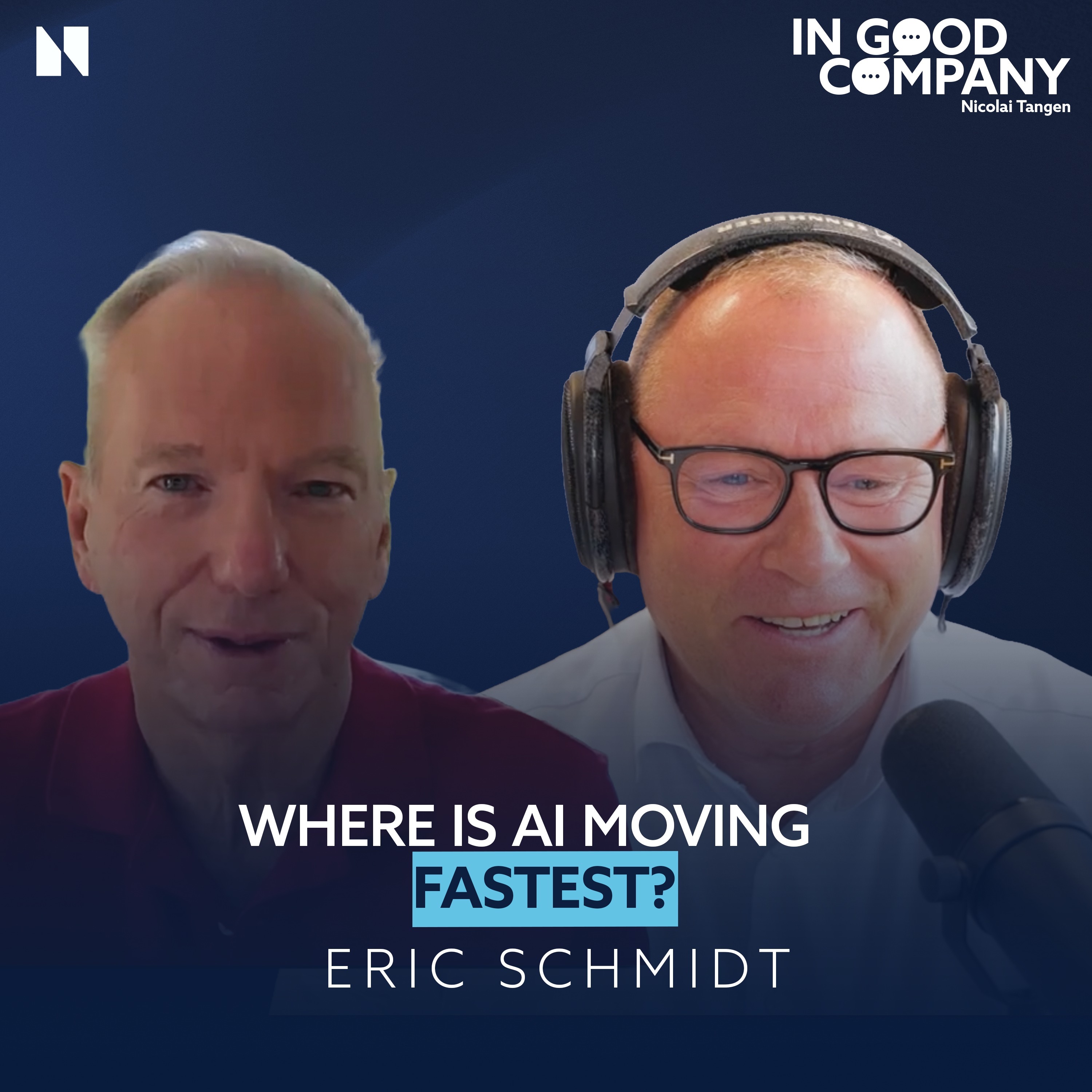
Eric Schmidt argues AI “agents” and rapid compute scaling will drive a new wave of intelligence, with major implications for business, science, alignment/safety, democracy, and especially Europe’s regulatory and innovation lag.
Eric Schmidt, former Google CEO (2001–2011), long-time tech executive and AI adviser to governments; Nikolaj Tangen, CEO of the Norwegian Government Pension Fund Global (interviewer).
Regulators in Europe constrain innovation more than the US (Brussels AI strategy vs US “run fast…fix immediately” approach). AI cycles now move in months, not years; models cost hundreds of millions and become obsolete quickly. Agents will flatten organizations and speed decision-making, but companies must change culture to adopt them. AGI/discovery of new science may be ~5–10 years away; current limits resemble an “event horizon” beyond known facts. Biggest risk is misalignment and a ruinous China–West competition; treaties may require an “accident” (a “mini-Chernobyl”). Democracy is threatened by AI+social media misinformation.
Brussels AI strategy restrictions; Claude “Tags” in Slack monitoring; founders using AI assistants to audit values and accelerate execution; “10 major math problems” solved recently; aviation/electricity safety analogy; bot attacks as a warning; China “distillation” and free product strategy; Europe lacking its own foundation model; data-center energy concerns and “cattle-killing” misinformation.
Written by AI. May contain mistakes.
Explore contrasting regulatory strategies for AI in Europe and the U.S.
“The regulators regulate before they innovate.”
Learn about the major transformations in technology over the decades.
“And let me just tell you, what you have done in Norway and for Norway is extraordinary.”
Discover how AI is creating vast opportunities and changing the landscape.
“And the reason it's vast is that these are platforms.”
Understand the fierce competition among tech giants in AI advancements.
“You're old enough to remember the PC versus Mac fights, right?”
Examine how technology cycles are compressing and the implications for companies.
“You know, everyone says, oh, it's a bubble.”
Learn how AI is transforming decision-making processes in businesses.
“And if you look today, the hyper competition is at the moment, and this moves around, between Anthropic and OpenAI because of deep reasoning.”
Understand the significance of recent AI breakthroughs in mathematics.
“More literally more profitable if you will more scalable as a result of this technology And that's just the base case.”
Discuss the current state and future possibilities of achieving AGI.
“When given what you said, how close are we now to AGI, the artificial general intelligence?”
Explore the concept of agents in AI and their potential applications.
“There are a couple of proposed techniques for this.”
Investigate why companies struggle to adapt to AI and technology changes.
“It's somewhere between, my estimate is five to 10 years.”
Learn how technology is reshaping productivity dynamics in business environments.
“Wouldn't you like to have a phone call or the equivalent of a phone call if someone was exfiltrating data because they're going to a competitor?”
Explore the reasons behind Europe's resistance to technological change and innovation.
“In a democracy, if you're not growing, new needs arise.”
Understand the potential risks of a competitive divide between China and the West.
“How do you keep the computers doing what humans want and not on their own?”
Discuss the need for regulatory measures in the rapidly evolving tech landscape.
“And the industry is now thinking about how to prevent that kind of escape out of the cage, if you will.”
Delve into the implications of free AI models from China competing in the global market.
“When do you think the Chinese models will overtake the American ones?”
Explore the challenges and opportunities for Europe in the AI sector.
“which is easy to do, why don't we simply say they're still learning, right?”
Discuss the impact of AI and misinformation on democracy and public trust.
“The venture industry is too small in Europe.”
Understand the unique influence of founders in technology companies and their return.
“Classic liberalism, as you know, is personal freedom, freedom of regulation, and capitalism.”
Learn about the evolving traits and pressures facing modern leaders in tech.
“But as a professional CEO, I did not have the power that the founders of the companies I worked in did.”
Hear personal insights on leadership failures and the drive for improvement.
“You've been, you've been, you've been prisoned in Europe.”
Eric Schmidt discusses his passion for building organizations and driving innovation.
“I'm a big time helicopter airplane pilot, and I started racing cars just for fun.”
Schmidt shares insights on how young people can harness technology for personal and professional growth.
“The opportunity to use non-human intelligence to solve the problems of the world, of which there's a very long list, is right in front of us.”
Exploration of superintelligence and its transformative capabilities.
“Many people believe that in the next few years, we're going to build superintelligence in key categories.”

Get the gist, explore an idea or ask about something said.
 Claude
On In Good Company with Nicolai Tangen, what are the key points of this episode?
Searching your listeningAutomatic transcript. May contain errors.
0:00The regulators regulate before they innovate. My favorite example is that five years ago, Brussels wrote their AI strategy. I helped write the one for the U.S. And the U.S. one said, run as fast as you can, align it with human values, and if bad things happen, fix them immediately. The Europeans wrote, you can't do this, you can't do this, you can't do this, you can't do this. And you can't run startups in a limited market where there's a lot of rules like that.
0:37Hi everyone, I'm Nikolaj Tangen, the CEO of the Norwegian Southern Wealth Fund, and today I'm joined by Eric Schmidt, one of the most influential technology executives of our time. Eric was CEO of Google from 2001 to 2011, and has since become one of the leading voices on AI, advising governments, writing books, and arguing that AI will change the world more than most of us expect. Erik, great to have you here. I'm so glad to be here. And let me just tell you, what you have done in Norway and for Norway is extraordinary. But it's just the beginning. Well, that depends on where AI is going. So you've been at the center of the technology world now for three decades.
1:19Where are we now in the story of technology? It feels like five decades. I'm getting older. My industry goes through a series of transformations. I started off in the IBM mainframe era and through the PC era, then the internet area, then the social media era, and now AI. And each of these transformations is vast. And the reason it's vast is that these are platforms. and so what you want to do if you're in my situation is you want to watch for something where the whole ocean is rising and that there are enormous number of new opportunities appearing and what and you want to figure out why the ocean is rising now in our case it's rising because a few years ago there were some fundamental discoveries in how technology could work but it's also rising because of what we call scale compute literally the physicists making the chips faster moving down to two nanometer chips, which are largely made in Taiwan, incredible improvements in memory.
2:25The supercomputers that are being built, these data centers, are hard to describe how powerful they are, how much is going on. It defies logic. It's like the scale of the universe. It's too big for humans to understand. How big is this change compared to what you've seen before? Each of the waves is materially larger. This one, because it touches everything, It's the rise of intelligence is the biggest yet. And one thing to look at is look at how brutal the competition to be the leader is. So let's go back. You're old enough to remember the PC versus Mac fights, right? Which was largely purchased by Microsoft, won by Microsoft.
3:06That was a battle which I thought was impossible, impossibly difficult. It drove prices down. It was monopolist. It was brutalist, so forth. Then we had Android versus the iPhone, right? Which I thought was even more brutal and even bigger, even larger. Well, this one is even larger than that one. When did you first realize that this was off the chart bigger than everything else you've seen? I'm always not first. I wait to see where the slope is. And we get all sorts of data in the things that I do to see that this is not a bubble. You know, everyone says, oh, it's a bubble. They're wasting their money.
3:47If you look at Anthropics revenue growth, when I was CEO at Google, we set the revenue growth record. They smashed it more than twice the speed as we did, right? That's real growth. It's not fake. It's real money with real customers who are paying for something useful in their eyes, right? And one way to understand tech is that time compresses every cycle. So 30 years ago, I had lots and lots of time to build products, to think about it, to give talks, to make mistakes, and so forth. Now there's no time. The models, for example, take roughly six months to build, two months or so to actually test, and they're released and they're antiquated within five months.
4:36The models themselves cost hundreds of millions of dollars to make. Some estimates are much higher. I'm using conservative numbers. Can you imagine being in a business where you get six months to build something and then it expires in less time than you built it because the next thing is coming along? And if you look today, the hyper competition is at the moment, and this moves around, between Anthropic and OpenAI because of deep reasoning. I was with my friends at Google, and they said, just wait. When Gemini 4 comes out, it's going to beat them all. And I bet you that if we go to Meta, they'll say, just wait until the next one.
5:15And the timing is measured in months, not years. I don't know. The next cycle will drive people insane because it'll be days. It's fun to be alive, huh? It's a great thing. Can I just say one thing for your audience? we're living in a piece of history that people will write about for a thousand years it's the development of non-human intelligence a kind of intelligence that we hope to have under control we hope to use it for good we hope to represent western values uh european values american values what have you but this is history absolutely what part of the ai revolution you say is under hyped right?
5:58What is it that people don't understand? What is the most difficult thing to grasp? My own view, I'm a professional manager, tech manager, essentially. My own view is that I, as a CEO, will have an AI assistant. And that AI assistant will help me. So here's an example. I have a small company I'm friends with. There are two founders. Every Friday, they ask their AI assistant to look through everything going on in the company and tell them if there's anything going on in the company that's inconsistent with their morals and values. Interesting. I have another company where there's one of the executives who's super smart, decided to make an AI version of himself.
6:44And there's an employee, a human, whose name is Vinny. And so I watched the chat and the AI assistant from the boss says, where are you with this project. And Vinny says, oh, I'm sorry, I'm late. I'll work on it in the next hour. I've been busy. So we wait an hour. And then Vinny says to the AI version of the boss, hey, I need trouble. Boom. It gives it all the next steps. And then he sends in his results. And then the AI boss says, boom, here's the next thing. Now, this sounds pretty abusive, and I'm a little bit worried about that. But the fact is that this particular CEO is using this technique to amplify their decision making and their speed.
7:28The AI assistant is very, very powerful. Now, I'll give you another example. I'm running a business and I want to make more money. I'm a capitalist. People want to do that. The question that you ask the system is, how do I make more money? And it can reason through everything going on in the business. So even if you think that ai is a terrible idea and you want to sort of continue to sip your latte in your current state The world will get more efficient more targeted More literally more profitable if you will more scalable as a result of this technology And that's just the base case. Let me just give you another example in the last month 10 major math problems, which I cannot possibly understand were solved and they were not thought to be solvable Now, does that matter?
8:17Yeah. Math is the beginning of every next revolution. Now, we don't know which of those programs will ultimately lead to a Nobel Prize for the AI, right? But it's possible that in 10 years, this discovery will enable something in, for example, dark energy and physics, which could then be used to make better batteries. You see how it works? Absolutely. Brilliant. When given what you said, how close are we now to AGI, the artificial general intelligence? The way I would like to describe it is I think that there is a current boundary, a current event horizon. And the current horizon goes something like this.
8:58I can have a computer that works with you and me because you and I are good friends, helps us work through everything. It does our physics. It calls they're called tools. It figures stuff out. It can think for hours. It can write all code. I was a professional programmer. My job is dead, right? I can just ask it. It can write all the code. I don't have to remember how to do all that anymore. All of that stuff is over. There appears to be a limit for things which are not already discovered. And it goes like this. You and I, with our AI, we'll know everything. We'll know every fact, every book, every math formula, and so forth.
9:37it appears that real discovery is still a while away. And the example that's used in the industry is build a model that has all the math known in 1902. Can you discover general relativity? In other words, you know nothing past 1902. The current evidence is that you can't. There are a couple of proposed techniques for this. There's something called recursive self-improvement, which is the technical term for learning and learning and learning and learning. And the command would be, learn everything, start anywhere. That's the command to the computer. And it randomly decides French literature, and then it studies war, and then it studies physics, and so forth.
10:24And eventually, it knows everything. But how does this discover something new? So there's two theories of how that would occur. One is literally the monkey on the keyboard. You just keep randomly going in different directions. It's called reinforcement learning. You go A, B, C, D, and you do this at billions of times, and eventually you discover something through randomness. A better idea is that the theory of how extraordinary discoveries occur, again, this is unproven, is you have a physicist who studied fluid flow, and then they're working in energy, and they see a pattern that's not fluid flow, but it kind of reminds them of that, and then they apply the old techniques in a new field.
11:10It appears that that is going to be the solution. We don't, this is a long-winded way of saying we don't know. It's somewhere between, my estimate is five to 10 years.
11:24You've been talking about agents for quite some time. Just how do you see the development of agents and the use of agents? What is it going to lead to? So agents, it's first important to define agents. One way of understanding the path was we went from chat GPT, which is language to language, to essentially systems that have tool use. So you can talk to them and they can invoke tools. Then the next thing, which we're all gaga over, is agents. And an agent can be understood as an input, a request or a fact pattern or something. And then a set of reasoning and a set of activities of which there's a lot and then a summary this works well agents work well in business flows but it also if you think about it it kind of works in everything uh travel agents right what does a travel agent do he or she knows your preferences they talk to other people they sort of integrate it and they make a recommendation of where to go a human one that's easy in almost everything if you look at human business activity, professional activity, you can work it out as a series of agents that are concatenated.
12:37So you have the person that designs the car, you have the person that manufactures the parts, you have the person that assembles the car, and you have the person that services the car. Almost all of that can be agentic. And if you combine it with robots, which are not occurring as quickly as the software, you could imagine replacing that human workflow by agents plus robots.
13:04I have a strong view that almost none of the companies that are listening to this will actually do the necessary changes in their culture. I'm sorry to be so blunt, but historically, companies are organized around belief systems. They have ways of operating. Everyone's comfortable. They show up in the morning, everything's predictable and so forth. This is a very, very powerful flattening of the organization. I'll give you an example. This is not an ad for Anthropic, but they brought out something called Claude Tags. And a Claude Tag sits in your, basically in your Slack and you can talk to it.
13:51so you and i each have our own tag that we talk to but there's other tags sitting in the background that are also monitoring systems and you're the ceo which you would naturally be in our company you would have access to everybody's tags and you would be able to have your tag run around and look at what everyone else is doing so as a matter of productivity wouldn't you like to know that all All the people that are working with you are working on the right things. Wouldn't you like to have a phone call or the equivalent of a phone call if someone was exfiltrating data because they're going to a competitor?
14:30In your case, because you do so much investing, wouldn't you like to have an immediate summary of a business opportunity and then have it sort of take off and have everybody go, oh my God, we have to deal with this right now? So business will be flatter, smarter, and more intense, faster. And by the way, that's not a new fact. That's been true in business for 100 years. Why so slow? Why so slow to happen? Why so slow to happen? Why do people hate change so much and making de-layering so difficult? That's a question for people who understand humans better than I do. All I'll tell you is that human organizations, and if I can be blunt, European human organizations will be extremely change resistant.
15:16The way these things work is typically the small startups pioneer it, and then eventually the large companies get there. If you look, I'll give you an example. Anthropic is busy writing most of its code using its own code. In other words, the human tells it to write something, it writes the code, and then the code gets rewritten by the computer. So it's better and better and better. This is a huge productivity change. How quickly can other companies that are doing software do this? It depends on how quickly they understand it. Do they have leadership? Are they technically strong enough? Typically, the tip of the sphere are in tech, intense businesses.
16:05Think of shareholders, stock markets, those kinds of things. information centric because you can move quickly. There's one other point to make, which is that the gains that are occurring right now are in software, cyber, and math. Software because the system is learning. As it writes code and it runs the code, it gets a signal and it says, oh, that was bad, tries again. The faster the learning loops, the smarter it gets. Cyber because writing software is the same as writing cyber attacks. it's just it's just evil right and so we have this huge set of threats now from these models being used for the same purpose they weren't designed for that but it's a natural and again because they can just keep learning and math because it's so-called scale free you don't need more data you can just do more math the mathematicians invent stuff in their own head whereas in physics and chemistry you have to have you have to have real or simulated data So the industry is moving the fastest in what are called the scale-free parts and will be the slowest where the data collection is horrible.
17:13Biology, for example, is so complicated that we hardly know why the details of cellular cells work. There are so many examples where we just don't have enough data to train the initial models. Now, people are working really hard on this because of the importance of getting to medicine. I have friends who think that in the next 15 or 20 years, we can cure all human disease, which, you know, sign me up for. Such as Demis Hassabis? Yes. You indicated that Europe was particularly change resistant. What are your observations when it comes to Europe? Well, I'm going to sound like an incredibly obnoxious American, and I am.
17:55It's okay. The European, so Europe is a great place to live. The people that I talk to are generally happy, although they complain about their governments a lot. Europe is not growing. In a democracy, if you're not growing, new needs arise. New problems arise. Right now, Europe needs more money for defense, for example. But in democracies, you can't take from. Unless you're growing, the democracy begins to fray. The American democracy, which is fraught with issues, is growing. Also partly because we print our own money, as you know very well. which is a separate problem on the US side. But getting Europe onto the footing of innovation has been a project of mine for a couple of decades.
18:37I've not succeeded. There are a few companies, Mastral in France, Helsing in Germany. The UK does better. There's a number of Scandinavian countries. You know the Scandinavians are particularly good at this. Most European structures are locked. I think the mechanical reason in Europe is the universities have much less money. There is a cultural angst about wealth. In Britain, it's called the tall poppy syndrome. And frankly, there's just not enough aggressive innovation. The regulators regulate before they innovate. My favorite example is that five years ago, Brussels wrote their AI strategy. I helped write the one for the US.
19:24And the US one said, run as fast as you can, align it with human values, and if bad things happen, fix them immediately, roughly. That's the summary. The Europeans wrote, you can't do this, you can't do this, you can't do this, you can't do this. And you can't run startups in a limited market where there's a lot of rules like that. All those people move to the US because talent moves. and so europe needs so to be very precise what does europe need need to do you've got to allow for the innovation the animal spirits as in the words of adam smith you have to allow that capital formation occurs the funny thing about europe is the people are incredibly smart there's no educational lack there's no iq lack there's no motivation like it's the systemic change and europe has so far appears to me to be change resistant to the point where it's failing in this regard.
20:20And that's a tragedy. Another example, these data centers are extremely energy hungry. Europe has among the highest energy costs in the world. Okay, no problem. Do the training somewhere else. So again, there are ways of solving this problem. But until Europe takes the extraordinary human assets, the young men and women who can found these things and get them in the right place, Europe is going to continue to lose. And that's a tragedy because that means that US values as opposed to European values will dominate. An example would be that Europe does not have its own foundation model. There are people working on this, but doesn't have one.
21:01So if you as a European, if you want to make sure you get accurate European history, you're looking at a US trained or a Chinese trained model, well, maybe they got it wrong. If I were you, I'd be annoyed. right your history matters your language matters your culture matters i'd want to have control over that in your book genesis you you warn that ai will reshape truth politics security science what what worries you most just now of these things well before i answer that let me say that the in the upside scenario solving climate change energy scarcity medicine disease long lives human prosperity and happiness would be the best outcome.
21:46And so it's very important to phrase the bet. So there's this huge positive bet, but then there's the negative bets. I think the worst bet, the worst possible outcome is that we end up in a ruinous competition between China and the West. we lose control over these systems and they begin to do stuff which is inconsistent with our values and we ultimately end in some horrible conflagration i think that's extremely unlikely but it's at least theoretically possible i am part of a team that talks to china to try to keep everybody kind of aligned but that in our industry this is called the alignment problem How do you keep the computers doing what humans want and not on their own?
22:35There's a very famous breakout that occurred about a week ago. And for various reasons, a whole bunch of bots decided to attack a particular website, kind of on their own. And there were some mistakes made by the humans. But the important point is once it started, it was very hard to stop. and it was a warning. And the industry is now thinking about how to prevent that kind of escape out of the cage, if you will. How can you prevent that? Well, there are technical solutions and there are bugs and so forth and so on. But if you think about it, when aviation started, the airplanes were incredibly unsafe.
23:19Today, they're extraordinarily safe. When electricity was invented, it was extraordinarily unsafe. Today, it's extremely safe. So I am an optimist, and I believe that these challenges are real, and the press loves to write about them, right? And they love to write about them in the most exciting way. But that misses the story. As long as the industry understands them and can mediate them, we're fine. There's one that I don't know how to solve. A bit of technical background is that if you use the companies that I've named, Google, Anthropic, what have you, you're using models that are called closed.
24:01That is, the software and the weights are not available. The Chinese have adopted an open weight strategy. So they give the software and they give the so forth. There's evidence that you can take an open source software and make it really bad. So you basically take the, they're called guardrails, you take the guardrails out of it by adjusting it, and then it can do bad things like design a bomb, kill people, that kind of stuff. And that's not a problem that we've solved yet. Given that both the US and China is embedding AI into all the races, be it the EV weapons, you know all these things how can you really regulate those two countries and the competition between them well the industry believes and i believe that eventually there will be treaties how are they going to how are they going to happen well i'm going to be terrible and say the way treaties happen is there's an accident yeah so other people in the industry have said we need a mini Chernobyl, okay?
25:09Something that scares everybody just enough to regulate, but not enough to harm a lot of people. And I'm not minimizing Chernobyl. I'm trying to say that as industries, this thing is moving so quickly, a little bit of fear is not a bad thing because it would cause everyone to understand the actual problem. um so far we people like myself have been talking about this for about the last five years we haven't seen one yet we've seen the indications that it could happen but we haven't seen it yet a good example would be you get a terrorist attack from some evil group and we eventually figure out that it's you know the xyz group and that they used one of these techniques I think that, unfortunately, would probably drive regulation.
26:01When do you think the Chinese models will overtake the American ones? This is the question of the year. I was just in China, and I have a team that does China versus U.S. model valuations. Before I answer the question, it looks like the Chinese are essentially fast followers. There's a technique called distillation where you basically ask the big model a series of questions. And then with that, you learn enough to think like the big model. It's more or less illegal. And it appears that distillation has been used in Chinese models. And you can tell because if you ask them, they'll show some traits of their train model.
26:45It also appears that the Chinese have used chips that they were not supposed to have that have been pilfered or smuggled into China, but that's neither here nor there. It looks like they are six months behind. I don't know that they will get ahead, but I will tell you that if they're six months behind, then we're already losing because their strategy is that the products are free. So if you define losing as users, the vast majority of the world will use the free Chinese models rather than the more expensive Western models. That's a loss. And think about it. If you're a poor country, you don't have the money to afford the expensive stuff from Europe and the United States.
27:29And I understand that. But you need this stuff. You want it. You want modernity. You're going to use a Chinese model. Yeah. And also after 12th of June, when suddenly you couldn't get access to the best U.S. models, you have to rethink again if you are living outside the U.S., right? Yeah. And my European friends were particularly upset about the banning of Mythos. Yeah, we were upset too. Yes, of course. And you and I, in fact, talked about it, as I remember. And the important thing about that decision is instead of complaining about the administration, which is easy to do, why don't we simply say they're still learning, right?
28:07They have a role too. They're still learning where the power is. I think all of us were surprised at the power of mythos. I knew it was coming, but it's better than I thought it would be. And now there's another version coming, which looks like it's better than that. It looks like the other Western models are better than I thought. There's a lot of evidence, although maybe the classified people know this, that GLM, which is called Shibu, in China looks like it has similar capabilities. But how would we know? It's a closed culture. For all we know, there's some Chinese cyber attack group that's busy doing this.
28:47I don't know that, but I suspect it. Now, it looks like Europe has kind of lost out on energy chips, cloud models, but still can do well in applications, right? I mean, what would be your advice to European leaders in order to really try to do extremely well on the application side? And how important could that be? I think there's good news that there is a market that European companies can dominate, and that is the market of Europe. And the reason is that Europe is full of regulations, as I previously complained about. And so an example, I'm one of the first investors in Mistral, which is an extraordinarily impressive company, French company.
29:32And much of their business is related to European businesses, all of whom want the benefits of AI, but they want a European regulatory structure. They need to be compliant with European laws. So at a minimum, Europe can be successful selling to Europe. And I think that that's underway. The venture industry is too small in Europe. There are too many barriers to starting. I had proposed a long time ago to President Macron and others that here's a simple rule. You guys have these labor laws that are incredibly punitive. For a company that's between zero employees and 20, the only laws that apply are health and safety.
30:13None of the other ones do, but when you get to 21, all of them do. So coming up with a way that generates a large number of small bets, which is what Silicon Valley does all day, that's a start. The energy costs are going to be very hard to deal with. So you're going to do training with partner countries. The most obvious ones would be the Arab countries, but you can pick others. And if I look at ASML, ASML is one of the most important companies in the world. It's completely vertically integrated, and it's vertically integrated inside of Europe. So this proves that Europe can do it. If I can just hold forth on one more point, there's an awful lot more softer people in Europe than there are software companies.
30:59So there's something wrong with the capital formation of software companies in Europe, my guess is that they have trouble going from a local software to a global platform, and we need to fix that for Europe. What are the implications for democracy? I'm generally, I'm an optimist except on this question. I had thought and was trained as a citizen of America that democracy was a set of sort of values and belief systems around classic liberalism. Classic liberalism, as you know, is personal freedom, freedom of regulation, and capitalism. It doesn't look like that's really true. It looks like because of AI's use and social media's use, we can get large groups of people who really believe the wrong thing and then vote in an incorrect way to their own interests.
31:53So the threat of AI to democracy is very real because in the hands of a skillful operator, you can convince people anything is true, even though it's completely false. And what appears to be true is that in a situation where the institutions are declining in trust, people trust their friends. And because they have friends online, they think those friends are real humans. So if you wanted to do a misinformation campaign to advance some evil cause, which you would never do, it's relatively easy. You just build fake friends, and then you befriend everyone, and then everyone believes you. If you look, in America, everyone's very upset about the data centers.
32:41I happen to build data centers, so I have an interest in this. And so one of my friends, who's a perfectly nice woman, said, you realize the data centers are killing cattle? and i said hmm i've heard many claims but i haven't heard that one so of course i went to google i did my research and there's a farmer who said that he observed this there are no police reports there's no veterinary reports in other words it's fake why why does this particular person believe it i think she saw it on one of the instagram or tiktok i don't know i didn't get into that because the algorithm and social media thought this is so interesting, of course it's false, that it promoted it.
33:28So in a world where social media and AI together are working in this loop to promote the most alarmist things, where does truth end? So this backlash against AI even caused you to be booed when you gave a commencement speech earlier in the year, right? I retired from public speaking.
33:53But when you experience those kind of things, what are your reflections? Well, the strange thing about that speech was because I was booed, it got a lot more coverage and everyone actually read my speech. I read it. I read it. I listened to it. Oh, thank you. I thought it was a good one. Thank you. And my speech was, in fact, about the issues, right? So clearly it was not the content. Maybe it was my appearance. um so i think when when society and i think europe is because europe is so educated compared to say the u.s europe is not going to have the same problem um but i think when you it's the old the madness of the crowds when these memes start especially if they're misinformation it's very hard for any individual you know to address them and that's what i learned
34:43question about leadership uh it's interesting how many of the founders of the great technology companies are now coming back right to the companies they had they had left why why are they coming back you know i've worked in this industry for 50 years and in my industry the myth of the founder is very real i am a professional ceo i'm not a founder although i'm a founder of what I'm doing now. But as a professional CEO, I did not have the power that the founders of the companies I worked in did. Let's go back to Apple. Could anyone else have overseen the transformation of Apple except for Steve Jobs?
35:25A number tried. They couldn't do it. They didn't have the political currency, the economic currency, the control of the board. So let's use Mark Zuckerberg, who clearly controls his company. He decided one day to work on virtual reality, spent billions of dollars, largely, which didn't work very well. And then he pivoted to AI, which is working very well. That's a founder. Professional CEOs like me tend to get fired in those transitions. But do they come back now because it's so interesting and so much fun or because they want to make sure the legacy of the company remains intact? I think it's both.
36:04If you believe, as I do, that this is a historic period, that people in 100 years will all be dead. They'll be writing about the key players of how this intelligence explosion was shaped. People want to be part of that. It really is history. AI is going to affect war in powerful and horrible ways, right? It's going to affect governance. It's going to affect jobs. It's going to affect children. You want a seat at the table, right? so for example another example we need to regulate ai with respect to children you know i'm an adult you can do anything you want to with me and people many people have tried it's not okay to have 13 and 14 year old boys and girls killing themselves because of social media it's just not okay it's just not there's no there's no world where that's okay they're not fully formed adults they don't have their own judgment let's fix that like now like this year not next year I feel very strongly that there are people who are vulnerable, which does not include you and me, who need to be protected.
37:13How has your view on leadership changed over the years? In my professional career, the leadership started with sort of generically competent business people. They're all gone. Then it became people who had a background in leadership, and they were very, very smart. They're all gone. And the reason is the timeframe for decision-making is so fast now. So in what I do, you have to have enough of a leadership capability that you can see the future and you can move quickly, right? Because the bets are so fast. And I think what happens is everyone is jealous about my industry and everybody wants to be this person or that person and have the entourage and the wealth, but they don't realize that the pressure that is on these people, and they're typically 40 years old, right?
38:04So they're young and aggressive and so forth. Unfortunately, they're typically male, which I think needs to get addressed. But nevertheless, this is where we are. These people are moving so fast. Imagine the pressure on them to scale at the rate they're doing. So what are the personality traits which are important now, which weren't so important before? I don't know how to say it any other way. It starts with being really smart and just the processing speed. So all of these people just see and think very quickly, and they react quickly, right? In my case, if I can self-criticize, I think, but I don't react quickly.
38:46That's a defect. I need to react quicker. I need to move quicker. That's what it tells me. What are the implications for the way these companies should be organized? Well, the future companies, I think if you think about it for a while, I'm used to running large companies. You are as well. If you have 10 ,000 people, what is the inefficiency of coordination among those 10 ,000 people? It's high. People spend days and days and days in meetings. I used to tell people, my job is to sit in meetings 12 hours a day, five days a week. And I work on the weekend too. So that's, I worked 63 hours a week.
39:26That's what I told people. By the way, that's probably illegal in Europe, but that's what I did anyway. You've been, you've been, you've been prisoned in Europe. Yeah. Well, you need to fix that. On the other hand, the prisons are good. Yeah. The prisons are nice, but not to, not to denigrate it, but you need to fix that. So in any case, um, a, I would sit in meetings 12 hours a day, person, person, person, reason, narrative, so forth and so on. much of that coordination tax can be eliminated by these ai platforms for business for the in companies that you guys invest in which i think is you know our first audience for what we're talking about they will be far more efficient they will have fewer people in staff right one of my friends wrote a piece in the wall street journal where he had his companies He's growing very fast.
40:19He made a 20, he decided to lay off 20 % of the people. He told me later he got death threats for this. Who did he lay off? The glue people, the people who were doing sort of planning and moving numbers around. So he didn't need them anymore. What did he need? He needed salespeople. He needed people to talk to regulators. And he needed programming people who built the products and who talked to people on the phone, although less of those. so you're going to see more much more efficient business operations so for your audience let's say you're running a 10 000 person company my guess is you've got a couple of thousand people who you don't need and you better figure out a way to legally and humanely transition them retire them out or what have you you just don't need them and instead you're going to need the great inventors, the great salespeople, because it's a human deal.
41:15You're going to need some great leaders and you're going to need people to talk to the government. Two questions we always ask people. One is, what's been your biggest personal failure? Well, at work, there was a moment when Google was ahead of everybody else in social media. It was fairly short. And I think, and I was a CEO at the time, I take responsibility for not getting ahead of that. That was a big error. And on the personal side? Without getting into too many details, I think that I'm just too slow. When I look back, everything was foreseeable. I just didn't see it soon enough. I live in a world of time compression.
41:56The people who beat me saw it quicker than I did. What is something about you that most people don't know? Well, I like to build things. We know that. So I like to build organizations. I'm a big time helicopter airplane pilot, and I started racing cars just for fun. Is that what you do to switch off? I don't switch off. One of the human problems with this is if you care as much as, and I know you have the same problem, if you care at the level that I do, you can't turn it off. It's terrible. It's really hard. It's not healthy. And I think all of us are suffering from, it's not PTSD, but it's the feeling of, oh, my God, oh, my God, oh, my God.
42:45On a Saturday night, I'll say to myself, oh, my God, I'm not working hard enough. Now, then I say, everyone else is taking the weekend off. It's just, it's a problem. Who do you compete against? Who do you want to prove? Well, in my case, I'm running four companies that are new, and I'm trying to create a great deal of wealth to give to science. So my actual goal, I don't need more money, obviously, is that when I was 22, I'll give you an example. When I was 22, I went to Berkeley, and there was a computer, that single computer, which was a VAX 11780, was the basis for much of the computer science that we did in networking and the internet and so forth.
43:30That one computer, and it was a few million dollars. I didn't know what it was at the time. And if I could help create that opportunity for the next 22-year-old at a time in America where the government is, for whatever stupid reason, decreasing support for basic innovation, right? I'd like to do that. And I want to do it at scale. I think that if I can pump myself up, I would say I'm an expert in scaling industries. I want to scale science. The opportunity to use non-human intelligence to solve the problems of the world, of which there's a very long list, is right in front of us. I want to fund that.
44:13I want to drive it. I care about it. I'll do it until I keel over. What do you read? Well, technical reports at the moment. What is your advice to young people? That's the final question. It used to be get into biology. I think now the best example is try to build a agentic system that automates the things you care about. One of my friends wrote, well, I have a home bot and I have a work bot and I have an email bot and I have a bot that manages my bots and I'm architecting it. because frankly, he wants some free time, right? Because he's too busy in the weeds of it. But I think right now, if I were 18, 19 now, I would say, what's a foundation model I could build for a field I'm interested in?
45:01A foundation model is a computer system that understands all the details. So for example, let's assume that I like architecture. I'd like to, which I do. I'd like to build a foundation model for architecture, which has every aspect of architecture knowledge and I can query it. I can say, build me a house, analyze this, where are the structural points and so forth, and accelerate all that. The same is true in biology. Another term for this is called superintelligence. Many people believe that in the next few years, we're going to build superintelligence in key categories. I'm talking to one startup which thinks it can do visual superintelligence.
45:40In other words, super intelligence that humans can't do that is useful in the visual domain. There's clearly going to be robotic super intelligence. Don't be afraid of the word super intelligence. Super intelligence means it does things that humans will never be able to do. Better visioning, better reasoning, drive the car better, drive the airplane better. That's interesting. Well, Eric, I have to say, because of you, this has been a super intelligent podcast. It's just been totally fantastic to listen to you. A big thank you for taking the time.
Eric Schmidt has watched the technology industry reinvent itself again and again, and he is convinced this wave is the biggest yet. The former CEO of Google, today one of the leading voices on AI, joins Nicolai Tangen for a conversation about agents, superintelligence and power. Where does this leave large companies? What happens to Europe? And what is Schmidt most worried about? Schmidt also speaks about failure, the myth of the founder, and why he can never switch off. Tune in!
In Good Company is hosted by Nicolai Tangen, CEO of Norges Bank Investment Management. New episodes every Wednesday, and don't miss our weekly wrap-up on Friday’s.
The production team for this episode includes Isabelle Karlsson and PLAN-B's Niklas Figenschau Johansen and Håkon Klemsdal. Background research was conducted by Isabelle Karlsson and Marius Dale.
Hosted on Acast. See acast.com/privacy for more information.


