
 Ask ChatGPT


 In Good Company with Nicolai Tangen
19 Jun 2024 · 46m
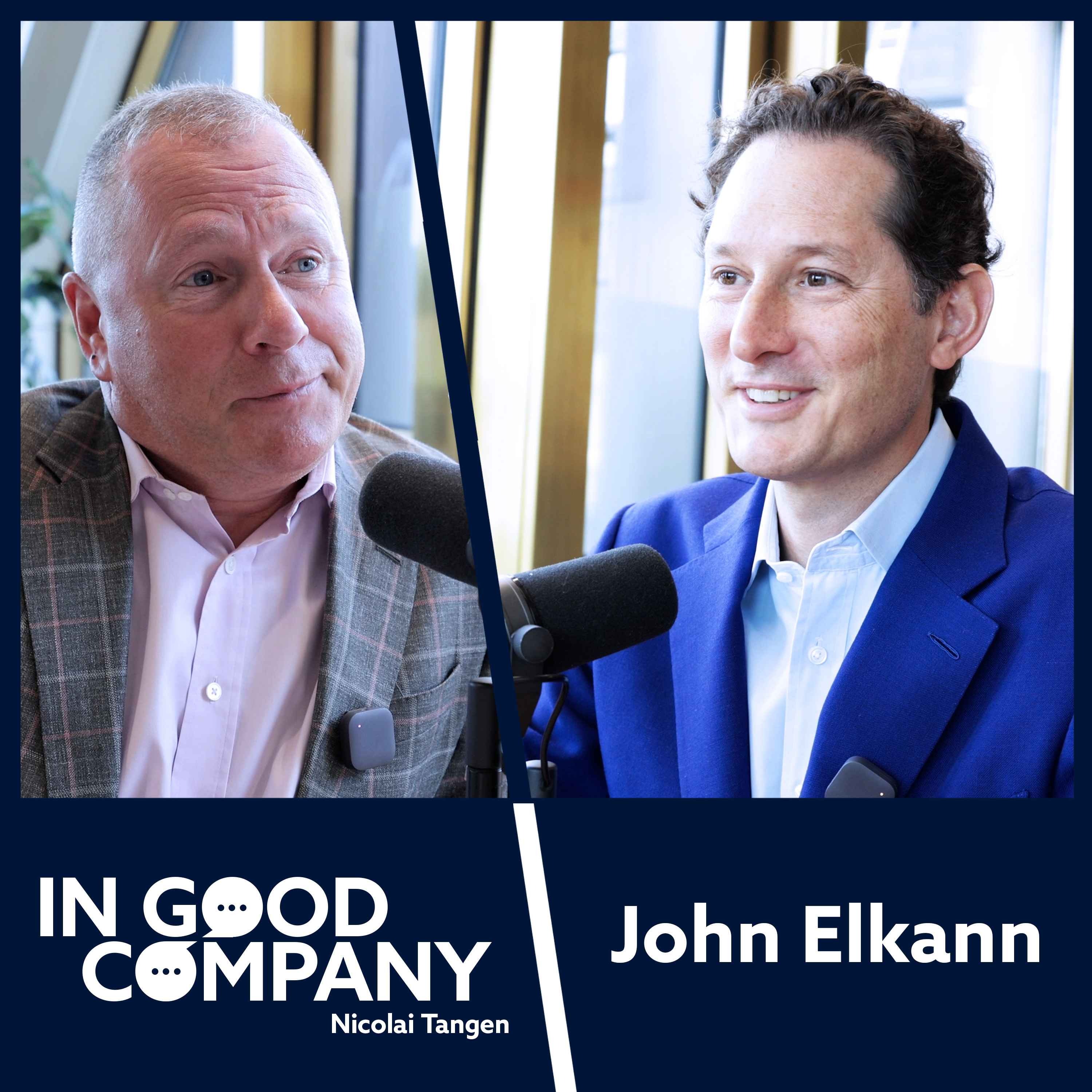
Host: Nicolai Tangen
John Elkann, CEO of Exor
Nicolai interviews John Elkann about Exor's history, family ownership, long-term value creation, and leadership principles. Exor is a holding company controlled by the Agnelli family, encompassing brands such as Ferrari, Stellantis, Philips, and Juventus.
Written by AI. May contain mistakes.

Get the gist, explore an idea or ask about something said.
 Claude
On In Good Company with Nicolai Tangen, what are the key points of this episode?
Searching your listeningAutomatic transcript. May contain errors.
0:00Hi everyone, I'm really lucky today because we've got John Elken visiting. John is the CEO of Exor, which is a Dutch holding company with Italian roots. They own things like Ferrari and through Stellantis. They also have brands like Fiat, Peugeot, Jeep and Maserati. They are also the largest owner of the Economist Group and they even have a football club called Juventus. So pretty amazing. All together in a fun, we own shares worth 34 billion groner. A very warm welcome, John. Thank you for having me, Nicolai. And thank you for your trust with us and our companies.
0:44Now, how do you look at Exor as a company? Exor is a company that builds great companies with great people. And how do you do that? We try and do that by choosing the companies, by committing ourselves as owners of these companies, and aligning our ownership with the governance of these companies and the leadership of these companies. You have some other groups worldwide who is trying to do the same. You, of course, have Warren Buffett's Berkshire Hathaway. You have the Wallenbergs in Sweden. Just how would your philosophy be similar or different? Well, those are very good examples and very respected examples by us and admired.
1:29And both have served as role models, as both of them are owners of many companies, engaged, long-term thinkers, and true believers in people and leadership. How do you decide what to buy? we end up really trying to reflect on sectors we're interested and most recently healthcare has really become the area of focus that we've have at exor and we'll come back to many of these companies but you know you are a really long-term thinking group you own the football club for 100 years pretty much and few companies get really old. I think you have mentioned that only 45 out of a million companies survive for more than a century.
2:20So why are you guys still in business? Well, what you need really to think about is to last you need to renew yourself and make sure that what you do remains current. And your abilities as an organization, as a company, are ones that allow you to make sure that you are as current today as you were yesterday, as you will be tomorrow. And there's that real belief and fortitude that comes with it in trying to make sure that what you are working on and what you're working for is enduring. How do you make sure you stay current? You are always reminded in a competitive marketplace about what is happening by your customers, by your competitors, and being aware of what your customers want and how your competitors are actually behaving is what keeps you most alert.
3:28On the other hand, what is wonderful is also to be able to explore, innovate, invent. And that is a big part of renewing oneself. Because you are particularly in the industries in which we operate, and some of our companies have over three centuries of existence, and the most recently one is Philips, over that amount of time, it is also based on new things, new ideas and inventions that become reality. How important is the family ownership and family backing or commitment? I think that a committed ownership is very important for an organization. It provides that stability. I believe that family-controlled companies and within the public markets are a very good combination between the stability that a family provides and the long-term thinking, but being a public company, the stimulus that you have by having investors.
4:38um john your background is is uh pretty incredible you were put in charge of this group when you were 21 22 i became a director at 21 in 1997 yeah um do you just want to tell us about uh how this all came about because your uh you know your grandfather was uh you know the legendary Agnelli and he kind of picked you just how did this come about? I always had a very keen interest in learning and learning about business and I studied engineering in Turin when I was 18 years old, I lived in multiple countries. And as I started studying, I also started working and spending more time with my grandfather and his colleagues and being more and more involved with the company.
5:41And he felt in 1997, as we were approaching the centennial in 1999, that it was important to have on the board a representation of the younger generation. And he appointed me as the choice of continuing the commitment our family had with the company at 21 years old, which by the way was the same age he joined the board of Fiat, which was his grandfather, my great-great-grandfather, the founder of Fiat, that indicated him. And I think that it was partially symbolic to show commitment to a company that was turning 100 years and in preparation for its next century, but also a great opportunity that he wanted to give me as he was observing that I had a keen interest in learning.
6:45And his advice, which remains true to this day, was no one's going to expect nothing from you. The important thing is for you to learn to listen and to ask questions. What did he see in you? What do you think were the traits that he admired in you? I think that my grandfather was someone who believed in freedom and that you can't force people in choices, but you need to enable them in making sure that they can work to what their aspirations are. And he generally felt as also his working environment that I had real interest and real curiosity. So that is really at that point what he was seeing and commitment.
7:44I was studying and I was also working and I was doing that because I truly enjoyed it, not because it was forced on me. And the combination of those two were definitely at that point because at 21 years old, you cannot say you've achieved much. But you are now the biggest employer in Italy, right? You have 400 ,000 people working in your group. How does that feel like a 21-year-old to be given that type of responsibility or to know that you will get the responsibility at some stage? Responsibility is something that you have. And I've personally always felt responsible, felt responsible since a very, very early age as we were growing up in many different countries.
8:42and we had divorced parents and was very much very close to my siblings and always tried to be responsible in school settings, sports settings, and taking on responsibility was definitely something that I always was drawn to. One of the values we have at Exor is courage and responsibility. and difficulties are the moments in which you can show courage and you can show responsibility for others. And over the course of the more than 20, getting close to 30 years that I've been involved as a director of Fiat back in 1997, there have been many moments of time where that responsibility was acted on.
9:43How does a family like that prepare somebody like you when you were 21? I mean, how do they prepare you for taking on that responsibility? What kind of things do they expose you to? Who do they introduce you to? My grandfather, he would take me and also my brother and my sister. we would be exposed to his life and to people he would be meeting. What he liked to do is he'd have these phone calls, which were professional work-related phone calls, and we'd spend time with him as we were speaking. Then he'd take a phone call and he'd have that phone call. We couldn't really listen to what the other person was saying, so we had to guess.
10:31And then somehow we had these conversations after about what actually the other person was saying. What type of people did he speak to? It would be colleagues of his, would be business partners, would be different persons with whom he was working. And that definitely was a very formative way. my family my grandfather were not imposing any form of apprentice apprenticeship that was more something i ended up wanting which is why i i started while i was studying
11:19you mentioned apprenticeships and you mentioned yourself people like sargio Marcioni, who's a phenomenal CEO in Italy. So who have been the really instrumental people in forming you as a leader and thinker? I was incredibly fortunate to have many people whom I worked with had wisdom and experiences. My grandfather's colleagues, Gianluigi Gabetti with whom he worked for many decades, Sergio with whom I worked for 14 years and many of my colleagues have been incredible particularly as I started relatively young. I was very fortunate to be able to work at a young age with people who had a lot of experience.
12:13I will also say that I've always been trying to learn from others and spend time studying what other family-controlled companies did. And the examples you mentioned of Berkshire Hathaway or Investor have been role models. And I was very fortunate to spend time with Mr. Buffett in Omaha or with the Wallenberg family in Stockholm. And by asking and also really generally being interested in trying to see what that could apply to us. And equally also within the entrepreneurial world or the investment world, my life has allowed me to be able to interact with many people who have been very helpful in helping us become what we are.
13:19At the same time, you mentioned to me that you kind of want to reset as well, right? You want to have a clean slate. You are, you know, the new start of a new generation. How do you think about that reset? In our case, the reset was imposed, Nikolai. It was imposed because when I came and got more involved, which was in 2003, 2004, my grandfather passed away in 2003, my great uncle passed away in 2004. At that point, I was, in effect, representing my family in our business. And those were times of big trouble. And when you are going through those circumstances, you are forced into decisions. How dire was the situation when you took over?
14:11Incredibly dire. I mean, if you look between the financial and operational difficulties that the company was facing back then, And the likelihood of us not making it were extremely high. So what did you do? We were... Because you talk about the different phases that you've been through in XO after you took over. So what's the first thing you do? You come into that situation. It doesn't look great. What do you do? We ended up as a family investing in the company. So we committed capital, which strengthened the balance sheet. and renegotiated with the banks. That allowed us to have headroom. We were fortunate to appoint Sergio after having appointed four different CEOs before within those two years who did not work.
15:04And Sergio gave the company a complete projection with a turnaround we worked on and the moment in which we launched the Fiat 500 in 2007, just 50 years after it had launched, being the first time was really a moment of, where we felt the company was actually flourishing. And that was just when the financial crisis was going to hit. And then we had the financial crisis and the financial crisis led us to America, where we got involved with Chrysler. and Chrysler allowed to create Fiat Chrysler and also to start separating the different companies of the Fiat group, who today are CNH, which is a global leader in agriculture equipment, Iveco, one of the leaders in trucks and commercial vehicles, and Ferrari, which had a very different destiny in terms of what it did versus a large car company.
16:11In the midst of that, we also simplified the group and we had different holding companies, which we merged into one, which was Exor. And we also started rethinking what we owned in trying to own less companies, but more of these companies. So if you look at the decades, the first decade was really survival. The second decade was stability and really trying to find the right construct. And the third decade, which is the one we're in, is the decade where we have been able to grow. Well, an incredible development since you took over. Now, when I look at the group, you have really, really strong companies with strong brands.
17:07So what kind of ties them together? What do you think they have in common, these companies? Well, Nikolai, the defining commonality of these companies is really through our ownership. And we believe very much that the most effective way in which you can manage a company is a founder-led company. And that combines the ownership, the governance, and the leadership. And we have tried within our companies to make sure that that clarity of purpose is very much felt within all the companies in which we are involved. Now, you put great CEOs in place. How do you define a great CEO? I've been very lucky to work and be working with great CEOs.
18:11And for me, a great CEO is someone who's really interested in the job and not the title. and who's really interested in competing in the pure sense of what it means and really likes not only the company but likes the people with whom he works. A great CEO is also someone who has the ability of thinking long term but also acting now, being strategic, but yet being operational. How do you find them? One of the values that define for me, one of our values that define for me well the leaders with whom we work is ambition and humility. And in some ways, I feel culture is self-select and the ground in which and the environment in which we operate is one that self-selects the leaders that our companies have.
19:29and the opportunity have really been that when you work with someone very good, Sergio was leading SGS which was one of our companies and then the opportunity of taking over Fiat presented himself. More recently Garrett was running Iveco and he's now been appointed to run CNH and I feel that having the abilities of creating also opportunities for talented leaders that we work with has been one in which we have made a lot of progress. Some grow up in the companies, some come from outside. Benedetto, whom you interviewed, Nicolai, who's running Ferrari, came from a different industry, from a different world.
20:28I was acting CEO of Ferrari for a year and clearly understood that Ferrari needed not someone from the car industry, not someone from the luxury industry. And Benedetto has given Ferrari with his enthusiasm and also his experience, something that was very needed for the company to look at building something new for this century. You also pay your people very well. And as you know, we have voted against the pay package at Stellantis, the car group, because we think the pay package is not correctly aligned with our interest. Just how do you look at executive pay? Is there such a thing as too high a pay package for you?
21:24I believe that if you are a high performing company, which is what we aspire to be, and if you compete within a competitive marketplace to win, what we believe is that we need to align our compensation with what our objectives are. And our compensations are variable compensations. And these compensations are completely aligned with results. So if we win as a company, everyone who works in the company, from the CEO to all the different participants in the company are ones that benefit from it. And if you look at 2023, where results of our companies have been good, the overall compensation, the variable compensation has been very rewarding for everyone.
22:25So we believe that what is important is to be clear with your objectives in the way you compensate, which is what we feel we are. what we also uh what we also um observe is in some ways the better you do the more compensated you are and so there is a lot of debates about the quantums but in some ways we believe that if the quantums are high as it's a variable pay that is a reflection that the results are there On the other hand, we also think it's important that we have an alignment and that alignment is a medium long-term alignment. And we expect not only the executives, the leadership of our companies to own shares within our companies, but we also believe that if we can have a broader based ownership, which is what we have been doing in our companies, it is really important to have that alignment.
23:37Well, as you know, we are very transparent about these things. And the important thing for us is that the packages are long-term, they are equity-based, they are result-based, and not kind of too stand out from industry standards. So you may continue to get over against vote on these kind of things, but we are grown-up people. But I think, Nikolai, that's exactly aligned with us. You are 100 % aligned. The difference is we would do more than industry standards because we feel that if you overperform within your industry, you should also be overcompensated.
24:23Talking about full speed here, Ferrari. I can see when you talk about Ferrari, you smile differently from some of the other companies we talk about here. so what's so special with ferrari ferrari is uh is about passion uh ferrari is about uh being able in the free souls that the company has is it a car is it a car company ferrari is not a car company what is it ferrari is a very special company so it's beyond great it's beyond a great company It's a special company and its roots in racing are very strong. The sports cars that it does are incredible. And the opening up to all different areas within lifestyle is giving a lot of opportunities to many people to be able to have Ferrari in their lives, not necessarily all of them being able to have one of our cars.
25:27What does Ferrari mean to an Italian? Ferrari is prideness of what our country can achieve and also a demonstration that we are a country of incredible abilities, ingeniosity, and there is a competitive spirit also within the racing world. We won in Monaco just a week ago with Charles Leclerc, who is from Monaco, winning the first time in his country. And Monaco is a really important race. And those are moments of incredible joy. Now you are launching your first electric car next year. And I tried to get you to show me a picture, which you didn't want to. I think you needed to kill me afterwards if you did.
26:25but what is it going to look like? It's going to look like nothing you had expected to look like. Right. And for us, the electric car is a white canvas, which allows us to use new technologies from the electric and the electronic world and to really be able to create and design a car which is very different. And that is incredibly exciting. And I think the industry as of now has not yet explored the realm of possible that these new technologies can provide us. Have you driven it yet? I have tried it, yes. What does it feel like? It's incredible. In what way? In all ways. If you like to drive, the frills and the emotions that you will have on this car are just exceptional.
27:17Does it have a sound? It has a sound. It will have a sound. Which that is even more precious to listen than the pictures I didn't show. So tell me, you sat inside the car. What did you experience?
27:37It's a very different experience. And what we are trying to do, Nicolai, is to give the opportunity at Ferrari to really take the most advantage we can. And the spaces, particularly as you think about more space that you can obtain, is going to be special. I can tell you different, special, and incredibly fun to actually drive. You have now Johnny Ives also working with you at Ferrari, who was the famous Apple designer. What does he contribute? Johnny Ives and Mark Newsom have created Love From, which is a creative collective. And we are at Ferrari a very creative company and design is very important.
28:39And there's always dialogues between design, engineering, and finance. You'll always need to make the numbers work, as you well know, Nikolai. And the contribution of Johnny and Mark is really been incredibly positive. Because they've taught us other ways of thinking. They've taught us other understanding of not only hardware, but also software. And as the architects of the Apple Watch, which has been now the most successful example of what is a traditional mechanical analog product into an electronic and digital one, all of that has been very very important as we think and we frame our our actions toward building this car all together and also working together working with them in california us in maranello the exchange we've had the discussions the dreams of what we wanted to do but then we can't do.
29:51It has been a very invigorating experience and one that gives a huge amount of optimism and courage to Ferrari as we think at our future that won't only be with our great combustion engines and 12 cylinders, our hybrid engines that exist today not only in the racing with our V6 hybrid, but also in our sports cars and the electric cars that's going to be starting its unveil in 2025. Some of the other car brands you've grouped together in Stellantis, so that's Peugeot, Fiat, and so on. What are you working on here? Stellantis has 14 and now 15 brands with Leap Motors, which we recently announced, which is our a fully electric car company in China.
30:43We're working very hard. Stellantis is very committed to be able to be cost competitive at scale in electric vehicles. Do you think you'll get there? I mean, is it possible to beat the Chinese in EV? I think we're getting there. And I think it's a very exciting challenge. And we also believe that with Whitley Motors, we are also now within the Chinese electric vehicle. which by the way is the electric vehicle market. More than two thirds of the electric vehicle cars have been sold in China in 2023 and even more have been built in China. Can the Europeans compete in battery technology? I think the Europeans have to compete.
31:30And the way in which the car is composed is of many different components of which also batteries. Who is going to do well in Europe? on the battery side? Batteries are an important component and one of the most expensive one. So the importance is really to try and make sure that as you develop these new technologies, both in chemistry and actually in assembling these batteries, you're able to find cost competitive solutions. I believe that there's going to be a very broad offering. Stellantis has ACC, which is a joint venture with Total Energy and Mercedes, which is building batteries in Europe, in Germany, in France, and in Italy.
32:25And we have strong partnerships with LG and Samsung in North America. So we think it's important in this stage for an OEM to have access to batteries that they control in addition to the ones that they buy. I feel that building an electric car is more than the battery. And that's where a lot of the concentration should be going, both in terms of engineering, manufacturing and the overall product is is one that we're starting to see with great excitement the fiat 500 electric which is built in in turin has been incredibly successful smaller cars like the citroen ami uh the the topolino fiat topolino which is a two-seater which you can drive in urban centers is very successful.
33:23And if we think about the muscle car that we historically have with our Dodge brand that are also going electric, that was a big demonstration of what we can do in terms of our range of brands. What do you drive? I drive the Fiat 500 electric. That's a car that I enjoy driving. I also have a bigger car, which is a Jeep Grand Vagoneer. And luckily, I also have the opportunity with my wife to drive nice cars like Ferraris or Alfa Romeos and Maseratis. Well, good for you. Now, staying in the fast lane here, you also have a football club. So Juventus you owned for 100 years. Why do you own a football club?
34:19Juventus was acquired by my great-grandfather. And he was very passionate about football, very passionate about his community. And he felt it was important to, and he spent a lot of time with Juventus. And in the 30s, there was an historical moment where Juventus won five championships in a row with an incredible team, which is when my grandfather was young and he got incredibly passionate by football. So football has been a true passion that we've had, a responsibility that we've had as a family for more than 100 years, and a passion that my family shares with the many families that love Juventus.
35:13Do you go to all the matches? I go to many matches. And my children were very fortunate to grow up in a period where Juventus won nine championships in a row. So as my grandfather, they actually ended up growing up with Juventus having extraordinary results. So they're incredibly passionate. Do you learn anything from running a football club that you can apply in other parts of the business? A football club is made of people. A football club is made of competing. A football club is made of resources that are limited and that you need to try and use in the best way. There are many leadership traits that sports and particularly football club have.
36:02And so as our companies aspire to be high-performing companies, you definitely learn in high-performing environments like professional sport is. John, you are less represented in some of the high-tech industries and IT, AI, and so on in terms of direct investments, but I gather you are investing through venture capital systems? So I studied engineering, and when I was studying engineering, internet and mobile were their nascent technologies. And I actually, among the other things I did during those years, I also founded a company, a startup back then, which was a portal. So I've always been very inclined and attuned with innovation and technology.
36:53And we actually are involved directly in investing. We have over 100 companies, particularly within the fields of our interest, like mobility and healthcare. and we also host the largest tech conference in Italy, Italian Tech Week. And we have now a program which we're very proud of, which is called Vento. And we are trying to really help with seed money any Italian entrepreneur or any Italian company within the early stage space and have become the largest investor within that area. And it's very promising. We also - So you give them a tiny bit of money and see how it goes. Yes. And then what you do.
37:35And we also have a specific program which we learned from Y Combinator and others. Which is Sam Altman's setup. Yes, and was Sam's setup. And we have different batches of to be founders. And we go through that and it's a very rigorous process. And it's a very good team that is doing that in Turin. and I was with them just a couple of actually last week. And it's very promising. Every year there is more courage to really innovate and there's more courage to want to actually build companies based on technologies. And do you do this because you want Italy to be great or you do it because you think it's good business?
38:26um we we do our contribution with vento and italian tech week because we fundamentally believe that a country needs a future despite its great past and we believe that that's a very effective way in stimulating that future which goes alongside the work we do on philanthropies particularly with our foundation on education where we provide many different programs around education, starting at schools with maths and physics and around all the different stages within education. On the other hand, we also think that it's important not only to transform and to renew 19th century companies within old industries, but also to start 21st century companies.
39:22And that's something which we are very keen in doing and working with entrepreneurs who really believe that our purpose of building great companies with great people and our values are very aligned with what they're trying to do. You increasingly are also active in the healthcare space and you bought a big stake in Philips. How did that come about? we we believe health care is is a critical industry and we've become much more much more aware of it after what we live through during the pandemic and how how frail we are as humans and and how health care is so important to be able to sustain us in the future and particularly if you look at the increasing cost that we have in providing the right healthcare, we believe that these problems are going to require solutions.
40:22And we've been focusing very much within the enablers. And we believe that Philips is an extraordinary company in really addressing those issues. And Philips is a company that has an incredible history. So we were very taken by history and also one that is in a phase of really renewing itself with the focus it has had over the last decade in healthcare and technology. And it's a very determined and ambitious company in solving important factors. So we truly believe that healthcare is not only a place where we do think there is a big impact one can have, but we also believe that there is going to be a lot of solutions that ultimately will result in good commercial applications.
41:15Tell me about your interest in sailing. You know, you've had a monohull with Maserati. I gather you're now doing a Ferrari project within the sailing area. What is that going to look like? um we we we announced that we were going to do a a ferrari boat and it was going to be a boat uh that would not have an engine and uh it it was really important uh for us to do a an internal project uh where we could use our capabilities in aerodynamics and also looking at how we can fly because the new boats that are coming up are all with foils. And also creating a spirit of competition. Giovanni Soldini, with whom I've worked over the last decade with a monokeel, then a multi-keel, and now with this new project, is someone who has incredible experience.
42:14And the level of internal excitement of trying to build something from new that doesn't exist and that is going to be flying and not powered by engine is also very important in terms of how we as a company at Ferrari are thinking about the future. When is she going to be launched? We want to launch it when we will launch the electric car. All right. In 20, the actual year will be 2026. Right. How do you relax? Do you relax? That's a good question. I tend to, I'm very fortunate to really love what I do. And I like to spend time with my family. As a family, we like to travel. We used to do a lot of cultural traveling.
43:14And then at some point, our second son said that we ought to also explore nature. And there was a lot to be learned by nature, which we have been doing. And one of our most recent trips was not far from here. We went to visit Iceland, which was an incredible, incredible trip. And we enjoy sports. We enjoy practicing sports. We enjoy watching sports together as a family. And personally, sailing has been a big passion of mine. I'm not able to sail as much as I would like, but in the last decade, I've been able to sail competitively and doing incredible adventures.
43:57Cape Town to Rio, Los Angeles to Honolulu, and the most recent one was Hong Kong to Vietnam last year. and those are moments of where you are in a very small environment as you being a sailor you know, which creates a very strong camaraderie and intimacy and you are in these extraordinary scenes where you live with nature and the wind takes you or there's no wind and you need to wait and you are within the ocean And those are really magical moments. Now, John, what is your advice to young people? The advice to young people is, first of all, they need to be optimistic about the future because the future is theirs.
44:50And they have the responsibility of building that future. And that's not daunting, it's exciting. On a more practical, I think the advice that my grandfather gave me remains true. to listen and ask questions. And in some ways, curiosity and learning are really what you need to start young at. Well, John, it's been great hosting you here in Oslo. I think Italy is very lucky to have you. And I think we need many more people like you in Europe generally. So all the best of luck with everything. Nikolai, thank you. Thank you.
45:31Thank you.
In this episode, Nicolai sits down with John Elkann, CEO of Exor, to discuss the history of the holding company, the importance of family ownership, and the focus on long-term value creation. Exor, controlled by the Agnelli family, has companies like Ferrari, Stellantis, Philips, and the Italian football club Juventus in its portfolio. Altogether, we own shares worth 34 billion Norwegian kroner in the fund. Tune in for an inspiring conversation on leadership, legacy, and the art of building great companies!
In Good Company is hosted by Nicolai Tangen, CEO of Norges Bank Investment Management. New episode out every Wednesday.
The production team for this episode includes PLAN-B's Pål Huuse and Niklas Figenschau Johansen. Background research was conducted by Kristian Haga.
Hosted on Acast. See acast.com/privacy for more information.


