Ask ChatGPT
 In Good Company with Nicolai Tangen
21 May 2025 · 47m
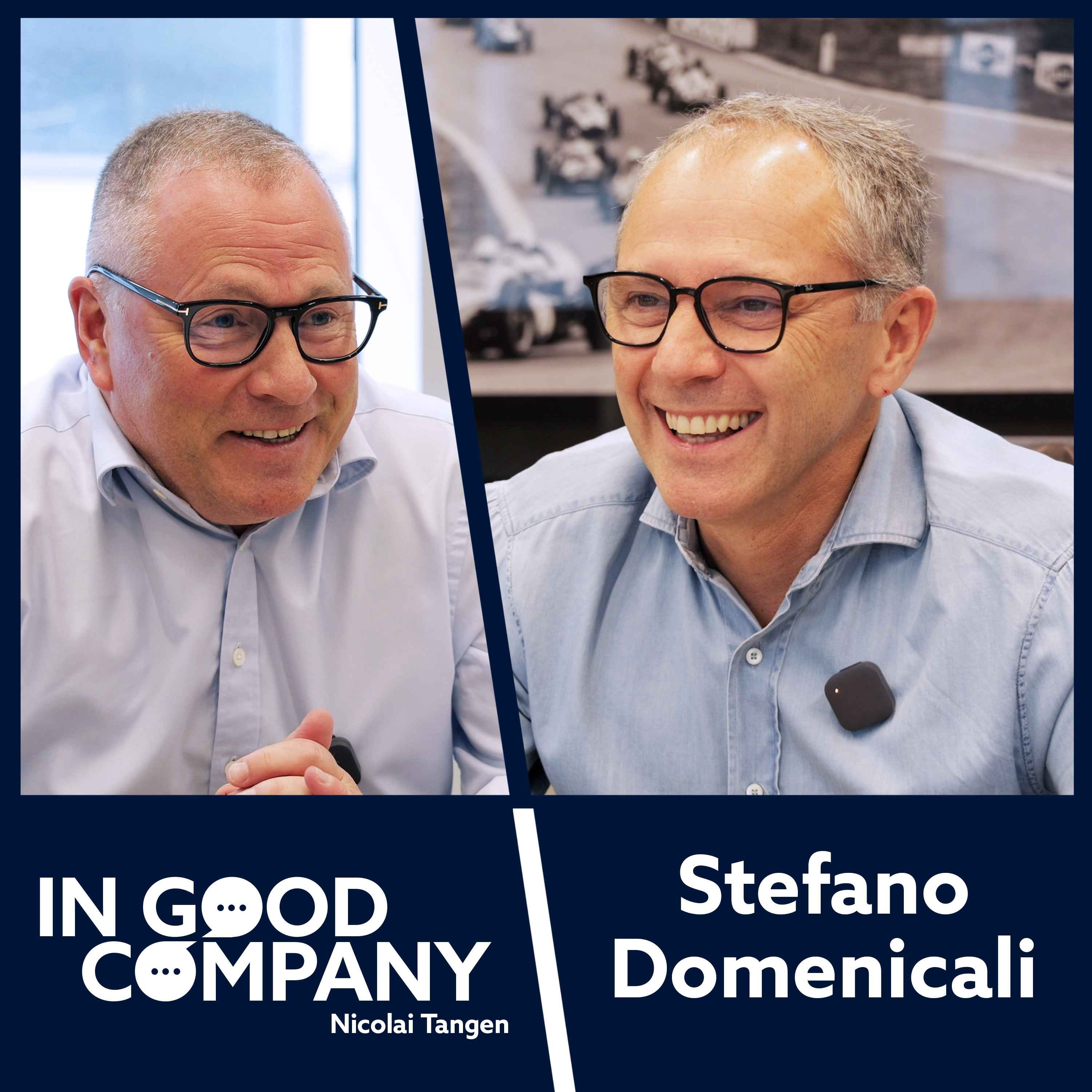
In this episode, Nicolai Tangen interviews Stefano Domenicali, the President and CEO of Formula 1 (F1). The discussion centers around the evolution of F1 as both a sport and an entertainment platform, the changing demographics of its fan base, safety regulations, and the future of the sport with a focus on sustainability, technology, and leadership.
Written by AI. May contain mistakes.

Get the gist, explore an idea or ask about something said.
 Claude
On In Good Company with Nicolai Tangen, what are the key points of this episode?
Searching your listeningAutomatic transcript. May contain errors.
0:00Hi everybody, I'm Nikolaj Tangen, the CEO of the Norwegian Soverelland Wealth Fund, and today I'm in really good company, in the fast lane with the motorsport legend Stefano Domenicali. Stefano is the president and CEO of Formula One. Great, and thanks for joining us. Thank you, thank you, Nicolai, and thanks to all our fans and supporters, and above all, maybe new people that they don't have a clue who I am. That's great, so we can connect with them.
0:36Now, Stefano, first of all, is Formula One a sport or a TV show? Well, it's definitely a sport. But of course, when you're talking about TV shows, I need to understand what you think is a TV show. Is it a negative approach or is it a positive comment? I would say what is definitely different from the past is F1 is listen, what is all around the world. So we definitely need to understand what are the ingredients to be relevant in the world of ice and entertainment. Because sport is a part of what I believe a bigger picture what an entertainment platform should be. And we are definitely that. It's an entertainment platform where we have at the center, of course, the sporting challenge, the sporting fight on the track with the drivers who are for us the jewel of sport and the cars, which represent the technological aspect of us.
1:30But today, F1 is not only about it. It's about having people gathering together, having people that have the chance to have fun, enjoy, and giving the chance to other opportunities like business development for partners or having the chance for everyone to connect with what we can offer to make sure that in a sort of situation where I can choose a lot of things, you can be attracted of our menu. And your menu is incredible just now. So how has the fan base changed? What's the fan base now? Well, the fans' base has changed definitely in the last couple of years. The fans' base has changed because before we were very avid fans, male 90%, quite old in terms of age.
2:19Of course, we are worldwide, so it has to be a sort of average of what we are talking about. Now we are getting younger and younger, which is a much diverse population. New market, for example, we are 40 % women, 60 % men. 35 years of age, so we are getting in that landscape. And as we said, different culture, different sensitivities, different approach to the sport, but we work common ground, you know, and that's where we need to make sure that everyone is sitting in. How do you, when you look at your venues, you are now at 24 races a season, how do you balance the kind of the historic venues with the new with the newer ones well first of all uh for me is has to be clear one thing historical is a value yeah if uh means that there are great foundation related to our sport if historical mean old is not anymore historical is is looking in the past and therefore what i think is relatively important for us is to make sure that the races and the countries that has been part of our history with the will to keep investing in the future will be vital to stay in our calendar.
3:36And this will happen. And 24 is max? 24 is a max number. Do you think it's a bit high even? No, I don't think so. And I tell you why. I mean, there are a lot of polarized position on that. First of all, I go back to what we need to be in terms of relevancy. I said to my people, we are not here to compete against other sport platforms. We are here to compete with movies, with music, with events, with other things that are in the agenda of our fans. You know, our life is really, is a sort of, and this is very close to F1 approach, in a sort of quick, speed, action, needs of seeing new things. Otherwise, you get old and not relevant.
4:24Therefore, I go back to the fact that we have not a lot of content. If you think we have 24 races, 20 drivers, can you imagine if you have to be competitive in the world of creating the right news with sport when they have 100 games, when sport when they have hundreds of athletes? You know, we need to find the right relevancy on that. Therefore, it's more complicated than ever. Therefore, I don't think the 24 are too much. Do you think you drop some to introduce some new countries? Well, yes, for sure. Or we are thinking also to rotate some places in a sort of possibility to give chances to come and go.
5:02What are some of the new places you would love to do? Well, we are thinking, first of all, let me do one thing that is important to state. We are very healthy today because we have a long-term agreement with a lot of partners. Therefore, there's a lot to be able to jump into the calendar are very minimal. Therefore, we need to, first of all, keep the intensity of pushing the actual one to keep increasing the quality of the offer that we want to give to our fans. In terms of new markets, I would say that we have done a big jump in US. We were one race just three years ago. Now we have three. I think that one relevant area to control or to see what we can do in the future is the ferry station.
5:46and of course one area that we want to monitor is Africa because it's the only continent that is not there in the championship but before getting there we need to make sure that they're at the right condition in a long term structure. So these are the places. You know, if you think back, you know, we were, we have been always at World World Championship but we were Europe-centric. We were having the majority races in Europe. Now, we have basically a very, very clear way of dividing our calendar in zone, in area where now we are really very balanced on that. But as I said, the focus is to stay, to check if there are new opportunities that are coming in.
6:33We have options for sure. So we are in a sort of qualitative situation where we can choose and make sure that the decision is right. Is there a trade-off between entertainment factor and safety concerns in this sport? Well, safety has been always at the center. We don't want to jeopardize or to minimize at all the approach on safety. Safety remains as a sort of fundamental pillars of a sport that in any case, as is written in our past, motorsport is definitely dangerous. But what I have to say that the turning moment of what has happened in the past has been the accident in 1994 when Senna and other drivers, Ratzenberger, died in a very tragic event.
7:20From that moment, the FIA did an immersive step versus safety. And we need to recognize that because, of course, we had other tragedies later on, but very minimal. And our duty is not to give any kind of sort of excuses to that, because that will stay always at the center. And by the way, safety doesn't mean that you cannot have a proper championship in terms of action, in terms of drama on the track. That is a different story, but that will not be negotiable. Now, you have some regulatory changes, partly to increase drama, right? or the competitive spirit of it. Now, how do you think these regulation changes will change the sport?
8:09Well, I think that, first of all, there is always the reason why there is a change on the regulation. There are mainly two factors. One is to stay relevant in terms of technological opportunity that we, as a sport, need to keep at the center of our project. Secondly, of course, the other thing that has been done in the past is to make sure there was a sort of reshuffling in terms of keeping the sport at the interest. That is not the case for this year. Reshuffling of the teams and the technology. So if you go to like a supercar, you change regulations, so then that car is less good next season.
8:42Well, it could be that others could have a chance to re-catch up. But that's not the case of this year, of next year, sorry. Because if you think, and if you look today, the gaps within the cars is so minimal and never been so close that the reason why there has been a change decided a couple of years ago is because we want to keep the relevancy of the sustainable fuel and the hybridization at the center of the technological package. So that was the reason why we have the change. Therefore, what I'm expecting this year, there will be for sure something that will have an effect on the fact that some teams and or manufacturer has been able to develop better the new regulation if you compare with the others.
9:25That means that we can have bigger gaps, but the regulation is tied up in a way that if this will be the case, there will be less time for the others to catch up. So that's very important to keep it clear. So with the regulations coming in for next year, for instance, what do you think will be the result in terms of the sport? The result of the sport will be, we will see where it's developed better, their understanding of the new regulation. I think that that's always, because that's history that shows that, There will be teams that will be stronger than others. And the only thing that is different is that we have put in place a system that will enable, if this will be the case, for the others to catch up as quickly as possible to make sure that we can have, as today, a championship with the gaps that are very, very marginal and a fight between different teams and different drivers.
10:13So closer racing, easier to overtake? Yes, that's always the principle of what we want to do, to achieve in a different way. But that's, of course, very important for us. What about the aerodynamic changes? The aerodynamic changes are connected to the different way of using the power unit, because the power unit actually will be 50 % deployment electric power and 50 % deployment of traditional and thermal power. Therefore, in order to adjust the complexity of this, the cars will be different in terms of aerodynamics, in terms of management of the different surfaces that you can activate. And this is something that will be incredible because we have given, as always, the chance to the engineers of a team that have the best in the world to develop and to see what they can come as a sort of solution to allow that team to be faster than the others.
11:03Historically, we've seen a lot of the advances here moving into the mass market eventually. What are some of the things you are seeing now which could move into the mass market? Well, definitely what is relevant for the future is the sustainable fuel. You know, and this is not really the place to talk about right or wrong. It's clear that on the mobility side, there has been a shift versus full electrification that cannot be seen as the only answer to the world of mobility because it's too complicated, too complex. Sustainable fuel that today is very, very expensive should and will, thanks to Formula One development, be able to be another solution on the portfolio of the offer that the manufacturer will give to the different customers around the world.
11:49And that's very, very relevant. But the fuel is a small part of the carbon footprint, right? Absolutely. And you have some goals here for Formula One. Yes. I mean, the fuel that we burn on the track is very marginal. If you look, we have two main sources of our footprint of carbon emission. One is our logistics, because we are a world championship and we cannot stop traveling. Therefore, for example, already this year, we are working together with our partners to use a sustainable aviation fuel that is very expensive, but is already a step in the right direction to minimize it. The other logistics are already using a system of transport that are minimizing the carbon footprint.
12:31Then, of course, the other big step that we are working to be even stronger is how we work with the promoters. You know, when we are hosting events with 400 ,000 people gathering together, you can imagine the complexity of having the right energy, the right quality of material to be used. So it's a huge project that is involved with all the ecosystem of 401 to try to understand that this is not a joke. This is a very important element of our future. And therefore, that's why we want to keep the target of being carbon neutral within 2030. It's a big task. No other sport, no other sport in the world has taken that as a commitment with facts, with independent auditing that is monitoring what we're doing.
13:16So we have to say we are very proud of what we're doing.
13:23Moving on to the drivers. Now, you've got 20 drivers. How good are the current 20 drivers compared to history? Difficult to compare because drivers has to be put in the contest over the period. But for sure, the drivers today are very, very competitive, very, very professional. This year, for the first time, we have five new young drivers that are coming into 411 that shows that... And doing well, right? Are doing very, very well. And that's why we are very happy because that means that the pyramid behind, that is 412, 413, are very strong. That means that we can have the future. And now, as you may have noticed, we have added into our pyramid the F1 Academy to make sure that in our diverse project that we want to, an inclusive project that we want to take on, also women to be in the future be able to be part of the F1 idea that is massive.
14:18So, therefore, I think that the drivers are very, very strong, very, very good, different personality. We don't want to have everyone the same. We want to make sure that everyone is different from each other. and able through the way that we are able to communicate our social media, their social media, the new platform of communication that we are offering to be a sort of role model that can inspire other people or other lovers of our sport to be attracted to what we're doing. What makes a good driver? Makes a good driver for sure. No need to say that you have to be quick. If you are not winning, you can talk a lot of good things, but you need to win.
14:58therefore results are very important of course you need to understand that there is a big picture today is not only driving is also understanding that F1 today is so big that you need to understand your public role you're committed with the fans with the customers, with the partners you have a public face you have to accept when you are driving in F1 otherwise if you just want to drive without being disrespectful if you want to do only mileage you can be a great Uber driver but that's what we don't need in FOMO 1. Do you think there are faster drivers out there who don't have because they don't have a personal face?
15:34No, I think that F1 is representative of the real picture, always the fastest. Of course, you cannot be a champion without a proper car because you can be the best and you don't have the possibility to have a fast car. You're not showing the real quality, but that's life. What does it take to be a really fast driver? What are the skills, what's the mental capabilities, the motoric? Well, I think that let's assume that today, when you are in that arena of being a F1 driver, you're given for granted the fact that you are a very good professional. You are very, very well fit. You understand the needs of being an F1 driver.
16:22What makes the difference of, really, in my opinion, of a pure championship is to be able to defragment the action that you are doing and the action of the car to maximize every single frame of the performance. So on your side, how to maximize? We're talking about the gaps of milliseconds. Can you imagine? It's nothing. So if you want to be the best, you need to slow down everything to try to see where you can improve and where you want for your car to be faster. That's the characteristic of the best driver. Understanding that even if, no matter if you're running at 300 or maybe more kilometers per hour, you're able to have everything under control to maximize your performance, the performance of your team, the performance of your car.
17:09How important is the car? Crucial. There's no doubt about it. But how much is actually, if you put the best driver in the worst car of the 20, what would the results be? There will not be the leader of the championship, for sure. I mean, he cannot make, if the gap of the car is too big, he will not make that jump. And how big is the gap? Well, today there are some cars that, you know, are behind, for sure. And the best driver you see when the gaps will become marginal. when you have difficult conditions, when you understand really what is able to make as a sort of call on his side rather than that the others are doing other stuff.
17:50So as always, the good drivers you see in the extreme condition, but it's pretty clear that you can talk with all the drivers in the world that if you don't have a good car as a base, you cannot be a champion, that's for sure. And these, the best drivers, are they more like fighter pilots or are they like downhill skiers or what uh i know you're a good gear i have heard rumors i love it's always relative but it's okay what is it what's the what is it most similar to you well i think that is is a combination of everything in a way if you are a former one driver uh you need to be scared about something that is totally crazy but in a way you are a little bit crazy because you will never run in in the in the way that they're running.
18:34But you know the drivers of today are like the pilots of today. They are the ones that know how to maximize their performance and the performance of the of the vehicle that they have under their body. So they are great men. I mean there are only 20 in the world and everyone believes that I can do that. But when you're there you you know you will understand the reason why is not everyone ready for Formula 1. How important is physical fitness? It is important, no doubt, but it's not like in the past. We have been able, through the development of the cars, to put out a lot of limitations in terms of physical constraint.
19:15Therefore, if you have a good athlete, of course there are muscles that are more important, that are neck, that are the pressure that you can apply on the feet. But for example, today on the steering, that is the power steering is not anymore like in the old days, where you really have the big muscle, or when you have the gearbox in the old days, that you have people with the blister on your hands. So that's different. But I would say they are all today great athletes, but great performance also when they train. They train every day, because they are a really sportman. And how hard do they work?
19:53They work very hard. What does a day look like? I think that you see what is different from the old days. In the old days, there were a little bit romantic approach on driving. But today, they are. The morning is preparing themselves as a physical attitude in terms of preparation. Then they work on the simulator. Then they work with the engineers. Then they watch the different video to improve themselves, to watch the others, what they are doing. They prepare the new truck. So they are really professional today. There's no space for a lot of old-fashioned approach of the drivers where, you know, like a sort of a playboy and so on.
20:32That may be another point that is still there, but it's very marginal. Is it fair that one company can have multiple teams? It is fair to say that, well, actually, in F1, there is one company that has two teams, but there is a reason why. And we need to always remember the reason why, and we need to be thankful to Red Bull that has invested a lot to develop the sport and we need to recognize that. Now, what's your position to allowing new teams such as Cadillac to join? Well, my position is very clear. We were in agreement to allow one more team to be part of the championship because we had all the elements at the end that we fulfilled what we believe is really important to have in terms of credibility, in terms of what could be and will be the added value to the sport.
21:25And Cadillac, at the end of the process, basically fulfilled these criteria. So we are very happy that now they will be part, starting from next year, to be part of the championship. It will not be easy, but I think that is a learning curve that they need to consider. But I think that will benefit the sport.
21:47Now, you have a regulatory body, the FIA. which very few sports have. What's the relationship between the FIA and the F1? Well, first of all, the difference between our sport and other sport is that we have two different complementary roles to play together. They are the regulator, we are the commercial right holder. Together, we need to develop the shape of our sport. It is written in our agreement that's been done many, many years ago, and this is a fundamental thing that we need to remember. Other sports have one federation and they're running everything. We are not like that. So we need to make sure that each of us is doing the right thing for the benefit of the sport.
22:28And that's for sure the goal that we have, sharing, you know, despite we have different people and hoping that our decisions are done for the best of our sport. Now, you're already at the max number of races. You've been hugely successful in developing a lot of revenue streams. Just how do you intend to grow the revenues from here, the sport from here? Well, I remember when we had the first turning calls a couple of years ago, because we are a public company, as you know, and everyone would say, how you can do it? They said, listen, just work hard and keep understanding that there is always a place to grow.
23:03If you're doing a good job, that's the way we are going. I mean, it's just to think big, to understand it's not only a sport today and understanding that we have, of course, mainstream media rights, sponsorship promoter fees but then we have the possibility to go deeper in in exploiting the value of them also through the the access to the data of our fans and that will enable us to do another step in terms of growth and the business how do you how can you use the data we can use it to to create personalized content that we can offer to our customer we can prepare special package to all of them there are millions around the world therefore it's just for us to be ready to do it.
23:43And the more the system is solid, the more this create value and the more this value will be bring back to the value of the asset that we are investing in. So if you just look, for example, a couple of years ago, we had four global partners. Now we have much more. We have to rationalize the differentiation between global, regional, technical, official. And that's a quality problem because, of course, this platform is raising up the level and the bar because everything is pushing in this direction. So the drive to survive on Netflix, how important do you think that's been to developing? Very important.
24:19Very important. How did it come about? It came back, it came about from the fact that, you know, the people that were previously close in this position with the Chase Carey, you know, understanding the approach of having, you know, a different way to communicate with the people. They're coming from American approach. And I would say drive to Survive was a perfect example that came also at the right time with COVID for people to have more time to digest and see these kind of things that enable us to open new markets to people that didn't have a clue who we were. And therefore, that was very beneficial for us to get into new dimension of fans.
25:02And it was good because it was opening the eyes to people that do not see us because, by the way, our drivers have gloves, overall helmets, cars. You don't see them. So we were able to open the window to a different way of explaining our sport to new fans. So that was very important. Not only that, of course. Then we had a new way of connecting with our fans through social media, much more open. I always used to say that we are very inclusive in our exclusive proposition. But then, of course, we are not stopping what we want to do. I mean, we're going to launch the movie F1 this year. That's another way to be on a different landscape for fans.
25:47With Brad Pitt? Yes, correct. We're going to launch it in the middle of June. Do you have a role in it? No, no, no, I'm not a role. The jewelers and the drivers. And, of course, the story is very nice. And the reason why we choose to be together is because it's an authentic project with a serious professional and incredible people, Apple Production, Jerry Bruckheimer, Hollywood, and Joe Kosinski as a director. And as you know, it's a big, big, big thing that we were able to do it during the course of racing weekend without touching the live sport. So it's another way to show that we are committed to think laterally.
26:30And another way to communicate with other people is, for example, we create a kids TV. So using the same kind of images, but with the commentators that are kids, with the graphics that are for kids, music for kids, just to be relevant for different audiences. That's what we want to do. Does Drive to Survive amplify rivalries? Yes, definitely. When you go to the personal side of it, you create rivalries that are good for people to be attracted. It has to be real, of course, but that's definitely so. But is it real? Absolutely. But do you think it exaggerates rivalries? To be honest, I don't think so, knowing the truth.
27:13It may be explained in different languages, but the rivalry behind the scene is there. I mean, it's a sport. Everyone tries to compete at its best. and certain dynamics are part of our world. So I think that overall, at the end of the day, we know that the context of that is also, if I may say, something that the true lovers of our sport do not really appreciate, but that's not really so relevant. The relevance is to make sure that it's as authentic as possible and then relevant to the fact that we have increased the awareness of who we are around the world.
27:59Moving on to leadership. So running Formula One, do you think that's the coolest job in Italy for an Italian to have? For sure it's something that there will be a lot of people queuing up out of the office to have it, but that's not my problem. My problem is to make sure that I take that as a big responsibility I'm very privileged. I know that. I'm very proud of it. But it's not given for granted because it's a big job. And, of course, as an Italian that I was able to do, I would say, almost 30 years, no, more than 30 years in the world of cars with Ferrari, then CEO of Lamborghini, then be here in 401.
28:43I know that it seems to be a sort of incredible story, but it is what it is. The only thing I can guarantee to you that I have not lost any second of my energy because I'm the first to run in the office, I'm the last to leave. I travel all around the world, so I don't feel that pain at all. So it's a privilege. What advantage did it give you to have been the sporting director of Ferrari? What kind of insights into... The advantage is that you know the mechanism that are related to the team approach. You know the ecosystem and therefore it's important. But at the end of the day, you need to be credible and reliable to be effective in this business.
29:25And what about the experience from Lamborghini? Very important to understand that there is another world, not only on the motorsport side of it, but it was relevant to understand the automotive industry better. And also to understand that, you know, sometimes we as F1 believe that the world is only connected to Formula 1. And it's not the case. We have, as I said before, we are very privileged, but the world is very big. And therefore, that experience helped me also to move to Germany before because I went to Audi. And therefore, understanding there are different ways of working, different ways of relating with people, that for me was relevant to understand the mechanism and to manage complexity, cultural complexity.
30:06That is one of the things that you learn when you are in this job. What car do you drive now? Don't laugh, but I don't drive. because here in London, I've got a good driver. But I love a Fiat Cinquecento, not such a big car. So that's the Fiat 500, right? Absolutely. Yeah, we got one of those. They are very good. What can we as an investment organization learn from Formula One, you think? Well, I think to think big. You know, investment sometimes look at correctly at the parameters that are very rational. We try to give an emotional side that is not present in the rational approach that I believe is very relevant and very important.
30:51And I think that our ecosystem is quite transversal because we have partners that belong to different areas of the business. Therefore, I would say, if they are connected with that, that means that we are relevant for them. That means that in terms of bigger picture, is there a way that people can invest on. What about the way you use data? So not necessarily for the audience and so on, but just for the race itself. What do you think is the most fascinating way you use data? We use that to explain the performance of the car in a basic way, not too complicated. That's always in life. The only way to be attractive is to explain in an easy way.
31:36So we create graphics from data analysis in order to explain what we are doing, in order to give the chance to our fans to understand better. That's really an incredible asset that we are already doing and we need to improve even stronger in the future. When you look at the teams, what do the best teams do differently in terms of the dynamics and the way they work? Well, I think the best teams have a better, logically, you know, without getting to the financial dimension of it, are the teams that have the best organization, the best people in terms of quality and the best process. Okay, let's do those three.
32:17So, the best people, what does it take to be great people in the teams in Formula One? Well, first of all, I start from a soft skill approach that has to be, you have to have people that are able to manage pressure. The pressure in Formula 411, whatever is your level, is huge. Can you imagine? You know, normally you can say with all respect to mechanic, you know, mechanic during the course of the race has the responsibility of changing the tires in two seconds. And this can give you the win or the lose of the race. So at every single role, pressure management is very important. Then teamwork approach.
32:57You need to understand alone you cannot win anything. You need to understand what is your position and your responsibility in a team that has to be very well structured. And then, of course, competences. Without that, I would say it's not given for granted. But the world of home one is very specific, and you need to know the business very well, no matter what is your role. So these are the three elements which I believe are very, very relevant. And, of course, you need to love and you have the passion of this job. Otherwise, you will never do it. How important is speed? Not on the track, but speed as an organization.
33:30Well, speed is the essence of our job. It's not only the reference that, you know, you win because you are the fastest. You win because as an organization, you take the right decision in the minimum time that is required. Speed doesn't mean that you have to be frantic or active in your decision process making. Speed means that you need to take decision with the element that you need to make the decision, not to over-structure yourself in actually more information, more information to delay the process of a decision. So this is what I believe is the essence of speed. Speed means to be the fastest with the elements that you need to make a decision.
34:08And that's where, as an organization, we need to anticipate the fact that the world is running very, very fast. If you do just reverse engineering, you don't have to go 20 years ago, but just two years ago where we were. And now the things that have evolved, if you're not able to react or promptly anticipate the things, you're out of the business. How do you make sure that you don't slow down as an organization? First of all, to make sure that every single people in the organization is in a record mode, to understand, listen, having the right information. Secondly, to have a process of sharing and keeping the people up to speed to what is this need.
34:49And third, that is for me the most important thing, that when you do this job, it's 100 % full speed without any moment of relax because you cannot take it. Therefore, it's very intense, but the intensity and the energetic approach that you should have has to be transferred to your people. Otherwise, alone is very difficult. And how do you do that? How do you transmit that mindset? With example. And how, for instance, what? I'm the first to arrive and I want to have immediately the meeting of the people in the way that I want. And if I'm not able to go with my rhythm, it's probably not mine. Are you faster now than you were in the past?
35:27Faster, yes. Definitely so. I think that with the experience I've learned how to manage the speed.
35:35In a way that I know when I need to use the full throttle or when I need to brake. that's the good understanding of a manager that needs to understand who is the people around him. You know, you cannot destroy your horses if the horses are not ready for that. So it's a matter of fine tuning and having the right understanding of your ecosystem. And that will be, you know, the right thing that you have to do if you want to lead the organization for a long term. When do you break? Summertime. The only slow time is when we have, you know, two weeks on holiday in August. and two weeks on holiday and Christmas time.
36:12And that's the only moment where I will break. So there's only one speed, that's full speed? 100%. For one, there's no doubt. But I think that all around the world, if you want to be a protagonist of what we are doing, there is only full speed. When you look at society, are you surprised that it's not going faster? Well, I'm surprised, not surprised, not the right word. I think that today, as a normal human being, I would love to see more quality for people that are managing the bigger decision of the world. Quality means understanding. Quality means knowledge. Quality means respect. And this is something as a human being I feel a little bit the bitter spirit.
36:56So in your private life, I mean how, I mean if I were to be your wife, I mean. Mama, thanks God, I'm very happy with my wife since many, many, many, many years. I've got two children. I think it's moving fast enough at home. Thanks God, I have a wife that is faster than me. But that's me. I mean, I'm just focused out of the business. I'm focused on my family and with my friends that are the same since I was in high school. So that's my legacy with my past that keep me with the feet on the ground. and for me that is very important. It seems to be a common denominator with Italians. Friendships go back quite far.
37:38Well, for us it's a sort of the way we were born and our community is very important for us and it's not a qualitative comment, it's a fact. And therefore, when you are in this position, you can be taken away because you meet all the most important people of the world. But at the end of the day, when you are alone in front of the mirror, you are yourself. And therefore, for me to be like this, I need to go back to my normal life. That is what I told you. And that's it. How do you prioritize? Well, priorities in terms of time. I know that, you know, during my work day, the priority is the business.
38:17But when I'm at home, I want to give quality time to my kids. Kids are really bigger, but the kids and my wife, 1000%. And at work, how do you prioritize? You come in in the morning. How do you prioritize what to do? Well, it depends. Because you know what, I've been thinking a lot about it, and I think we just are too bad at prioritizing what's important. Well, the priority is what makes you efficient and effective. Because unfortunately, when you go, you have so many things to do, then you need to understand what are the priorities you need to bring home. Strategic, tactical, and therefore is a matter of...
38:50I'm not doing that in the morning. I mean, in the morning, I'm already on the action mode. What I need to do is to make sure that I prioritize, you know, in a different way, long term, medium term, weekly term, and I have to make sure that I have a clear understanding of what I need to bring home. What I'm doing to myself, and this is something that I use for me to be effective, is every evening I count the decisions that I've taken. Is enough or not enough is not a number, but let's say, did I take decision today? In my position, in our position, every day you need to take decision. If you're not taking decision means that either, you know, people have done your job better.
39:34That is good in a way, maybe, I don't know. But otherwise, you are not performing the way they should.
39:44How has your decision making changed? The decision making has changed, of course, with experience, with the fact that now, hopefully, I am a little more mature, not to make mistakes. Even if I put in the process of what we're doing, also mistakes is part of our life. You know, it's, it's, by the way, also here, we have a different cultural approach. If you take the example of our, you know, approach as an Italian, mistake is always being always seen as, oh my God, you cannot fail, otherwise it's a disaster. You go with the American mentality, the American mentality failure, if you don't fail, you are no one.
40:18Therefore, how you can mix that is relevant. And how do you mix that? I think that it's just a matter of understanding the magnitude of the mistake that you're doing and try to, if you feel that you've done a mistake, how you can rectify it. As simple as that. Very simple. I don't have to overcomplicate it. If I feel that we, and I always say we because it's not being a response for an organization, if some of my people are doing a mistake, it's my fault. I think that the only thing to do is to rectify it. If we see people not understanding that, then it's a matter for me to change it. Tell me a mistake you made this year.
40:53This year, so far, not one. That's good. Very straightforward. So far, I think that I was managing quite well the things. Last year? Last year, I got two mistakes. One, I cannot tell you. One is related to a process that I didn't feel completely done in the proper way for an assignment here in the organization. How much time do you spend on debriefs? Every week. It's a part of my process of approach. I mean, every event, there has to be a debrief. That's what Formula One teaches you. There is a proper debriefing of the event, in our case, where everyone has to go through a checklist of understanding if we have done the right thing or what we have done wrongly and what is the things that we need to rectify.
41:43How do you make sure that there is a good feedback system, that people tell you the truth? Well, there is for sure a process of sharing information. In terms of truth, it's a way that you build your strengths. Knowing the different channel, you need to know, or you should try to know all what is around you and use this information at the right moment. So once again, it's a matter of deeply understanding who we can really rely 100%, who 50%, who 30%, and make sure that you have the ecosystem under control. That is relevant, for sure. So talking about the ecosystem, what's the most complex part of your job to get right?
42:29Well, the most complex part of my job, I do believe, is to make sure that this job is divided in a lot of different areas. There is one error related to the relation with the broadcaster, one error related to the promoters, when I relate to with the teams, when I relate to with the FIA. Most importantly, my job is to make sure that our organization is running smoothly. So the complexity in all these kind of things is to manage the quality of the people that are working. This is my organization. Secondly, is to manage the different relations that they have to have in the different contexts that are quite complicated.
43:03So I cannot say there is only one. It's multiple, but the approach is always the same. Try to understand, try to listen, try to understand if there is something behind that I need to understand when we are talking about certain things and make a judgment. What more do you want to accomplish at Formula One? I think that I want to do two things. One, to keep the relevancy of what we're doing in a much solid foundation, create even a stronger team that we can take, you know, this business stronger in the future. Because I have taken a committee of five more years and I will do it with full dedication.
43:46But one of the legacy I want to keep is to make sure that what we are doing now will stay for a long time even after. A couple of personal things. You mentioned you were the first one at work in the morning. When do you wake up? I wake up at 5.30. 5.30. What do you do then? I run. Every day? Yeah. If it's not ugly weather, yes, I go around to around 8 kilometers, 10 kilometers per day. It's the only time that I have free so I can listen to music because I love music and I'm trying to think what I should do during the day. And then I come back in the work here. And then I go back home if I'm not around the world because I tell you my schedule, maybe you don't believe it.
44:25I believe it. If I tell you what I did in the last months, you cannot believe it. So I go back around eight to have dinner with my wife and see our kids. And when you run, what kind of music do you listen to? Well, I normally listen to Italian music and pop music. Right. Do you get any time to read? Not a lot because normally I read when I'm on the plane to try to have a strategic time for me. Because normally when I'm doing a daily job, here is always meetings, meetings, meetings, meetings. So I take the time to think strategically. So I was really more, you know, the history of Rome, history of, because I love history, and the Second World World, because I'm fascinated about these kind of things.
45:16but today I take more time when I have free time, honestly, to think strategically. Stefano, we got tens of thousands of young people listening to this and of course probably more young people than normal and perhaps even more female listeners than we normally have. What is your advice to young people? Well, first of all, I'm not a professor, I'm not a teacher. I just really can share what I believe is important that I live on my own. I mean, when you're young, you need to think and I think that you need to think that things in the future are becoming opportunities and the opportunity instead of being opportunities the dreams will be seen as problems when you're getting older so stay focused on being younger to think that to think big to think that you need to be to believe in yourself not to give up stay focused and and work hard work card means you need to stay dedicated to what you love and knowing that the competition is very tight and very, I would say, stronger today because it's more transversal, more international.
46:23But if you believe in yourself, there's no reason why you shouldn't do it. So really believe in yourself, being humble, listen, try to understand and to learn from everyone is around you. This would be my basic, I would say, advice as a 60 years man that has been in For One. And in this job that is getting older, no, let's say one year in For One is around 10 years of a normal life. So that's what I'm saying as a shared experience with our friends that listen to us. Very good. Well, you for sure exemplify all the qualities you mentioned here in terms of working hard, thinking big, and moving very fast.
47:05Yes. Really great talking to you. Big thanks. Thank you, Nikolai. Thanks to you. Congratulations. Very good. Thank you.
Buckle up as Nicolai Tangen goes behind the scenes with Stefano Domenicali, President and CEO of Formula 1, to explore how the world's most exhilarating motorsport is evolving at breathtaking speed. From transforming a traditionally male-dominated audience to attracting younger, more diverse fans worldwide, Domenicali reveals how F1 has become an entertainment phenomenon without sacrificing its sporting essence. Discover what makes a truly exceptional F1 driver and learn about F1's ambitious plans for sustainable fuels, the delicate balancing act between historic tracks and emerging venues, and why Domenicali believes "there is only full speed" when leading at the highest level. Tune in!
In Good Company is hosted by Nicolai Tangen, CEO of Norges Bank Investment Management. New full episodes every Wednesday, and don't miss our Highlight episodes every Friday.
The production team for this episode includes Isabelle Karlsson and PLAN-B's Niklas Figenschau Johansen, Sebastian Langvik-Hansen and Pål Huuse. Background research was conducted by Torgeir Rimstad and David Høysæter.
Hosted on Acast. See acast.com/privacy for more information.