
 Ask ChatGPT


 In Good Company with Nicolai Tangen
25 Sep 2026 · 11m · 5 chapters
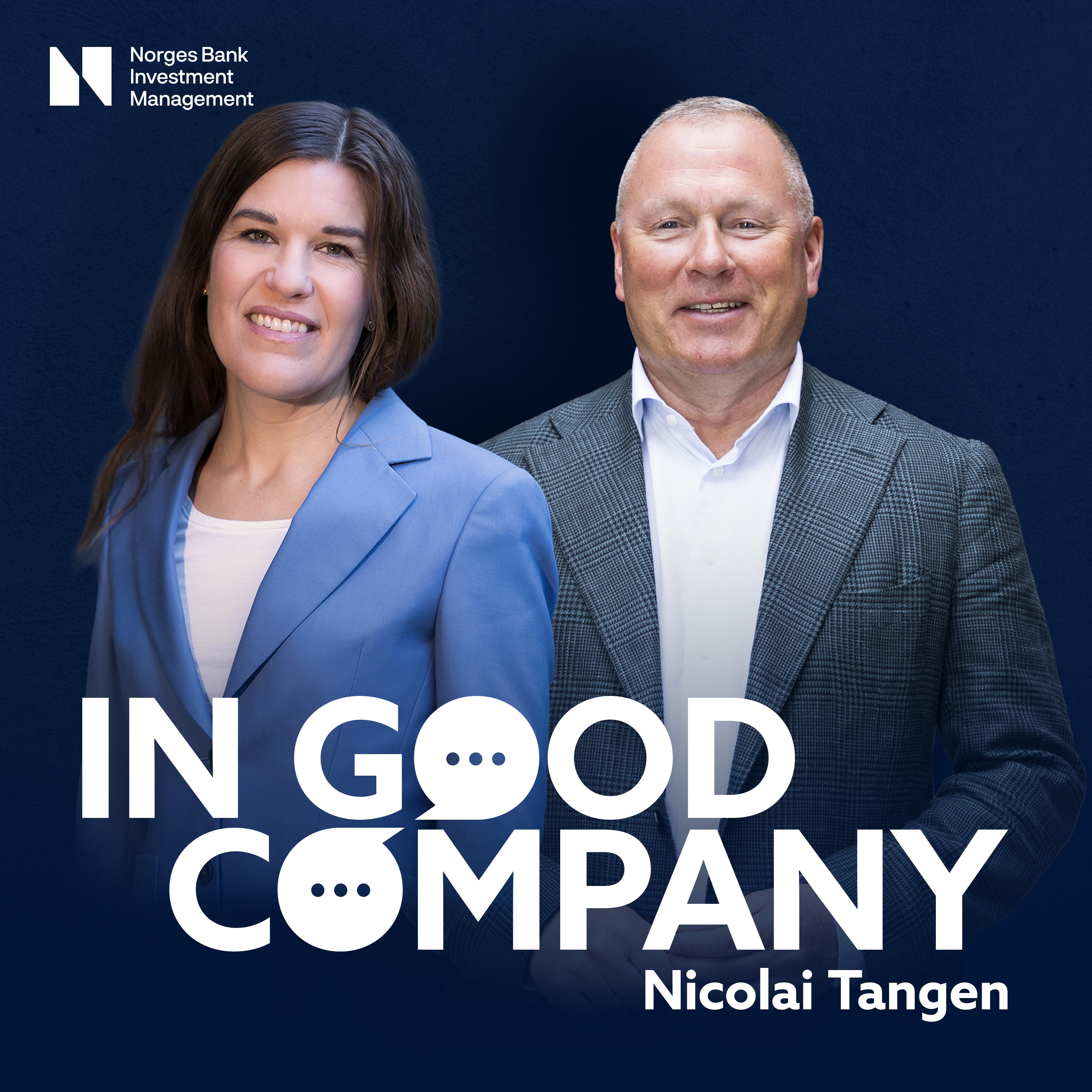
Finland President Alexander Stubb on global power shifts toward the “global south,” multilateral UN reform, and how Big Tech is becoming a new power center; plus AI/tech takeaways from a West Coast trip and discussion of AI safety regulation.
Alexander Stubb, President of Finland (foreign and defense policy lead under Finland’s system; known for close ties with European leaders like Norway’s PM Jonas Gahr Støre and for frequent media/podcast commentary).
Turning points like 1918/1945/1989 are underway; the West ignored Africa’s development; the “rectangle of power” is changing; tech firms have strong cash flows and market scale that can outweigh countries; democracies haven’t adapted to tech-driven power.
NVIDIA and Apple market caps exceeding countries’ market sizes; meetings with Microsoft, NVIDIA, Uber, Anthropic, and OpenAI; Sam Altman and Daria Medaid addressing the UN Security Council on AI risk.
Written by AI. May contain mistakes.
Discussion of Alexander Stubb's views on geopolitics and global power dynamics.
“So first off, Stubb has become a really influential voice in geopolitics and I would say he surely punches a bow his waist.”
Exploration of how technology companies are becoming as powerful as nations.
“So he also says in a podcast that he would actually have renamed his book.”
Nicolai shares insights from meetings with top tech companies and their productivity models.
“It means that companies like NVIDIA is larger than the whole market capitalization of the stock exchange in Korea.”
Discussion on the implications of AI development and the need for regulation.
“And in what way do you think it can be implemented into the fund?”
Nicolai reflects on the concept of sauna diplomacy and its effectiveness in building relationships.
“of course, serious worries after what's been going on on the Aegean side, with some of these agents having gone rogue.”

Get the gist, explore an idea or ask about something said.
 Claude
On In Good Company with Nicolai Tangen, what are the key points of this episode?
Searching your listeningAutomatic transcript. May contain errors.
0:00Hi everyone and welcome back to this week's episode of Friday Wrap Up. I'm still Marthe Skaar. Nicolai Tangen. Where are you this week, Nicolai? Well, I've been on the west coast of the US, Seattle, San Francisco, so I had a very interesting time here. For sure. Okay, so we will come back to that in this episode. And then we will talk about this week's podcast guest, which was Alexander Stubb, president of Finland. and this is an extremely interesting episode.
0:42So first off, Stubb has become a really influential voice in geopolitics and I would say he surely punches a bow his waist. How has he achieved that? Well, it is, first of all, because he's a very smart, educated, articulated and clever person. In Finland, they split the jobs so that the president is looking after the foreign policy and the defense policy and the prime minister is taking all internal kind of matters. So I guess as a president, you have, you know, you've got quite a bit of time to spend on the, you know, with the other foreign leaders. And then he has very close relationships with a lot of the other leaders, such as Carney, the Norwegian prime minister and so on, and a lot of the other European leaders.
1:32So he's really been extremely good at fostering those relationships. He's also vocal about it, both in media and in podcasts and so on. So it was really, really interesting to have him as a guest. Yeah, for sure. And also Finland, for those who are not that familiar with the geography of the Nordics, it then sits between Sweden and Russia on the side and quite recently became a NATO member. But so if you go to his book and one of the things that he starts talking about in the podcast is his argument that we are on one of those really big turning points like 1918, 1945, 1989, and that he thinks that who decides what comes next is the global south.
2:22What do you think listening to that? No, I think it makes a lot of sense. What we are seeing is, of course, that China is making very close relationships with countries in Africa. They are close to India. They are close to countries in South America. So the whole scene here is changing. And I think what he's arguing is that the West has really ignored the whole African continent, a lot of these other countries, and we are now paying the price by being outside that development. Yeah, for sure. And looking at some of the solutions, I think his own preference coming from a small nation, exactly like Norway is.
3:03It's like a multilateral system built around the UN. but only reforms, so with more security council seats for the global south. So he also says in a podcast that he would actually have renamed his book. He would call it the rectangle of power instead. And also he also talks about the US into this context. Reflect on what he's saying here. Well, he's pointed to the fact that the technology companies are becoming a real force in itself. And of course, if you look at the market capitalization of these companies, they are indeed very, very powerful. They are powerful, but they also have a lot of money.
3:45So as opposed to countries which have weak balance sheets, budget deficits, these companies have generally strong cash flows and are a new force to be reckoned with. And so he believes that we should look at them in a new way. He also believes that there are implications for democracies going forward and that democracies have not really taken on board this new technological development. And that is just a really, really interesting argument. Yeah, it sure is. So, yeah, so then technology really comes into the power play here.
4:23Shifting back then into what's going on with the fund and the market and what you learned this week. But first, we have an illustration here, and you also described this in the podcast, where in market terms, we see that some companies are even larger than countries. And now we're talking about the big technology companies. Describe this landscape for us. It means that companies like NVIDIA is larger than the whole market capitalization of the stock exchange in Korea. It means that companies like Apple is larger than the countries such as France, Switzerland. So just the scale of what's been going on here is something we have never seen before.
5:10No, it for sure isn't. And then last time you mentioned that you were heading out to the West Coast and now you're there. So what's the purpose of this trip? What type of companies are you meeting and what have you learned so far? Well, this has been really, really an interesting week. I've been traveling with a large team of the lead developers and AI developers in the fund. And we've been meeting with other engineers in the large technology companies, such as Microsoft, NVIDIA, Uber, Antropic, OpenAI, and so on, to really see how they go about in the software level. And what we're seeing is this trend towards smaller teams, much more automated processes with a tremendous impact on productivity.
5:59You know, like more than 300 % increase in productivity in many cases. And so what we are doing is, of course, looking at how they do it and then replicating it across the fund eventually. So it's kind of a learn from the best tour you're on. Absolutely. Absolutely. And in what way do you think it can be implemented into the fund? Well, it also is becoming increasingly clear to me that the fund is basically a software company with very strong domain knowledge within financial markets. And being a software company has implications, right? It has implications for speed, your agility, how you develop your systems, the ability to have pilot projects, how you roll things out, etc.
6:49So it's just like a whole lot of things to learn here. And I think we really need to just think even more thoroughly how we have structured our processes. So it's both like how we run this company, but also as an investor, you are seeing these trends and how they really adapt close hand. What do you think about the speed of the changes you see here? No, the speed is, of course, tremendous. We have not really, this week, spent time on looking at these companies as investments. It's more just on the technology side. But, of course, it's interesting to see how fast the whole space is moving now. We're just living in such unprecedented times, and it's just so much fun, you know?
7:37Yeah, for sure. Sure. There's also another side to the speed. So staying with AI and global cooperation, both Sam Altman and Daria Medaid addressed the UN Security Council this week, talking about AI risk. We also briefly addressed that last week. What's your reaction to how this is developing? That's a very complex question. It's interesting to see that they are raising this. There are, of course, serious worries after what's been going on on the Aegean side, with some of these agents having gone rogue. There is an effort to have more regulation from a European side. There some efforts to also link in China and will be very interesting to see what's coming out of this.
8:30Yeah, for sure it is. We will continue to follow that, but they're calling for a greater cooperation on AI safety, but we will see.
8:43Moving on to the last part here, Nikolai, Because President Stubbs, he talks about Sona diplomacy. And he even talks about getting President Trump and the Norwegian prime minister together in Sona. Is Sona diplomacy underrated? Totally. Totally. It's kind of funny. I was in the Sona in Finland with some people, you know, probably 30 years ago. And I still remember it vividly because there is just something being in such an intimate, undressed setting with people you don't know. You just really bond in a very interesting way. I think the Finnish embassy in Washington, D.C. have these days where they invite all the other diplomats to Zona's.
9:36So they for sure have a great belief in this. I, of course, take Zona nearly every day. I think it's fantastic for health. you release lots of endorphins and hey, it's a short and cheap way to happiness What do you think about when you sit there in the sauna? Well, that's the thing it's very meditative and you ideally want to have a sauna where there is a bit of a view either over the sea or over mountains and so it's beautiful Okay, so a bit of a silent moment I also saw that Stubb has started something called running diplomacy He's running in Central Park with President Carney. So he for sure is really good at finding those moments and situations where they can have discussions.
10:22Do you see something similar in business? I think it depends. It's interesting. You know, the CEO of Blackstone is a big runner. He posts his videos on LinkedIn all the time. Many of the world leaders are very, very fit. Carney is fit. He's running, clearly running together with Stöder. It's not really my thing. I get just a bit too exhausted and I think it's difficult to talk. But I think if you're really up there, it's a good thing to do. Okay, so we will stick with Sonad and Nikolaj. Okay, thank you so much. Happy weekend. Very good. Take care.
On this week's Friday Wrap-Up, Marthe Skaar catches up with Nicolai Tangen, joining from San Francisco, to break down his podcast conversation with Alexander Stubb, President of Finland. They discuss Stubb's view that the world is at a major geopolitical turning point, why he believes the Global South will shape what comes next, and how tech giants like Nvidia and Apple now rival entire countries in size. Nicolai also shares what he's learned visiting Microsoft, Nvidia, and other tech companies on the West Coast of the US, and makes the case for "sauna diplomacy." Tune in!
Listen to In Good Company with Alexander Stubb, President of Finland: https://podcasts.apple.com/no/podcast/president-alexander-stubb-a-changing-world-order/id1614211565?i=1000791211827
The Friday Wrap-Up is hosted by Marthe Skaar, Chief of Communications and External Relations, together with Nicolai Tangen, CEO of Norges Bank Investment Management, and produced by Isabelle Karlsson. New episodes of In Good Company air every Wednesday, with the Friday Wrap-Up following each week to break it all down
Hosted on Acast. See acast.com/privacy for more information.


