
 Ask ChatGPT


 In Good Company with Nicolai Tangen
4 Sep 2026 · 15m · 8 chapters
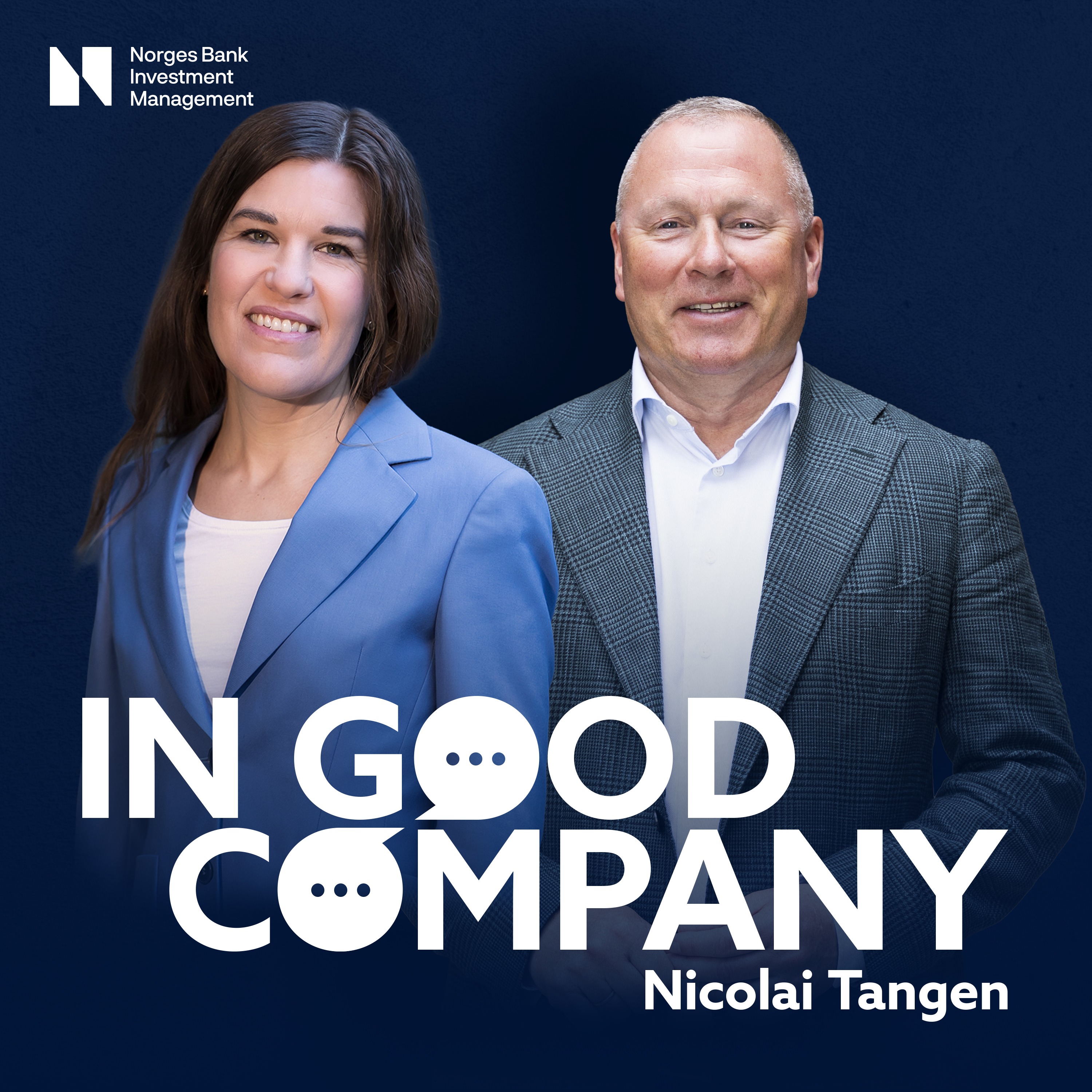
Leadership longevity, innovation in agriculture (John Deere), market/portfolio turnover amid faster tech change, and the fund’s recruiting (students, women, AI skills), plus personal regrets and weekend plans.
Nicolai Tangen and Marthe Skaar (hosts). No external guest appears in this wrap-up; they reference a prior main episode with John Deere.
AI adoption in agriculture is accelerating (computer vision to distinguish weeds vs crops and target spraying). Driverless tractors are feasible (automation goals by 2030). CEO tenure is a balancing act: too long can block change; too short can signal failure. S&P 500 average company lifespan has fallen (33 years in 1965 to ~15 today); no clear “best stock of 2040” exists now.
John Deere’s 190-year evolution from tractors to technology, cloud/data analytics, autonomy since 2022, and plant-by-plant fertilizer optimization. Recruiting at NTNU in Trondheim; Women Investment Club/“Women in Finance” student-led clubs; target 40% women (currently ~34–35%). Personal regret: not practicing languages (Russian, French, German) after studying Russian for two years. Weekend: Financial Times “FT in the Park” in Kenwood, North London.
Written by AI. May contain mistakes.
Discussion on AI advancements in agriculture, particularly with John Deere.
“And this week, we're heading into the fields.”
Insights into the significance of innovation and automation in farming.
“Yeah, and talking about that because he also talked about this computer vision which I thought was really fascinating where you can tell a weed from a crop and then you know what to spray.”
Discussion on the impact of CEO tenure and leadership stability in businesses.
“So, therefore, you just kind of up the size of the tractor a bit.”
Insights on the evolving market dynamics and the lifespan of companies.
“and what's going in the funder last week, I also want to start out by talking about tenure because the average tenure of a company at the S &P 500 has actually fallen from 33 years in 1965 to about 15 years today.”
Discussion on the importance of diversity and recruitment strategies in finance.
“We actually asked our employees the same question at a town hall in London this spring.”
Nicolai reflects on his personal experiences with language skills and their significance.
“And I think it's just to forget all the languages I spoke when I was young, because I had spent two years studying Russian.”
Nicolai shares his exciting weekend plans and wraps up the episode.
“And I think it's important for the way you learn, how you understand cultures, just the way you connect with people.”
Discover the joy of a diverse learning environment and its appeal.
“It's in a beautiful setting in, you know, lots of different type of tents, food trucks, all that kind of thing.”

Get the gist, explore an idea or ask about something said.
 Claude
On In Good Company with Nicolai Tangen, what are the key points of this episode?
Searching your listeningAutomatic transcript. May contain errors.
0:00Hi everyone and welcome back to In Good Company. I'm still Marthe Skaar. I'm Nicolai Tangen. And what we'll do today is this is a short 15-minute chat where Nicolai and I cover three things, highlights from this week's main episode, what's going on in the fund and the markets, and then we will talk about what you will do in the weekend. Absolutely. It should be fun.
0:31And this week, we're heading into the fields. Absolutely. We have had a podcast with John Deere, which you may recognize for the Green Tractors. And wow, what a company. Have you learned anything new this week? I just didn't think. I just hadn't taken on board how far AI has come in agriculture and how important it's going to be. And interestingly, Bill Gates wrote a letter recently also where he talks about who the main beneficiaries are going to be. Number one, healthcare. year number two agriculture and having listened to John Deere you see how important it is for you know having gone from like a field-based treatment of everything from like fertilizers how you put the seeds in the ground to now going like you know plant by plant fertilizers all these kind of things it's saving them just so much money and energy and it's good for climate and productivity yeah i agree and that struck me most with episode as well because when i talk about john jerry i must admit i think about tractors and green hats but this is a company that 190 year old tractor making turned into a technology company absolutely no it's um it's very very impressive um you see uh you know the service business is really growing there is a lot of there's a big cloud element to it more and more autonomous uh driving tractors harvesting just huge productivity gains going on there.
1:57Yeah, and talking about that because he also talked about this computer vision which I thought was really fascinating where you can tell a weed from a crop and then you know what to spray. So how important is it for companies to be able to innovate? It's totally key. It's basically what differentiates the winners from the losers. Interestingly, next year at the investment conference we have in April, that's what we're going to focus in on. So we have a lot of the best leaders in the world, the leaders in innovation. They are going to come and tell us how they do it, how they structure the companies and what kind of process they have.
2:33That would be very interesting. And you also touched upon driverless because they have had driverless tractors all the way since 2022. What do you think about what they're making and kind of the timeline when they also look into U.S. corn production that they really want to automate by 2030? Yeah, no, it seems to be totally feasible according to what we know. We, of course, see it from many different industries that automation is coming really, really fast. You know, you have it on the car side, you have it on humanoid robots. This is just really, really fascinating. I have to say, I went to drive a tractor this week because, you know, you have to check out the kind of things you do.
3:18And wow, that was fun. And it struck me also you have tractors coming in all these different sizes. And I'm just wondering whether you have the same kind of vanity problem as you have for most vehicles. That, you know, you're on a farm, you made a lot of money, you want to show the neighbor guy, you know, a woman, that you made more money. So, therefore, you just kind of up the size of the tractor a bit. Because they are huge, some of these things. They are really huge. You learned how to back up as well, right? I did back. I drove both forward and backwards. I have to say they had capped it kind of on 20 kilometers an hour because they were a bit worried that I was going to destroy the whole thing but hey fun I mean Lamborghini the Italian tractor maker started to make racing cars so let's see perhaps in the future we'll have a fast green racing car from John Deere yeah there might be I also was really fascinating about how kind of the role of farming is changing and one thing is that there are these tractors are super fancy with instruments and everything.
4:18But what also struck me is he talked about data and the cloud and how they look into it. For me, it sounded like there were analysts in the Sovereign Well Fund. Yeah, I think they, well, there's just so many commonalities now in terms of working in business and industry compared to working in a financial company. It's the same way of analyzing data. You use the cloud, you use business analytics. it's a lot of the same things one thing that struck me was just like how long the CEOs have been in place at John Dare yeah so the company is 190 years old and they've had 10 CEOs 10 CEOs in 190 years it's very rare to see that type of situation I mean we have a similar well not that long actually but in in L 'Oreal in France you've had six CEOs in 100 years I mean in this fund I'm CEO number three in 30 years so longevity is just an interesting concept Do you see that as a positive to have a long tenure?
5:25I think on average it's positive it can be too long too because if it's too long you basically will hold back change I think and so that's bad but at the same time if you shift too often that's also not very positive and also often you you shift because you need a change and because the previous one hasn't worked out in which case it's not good and then of course you have the the the next thing which is do you do you recruit internally or externally so on average it's better to to recruit internally and to have that kind of continuation because people who worked in a firm they have a better better idea of corporate culture you know how you do things around there and so on.
6:07Whilst if you need change, if something has gone wrong, you sometimes need somebody from the outside. Moving into to talk about the markets and what's going in the funder last week, I also want to start out by talking about tenure because the average tenure of a company at the S &P 500 has actually fallen from 33 years in 1965 to about 15 years today. Okay. And so given that everything we heard from John Deere about how to reinvade a 190-year-old company, how do you think about that, the average turnover in our portfolio? No, I think it raises a lot of questions, of course. It tells you how difficult it is to pick the winners and to actually make sure that the winners remain winners because the technology change is so fast that you can be obsolete very, very quickly.
7:02So that's, of course, one danger. And then you also see some of the competitors from China, and we've done some podcasts with Chinese companies recently, which are going to be released quite soon. And some of these companies have had a lifetime of, you know, six to 10 years and they've already revolutionized their industries. So it's just really, really fascinating. But for sure, things are moving faster and faster. Do you think the best performing stock of 2040 exists today?
7:31No. No. So interesting. We actually asked our employees the same question at a town hall in London this spring. And 87 % answered no to the question. So, yeah, I guess it's a signal of how fast things are moving. And on that note, talking of fast moving, because we have been to Trondheim this week, which is kind of like the city that have a university called N-Terno. They have what we would must call the leading tech university in Norway. And we met some brilliant students. We met the faculty. so a feeder it's in a way it's been a feeder university number one lately because of the technology people we have we have hired yeah it sure has why is it so important for you to be kind of so hands-on in recruiting well because the people we recruit they are going to be the key to the success of the firm going forward so that's the one thing the second thing is that the competition for the the best brains is very high and you need to be there and you need to make sure they understand what a great job it is to work in this fund.
8:39And then in particular, the type of people we recruit, who are both in finance and also often in technology. It's difficult to get great women. And we have as a goal to have 40 % women. We are now at 35 or 34. And so that continues to be a goal for us. And so we made some great initiatives to improve that. And indeed, Martin, you were behind one of the initiatives, which is called Women in Finance. So what is that about? Yeah, so it's called Women Investment Club. And it was initiated by us, but it is a student-led initiative. And they have clubs all over Norway, but also all over Europe at the different universities.
9:23And the whole idea is just to have somewhere where the female students can discuss and get really interested in finance and we come and we give lectures but also a lot of other companies do and i think it's super important but i also think when you add on the whole technology layer where we see that okay maybe it's even harder to recruit enough females we really need to push on this they're also separate club for kind of women in ai yeah they have that as well but before we go into that like nicolai in your opinion do we still need juniors Oh, absolutely. I think that we'll end up in a situation where you have people at the top, you've got fewer in the middle, and then you've got more at the kind of starting levels.
10:09But the type of people you need there would be what we call high agency people, people who use technology to the full extent, who really leverage up what they do. And high agency people, they are just people who get stuff done. and we see that if you are in command of technology, you are just turning into like a superstar, a whiz kid, you know? So, and part of our message is that we still want to hire juniors, but we need them to be techie. We need them to learn AI at uni. And we've done some research on what we think that unis can do a little bit different going forward. Absolutely, because we do think universities are behind the curve in teaching students AI.
10:55When we interview young people, but also other companies in Norway, we see that they want to have more frequent curriculum updates, faster cycles. They want the universities to work more with practitioners and have more real-world assignments, so just more contact with industry. should also be mandatory ai courses which is not the case now strangely enough more project work and then also a kind of two track assessment so one track which is without aids where that kind of makes sense and then one track which is with ai so you can kind of see both things one how they control ai also what they actually know and then some of the deep knowledge topics must still be preserved like statistics algebra foundational computer science and so on so we think the universities have quite some way to go here so it's a combination of both like holding on to what really matters and also like critical thinking is super important going forward but they must learn them how to use these ai tools yep okay wrapping this up because john got personal in his episode two and he talked about his biggest regret was not having enough patience earlier in his career you recognize yourself in that uh yep i probably wasn't um too patient and you know what that probably leads me to kind of my biggest personal mistake, because I think you said last time you're going to ask me about that, and I've been thinking a bit about it.
12:36And I think it's just to forget all the languages I spoke when I was young, because I had spent two years studying Russian. I was quite fluent. I did speak French at the time and German, and now I hardly speak anything. I hardly speak English. And so I just wish I had been better at, you know, practicing those languages, because I think language is just one of these incredible things. And I'm quite surprised actually when I see all these CVs and I read hundreds of CVs, very few young people today really develop language skills in a lot of different languages. And I think it's important for the way you learn, how you understand cultures, just the way you connect with people.
13:13So it's a personal regret for me. And I think it's something that more people should be focusing in on. You think you would have been a better CEO if you still had these languages? is i think i would have had more fun in life you know uh okay and talking about fun in life what are you up to this weekend oh hey now this is going to be so much fun because i'm going to what is called ft in the park financial times in the park and this is in kenwood in north london they have laid out a whole a whole day on saturday with just all types of different things so So everything you read about in the weekend edition of Financial Times, be it kind of art, food, wine, politics, you know, economics, business.
13:58They have this incredible lineup of people who are coming there to talk, to be interviewed. It's in a beautiful setting in, you know, lots of different type of tents, food trucks, all that kind of thing. I mean, it's just like paradise for a curious person. Festival of learning. Totally. Very cool. Okay, happy weekend. Happy weekend.
In this week's Friday Wrap-Up, Marthe Skaar sits down with Nicolai Tangen for a debrief on the podcast episode with the CEO of John Deere, news about the fund and the markets, and what's on Nicolai’s agenda for the weekend. Nicolai reflects on what surprised him most from the conversation wit the CEO of John Deere: how far AI has come in agriculture, and what it takes for a company to keep reinventing itself over nearly two centuries. He also opens up about a personal regret that has stayed with him over the years. Tune in!
Listen to In Good Company with John May, CEO of John Deere: https://podcasts.apple.com/no/podcast/john-deere-ceo-farmings-future-autonomous-tractors/id1614211565?i=1000787298658
The Friday Wrap-Up is hosted by Marthe Skaar, Chief of Communications and External Relations, together with Nicolai Tangen, CEO of Norges Bank Investment Management, and produced by Isabelle Karlsson. New episodes of In Good Company air every Wednesday, with the Friday Wrap-Up following each week to break it all down.
Hosted on Acast. See acast.com/privacy for more information.


