
 Ask ChatGPT


 In Good Company with Nicolai Tangen
23 Oct 2026 · 11m · 7 chapters
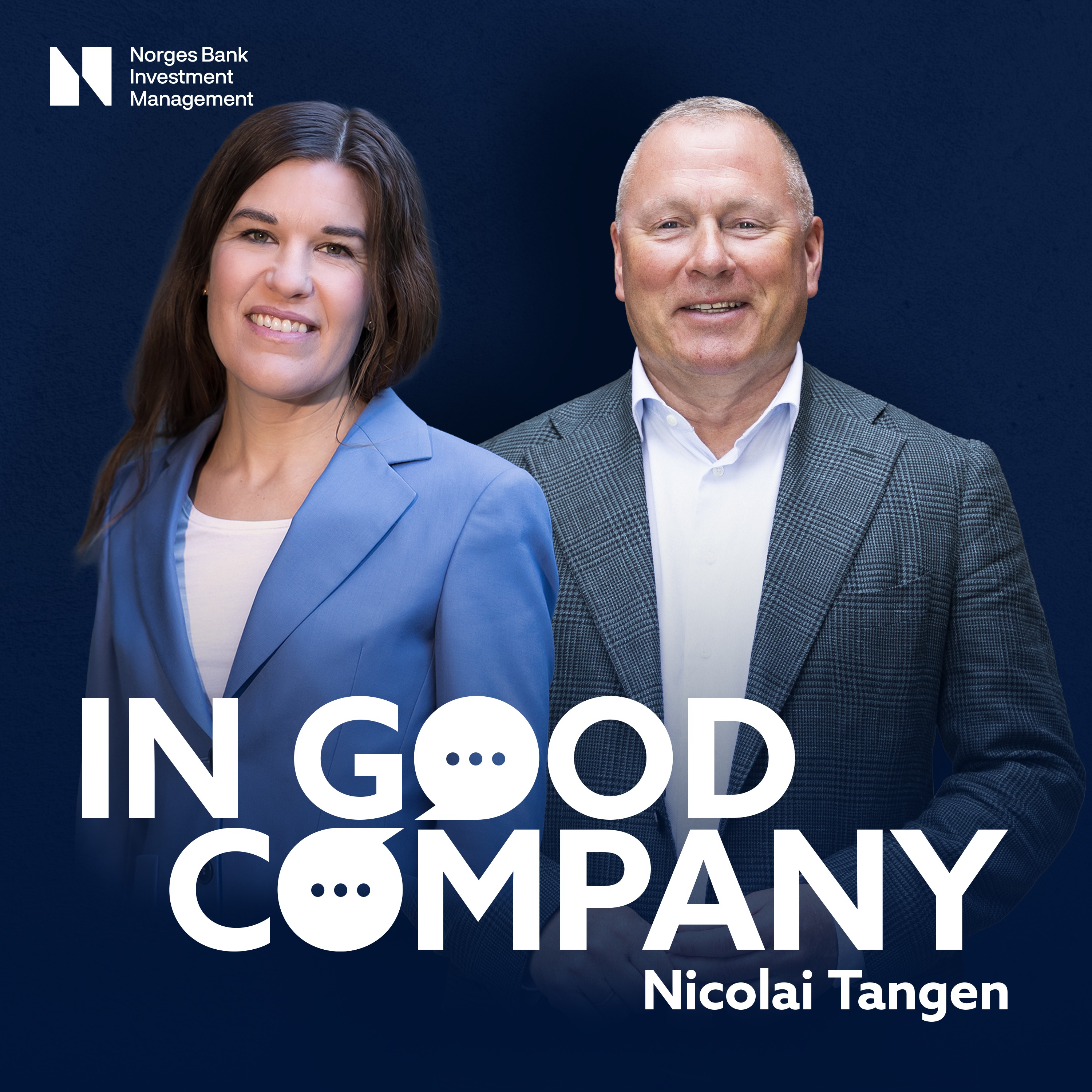
Eric Schmidt’s lessons on AI business models, labor impacts, and regulation; plus the fund’s focus on AI culture metrics and Norway’s Jedrem Committee on investment/ethics.
Eric Schmidt, former CEO of Google; described as a major AI voice, still active in AI and involved in weapon/defense development and Ukraine-related work. Also host Nicolai Tangen and co-host/host Stillen Marthe Skaar (fund representatives).
AI models take ~6 months to build but can be outdated in ~5 months, raising investor questions about sustainability, depreciation, chip lifecycles, and model validity. Europe regulates before it innovates; over-regulation could halt development, so Europe should deploy AI for competitiveness. Companies must change culture faster for AI.
IKEA reskilling instead of layoffs; Norway’s Jedrem Committee report on weapon criteria and Council of Ethics structure; Harvard Business School study on gender gaps in AI usage; token-usage stats showing men use 2.5x tokens (1.6x excluding power users).
Written by AI. May contain mistakes.
Discussion on Eric Schmidt's views about AI, its implications for business, and the labor market.
“This week you spoke to Eric Schmidt, his former CEO of Google and I would say one of the loudest voices on AI.”
Analysis of Europe's regulatory stance on AI and its impact on innovation.
“We for instance in this country we were the first country to regulate away metaglasses in public places.”
Discussion on the need for effective AI implementation to maintain competitiveness in Europe.
“that in order to keep competitiveness in Europe, we really need to deploy AI wherever we can.”
Exploration of how corporate culture needs to adapt to AI advancements.
“So the more efficient you can get, the better it is.”
Examination of gender differences in AI tool usage and its implications for productivity.
“We had the so-called Jedrem Committee, which is looking at several things.”
Nicolai shares his process for preparing for interviews and discussions.
“Also, if it's about, let's say, technology, we will get input from our technology department.”
Preview of upcoming podcast episodes and guests, focusing on various industries.
“You know, you have to zoom in on AI, on obesity drug, on, you know, utilities, on just all types of industries, Chinese car companies.”

Get the gist, explore an idea or ask about something said.
 Claude
On In Good Company with Nicolai Tangen, what are the key points of this episode?
Searching your listeningAutomatic transcript. May contain errors.
0:00Hi everyone and welcome back to our Friday Wrap Up. I'm Stillen Marthe Skaar. I'm Nicolai Tangen.
0:15This week you spoke to Eric Schmidt, his former CEO of Google and I would say one of the loudest voices on AI. Absolutely. I mean, he was very important at Google, but he remains very important in the tech society, extremely well plugged in and very, very knowledgeable. And having seen the whole development and continues to be involved in AI also within weapon production and weapon development and very involved also in Ukraine. A new AI model takes about six months to build and then it might be out of date in five months. How should we as an investor think about a business model like that? Well, that's the really big question when these companies come to the market.
1:00What's the sustainability of the business model? How long time does it take to depreciate the costs they put into it? How long is the model valid for? And I guess the same goes for the chips companies. What's the length of time one can use these chips for? And how do you depreciate? It's really one of the biggest questions when it comes to valuing these companies. What do you think about the changes to the labor markets we might see here? Well, I think it's very interesting. We have always said that we are not going to lay off people in the fund due to AI use. We rather use it to make the company more competitive, better.
1:38we can do more with the same amount of people and so that's how we are looking at it and some other companies are doing that too for instance ikea are saying they're not going to lay off people they're going to reskill whoever is not needed in their current jobs and that's an interesting way of doing it and then you get other companies again which are going to lay off people i think uh if the jury is out we really don't know what's uh how this is going to pan out we really we really don't so it's one of the biggest societal questions we are we are facing just now yeah and And then he also talked about how we should think about this when it comes to regulation.
2:12He says Europe regulates before it innovates and it's something we heard other people say as well. What do you think about that? Well I think that's for sure a fact. We regulate a lot in Europe. We for instance in this country we were the first country to regulate away metaglasses in public places. So we do regulate a lot. we have more regulations than AI, whilst in the US they have more AI than regulations. I think over-regulating AI in Europe is a potentially very unfortunate thing, because you can really stop the development before it started. And if there is one thing we need in Europe now, it's really implementation of AI.
2:55Draghi mentioned it some weeks ago in an article in Financial Times that in order to keep competitiveness in Europe, we really need to deploy AI wherever we can. I think it's interesting that Chinese competition is becoming increasingly forceful in many areas. And to compete against that, we really need to become more efficient. And NII is going to help us doing that. And if you look at the stack, we kind of lost out on the energy side. We lost out on chips, the cloud, the models. And so application is where we still could have a possibility. It should be perfect for us in Europe because we are highly educated, we are digital, and we basically hate working, right?
3:39So the more efficient you can get, the better it is. And the reason why this is important for us is that we have 25 % of the fund invested in Europe. We want European companies to do as well as they can. We want them to be competitive so that they make more money and so that we make bigger gains in our portfolio. so moving on to the fund and the markets and just to continue here with with ai and then in the track of culture because eric also said that most companies won't change their culture fast enough for ai as an owner in thousands of companies how do you think about that no you need to change your culture much faster than you've done in the past and it's tough culture you know corporate culture the definition of that is just how we do things around here and when you've done things in a certain way for a long time it's very difficult to change so cultural change is becoming more important we need to increase the speed the agility the ability to change jobs and so on and it's a very very tough thing any reflections on ai and the culture in the film yes what we are seeing now and we're doing a lot of work on is the the difference in use between men and women And it was something that started with an article I read from, well, it was a study from Harvard Business School, which showed that women were roughly 20 % behind in AI usage.
5:00And so we were running the token usage on a gender basis in the fund and saw some pretty worrying stats. First of all, if you look at it across the board, men use two and a half times as many tokens as women. Now, we got some power users who basically consume a lot of tokens, and 9 of 10 out of those people are men. So excluding that, still men are using roughly 1.6 times more tokens than women. And I think it's a real worry because it is a productivity enhancing tool that we use. we do want to increase the proportion of women in the fund and we need them of course to be as efficient as anybody else but that requires ai usage and so we must just nurture it across all divisions we do have divisions actually where women are ahead of men when it comes to token usage for instance over risk department and and some other parts but it's uh it needs to be at the top of the agenda everywhere and it hasn't been so far.
6:10And then token usage is of course not well it might not be a good example of what you achieve with it but it's a signal. It's one it's it's the one really easily thing to measure and of course outcome is not and success is not dependent on the number of tokens you use but there is of course there is some some relationship between the two. And so, very important. Yeah, so it's important to follow up on this and to give the support that is needed. Okay, so closing in on this segment, what have we been focusing in on the last week? Well, we've had a very important piece of news lately in Norway. We had the so-called Jedrem Committee, which is looking at several things.
6:55It's looking at the weapon criteria for the fund. What should we be invested in? What should we be doing on the nuclear side and so on? And the other thing is just how should the Council of Ethics be structured? Should it be inside the fund, outside the fund? How should we publicize potential exclusions? How should we use ownership and so on? And so we had a great report coming out. It's spurring a lot of discussions in Norwegian media. It's now going out on hearing. It means that all the interested parties will come and comment. and then it will go into the white paper and the political discussion in the spring.
7:32And this is really exciting times and it will decide how we're going to work with these important issues going forward. And then we will come back with our comment as part of that hearing. But it for sure will be interesting to follow and very important. So moving into the last segment, Nikolai, I would like to ask you some questions about how you're preparing for all your podcast conversations and the interview you do with CEO and business leaders? Yeah, first of all, I get a lot of help from the great colleagues in the fund. And so typically we have one person running the prep work, speaking to our industry analysts and get questions from there.
8:14Also, if it's about, let's say, technology, we will get input from our technology department. Sometimes I put out a general question for help on our internal communication channel. So for instance, when we did the one on Tinder, I have never used Tinder. And so I needed to ask my colleagues for help and my kids, by the way. And so then we get like a framework and then I continue to work on it. I listen into podcasts which are relevant, which the people have done previously. I read the interviews that done in the various papers. And then I think what could be interesting questions, what could be interesting angles.
8:52And then sometimes I shoot emails to people I know who are in the same business or industry and they help me. So it's a lot of kind of crowdsourcing of ideas. But how important is this research phase for you for how you're developing your thinking? Well, it's super interesting and important. It's how I read up on new businesses and new industries. Now, if you have a job like this where you need to be generally informed about what's going on in society, to have this opportunity to read up and zoom in on all these various topics. It's incredibly important. You know, you have to zoom in on AI, on obesity drug, on, you know, utilities, on just all types of industries, Chinese car companies.
9:39Everything is really playing into what makes capital markets so vibrant and so dynamic. I agree. And the research phase is, one thing is it's super important, but the other thing is it's much more interesting. Absolutely. Than one would think. And talking about this podcast, Nikolai, because you have several upcomings, particularly that you will do in New York. Yeah, absolutely. We have a very cool lineup. I'm interviewing Henry Cravis from the founder of KKR. Michael Moritz, who was at Sequoia to talk about the venture capital industry. Schulman from Verison, my friend Uvrid Shama, who writes for the FT and who is always a very, very popular guest.
10:24And I'm doing one with Jeff Koons, the artist, because we want to explore also art as an asset class. And I think that's going to be great fun. If you have any questions you think we should ask these people, please ping them through on LinkedIn. And remember to listen to the episode with Erik Schmidt. Thank you. Happy weekend.
10:47Thank you.
This week’s Friday Wrap-Up looks back at Nicolai Tangen’s podcast conversation with
Eric Schmidt, former CEO of Google and one of the most influential voices on AI.
Marthe Skaar and Nicolai discuss how investors should think about a business model
where a new AI model takes about six months to build and may be out of date within
months.
They also cover why Nicolai believes over-regulating AI could hold Europe back, and
why companies need to change their culture much faster than before.
They also look at the gender gap in AI use at the fund, and Nicolai also shares how he
prepares for his podcast conversations. Finally, he gives a preview of his upcoming
guests in New York. Tune in and find out!
Listen to In Good Company with Eric Schmidt: https://www.nbim.no/no/nyheter-og-
innsikt/podkast-in-good-company/2026/eric-schmidt-the-age-of-agents-
superintelligence-and-why-europe-is-falling-behind/
The Friday Wrap-Up is hosted by Marthe Skaar, Chief of Communications and External
Relations, together with Nicolai Tangen, CEO of Norges Bank Investment Management.
New episodes of In Good Company air every Wednesday, with the Friday Wrap-Up
following each week to break it all down.
The production team for this episode includes Halvor Pritzlaff Njerve, Isabelle Karlsson,
Line Aaltvedt and PLAN-B’s Niklas Figenschau Johansen.
Hosted on Acast. See acast.com/privacy for more information.


