
 Ask ChatGPT


 In Good Company with Nicolai Tangen
26 Nov 2025 · 1h 12m
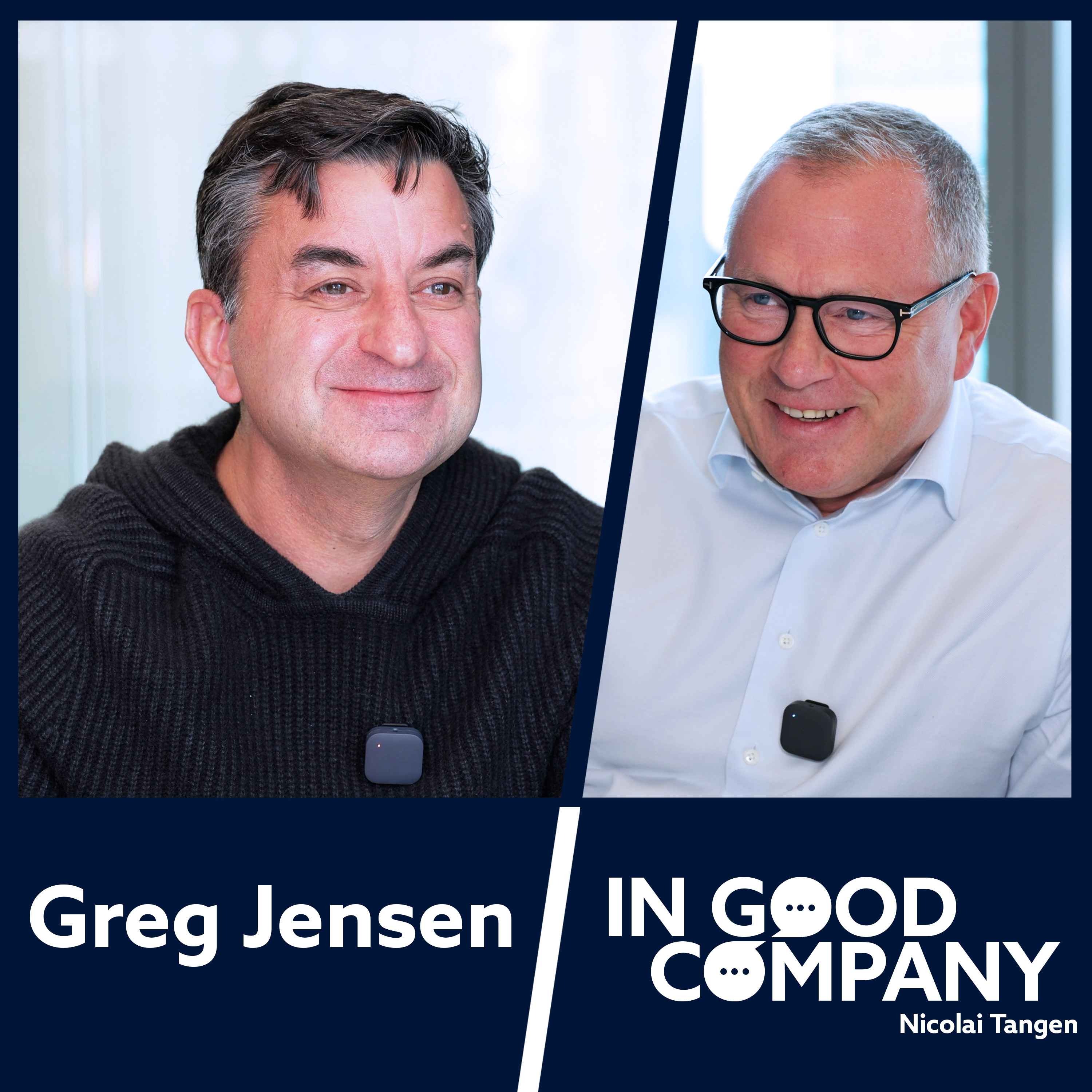
Description: Greg Jensen, Co-CIO of Bridgewater Associates, discusses the evolving landscape of global finance with Nicolai Tangen. They delve into modern mercantilism, the AI arms race, and the significance of radical transparency in decision-making at Bridgewater.
Written by AI. May contain mistakes.

Get the gist, explore an idea or ask about something said.
 Claude
On In Good Company with Nicolai Tangen, what are the key points of this episode?
Searching your listeningAutomatic transcript. May contain errors.
0:00Hi everybody and welcome to In Good Company. And today I'm here with Greg Jensen, who is the co-CIO of Bridgewater. Now, Bridgewater is just an incredible hedge fund, the world's largest and best, I think we can say. And it's an honor to have you here, Greg. Thanks for having me.
0:27What are the most important things you are spending time on just now? What are you looking at? Yeah, if I said sort of at the biggest level, the three big themes that I'm concerned about or focused on are, A, the change in how the global and U.S. economy is being managed. Essentially what we call a shift to modern mercantilism. That's been a reaction to China's rise. It's created political changes across the West, probably most clearly in the U.S., leading to a whole different philosophy on how to run the economy. So that's one big theme, modern mercantilism, the way the U.S. is operating both with respect to economics but also with respect to geopolitical conditions.
1:14Huge change, really important to understand. The second is the technological change that we're in the midst of. I've been, as I'm sure we'll get into, think about and working with AI for a very long time now, machine learning for 15 years and more generally my whole career. And I remember people used to say, Craig, why are you talking about AI all the time? Nobody says that anymore. It's nice to be right at the end, isn't it? Well, there's a lot of being wrong along the way, plenty to be wrong about. But that, it's so important, right? It's a third to half of everything, geopolitics, markets, everything.
1:53You have to understand it to understand the macro world. And third, that all is happening in a world where capital is more concentrated in the U.S. than ever, more concentrated in equity and illiquid assets. So a kind of risky setup. So understanding where money has flowed to, why it's flowed there, and how likely that is to change. Those are the big three headlines. Well, let's unpack them one after the other. What are the implications for investors that we are moving towards mercantilism? Yeah, well, I think it's a big shift. If you're thinking the economy works the way it used to work, it's a really important change, right?
2:39If you take – there's a major change in the 1980s, a shift towards small government, a lot of capitalism, a lot of like kind of freedom of the private sector to a very different view, right? That because China has risen, because you've hollowed out the middle class in a lot of the West, you've got a political reaction. It takes different forms, but you've got a political reaction in the rest of the world. And in Trumpian kind of mindset, the basic issues are, OK, you need the government to step in and stop what's been going on in terms of the neoliberal consensus on trade. You need this to basically protect U.S.
3:19industry in order to be geopolitically strong. You can't be dependent on other countries. So you need to be independent, looking at trade as a zero-sum game where if you have a trade deficit, that's actually a problem for your wealth. And that that, along with other elements that come with more government control on these things, corruption and other things, have changed the way the game is being played. So for investors, you've got to adapt, right? But if I, 12 months ago, had told you what the world would look like now in terms of mercantilism, tariffs and so on, what would you have expected markets to have done?
4:01Yeah, well, if it's only one thing changing, right, you would think that this would have led to a bit of a shift away from the US. You would have thought that people would have taken down their massive risk concentration in the US because it's changing so quickly. You need more of a risk premium on those assets. And you're getting more like the U.S. from an exceptional place to invest to a more normal place to invest. But it hasn't quite happened, right? Exactly, because it's not the only thing going on. If you look underneath the system, right, in one way it did in the sense that if you look at U.S.
4:32equities for the first time since American exceptionalism really emerged post the global financial crisis the last 15 years, you've had the worst performance of U.S. equities relative to the rest of the world equities in common currency terms that you've had over that 15-year period. So under the surface, you're seeing it. But the U.S. is, of course, buffeted by the other big thing we talked about. AI is sucking up incredible amount of capital. And that's about to enter a new phase. We'll get to that. But you've got this, like, yeah, modern mercantilism, people are questioning the wisdom and the rule of law in the United States.
5:06You see that across institutional investors, et cetera. But you have an offset in that where else are you going to invest in the technological revolution that's going on? You've seen that massive offset. And so what looks like calm on the surface, right? If you said S &P 500 is having a perfectly good year, very similar to every year. And if you look at bonds too, everything looks fine on the surface. If you look underneath that, split up the equity market. Well, where's that equity coming from? How is the U.S. equity market X, the AI names, doing relative to investments in the rest of the world?
5:36If you look at gold as another example where you're seeing the geopolitics play out, those places you see it. And so I think you can make a mistake of thinking it's not happening by looking just at the calm of the averages versus what's happening beneath those averages. So you've been talking about AI for a long period of time, and now it's happening. And so how is it panning out compared to how you thought it could pan out? well on the big trajectory pretty much in line so for me if i go back i um i came to bridgewater 30 years ago and one of the things that attracted me is bridgewater is now just celebrated his 50th birthday so bridgewater i've been around for 20 years at that point well you you came straight from dartmouth straight from dartmouth in 96 in 96 straight from undergrad and i was attracted to bridgewater it was a tiny place five 40 people tiny place at the time but i was attracted to the basic concepts, which was, A, that you would have the discipline to take all of the things you believe, write them down, and stress test whether they're actually true.
6:38What an important thing that fit really with my personality in many ways. But I said, this really makes sense to me. And on what questions? On the questions of how does the macroeconomy work? How do markets set prices? Take all of your human intuition, translate that into algorithms. And in that phase, Bridgewater, and I believe it's probably the most profitable expert system that was ever created. We built an expert system for how you do that. Everything was human intuition. I worked on how do you take hundreds of people, really smart people, how do you get them to take their intuitions, put them into algorithms, do that.
7:12My expertise was generating those intuitions and building a community of people who deposited their intuitions into our compound understanding massively. Then about in 2012, I said, okay, how are we going to – when will machines write the rules? Not just support the rules, which we've been doing, having great technology, support human intuition. But when will their intuition actually be better than human intuition? Right? And that – I started on that journey in 2012, and they were nothing like that. There's big data, great pattern matching, but there was nothing like intuition. But I was looking for the pieces that I knew we need.
7:49We needed a reasoning engine. to generate intuition. And we needed certain pieces. You needed language models to come along. You needed diagnosability to come along. You needed to figure out how to deal with small data problems where you don't have a lot of data. And I went through the world and that journey brought me to OpenAI. I was in the first round of investors in OpenAI because they were doing unique things. When was this? That was, I think it was about 2016. and so Elon Musk had just stepped aside and they needed funding and they were deciding to You invested in it on behalf of Bridgewater or No, personally.
8:30We had different views of Bridgewater at the time on how to handle AI. But so I invested in that personally and I because I was interested. I wanted to see how can we build these pieces together. I was also very interested in AI safety issues and so anyway I was there for that. Got to know a lot of the scientists and the thinking which brought me to Anthropic later on when some of the best scientists I knew started Anthropic. It was literally the first check there. But all that was a journey to find, how can we find these pieces we need to create reasoning that could compete with humans? And most importantly, along that journey, I met Jazz Seacon, who's our chief scientist at Bridgewater.
9:05And now we've built an artificial investor and continue to make it better. When did you hire him? 2018. So he was a professor at Berkeley working on some of these small data problems. He was working with private companies as well. But it wasn't in our field, but what he was doing was exactly what I was looking for. And he's an incredible genius. And so brought him into Bridgewater and we started working together. And still the technology wasn't ready for what we wanted to do. 2022, I said, the technology is almost ready, that the pieces we needed, we could start building an artificial investor.
9:39We started that March in 2022. That was Chachi Petit basically at the same time. Right, right around then. All the tools were coming together at that time that I thought we could get all our pieces and we could actually build an artificial investor that could compete with me and you on how do you think about the world? How do you actually generate intuitions about the world? How do you write rules to say, okay, this is how I would apply that intuition? And we then by 2024 thought we had a smart enough investor to generate alpha in the world and have been doing that. We're with some of our incredible clients.
10:13And so right now, my role is running Pure Alpha as managing CIO of Pure Alpha, where all the human intuition sits, but also running this separate entity that's designed around a machine learning agent. But we'll come back to this a bit. But just so from there, looking at what's been happening to the market, the AI stocks, you know, the chip producers, and so on? How is the market reaction to this panning out compared to what you thought? Yeah, and I'd say that's where it's panning out. I think people were way underestimating. The phase that we were in before, I used to say, the bubble's ahead of us, not behind us.
10:56I get the question, starting with TGP moment, more or less, is this a bubble? And my thought was, I think there will be a bubble, but we're nowhere near the bubble phase. We were in the phase where people have no idea what's hitting them, like meaning how important this is and how much is going to get invested, because this is not a typical cycle. When you have people like Elon Musk and Sam Altman and Google and so on, whose businesses are threatened and believe that the power to control Earth and the universe is only a couple years away. They're not motivated by this normal profit incentives of the typical cycle.
11:35It's not a CapEx cycle. That's the same as other CapEx cycles. This money is going to get spent, right? I'm thinking that in 2022, 2023. They're going to build this out. Maybe someday they'll be proven this is a dead-end path, but we're so far from any possibility of that happening that the data centers are going to get built out, the semiconductors we're going to get used. That has played out. So where are we now? So now we've just entered what I've said is a more dangerous phase. I still don't think we're in a bubble, but we are in a more dangerous phase for the following reasons. That A, we're in the resource grab phase.
12:10Now to do AI, there isn't enough resources to go around. So everybody's trying to grab their resources. Microsoft's got all the land where you can get power on the grid. They've done a great job of getting that land. Other people need to figure out places off the grid to get power. NVIDIA's supply has been bought up for years to come in the future, and so on and so forth. So you're in this resource grab phase. Compound growth is easy to do when it's in cyber. In the tech world, you can do that. But now it's in the physical world. To continue growing 50%, 60 % a year. Tell me about the land grab a bit more before we...
12:50We're also going to cover capital here as a third point, but tell me about the land grab. So what are the important elements of land grab? Yeah. Basically, to control this, you need power, you need ships, and you need scientists. What's going on with all of those? Everywhere you could get power. I don't know last time you were in Abu Dhabi, but it's just incredible. If you go to Abu Dhabi and you sit in a cab, like the cab driver and his brother are building a data center. Anywhere you can build power, they are building data centers. Maybe Europe's the exception. But everywhere else, you get power, you put chips in there, and you're building a data center, and the rate of that is huge.
13:31So you have to get, where can you get the cheap power? Who gets it? Where do you get the chips? So the power, you don't think it's kind of overhyped? Do you think that's that whole I don't think it's over a height. I mean, I understand that. Like, one of the real challenges, the whole thing has this risk that the depreciation schedule is probably going to be quite fast. And you hope it has to be in a sense that if you take Anthropics Mission or OpenAI and Google, like, the idea of building AI that builds faster AI, one of the things they have to do is figure out how to make the chips more efficient, make the energy more efficient.
14:08And they're trying to use AI to do those things. And given what Google achieved on protein folding, et cetera, I think some of the scientific advances that will depreciate the current assets will come from those assets themselves. The AI will generate better ways to do this. So that's the power. And then the chips. Just to finish that. But in the meantime, everybody needs power so desperately. And there's such a shortage in the West. That is a huge problem. China is a different picture. But that is – I don't think it's overrated right now for the reason that I just described. People really believe – many people believe, including myself, that incredible power is at the other side of this, meaning like power to control outcomes on Earth, the fountain of youth, et cetera, these types of thoughts.
14:53Then, man, people are going to use every resource available to get there. And so I don't think it's overhyped is the first point. The second on chips, you were going to ask the same thing. And also the kind of the circularity and the vendor financing and so on that we're seeing here. Yeah, good. So the first part I'd say the land grab on chips is, look, everybody needs to, if you want to get to the next level and the next two levels of models, right, this is what exponential growth is really hard to keep up with, right? It was one thing to grow 60 % a year when you're small. Now, to grow compute 60 % a year, if you extrapolate that out for three models, you've got data centers everywhere on Earth.
15:34That's obviously not going to happen. Things have to change to prevent that from happening. But that exponential growth is incredibly hard. And the chips are so scarce that you need that NVIDIA is now in this position, and this goes to the vendor financing. People look at this vendor financing and think it's because of normal bubble dynamics. This is how they're going to get their revenue. Not at all. NVIDIA could get as much revenue as it wants. They have no problem selling the chips, but they don't want to set up a system where they lose their competitive edge. Their problem is Google is a true competitor.
16:06Google is trying to go the whole stack all the way down to the chips. They don't want Google to win or they don't want Google to be the final win. So they're trying to control the ecosystem. They're like Standard Oil in the Gilded Age trying to create monopolistic control on things, so create their own ecosystem and sell their chips to people who need their chips, who will not create an alternative to their chips. So what you're seeing is a design of the ecosystem where there's a Google ecosystem. There's somewhat of an Amazon ecosystem. And then there's an NVIDIA-controlled ecosystem that has, let's say, open AI, certain models on the top, and goes all the way through all the steps that Google has.
16:47And that's what you're seeing when you're seeing all these deals is everybody's got to lock up. Who do I partner with? Where am I going to get my chips in power? And if I don't do it, I'm going to die. Yeah. What about the land grab of scientists? Yeah, well, you're seeing that's like the toughest one, right? Because there are not that many cutting edge scientists. How many are there? How many really good ones? I mean, it's probably not a great question for me, but I think less than 1 ,000. And so that's really constrained. And if you're meta and you don't feel like you have the scientists, but you have the chips and the power, you get the scientists, right?
17:26And you're seeing this actually really bad phase. And you kind of buy them at a very high price. You buy them, right? But then you're buying the ones who are buyable. That's always culturally, as you know. That's a cultural issue. And, of course, then they're also buyable again, meaning, like, this is one of the problems. If you take how fast, if you're, like, things that are going badly in the ecosystem is, too many of the scientists, too many people, naturally, are drawn to, like, where do I jump to get the next paycheck in that when you're trying to do a hard job? So the soccer players and the transfer season.
17:56Exactly. So that's really bad. Now you're seeing, and this is where I would think, you see differences in the labs. There are people that went to Anthropic because of the mission. Many of them are there. I'd say their ability to maintain their talent is unique because the people that went there are there for a mission that's a little bit different. Now everybody has them. I don't blame anybody. Everybody has greed in them to some degree. But you're seeing differences in the different places of who can hold on to scientists. And so in a different two entropy, who else can hold on, you think? I think Google is doing a good job of holding on to scientists and have been fighting this culture for a long time and have a lot of raw material.
18:37That's incredible. Otherwise, it's just very, very hard. You're seeing some startups like I'm very impressed with Thinking Machines. I think they have great people there, but they just got there. And who knows? And so I think when you look around, this is sadly slowing down scientific progress in a big way, this sort of everybody jumping around and not – it's going to take – some of the big breakthroughs are going to take a team working together for an extended period of time to get through. I think they're very possible, the breakthroughs that are missing in AI today. But with everybody jumping around, that's certainly slowing it down.
19:17Okay. So just to remind everybody of the structure here, we talked about the economy, mercantilism. We talked about tech, where we touched on power, chips, and scientists. And then the last of the three points is capital and all the capital that's gone to the US. So what are you thinking here? Yeah, it's super interesting because these two other pressures cut against each other to some degree. But I think the economy has changed. Just back on mercantilism for a second. And the U.S. is no longer the U.S. that has been post-World War II. The idea of global institutions and even what the U.S. currently sees in its interest has changed radically.
19:55The U.S. was always pursuing its interest, but what it saw is in its interest of international cooperation and things like that have changed in a significant way. So I think you are seeing that start to play out. We're still in the very early phase of what the next steps are. What is the retaliation from the rest of the world against what the U.S. has happened? One of the things that surprised me this year is that the U.S. came out as a bully in a sense. Like came out and said, OK, we're going to raise your tariffs and you're not going to do anything about it. And everybody except for China went along with that.
20:31I was surprised. Honestly, I remember the conversations with members of the administration saying, like, how are you going to do this? Like they're going to hit back and we are desperately in need of the rest of the world, not because of trade, but because of capital. So why are they not taking back? I think people – first thing is Trump has been successful in picking people off, right? If you try to punch back, he raises the tariffs even more. And there is like a problem of all the countries being smaller and so they can't punch in the same size and they take the risk of being picked off. So that's one reason.
21:07I think beneath the surface, though, on things that are less obvious, like how do you invest, etc., you are seeing countries. You're seeing certainly the lawmakers in Canada saying, OK, we've got to invest in Canada. You're seeing home bias everywhere as a reaction to this. I think you will see more of that. But the punching back is difficult with Trump in the presidency because he's going to punch again and you have to be up for that fight. But what you see in the politics, which will lead to this, is the U.S. goodwill among the rest of the world's voters has collapsed. We saw from 2024 to 2025 the biggest collapse in support for the United States in the rest of the world that we've ever seen.
21:47And what are the implications of that? What you're seeing is populist, mercantilist candidates gaining ground everywhere. So I think you're going to get the first wave is a shift to the populist right everywhere. And you're seeing that if it's the AfD in Germany, if you, I mean, shocking, but if the UK had election today, I think I might be out of date by a couple of weeks here, but Reform Party would win. I mean, take that compared to five years ago. That's like an insane thought. And same thing, France, et cetera. So a shift towards populist to people that are going to take care of their own countries in that way of a populist right kind of thing.
22:26And of course, what the populist right then sets off is more strength than the populist left, the New York City mayoral election or whatever. But you see this shift towards populist right, populist left and the continued, just like you had the hollowing out of the middle class, you've had the total hollowing out of the middle of the economic, of the political spectrum. And that's the world we're going into is this probably shift to populist right. If those policies don't work, shift to populist left. And that's the dynamic. And the populist right, the hit back, even though they're aligned to Trump, is just more domestic, more focus on their domestic issues and less international cooperation.
23:09So now we have painted the world, right? Yeah. What are – so when you then look at what it's going to lead to in terms of economic indicators and developments, let's kick off, for instance, what are the implications for inflation, for instance? Yeah. And so if you take the things that just happened from a marketless perspective, they're clearly inflationary. Two big things, right? You get tariffs, which creates rather than being able to secure your pipeline in the cheapest way, you have to secure a pipeline of goods that's more resilient and more domestic than cheap, right? So, A, that's inflationary.
23:49One of the huge benefits over the last 30 years was the productivity change by taking advantage of the cheapest and most efficient places to build things. That's totally wrecked in the world. Even you thought, OK, we'll get out of China and go to India. Well, India's tariffs are now higher than China. If you're an international company, this is incredibly hard to build that. So that's inflationary. Secondly, the big inflationary push from this is everywhere you're seeing a fiscal reaction. right? That Germany, most extreme, but a great example, A, you got to build your own military now. You have to get off the dependence on the U.S.
24:24You got to build your own military. And there's nothing more inflationary really than military spending because it creates demand for labor and demand for goods with no supply into the real economy. So you've got military spending surging at non-war time, incredibly fast rates. And you've got military spending, plus you've got the need to rebuild the infrastructure so that in Canada's case, but just in Europe's case too, you can't ship to the US as much anymore. How do I get my goods to other places? And those pieces are inflationary. And the magnitude of this, so how much worse do you think inflation will be than the general consensus?
25:08Well, let me say the flip side of that is, on the other hand, growth is dominated by this AI investment. AI investment, while starting to take up power capacity and whatever, is very low labor intensity relative to the unit of GDP. So you have a disinflationary, weak labor market because so much of the growth. If you take U.S. growth this year, right, you can have a normal growth year. This is the same thing as the averages, 2%, 2.5 % growth. But without AI, it would be 1%, right? So and that 1 % of growth that's coming from AI investment, it's very non-labor intensive. So that's a disinflationary effect.
25:51Net-net. Net-net, I think we are inflation, particularly for the next couple of years, is going to be a significant constraint on policymakers. That you're running around like break-even inflation is around 2.5. half. We think the Fed is very comfortable above two and a half. And probably we're in the three range as a base right now with the risk that these things push higher. But the AI story, right? And this depends, all these investments have a J curve. In the first phase, you don't get, you spend a lot of resources, you don't get a lot of output other than the investment itself. But then you get the part of AI that will eventually be highly disinflationary, although I think that's further out.
26:35And in the meantime, central banks, it depends a lot on what central banks choose to do. You know, the U.S. part of populism, certainly in the U.S., is getting control of the central bank, taking it into executive power and getting them to lower real rates, which lowering real rates into a boom like this is particularly inflationary if it ends up going down that path. Economic growth. Yeah, so growth is going to be this two-track economy, right? I think you're going to have good growth in the United States and generally decent growth because you've got this fiscal thing in Europe and you've got this in the U.S.
27:11You've got AI where growth next year is going to be further pushed by this AI push. And so growth in the U.S. we think will be a little bit above potential, like 2.5 % growth. growth, but a lot of that, 1.5 % or so, is going to be AI. So you're going to have a weak, probably weak labor market, weak economy in many places while you have this huge boom in a very concentrated sector. So what about budget deficits and the government debt situation? Yeah, that's another aspect of what's changing in the world is you've got, you've put yourself where, let me just say one thing, at the beginning of the, you know, at the beginning of this year, a little before the beginning of this year, I wrote a piece called We're All Mercantilists Now.
28:00And I'm thinking about the piece for next year, which is a little overstated. I'm not quite there, but something like We're All Brazil Now. And what I mean by that is Brazil for a long time has been constrained, despite having their debt mostly in domestic currency now. It's not like Brazil in the 90s where the problem was having dollar-denominated debt that they couldn't fund. But despite having most of their debt in domestic currency, they're very limited in what they can do. You're starting to see that. The U.K. is in that position. And that changes the dynamic. When you have fiscal policy and you have a lot of room, like Germany does as an example, and you announce a big fiscal policy, what happens?
28:33Your currency goes up. Your stock market goes up. When you have – and interest rates go up a little. So when you're the UK, if the UK said, I'm going to do what Germany's going to do, I'm going to write a big fiscal check, currency would go down. The equity market would probably go down, although that's a closer call. And interest rates would rise a lot. And so what you see now is more developed world countries constrained by hitting the limits of fiscal policy. And the limits of fiscal policy are complicated. It's not like a simple number like you could take Japan. They can have 300 % of GDP in terms of their accumulated debt for the government.
29:11And in Brazil, you might hit that limit at 60%, 80%. The difference is how much domestic savings you are, how much productivity you have, how much willingness there is to save in your currency. But all countries have limits. And we are testing those limits in certain countries, which means you're moving from a world where policymakers were unconstrained. When something went bad, they could lower interest rates and spend money. to a world where more and more countries, including by our measures getting close in the U.S., are constrained, where actually when you get constrained, spending money becomes counterproductive rather than productive.
29:47That's the case in the U.K. and Brazil today. And the U.S. is drifting towards that line as well. I think we're in this death march on institutions. You've already seen that. The World Trade Organization, what does it even do now? I mean, international institutions are gone. And in the U.S., the domestic institutions are fading fairly quickly. Although I will say it's been interesting, and I do think we're going to face this next year, that they're going to put in a chairman who's going to, for the first time in a very, very long time, I don't know if this ever happened in the U.S., where the chairman's going to get outvoted a lot.
30:20That'll be an interesting period while the Trump administration tries to get more governors in who will vote in line with the new chairman. But for a while, you're going to have this very divided fed and where the chairman may be in the minority.
30:41So now we have set the scene for what the world looks like and what it's going to look like. So here I give you all my money. Greg Jensen, could you please take a look after our money? What do you do with it? well just again so you so let's say it's a hundred just where do you put the money and how do you invest it yeah and the main thing that i'd say is different in our philosophy than most is i i would say the way i would take your hundred dollars is is to say how do we survive in the wide range of possible worlds yeah rather than try to pick the best thing yeah and um and that is very different right if you take basically the last 15 years i'm sorry is that the way you always think let's survive rather than let's get rich?
31:28Or do you just think that's the way to get rich in the long term? I think it's the way to get rich in the long term. And that because basically there's a lot of ways to make money in the world. The main thing you want to do is avoid really bad outcomes. And that's how compounding wealth works. If you keep earning more and you're in the game, you'll be able to compound wealth in an incredible way. So for me right now, if I look at the world, I think it's very dangerous. And this depends, because you have this home bias move and a lot of the geopolitics, literally where you're located. Being located in Norway is an advantage and disadvantage in certain ways.
32:00Being located in the U.S., advantage and disadvantage in certain ways in terms of what you should do. But to me, where I think most people, the last 15 years, are a trap. Most people have moved away from diversification because it hasn't worked for 15 years. All you needed was the U.S., U.S. equities, and more illiquid, the better. That That has worked incredibly well. I think it's mostly a trap. So the ways I would do this is, look, get a much more globally diversified portfolio than most people have. And because you don't know where the winners and losers are going to be and the change in the U.S.
32:35are quite radical. What about Europe? Yeah, look, I think Europe is investable, like even though we agree. Hope so. We got 25 % of the money there. Yeah, yeah. And that the fiscal changes. Look, there's two things that have changed a lot in Europe. The fiscal move, the move like, look, you can't build this economy on exporting to the U.S. and you can't build this economy on exporting to China even. that you've got to create a more domestic economy, a shift towards fiscal policy. Fiscal policy works in the profits of domestic companies. And you need to move to a more independent economy in Europe.
33:15And I think they'll do that. And companies in Europe have seen what's happened to the U.S. And in some ways, unfortunately, not in the technological domain, which is a massive problem, But on treating shareholders better, on returning money to shareholders, buybacks, et cetera, that Europe has actually moved to a more shareholder-friendly place in many ways than it was for a while. And the companies that are bigger, if you look at companies that directly compete between Europe and the U.S., they're generally priced cheap. And a lot of cases, the European companies actually have better earnings and better management than the comparable companies in the U.S.
33:55Where does China come in? So again, this depends a little bit where you're located because the biggest risk of being invested in China is your government saying you can't be invested in China than the risk of being in China. Look, I think China is really important to global diversification. They have taken a big step. You were in this big deleveraging in China. The deleveraging was playing a certain course. You also have obviously the challenge that the party in Xi in particular needs the party to be more powerful than the companies. And so you went through that phase really badly. But what they have seen is if they want to compete with the U.S.
34:29on AI, and this is worth taking a minute on, which they now know they need to. It's existential. They determined this about a year ago. It's existential to compete on AI. They need the private sector to do it. They watch what happens in the U.S. They see the U.S. has so much more funding to AI because the markets work well. The equity market works well. It gets a tremendous amount of funding beyond what any government could do. And they've shifted. You've seen the shift bringing Alibaba back in, saying, OK, we've got to go do this. And they need the equity market to function, to do it. They know it.
35:03And you've seen the shift there. And they have incredible, unlike Europe, there's incredible technological ingenuity there that while they're behind in cutting edge AI, they're probably on the cutting edge of applying AI in businesses in China. And bonds, bonds and equities, how you split it? So bonds, I think, are, again, depends a little bit on your starting point. I think most people got out of bonds, many investors got out of bonds when interest rates were zero and interest rates have risen and real interest rates have risen such that there is a place for bonds in portfolios. But I would say you really, bonds are not what they were for the last 30 years.
35:44That these fiscal limits are really important. All of a sudden, the correlation between bonds and equities and currency will shift when you hit limits in the UK. You have a very different diversifying instrument than you had before. And B, when fiscal policy is such a powerful lever, the big thing bonds diversify against are major deflations and disinflations. But if you believe if there's a disinflation, they're going to just push on fiscal, they don't hedge as well. So I think bonds are risky into this and particularly the massive supply that's coming, the fiscal supply, massive. The need now for the next wave of AI, AI ecosystem used to be a net capital provider of the world.
36:26The Microsofts, the Googles, they were so profitable. They were buying back assets while investing a lot. Now you're about out of that. They're basically spending their cash flow. When you look across that ecosystem, they need a lot of money. You're seeing that in private credit. And that's going to be sucking in money. So you're going to have the shortage of capital, both between fiscal and AI, that's going to create, I think, problems, potential problems for real rates. Although what's fighting against that is central banks in the U.S. that want to drive down real rates. But the picture I would say is that you're going to have this big competition for capital between fiscal and AI moving from a world where you had an excess supply of capital because you had huge savings in Europe and in Asia to a world where Europe, Asia and the big tech companies were big savers to where Europe, Asia and the big tech companies are becoming spenders.
37:19Real estate. What do you do with real estate? I don't know enough. Crypto, what do you do with crypto?
37:28Look, I think it's most, my view on this, I started studying crypto around the same time I started studying AI. So 2012, 2013, 2014. My thought then, which hasn't changed much, is this is not very helpful technology. This is a complicating thing. Do you understand it? I think so. And my basic view of the use cases back then were mostly speculation and the thing and the use cases have largely worked out that way. And I thought at the time, like, AI is a much better bet on how the future will go than crypto is. With, like, I think there's obviously a place for Bitcoin in the sense that you, in this world, if you don't trust governments and such, having a way to move money around the world, Bitcoin's obviously the best choice.
38:18It is a replacement in some ways to gold, although in many ways it's not. We could get into. And so I think that has some merit to it. You have the two problems of you have a very intense bubble corruption thing going on in that area. And you have some - So what do you mean in that area? What do you mean by that? Cryptocurrency was like a, it was a magnet for the most corrupt people in finance because there's low, I mean, just for the reasons, low regulation. Is it still? Yeah. I think so. I mean, bubbles are always, but I would say the crypto area is just focused for that edge of corruption. If you look at the companies that just buy the Bitcoin and put in their treasury or whatever, like the things going on there, I don't think they're supported by the use cases.
39:11and I think the idea, like it is possible because there is some good to the idea of taking a database and then distributing it so that no one person has that power, no one entity has that power. You get the need for that in this world, particularly in the world, but that's what it does. That's a more inefficient database. It may be necessary because you can't trust anyone, but it's basically built on a technology that deals with a trust issue that makes it more inefficient. Living in a world without trust is a very inefficient world and crypto represents that. Very good. So, Greg, here we're going to play a little jingle so that people can get a cup of coffee.
39:47And then we're going to move on to Bridgewater.
39:54Why has Bridgewater been so successful? I think the most important thing that Bridgewater did well was to say, A, we're focused. Two things. How do you deeply understand how the global financial system works? And how do you build great portfolios? Those are the two things that we do. And then to drive that, the idea that you have to do that by compounding understanding. You have to have the discipline to write down what you believe and why you believe it. Share that with others so that they can assess what's wrong about that, what's right about that. Build that out and keep compounding understanding.
40:36So to me, basically, the focus on those things, getting a culture of people who care deeply about how those two things work, and then taking everything we ever learned and having the discipline to write it down, translate it into algorithms, and keep moving forward that way. Those are the magical pieces. But is it possible to compound knowledge within an organization like that? I think it's very, very difficult. But yeah, I definitely think it is. because... I mean, so now, let's say now I joined Bridgewater. So how do, so then I have access to everything you have ever thought? No, because of security, but you could, like meaning like if we didn't have security constraints, we could make that all value.
41:18You could literally see everything. And one of the amazing things that we built, which I think is super important, is not only everything, how it changed. Every time we learned something new, what we replaced with what we built, that's all available, right? I can go in there and see everything. And for what it's worth, AI could read over everything we've ever believed about markets, all the rules we had, how we changed them, why we changed them. And why is that good to have? Because you can't carry in your brain all of the things that you've thought about and forgotten, not even just that you've done.
41:53Now we have hundreds of people that have studied these issues in China that if you start and you start from somebody's understanding, that's been what we say is to compound it. What I mean by that is it's got to be human readable and computer readable, meaning like a human's got to be able to pick this thing up and make sense of it. And a computer's got to be able to run it. And that is extremely, extremely powerful to have that everything that we've ever believed. Where else in society do they use a similar type of system? Well, I think if you look at, I mean, this is how society progressed, right?
42:29Like writing was such a, if you take major, major technological advances, right? The printing press. And once you started being able to compound human knowledge through the printing press, et cetera, that is like at a society level, we're doing that. We do that inefficiently. We do that in certain ways. But institutions rarely do. People come in. Why don't they do it? Because it's so damn hard. You know, this was one of the great things. What's the hardest thing doing it? The discipline. Like you don't need it that day. Why am I writing down what I'm doing? And it just takes so much goddamn discipline and people are lazy.
43:07And so. How do you force people to do it? Yeah, it's super hard. So the thing that I did in 2012 or maybe a little before that. And I said, it doesn't exist unless it's compounded. You get no, you don't get any bonus, nothing that you did. I don't care how great your results were. I don't care what happened. If that knowledge is not in what we call our secure garden, but if it hasn't been translated into compounded knowledge, it does not count. Zero. You get nothing. So do people have to write it down, or do they tape record it, or do they transcribe it, or what happens? It's all written. I mean, we have tools to make it better, but meaning written and translated into algorithms.
43:43So meaning, like, there is a plain English version of everything we did, and then there are algorithms that represent that so that when you're done with it, you have this idea. I want to go buy this thing. I want to go do that thing, that the reasoning is written and the manifestation of that reasoning in code exists. And otherwise, you get no credit for it. And secure, so you call it secure garden. Yeah. So secure garden, just tell me, what is it? Is it like, is it in the cloud or you have a computer down in the cellar or basement? It's in the cloud. And so what it is. How big, how many flips or flops or whatever?
44:20Huge. I mean some stuff we've started to try to cut back we used to keep all of the videos and everything and so we cut back some of it but mass mass amount but but what it is but it's curated right so you can go in there and say okay I'm interested in modern marketism I'm interested in oil I'm interested let me get every manifestation of that organized for me right and and so that it's both computer and human readable so I can go in and see the algorithm that's making our decisions on this process or I could see the charts that that generates to help me think about those problems. And that thinking was like, how do we take it?
44:55Because if you were at Bridgewater before that, right, one person would do something in Excel, another person would do it in C++, another person would do it over here. It was impossible, right? Like to go, you have to go like nine different languages and all of these different ways to manifest it. By agreeing that, no, no, we will build the best way to do that across the whole company and everybody will work on that platform, you change that and you compound it across the whole thing in a better way. We're always trying to do that. But manifesting your culture, both in technology and in process, is super important.
45:28And that's what we did there. And which also sets us up for what it's worth, because of that, is sets you up for this world that we're now in, where, look, it's very hard for humans to go dissect all of that. AI is built to dissect that stuff. But you set up the AI as a separate kind of venture. Why did you do that instead of applying it to your secret garden? Yeah. So the reason was a couple of reasons, but most importantly is the nature of the technology at this point, although this is changing, but let's say in 2022 is you needed people who wanted to do it, that were 100 % in this and it had to be the whole thing.
46:08So we designed a factory, idea factory in AYA where AI is at the center and the people are trying to help make the AI work. Bridgewater is not like that, right? Bridgewater, like what people want from technology is they want it to help them work. And so to me, I wanted to do this where you put AI at the center and you hire the different kind of people and you build a team that's going to say, okay, how do I make the AI work and how do I fill in the things AI is bad? The way humans tend to look at it is like, how do I get this technology to help me? So two different factors. Now, more and more, we're using AI in the other factory because it does actually allow us to systemize ideas we couldn't do before.
46:56It allows us to accelerate that process so it's coming more in there. The second reason is the security challenge. Like, look, what you couldn't do then, we're much closer now, is put this over all of your proprietary stuff. So that I had just had access to the data, had a lot of benefits of being in the midst of Bridgewater, but it didn't have access to all, you know, 50 years of intellectual property. Now AI being able to, but I was setting it up so that we would design AI that eventually could suck in that intellectual property and be that much better. And the third reason was I don't want a copy of us.
47:32We're so flawed. We're so bad at so many things. I want something better than us. And if you start particularly before, but if you start AI and you give it too much stuff that it can cling on to, it gets stuck there. You really want it to be able to generate its own independent ideas. So I wanted AYA to be uncorrelated to pure alpha. I wanted to generate different ideas. When you look at it now, do you think it was the right thing to do? Yeah. I really do. I think it's changing now. I think we are bringing it back together again now. But at that time, and I'd still say for everybody, this is like, I love this lesson from Amazon, but when they started trying to build robots for their warehouses, it sucked in the beginning because they tried to have robots do what people were doing.
48:16As soon as they were like, no, no, no, let's let robots do what they do. I don't need a robot that's human shape. I need the robot just like move the stuff in the warehouse. Once they design it around the robots, incredibly efficiency gaining. You see this in China all the time. If you try to get robots to do what humans do, you're in a mess. That, I think, is the same thing in business. One of the reasons that AI hasn't swept through corporate America is people keep trying to replace humans with it rather than design around the technology and reset their processes. So how many people are you?
48:51Bridgewater in total? So Bridgewater, 1 ,300. We have 50 in IAM. 1 ,300. And what do these people do? So most, like, at the center of it is our alpha engine, where there's a couple hundred people thinking about, looking at everything that we've ever figured out in the world, the 50 years of compounded understanding. And because that's all systemized, they can just focus on what we're missing. What is happening in the world today that you're worried that process doesn't have reflected, right? And there's a lot. Modern mercantilism, all that. Okay, so that's a couple hundred people. That's a couple hundred people.
49:23We have people then building the technology that support that, another couple hundred people that build the infrastructure that support that. Then we, back to our mission to build portfolios and understand the world, we have a big team of people supporting our partners, our clients all over the world who we have great relationships with where we share our understanding. They share what they're seeing in the world. So that's another, you know, big chunk. and then you're running a large company, so you have internal processes that are super important to us of how do you hire the best people, how do you motivate them well, how do you support that whole ecosystem.
49:59You've got like one big fund at the core here, or do you tailor make all the portfolios to your clients? Well, I'd say one, Pure Alpha is the center of it. It's like if you were just like, how do you take everything that we've ever learned and apply that? That's Pure Alpha, right? We also have bespoke solutions that take advantage of some of that alpha, but also our strength in how to build great portfolios. We've thought about that question for a long time. If you say, why did we survive? Bridgewater is a hedge fund in 1991. If you looked at our competitors in 1991, none of them exist anymore, right?
50:37That the reason we survived was partially this process that I'm saying is good and you make good decisions. But much more important is risk control. much more important is how you take the fact that we're all flawed and survive. And are you in charge of Pure Alpha? I am the managing CIO of Pure Alpha. So, yes, I'm in charge. So, if it's a good year, it's kind of you. No. Because you've had a good year, right? We're having a great year, but it's because... Is that why you're quite happy? It's the first time we've lost today. People do think, you know, I think like, look, performance has luck in it, but mainly it's the work of so many people.
51:19I sit in this incredibly lucky seat to have 50 years of compound understanding and a couple hundred people who are trying to make that better. That's what's doing it. I am trying to make that meritocracy work as well as possible, evolve that process as well as possible. But those are the things that make this performance this year happen. Do you overrule the machine from time to time? Yeah, so yes in both cases. Look, the reason to have all this compound understanding is so that you can reflect your thinking in a way much better than you can. But it can't be a straitjacket. On average, has it made sense to overrule?
51:58So when you overrule, on average, is it a sensible thing to do? Barely, but yes. And that's why we do it. So only because we don't do it very often and we're very disciplined in when to do it. And there's different types of things, right? The one thing that we've done a lot better is what do you do when you have research in the lab, like actually building it out so that it's sustainable or whatever, take some time. You've researched in the lab. It's not quite ready yet, but you think it would change your positions, right? We've created a process to allow that to happen much more quickly. So when new things are happening, if you're like the worst moment at Bridgewater, the worst moment in my career and where I failed the most was COVID.
52:38We had the best research on COVID. We were incredibly on top of it. From the very beginning, we have a huge presence in China. We had a very good understanding of what was going on. And we totally screwed it up because we were trying to systemize. We got caught in our straitjacket that if you couldn't systemize it, okay, we had done work on the 1917 Spanish flu. But the economic impact of the Spanish flu, because it was so disparate, was so different than what ended up happening. And we knew it and we didn't. We got stuck with our process. And we didn't take in what we knew and apply that quick enough.
53:12Since then, I was like, a bunch of things that we did organizationally to say, okay, that can't happen again. And that led to things where our systematic ideas get in much quicker. Our researchers have a lot more independence to move faster. and that led to where quote unquote overruling the system although I would really more describe it as accelerating new research such that you can use it in an intermediate phase before it's totally done when necessary is a big part of what has made Pure Alpha better since COVID than it was before. Okay. So we'll play a jingle. Okay. Jingle, jingle, jingle.
54:00You play poker. I do. I love poker, and it is an interesting game that's somewhat connected, right? One of the reasons I— How good are you? Not good enough. I did win a bracelet in the World Series of Poker. I had an edge for a while, particularly when the machines had learned more about poker than humans had, and many humans hadn't caught up. but I knew a lot about what machines had learned about poker, and I was good. But like in the world, how would you rank yourself? Top? I don't play enough to be the top of the top anymore because— But what's the best? When you were at your best, you were at top what?
54:43I think there was a time—I mean, this is a bold statement, but there was definitely a time when I think I was in the top couple hundred people at poker. and with playing solo. How does poker help? How does it help you in your day-to-day investing business? Well, I'd say a couple things. So I, the things I like about poker, I mean, first off, it's very meditational to me because it's when I'm playing poker, I can zero in on poker and everything else can go away. That's a very rare, usually there's, I'm talking to you, I've got 12 different ideas going on in my head and I'm distracted and poker allows like, I need to, and when I do it, I can just totally focus on it.
55:23What's good about poker? So you're thinking about 12 things in parallel when you talk to me at the same time? Yeah, I mean, you're interesting. I kind of thought I was kind of engaging. But poker, for whatever reason, I could do that when I'm playing poker. I thought men could only do one thing at a time. Probably one thing well at a time. I could do this badly and think about 12 other things. But poker, look, there's – I like poker before I like markets. And what – I think the markets and the thing that we do is much better, much bigger, much more impactful. But it was a good stepping stone for me that dealing with incomplete information, the dealing with probability, the dealing with making good moves and being wrong and learning how to handle that and then also being able to find your bad moves.
56:15All of those things are really helpful. It's just investing in a game. Well, I think predicting the future, right? In the end, markets are really tough. How do you win in markets, right? You have to know the future better than other people do. Otherwise, you should just be at the benchmark, which is totally reasonable. And that's very, very hard to do. So first off, in that way, it's a probabilistic exercise where you have to be used to being wrong. You have to get more right than you're wrong about. You have to make decisions in high-quality ways with a lot of uncertainty. And so in those ways, it's sort of like a game.
56:57And that that's what it takes to be good over a long period of time. And there's some of that in poker. There's a lot of that in poker. but I would say like my interest in what drew me back to poker was I thought it was at a very good intersection which is also happening in investing of where you had this breakthrough around eight years ago where machines got better than poker than people and most people didn't know it and that was a huge opportunity because if you could conceptually see what computers had discovered people had played poker for hundreds of years and they were really bad at it like if you played poker 20 years ago you play poker today totally different Despite the fact that hundreds of years of trying to get good at poker, people had no idea what they were doing.
57:41And that is like a pretty amazing thing. I mean, I think God always— What's the biggest change in poker from 20 years ago? Well, I think people—the biggest thing is—let me see. A, and this maybe happened 15 years ago or so, but really starting to understand how to think about the range rather than think about your cards. Think about the range of cards you could have and that your opponent can have and how to handle that. That was kind of building block number one. That was a big deal of how to play ranges rather than playing the individual cards you have. How to get to the math of bluffing, right?
58:17A lot of people, like, they were just building on their intuition of when and how often to bluff. There is a real math to how to bluff that people just didn't understand. It was a hard thing to take out. Everybody knew you had to bluff a certain amount. Are you a good bluffer? In poker, because literally there's like a good theory on how to handle it. Now, you need to modify it for who you're playing against, but there's good theory on how to bluff. Absolutely. I mean, you cannot play poker if you don't know how and when to bluff. In poker, you hide your cards. In Bridgewater, you are known for radical transparency, right?
58:57Yeah. Is radical transparency real, or is it like a storytelling? thing? No, I think radical transparency is critical. If you come back to what's necessary to compound understanding in a community, right? Very different than it's in poker is an individual game. This is kind of the problem. But if you want to compound understanding in a community, you need transparency. Now, we say radical transparency, and I want to differentiate that from complete transparency. That doesn't mean everything's complete transparency. It's just radically transparent, meaning like compared to most other organizations.
59:27And if you're trying to get to the best ideas, you have to fight against certain human things. Like humans, most humans like order. They like the person at the top to make the decision and whatever. You need to fight against the political things that are natural and allow the best ideas to win. And one part of that that's so critical is take all the decisions you make at the top and make them as transparent as you possibly can so people can push back on all of these things. And so for us, the radical transparency of saying, hey, we've got to share why we're doing what we're doing and take feedback on those things, I think that if you go back to things that made Bridgewater successful, that is really important.
1:00:10We've screwed that up in many ways through history. So it's not like we get that totally right. When did you screw it up? Well, for a while, I'd say the demand of transparency and the demand of feedback was all kind of top down, pushing down. You must be transparent. You must get this feedback. You must. And actually, transparency at the top wasn't working. So what we did, what we realized, and I'm going to give Nir Barde, our CEO, a lot of credit for this, but we had to focus the arrow of transparency and feedback up rather than down, saying the people that need the feedback the most, the people for which the standard of transparency has to be the highest, are the people at the top of the organization.
1:00:50It doesn't really matter. You can give truly honest feedback to a junior member of your team. It's easy to do, and it might help them a little bit, but it's not the important thing. The important thing is that the leaders get the feedback. It's okay if a young person's arrogant. It is a huge problem if the leader is. Do you think people are honest with you? I think it's a huge problem, right? People, that's back to you have to fight human nature, right? Look, I'm powerful. They worry about insulting me or whatever and worry about me being mad at them. So how do you fight that, right? A, you measure it and you treasure it, right?
1:01:24So A, we look at the best managers in the company are the ones that get the most negative feedback. Try to encourage this. People think terrible things about you. They must. They're independent thinkers. They must think you're screwing things up. They're smart people. The people that are able to draw that out, which we measure, we have ways of measuring, are you drawing out the criticism about you? The worst managers in the company are the ones that their people say all good things about. So I could whip out our tool here, but you could see the incredible amount of negative feedback I get. And I'm still sure that people don't tell the total truth or anything like that.
1:01:59But that's what you have to focus on. Are you ever hurt by feedback? Sure. You find it like— When were you less hurt by feedback? This morning, meaning like I was just sort of annoyed with like, because I made a decision to say, okay, somebody could talk to the press about this thing and I didn't follow our process. I thought it was a small thing like, meaning like, and just yesterday, one of the members of the team was talking about how some of the things I've been wrong about that I, mercantilism being one, like I thought it would have bigger impact than it has as an example, and that I kind of can explain it away a little bit like I did today.
1:02:34Well, there was AI on this side. And so I get this feedback. And I react. Do you ever think, you know what? I've been doing this for 30 years. I'm stinking rich. I know what I talk about. And here you are, 26-year-old, and you're telling me what to do. Exactly. And that's the thing back, like, and that's the worst of me, right? And if you know it and you expose it and you help other people show it to you when you're doing it, that's great, right? The same thing as the 26-year-old. Like you got to flip that on the other side, that 26-year-olds unlikely to say it to you, even though, man, how much better are you to have these observations about yourself?
1:03:14There's no actual downside. There's only downside because you're a weak, fallible human. Like what's the actual downside? If I listen and think hard about, wait, what am I missing? I'm still rich. I'm still like, and if I don't, I miss out on all of these jewels. So I am definitely flawed in that. I feel it. I feel that anger. I feel that like, who the fuck are you? Sorry about that. But I feel that, and I have so much experience with this and say, when I feel that, treasure it. Know that that's because they're saying something that you're trying to block out. That's a great point. That's a great point.
1:03:54How do you – who do you hire? What kind of people fit into your – well, I read the book about you, which is kind of – about the firm, which is kind of a bit one-sided, one could argue. But people who don't survive, they leave very quickly, right? Yeah, I think it also evolved, right? And so I'd say there's a lot written in the press that has nothing to do with what happens at Bridgewater. I'm sure you can imagine a press written about you. But the basic picture is, look, it's a very unique place. It's not for everyone. This thing that we're talking about, transparency, some people just, the pain of that is too much.
1:04:33And I'd say this balance between the thing that the two failure modes for people are either being unwilling to say what they believe or being unwilling to listen to other people. So we try to balance open-minded and assertiveness. If you say the two things you want in yourself as much as possible is to be really open-minded and be really assertive. And those two things are somewhat in conflict. but it's the way to get to improvement because if you're open-minded to people listening but you're willing to say what you believe, that's the mix, right? And I think two failure modes are people who are too open-minded and won't say what they believe and people who are too assertive and won't actually take in what's coming at them.
1:05:19How does it work to have had a really kind of dominant founder and figure in the firm? Yeah. It's a really hard dynamic in many ways and a great dynamic, of course. I benefit from the impact Ray had for 50 years because we compounded it all, and Ray had some great cornerstone ideas. Yeah. So for the people who don't know, Ray Dalio started this, and he is, you know, like a bit of a legend in the industry, like you are increasingly becoming. Yeah. And for great reason, right? He came up with so many of the cutting edge ideas on portfolio management. We had a hedge fund for institutions to create uncorrelated alpha way before that existed virtually anywhere, and currency overlay, and inflation index bonds, and all of these things.
1:06:09Ray was a huge part of that. And probably most importantly, Ray was a huge believer in culture and in building something that would outlast yourself. such valuable things and he was as most great people are he had a huge impact and shadow on everybody else and so we Ray decided you know this was like 15 years ago that to replace me it will take a decade right and that sounded kind of crazy and arrogant at the time but it did and to his great credit I believe he did let go you know like meaning it was hard Took some time, right? Took a lot of time and a lot of pain. But here you had people like Bob Prince, who's been at Bridgewater 40 years, me, Bridgewater 30 years, Ray had been at Bridgewater for 50 years, all totally committed to making Bridgewater long-term successful, different views on how to do it.
1:07:04But if you have people who are committed to the same goal and they're good people, you will work your way through it. And I don't know, I mean, I'm not sure of a place like Bridgewater that has successfully transition the fact that we finished, we started this process 15 years ago, Ray stepped out of the CIO thing right after COVID and let us change how we did the investing in a big way. And then, you know, stepped out of management and then stepped off the board and totally out of Bridgewater in June. That is an incredible success story. So the press loves to pick up on the pain. But if you look at that, that's a huge success story.
1:07:41What's the best piece of advice he gave you?
1:07:47I'd say I learned more from like watching him than like literal advice. But I would say pain plus reflection equals progress is great advice. Meaning like when, just as I was describing before, every time you're in pain, reflect on the pain, don't run from it. And that's how you get progress. I think that's incredible advice. I think his view on compounding understanding on the fact that we should be disciplined and the incredible energy it takes to be excellent. He was a role model in those things, and I was very lucky to know him as well and for as long as I did.
1:08:27What's the hardest decision you made as a co-CIO?
1:08:34The hardest decision. I'd say, I probably need to give this a little bit of thought, But we've done a lot of reorganizing the investment engine that's been very hard. Like I mentioned the mistake pre-COVID, but how to get comfortable distributing more of the decision making, empowering people when you're managing a lot of security and intellectual property. How do you actually build that out? So we take big steps that required taking a lot of people who had been at Bridgewater for life and removing them from a process because they were slowing down the progress. And that not purposely, like they were great, but they were built in a mode where we centralized the decision making largely at the CIO level.
1:09:22And we had a lot of like people working for the CIOs versus freeing up great investors, making them independent and doing that. That transition, which kind of happened post-COVID in a couple of waves, has been extremely painful and extremely powerful at the same time. Those were probably the hardest decisions to take people who are great in the old mode and move them away as we move to a new mode of how we generate the ideas. Last question. What's your advice to young people? Yeah, I'm really bad at this. because for me, all I can say is what it was like for me to be happy and to get contentment from life.
1:10:05I was lucky in that I graduate college, come to a place that I fall in love with, that I want to build, you know? And the things for me were, A, a passion for what you're doing, which I had, combined with a community of people that draw out the best in you, back to like Ray, like getting feedback over and over again shapes you if you're willing to take it. And I was surrounded by people that were willing to give me feedback all the time that made me better. And this problem of trying to understand the world, those things came together for me in a way that, I don't know that everybody wants those same things or whatever.
1:10:53So I see it more like I could share my journey and what makes me happy. That, I want to raise great terms, that I totally believe meaningful relationships and meaningful work. My wife, my family, my three kids, et cetera, like having meaningful relationships that support you in the difficulty of the things you're trying to do and having meaningful work, which to me, that means interesting work with people that push you to be the best. Those are the things that worked for me. And I was lucky to get them in spades. And I don't know that I had any, like, other than knowing it when I felt it, I don't know that I had any great advice on how to get there.
1:11:33I found these things that I loved and was able to pursue them with great passion. Very good. It's been a great pleasure. All right. Thank you so much.
Greg Jensen, Co-CIO of Bridgewater Associates, joins Nicolai Tangen to discuss the forces reshaping global finance. They explore modern mercantilism, the AI resource grab for power and chips, and why talent competition matters. Greg shares how Bridgewater systematized 50 years of knowledge into algorithms through its "Secure Garden" platform, and discusses building an artificial investor to compete with human intuition. He also reveals how radical transparency and honest feedback drive decision-making at the world's largest hedge fund. Tune in for an insightful conversation!
In Good Company is hosted by Nicolai Tangen, CEO of Norges Bank Investment Management. New full episodes every Wednesday, and don't miss our Highlight episodes every Friday.
The production team for this episode includes Isabelle Karlsson and PLAN-B's Niklas Figenschau Johansen, Sebastian Langvik-Hansen and Pål Huuse. Background research was conducted by Tobias Hyldmo.
Hosted on Acast. See acast.com/privacy for more information.


