
 Ask ChatGPT


 In Good Company with Nicolai Tangen
2 Apr 2025 · 55m
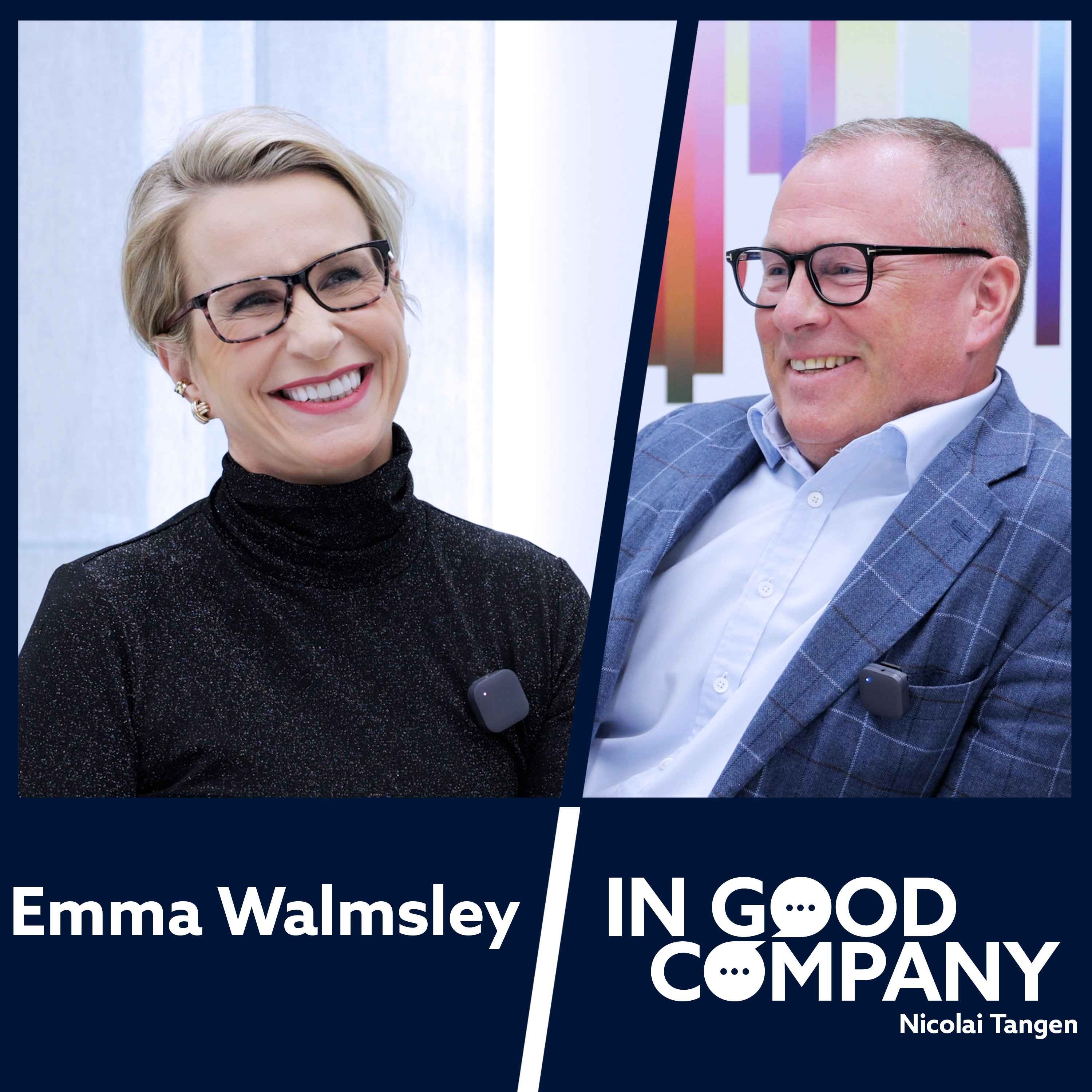
In this episode, Nicolai Tangen interviews Emma Walmsley, the CEO of GSK (GlaxoSmithKline), focusing on the transformations within the pharmaceutical industry, particularly GSK's strategies in drug discovery, the integration of AI in pharmaceuticals, and the evolution of company culture.
Written by AI. May contain mistakes.

Get the gist, explore an idea or ask about something said.
 Claude
On In Good Company with Nicolai Tangen, what are the key points of this episode?
Searching your listeningAutomatic transcript. May contain errors.
0:00Hi, everyone. I'm Nicola Tangen, the CEO of the Norwegian Sober and Wealth Fund. And today I'm in really good company with Emma Wormsley, the CEO of GSK, one of the global leaders in pharmaceuticals. Now, we own 1.7 % of GSK, valued at 1.3 billion US dollars. Emma, great to have you here. Wonderful to be here. Thanks for having me. And I believe this is the second podcast ever in your life. The second ever. Wow. Looking forward very much to the conversation.
0:36Now, which areas of research excites you the most just now? Well, I'm excited about a lot of the ways that research, both in science and technology, are advancing, particularly those two things together. I mean, it is literally the point of our company is to innovate, and that's where we allocate most of our capital. So in fact, since I've been in this job, I think we've nearly doubled our R &D spend organically, And then, of course, opened up huge amounts of partnerships that we do externally in business development to supplement the pipeline. What excites me most is when we can innovate in a way that has real impact at scale for patients around the world.
1:18So I'm incredibly excited about five new approvals for new drugs and vaccines that we're expecting to get this year, one down and another four to go. And that's the first wave of a cohort of, we think, 14 scale medicines and vaccines, each of the potential of more than£2 billion worth of sales that we expect to launch this decade. And that includes in areas of oncology and infectious diseases, in respiratory immunology, in HIV. And, you know, some of these, what's really exciting is when you have totally new technology platforms in pharmaceuticals. pharmaceuticals. So for example, in multiple myeloma, very nasty blood cancer where there are 180 ,000 new diagnoses every year, we have a new technology platform, something called antibody drug conjugates.
2:11And you have to think of these as like kind of biological missiles that have precision targeting for cancer, which means they can bring greater efficacy, but also with less side effects. So we hopefully have a new multiple myeloma drug that has data that proves it extends life expectancy by three years. That's a very big deal for these patients in terms of overall survival. In that new platform technology, another example of something totally new in emerging science is in a field called oligonucleotides. You have to think of these as a kind of spellcheck for RNA expression to correct the way disease develops.
2:54And there we may have a new functional cure for a horrible disease, hepatitis B, which impacts 250 million people around the world. So these are examples of new near-term assets. You are both in vaccines and in medicines. And how do these areas complement each other? Well, vaccines are there fundamentally to prevent disease before it starts. And at GSK, we say we combine science, tech and talent to get ahead of disease. There is no better return on investment than vaccine technology. In fact, in healthcare, perhaps except for clean water, it really is a very powerful solution, mainly in infectious diseases.
3:40but you talk about what's exciting and new science coming through. A couple of weeks ago, I was in Oxford looking with a partnership we've developed there to look at pre-cancer cell biology. And that is potentially, and we're really looking on long-term horizons in terms of exciting science here, to imagine what cancer vaccines could bring. And that's very exciting science. When you talk about the complementarity, obviously, when you're in medicines, you tend to be more in the treatment space. But that can also be earlier intervention in disease to change its course, because what costs money for society and health care systems is hospitalisation and spending on people being sick.
4:27So intervening earlier is really important. And that can be with long acting medicines that keep people out of hospital. And we have lots in our pipeline, be it in HIV or respiratory that's looking at that too. For the people who don't know GSK, what are your three best selling products? Well, our biggest sellers are in HIV, in respiratory drugs and in vaccines today. So in respiratory, if you look at a drug called Trilogy, and that's for both asthma and COPD, chronic obstructive pulmonary disease, Perhaps many haven't heard of it, but it's the third leading cause of death in the world. So I think 300 million people living with that.
5:11And so we have an everyday inhaler for both COPD and asthma called Trilogy because it's got three drugs in it. That's a huge one. In HIV, we have two drug regimens. I mean, remember, an HIV diagnosis used to be a death sentence. Now it's something that you can live with as a chronic disease because we have these fantastic drugs that people can take and integrases, inhibitors. But we also now have been pioneering in long acting solutions in HIV. So that means an injection you can take six times a year. We're now looking at being four times a year and eventually a couple of times a year. That's an extraordinary solution.
5:53solution. And then in vaccines, we really pioneered with an incredibly effective shingles vaccine. That's a multi-billion asset today. It gives 90 % protection for at least 11 years, one in three of us. So your camera woman or you or me, we're going to deal with shingles at some stage, incredibly painful. And we have a highly effective vaccines there. And then another example would be we had the world's first RSV vaccine that we launched last year, still only in its very early stays of global penetration. So those are the big ones today. But for the future, I think we're looking more and more towards cancer drugs as well.
6:35You've kind of seen a major overhaul of your R &D approach since you became the CEO. So what are the biggest changes you made to that process? Well, I think this process is always ongoing because, as I said at the beginning, the purpose of our company is to innovate. And we're one of the only industries that has to literally replace itself every decade because of the patent model, which is in place. And the first thing to do was simply to say we want to prioritise it and really organise ourselves to prioritise the allocation of capital to R &D. We had a radical overhaul of the key disease areas that we wanted to go into.
7:23So we explicitly said we're going to prioritise specialty medicines and vaccines within the portfolio. And within that are key therapy areas. We bet back big in cancer, both through business development, acquisitions in licensing and homegrown innovation as well. I've been really excited to see that business more than double last year. It's still emerging. But I think when we look forward to the pipeline that's coming next, be it the multiple myeloma approval we hope to get this year or a whole new portfolio of ADCs, these antibody drug conjugates, which we think will open up solutions to new areas of cancer.
8:06I mean, this is, as you know, and you very kindly brought forward this recording because I'm going from this meeting to the funeral of a friend who died of pancreatic cancer. She was in her early 50s, mum of three. More and more we're seeing diagnoses in younger people for cancer. And although the science is advancing so fast here with new modalities, we've still got diseases like lung cancer, where even the biggest drugs in the world are only effective on 20 percent of the population. So I think, you know, there's a lot, lot more work to do there. It's one of our areas of our portfolio. The other incredible transformation that is coming to R &D and our industry, and frankly, the healthcare industry writ large, is what's going to be done with technology.
8:59Exactly. And you are on the board of Microsoft. Correct. Great privilege that that is. I have been for six years. What are you taking from Microsoft into the processes? Well, first of all, just to reiterate, obviously, my core job and accountability is as the CEO of GSK. Yeah, sure. But I mean, normally I'm a bit sceptical when people are on boards, right? This is hugely useful. But this, well, exactly. So here you can just see it, right? It should really enable you to bring in new technologies and be totally cutting edge. I believe... We should all be on the board on Microsoft. I wish I were.
9:38I would love to. First of all, it's very interesting, the crossovers. What are the crossovers? Well, let's just, before you get into the obvious relevance of the fact that technology, AI, now gen AI, are going to change every industry and society. And it's the most exciting time we can possibly imagine, especially when you consider a third of the world's data is related to healthcare. And healthcare is one of the biggest challenges in terms of its sustainability, its affordability, and the enormous amount of unmet need there is out there when you think about aging populations and the rest. In fact, there isn't a single tech company that doesn't think that the best case study for the possibilities of technology and its positive contribution to society is healthcare writ large.
10:25What is most exciting for GSK is our biggest challenge is the productivity of R &D. It is really, really hard to discover and develop a drug. 90 % of, and this is industry writ large, 90 % of the assets fail, which by the way is an important thing when you think about the economic model of our industry and having to cover the cost of failure. It takes a decade and it can cost billions. So capital allocation is a very, very important thing for us to do. But just imagine in this world of the explosion of data, genetics and genomics and healthcare systems provision and new tech, wearable tech, how every aspect of the value chain for us in R &D.
11:20And we think of that, if you looked at the traditional linear mode, you would say target selection, so biological target selection, molecule design, what we call CMC. So the transition of that into manufacturing, because that's often can be, you know, especially with all these new technology platforms, it can be an area where you can get bottlenecks or a failure rate. And then you get into clinical trials where things get really expensive. And patient identification is a part of that. So we've traditionally gone through a linear mode and each one of those today we are using AI and sometimes gen AI, whether it's to get more precision around the probability of success about the original biological target.
12:06and we're using genetic data as well, and we have examples of that, whether it's about building completely industry-leading chemistry libraries to allow us to design molecules in silico. And again, that work is going on. We're not, it's that famous quote about, you know, the future here is here, but it's not scaled and evenly distributed yet. I would say we're still in the sort of early stages of doing these experiments and stations, but there's a lot more coming through. So when you see how you've used technology and how you use AI, What has it done for you so far and how much more improvement will there be?
12:40Oh, I think we've hardly scratched the surface. We're already using it in the design of our clinical trials to predict outcomes, to be able to follow patterns of infectious diseases. So what do you think it will do, let's say, over the next five years? What will it do and how will you measure it? Well, we will measure it in the performance of the discovery and development process. process, it will reduce cost, reduce time, and ideally allow us to target labels for the medicines and vaccines that we have. So either the descriptions of their benefits, because we can design trials in a more precise way for patients that are specifically targeted so you can get a disproportionate benefit.
13:24I'll give you two examples. I talked about three examples. I talked about hepatitis B, which is this huge disease that impacts 250 million people. But there are very different profiles within that. By being able to do much more precision profiling, phenotyping of patients, we're then able to design clinical trials to show a disparate proportionate impact on a smaller cohort, not all of them, so that you can then get to what we call a functional cure, as in people can then live with the disease more normally. Our early trials are showing that. We're going to have readouts of phase three as well.
14:06That would be one example. Another would be when you look at the biomarkers around different cancer types. So in colorectal cancer, from learnings we did in endometrial cancer, actually, we looked at a particular genetic marker called DMMR, which allowed us to be much more precise on the targeting in cancer and then have trials where we've had them in the early stages, 100 % success rates, which will allow us to then go into at-risk phase three trials. Another example would be accelerated our RSV vaccine. And this is a simpler one, accelerated our RSV vaccine outcomes by two years because we were able to look at the infectious disease patterns in different parts of the globe and call the closure of clinical trials earlier.
14:59And we've got a vaccine that has over 90 % efficacy on those that represent 90 % of the hospitalisation. So at the moment, these are spot examples. Do you think it will improve the hit rate? Yes, without any doubt. With which you bring the early stage breakthroughs? Without any doubt. And that's the most important fact. In fact, I think what we're going to do, I think this five years, I'd say definitely within 10 years, and I hope we'll have more and more examples along that way. But instead of having this linear process, we're going to move to more of a lab in a loop, which is an overused term.
15:35But you actually get into reverse translation, patient back rather than target out so that we can get to, frankly, faster, better outcomes with more precise targeting for patient cohorts. But Emma, aren't all pharmaceutical companies doing this? I hope so. Absolutely. I mean, there's a lot more. I mean, if not, I think you need to be pretty thick. But the thing is that what is it going to do to the competitive landscape? Well, what I hope, I mean, Nicolai, let's just step back. In the end, our job is to meet the enormous amount of unmet needs there is out there in the world. And most of what we do doesn't work.
16:24I think it is a wonderful thing if this industry that frankly has, you know, too many negative Netflix movies made out about it, is able to show the world what science and technology combined can do for good. We still have so many diseases that don't have solutions around the world. You know, one of the biggest ones, the most exciting area for science, I think, for the long term, where we don't have good solutions is in everything to do with neurodegeneration, dementia and Alzheimer's. The trajectory of disease is going to change hugely, I think, over the next 10 or 20 years. If you imagine that metabolic disorders that are going to be, I think, you know, and their sequelae because of what's going on in these amazing discoveries in the obesity drugs is going to be less of a burden, but we're going to have triple the number of over 80s in 20 years time than we have today and you know i'm afraid like shingles i'm going to be there soon but well no but you're in our age group again the probability for all the brains in the room the probability of um of dementia or alzheimer's i'm afraid is again one in three so we need solutions the introduction of of increasing technologies into into r &d and so on um are the u.s companies going to be a better position than the Europeans?
17:49I wouldn't say that. I mean, we have some great European-based pharma companies with proud histories and strong innovation. But are we held back by increased regulation and different ways of looking at technology, AI, and so on? I would say, first of all, the American tech companies supply the world. They don't only supply the US. I do think the question of regulation is important. And we need growth-focused regulation. But honestly, Nicolai, I think it's really important that we have responsible regulation too on questions like quality, privacy um security uh i think it's important that europe opens uh up uh the possibilities because we have strong regulators in the ema and the fda and the mhra here in in the uk we have to recognize the most important thing we do is bring trusted safe scale solutions and patients are waiting.
19:04What are you now seeing coming out of China and India? A lot. The share of first-in-class drugs developed in China, the pace of clinical development, the pace of innovation approval are all speeding up a lot. And we're doing quite a lot of business development, finding great assets in China that want to export their drugs to the world.
19:38Now in the medical sector there's always a trade-off between how you price your drugs and the availability and affordability. You don't think there is a trade-off? Well I think they're both there I think there's occasionally tensions but I don't... Has that tension changed? Is it tension changing in any way? Well I don't see these as an either or in any way. I think they are structurally, they have to be an ant. Because you're not innovating unless you do it at scale. At GSK, we say we want to reach two and a half billion people this decade. It's one of the things that differentiates us. I think there is the scale of our impact relative to our size.
20:17I think there is a huge misunderstanding about the economics of our industry in terms of the pricing that is required to cover the cost of failure and the value that drugs and vaccines bring to a healthcare system. And remember, what's expensive is treating sick people and having them in hospital. We all know an earlier diagnosis is better, an earlier intervention is better. So we need to value the innovation and recognise that there are so many diseases that don't have solutions yet. But at the same time, we have a social responsibility, I believe, to drive access. And there are 2 billion people in the world that don't have access to the healthcare they need.
21:02And it's not just a developing country agenda. By the way, GSK has been top of the access medicine or second of the access to medicines index every single year since it was founded. And we're really proud of the work we do with Gavi to provide tiered pricing on vaccines in HIV, where of the 28 million people that are on these integrase inhibitors, 23 of them are million of them in the world, mainly in sub-Saharan Africa, because we opened up our IP to provide those drugs there. So I think it's not an either or, it is an and, But we have to do a better job of communicating also about, you know, the business model and the value that our industry brings and take these responsibilities, you know, extremely seriously.
21:56And it's not just a developing country issue, Nicola. I mean, you know, in London, between East London and Southwest London, there's a 12 year difference between life expectancy. And in your beautiful country, you know, access to medicines. I checked this and I was just looking at it before coming here, but I think of the 278, I think it was, medicines in 2022 that were centrally approved in Europe, 40 percent of them are not yet available in Norway. But I'm just saying that access is not simply a question of, you know, what we're familiar with talking in terms of aid to the poorest countries in the world.
22:43In the richest countries in the world, sometimes it's getting approvals on time. And this is where the US is definitely ahead. Definitely ahead. Drilling down on vaccines. Now you're a global leader in vaccines. What did we learn from COVID? Well, a lot. Top three things. older adult vaccination is a really important contribution to healthcare and society a lot of us are used to vaccinating our children and have been familiar with flu vaccines but you're seeing this opening up of vaccine technology for older adults supply chain security geopolitically is something that we all have to be thoughtful about.
23:32And certainly something that GSK has invested in very aggressively in terms of regional supply chains, not just in vaccines, but also in medicines. Last year, we announced another 800 million that we're spending in both medicine and vaccine manufacturing in the US. We also have strong European supply chains and we have partnerships in China for distribution of vaccines. And then I think the third thing, if I'm only allowed three, although I could make the list go on, is, you know, we really have to watch out for the questions of vaccines hesitancy around the world. And there's been a bit of politicisation of that specifically through COVID.
24:15So how come? I mean, vaccines got the world back on its feet and then now there is so much misinformation and vaccine hesitancy and anti-vax and so on. Yeah. Just why is this? Let's remember, vaccines by definition are being given to healthy children or adults. It is preventative care. So you wake up in the morning. I can remember, I'm a mum of four. I remember taking my brand new babies, by the way, which were born in, I have experience of three different countries of giving birth and you have different vaccine policies or it felt like you did. And you have these questions like, well, this precious newborn, what is this?
24:55What am I giving them? What's it mean? And you want to have information. Then I think, obviously, we went through the global experience of COVID, which engendered, you know, huge pressure on the healthcare systems. I think, you know, a lot of national protectionism, tremendous energy around vaccines and a focus on some brand new technologies that had never been developed in vaccines before. And people had questions about that. They had simultaneous fears about the risks involved and the news that was coming every day. And then new technologies that they wanted to make sure that they could trust the communication about.
25:38So it does come back to these questions of trust and transparency. And what does GSK do here? Well, our answer is what it has always been, which is you start off by saying, if you have the responsibility of, as we do today, frankly, vaccinating 40 % of the world's children through our global programmes and a pipeline of new vaccines, of listening hard to people's questions, communicating transparently, underpinning everything with a 100 % commitment to the vaccine. quality and safety and trust in our products. And remembering shouting, trust us, you know, as a, frankly, a company that is a public company with responsibilities to shareholders and that has to generate profits from these things is not the most effective way.
26:29So we seek to partner with governments to provide the data and total transparency and to frankly go to where people are with their questions, be it in the community, because that often is that as well, but also not to lose sight of the fact that, I mean, you know, the US spends$9 billion a year on the hospitalization of people from vaccines preventable diseases. So, you know, I think we're working through an age where people have questions and we just need to calmly continue to underpin our work with the value set that we've been committed to for generations and keep answering people's questions.
27:11Bill Gates wrote a book about how the next pandemic could be handled better by spending, I think it's roughly a billion dollars per year. Yeah. But that's not happening. So why are we not preparing ourselves better for the next pandemic? Well, I think we are, actually, at least inside the industry. Although I agree with you that, you know, memories feel a bit short, don't they, at the moment. And the challenges around this one is you're trying to keep capacity warm, if I can say that. Now, the reality is at GSK, we have contracts today with Europe, the US, Canada, around pandemic preparedness.
27:55be it to be ready with our adjuvant and pre-pandemic assets. We have some prioritised reviews for pre-pandemic flu vaccines. And in fact, we're contracted also with the WHO to make sure that I think 10 % of any ready supply would also be immediately available to some of the more underdeveloped countries in the world. So I would say there is better preparation. We won't be able to stop another pandemic coming, but I hope the world will remember and that we will mobilise faster before so many lives are lost. But I'll tell you something else that we are really thoughtful about at GSK, which is a different kind of pandemic.
28:41And that's sometimes referred to as the slow one, which is antimicrobial resistance, which will kill, I think it's 38 million people by 2050 unless we develop more antibiotics. And we have a very big portfolio and pipeline here. Last year, we invested, I think, 40 million with the Fleming work that's done, led out of the UK with Imperial as well to try and research. Because this is where the UK is very strong, right? Well, it's got a proud history in AMR. And I think, you know, this is killing people all over the world. It's a real challenge in antibiotics because obviously you're asking the industry to develop drugs that you then don't want to be oversubscribed.
29:27So, you know, actually one of the five approvals I'm hoping to get this year is for a brand new antibiotic. And, you know, the common, very common for women, UTI, uncomplicated UTI space. We haven't had a new antibiotic for 20 years. So, you know, I'm hopeful we'll get that approved later this year. You mentioned that I was soon going to be 80 years old. Now, I didn't mention that. But yeah, absolutely. The elderly need to get a lot of vaccines, right? Flu, COVID, shingles, pneumonia. When will we see a combination of all these things into one shot? There is ongoing work on combo vaccines from us and from others.
30:14We're used to having some combination vaccines with pediatric vaccines. I think the thing you have to think through is what is, well, it's not as simple as just adding them together, obviously. But you also have to think through what the durability of different vaccines is. So I'll give you the example of RSV vaccine. We now know that's a seasonal respiratory infection. We know we have protection probably at least three years. Maybe it will go up to five. So, and flu tends to be something that mutates obviously every single year. So, you know, you have to think about what the combinations would be when you're providing a solution that is required on an annual basis or, you know, more extended like that.
31:05So it's a bit more complicated. I think there are new technology platforms that will allow more combinations potentially. So mRNA is one that we and others are looking at. But the science here is quite complex. And again, you want to be in a place where you're looking at both efficacy and reactogenicity as well to see whether that combination is going to be an effective solution. But definitely something that's on the horizon.
31:45Moving on a bit, you came into GSK with a remit of dramatically change. Yes. The company. What are some of the dramatic changes you've done? Well, I don't know what the dramatic is the word that I'd want to use to describe it, But certainly a very significant change in group strategy, structure, capital allocation, balance sheet, which was a major challenge when we came in, which is part of the reason why we did the de-merger of Halion. I mean, I'd originally joined BSK. Which is where you came from, right? Yeah, I mean, my background was in consumer goods. I moved from China to London to build the consumer division of GSK.
32:31And we went through two massive global joint ventures, firstly with Novartis' portfolio and integrations, frankly, and then with Pfizer's. And then, you know, when I was CEO, it became very, very obvious that to me that to solve the business that we built up from, I don't know, four to 10 billion in sales was never going to be the primary recipient of capital allocation. And it was sort of locked up division inside GSK that I never got a single question on at quarterly results. And so it would be much better to set that business free. And I'm delighted to see how brilliantly they're doing with that.
33:09but also use that to reset the balance sheet of GSK and frankly enable this fueling of growth and a step change in growth. How far are you into your change plan now? Well, you know, I was really pleased at the beginning of this year to upgrade our 2031 outlook for the second time. And that's, you know, we've added another 7 billion to the outlook just in four years. That means we'll grow 17 billion this decade in sales, which, you know, when I started, we were only just over 20. So on the bio farm a bit. So I'm really pleased with the progress, but the work is never, ever done on this because as I said, you know, in our industry, we have to reinvent ourselves every decade because of the rolling patent model.
33:55What's the biggest mentality change you have? Oh, well, this is my favourite question. Well, mine too, you see. So we should delete the rest of this podcast and just start here.
34:10I like the way you said mentality, by the way, because if you say what was the radical change that I wanted to drive for, I think culture is definitely one of the things that we've been working hard to change. What was the culture in the past? Well, it's a company that's been around for over 300 years in a whole variety of forms. So it's got a long and proud history. But when I was asked to start, it was to change the performance trajectory of the company whilst retaining some things that have made it very special for a long time, including a commitment to global health, including a deeply collaborative culture.
34:50because this is an industry where partnership and serendipity matter because it's hard and because it's the clash of brains and ideas and creative friction that can create good things. But I think we've become, for all the pride in our purpose to change the course of disease and to provide access to medicines. We'd lost our way in terms of performance edge, in terms of looking outside the company. This happens in a lot of big companies, by the way, that you get heavily matrixed, you think a day at work is doing good meeting, and you're not agile enough, and you start to think that all good science is inside.
35:43So how do you change this? It is, first of all, you say it's really important and you make it one of the stated priorities for the company. So I've been very aggressive since I started to say that we've got three priorities, which are innovation, performance and trust. Writ large, obviously, we take our strategic direction in the therapy areas we're going to work in and specialty medicines and vaccines. But we underpin that and we power that by culture. So you say culture is the risk. It's not an HR issue. It's not something we write on the wall. It is literally the job of the leadership of the company, CEO first, by the way.
36:18And I think that is the secret sauce of everything, because when you're running a company of, you know, at the beginning, it was 100 ,000 people. We're now 70 or so. You know, you can't you have to set an environment that doesn't need constant oversight or inspection. It's just the way we work. So we spent a lot of time defining what we wanted that culture to be at a leadership level. And we say three simple things. Ambitious for patience, because that's the point of everything. And there's a notion of ambition in there, which is delivering what matters better and faster. Accountable for our impact.
36:54And that is about results, not process, which we needed to shift being a bit government department in the way we do things. A lot more individual accountability. but in the spirit of clear ownership and I think that's what sometimes goes wrong in collaborative organizations is that there's a bit too much by committee I'm a big believer in single point accountable decision making so clear ownership and a positive mindset of support to succeed and then doing the right thing we have to do so this is all very good so this is what you say and this is what your leader group say but how would you get it through how do you get it down through the permafrost level in the organisation?
37:32Really simple. You define it and you just said that you get the message on that. You never stop talking about it. You use a common language worldwide, worldwide. Every single country when I go and visit, I ask for a session on culture explicitly. OK, you appoint for it. I've been very, I mean, the overhaul in talent in the company is one of the most radical things that we've done. And by the way, it's foundationally my philosophy of leadership is it's always about people. And it's people that define culture. It's how they show up every day. It's the way you manage people. So you're incredibly intentional about your talent processes.
38:11I bet you are in order as well. I mean, there's no way. But you don't appoint people at level six and seven. No, not at six and seven. But there is a shadow of a leader principle. I spend a lot of time looking at succession planning. Two weeks ago, I spent three days with the next generation top 30, literally. And I am very planful, not on my own, because it's a team effort with the leadership team around their career development. This is purely three days of development on people and talking about cultures at the heart of it. You incentivize it, soft and hard incentives. So we change literally down to the bonuses system for the organisation.
38:55You promote for it and you fire for it. So there's those famous matrices about the high performers with the bad culture. When I've made mistakes on people, it's usually for cultural reasons. So that's really important. And you measure it. And how do you screen for attitude? So here I am, and you're interviewing me. I'm applying now, level five. I'd love to work in GSK. Now, how are you going to figure out whether I... Well, referencing. I'm a big fan of referencing as a system informally. Yeah, I mean, but also we do surveys, and we also do something called 180s, which sounds a bit, you know, we're all familiar with the 360 thing.
39:37180 is purely your team giving feedback on you. completely anonymously in this case. And we all do. I have one on me as well. And we look at the, and we spend time talking about that in our mid-year and our year-end reviews. So listen, here's what I would say. The work is not done. And I am sure, in fact, I know there are still things that we've got room for a lot more improvement on. But my goodness, the culture of the organisation has shifted. You also look at where you spend your time, Nicola. I mean, I don't know how you work on this, but if you want... I spend 55 % of my time internally in the company because I tag every hour of what I do.
40:20But how do you work on culture specifically? Oh, all the time. I mean, every time I get the microphone, every time I meet people, I'm a maniac about it. And we need to stay that way. And by the way, the other thing you have to remember is if you look at your workforce and if a third of it is new in the last three years, Don't forget, don't believe for a microsecond that what you said in a town hall last time in the country has been heard. So you have to be relentless on it. Tell me about Emma Warnsley, 180 degree survey. Well, I'm not sure I want to publish that completely. But listen, people know that I care deeply about the company and individuals' development.
41:10And I'm hard driving on clarity of strategy and ownership of objectives. I could do a better job of saying thank you and well done because I have a habit, which I'm sure is all sort of deeply rooted in my childhood, of looking up the mountain about how much more we've got to do rather than sometimes occasionally enjoying the view. And I think we have to remember work is a human endeavour and everybody needs to celebrate the wins along the way. So I could probably do a bit more of that. Tell me how your childhood has informed your leadership style. Only if you do the same for me. Come on, you.
41:59Well, I grew up in a military family, so my father was in the Navy his whole career, and I think that has definitely informed a sense of responsibility and a sense of duty
42:16and a huge amount of, I think, frankly, a pretty strong work ethic and a lot of curiosity about the world as well. I mean, I think I wasn't well-travelled at all as a young person, but I had a chance when I was at university to go and live and work abroad. And just before I went to university, weirdly, in the 1980s, 1980s, I decided to take myself off to China, which is in the 1980s, which was an odd thing to do. It was the first long haul flight I'd ever been on, but that opened my mind to the world. And, you know, because I was in the way the system worked in the UK, I was in a boarding school from a very young age, because that was funded by the military in those days.
43:03And I think that gave me a sense of independence. So I quite early in my career had an international career and wanted to go and do that. And that opened up all sorts of opportunities I never dreamt of having. So I had no business background in my family. You said, I heard somewhere, you said that you need to have a really hard skin, a tough skin to survive as a CEO. Well, I think... Thick skin. Yeah, I think there's nothing more obnoxious than CEOs saying they have a hard life because it's an insane privilege and opportunity, and especially at this time in the world, which is volatile and uncertain, as we all hear.
43:38and no, but it is extremely exciting and science and tech are advancing and there's just so much talent out there with ambition and creativity. So I think these jobs are a tremendous privilege, but with them come the responsibility to absorb a certain amount of public pressure and not take that personally. but I do think part of our job is also to protect the organisation from that kind of distraction and that comes with the territory. So yeah, you need some resilience. What kind of things get under your skin? I think like all human beings, if your organisation is being distracted by public reporting that is factually incorrect, that is annoying because it's hard to, you know, what do people get to measure public commentary on?
44:41So, you know, I think, you know, my job is to keep the organisation alongside my leadership team, because by the way, I really don't agree with the kind of CEO as superhero notion. I think our first job is to hire people that's part of culture who are better than us and who stand with us in the leadership.
45:03priorities and an agenda. But our job is to keep the organization focused on what it can control and what it is there to do. And our people are so inspired by the purpose of GSK. I mean, they literally, it blows my mind when you see the energy with which 15 ,000 scientists get up to do the near impossible and to try and explore new frontiers of neurodegeneration or literally cure cancer or help people breathe easier every day. Where do you seek advice personally? I have a very good board and a brilliant chairman. I quite like the European way of the separation of these jobs. Everyone will have their different views on that.
45:52Yeah, we fully support that too. And, you know, a good board and a brilliant chairman means people who challenge you to be better at the job and are at stake for the company and its stakeholders, be they patients, shareholders, or our people. I have technical advisors who are externals, who are experts in their fields. And then I have, I suppose, maybe they're not advisors as much as the sort of support system of your family. My children are adult now, so they advise Not that they advise me on the strategy of GSK, but they sometimes they remind me to keep my feet very firmly on the ground in terms of what matters in life and the point of it all.
46:39You have an honours system in the UK and you were named a dame. Yes. You are Dame Emma, right? Yeah. What did that do to you, you think?
46:57Well, it was a surprise. That was certainly true. I think it was a very important moment for my parents, actually, and my family. And then sometimes, I mean, it's an incredible honour. And I never dreamt that my life would take the paths it has. And that's, you know, I'm a great patriot. I'm a globalist. I've lived in mainland Europe, in the US, in China. I travel all the time. But I am very proud of this country. So it meant something. But honestly, it's not something I think about very much. And I usually forget. I saw some research once that when you get an honour like that, you tend to think more about all the stakeholders in society.
47:46And actually, people tend to lay off less people. They tend sometimes economic results of the company you run actually deteriorates. and takes a hit from this because you just become, I don't know, you become perhaps less cynical and more thinking about society overall. Do you think there is something in that? Well, the thing I would absolutely argue against is the notion that there is a contradiction between the delivery of performance and strong financial results and being social responsible. I mean, in my industry and in my company, They are literally completely aligned because if we grow, we are changing the lives of more patients.
48:32If we innovate, that's recognized by the market in terms of the value of our pipeline. And by the way, if you actually look, not to sound offensive, but at our track record of performance since that happened, it has been completely transformed. That is literally probably the pivot point. But I'm afraid that it would be, again, I don't want to, I would express my gratitude, but it is, it's not something I think about. And I, honestly, I have never felt more full of energy and appetite for impact. But I do think it's important to remember, it's not only about, you know, pounds and dollars, it's about the lives that you change, which is why you asked me earlier, what are the biggest things that you're doing?
49:19And I answered in terms of revenue. Actually, I think it would be fair to say that last year, the biggest medicine or one of the biggest medicines that we gave were donations, I think 440 million donations of doses of a drug that's for a neglected tropical disease in Africa, which we've called lymphatic filariasis. a horrible disease and the scale of lives you know protected from that is is really meaningful so I think we do have to think in a multi-stakeholder world but nothing will happen unless we are financially successful because we need to fund the next wave of innovation a bit more on the personal front here at the end sure what is energy well for me it's something that is fueled and allows you to keep getting back up, whatever the challenges are, but also inspire others as a leader to do more than they ever dreamt possible, both individually, but also as scale.
50:38And where do you get your energy from?
50:44Purpose, opportunity, curiosity, other human beings,
50:52the love of my family, and the deep belief that you get one life and you shouldn't waste a single second of it. What are you trying to learn these days? Oh, everything about what's possible. I mean, I'm just, I am so fascinated by how technology is going to change society again. I mean, as it always has done, by the way, I think we think we're in a uniquely privileged moment, but probably people have done throughout history. I've been lucky enough to have a lot of exposure to the world and issues that matter to society more broadly and the role of business in society and all of those things I'm extremely curious about but I get annoyed when I walk into libraries about all the books I haven't read What about you?
51:49What do you read now? I've got far too many books going on I've just finished a novel called Demon Copperhead. I don't know if you've read it, but it's absolutely extraordinary and so clever in terms of the David Copperfield alignment. I listen to things when I'm exercising badly in the gym occasionally. I love, I mean, I'm originally a literature student, so I like poetry. I don't get enough time to read, to be honest. It's one of the things. If I could have a, I was going to say a bad habit, It's not a bad habit. What poetry you have in common with Sartre Nadella? He's actually the only one we've had on the podcast series who reads poetry or who talks about reading poetry.
52:32Well, you know. So it's the two of you. I didn't know that. I'll have to ask him about it. I definitely can't talk to him about cricket, so I should ask him about that. When do you wake up in the morning? Early. I'm an early morning person. I mean, by the way, because I travel so much, I don't know whether it's morning or night, and I'm good at sleeping. But normally my alarm is set for five. What is your advice to young people? Well, first of all, I will answer that question if you answer it. And I would say three things. First of all, don't listen to the advice of old people too much. Second of all, you know, we invented a sort of family motto when the kids were little, which for us was, and this is probably us just trying to shorthand what parents thought you should do, which was be kind, be brave and be truthful.
53:23and I still stand by that. I'd probably add be curious because I think to – I worry about the pressure that's on young people today who all seem to be worrying about strategising their careers. I don't know how much strategising your career you did. I said none, like literally none. I think my entire work experience was waitressing when I left university and then I just worked really hard at things I thought were really interesting and opportunities arose. I mean, luck was a huge part of it, But I think they put too much pressure on themselves and should genuinely be just crazy curious to learn as much as they can in this exciting world at the moment.
54:00And then the last thing I would say is I think the title of your podcast, which I'm now going to be very enthusiastic about listening to all the past episodes of, is brilliant. Because what matters in life is the company you keep. so whether it's personally or professionally hang out with extraordinary people who teach you a lot and make you laugh uh help you get up again when you fall over um and stretch you to do more than you ever thought you could do well dame emma won't do that you are for sure an amazing person and a big thanks for coming here well thank you that's been such a pleasure but what about you you've got to tell me the last answer yourself what do you say to young people separate podcasts ınız
How is the pharmaceutical industry evolving to meet the world’s biggest health challenges? In this episode, Nicolai Tangen sits down with Emma Walmsley, CEO of GSK, for an insightful conversation about the future of pharmaceuticals. They discuss GSK’s latest advances in cancer treatments, HIV therapies, and respiratory medicine, as well as the role of AI in speeding up drug discovery. Emma also shares her thoughts on navigating change, transforming company culture, and the role of curiosity in staying motivated. Tune in!
In Good Company is hosted by Nicolai Tangen, CEO of Norges Bank Investment Management. New full episodes every Wednesday, and don't miss our Highlight episodes every Friday.
The production team for this episode includes Isabelle Karlsson and PLAN-B's Niklas Figenschau Johansen, Sebastian Langvik-Hansen and Pål Huuse. Background research was conducted by Isabelle Karlsson.
Hosted on Acast. See acast.com/privacy for more information.


