Ask ChatGPT
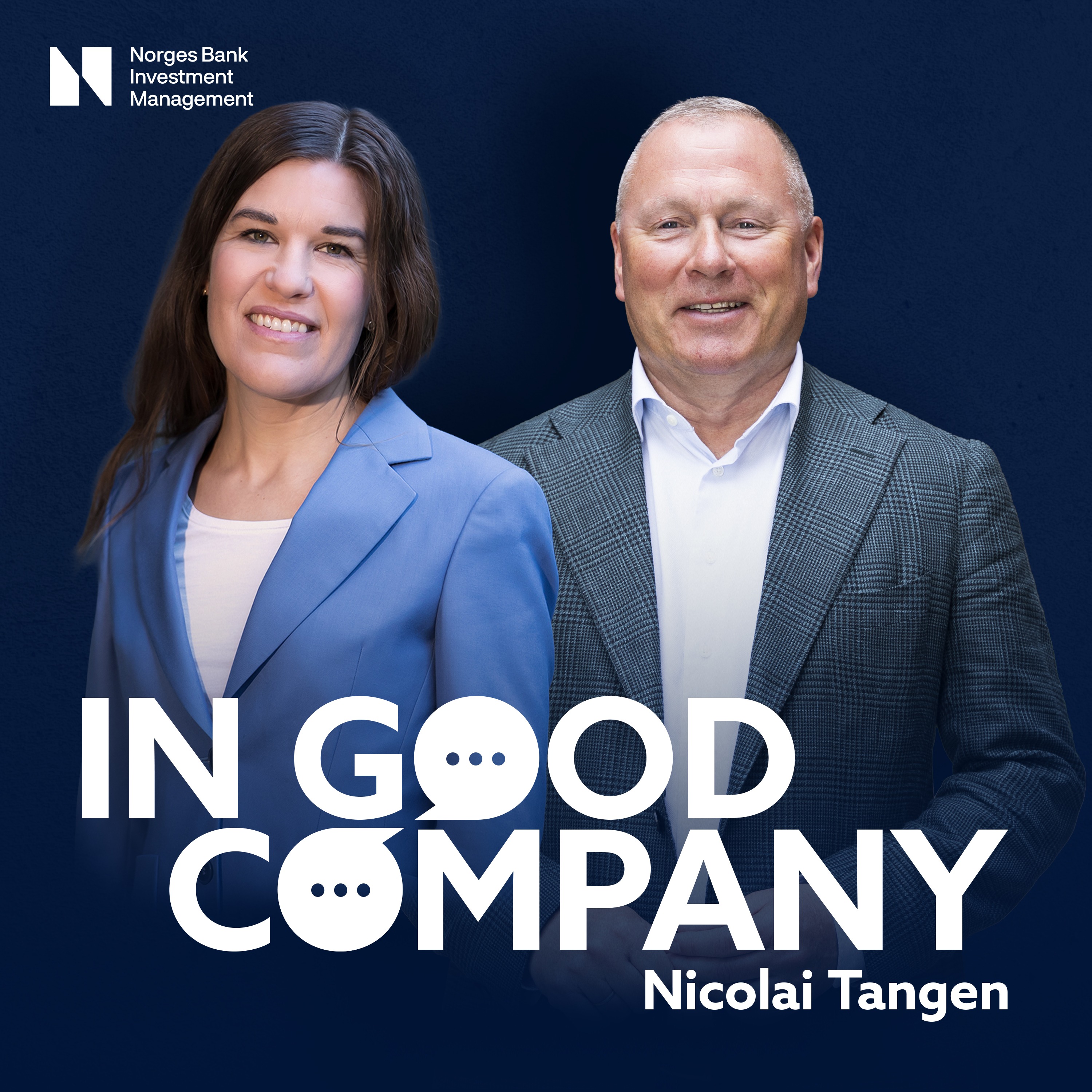

 In Good Company with Nicolai Tangen
13 Mar 2026 · 10m · 6 chapters

In this episode, Nicolai Tangen interviews Andreas Berger, CEO of Swiss Re, a leading reinsurance company. The discussion focuses on the intricacies of reinsurance, the impact of climate risk, evolving insurance landscapes, and the role of artificial intelligence (AI) in the industry.
Written by AI. May contain mistakes.
Andreas explains the role of Swiss Re in the insurance industry.
“Some refer to it as the central bank of the insurance industry.”
Discussion on the different types of risks Swiss Re insures, including life, health, and corporate solutions.
“If you look at it at group level, it increases to 40%.”
Exploration of the complexities and uncertainties in insuring against cyber risks.
“So we make some AI models in, you make some AI models in a firm.”
Andreas discusses the role of AI in insurance and the importance of data governance.
“So then you get more capital coming in, competing prices down back again.”
A look into how quantum computing may influence the insurance sector.
“Because the problem very often is that data and technology is outdated.”
Andreas shares personal insights on how his background influences his business approach.
“Do you think that impacts the way you play football?”

Get the gist, explore an idea or ask about something said.
 Claude
On In Good Company with Nicolai Tangen, what are the key points of this episode?
Searching your listeningAutomatic transcript. May contain errors.
0:01Andreas Berger: Hi everybody, tune in to this short version of the podcast which we do every Friday. For the long version, tune in on Wednesdays.
0:09Nicolai Tangen: Hi everybody and welcome to In Good Company. I'm Nicolai Tangen, the CEO of the Norwegian Sovereign Wealth Fund. And today we are in really good company. We are here with Andreas Berger who is the CEO of Swiss Re. Now, Swiss Re is a very interesting company. They basically insure insurance companies. We own 1.6 % of the company or 800 million US dollars. Warm welcome, Andreas.
0:33Andreas Berger: Thank you very much. Thanks for having me.
0:35Nicolai Tangen: So let's start with the simplest thing here. What does a reinsurance company do?
0:40Andreas Berger: Well, you already said it. We are the insurers of the insurance companies. Some refer to it as the central bank of the insurance industry. Technically not 100 % correct. So we are giving financial protection to insurance companies. So why do insurance companies need to insure themselves? Insurance companies sit in a national or maybe also international context, but they need to protect their balance sheet. And they benefit from our diversification that happens at global level. So we've got global diversification because risks are not correlated. But if you look at a standalone basis, then obviously the insurance companies need more capital for this.
1:21Andreas Berger: So diversification helps.
1:24Nicolai Tangen: Andreas, can we talk about the different types of risks that you insure? How do you split it?
1:28Andreas Berger: Yeah, we focused on three business units. One is life and health reinsurance. So our insurance companies, life and health insurance companies are our clients. Property and casualty reinsurance company. That's where the insurance companies sell property casualty, homeowners insurance, motor insurance, etc. Then we have a third unit that's called corporate solutions. There, we insure large corporates, who also have their own insurance companies, captives. So, these are the three units. And they have a very nice diversification benefit for the group. Life insurance is not correlated to P &C reinsurance.
2:06Andreas Berger: And within P &C reinsurance, the two units are not directly correlated because Corporate Solutions reinsures externally. I'll give you an example. Natural catastrophes. The capital return on a standalone basis for natural cataphyses is 8%. If you look at it at group level, it increases to 40%. So that's the diversification benefit that I'm talking about.
2:31Nicolai Tangen: What are some of the new issues that you need to think about in terms of whether you can insure them or not?
2:39Andreas Berger: So how does insurance work? You need data. You need data and you need to start to model. You need to understand the data. Let's take one risk where cyber, as an example. It is a common event. But if you go out and ask people, tell me what your worst case scenario is, then you get a lot of answers. Also, the deep understanding of the cyber exposures is not good enough yet.
3:10Nicolai Tangen: Can we fully insure against cyber? I mean, could we, with our sovereign wealth fund come to an insurance company and totally insure against cyber so that if somebody stole our money we would get it back from you yeah it's really it starts with the
3:23Andreas Berger: understanding of the exposure yeah and that is something that we have to work together and that's the most critical piece and why don't you get so many so high limits because insurance companies are reducing their exposure by offering smaller limits because we don't know actually what the worst case scenario actually could look like.
3:44Nicolai Tangen: So you cap your exposures for each case?
3:47Andreas Berger: Absolutely. And we have capacity limits and we have risk limits in our company also. And that's very important to measure these.
3:57Nicolai Tangen: What about AI? So we make some AI models in, you make some AI models in a firm. It goes totally ballistically wrong. Big losses. How can you ensure that?
4:07Andreas Berger: Yeah, so that's a new area. And I've been talking about this for quite some time, even before the big hype of AI. Because what's happening, people work with data. Data has biases too. And then the algorithms come in. By the way, software programs have the same. The malfunction of algorithms or software programs is a topic that we need to really get a better understanding for. In our company, the AI governance and the framework for the digital use of data in business is strongly regulated. We always have the human in the loop. We don't allow AI to take decisions for the humans. We have this dilemma and managers have this dilemma.
4:59Andreas Berger: There's this excitement, but then there's also the risk.
5:03Nicolai Tangen: Now, the way I understand this business and the cyclicality of the business is that you have some years with big losses. Afterwards, prices go up and when prices go up, it's really profitable. So then you get more capital coming in, competing prices down back again. How do these cycles work?
5:26Andreas Berger: First of all, there's not only one cycle. Very important to note. each product, each line of business, as we call it, has a different cycle. So when a cycle, a rate environment is declining in property or natural catastrophe insurance, there are other lines of businesses that are not correlated to that. And I think that's what we observe. We look at our total portfolio and we call it the target liability portfolio. We have a five-year forward-looking view, and we assume developments, rate developments, but also inflation, et cetera. That all comes in, and then we see how does my portfolio behave.
6:08And if there's one cycle that goes down, I probably will not grow in that area so much anymore.
6:15Andreas Berger: So I limit capacity deployment to that area. And then I have focused growth ambitions in other areas that are not correlated with that, are not going down. And that's the cycle management. And it's important to understand the behaviors of players in each part of the cycle that a line of business is in. So how is AI changing the way you work? I think AI is changing our work dramatically. We have been dealing with AI for quite some time. So we were at an early stage already working with machine learning, advanced analytics, etc. We are a data company and people company. We think in data models. So we have established a clean data strategy with a front-end ontology and then based on a clean, globally integrated data platform.
7:18Andreas Berger: Now we're AI ready, I always call it, because every AI use case we have will instantly be integrated into our data and technology infrastructure. So that's where you can then detract the benefits. Because the problem very often is that data and technology is outdated. It's fragmented. huge IT legacy and IT debt, so that the individual AI use cases are still standalone use cases and cannot be integrated into your data and technology infrastructure. So the benefits are not visible. I think that's the biggest problem we have in the industry. Now, what we do with AI, We use AI also to augment, to improve our decision-making.
8:12Andreas Berger: But we also use it to improve our processes.
8:16Nicolai Tangen: What do you think quantum computing will do?
8:21Andreas Berger: Well, this is the next development. Now, quite frankly, I am happy if we manage phase one and implement, in particular, agentic AI because the change we go through is massive because it changes the way people work today. We have to reimagine our processes. Now, quantum computing comes obviously because we deal with such an amount of data, but I'm happy if I do step one and actually implement it properly and generate the benefits. The rest, it's very far away and will come as a next step then for me.
9:07Nicolai Tangen: Now, you were born in Rwanda. Do you think that impacts the way you play football?
9:13Andreas Berger: Oh, I never thought about that. Rwanda is a beautiful country. I was...
9:19Nicolai Tangen: Do you feel like this outside-in view, does that impact the way you think about
9:24Andreas Berger: three you think maybe one aspect shaped me as I was confronted with a lot of changes or uncertainties you know there was a coup d 'etat and and in Portugal was a revolution I always take a step back and try to analyze what does that actually mean also for me personally you know for family for for for you as an individual and that probably is something that i applied in business um to not shoot from the hip to really analyze the situation and in today's world with all the uncertainties with changes every day you've got to think all the time what does that actually mean don't panic so i call it strategic patience and that i apply personally but but also professionally.
We've curated a special 10-minute version of the podcast for those in a hurry.
Here you can listen to the full episode: https://podcasts.apple.com/no/podcast/swiss-re-ceo-the-business-of-reinsurance-climate/id1614211565?i=1000754597591&l=nb
Who insures the insurers? In this episode, Nicolai Tangen talks with Andreas Berger, CEO of Swiss Re, about how reinsurance works and why it matters. They discuss natural disasters, climate risk, and why losses are rising as more people and assets move into high-risk areas. Berger explains how Swiss Re uses data and technology to understand risk, prevent damage, and decide what can — and cannot — be insured. They also touch on cyber risk, AI, leadership, and how to make decisions in an uncertain world.
In Good Company is hosted by Nicolai Tangen, CEO of Norges Bank Investment Management. New full episodes every Wednesday, and don't miss our Highlight episodes every Friday.
The production team for this episode includes Isabelle Karlsson and PLAN-B's Niklas Figenschau Johansen, Sebastian Langvik-Hansen and Pål Huuse. Background research was conducted by Oscar Hjelde.
Hosted on Acast. See acast.com/privacy for more information.