
 Ask ChatGPT


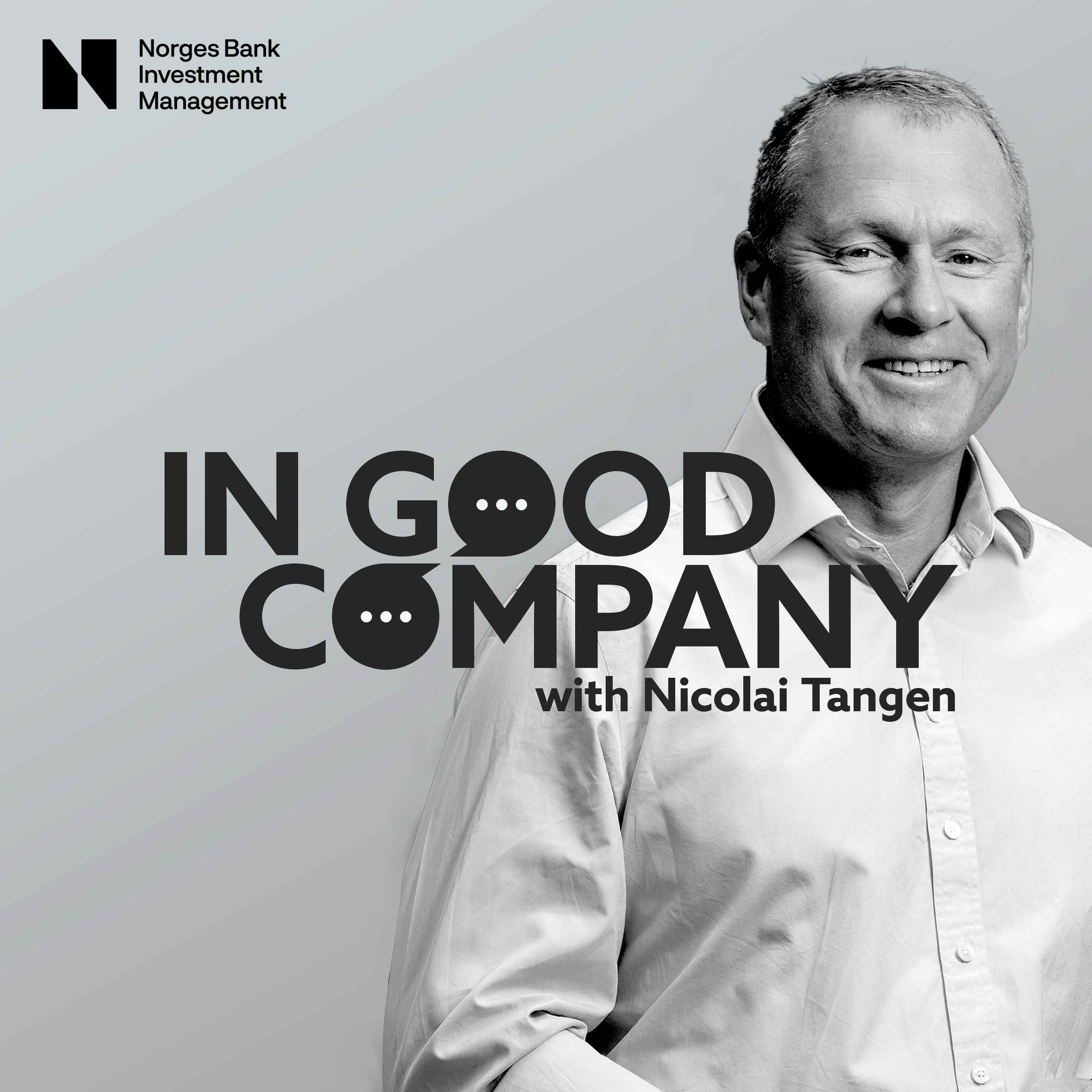
 In Good Company with Nicolai Tangen
30 Jan 2026 · 11m · 7 chapters
Written by AI. May contain mistakes.
Bill Winters discusses the history and distinctive nature of Standard Chartered.
“So tell us, what is it that makes Standard Charter so special?”
Explains the bank's client demographics and business focus.
“Of course, the UK is our home market in many ways.”
Bill shares the challenges he encountered when he became CEO.
“And the problems that were very clear at that point were compliance problems, largely with the US, but also with the UK and elsewhere.”
Discusses the importance of communication with regulators and shareholders.
“And so my first interactions were just to be very clear that the regulators actually were the very single number one priority, even at the expense of shareholders.”
Bill describes his collaborative leadership style and decision-making process.
“And I overdid it because I acted before I investigated.”
Explores the potential separation of global financial systems and the role of China.
“Others would say the fact that you're prepared to back non-sure things is what has changed the organizations for the better that you work for over the years.”
Bill discusses his motivations including curiosity and ambition, and their interrelation.
“But we've also seen that very important countries in the world, starting with India, Brazil, South Africa, the Middle East, aren't going to choose sides.”

Get the gist, explore an idea or ask about something said.
 Claude
On In Good Company with Nicolai Tangen, what are the key points of this episode?
Searching your listeningAutomatic transcript. May contain errors.
0:00Hi everybody, tune in to this short version of the podcast which we do every Friday. For the long version, tune in on Wednesdays. Hi everyone, I'm Nikolaj Tangen, the CEO of the Norwegian Southern Wealth Fund. And today I'm joined by Bill Winters, the group CEO of Standard Charter Bank, one of the world's most distinctive banks. Headquartered in London, you have most of your activities in Asia, Africa and the Middle East. And we own more than 2 % of the company, worth a billion dollars. We are really proud shareholders. So Bill, the bank opened its first offices far away in Mumbai, Kolkata and Shanghai in 1853, a long time ago.
0:41And you've been CEO for 10 years, which is only 5 % of the duration of the bank. So tell us, what is it that makes Standard Charter so special? Yeah, first it's great to be here. Thanks for having me. So you're right. It actually started as a Standard Bank of Africa, which started in Port Elizabeth in South Africa, today South Africa, and the charter bank of India, China, and Australia, which first branched in Calcutta. And obviously, at the outset, it was two banks. It only came together in 1969, still a long time ago, but to finance the empire. It was to finance trade within the empire. And those are still our roots.
1:17People sometimes refer to us as an emerging markets bank. That's not quite right because we have big operations in the U.S. and Europe. And I'm not sure that places like Hong Kong and Singapore are emerging markets anymore in any case. Or they refer to us as a trade bank, which is true. We are a trade bank and the second largest trade bank in Asia, of course, which is the biggest trading center of the world. But really, we're a connector bank. We just connect markets to markets and people to people because we have multiple home markets. And what attracted me to Standard Chartered was this unique culture of being a connector with no single home market.
1:50Of course, the UK is our home market in many ways. It's where we started and where we're headquartered. Hong Kong is our biggest single market. Hong Kong, China, which is increasingly a single market, is by far our biggest profit source. Singapore is our major operational hub. India is our operations center. And then we're a big bank in India as well. But who are your clients then? Our clients, so roughly two-thirds of our businesses are corporate and institutional clients, including governments. They're almost all multinational. If they're not multinational, they don't really need us. And of course, we can deal with some local clients as well.
2:23But for the most part, they're multinational. They have some cross-border nexus. One third is retail. All of the retailization, at least in Africa. But the corporate is truly global. And the clients use us to connect them to markets and investments. When you took over the bank 10 years ago, the state of affairs were very different. What did things look like back then? I had left banking at that point. I'd worked at J.P. Morgan. I had set up what today we would call a private credit fund. And then we just called it an asset manager. It was fine. It was a good life. You know the asset management life.
2:57It's a good life. Not always, but some. I'm going to say it's a good life. That's how I remember it. And then I got this call from Standard Chartered. I knew the bank pretty well from my time at J.P. Morgan because Standard Chartered was a client and a partner. They were still clients and partners. And the chairman said, we've got a problem. I said, I'm aware that there are some problems. But he said, I think we've got a really good underlying franchise. And we just need to clean it up. And the problems that were very clear at that point were compliance problems, largely with the US, but also with the UK and elsewhere.
3:28But it was also clear that there were some credit problems. I don't think anybody was aware how substantial the problems were. And I wasn't when I arrived, I have to confess, despite my due diligence. How bad were they? We wrote off a quarter of the book Equity of the Bank and had to fill that up with the rights offering, which took the share price down. It had peaked at almost double the price that it was at when I was announced, but it dropped by another half again. So that's now 75 % down, peak to drop. So that's, yeah, but the bet I made, which I questioned at a few points, but fundamentally I'm sure today was right, was that there was a really good underlying franchise with a really interesting, and thank you for calling us distinct at the outset.
4:06That's a neutral term. It could be distinctively positive or negative, but it is in fact distinct. It's a positive now. It is a positive now. And people have wondered at times whether it is a positive, because sometimes it's expensive to be distinct or it's tough to get to scale when you're distinct. But I took the view that we were distinctive and that that distinction was a strength and that we could leverage that strength and that we just had some problems that we had to clean up. When you come in there and the bank is in trouble and you're like a fallen star and you're a new person, how do you communicate with shareholders?
4:38What are the key things and key messages? You know, the very first and most important communicators were with regulators because the bank had lost the confidence of regulators. And so my first interactions were just to be very clear that the regulators actually were the very single number one priority, even at the expense of shareholders. Not because that can sustain for any period of time, but because that was necessary for existence at that point. Stupid question. Why is it important to be friends with the regulators? The regulators give you your license to operate. And without the support of the regulator, you can't operate.
5:13There were questions back in 2012 when Standard Chartered was first identified as having violated some of the financial crime rules in the US. There was a question whether the US would remove our banking license. I don't know how close that ever came, but it was certainly considered. And a bank without a banking license, that's not a good place to be. It doesn't exist. It doesn't exist. If you were to take over a bank in the same situation again, what would you do differently? But the biggest mistake I made, and it was a big one, was to not realize that the risk appetite inside the bank had already collapsed before I arrived.
5:48So I showed up on day one. I saw many indicators of loose controls on the compliance side, on the conduct side, and then on the financial side, so credit losses. And I hit the brakes hard. And that was, I overdid it. And I overdid it because I acted before I investigated. So the indicators were very negative. And so I said, you're out of control. Basically, you can't do anything without my approval for a little while. And they were already scared to death. But they were already scared to death. And they had been scared to death for six months. So the balance sheet shrunk by the better part of a third in my first year.
6:25Probably half of that was unnecessary. I may be a little bit harsh on myself on that one. But I think I overindulged on the risk messaging. And maybe even more harmful than the damage that I did in the short term was that it meant it was that much harder to get out of that risk-averse position. How would you define your leadership style? I would define my leadership style as very collaborative. I'm not particularly directive. I mean, I can get deeply into the details if I need to, but I would prefer not to. I'd prefer that the people that are working for me are really taking care of the details themselves.
7:05I try to push accountability down at every opportunity. I try to create a team that is a team rather than a team that has a series of bilateral relationships with me. I probably, some would say that I over-index optionality, so that I carry too many options at too high a carry cost. Some would say that. Others would say the fact that you're prepared to back non-sure things is what has changed the organizations for the better that you work for over the years. I would accept that I probably over-index optionality. On balance, I think that's a good thing. But that's probably the most controversial of the things that are attributed to my leadership style.
7:47Some people say I just can't make a decision sometimes. And what would you say? I say I love optionality and I'll make a decision when it's the right time to either exercise, sell or shut down that option. Are we moving towards a world with separate financial systems? I fear that we are, although I think there will be a big chunk of the world that operates in both. So for the time being, the dollar and the Bretton Woods system is still preeminent. China is steadily building up a financial infrastructure that is an alternative to the U.S. dollar. I don't think their objective is to displace the U.S.
8:23dollar, certainly not as a reserve currency, but I don't even think as a currency of trade. But they do want to have a facility to continue trading if their access to U.S. dollars is shut down. And we play very actively in both financial systems. They're completely interoperable today, but of course we could imagine a time when they're disintegrated as Russia was disintegrated from the global financial system after they invaded Ukraine. So I fear we're heading that direction bit by bit. I fear we're heading the same direction in technology and an underlying technical infrastructure. But we've also seen that very important countries in the world, starting with India, Brazil, South Africa, the Middle East, aren't going to choose sides.
9:06And I don't think they can be compelled to choose sides. So they'll be operating in both financial systems. And as soon as you have somebody in the middle, then you've got the bridge between the two, which will render them interoperable, even if they're technically not interoperable. What is it that drives you now? Curiosity and empathy. I'm extremely curious. I love learning. That's also very cliche, but it just happens to be true. What are the kind of things you try to learn now? So I learn in lots of different realms. Of course, the environment that we're operating in is changing every day.
9:39And I'm learning a lot about geopolitics at the moment. I'm learning a lot about innovation. And I've always been curious whether innovation can be taught or it's a character trait. What do you think? I don't know. I think some people are innately curious. And I think other people can adopt, sorry, innately innovative. And I think other people can adopt innovative characteristics through training. Why are some people more curious than others? More curious? It probably starts in the womb, more or less. But I grew up in an extremely curious household. And we didn't have a lot of money to travel around.
10:16But when we scraped a little bit together, we tried to see the world because it was something new and something different. And now I'm getting paid to do the same thing. It's fantastic. Do you think ambition and curiosity go together? I do. I do. ambition is a bit of a curse tell me I think ambition leads to perpetual dissatisfaction unless you lose the ambition at some point so I think it's a bit of a curse sometimes I wish I wasn't ambitious are you like perpetually dissatisfied? I always want to keep on going
We've curated a special 10-minute version of the podcast for those in a hurry.
Here you can listen to the full episode: https://podcasts.apple.com/no/podcast/standard-chartered-ceo-global-banking-geopolitical/id1614211565?i=1000746957764&l=nb
Nicolai Tangen sits down with Bill Winters, Group CEO of Standard Chartered, one of the world's most globally distinctive banks. They discuss what it takes to rebuild a complex financial institution after crisis, the critical role of regulatory trust, and why Standard Chartered's presence across Asia, Africa, and the Middle East positions it as a true "connector bank." Bill shares his perspective on geopolitics, digital assets and blockchain technology, and AI's transformative impact on banking. He also reflects on lessons from his career at JP Morgan, his leadership philosophy, organizational culture, and how curiosity and empathy drive long-term success. Tune in for an insightful conversation!
In Good Company is hosted by Nicolai Tangen, CEO of Norges Bank Investment Management. New full episodes every Wednesday, and don't miss our Highlight episodes every Friday.
The production team for this episode includes Isabelle Karlsson and PLAN-B's Niklas Figenschau Johansen, Sebastian Langvik-Hansen and Pål Huuse. Background research was conducted by Isabelle Karlsson.
Hosted on Acast. See acast.com/privacy for more information.


