
 Ask ChatGPT


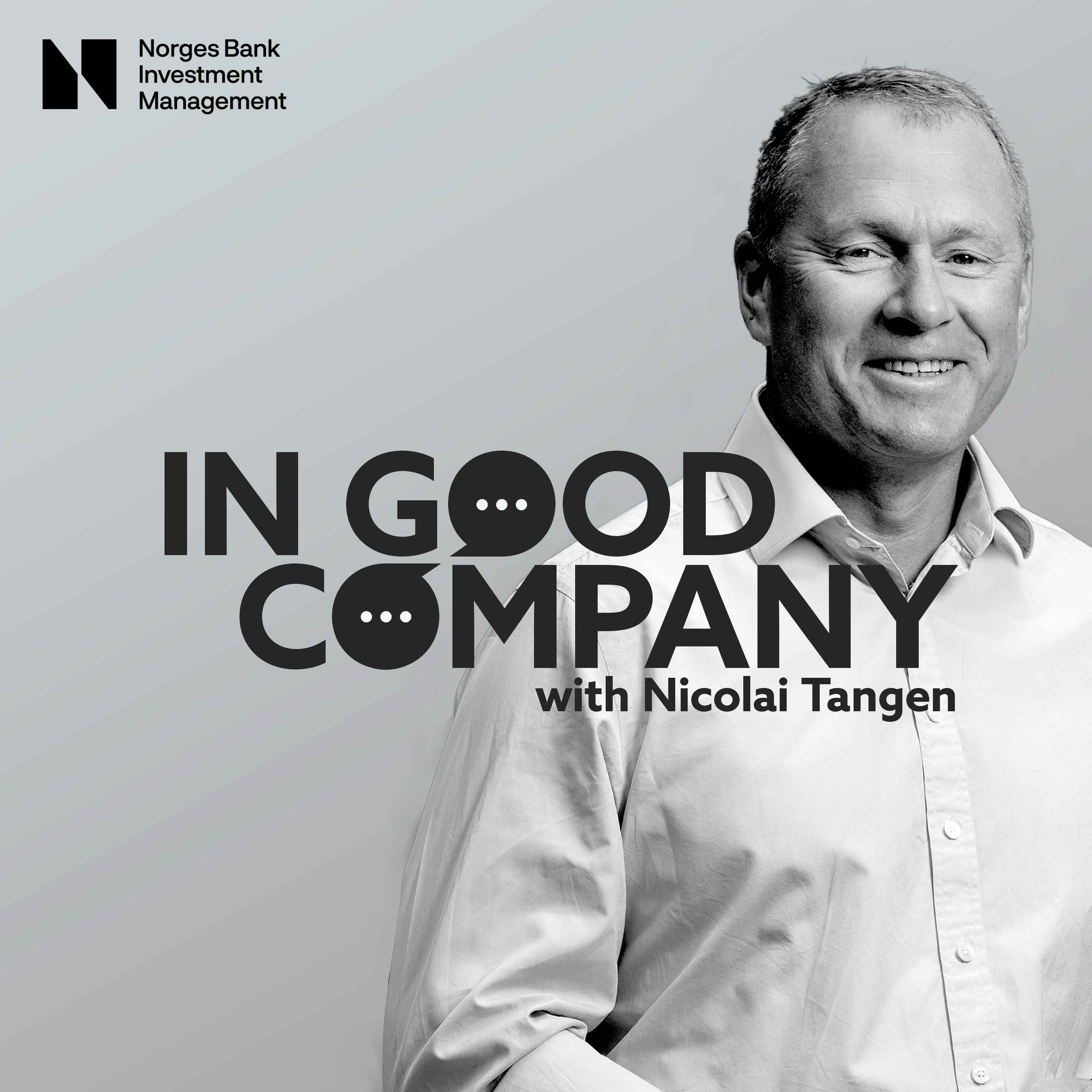
 In Good Company with Nicolai Tangen
15 Aug 2025 · 10m
Written by AI. May contain mistakes.

Get the gist, explore an idea or ask about something said.
 Claude
On In Good Company with Nicolai Tangen, what are the key points of this episode?
Searching your listeningAutomatic transcript. May contain errors.
0:00Hi, everybody. Tune in to this short version of the podcast, which we do every Friday. For the long version, tune in on Wednesdays. Hi, everybody. I'm Nikolaj Tangen, the CEO of the Norwegian Sovereign Wealth Fund. And today I'm thrilled to have Brian Moynihan with us. Brian is the chairman and CEO of Bank of America, one of the world's largest financial institutions. And we own 1.5 % of this great company. Brian has led the bank for 15 years, steering it through the aftermath of the financial crisis and transformed it into a digital powerhouse. So, Brian, wonderful to have you here. It's great to be here.
0:35Brian, you sit on the top of one of the world's largest banks. What's happening in the world? Well, I think there's a little bit of bifurcation between what's happening in various segments of the world, but you can add it all up to the world. But I think largely what's being driven now is the United States change in its policy from an economic basis, leave aside a geopolitical basis, but on an economic basis, a major change going on is that the U.S. has changed with respect to four policies, trade tariff type policies, immigration policies. This is more domestic in the U.S., but the taxation, budget policy, and then deregulation.
1:14And you're seeing that play out in the U.S. and obviously as a world's large economy and the biggest trading partner with most countries, you're seeing that impact around the world as we go through that change in the set of policies with the new Trump administration. Have you any private kind of secret indicators that you are particularly keen on that nobody else is really looking at? Well, if you look at the American consumer, the discussion of public domain was as consumer confidence factors went down after Liberation Day, April 2nd, and went back up, all the back and forth. What we saw was no change in activity.
1:52So what are we talking about? The Bank of America consumer,$70 million, them will send out of their accounts about four, four and a half trillion dollars this year into the economy. Year to date, it's almost two trillion because we're almost halfway through the year. If you look at that, it's up about four and a half to five percent of the first part of 25 versus the first part of 24. If you look at the month of June, four, four and a half percent. When you look at that amount of money going in the economy, that means the American consumer is participating heavily. When you look at their balances and accounts, stable to growing, bouncing around, not, you know, the core consumer kind of stable and the higher consumer money went into the money market funds and other instruments are in interest, but the amount of cash they have is actually at record highs.
2:36And so they're in pretty good shape. Unemployment's 4.2 % or whatever, you know, the prospects for being unemployed are relatively low. So you put that aside, and then you have to balance that against what consumers are saying they're feeling, which is negative due to all the change and all the activity going on, meaning, what's that mean? That means the tariff war. That means immigration. That means the reading of the economy is slowing down. And so what we see is U.S. consumers doing pretty well. We look at small, medium-sized businesses. Brian, are you surprised that the consumer is doing so well?
3:06No. Given the survey? And it comes down to, Nicola, the thing people miss is that the unemployment level is 4.1 in the U.S., which is 100 basis points per full employment, number one. And number two, wage growth is actually exceeding inflation and the aggregate across a period of time. Now, it ebbs and flows. Inflation came first and wage growth cut up to it. And now they're running more in sync. Is it the level of rates, which is the main concern for the business clients? Or is it other types of uncertainty, you think? Well, our survey of small business customers over the last year has shown different elements.
3:45First, it was rates and inflation because that was preoccupied. but um and then it shifted back to work is why i say back to workers it was at that during the great resignation a couple years ago in the united states and what they're saying is the inability to get enough employees that can do the jobs that they have that is being exacerbated by a lot of discussion you hear from them about the impact inflation and if you're in construction and all its related parts you're a cement company you're a delivery company you're construction, actually building the buildings, the impact of the immigration policy is causing people not to show up.
4:20If you're in the hotel leisure, farming, it's impacting you. And so, I think in the broad-based employees, that's why you're hearing the administration saying, we got to sort this out to make sure people know they're going to have the workers to be successful. And being agriculture and travel and entertainment and other types of industries, because it's not that the activity is affecting a lot of them. It's the worry about the activity that's going to affect them that causes the workers not to come. So they went from being all about inflation, all about rates to, wait, I can't get the workers again.
4:52And can I get those workers? So everything is on their mind, but uncertainty about some of these topics is critical to them. How will AI transform the bank? it it's already started um so it's going to transform the bank around a couple dimensions are different and it's just started in earnest um first it enables you to have replace uh human interaction with to human interaction second it replaces your it helps you analyze what we call text-to-text in other words big amounts of information how do you pull them together and have them come out the other side so somebody then can take that and utilize it differently It also can help you with testing and checking things.
5:37We file literally millions and millions of reports a day, and it helps you not only prepare those, but more importantly, to test those to make sure they're accurate and helps you find out ways to improve them. So if you're back, and it helps us in computer coding, we're already using it, 18 ,000 plus programmers already use it and stuff. So let me give a very concrete, straightforward example. So this product, this technique we called Erica. So Erica is the way a consumer can have a virtual assistant at Bank of America. You're hearing a lot about agent bots and all that stuff. We've had this now for five, seven, eight years.
6:17We started about 10, 12 years ago. And what we had them develop is we looked at the search technology and it just wasn't going to work in financial services. So we had them develop a new natural language processing predictive model. which today we call a small language model. Back then, nobody would have called it that because it was a different world. We had them build that for us. Then we used it and trained it on our own data, and it can answer questions. Now, 20 million Bank of America customers use Erica each quarter about 200 million times to ask questions that it can answer. Now, Erica has a lot of room to go in refinements and improvements and doing it, but we know it works.
6:55And those 200 million interactions would have been a phone call, a text or an email, or walking into the branch. So 200 million times a quarter, we're moving. We're heavy digitalized already. We have 50 billion consumer interactions a year. So it's a massive amount of activity. It's heavy digitalized. But the room to go to digitalize more with AI is different than with the machine learning and other types of models we had. And Erica shows us that bridge. So, Brian, you became CEO in 2010. after the financial crisis. What's the toughest decision you made during your tenure in the bank? Well, the toughest decisions all ran around how we got through the aftermath of financial crisis and how we had to be so resolute on resolving issues.
7:42So we had a quarter where we settled lawsuits, the$20 billion lawsuit, etc. Those are tough decisions. it wasn't necessarily the financial decision that was tough enough but it was the people implications of deciding to take a completely different position in the mortgage business and you know from company was doing one in five mortgages we had to go down to where we got to five percent share because we what we were doing was not directly with consumers those were hard decisions could affect people's lives and our ability and had to retrain our whole brain power in the company that was a tough all the decisions that are toughest are about people, you know, and disrupting other people's lives.
8:22So downsizing people, changing people. And that's why we frankly worked very hard to do headcount management to avoid layoffs. And we've been pretty good at the last 10, 15 years. In the early days, we had to do some layoffs. And to me, that's the toughest decision because you're basically walking into somebody who was a great worker, worked for the company and say, you know what, we just can't use you anymore. And that's going to our AI conversations, why we're managing headcount so carefully and trying to figure out how to make sure that we aren't overstaffing and then having to take people out.
8:52The other tough decision... Do you tell anybody yourself or is it delegated to other people? Oh, I never start a process like this unless I'm willing to change the people who work for me. So actually, ironically, in the first downsizing we did as a financial crisis, I lost my job and it was before I was CEO. I was running integration and I decided that one of the positions they had to eliminate was mine. And I was almost out of the company and they offered me a different job and I stayed. So I believe resolutely that you have to start from the top. This is not a bottoms up thing. What are the biggest reasons for failure that you are trying to avoid?
9:30I think A, complacency. B, you get stuck in bureaucracy and progress, a large company. How do you break through that? see you don't get ahead or get ahead of a trend. And this is where AI is kind of interesting. We got to utilize this and drive it. But if you get too far ahead, you can bet the company in a way that may not work. And so that's the source of failure people who get too far ahead of a trend or don't keep up with the trend or don't keep the brand fresh. You don't think they're doing well when they're not doing well and willing to poke at it and ask questions. So while a CEO always has to be optimistic, in the heat of the night, you have to be very sort of, what are we doing wrong?
10:12What can we do better all the time? But you have to make sure you translate that into action, into process so it gets done.
We've curated a special 10-minute version of the podcast for those in a hurry.
Here you can listen to the full episode: https://podcasts.apple.com/no/podcast/bank-of-america-ceo-economic-insights-regulation/id1614211565?i=1000721746844&l=nb
What does it take to steer one of the world's largest banks through unprecedented change? Nicolai Tangen speaks with Brian Moynihan, the CEO of Bank of America, to explore the global economy and what lies ahead. They discuss how AI is transforming banking operations, the future of physical branches, and why Brian believes regulatory pendulums have swung too far. The conversation covers international expansion, the resilience of American consumers, and his philosophy on building high-performance culture. Leading 212,000 employees and serving 70 million households, Brian shares insights on leadership and staying curious in an ever-changing world. Tune in for an insightful conversation!
In Good Company is hosted by Nicolai Tangen, CEO of Norges Bank Investment Management. New full episodes every Wednesday, and don't miss our Highlight episodes every Friday.
The production team for this episode includes Isabelle Karlsson and PLAN-B's Niklas Figenschau Johansen, Sebastian Langvik-Hansen and Pål Huuse. Background research was conducted by Torgeir Rimstad.
Hosted on Acast. See acast.com/privacy for more information.


