
 Ask ChatGPT


 In Good Company with Nicolai Tangen
26 Sep 2025 · 11m
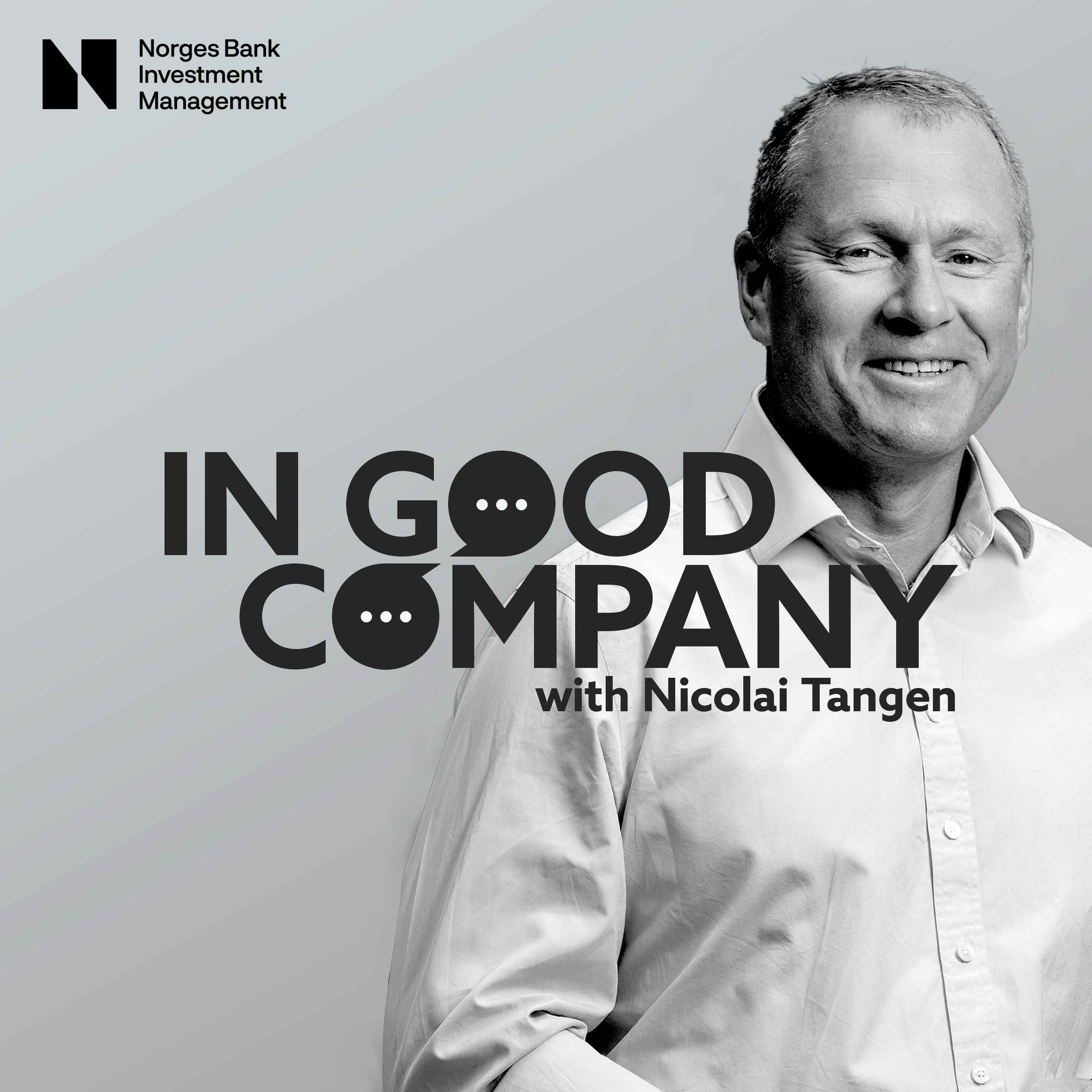
In this highlight episode of "In Good Company," Nicolai Tangen, CEO of Norges Bank Investment Management, interviews Dilhan Pillay, CEO of Temasek, Singapore's sovereign wealth fund. Their conversation dives into Temasek's long-term investment philosophy, global strategy, and the impact of geopolitical dynamics on investment decisions.
Written by AI. May contain mistakes.

Get the gist, explore an idea or ask about something said.
 Claude
On In Good Company with Nicolai Tangen, what are the key points of this episode?
Searching your listeningAutomatic transcript. May contain errors.
0:00Hi everybody, tune in to this short version of the podcast which we do every Friday. For the long version, tune in on Wednesdays. Hi everybody, I'm Nikolaj Tangen, the CEO of the Norwegian Sovereign Wealth Fund. And today I'm really delighted because I am here in Singapore with Dylan Pillay, the CEO of Temasek. And Temasek is Singapore's Sovereign Wealth Fund managing roughly 300 billion US dollars. Now Dylan, he's been in charge of Temasek since 2021. and after a remarkable journey building up to the leading law firm in the country. And so, big thank you for taking the time. Thank you, Nikolai.
0:38Pleasure to be here. Lots of things to talk about, but let's just kick off first. I wish I'd given you better weather. I think it's pretty good. What is Temasek? Well, I think that people define us in two different ways. I think most people will see us as a sovereign wealth fund based outside of Singapore because we're owned by the government. But we're really an investment holding company. We own three different portfolios. We have operating companies, which together have something like about$150 billion US in revenues. We have a global portfolio of investments around the world, mostly minority investments.
1:15And we also have a business that builds asset management platforms and also invests in private refunds and alternative investment managers. What's the main difference between you and GIC, which is the other? So GIC manages the government's reserves. And so it is really a fund manager, no different from NBIM, I would say. And so they're also multi-asset, multi-strategy. For Tomasic, we have been set up from day one as an equities owner. You know, so whether it is in relation to the companies that we control or whether it's in relation to our global investment portfolio, we're primarily equities.
1:49We have a very small credit portfolio, something like about two odd percent of our portfolio value, but the rest of it is equities. And so if you look at it from that perspective, the big difference is GIC manages money and we own our assets. And so therefore, for us, it's very important that we recycle our capital because that's how we get capital to invest. And so we have to make the trade-offs between sometimes owning it for longer or secondly, trying to recycle some of the capital into better opportunities for long term. So tell me about the split now, the current split. Just how, what does that reflect in terms of your, I guess, geopolitical thinking?
2:28So much of how we have constructed a portfolio over the last 20 odd years since we started to become a global investor has really been determined by the external environment. So if you look at the 2000s, really it's about the opening up of Asia following WTO, the extension of India and China in particular, and the ability of these two economies of becoming not just plugged into a global economy, but becoming leading economies for the world, which has largely happened. India a little bit later than China, obviously. And so when we looked at it, we realized that we couldn't be Singapore-centric.
3:04We had to step out. and therefore going out to Asia first made sense since Asia is our sort of backyard, if I can call it that. But in the 2010s, following the GFC, we recognized that you need to have a balanced portfolio and you couldn't just have a merging market focus, which is really where we were for the previous decade outside of Singapore. And so that's when we started to invest significantly in the US and Europe. So our exposure to the US and Europe in 2011, before we embarked on our 2020 roadmap, was by 11 % in aggregate. By the end of the decade, it was 33%. So three times. And the portfolio doubled in value.
3:39So that's a significant uplift. That meant that capital... What drove that? What was the thinking behind that? Well, because the one thing that the GFC thought is is that actually you have to look at, first of all, macro factors and look at strength of economies. As you think about your thematic investing, you've got to go where there is capital flows, but also where you see the best of innovation. And quite apart from what we saw in China, We thought that the US would be clearly their leader in innovation. For Europe, we always felt that they had globally competitive companies that were extremely good, despite whatever people may think of in the macro of Europe.
4:14We still have that view that we're not a macro investor, so we're not saying avoid Europe because of the macro. But we are investing companies. So what was driven by was this whole issue of globalization and which are the likely winners, depending on the sectors that we were in. Now, in the last decade, when we started to really push out, in actual fact, we were driven by themes. You know, we were looking at things like urbanization, rising middle-income populations, you know, the comparative advantages of companies which would be like linked to IP, for example, for example, biotech. And then we're looking at domestic champions who will go beyond their geographies into the world.
4:52Later on, we looked at trends. And trends are things like, you know, four broad trends we have are digitalization, future consumption, longer lifespans, sustainable living, which embodies within it, obviously things like sustainability. And so as we looked into that, you know, you could find, you could actually determine which geographies are more likely to give you those opportunities. And so allocation of capital went to some extent according to trends, geographies according to where we thought there would be flows and where we could get the alpha, and then finally into sectors. How do you think about private versus public markets?
5:27Well, going back almost a decade. So private are the companies which are not listed on the stock exchange. Yeah, going back more than a decade, when we started our 2020 strategy in April of 2011, 80 % of our portfolio was publicly quoted, 20 % was private. Fast forward a decade later, it was 50-odd percent private, 40-odd percent publicly quoted. And if you include in a publicly quoted our Singapore companies that we control from 20 % to 50%, 60%, that means a very small part of our portfolio is actually really publicly quoted. And by the way, I would say in a low interest environment and in a rather benign 2010s decade, going into private made a lot of sense.
6:17You know, because first of all, you didn't have the mark. And where are we now? I think now you have to be a little bit more circumspect. I think private still gives you a lot of value because I think it's wrong to conflate a generic model into where you should invest in the private markets. So there's still value in private equity, but you have to be very good at manager selection. There's still good value in private credit, despite what people think, because if you are very clear-minded about how you invest in private credit and you're looking at actually cash yield rather than just pure pick and so on, you might have a good opportunity set even as you go two cycles.
6:58The third, of course, in the private markets is call-plus infrastructure. And call-plus infrastructure is not a public market product. It's a private market product, but it gives you a yield and a decent low double-digit return. What's more risky now, private or public? Both are risky for different reasons. I would say that the problem of private markets is you have more opacity. As an investor in the private markets, you don't have the same access to information to know what to do. If you're in the private markets, because it's illiquid, you can't pivot easily. So you have to be clear that when you put money in the private markets, you're in there for a long haul.
7:41Well, in today's terms, five years could be long haul. And you are in there with long-term partnerships. Yeah. How do you think about your partners and who are they? Yeah. By the way, before I forget, the danger of public markets is that if you measure from year to year, the volatility hits you. Yeah. So it has to be managed. So long-term partners. So I believe that really, and I've said this internally with everybody, I said, look, you know, we have to look at ourselves as a network organization, as one focus on partnerships. So in everything we do now, we should find ourselves thinking first and foremost, who could partner with us on this?
8:15Unless it's an investment opportunity where it doesn't allow us to look for partners. But I think that's important because we need to realize that at Temasic, we do not have all the skill sets needed for all the opportunities to come through our door. And so we have to augment it with others who have it. And therefore, partnership is more important for them from that perspective. It's not about risk diversification. We don't look for partners of risk diversification. We look at them as partners to augment what we already have. Why has Singapore been so incredibly successful? Much of it, I think, is due to our founding fathers, Lee Kuan Yew and his first generation of leaders.
8:56And not just the political leaders, but also the civil servants who supported them. It was a whole team that took, I would say, took over a Singapore that became self-governing away from colonial running of our country to one that became part of Malaysia for two years to become independent without natural resources, where your only resource are your people. That's why I say, Temasek's not really primarily in the investment game. We're in the people game because the only way for us to advance is to make sure the quality of our people, how we train them is critical. But if you look at the civil servants, they are much more highly paid than in most countries relative to...
9:36So are the politicians. Absolutely. Civil servants, politicians, really highly paid, very highly educated. They work very hard too. Yeah? Yeah. Extremely hard. What's the consequence of having such like a caterer of civil servants and politicians who are so, what should we say, outstanding? That's good for the country. You know, I would say, you know, if you are a young Singaporean, you'd want that to be the case because if you have your life ahead of you, if you're 30 years old and you're going to work to the age of 80 because you can live to the age of 100, you know, You want to make sure that your leadership, your political leadership and your civil service have top-notch people.
10:24And they have to be there to formulate policies where business can thrive. Okay, that's the main thing. So you need good people there who are able to engage with industry, both within Singapore and outside, to be able to think of the policies we need in the short term, in the medium, and definitely in the long term for Singapore to succeed.
10:46bem
We've curated a special 10-minute version of the podcast for those in a hurry.
Here you can listen to the full episode: https://podcasts.apple.com/no/podcast/temasek-ceo-investing-for-the-future-navigating/id1614211565?i=1000728153466&l=nb
What drives Temasek's long-term investment philosophy? In this episode of In Good Company, Nicolai Tangen sits down in Singapore with Dilhan Pillay, CEO of Temasek, to explore the philosophy and strategy behind one of the world's most influential investment companies. Dilhan shares how Temasek—often described as Singapore's sovereign wealth fund—sees itself as an investment holding company with a long-term outlook, balancing financial returns with social impact. They discuss the firm's global investment approach, how geopolitical tensions affect strategy, and thoughts on integrating AI into workflows. Dilhan also shares insights on Singapore's governance success and his leadership philosophy built on integrity and trust. Managing $350 billion across 13 offices worldwide, Temasek demonstrates how relationship-focused investing creates lasting value. Tune in for an insightful conversation!
In Good Company is hosted by Nicolai Tangen, CEO of Norges Bank Investment Management. New full episodes every Wednesday, and don't miss our Highlight episodes every Friday.
The production team for this episode includes Isabelle Karlsson and PLAN-B's Niklas Figenschau Johansen, Sebastian Langvik-Hansen and Pål Huuse. Background research was conducted by David Høysæter.
Hosted on Acast. See acast.com/privacy for more information.


