Ask ChatGPT
 In Good Company with Nicolai Tangen
24 Jun 2026 · 36m · 21 chapters
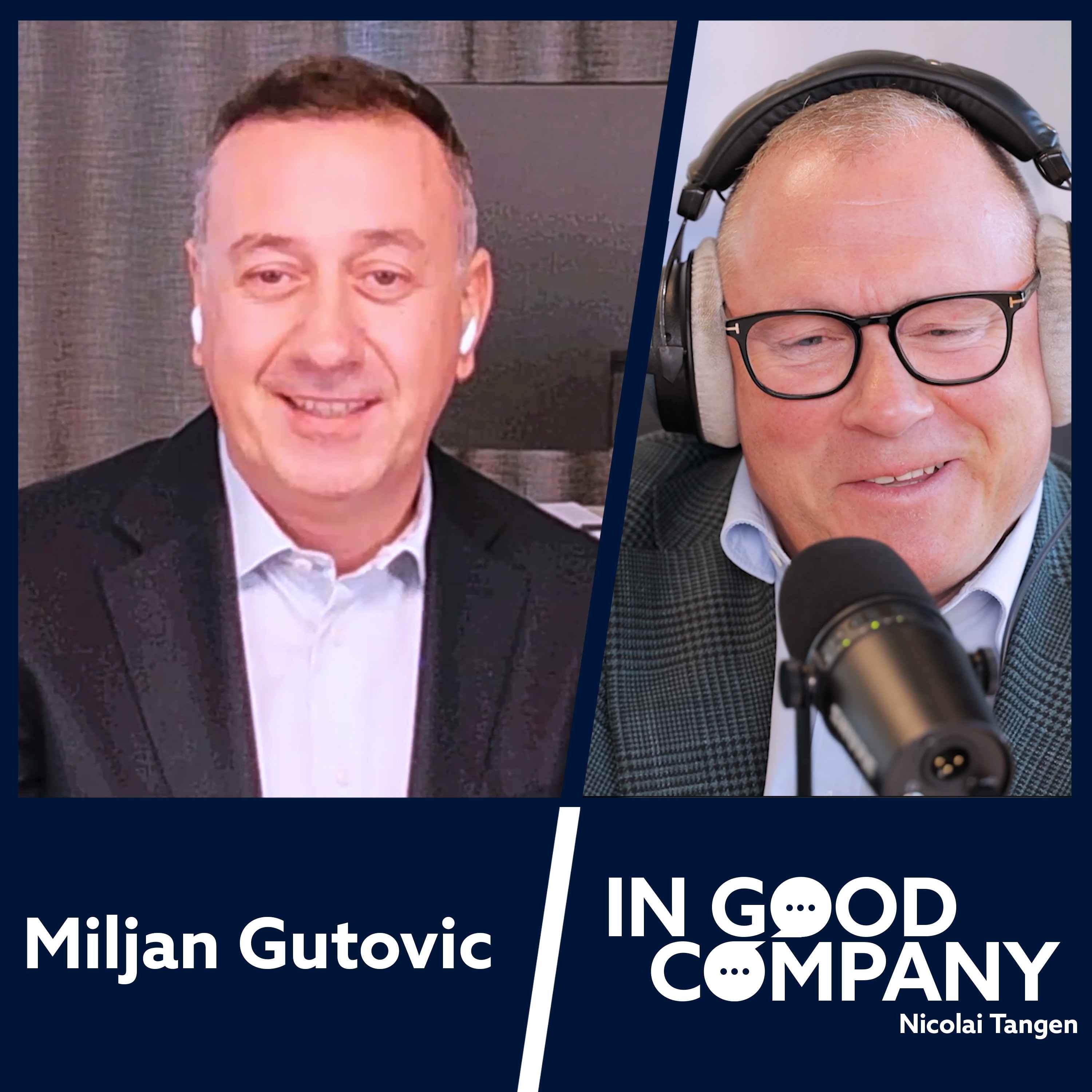
Holcim’s role in construction, Europe’s housing shortage, decarbonising cement, and leadership lessons (innovation vs complacency).
Miljan Gutovic, CEO of Holcim; civil engineer with a PhD in material science; previously head of Europe for five years. Nicolai Tangen, CEO of Norway’s Sovereign Wealth Fund (host).
Concrete is the second most consumed material after water (~30 billion tons/year). Holcim’s “eco-friendly” cement/concrete now exceeds one-third of sales by replacing CO2-intensive raw materials. Europe needs ~10 million more homes; permitting approvals are improving, enabling short-term recovery. Sustainability remains central despite political shifts; it drives profitable growth. AI targets operational warnings to plan shutdowns/maintenance without layoffs.
North America spin-off (separated via Emrise); AI-driven plant monitoring; alternative fuels from waste; circular construction (recycling demolition materials). Latin America growth via Peru acquisition and Mexico’s plan for 1.8 million homes in five years.
Written by AI. May contain mistakes.
Miljan Gutovic explains Holcim's contributions to building materials and construction.
“So, most people don't realize how embedded Holtzim is in their daily lives.”
Gutovic discusses the transformation and focus on innovation and sustainability in construction.
“Recently, we have gone through massive transformation.”
Gutovic shares details about new eco-friendly building products and their market impact.
“Tell us about some of the innovations you have coming.”
Gutovic elaborates on the strategic spin-off of Holcim's North American business.
“We work with construction companies, we work with hyperscalers, we work with governments.”
Gutovic reflects on business activity and housing shortages in Europe.
“What are you seeing in Europe in terms of business activity?”
Discussion on regulatory challenges and the introduction of an affordable housing plan in the EU.
“What we are seeing in Europe, for example, there is a massive shortage of housing.”
Gutovic discusses how defense spending will boost infrastructure.
“And also EU and also local governments are working to simplify the rules to make permitting quicker and faster.”
Gutovic shares insights on Holcim's growth and acquisitions in Latin America.
“And then there is a topic of reconstruction of Ukraine, where we can participate as Holcim from different countries around Ukraine, Poland, Romania, Moldova, even Hungary.”
Discussion on Holcim's unique business model catering to self-builders in Latin America.
“But the biggest country for us is definitely Mexico.”
Gutovic explains the implementation of AI technologies at Holcim for efficiency.
“You recently came out with a statement about AI and quantified the savings that you expect to get from the implementation here.”
Learn how Holcim integrates sustainability into its core strategy, focusing on decarbonization and circularity.
“This is about enhancing operational efficiency.”
Discover the innovative practices Holcim employs to enhance sustainability and profitability.
“So for us, sustainability is a driver of profitable growth.”
Explore the corporate culture at Holcim emphasizing purpose, people, and performance.
“How would you define the corporate culture at Holcim?”
Understand the leadership philosophy of Holcim’s CEO and how he addresses complacency.
“I see them as mentors to coach the local teams, to provide constructive criticism, or to share best demonstrated practices.”
Examine the importance of cultural understanding and the decision-making process in leadership.
“I think you were born in Sarajevo and grew up in a place which wasn't always the most peaceful place.”
Explore the challenges of encouraging long-term thinking in leadership.
“You know, people generally are quite short-term thinking, don't particularly want to share a lot of information because it takes time and effort.”
Discuss the importance of learning from mistakes rather than fearing them.
“Oh, look, I have made many mistakes, but it's not about the mistakes.”
Learn strategies for revitalizing complacent high-performing teams.
“time world will change so fast that this decision will be relevant.”
Understand the balance between oversight and empowering team members.
“Oh, look, I would not say that I'm micromanaging, but I do like to know what's going on in my business deep down.”
Discover the CEO's personal interests and how they unwind.
“I like spending time with the family and friends.”
Hear valuable advice for young professionals entering the workforce.
“Kids make sometimes fun of me when we are driving in the car.”

Get the gist, explore an idea or ask about something said.
 Claude
On In Good Company with Nicolai Tangen, what are the key points of this episode?
Searching your listeningAutomatic transcript. May contain errors.
0:00Hi everyone, I'm Nicolai Tangen, the CEO of the Norwegian Sower and Wealth Fund. And today I'm joined by Miljan Gutovic, the CEO of Holsim. Holsim, one of the largest building material companies in the world. Cement, aggregates, concrete, the stuff that the world is literally built from. So if you walked into a building today, drove on a road, crossed a bridge, hey, Holsim has probably been involved. And we own nearly 2 % of the company. Miljan, warm welcome. Pleasure to be here, Nikolaj. And thank you for a warm introduction. Thanks for selling Holtzim.
0:46So, most people don't realize how embedded Holtzim is in their daily lives. So, in short, what do you guys do? So basically we are producing and supplying to our customers building materials and building solutions that are used across built environment, in buildings, in industry, in infrastructure. So the word is construction. And when you think about construction, you're probably thinking about concrete. And concrete is indeed one of the most essential materials. To put it in perspective, and maybe you will find this fascinating, after water, concrete is the second most consumed material on earth.
1:35We use approximately 30 billion tons of concrete every single year. So we can say it's actually a bedrock of modern civilization. But it's also, I mean, it's not like it's a very glorious sector, right? So, but it's a sector which is transforming fast just now. So what is happening? Indeed, beautiful times for the whole construction industry. And now I'll be talking to you as a civil engineer with PhD in material science. And so this industry has been very conservative for many years, for many decades. Recently, we have gone through massive transformation. The key word in our industry today and for Holcim is innovation and sustainability.
2:31What happened? Why is this a sudden change? The pressure to build better, to build smarter, to build more efficient is coming from our customers, from all the different stakeholders. And that's why we have positioned today Holtzim as a leader in innovative and sustainable building products. Tell us about some of the innovations you have coming. What's the most exciting things? So we are really changing the way we formulate products, we produce products, and we use the products on construction site. I'll give you a few concrete examples, as we would say. Formulation. We are changing formulation constantly.
3:20A few years ago, we have launched the new generation of eco-friendly building products, cement and concrete. Today, after five plus years, these products represent more than one third of our sales. So what we are doing, we are replacing highly CO2 intensive raw materials and you can say even expensive raw materials with more sustainable, more CO2 friendly and cheaper versions. Who are your biggest clients? I mean, you name it. We work with construction companies, we work with hyperscalers, we work with governments. So really, it's a fragmented ecosystem. We are building houses, we are building tunnels, bridges, we are building data centers, logistics centers, all the way to the factories and high rise buildings.
4:23Recently, you made a big structural move in that you separated your whole North American business. Why did you do that? It was all about creating value, creating value for customers, for people and our shareholders. We saw that strategies are diversifying between North America and Europe. So we wanted to create a new chapter of growth for Holcim to unleash actually this new chapter. And that's why we decided to spin off the North American entity. And now we are focusing on the most attractive markets across our 40 countries where we operate. It's interesting. We often see with spin-offs that the companies which are being spun off are so happy to get rid of their parent.
5:16You know, it's a bit like young kids moving out, get a lot of energy, do new crazy stuff. Have you seen any change in Emrise, which is the name of the company you spun off? No, it was a very healthy, constructive process that lasted probably more than a year and a half. And at the end, we wanted this to happen as soon as possible because we were ready to take the next challenge and the result was very satisfactory for us, for Holcim. We finished 2025 as the best performing stock on Swiss market index. Do you now compete with them? Not really. There are a few overlaps, but this was a geographical separation.
6:09So business in North America is negligible. So now Europe is your biggest market. What are you seeing in Europe in terms of business activity? So before becoming a CEO, Nikolai, I was actually head of Europe for five years. So I know this region inside out. And I was happy to be part of these last five years when we went through some, I would say, challenging times. I took over in 21, then 22 came energy crisis, relatively softer construction activity in the last few years. And despite of all of that, we continue to outperform. I would like to say that I am optimistic about Europe. change is coming.
7:02What we are seeing in Europe, for example, there is a massive shortage of housing. We are missing close to 10 million homes. But Miljand, that's been the case for some time and still building hasn't really taken off again. So what we are seeing at least since second half of last year, number of permits is coming through, especially in the last two months, we have seen a very healthy permitting approvals across all our key markets. This makes me confident that we will see recovery in short term. If you could change one thing, I mean, what is it? What is holding it back? Is it regulation, permitting, affordability, labor rates, just what is it?
7:56So it's a combination of few factors, but permitting would be on top of my list. So I'm very happy to see that EU introduced this affordable housing plan, which will boost supply and investment. And also EU and also local governments are working to simplify the rules to make permitting quicker and faster. The increase that we are due to see in defense spending, how do you expect that to impact you? So we will be part of this because, you know, if you want to store the weapons, ammunition, you need to have the infrastructure. You need to have a rail and road network in place. So the infrastructure spending will definitely be boosted by defense spending.
8:54What about Ukraine, where at some stage we need to see a major reconstruction? Let's hope we see it sooner than later. But firstly, to stop the suffering there. But it definitely have a huge uplift across Europe. I mean, I just think that if this war stops, the optimism about the future will significantly change. And then there is a topic of reconstruction of Ukraine, where we can participate as Holcim from different countries around Ukraine, Poland, Romania, Moldova, even Hungary. In the meantime, Latin America is a big market for you. And you made some acquisitions there. Why are you so excited about Latin America?
9:51So it's a region where we have the highest EBIT margins. It's a region where there are global megatrends that are actually shaping the future of construction industry. You see population is growing, urbanization is increasing, people want to live better, governments are committed to spend on residential and infrastructure, and we do have an excellent footprint in Latin America. We just concluded a big acquisition in Peru, which is an amazing market, a market that is booming. There are mining investments, there are agriculture investments, and with our presence now in Peru, we are happy to capture this growth.
10:42But the biggest country for us is definitely Mexico. Mexico is a country where we are seeing accelerated growth when it comes to construction industry. The new government, President Claudia, has made it very clear. She wants to see Mexico in top 10 economies by 2030. She is committed on infra spending. She wants to build 1.8 million homes in the next five years. and some of this has already started. How different is it to do business in Latin America compared to Europe and the US? It is different. In Latin America, nearly half of our customers are self-builders. These are people that buy cement in bags, they mix it on side to renovate their home, to increase the space of the house.
11:44So what we did, we actually changed the route to the market. We operate close to 2 ,500 retail construction shops called Descensa, where we are servicing these very powerful customer base. And through our shops, that most of them are franchises, we are able to supply up to 85 % of their needs.
12:20Let's move to the topic a bit. You recently came out with a statement about AI and quantified the savings that you expect to get from the implementation here. How do you think about AI in Holcim? It is definitely changing the way we process, we produce. It is something that we have been doing now for several years. And yes, this year we came out with the ambitious plan to hit 200 million Swiss francs in net benefits by 2028. So just imagine, Nikolai, we are running complex industrial operations. There are our factories, cement factory on average in size is 1000 by 500 meters. So they are big industrial complexes.
13:13So we need to operate 24 seven. And in such a situation, you wish you can have a crystal ball to be able to predict the future when this section of the plant will stop. With AI, what we are doing internally, we are generating huge amounts of data. This data is sent to AI platforms where we have specialized algorithms which were developed just for Holcim. And these AI platforms, they are giving us warning signals that something might go wrong in this section of the plan. So with this info, we are able to organize ourselves better, we are able to plan the shutdowns and also to better plan the maintenance in our production facilities.
14:11So this is not laying off people? Absolutely not. This is about enhancing operational efficiency. This is about exercising strict cost discipline. It's not about laying off people. In fact, it's actually about upskilling people. You mentioned previously your approach to decarbonization. Now, what does it mean to be a leading partner for sustainable construction? Just what does it mean in practice? decarbonization you talk about? So we put sustainability at the core of our strategy. And when we talk about sustainability, we talk about decarbonization, reducing our CO2 footprint. We talk about circularity, which means recycling of old construction and demolition materials into the new ones.
15:08And we talk about reducing freshwater usage. So when it comes to decarbonization, we are leveraging all the levers possible to reduce the CO2 footprint. I mentioned we are reformulating our products, we are changing our energy mix, and also we are working on the next generation projects related to carbon capture. So where do you think, so now you are, now Cement accounts for, I think it is 8 % of the global CO2 emissions, even higher than aviation. Where do you think it could go to? Well, we were the first company in our industry that committed to net zero by 2050. So it is a long journey, but it's a journey that will bring many innovations and it will change the way we operate today.
16:06I'll give you one concrete example. For instance, during last decade, we have been working on reducing fossil fuels in operations, replacing it with alternative fuels. So what we do, Nikola, is basically we get paid to take the waste materials, we process this waste into energy source, and we use it instead of the traditional fossil fuels. By doing this, we are reducing cost, but we are reducing CO2 as well. So for us, sustainability is a driver of profitable growth. So we are doing it because, first of all, it's the right thing to do. And for us, it makes perfect business sense. I mentioned to you some of the products that we launched, these eco-friendly products.
16:59On these products, we do have cost advantages because we are using our production know-how, our formulation know-how. We are able to reduce the cost in these products as well as reducing CO2. That's why we keep bringing this statement back over and over again that at Holtzim, sustainability is actually driving profitable growth. Okay, so greener products will not be more expensive. We do get a small price premium, but in fact, we do have a cost advantage and we are using this to reinvest into the new initiatives, to invest into the new formulations. because eco-friendly products that we have today, probably in four or five times, they will change.
17:52Formulation will change as we will be developing next generation of alternative raw materials. When you came out with your plans and your visions, I mean, we have to admit that it was pretty fashionable to bring out these kind of plans. And subsequently, we've had a political shift in the US. Has that changed the way you look at these things? Absolutely not. Still today, sustainability is at the core of our strategy. And sustainability and innovations are driving our growth and will continue to drive our growth in the years to come. I can give you an example for Europe, for instance. Last five years, one of the best performing regions in our portfolio was Europe.
18:44Despite all economical challenges, market conditions, in the last five years, we have managed to increase our profit in Europe by 430 basis points. And one of the key drivers behind this was investments in sustainable offering, in decarbonization, and also in circular construction.
19:14Can we talk a bit about culture? How would you define the corporate culture at Holcim? So if you walk into the Holcim, you will see one slogan consistently everywhere. If you go into our office in Mexico City, in Zurich, or in Sydney, you will see HaltSim Spirit. So what we did is, you know, when you are going through a spinoff, and I took over as a CEO, my first goal was that we aligned the teams on the ground. So we launched this thing called HaltSim Spirit, which is based on three Ps. Purpose, people, performance. We all have the same purpose. Innovation and sustainability are the core of everything what we do.
20:06People. Still, the biggest asset of this company are people. 45 ,000 of our employees. And this is what I'm especially proud of. We launched, for instance, Holcim University. Last year, we have 3 ,000 of our employees going through this Holcim University. We are constantly investing into people and we want Holcim to be a place where we reward performance, we nurture talent and we encourage innovation. What were the changes you put in place when you took over as a CEO? So one of the changes is this Holcim spirit, where we started investing heavily in upskilling of our next generation of leaders.
20:55And the last P, which is equally important, Nikolai, is performance. One of the key strengths of this company is our deeply embedded performance culture. And this goes the way we are organized. We are fully decentralized business. And the reason why our business is local for local. We source everything locally, we produce everything locally, and we sell to local customers. So our corporate structure is very slim. It all goes down to the country, and countries are driving performance of the wholesale. And that's why we are the company with industry-leading EBIT margins. We have the most advanced decarbonization roadmap in our industry.
21:42This all goes back to our deeply embedded performance culture and our fully decentralized business model. How do you look at the trade-off between decentralization and having one culture and one system? Look, at the end of the day, we do have a slim corporate organization. I see them as mentors to coach the local teams, to provide constructive criticism, or to share best demonstrated practices. I personally, one of the things that I like most about my job is to spend time on the ground. I travel a lot, nearly every week, and I do enjoy spending time in our factories, on construction sites, and this is where me, a part of the corporate team, I am learning from the countries, And then these learnings, we are copying across the rest of our footprint.
22:47What would people say about you as a leader? Look, they will probably say that I keep repeating three things over and over again. I have three very simple rules. First rule is control the controllables. Very simple. I don't want to have endless meetings talking about geopolitical situation, predicting the future, impossible. Our goal is to focus on the things that we can control, on our strategy, on our initiatives. So all my meetings are about internal discussions, what we can do better, exercising strict cost discipline and improving operational efficiency. The second big statement that I keep repeating, and I strongly believe that this is the case, is that complacency is our biggest enemy.
23:50I see my job to eliminate complacency from the organization. Because, you know, when the company is doing well, I mean, look at our performance last several years. Look at the performance of some of our key geographies. People have a tendency to become complacent. How do you prevent that from happening? Well, from constructive criticism to benchmarking, Many are different ways. The third pillar, the third point that I should mention is this benchmarking. I like football. I like tennis, I like sports in general. I like to benchmark internally and externally. And we do provide a lot of benchmarking to the country to encourage them to do even better.
24:41Why this country is doing better than you? Find a way to improve. copy and replicate best demonstrated practices. So these three rules are probably the ones I repeated thousands of times, and I will keep repeating them in the years to come. I think you were born in Sarajevo and grew up in a place which wasn't always the most peaceful place. How do you think that has impacted you as a person and as a leader? Yes, growing up there, it was not an easy period in my life. But then moving to Australia, where I finished school, uni, got married, had my kids, then moving to Dubai, and now last seven years in Switzerland, working from Australia to Europe, different locations, I think it did really shape me.
25:41I learned a lot about the new cultures. I learned about different ways of conducting business. And I believe this is helping me today and this will help me in the future. As long as I continue to evolve and I continue to learn. It's exciting now I'm spending more and more time in Latin America, fascinating region where I personally can learn a lot on personal level to develop myself on personal level, but as well on professional level. What do you think is the key to cultural understanding?
26:25Look, there are, I think, what today what we are facing is the world is changing on daily basis. We need to change as well. We cannot be stuck in the same time forever. We need to evolve as the world is evolving. And what I see today when I talk to the young generation of my colleagues, these people, they are very smart. They have access to information in a second. But at the same time, I feel often they are excellent at identifying the problems. but not very often they are able to bring the solution to the problem. Very often people are scared or reluctant to make a decision because they believe that the decision might be wrong.
27:35And this is something that we need to change. We need to encourage the decision-making process. We need to encourage the next generation to bring a problem together with a solution. And this is a culture change that will take a while. I think it's quite interesting. Most companies, the more I speak to CEOs, the more I realize that most companies are struggling with the same things. You know, people generally are quite short-term thinking, don't particularly want to share a lot of information because it takes time and effort. They don't particularly want to take risk. And the job as a CEO is basically to extend people's thinking in terms of time, get them to share information, better feedback systems.
28:24It's the same in so many places. So very interesting. What is your biggest mistake? Oh, look, I have made many mistakes, but it's not about the mistakes. I believe it's about learning. When people ask me about... Tell us about something which went really pear-shaped. I think very often I was too slow to make the change on personnel level. I was sometimes too flexible when it came to some organizational changes. And the list goes on and on. But when it comes to this discussion, I always go back to... And I love this quote. Maybe I won't repeat it exactly what he said. But Thomas Edison, he kept saying, I have not failed.
29:15I have just found something like 10 ,000 ways that won't work. So it's not about mistakes. And I keep telling my people, it's about learning. It's about developing. Make a mistake. And it's better to make a decision today, even if it's half good, because in three months time world will change so fast that this decision will be relevant. You said that you had been too slow in making personnel changes. Have you, and so that's also quite common, have you seen many cases where you had a problem with people and then it's actually improved? It happened. It happened. Sometimes people do need to be waken up.
30:04sometimes people I've seen for instance in the high performing teams when after a while because they are being praised so many times they do become complacent and I go back to my second principle I really believe that complacency can be one of the biggest enemies in the company so how do you wake them up so how so somebody has been praised a lot of times and they go into some kind of hibernation or whatever, right? How do you wake them up? It could be inspirational speech to motivate them. But at the end of the day, it's dealing with the facts. It's dealing with something, some benchmarking. It's presenting the comparisons.
30:52And there's so many different ways. There is no one single point. But that's the part of the job. It is my job to ensure that teams are performing. And very often, even best performing teams, they need to be waken up. You have a PhD. Does that mean that you are micromanaging? Oh, look, I would not say that I'm micromanaging, but I do like to know what's going on in my business deep down. I like to be able to talk to my plant manager in Egypt on the same level, to ask him about certain KPIs that usually a CEO would not know. So I would not call it micromanaging, I would call it more curiosity and comparing performance of different organizations.
31:56What's the kind of leader you do not want to be?
32:03I don't want to be a micromanager, since you mentioned it. I like to empower my people. I like to give them a free hands. I like to have open and constructive discussions. And at the end of the day, it's all about teamwork. They do not work for me. They work with me. And we are all in the same boat.
32:35On a personal note, how do you relax? Different ways. I like spending time with the family and friends. Occasionally, I like watching sports. I like to play tennis, to do cycling, reading books. So different, different. But family is on top of the list and friends. What do you read? I've read many. I really went all over the place. In my high school, I had obsession with ancient Greece, then during especially Sparta, then during university I was obsessed with war and peace and Russian literature. Then later on, last few years, I am reading a lot of biographies from Einstein to Nikola Tesla, all the way to the mosque and different people.
33:37What kind of music do you play? The last few years, Chopin, Bach. I like to relax. Kids make sometimes fun of me when we are driving in the car. Because you have a very old person music taste? No, no, no. Or maybe. It's not good for, you know, when you do this thing on Spotify and you get what's your music age, you are like up at 100 years or something. I would say 80. I'm at 27. You are at 85. So who do you like these days, Nikolai? I'm not going to tell you. I'm going to mute music, you know. Taylor Swift or? No, no, no, no, no. Lastly, what is your advice to young people?
34:29Be bold. Don't be scared to make mistakes. be open-minded. I believe young people, when they need to spend more time on networking, when they enter organization. I'm not a big fan of this working from home policy. I like to see them in the office talking to older generation of workers so they can learn, they can absorb their expertise. So it's all about open thinking, evolving, learning, and also being brave to make a mistake. Be curious to ask the question. William, it's been great talking to you. Big thanks. And please continue to construct, make apartments, make roads, make buildings. We love it.
35:25Big thank you. Will do, Nikolai. Thanks for having me. All the very best!
Where would the modern world be without cement? Nicolai Tangen sits down with Miljan Gutovic, CEO of Holcim, to explore the transformation underway in the global building materials industry. They discuss Europe's shortage of nearly 10 million homes and what it means for construction, how Holcim is turning sustainability into a competitive advantage, the logic behind spinning off its North American business, and the booming opportunity in Latin America. Gutovic also shares his three leadership rules: control the controllables, fight complacency, and benchmark relentlessly. Tune in!
In Good Company is hosted by Nicolai Tangen, CEO of Norges Bank Investment Management. New full episodes every Wednesday, and don't miss our Highlight episodes every Friday.
The production team for this episode includes Isabelle Karlsson, Olav Vhile and PLAN-B's Niklas Figenschau Johansen. Background research was conducted by Isabelle Karlsson.
Hosted on Acast. See acast.com/privacy for more information.