Ask ChatGPT

 In Good Company with Nicolai Tangen
30 Sep 2026 · 47m · 25 chapters
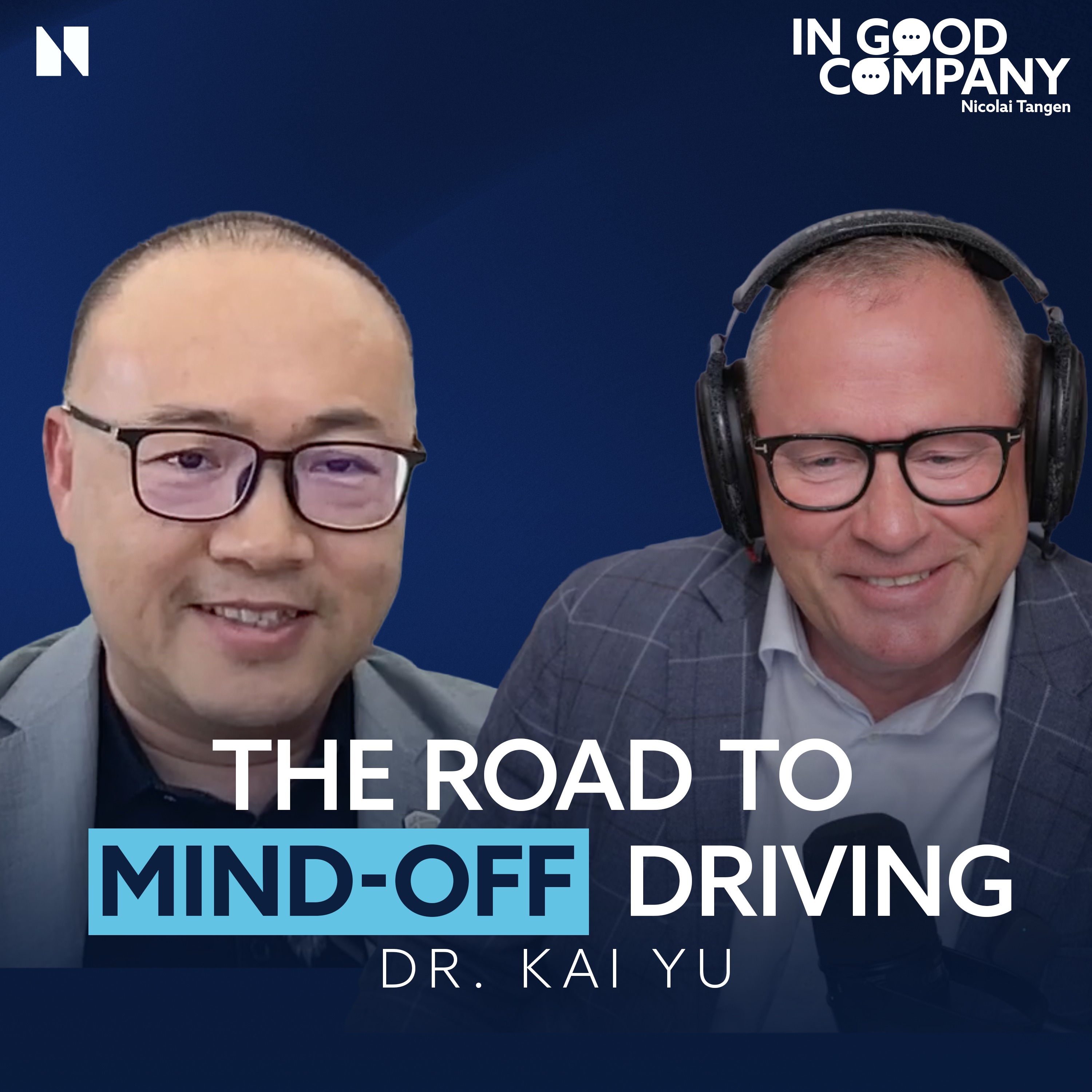
Horizon Robotics’ role in China’s self-driving push and the path to “hands-off” and “minds-off” autonomy, plus how the same automotive computing stack could converge with robotics (including humanoids) to give humans more freedom and reduce traffic and labor burdens.
Nikolaj Tangen, CEO of the Norwegian Sovereign Wealth Fund. Yu Kai, founder and CEO of Horizon Robotics; one of China’s leading AI scientists before founding the company; previously worked in research roles including Siemens, Silicon Valley, and Baidu.
Horizon supplies the in-car computing platform (camera perception through trajectory planning/control), with chips used in about 1 out of 3–4 cars in China. The company positions itself like “Intel/Microsoft for robots,” not as a carmaker. Autonomy milestones: fully hands-off by end of 2028, eyes-off by end of 2030, minds-off by end of 2035. Automotive entry barriers are high due to safety qualification cycles (often 5–8 years). China’s supply-chain ecosystem accelerates innovation.
Customers include BYD, Chery, Great Wall, Chang’an, and global OEMs like Volkswagen, Toyota, and Suzuki; competitors/peers cited include Mobileye, Huawei, BlackSesame, and Nvidia/Qualcomm/Texas Instruments. Horizon’s software stack “Horizon SuperDrive” on its Journey 6T SoC is described as enabling near fully hands-free driving.
Written by AI. May contain mistakes.
Yu Kai explains Horizon Robotics' role in self-driving technology and customer base.
“Nobody sits closer to the shift than my guest.”
Discussion on the founding vision of Horizon Robotics and the importance of a unified platform in robotics.
“Well, you know, the major Chinese OEMs like BYD, Chile, you know, Cherry, Chang 'an, Great Wall, and also some of the global OEMs like Volkswagen, Toyota, Suzuki.”
Yu Kai shares his journey in machine learning and the evolution of his career leading to Horizon Robotics.
“So every house, home, service, and elderly care, and also, of course, self-driving cars.”
Discussion on competition in the automotive market and Horizon Robotics' strategy to support car makers.
“Two companies that we've had on a podcast, XPeng and Xiaomi, they also make phones, cars, in addition to chips.”
Yu Kai outlines the challenges and long timelines in automotive chip design and production.
“Partially because we choose the position where this business is having extremely high entry barrier.”
Discusses the paradox of terrible business creating high entry barriers.
“But in my view, sometimes terrible business means great business because that's an entry barrier for all the other newcomers is extremely high.”
Explains the stages of autonomous driving technology and timelines for advancements.
“Well, we are in very good progress, I think.”
Details the progress of Horizon Robotics' technology toward hands-off and eyes-off driving.
“So that means by end of 2028, we're going to achieve fully hands-off.”
Discusses the importance of AI models, data quality, and computing in autonomous vehicles.
“right so I think already we are in a very progress to approach the stage of hands off but I think we need a much bigger you know knowledge to test and prove ISOF.”
Explores the work culture and flexibility of engineers at Horizon Robotics.
“I think we are very technology savvy companies so most of our employees they are engineers They are either software engineers or hardware engineers.”
Examines the intense work ethic and competition among Chinese manufacturers.
“We just, you know, caring about, you know, what kind of, how far we can achieve.”
Highlights the advantages of China's rich supply chain for innovation in automotive.
“So many companies and also so many car companies.”
Discusses strategic partnerships with global automotive companies and market dynamics.
“So I think that's a give China overall, very fantastic environment to innovate.”
Learn about the changing mindset of global companies in relation to China.
“For example, in the past, let's say, several decades, the general pattern was like global companies trying to make money from China, right?”
Explore the convergence of automotive technology and robotics.
“Your company is called Horizon Robotics.”
Discuss the challenges faced by humanoid robots and the importance of home service.
“Tell me about the speed of development of humanoid robots in China now.”
Understand how advancements in EVs influence the robotics field.
“So this is going to be a huge social and economical challenge for China.”
Envision how cities will transform in 10-20 years with robotics integration.
“This kind of zero-sum game, I'm not sure this is the truth.”
Reflect on the influence of ancient cultures on modern society.
“If you look at today, the traffic jam in Beijing and Shanghai, right?”
Gain insights into personal philosophy and reflections on failures.
“So when you're in Athens, what do you do?”
Explore the significance of culture and human potential in shaping a better world.
“like I think culture means everything human thinking is unbounded yeah and essentially we can do something much greater and than today what we can imagine.”
Learn about the speaker's perspective on personal failure and the power of positivity.
“Personal question, what's your biggest personal failure in life?”
Discover how Zen philosophy influences the speaker's approach to work and life.
“What's the key to the Zen philosophy for you?”
Gain insight into the speaker's self-awareness and their current reading interests.
“What's something about you that most people don't know?”
Understand the delicate balance between pursuing passion and accepting reality in life.
“to create the era of personal computing.”

Get the gist, explore an idea or ask about something said.
 Claude
On In Good Company with Nicolai Tangen, what are the key points of this episode?
Searching your listeningAutomatic transcript. May contain errors.
0:00In some sense, this is terrible business, you know, heavy investment, very slow return. But in my view, sometimes terrible business means great business because that's an entry barrier for all the other newcomers is extremely high.
0:27Hi everybody, I'm Nikolaj Tangen, the CEO of the Norwegian Sovereign Wealth Fund. Ten years ago, we all assumed self-driving cars would come out of Silicon Valley, but today the most advanced cars on the road are Chinese, and Western carmakers are going to China to buy the technology. Nobody sits closer to the shift than my guest. Yu Kai, who's the founder and CEO of Horizon Robotics, which supplies the chips and software that let Chinese cars drive themselves. He's one of China's leading AI scientists before he became an entrepreneur, and few people can explain better how China got there and where it goes next.
1:04So, Kai, welcome. Hi, Nikolai. Let's just start with a simple question. What does Horizon Robotics do? Well, essentially what we are doing is the computing platform for all generic robots, so including self-driving cars. But of course, our current business is probably, you know, 95 % or nearly 100 % focusing on cars, passenger vehicles. So if I sit in a car that you supply into, what does your chip do? Well, essentially it's running the software for all the way from camera perception to trajectory planning and control. So essentially it's kind of like brand for all the cars. Now your chips run roughly one out of four cars in China.
2:06Just tell me about the... One out of three, I think. That's our latest track record. Thank you. Well done. Who are your customers? Well, you know, the major Chinese OEMs like BYD, Chile, you know, Cherry, Chang 'an, Great Wall, and also some of the global OEMs like Volkswagen, Toyota, Suzuki. So quite some local, domestic and global players. Who do you compete with? Oh, very good question. I think like Mobileye, you know, and also Huawei and quite a few domestic players like BlackSesame. I'm not sure if you ever heard of that. And Qualcomm, Nvidia, Texas Instruments, you know, ReneSys, NXP. So actually a lot of global and China technology companies.
3:12Why are you the best? Oh, well, very good question. I think it's really because we are very focused. You know, we focus on this single one thing to enable automa driving and all the way to robotics. We are not doing anything, nothing else. So I think the intensity of focus is one thing. The other thing I would say is fundamentally our vision and the mission. Because if you look at the name of our company, you know, 11 years ago, when we founded this company, we named our company Horizon Robotics, right? Back to 11 years ago in China, there was even no such a business at all. Yeah. And even eBay business was just starting.
4:08Right. And we had this vision, which was not an existing opportunity. So we envision in the future, the world will be full of all kinds of different robots, you know, working in the farming field, manufacturer, assembly line, and the logistic warehouse, you know, So every house, home, service, and elderly care, and also, of course, self-driving cars. So we envision there should be a unifying platform, just like Windows and Intel did for personal computing. And just like ARM and Android, what they are doing for mobile computing. So we envision in the future there's going to be such a kind of like a computing platform, which is generic for all kind of, you know, robotics working across different vertical domains.
5:13When exactly did the vision hit you? Well, that's a very good question. Were you in the shower or were you walking in the mountains? Well, that's a very good question. I think exactly you are right. I think the vision actually hit me, not I find this opportunity or this vision. Well, I don't know. You know, I have been working in machine learning for over 30 years. You know, since my early days as a junior student in college. And by chance, I read a book about machine learning. And I was so amazed that it's so fantastic to develop a computer algorithm. One day, it can be like a human brain, getting smarter and smarter over experience.
6:10Yeah, by learning more and more from data. So then I decided to devote my whole career into this single subject, machine learning. Yeah, and that was for my thesis for my undergraduate and my thesis for my master and also for my PhD. And also for my first job back to my days in Siemens and later to Silicon Valley, joined the EZ Labs in Silicon Valley. And then later joined Baidu and then later founded Horizon Robotics. So I changed my locations and I changed kind of different roles from, you know, individual researcher to team leader to head of research labs and later become a founder of a technology company.
7:01So I changed my roles. But there's one thing, you know, remains never changed, which is my mission and my vision to develop machine learning algorithms to make machines getting smarter and smarter. Two companies that we've had on a podcast, XPeng and Xiaomi, they also make phones, cars, in addition to chips. So why did you decide never to build a car? I always position ourselves going to be like Microsoft and Intel, not for PC, but for robots. And I think a platform, an enabling platform, I think is a much more interesting positioning, not just about like a business model, but also about in terms of the impact you can make to the whole world.
7:58You know, for example, you know, back to the days of a personal computing era, you know, Windows and Intel, they are not just, you know, help or enable like Lenovo or Dell. They actually help the entire mankind, you know, get into the new kind of sort of technology civilization, a new area of technology with a personal computer to enable all the white-collar people to increase dramatically their productivity, right? It's what's an amazing impact. So, Xiaopeng, they actually maybe help one brand, you know, to become very, very appealing, very, very attractive to consumers. But I want to enable and help all the brands, all the cars.
8:53Is it difficult to build a car? Yeah, of course. So, but you have the technology, you have the chips. So if I ask you to build a car, how long time would it take you? You know, I wanted to achieve like a horizon inside, you know, that's I think that's a much bigger dream, much more interesting for me. I don't want to be a carmaker, you know, and I want to help more car brands to become more attractive. Now, the Chinese car market is kind of brutally competitive. What is driving the Chinese car market just now? Is it price, intelligence? Just what is it? Well, the current Chinese car market is really crazy.
9:46I think you don't see any market like here. There are, you know, I don't know how many, probably 60 to 70 different car brands. And for the first half of this year, more than 580 new car models launched. And it's an extremely, you know, tough market. But I think the market is really driven by competition. But on the other hand, it's also driven by consumer demand. So consumers are really expecting, you know, more and more smart features, you know, automatic parking, you know, autonomous driving and the more fancy infotainment assistance. And I think all of those factors driving the market, not just the competitive, but also very innovative.
10:45What does it do to Chinese manufacturers when you have such strong competition at home? that when you get out to let's say Europe is it just like easy peasy to compete relative? I think we position ourselves first we are not competing with any car makers we are actually enabling them we are helping them we are building strong partnerships with all the car makers and and all the ecosystem partners, including the automotive suppliers, for example, Bosch, Denzel, and many other global and local suppliers. And our philosophy is really make friends and make long-term trust with our customers and partners.
11:38Essentially, this is fundamentally in the gene of our company. So we don't have too much culture from the competition perspective, but more from what kind of value we can create. But luckily, if you look at our business, I mean, fundamentally compared to those car makers, we are not so crowded, right? And if you look at China, I think pretty much the three top players for the automotive computing, I think, namely nowadays. I think it really consolidated to NVIDIA, Huawei, and Horizon Robotics. Not very crowded. Partially because we choose the position where this business is having extremely high entry barrier.
12:34It's not like, okay, a bunch of guys having VC funding and then easily getting into the business. because this is automotive. Automotive means mission critical. And it has to have the highest standard for the quality, for the safety. And let's say we are doing this cheap design for automotive, right? It's not like a consumer type of silicon. And it has to go through all the very regular and the tough qualification and testing process. So normally, if we initiate a new project, a new generation of product, so it will take three to four years to get the product, the chip and the solution ready for car makers.
13:24And then, if lucky enough, we won a new nomination from one car maker. And then we need to also go through the cycle of the production for the car platforms. And that's going to be another three to five years. In China, two years, right? For global OEMs, they are slower than typically five years. So then think about it. It's going to be at least from five years to eight years for the cycle. So in some sense, this is terrible business. You know, heavy investment, very slow return. But in my view, sometimes terrible business means great business because that's an entry barrier for all the other newcomers is extremely high.
14:13And then I think a good business is something where you can sleep well overnight. And that's my opinion.
14:25talking about um sleeping well um and the autonomous autonomous journey so you you split between uh hands off eyes off mind off these are kind of the three steps that a car will go through and in january last year you put dates on them so we'll have eyes off in three years uh i'm sorry hands off in three years we'll have eyes off in five of my love in 10. Just where are we today? Well, we are in very good progress, I think. You know what? In the industry, there are sort of like standard from like a level two, level three, level four, level five. It's really from the engineering standpoint for the consumers.
15:09You know, they have no clue what is level three. So I always try to connect our technology and the product to something where my mom, at least, she can understand. So that's my way to interpret the technology stages from hands-free, hands-off, eyes-off, and minds-off. So what did you tell your mom just now? Right now, we are in very good progress to achieve fully hands-off. I think then I said that I made that statement last year, right? So that means by end of 2028, we're going to achieve fully hands-off. And then by the end of 2030, to achieve fully ISOF. And then by the end of 2035, going to be 100 % minds off.
16:02Basically, you can sleep in a running car. And I think we are in very good progress. And if you look at our product, our latest product, namely the software stack called Horizon SuperDrive, running on our Journey 6T SoC. Currently, essentially, you can feel completely hands-free. It's just like a new version, a smarter version of automatic transmission. If you remember, over the last 20 years, So the whole industry, the car industry, evolved from like the manual transmission and you need to control all the gears. And later getting into the automatic transmission, right? But now I call this getting into the smarter version of automatic transmission.
17:00Basically, you just need to, you know, like stay watching ahead and nothing else you need to take care. What is still lacking? What part of the technology are you still, what's the critical element which is still left here? Well, I think we need a much bigger knowledge to test. And we need to have better numbers for statistics. And then to prove that the technology is safe enough to clean, you know, ISOF. right so I think already we are in a very progress to approach the stage of hands off but I think we need a much bigger you know knowledge to test and prove ISOF. Do you build your own AI models?
17:52Sure sure the self driving model yeah you know remember we position ourselves as a Vintel right not just the Intel. We position ourselves as Vintel. And I think Vintel is the really, I think it's an amazing business model. And where is the kind of the future breakthrough going to come? Is it the model, the data, the chips? Well, it's a combination of three factors together. I think this is a typical formula of today's AI business. I think you need to have a much bigger compute running locally on the vehicle. And also you need to continuously collecting bigger and bigger data, but also meaningful data.
18:45It's not just the quantity, but also quality. That means you need to collect many, many of the meaningful coroner cases. and I think also you need bigger and bigger models in terms of number of parameters How many people are you now in the company? Around 2000 What do they do?
19:17I think we are very technology savvy companies so most of our employees they are engineers They are either software engineers or hardware engineers. And they are working extremely hard. Because you don't produce the chips. You outsource the production, right? Exactly. We are like a typical... For the hardware side, we are a typical fabulous company. We design the chip, but we don't manufacture the chip. Outsource to our partners. partners. And also we developed the software, the end-to-end neural network for self-driving. What does working hard mean? Very good question. You know, we are kind of like a typical technology culture.
20:09We don't have the rules or the policy, you need to come to work at 8 a.m. Actually, typically, most of our engineers, they come to work around 10 a.m. And they freely organize their working time. And there's no rules like, okay, before which time you are not supposed to leave office. So there's no such a thing. I think the sense of ownership of our engineers, I think it's very high. What do you think on average? how long days do you think on average they work? Actually, I have no clue. And quite some of our engineers, they even know working from home, right? Yeah. We don't measure that by like working hours.
21:01I don't know some of the China companies measure by working hours. We never measure that. We just, you know, caring about, you know, what kind of, how far we can achieve. When you say that the model time in China is, you know, the cycle time is two years versus five years in Europe, what explains the difference? As far as I know, because I work with so many Chinese OEMs, they are working extremely hard. They have a very strong sense of competition. Yeah, that's urged them to try all the ways to improve the process. You know, and yeah, but they work really hard. Yeah. For example, they don't have summer vacations, like 30 or 40 working days off during the summer.
22:07Right. So I think they are working really hard. what's the key to innovation how do you create a really innovative culture I think first of all we are a company not really is driven by the vision and we are kind of we are not like opportunity driven right we are not competition driven we work on that because we really want to push the boundary of the entire society and the industry. I think it is self-motivation is very important. That means that we don't want to be the same as any other company. You know, we don't want to do the sort of things that other companies are doing. So that's why I also explain that's why our business essentially is not so crowded in China.
23:08This is actually a very real phenomenon because in China, if any business looks even somewhat interesting, not even profitable, but somewhat interesting, typically hundreds of companies jump in to compete. It's crazy. Look at today the kind of, you know, AI and the embodied AI business, right? So many companies and also so many car companies. I think we are kind of working on something, you know, which we believe, but not necessary, you know, other people love to jump in. The fact that you have all these companies jumping in into these sectors, what does it mean in terms of the supply chain and the various choices you have as a manufacturer?
23:59How does it all go together? For us, we just choose the best to work on because we don't have any luxury to be, I mean something we need to be very innovative. For example, the chip architecture, the compiler, the algorithm. Some of the things, we are just so much respecting the tradition. Because this really means life and death, mission critical. If any car accidents happen, it's not just impacting the driver or passenger itself. It's sometimes a public safety issue. So we need to be very, very religiously, you know, to respect the tradition. So we just choose the best partner to work with. What advantage do you think it is for Chinese auto manufacturers now to have that breadth and depth of supply chain, which we don't have in Europe?
25:03Well, yeah, you know, I work very closely with like many global automotive companies like Bosch, Denzel, you know, Volkswagen. I talked to them about that. It turned out that actually over the last maybe two decades or so, China become a country where the supply chain of components and technologies is so rich. This is exactly one of my friends who is a German. he told me, he thinks China nowadays is like a wonderland for supply chain. Because no matter how kind of new ideas, then you can always find partners and suppliers in China. Either supply the technology component to you or work with you to actually fulfill your requirement.
26:00And the speed is incredible, right? So I think that's a give China overall, very fantastic environment to innovate. Yeah. So the kind of overall ecosystem is there. Right. You don't need to, you know, write the email to somewhere else. Yeah. It just make a phone call, send a WeChat message or just, you know, take a flight from Beijing to Shenzhen, just the three hours. And essentially, nowadays, including myself and also all of my friends, we travel so frequently within China. We take entire China as one village. When you see a client of yours, such as Volkswagen, laying off 100 ,000 people, what are the kind of reflections you are having?
26:57Well, we actually position ourselves as a strong partner to Volkswagen and many other global companies because we don't face any competition, let's say in Europe. If you look at in Europe, there's semiconductor companies like Infineon, NXP, and also ST electrical micro electronics. And we are not competing with them because they have their focus on, for example, analog chips and also the MCUs and those kind of their strengths. But we are working on something like computing for cars, which is exactly what they are not doing. And then in that sense, we find a very, very strong synergy to work together.
27:59So in my view, I think both European friends and Chinese need to change the mindset. For example, in the past, let's say, several decades, the general pattern was like global companies trying to make money from China, right? And typically for automotive. Nowadays, it's getting very difficult, right? And now there could be some other mindset. Let's say, oh, Chinese companies, Now we have a very competitive product. We need to get into Europe to take their market shares and make money from them. That's also not healthy, right? I think we all need to embrace a new mindset, which is a win-win mindset.
28:52Now the new opportunity is for us to work together, right? To explore a new market, to launch more competitive products and to make money. make profit, create value for global. So this is kind of the mindset I share deeply with many of my friends in Germany, in France, and in other countries. Your company is called Horizon Robotics. How far is a car from a robot now?
29:30Still a little bit long way to go, but not that long. Not that far. I think probably, as I said, in two years, by the end of 2028, all the passenger vehicles in China will be hands-free. Yeah. Right. So it's already kind of a semi-robots. And what is your business going to be in the robotics business? Actually, we are already a leading player in China right now. One of the, I think, top two players for the robotics, generic robotics computing. Yeah, we are enabling a lot of robotics companies. Yeah, we are supplying like computing solutions to enable them. What's the overlap in technology and systems between self-driving cars and, you know, humanoid robotics, for instance?
30:27Yeah, that's a very good question. And I believe eventually the two business, the technology will really converge and eventually become a unified computing platform. Right. So cars will become robots. and no big difference, I think. The cars will, you know, sense the environment and understand the intention of the pedestrian surrounding, you know, the surrounding traffic participants and also will understand the gesture of the policeman and, you know, and making decisions in very sophisticated traffic environments. I think that's basically fundamentally no big difference from any other computing pattern of robots.
31:28So eventually it will really converge. Tell me about the speed of development of humanoid robots in China now. Well, you know what? It's crazy. Again, there are like hundreds of such companies. that's so so intense but I think all of them are still a long way to go if you look at the automatic driving you know how many years I think Horizon Robotics probably is the first automatic driving startup in China but we are already working here for 11 years And now you're top two in robotics. Now, humanoid robots, I think it will take many years to go. What do you do inside the robot? What does your software do?
32:24We supply chip solutions. Yeah. And for robots, we are not so much into the software. Yeah, we are supplying chips to the robot. companies when do you think we'll have meaningful volumes of humanoid robots coming five years if if optimistic yeah I know I'm a little bit conservative compared many compared to many other guys and I try to be you know objective and and also partially as a CEO as a founder I'm a basically a technology guy. So I think then I'm a little bit more conservative and also objective. What will you personally use them for? I think the number one scenario is home service. Yeah, you know, I think for each of the family, we enjoy all the farm things, but we don't enjoy many of the tedious work.
33:39Yeah. Like, you know, cleaning tables after dinner. Yeah. Sometimes we like cooking, but we don't like cleaning. I have a theory that divorce rates will go down when you don't have to do boring things anymore. Exactly. You don't have to take out the rubbish or walk the dog. Yeah. There's another thing, which is, you know, China is facing very terrible Asian society issue. I mean, it's coming so quick, quite unexpectedly. Right. The problem, the issue is getting worse actually compared to Europe and even Japan. So I think what about elderly care? What about the lacking of laborers? So this is going to be a huge social and economical challenge for China.
34:40What's the overlap in supply chain between self-driving cars and robotics? I think almost the same. So if you win the EV race, you'll win the robotics race. Yeah, that's fundamentally what I believe. What I believe. Yeah. My argument is if you are a winner for automotive supply chain, and you're going to be a winner for robotics. If you look at the actuators, all the mechanical things, all the sensors, like the lasers, you know, radars, I think currently apply to cars. And then because car business is a big volume, and then over competition, all the supply will continuously improve the cost structure, the performance, and make it very compact, right?
35:45Very compact in the form fact. So it's gonna make those guys with very strong position for robotics business. Just like many of the companies for who were winners for the mobile phone supply chain. And later they become extremely competitive for the generic IoT business. Yeah. Stupid question, but where does that leave the race between China and the US in robotics? Yeah, you know what? I don't like this kind of view to look at this game. You know, it's, you know, I don't know. This kind of zero-sum game, I'm not sure this is the truth. You know, if China is very strong for manufacture, right? So if the robotics industry in the U.S., they don't work, if they work with China ecosystem, actually they could become more innovative.
37:01They could innovate in a much faster pace, right? And, you know, and if they only rely on the kind of supply chain or manufacturer, they will end up with a slower technology innovation. So I think it really makes sense, you know, always find the synergy to work together and to create a value for the global together. So what is a city going to look like in 10 to 20 years time? You know, I'm a huge fan of the ancient Greek culture and history. And, you know, in July, I've been to Athens again. You know, I've been there many times. It was a very golden age, you know, where people really enjoy free thinking, free, you know, exchange of ideas.
37:56And there's, you know, so many, you know, inspiring philosophers, you know, and make huge impact for the human civilization. Right. And they are free of labor work. right and so I think civilization is so much related to the freedom of human you know and then if we have all the robots to do all the tedious and sometimes dangerous work and then we can have more time like you and me right now chatting, exchanging ideas sometimes you know hanging around for other things and more time for entertainment, more time for research, more time for arts, and I think even more time for outing. That would be great.
38:54If you look at today, the traffic jam in Beijing and Shanghai, right? If you ever come to China, it's terrible, right? It's very often like a one-way commute from home to office. You're stuck in the traffic for almost like two hours. And then you waste your two hours, you know, of your life doing nothing because you need 100%, you know, focus, steering the wheel. And then are you the master of the car? No, in that situation, you are slave of the car, you know, because you don't have choice. You know, the essence of robotics is give the freedom, give the choice back to the human and the human can make a choice, you know, to do something or not doing something.
39:39What's the town going to look like physically? What's the city going to look like physically?
39:46You mean, you know, at that time, even today, China, I think, the housing, like Beijing housing price, you know, from school district to school district, from like region to region, quite different. Right. Maybe in 10 years, a housing price won't be so much different because, you know, essentially every car is like a moving house. And then you have much more freedom and you don't have such kind of anxiety about distance. And so I think, I don't know, the city will be very different, drastically different. And also traffic, you know. Today, I think all the people are kind of like competing, fighting for, you know, the lanes and the traffic, the parking lots.
40:44And if everything, you know, self-driving and then all the efficiency of the roads will be much more, much, because all the cars are coordinated rather than competing against each other. And so I think the efficiency of the traffic will be, you know, 10 times more improved. Right. And then the environment will be much nicer, you know, and much less noise and much less stress and much less anxiety. You know, I think the city will be much better. Take me back one second to your Athens visit. So when you're in Athens, what do you do? What do you do there? Museum. Yeah. And also I visit all the islands.
41:40So you go up to Acropolis and you stand there. Of course. And what do you think? The palatine temple, right? What do you think? What do you think when you're there? I was kind of it's stunning I think I was so so amazed like I think culture means everything human thinking is unbounded yeah and essentially we can do something much greater and than today what we can imagine. And yeah, I think it's such an amazing thing. And also in some sense, I think it's a shame today, this world. We are still doing so many terrible things. Not making the world a huge mess. I think it's a shame. We are not doing anything greater than the ancient and great, great people.
42:52Personal question, what's your biggest personal failure in life? Personal failure. To be honest, I'm not a very pessimistic guy. You know, if I ever encountered any frustration or failure, and I always turn into the new page and I almost immediately forgot. I think forgotten bad things probably is a good ability. Yeah. And I think I'm an insane optimistic guy. And also I care the power of now, you know. I'm also very good at following the philosophy of Zen, the Chinese, Asian, Buddhism philosophy. So really carrying the power of now. What's the key to the Zen philosophy for you? The power of now?
44:00You know, the happiness is so simple. You know, according to one of the great monks in the history of Zen, He said, actually, many people are having a miserable life just because when they are supposed to sleep, they think about work. When they are working, they are thinking about sleeping. And then the essence of happiness is very simple. When you are working, you just focus on working. When you are sleeping, you just sleep. And then I focus the power of now because I'm running this company, Horizon Robotics. I just focus on this and nothing else, nothing more, nothing less. And just doing this whole thing.
44:43What's something about you that most people don't know? Oh, there's one thing I'm not very satisfied about myself. It's about my weight. I'm just having too good, you know, appetite. I mean, I love food so much. So this is really something not so good. What do you read? Well, recently I'm reading one book. What's the name of the book? It's telling about the story about three companies, Microsoft, Intel, and Apple. It's about all the kinds of decisions, strategies. they've been making to create the era of personal computing. It's called strategic thinking. Yeah. What's your advice to young people?
45:44You know,
45:48doing what you love, love what you're doing probably are equally important. Many people are always trying to dream, to do what they love. But in reality, you are not always so lucky. Yeah. Sometimes you need to accept. Yeah. Sometimes you need to accommodate. Right. But it's nothing pessimistic, you know. And because you enjoy whatever you have right now. It's also a very good attitude. Right. Sometimes you love what you are supposed to do. what you are requested to do. And then maybe this whole thing can become something you really love to do. And I think, you know, we need to have such a kind of attitude, you know, love what we do and do what we love.
46:42Well, you, I think that's a wonderful place to end. Big thank you. What an incredible story. What an incredible company. You know, love your life philosophy. There is so much to take away from here. So big thank you. Thank you, Nikolai.
Horizon Robotics CEO: Car Chips, Mind-Off Driving and China's Speed
Who makes the brain inside a self-driving car? Nicolai Tangen sits down with Dr. Kai Yu, founder and CEO of Horizon Robotics, the company supplying the chips and software behind one in three intelligent cars on Chinese roads. They discuss why he never wanted to build a car of his own, the competition in a market that launched 580 new models in six months, and the road to hands-off driving by 2028 and fully mind-off cars by 2035. Kai Yu also shares his Zen philosophy of focus and why he believes robots will hand freedom back to humans. Tune in!
In Good Company is hosted by Nicolai Tangen, CEO of Norges Bank Investment Management. New episodes every Wednesday, and don't miss our weekly wrap-up on Friday’s.
The production team for this episode includes Isabelle Karlsson and PLAN-B's Guttorm Andreasen and Håkon Klemsdal. Background research was conducted by Simran Sahajpal.
Hosted on Acast. See acast.com/privacy for more information.